



Abstract
Background:
Lesbian and gay older adults have health disparities that are risk factors for Alzheimer’s disease, yet little is known about the neurocognitive aging of sexual minority groups.
Objective:
To explore cross-sectional and longitudinal dementia outcomes for adults in same-sex relationships (SSR) and those in mixed-sex relationships (MSR).
Methods:
This prospective observational study utilized data from the National Alzheimer’s Coordinating Center Uniform Data Set (NACC UDS) collected from contributing Alzheimer’s Disease Research Centers. Participants were adults aged 55+ years at baseline with at least two visits in NACC UDS (from September 2005 to March 2021) who had a spouse, partner, or companion as a co-participant. Outcome measures included CDR® Dementia Staging Instrument, NACC UDS neuropsychological testing, and the Functional Activities Questionnaire. Multivariable linear mixed-effects models accounted for center clustering and repeated measures by individual.
Results:
Both MSR and SSR groups experienced cognitive decline regardless of baseline diagnosis. In general, MSR and SSR groups did not differ statistically on cross-sectional or longitudinal estimates of functioning, dementia severity, or neuropsychological testing, with two primary exceptions. People in SSR with mild cognitive impairment showed less functional impairment at baseline (FAQ M = 2.61, SD = 3.18 vs. M = 3.97, SD = 4.53, respectively; p < 0.01). The SSR group with dementia had less steep decline in attention/working memory (β estimates = –0.10 versus –0.18; p < 0.01).
Conclusion:
Participants in SSR did not show cognitive health disparities consistent with a minority stress model. Additional research into protective factors is warranted.
INTRODUCTION
An array of health disparities exists for marginalized groups, including sexual and gender minority populations (i.e., lesbian, gay, bisexual, transgender, queer, intersex, asexual, and additional sexual and/or gender diverse identities and experiences [LGBTQIA+ 1 ]). The minority stress model conceptualizes disparities present among LGBTQIA+ groups as the result of identity-related stress, including personal experiences with discrimination and victimization; societal inequities for LGBTQIA+ people; and the internalization of heterosexist and cisgender sexist beliefs [1, 2]. The model also incorporates protective factors [3], such as social support [4, 5], social network size [4–6], perceived safety of the community [7], identity disclosure/concealment [2, 8–10], and connectedness to those with shared experiences (e.g., trans-specific social networks) [8, 11].
LGBTQIA+ older adults— often defined as those aged 50 years or greater— may have experienced decades of minority stressors relative to younger LGBTQIA+ generations. For older LGBTQIA+ adults, experiences of minority stress are associated with poorer self-rated health [12, 13] and quality of life [4] as well as increased chronic health conditions [5, 14], mental health symptoms (e.g., stress, anxiety, and depression) [12, 14–17], and functional impairment [12, 17]. Group differences exist with worse health-related outcomes among transgender relative to cisgender older adults [16] and bisexual relative to monosexual older adults [5]. Lesbian women and gay men also show discrete patterns of health disparities [12, 15]. The mechanisms in which minority stressors negatively impact health are complex and include, at least, barriers to accessing and utilizing healthcare services, such as financial barriers [12] and fear/stigma [16]. Older LGBTQIA+ adults in particular may be less likely to seek preventative services due to the magnitude and duration of prior experiences of oppression.
Health conditions, such as stroke, heart disease, depression, and substance use [13, 17], are not only more present among LGBTQIA+ people due to chronic stress, but also these conditions are independent risk factors for pathological cognitive aging and dementia [18]. General population estimates suggest roughly 11% (121,000) of all LGBTQIA+ adults aged 65 and older are living with Alzheimer’s disease (AD) [19, 20]; whereas, all-cause dementia for LGBTQIA+ older adults may be as high as 23% [21]. An emerging body of literature suggests LGBTQIA+ adults report more cognitive problems relative to heterosexual and/or cisgender adults [22–24] although findings are inconsistent across other studies [25, 26].
For example, three retrospective studies [22, 25] used the Behavioral Risk Factor Surveillance System (BRFSS), which is an annual telephone survey conducted across the U.S. In one study that focused on participants assigned female at birth [23], self-reported “cognitive limitation” was defined as a “yes” response to a question regarding difficulty with concentration, memory, or decision-making due to a “physical, mental, or emotional condition.” Bisexual participants had greater odds of experiencing cognitive limitations relative to heterosexual participants. The other two studies [22, 25] retrospectively analyzing the BRFSS defined “subjective cognitive decline” with the same question albeit one that was different from the question used by [23]. For [22, 25], a “yes” response suggested the participant experienced confusion or memory loss that increased or worsened within the last year. Longitudinally [22], heterosexual, cisgender individuals had the lowest prevalence of subjective cognitive decline (SCD) followed by gay, cisgender men. The highest rates were among cisgender, bisexual participants; transgender respondents; cisgender, lesbian women; and all other non-heterosexual, non-cisgender participants. However, in a cross-sectional BRFSS study [25], the odds of experiencing SCD were not significantly different across sexual orientations (lesbian, gay, and bisexual versus heterosexual, all genders; lesbian/bisexual versus heterosexual women; gay/bisexual versus heterosexual men) or between transgender and cisgender participants.
Retrospective data analyses of other U.S. population studies (National Health Interview Survey; Health and Retirement Study [HRS]) add to the lack of consensus. For example, participants asked whether they have memory or concentration difficulties (i.e., “subjective cognitive impairment”) indicated increased prevalence and odds among sexual minority groups (non-heterosexual versus heterosexual) [24]. However, another study suggested both heterosexual and non-heterosexual older adults provided similar ratings of their memory abilities (good to very good) when a Likert scale was used [26].
Studies [27–31] of cognitive screenings (e.g., the Montreal Cognitive Assessment [MoCA] and the Telephone Interview for Cognitive Status [TICS]), neuropsychological test performances (e.g., the Rey Auditory Verbal Learning Test [RAVLT]), and dementia diagnoses are even more equivocal. One study that used data from the National Social Life, Health, and Aging Project (a U.S. population study) showed significantly lower scores on the MoCA for lesbian, gay, and bisexual older adults relative to heterosexual older adults [27], but in the Canadian Longitudinal Study on Aging, lesbian, gay, and bisexual older adults showed better memory performance on the RAVLT relative to heterosexual older adults [28].
Same-sex couples are exposed to minority stressors that negatively impact their health and well-being [32, 33]. For example, people in SSRs were barred from getting married in the United States (U.S.) until 2015, and in the leadup to that Supreme Court ruling (i.e., Obergefell v. Hodges), older same-sex couples reported hypervigilance as well as fears of rejection, discrimination, and prejudice [34, 35]. In a longitudinal, population-wide survey study in the U.S., the self-reported health of adults in SSR declined more rapidly relative to adults in different-sex relationships [36]. The experience of minority stress among same-sex couples spans numerous social systems [37]. Historically, same-sex partners were unmarried and did not cohabitate to avoid discrimination. For example, a survey study of older lesbian, gay, and bisexual adults indicated that 63% of the sample lived alone, and 29% lived with their partner [6], yet cohabitation with a partner was associated with better physical health and mental health [13]. More recently, a retrospective analysis of the U.S. Current Population Survey showed that of all same-sex couples, approximately 55% were unmarried but cohabiting, whereas 45% were married and live together [38]. Interestingly, those in SSR who are married reported the steepest declines in self-rated health followed by unmarried, cohabiting, adults in SSR [36].
Few studies to date have directly compared cognitive risk for mild cognitive impairment (MCI) or dementia among people in SSR [29–31]. In one Alzheimer’s and related dementia study [29], adults aged 55+ in SSR were compared to those in mixed-sex relationships (MSR). Generally, people in MSRs were less likely to live alone or abuse substances; however, they were more likely to have an apolipoprotein E (APOE) ɛ4 allele. The SSR group included more female participants, and women in SSRs were more likely to live alone, have cardiovascular diseases, and use substances, including tobacco, relative to women in MSRs. The male SSR subgroup had a lower prevalence of diabetes relative to men in MSRs. Importantly, however, there were no differences in risk for MCI or all-cause dementia diagnoses between the SSR and MSR groups [29]. Another study used the same database of older adults, but given small sample sizes for participants in SSRs, that study matched 40 people in SSRs with 40 participants in MSRs based on sex, age, years of education, cognitive status, diagnosis (normal cognition or MCI/dementia), and APOE ɛ4 status [30]. There were no differences based on relationship status across neuropsychological tests or regional gray matter volumes. When the researchers separated SSR and MSR participants and compared the normal cognition and MCI/dementia groups, they found divergent patterns of brain volumes. Specifically, the MSR MCI/dementia participants had smaller volumes in bilateral medial temporal lobes and right insula/superior temporal gyri relative to the cognitively normal MSR participants. In contrast, the SSR MCI/dementia participants had smaller volumes in left medial temporal lobes, left insula/superior temporal gyri, bilateral medial prefrontal cortexes, and bilateral posterior cingulate cortexes relative to the SSR cognitively normal participants [30]. Finally, an HRS study of adults aged 50+ with same-sex partners versus those with partners of another sex indicated those in same-sex relationships (SSR) had greater odds of cognitive impairment, as measured by the TICS [31]. That difference appeared to be driven by differences in marital status; that is, the SSR group was more likely to be cohabiting than married, whereas the MSR group was more likely to be married than cohabiting.
Despite limited cross-sectional studies of same-sex couples, to our knowledge, no study has examined cognitive and functional decline over time between people in SSR and those in MSR. We expand on prior work [22, 29] by comprehensively examining neuropsychological and functional measurements for individuals in SSR and MSR. We hypothesized that: 1) SSR older adults would have poorer overall cognitive and functional status at baseline compared to MSR older adults; and 2) SSR older adults would have steeper declines relative to MSR older adults.
MATERIALS AND METHODS
Setting
Data were obtained from the National Alzheimer’s Coordinating Center (NACC) [39]. The NACC’s Uniform Data Set (UDS) includes clinical, functional, and neurocognitive data from Alzheimer’s Disease Research Centers (ADRCs) within the U.S. All contributing ADRCs are required to obtain informed consent from their participants and to maintain their own separate Institutional Review Board reviews/approvals from their institutions prior to submitting data to NACC. Each site enrolls its participants according to their protocol, and participants are recruited through various means including self-, family, community, or clinician referral. Participants select a co-participant to provide collateral report of cognitive, mental, and functional status. Assessments occur approximately annually. The data we used in the current study were originally collected between September 2005 and March 2021. The procedures herein were completed in accord with the Helsinki Declaration of 1975.
Participants
Demographic characteristics for participants are obtained by a site’s staff member based on scheduling records, participant interview, medical records, or co-participant interview (as needed). Co-participants’ demographics are based on their own report during the intake interview. Eligibility criteria (see Fig. 1) for our retrospective data analyses included at least two visits in NACC’s UDS, age of 55 years or greater at baseline, and co-participation by a “spouse, partner, or companion” in at least one visit. A co-participant’s relationship to a participant is determined by Item 8 of Form A2 of the UDSv3. Only one response is allowed, and the response options are: “1. Spouse, partner, or companion (include ex-spouse, ex-partner, fiancé(e), boyfriend, girlfriend) 2. Child (by blood or through marriage or adoption) 3. Sibling (by blood or through marriage or adoption) 4. Other relative (by blood or through marriage or adoption) 5. Friend, neighbor, or someone known through family, friends, work, or community (e.g., church) 6. Paid caregiver, health care provider, or clinician.”
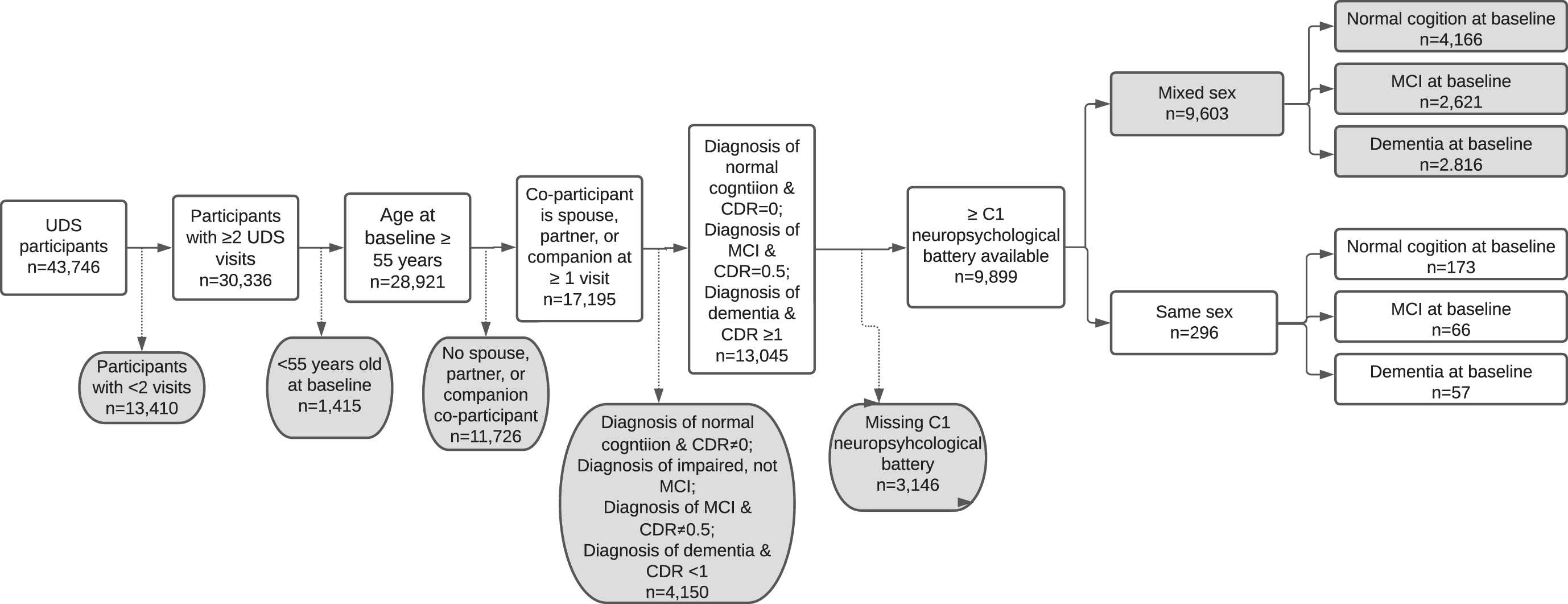
Flow chart of inclusion/exclusion criteria.
See Tables 1 and 2 for a summary of participant and co-participant characteristics. The overall sample included 9,899 individuals. Participants and co-participants reported their sex (“female” or “male”). We assigned participants to the SSR group if they had at least one visit where their co-participant was their spouse, partner, or companion and the co-participant reported having the same sex as the participant. Dyads reporting different sexes at each visit were demarcated as MSR. Given the limited available information about sexual orientation and gender diversity, the SSR group reflected a subset of LGBTQIA+ populations more broadly.
Participant characteristics at baseline visit
1The sum of having (or not) four known cardiovascular risk factors at any time point: diabetes (0 no, 1 yes), obesity (0 no, 1 yes), hypertension (0 no, 1 yes) and hypercholesterolemia (0 no, 1 yes). 2Includes self-reported, bipolar disorder, schizophrenia, anxiety, OCD, PTSD, developmental neuropsychiatric disorders, and other psychiatric disorders. 3Comparing same sex and mixed sex couples with any cognitive status at baseline; bold values signify significance at the 0.01 level. Missing data: (a)
Co-participant demographics for partners at first visit as a spouse, partner, or companion
1Comparing same sex and mixed sex couples with any cognitive status at baseline;
Participant marital status and living situation at first visit with a spouse, partner, or companion
1Comparing same sex and mixed sex couples with any cognitive status at baseline;
Measurements
CDR® Dementia Staging Instrument
The Clinical Dementia Rating (CDR®) Dementia Staging Instrument is a clinician-administered, semi-structured interview completed with a participant and their co-participant [40]. It is used to determine dementia diagnosis and severity by having clinicians rate levels of impairment across six cognitive categories (Memory, Orientation, Judgment/Problem Solving, Community Affairs, Home & Hobbies, and Personal Care). This instrument includes a global score (CDR-GS), which is computed via an algorithm, and a “sum of boxes” score (CDR-SB), which is the sum of each cognitive domain score. The CDR-GS ranges from 0–3 (0 = no dementia, 0.5 = questionable dementia,≥1 = dementia), and the CDR-SB score ranges from 0–18. For both measurements, larger scores indicate more severe dementia.
The CDR has been validated via comparison with postmortem, neuropathological diagnoses of dementia [41], and it has excellent interrater reliability [42]. The CDR-SB is considered a reliable instrument for tracking cognitive decline [43, 44], hence we used it for tracking dementia severity longitudinally.
Functional Activities Questionnaire (FAQ)
The FAQ is a face-valid questionnaire regarding a participant’s current functional status and is considered a reliable and valid instrument for measuring functional impairment [45]. On this questionnaire, the co-participant rates the participant on a scale of 0–3 across 10 instrumental activities of daily living (e.g., financial management). A total score is computed by summing the items, and it ranges from 0–30 with higher scores indicating greater functional impairment. Originally designed to include two additional responses (“never did but could do now” and “never did and would have difficulty now”) [45] that were scored as 1 or 0, respectively, the UDSv3 uniquely does not include those responses. Instead, a “not applicable (e.g., never did)” response is available for each activity assessed, and that item is not scored. To address artificial score deflation if “not applicable” responses were included in the total score, we replaced “not applicable” responses with the mean of the completed activity scores, but only if a participant completed at least five of ten FAQ items. This is an approach that has previously been used to correct for computational limitations inherent in using UDS FAQ data [46]. We used this method for 15.01% (7,363/49,007) of visits that were included in our analysis. Other approaches to calculating total scores exclude participants with fewer than five of ten items [47] or with any missing response [48]. We chose to prioritize retention of participants, so we did not exclude participants missing less than 5/10 valid FAQ responses. However, in post hoc analyses, we excluded participants who had missing and/or “not applicable” responses and recomputed our primary outcome models (see the Results section).
Neuropsychological instruments
As part of the NACC’s UDS, participants complete a standardized battery of tests derived from clinical neuropsychological instruments and paradigms [49, 50], which were selected for the UDS based on an earlier review of the literature by Weintraub and colleagues [49] to assess cognitive functions associated with aging and AD. Due to a change in the UDS neuropsychological test batteries, we restricted the sample to participants who completed the C1 battery from UDSv1-2 (September 2005 through March 2015).
The following scores were extracted for each participant: total Mini-Mental State Examination score, Logical Memory IA-Immediate total number of story units recalled, Logical Memory IIA-Delayed total number of story units recalled, Digit Span Forward total correct and span length, Digit Span Backward total correct and span length, Animal Naming total correct, Vegetable Naming total correct, Boston Naming Test (30 odd-numbered items) total score, WAIS-R Digit Symbol total correct, Trail Making Test A total time in seconds to complete, and Trail Making Test B total time in seconds to complete. We then computed the means and standard deviations of the first available test scores among all cognitively normal participants (i.e., all NACC participants prior to data extraction with a research diagnosis of normal cognition and CDR-GS = 0; see Design section below). We calculated z-scores by subtracting the cognitively normal group’s mean on a given task from a participant’s raw score on that task and dividing that difference by the cognitively normal group’s standard deviation. Next, we summed all z-scores within each domain to devise the five cognitive domain z-scores (global cognition, episodic memory, attention/working memory, executive function, and language). Last, we compared trajectories of decline in those cognitive domain z-scores. Those domains have been analyzed in prior studies using NACC data [51, 52]. See Fig. 2 for a visual depiction of the cognitive domain configurations.

Cognitive domains assessed in the C1 UDS neuropsychological test battery.
Design
We used clinician assessment and CDR-GS to create three baseline cognitive status groups by which to stratify our analyses. Clinical diagnoses of MCI or dementia were made by clinician(s) or consensus panels at NACC UDS sites. We assigned participants with a diagnosis of normal cognition and with a CDR-GS of 0 to the No Impairment group. Those with a diagnosis of MCI and a CDR-GS of 0.5 were labeled MCI. Finally, those who were diagnosed with dementia and received a CDR-GS score of≥1 were assigned to the Dementia group. Participants with missing data on either CDR-GS or diagnosis; those with a diagnosis of cognitively impaired, not MCI; those with a diagnosis of normal cognition but with a CDR-GS score other than 0; those with a diagnosis of MCI but with a CDR-GS score other than 0.5; those with a diagnosis of dementia but with a CDR-GS score less than 1; and those without a “spouse, partner, or companion” as a co-participant were excluded from analyses.
To compare differences between groups’ demographic characteristics (including co-participant characteristics) as well as participants’ functional and neuropsychiatric scores, we used chi-square tests and t-tests. To explore trajectories in cognitive and functional performances, we ran several multivariable linear mixed-effects models with random effects to account for ADRC clustering and repeated measures by individual. Time was calculated as the number of years from the initial UDS visit. We used all available visits, and there were no differences between SSR and MSR in terms of mean follow-up years (p = 0.17; see Table 1). Models were run for the FAQ, CDR-SB, and each of the five cognitive domains (Fig. 2). All models were stratified by baseline cognitive status groupings. Covariates in the adjusted models included age at baseline, sex, education, race/ethnicity, and APOE ɛ4 carrier status. These covariates were selected a priori as they are known contributors to cognitive and dementia-related outcomes and were not under examination in the present investigation. Statistical significance for this analysis was at p < 0.01, and no corrections were made for multiple comparisons.
RESULTS
Three percent of participants (n = 296) were in an SSR. There were no age differences between the SSR and MSR groups (Ps > 0.87). SSR participants were more likely to identify as female (58.1% versus 41.9%; p < 0.01). MSR participants were more likely to have an APOE ɛ4 allele and to report being married and living with their partner (Ps < 0.01).
Tables 3A-C demarcate baseline scores and rates of decline for FAQ scores, CDR-SB scores, and the five cognitive domains. Generally, MSR and SSR participants did not differ on baseline metrics, apart from FAQ scores. Specifically, SSR participants with MCI had lower (i.e., less impaired) FAQ total scores (SSR: M = 2.61, SD = 3.18, MSR: M = 3.97, SD = 4.53; p < 0.01). Also, MSR and SSR participants did not differ on longitudinal outcomes, except for faster attention/working memory declines in the MSR dementia group (Δ β est: 0.08, p < 0.01, 99% CI: [0.02, 0.14]), though this difference was small and may be subject to the problem of multiple testing. We recalculated FAQ total scores after excluding participants with missing and/or “not applicable” responses (see Supplementary Table 2). The outcomes were similar except for the annual rate of change in FAQ scores for the SSR group with dementia, which was no longer significant in the adjusted model. Thus, the MSR dementia group had accelerated functional declines. The difference between SSR and MSR dementia groups, however, remained nonsignificant. Since MSR participants were more likely to report living with their partner, we ran a sensitivity analysis comparing cognitive and functional trajectories that adjusted for co-residence in addition to the previously described covariates (Supplementary Tables 1A-C). The results of the sensitivity analysis were not different in terms of statistical significance or direction of the trajectories.
C1 battery - baseline scores, unadjusted and adjusted models showing annual rate of change in functional and cognitive domains among participants who were cognitively normal at baseline UDS visit
1Adjusted for age at baseline, education, sex, APOE ɛ4 status, race/ethnicity, repeated measures by individual and clustering by ADRC. 2Positive rate of change for the FAQ total score and CDR Sum of Boxes indicate increasing functional or cognitive decline, whereas for all other domain scores a negative rate of change indicates increasing cognitive decline.
C1 battery- baseline scores, unadjusted and adjusted models showing annual rate of change in functional and cognitive domains among participants who had MCI at baseline UDS visit
1Adjusted for age at baseline, education, sex, APOE ɛ4 status, race/ethnicity, repeated measures by individual and clustering by ADRC. 2Positive rate of change for the FAQ total score and CDR Sum of Boxes indicate increasing functional or cognitive decline, whereas for all other domain scores a negative rate of change indicates increasing cognitive decline. Bold values signify significance at the 0.01 level.
C1 battery - baseline scores, unadjusted and adjusted models showing annual rate of change in functional and cognitive domains in C1 battery among participants who had dementia at baseline UDS visit
1Adjusted for age at baseline, education, sex, APOE ɛ4 status, race/ethnicity, repeated measures by individual and clustering by ADRC. 2Positive rate of change for the FAQ total score and CDR Sum of Boxes indicate increasing functional or cognitive decline, whereas for all other domain scores a negative rate of change indicates increasing cognitive decline.
DISCUSSION
Using the NACC UDS, we examined neuropsychological and functional data for 9,899 adults 55 years of age or greater. We explored differences for participants whose spouse, partner, or companion was of the same sex or of another sex. Following minority stress models [1–3] and prior research suggesting older LGBTQIA+ people have more subjective cognitive impairment and worse performances on cognitive screenings relative to older cisgender/heterosexual people [22–24, 31], we expected to find differences in cognitive health outcomes among the SSR group (e.g., more severe dementia, greater functional impairment, and steeper declines on cognitive and functional measures) [18]. Contrary to our hypotheses, baseline dementia severity and functional impairment were generally not different between MSR and SSR groups regardless of baseline cognition. Similarly, annual rates of change in dementia and functional ratings were not different between any strata of the MSR and SSR groups. Moreover, baseline cognitive performances were generally equivalent across SSR and MSR groups, as were annual rates of cognitive decline.
Throughout most of the U.S., heterosexual relationships are considered the norm, and as such, SSRs are minoritized and have historically been stigmatized. Broadly, experiences with discrimination, oppression, and stigmatization contribute to health disparities in LGBTQIA+ populations [4, 17], including stroke, heart disease, depression, and substance use, that are risk factors for accelerated cognitive decline and pathological cognitive aging [17, 53]. Our study was not designed to directly evaluate the minority stress model’s application to cognitive health as we did not have an objective measure of minority stress. Rather, we used SSR status as a proxy for minority stress in this population. Specific measurements of minority stress (e.g., cortisol levels or self-ratings of stress) and social environments may be necessary to truly understand the role of LGBTQIA+ identity-related stress on cognitive functioning. The current findings suggest that people in SSR do not experience cognitive health disparities as measured by functional and neuropsychological assessments after accounting for genetic risk for AD via APOE ɛ4 alleles. However, this may be due to access to cognitive/dementia care, volunteer bias and the unique socioeconomic characteristics of the SSR group. Indeed, SSR participants were less likely to carry an ɛ4 allele, yet they showed similar levels of cognitive impairment to the MSR group. In the general population, APOE ɛ4 carriers have similar performances on measures of cognitive abilities relative to non-carriers, yet carriers have discrete patterns of thinning in the entorhinal cortices and the subicula, areas essential to the neuropathology of AD [54, 55]. Moreover, cognitively unimpaired carriers with two ɛ4 alleles, relative to those with one ɛ4 allele and noncarriers, have poorer memory performances, earlier signs of memory decline, and higher rates of decline prior to diagnosis [56–59]. Because participants in SSRs were less likely to carry an ɛ4 allele, we would anticipate that, longitudinally, their cognitive performances should be better and less susceptible to decline relative to the MSR group. Instead, both groups showed similar patterns of decline, which may suggest some degree of cognitive vulnerability to minority stress processes.
It may also be that people in SSR have unique protective factors that confer greater cognitive reserve relative to people in MSR. For example, being in a relationship, participating in one’s community, having strong social support, and having high social standing may have particular advantages for people in SSRs relative to MSRs [27–29, 60]. Prior work with lesbian, gay, and bisexual older adults revealed the benefits of being in a same-sex relationship, such as better self-reported health, fewer symptoms of depression, and less psychiatric distress [61, 62]. Those benefits may have downstream effects on cognition by reducing the impact of chronic health conditions and depression on cognitive decline. This speculation is hindered by studies demonstrating marriage itself is a more notable protective factor against dementia as opposed to being in any type of romantic partnership [18, 63]. Moreover, same-sex couples could not legally marry in the U.S. until 2015, so the social and economic benefits of marriage, such as access to a partner’s health insurance, have been less accessible to sexual minority groups [64]. Also, the benefits of marriage do not appear to extend to health and quality of life for same-sex couples as they do for heterosexual couples [36, 64]. Due to the nature in which a co-participant’s relationship to the participant was collected, we were unable to parse out married from unmarried participants.
In our study, participants in SSRs were less likely to live with their spouse, partner, or companion and were more likely to live alone. These findings corroborate other large-scale studies of older LGBTQIA+ minority groups [6, 65]. For example, older adults in SSRs are more likely to live alone relative to those in MSRs [29]. The lack of data regarding sexual orientation and nonbinary genders hindered our ability to fully explore group differences, but the trends between our study and those by other researchers are relatively similar. Work by Fredriksen-Goldsen and colleagues [17] indicated both lesbian and bisexual women were less likely to be married and were more likely to be partnered relative to heterosexual women, but the likelihood of living alone was similar among non-heterosexual and heterosexual women. Similar findings were reported for gay and bisexual men relative to heterosexual men, except gay and bisexual men were also more likely to live alone. Within-group differences were also significant. Specifically, bisexual men and women were more likely to be married but less likely to be partnered relative to gay men and lesbian women. Also, gay and bisexual men were more likely to live alone than lesbian and bisexual women [66]. Transgender older adults may have similar rates of marriage relative to lesbian, gay, and bisexual older adults, but transgender older adults may be less likely to live alone [16].
Prior research suggests cohabitation is one protective factor against physical and mental health disparities [6, 60]. People may experience greater social isolation and loneliness if they live alone, and social isolation is a risk factor for dementia [66–69]. Yet, a recent study indicated both married/cohabiting and unmarried/cohabiting adults in SSRs rated their health more poorly over time relative to heterosexual counterparts [36]. As such, the potential protective roles of relationship status and cohabitation on the health of older LGBTQIA+ groups are not fully understood. There may be additional and/or indirect factors that uniquely protect against minority stress. For example, cohabitation has been associated with larger social networks for sexual minority older adults [6], suggesting potential moderation effects. Additionally, the timing of key life events, such as when one gets married, and the types of relationships in one’s social network have been associated with different health and wellbeing outcomes for older LGBTQIA+ adults [70, 71]. In our study, SSR co-participants who were not living with the participant reported visiting and calling the participant more frequently than their MSR peers. This finding is worth further inquiry as more frequent social interactions may protect against cognitive decline, especially among people in SSR [28].
Consistent with a socio-ecological system view of minority stress [37], risk and protective factors interact across multiple levels that include not only SSRs and couples’ social networks but also the institutions and cultures in which SSRs exist. A recent population-wide study indicated perceptions of community safety were the strongest predictors of self-reported physical health across LGBTQIA+ groups [7]. Psychiatric disorders among lesbian, gay, and bisexual populations increased in the early 2000 s in states with bans on same-sex marriage but not in states without such bans [72], and rates of medical and mental health visits decreased among sexual minority men in Massachusetts following the legalization of same-sex marriages in that state [73]. The extant literature on social relationships and marriage equality for same-sex couples suggests the mechanisms for resiliency against minority stress are complex, but generally, affirming social support at interpersonal, community, and institutional levels is protective.
Although our results were not consistent with our hypotheses, they do align with two studies using the NACC UDS and one non-NACC population-based study. In the first study, no differences in risk for MCI and dementia were found between SSR and MSR groups [29]. In the second study, participants in MSR and SSR had similar patterns of neuropsychological test performance and there was no difference between the MSR and SSR groups in cognitive test scores, but there were differences in regions for brain atrophy [30]. Relatedly, lesbian, gay, and bisexual older adults from a Canadian study showed better memory performance relative to heterosexual older adults [28]. Our findings within the context of those studies suggest no differences between people in SSRs versus MSRs with regards to neurocognitive disorders and cognitive testing. In contrast, studies using cognitive screening instruments [27, 31] or subjective reports of cognitive decline [20, 22–24] tend to show deficits among LGBTQIA+ older adults. In the absence of actual cognitive disparities, LGBTQIA+ people may have more negative views of their cognitive functioning, and cognitive screening instruments may over-pathologize LGBTQIA+ people. Alternatively, LGBTQIA+ older adults accessing neuropsychological assessments and dementia care may have certain characteristics or resources that distinguish them from LGBTQIA+ older adults who do not access those services. Thus, self-report to or cognitive screenings by trusted providers (as opposed to a neuropsychologist whom the patient may never see again) could better encapsulate the experiences of LGBTQIA+ populations. Additional research is needed to discern the impact of relationship status on neuropsychological functioning given the tendency for single LGBTQIA+ older adults to disproportionately experience social, economic, and health inequities [61, 64]. Comprehensive neuropsychological assessments may be the gold standard for diagnosing neurocognitive disorders and determining cognitive strengths and weaknesses as opposed to cognitive screening tests [74]; however, additional research is necessary to identify the factors that impact access to and utilization of the range of neuropsychological and dementia care services across LGBTQIA+ populations.
Our findings have important implications for caregiving of older adults and people with dementia and MCI. Most research and public policy on caregiving has focused on heterosexual individuals and their family structures in which spouses or children are the primary caregivers [75, 76]. In a systematic review of family caregivers of people with dementia, most caregivers (approximately 69%) were female, and around 45% of caregivers were spouses or partners [77]. Yet, in a national sample of LGBTQIA+ and cisgender/heterosexual caregivers, there were no differences between groups in terms of the number of male and female participants [75]. Moreover, the LGBTQIA+ caregivers were more likely to be single; a relative other than a child, sibling, or grandchild; and a friend or neighbor [75]. In contrast, non-LGBTQIA+ caregivers were more likely to be the spouse or partner of the care recipient [75]. It is not surprising that LGBTQIA+ caregivers are more likely to be friends or neighbors and less likely to be spouses or partners given bans on same-sex marriage, stigmatization of SSRs, and the disproportionate impact of human immunodeficiency virus/acquired immune deficiency syndrome on LGBTQIA+ communities. However, when specifically isolating LGBTQIA+ caregivers of people with memory loss, Anderson et al. [76] found that 50% were the spouse or partner of the care recipient, and the overall sample was approximately equal in terms of male and female genders. (There was no heterosexual comparison group.) In our study, there were disproportionately more female participants in the SSR group, and the MSR group had greater functional impairment at baseline. However, there were minimal differences longitudinally. Within the context of the caregiving literature, the male participants in MSRs may rely more on their female spouses, partners, and companions for assistance with activities of daily living, but there do not appear to be significant differences between MSR and SSR groups in terms of their functional decline.
Limitations in the current study include nonprobability sampling, the referral-based nature of the NACC UDS, discrepant sample sizes of individuals in SSRs relative to those in MSRs, possible reporting bias and/or ascertainment bias due to using SSR status to infer sexual orientation, and subtle differences between the SSR and MSR groups (e.g., in education and psychiatric conditions). Given the small sample size for the SSR group, our analyses were likely underpowered to detect group differences, especially those of small magnitude. Additionally, we used a conservative threshold for determining statistical significance (p < 0.01). These approaches to data analysis limit the generalizability of our study to other same-sex couples. Yet, a matched-samples approach would have limited this study’s external validity because the findings would have been isolated to the demographic characteristics selected for matching. For example, Manca and Venneri [30] matched their SSR and MSR groups based on demographic and clinical factors, such as APOE status and clinical diagnosis. As such, relatively small sample sizes were available for subgroup analysis (Ns = 20). Nevertheless, their findings were similar to our current findings as no group differences were found on neuropsychological instruments, so when using both a matched-samples and a non-matched samples approach to the same database (NACC UDS), there do not appear to be significant differences between SSR and MSR groups on cognitive tests.
Importantly, relationship status is not an accurate indication of sexual orientation, sexual behavior, or other essential aspects of LGBTQIA+ identities and experiences, such as gender identity, gender expression, sexual attraction, or romantic attraction. A major limitation for many large-scale studies of cognition or dementia (including clinical case series, such as the NACC UDS, and population-wide studies) is the lack of data regarding LGBTQIA+ experiences. For example, in a recent survey of ADRCs (N = 13) [78], most study sites (n = 10) used participant self-report to collect “sex.” One ADRC obtained participants’ “gender identity,” two queried for “sex assigned at birth,” and two collected “sexual orientation.” All used forced-choice responses options. These approaches to data collection not only preclude researchers from understanding individual differences in cognitive aging, but also erase the experiences of LGBTQIA+ people [78]. Most LGBTQIA+ people are single, live alone, and have experienced stigma in healthcare settings, which frequently impedes access to and utilization of healthcare services. The current sample was restricted to people in relationships, a majority of whom lived with their co-participant, and all were actively accessing healthcare services with their spouse, partner, or companion. Access to healthcare services and to an affirming care provider may be a critical barrier for other same-sex couples. For example, some people in SSRs may utilize healthcare services alone to avoid stigma and discrimination. The participants in SSRs in our study attended research appointments with their co-participant. By attending appointments, co-participants’ perceptions of their partner’s cognitive and functional decline may change. They may become more involved in their partner’s care. Those perceptions may confer measurement error that we were unable to accommodate in statistical analyses. Hence, the unique social characteristics of the current sample likely do not reflect broader same-sex couples.
In summary, this study sought to comprehensively compare dementia severity ratings, levels of functional impairment, and cognitive functioning among people in SSRs versus those in MSRs. There were no differences between those groups in terms of baseline dementia severity and cognitive test scores, and generally, there were no differences in functional abilities at baseline. There were minimal differences in patterns of cognitive decline. Our findings may suggest that among ADRC research studies, participants in SSRs and MSRs do not differ significantly in rates of decline on neuropsychological instruments. People in SSRs may have some greater cognitive reserve relative to people in MSRs. The participants in our study are not representative of all LGBTQIA+ populations, so the generalizability of our findings to other sexual and gender minority groups is limited. As such, additional research is desperately needed to directly examine the patterns of cognitive decline among specific sexual and gender minority groups. Researchers and clinicians should include measures of sexual orientation and gender identity to allow for more accurate data collection of these important characteristics. This will enhance efforts to minimize health disparities and leverage unique protective factors present within LGBTQIA+ groups and subgroups.
Footnotes
ACKNOWLEDGMENTS
We thank the participants for their engagement in ADRC research studies. We would like to thank Dr. Julija Stelmokas for consultation and assistance with interprofessional team development.
FUNDING
This work was supported in part by grants P30 AG035982 and K01MD014177 (Dr. Perales-Puchalt) and K01AG056669 and R24AG066599 (Dr. Jason Flatt). The NACC database is funded by NIA/NIH Grant U24 AG072122. NACC data are contributed by the NIA-funded ADRCs: P30 AG019610 (PI Eric Reiman, MD), P30 AG013846 (PI Neil Kowall, MD), P50 AG008702 (PI Scott Small, MD), P50 AG025688 (PI Allan Levey, MD, PhD), P50 AG047266 (PI Todd Golde, MD, PhD), P30 AG010133 (PI Andrew Saykin, PsyD), P50 AG005146 (PI Marilyn Albert, PhD), P50 AG005134 (PI Bradley Hyman, MD, PhD), P50 AG016574 (PI Ronald Petersen, MD, PhD), P50 AG005138 (PI Mary Sano, PhD), P30 AG008051 (PI Thomas Wisniewski, MD), P30 AG013854 (PI Robert Vassar, PhD), P30 AG008017 (PI Jeffrey Kaye, MD), P30 AG010161 (PI David Bennett, MD), P50 AG047366 (PI Victor Henderson, MD, MS), P30 AG010129 (PI Charles DeCarli, MD), P50 AG016573 (PI Frank LaFerla, PhD), P50 AG005131 (PI James Brewer, MD, PhD), P50 AG023501 (PI Bruce Miller, MD), P30 AG035982 (PI Russell Swerdlow, MD), P30 AG028383 (PI Linda Van Eldik, PhD), P30 AG053760 (PI Henry Paulson, MD, PhD), P30 AG010124 (PI John Trojanowski, MD, PhD), P50 AG005133 (PI Oscar Lopez, MD), P50 AG005142 (PI Helena Chui, MD), P30 AG012300 (PI Roger Rosenberg, MD), P30 AG049638 (PI Suzanne Craft, PhD), P50 AG005136 (PI Thomas Grabowski, MD), P50 AG033514 (PI Sanjay Asthana, MD, FRCP), P50 AG005681 (PI John Morris, MD), P50 AG047270 (PI Stephen Strittmatter, MD, PhD).
CONFLICT OF INTEREST
The authors have no conflict of interest to report. No competing financial interests exist. The views expressed in this article are those of the authors and do not necessarily reflect the position or policy of the Department of Veterans Affairs or the United States government.
Earlier versions of this project were presented as a poster at the 2021 Alzheimer’s Association International Conference and as an invited talk at a meeting of the LGBTQ Special Interest Group of the Alzheimer’s Association’s International Society to Advance Alzheimer’s Research and Treatment, Diversity and Disparities Professional Interest Area. The abstract that was submitted for the 2021 Alzheimer’s Association International Conference was recently published (Correro AN, Gauthreaux K, Perales J, et al: Cognitive aging in dementia, mild cognitive impairment [MCI], or no impairment: A comparison of same- and other-sex couples. Alzheimers Dement, 2021; S10:e054864), but this manuscript has not been published in its entirety nor is it under the review of any other journal.
DATA AVAILABILITY

LGBTQIA+ is an initialism, and we use it broadly to discuss all sexual and gender minority groups. Conversely, when reviewing research studies with more specific samples, we name the groups that were included.