



Abstract
In recent years, the controlled-sources electromagnetic method has been widely applied for oil and metallic ore exploration. It is necessary to study the effects of the constituents and microstructure in pyrite-bearing hydrocarbon-bearing reservoir sandstones on 3D marine controlled source electromagnetic sounding, so as to improve the accuracy of the marine controlled sources electromagnetic (MCSEM) Method. In this paper, we present a new finite element algorithm for 3D MCSEM modeling, which is based on unstructured grids. In the modeling, we adopted the secondary formulation for the quasi-static variant of Maxwell’s equation, so that the source singularity could be avoided effectively. We first applied the four-phase incremental model to calculate the conductivity of the pyrite-bearing hydrocarbon. This is of use in studying the electrical conductivity of pyrite-bearing sandstones. The finite element equations were solved by means of the preconditioned IDR(s) method. We applied our algorithm to calculate the response of various key parameters of MCSEM (i.e. pyrite content, porosity, pyrite conductivity, grain aspect ratio and water saturation). The results of the modeling show the performance of the algorithm, and are expected to assist in future CSEM data interpretation when a pyrite-bearing sandstone reservoir is encountered.
Keywords
Introduction
The marine controlled source electromagnetic (MCSEM) method has rapidly developed to be a complementary tool for emerging seismic exploration related to offshore hydrocarbon exploration. The 3D MCSEM modeling and inversion problem is a hot research issue around the world. The technique of MCSEM modeling has been widely developed, including the 1DForward technique [1, 2, 3, 4, 5], 2D Forward technique [6, 7, 8, 9, 10] and 3D Forward technique [11, 12, 13, 14, 15, 16, 17, 18, 19, 20, 21]. However, most of the conventional marine controlled source electromagnetic modeling has either not considered the influence of the composition and structure of the rocks on electromagnetic (EM) fields, or only considered it in terms of the frequency relativity to study rock conductivity [22, 23, 24, 25, 26, 27, 28, 29]. For example, we may study the effects of the corresponding parameters of the complex resistivity model on marine controlled source electromagnetic (EM) fields by the introduction of various complex resistivity models, i.e. induced polarization effect. However, they fail to directly address the problem of how pyrite affects the low frequency electrical properties of reservoir sandstones, which can be further employed to study the response of low-frequency marine controlled source electromagnetic (CSEM) exploration. Therefore, it is of great theoretical significance and practical value to improve the accuracy of the data interpretation by researching the influence of pyrite or other mineral components in the reservoir on marine controlled source electromagnetic fields. One of the key factors by which to improve the accuracy of the CSEM data interpretation is using the petro-physical model to reasonably link the electrical conductivity of the sedimentary rocks to their components. At present, the petro-physical models (equations) of an effective medium mainly include Archie’s equation [30], Hanai-Bruggeman (HB) equation [31, 32], and Asami equation [33]. However, these equations were only developed for a two-phase medium, and cannot be applied to a multi-phase medium that is closer to the actual situation. Therefore, in order to solve this problem, Han et al. proposed the petro-physical incremental model, which is based on the Asami equation with an incremental model [34], while it can display some basic structure and lithologic characteristics of rocks and ores in the macro scale. In addition, the parameters are related to the physical properties of rocks and ores, which provide a quantitative analysis method by which to research the electrical conductivity of multi-phase rocks and ores.
On the basis of previous work, in this study we employ the multi-phase incremental model to realize the 3D marine controlled source electromagnetic modeling. We also comprehensively study various parameters (porosity, content of pyrite, pyrite grains conductivity, aspect ratio and water saturation), along with their effects on the pyrite reservoir conductivity and the components of marine controlled source electromagnetic fields, so that the marine controlled source electromagnetic exploration theory may be further enriched.
Introduction of incremental model
Asami equation
The Asami equation is a two-phase effective medium model proposed by Asami in 2007, based on the Maxwell-Wagner theory and a large number of specimens. The equation is as follows:
where
For ellipsoid inclusions with the ratio of long axes and short axes
We use the Newton method to solve Eq. (1) and obtain the conductivity of the effective medium.
In the case of particle aspect ratio (
Schematic diagram showing the steps used in the first increment in the incremental model.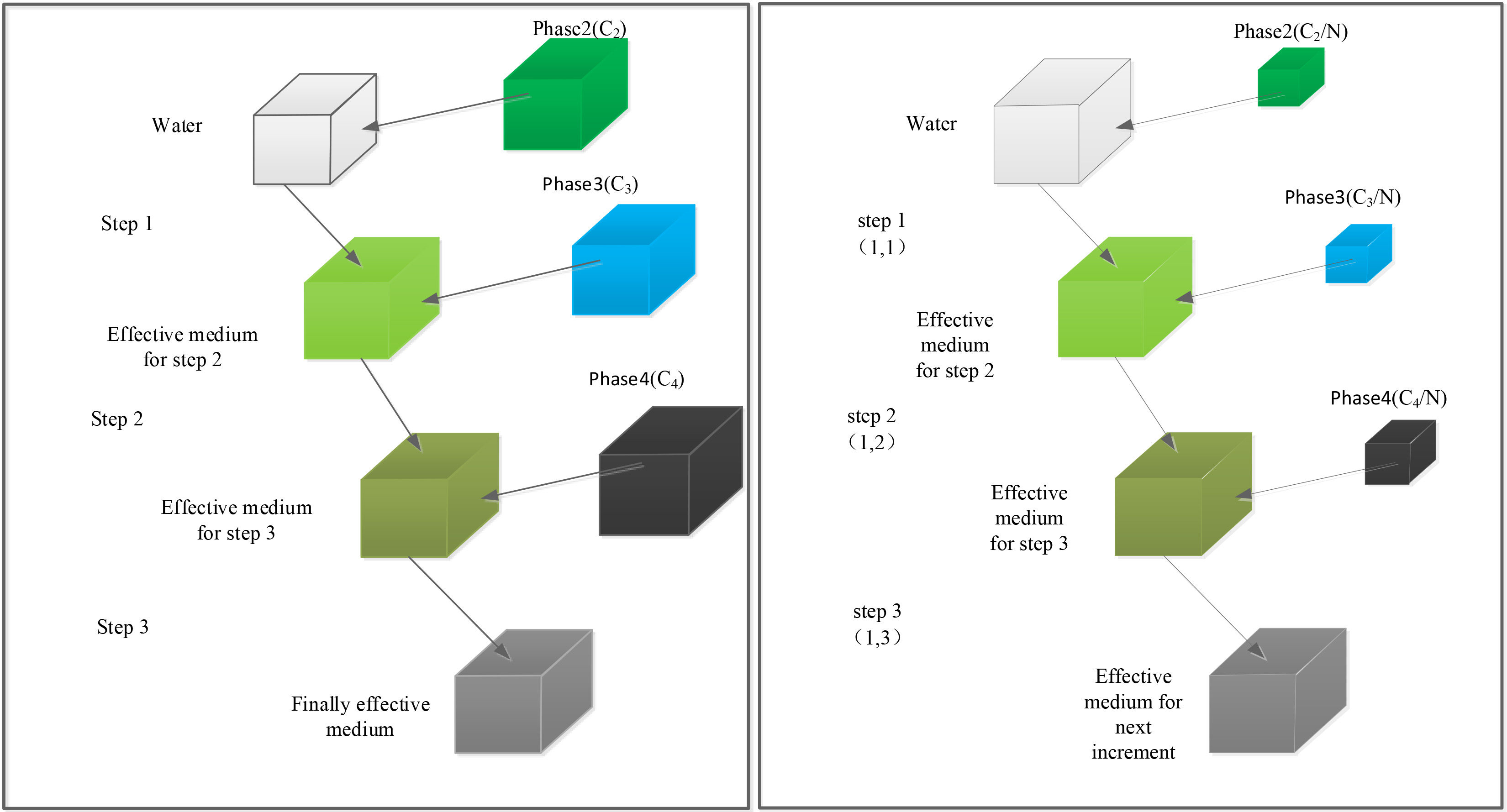
Plots of the conductivity of pyrite-bearing sandstones with different parameters.
Without loss of generality, we use the four-phase incremental model as an example. Figure 1 is the first increment of this model. First, assuming that the initial concentration of three minerals which are divided into N (i.e. incremental number) parts are C
Figure 2 shows the conductivity curves of the effective medium, where we change the pyrite conductivity, water saturation, volume fraction of pyrite and aspect ratio of the particles. In Fig. 2a, we set them as fitting rock parameters. The respective conductivities of the formation water (
From Fig. 2a, one can see that, under the same porosity, the effective conductivity changes little with increasing pyrite conductivity, yet the effective conductivity increases with increasing porosity. According to Fig. 2b, under the same water saturation, the effective conductivity increases with increasing porosity. In the case of the same porosity, the effective conductivity increases with increasing water saturation. Figure 2c shows that, at the same porosity, the effective conductivity denotes an approximate linear increase with the volume fraction of pyrite. In the same volume percentage of pyrite, the effective conductivity increases with increasing porosity. From Fig. 2d one can see that, under the same porosity conditions, the effective conductivity generally increases along with the pyrite aspect ratio. Moreover, in the case of the same aspect ratio the effective conductivity increases with the increasing porosity.
Governing equation
In geophysical electromagnetic prospecting, low frequency electromagnetic signals are typically transmitted. When the displacement current is neglected, and the sinusoidal harmonic time factor
where
To avoid the singularity of the source, the entire field is decomposed into a primary field and secondary field. The conductivity is then decomposed into background conductivity and anomalous conductivity, and two equations are obtained as follows:
According to Eqs (3)–(6), we can further deduce the differential equation of the anomalous field:
From Eq. (7), for a general layered earth model, the background field
When the boundary is located far enough away from the target area, the secondary field can be approximated as zero. For the sake of simplicity, we apply the Dirichlet boundary conditions as follows:
where
In this paper, Whitney type vector basis functions are used to carry out spatial discretization with unstructured tetrahedral mesh [36]:
where
The number sketch map of nodes and edges of tetrahedron.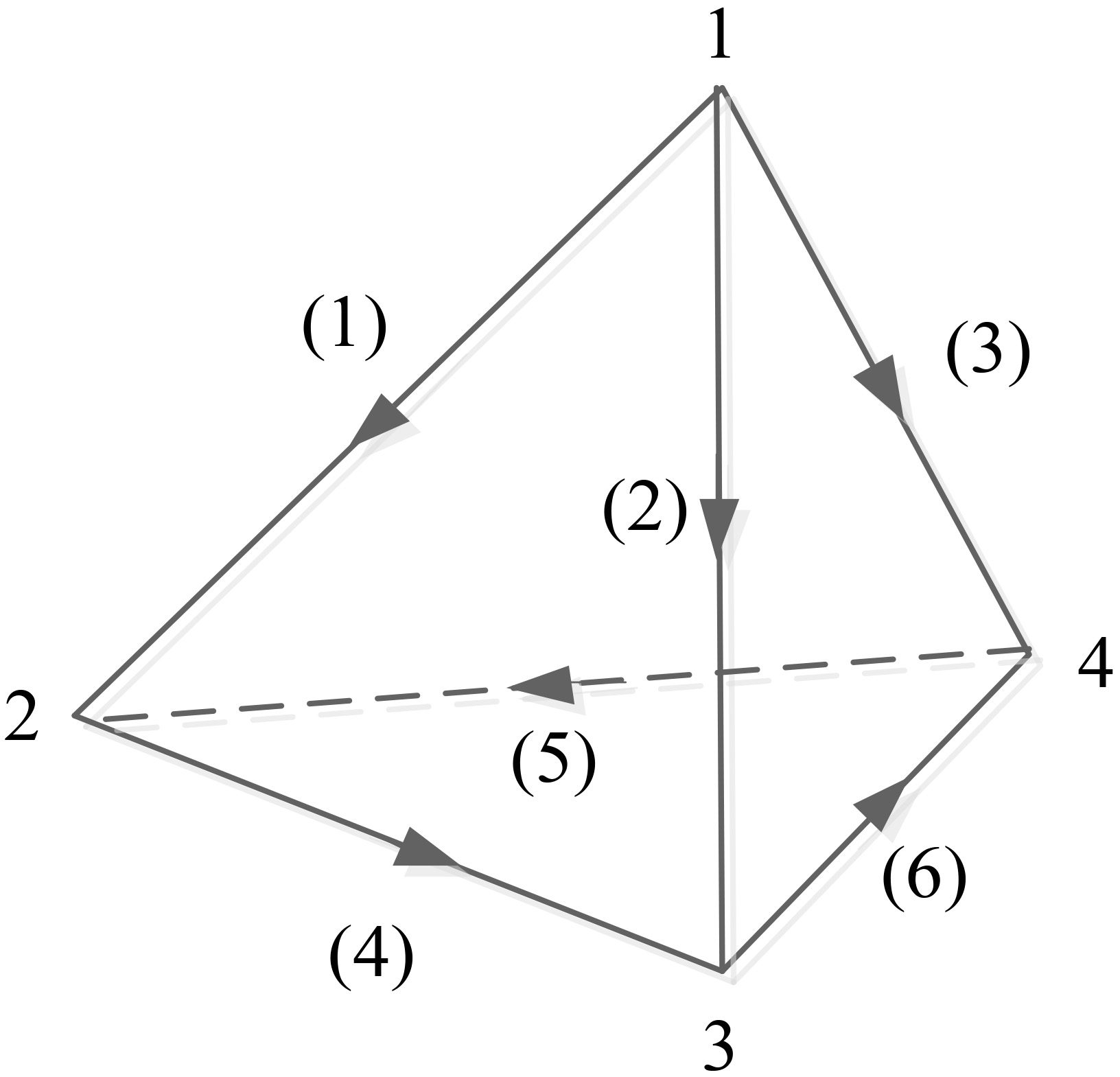
Equation (7) can be expressed as a form of weak solutions with the Galerkin method:
According to the first vector Green function, we obtain the following:
Considering that the Area division of Eq. (3.3) can be ignored when the boundary of the region is automatically defined and the outer boundary is artificially defined, Eq. (3.3) can be simplified as follows:
Deriving Eq. (14) into Eq. (7), we obtain the following:
where
Equation (15) can be rewritten with Eqs (16) and (17):
The weighted residual matrix equation of unit
With
We can redefine
By synthesizing the finite element equations of all of the elements, we can obtain the general finite element equation:
Where
We then use the IDR(s) iterative algorithm to solve the linear equation, namely Eq. (24) [37], and the coefficient matrix is compressed and stored in CSR format.
Proof of algorithm
To test the correctness of the algorithm, which is presented in this paper, we consider the design of a four-layer marine sediment model, whose parameters are given in Table 1. The fourth layer is composed of pyrite, hydrocarbon, water and sandstone, as shown in Fig. 4a. The unstructured mesh of the layer model is as shown in Fig. 4b. The A horizontal electric dipole along the X direction placed at 950 m under sea-surface is used as the excitation source. The frequency of the source is 0.1 Hz. The source current is 1 A. Receivers are located at 500: 200: 10000. Figure 5 shows the comparison between the numerical solution and quasi-analytical solution solved by the Hankel integral algorithm. We can observe that the numerical solution is in good agreement with the quasi-analytical solution, which validates the accuracy and validity of the proposed algorithm.
The incremental parameters of marine layered medium model
The incremental parameters of marine layered medium model
Sketch of an Marine horizontal layered medium model. (a) Geometric sketch map of a reservoir model. (b) Mesh for a reservoir model at 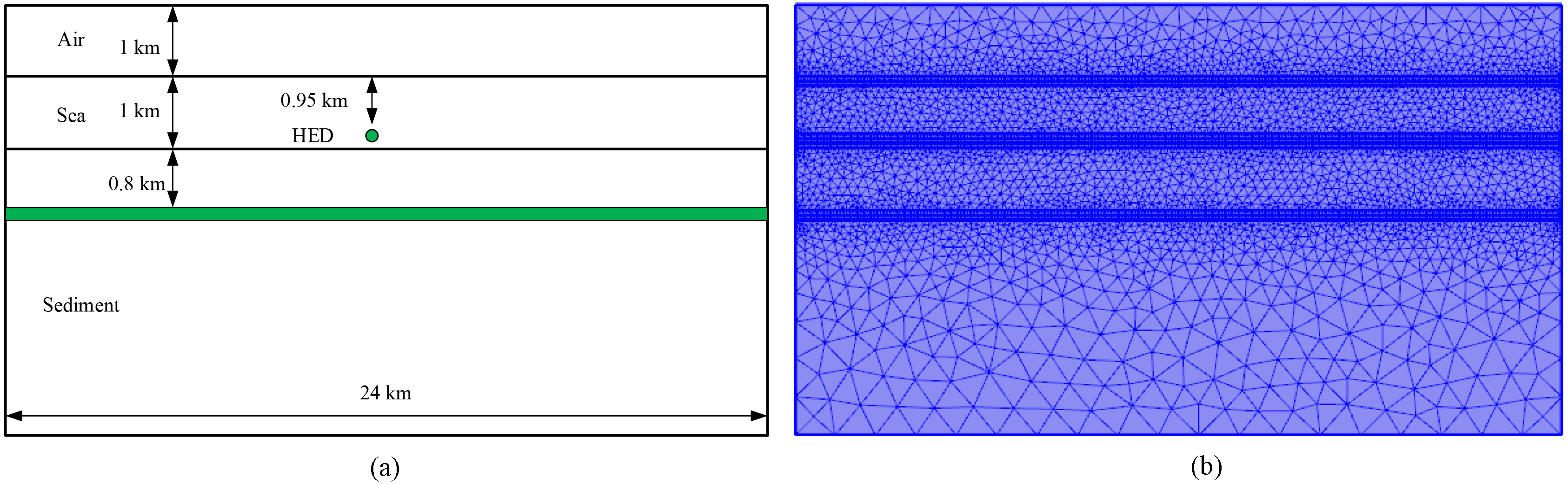
Comparison between numerical solution and quasi analytical solution of electric fields.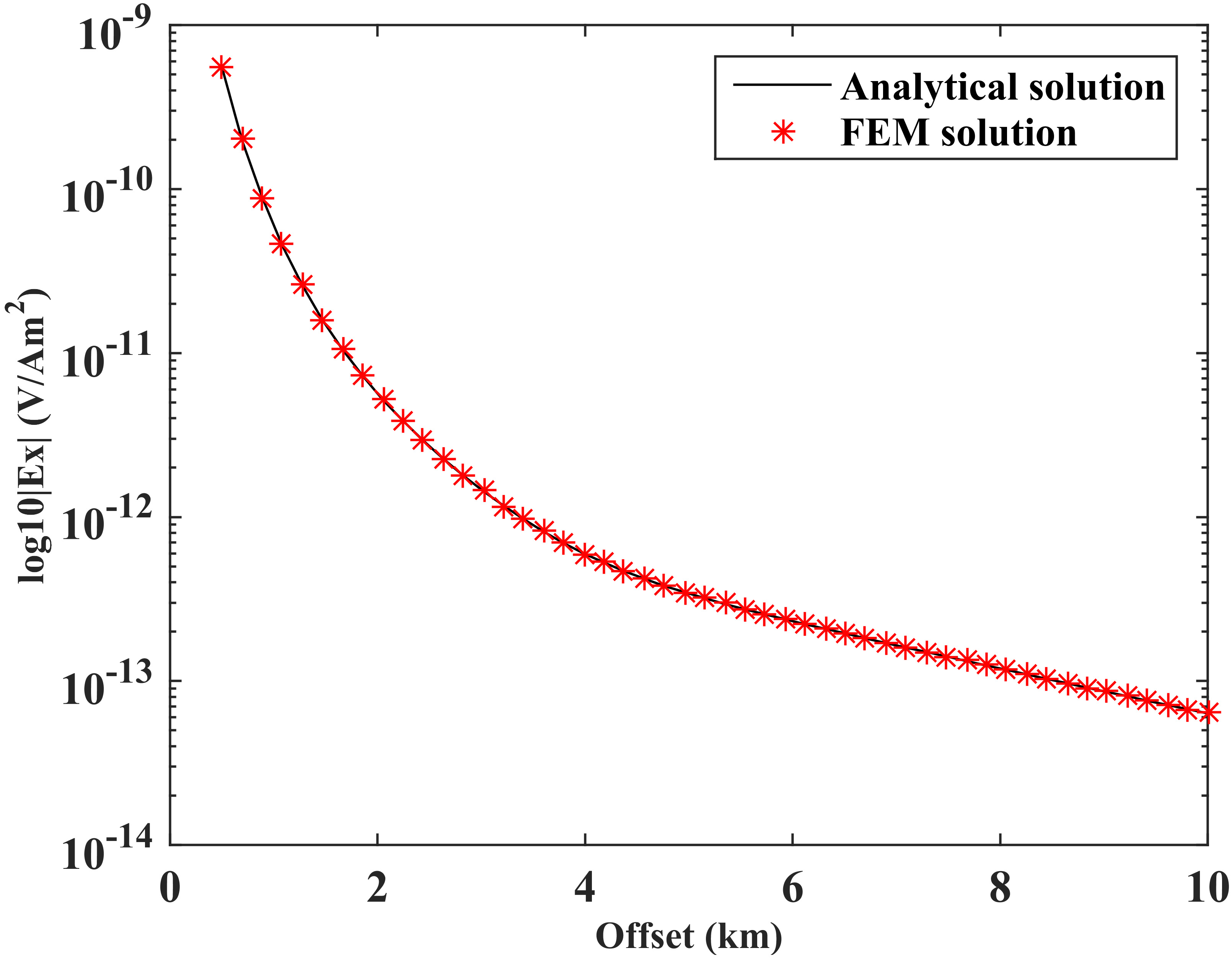
To analyze the influence of different rock structure parameters on marine controlled source electromagnetic fields, we consider a four-phase medium (pyrite, water, hydrocarbon and quartz) reservoir model, and study the forward responses with varying structure parameters. The size of the reservoir is 5*5*1 km, with the center located at (4500, 0, 2500). The incremental model parameters of the marine reservoir model are shown in Table 2, and the geometric sketch is shown in Fig. 6a. The domain is discrete by using the unstructured mesh, as shown in Fig. 6b. We carry out local encryption in the vicinity of the source and lines. The excitation source is a horizontal electric dipole along the
The incremental parameters of four-phase reservoir model
The incremental parameters of four-phase reservoir model
Sketch of an off-shore hydrocarbon reservoir model. (a) Geometric sketch map of a reservoir model. (b) Mesh for a reservoir model at 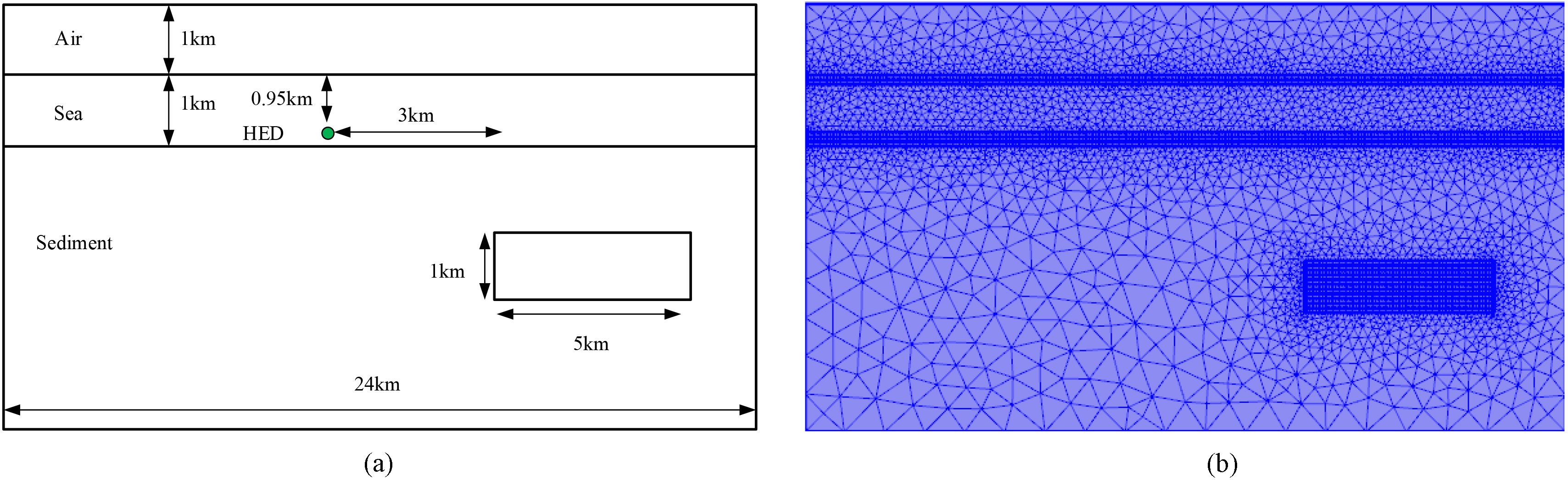
To analyze the influence of various rock porosities on marine controlled source electromagnetic fields, we set up various rock porosity parameters of a hydrocarbon reservoir for forward calculation. The specific parameters are shown in Table 2.
Figure 7 shows the imaginary and real parts of the secondary electromagnetic fields with varying porosity. It can be seen from Fig. 7 that with increasing porosity, in the case of the same water saturation, the variation range of the imaginary and real components of the secondary electromagnetic fields decrease significantly.
Influence of pyrite conductivity on the controlled source electromagnetic field
To analyze the effects of different particle conductivities on the controlled source electromagnetic fields, we set up different particle conductivity parameters of the hydrocarbon reservoir for forward calculation. The conductivities
The plots of the real and imaginary parts of the secondary electromagnetic fields with different pyrite conductivities are shown in Fig. 8. It can be seen from the figure that, with the increasing of the pyrite conductivity, the anomalous amplitude of the imaginary components and real components of the secondary electromagnetic fields first reduce significantly, then the abnormal shape is reversed. Therefore, the effects of water-bearing hydrocarbon-bearing sandstones at low resistivity of pyrite on marine controlled source electromagnetic fields are greater than the situation at high resistivity of pyrite.
Plots of the real and imaginary parts of the secondary electromagnetic fields with varying porosity.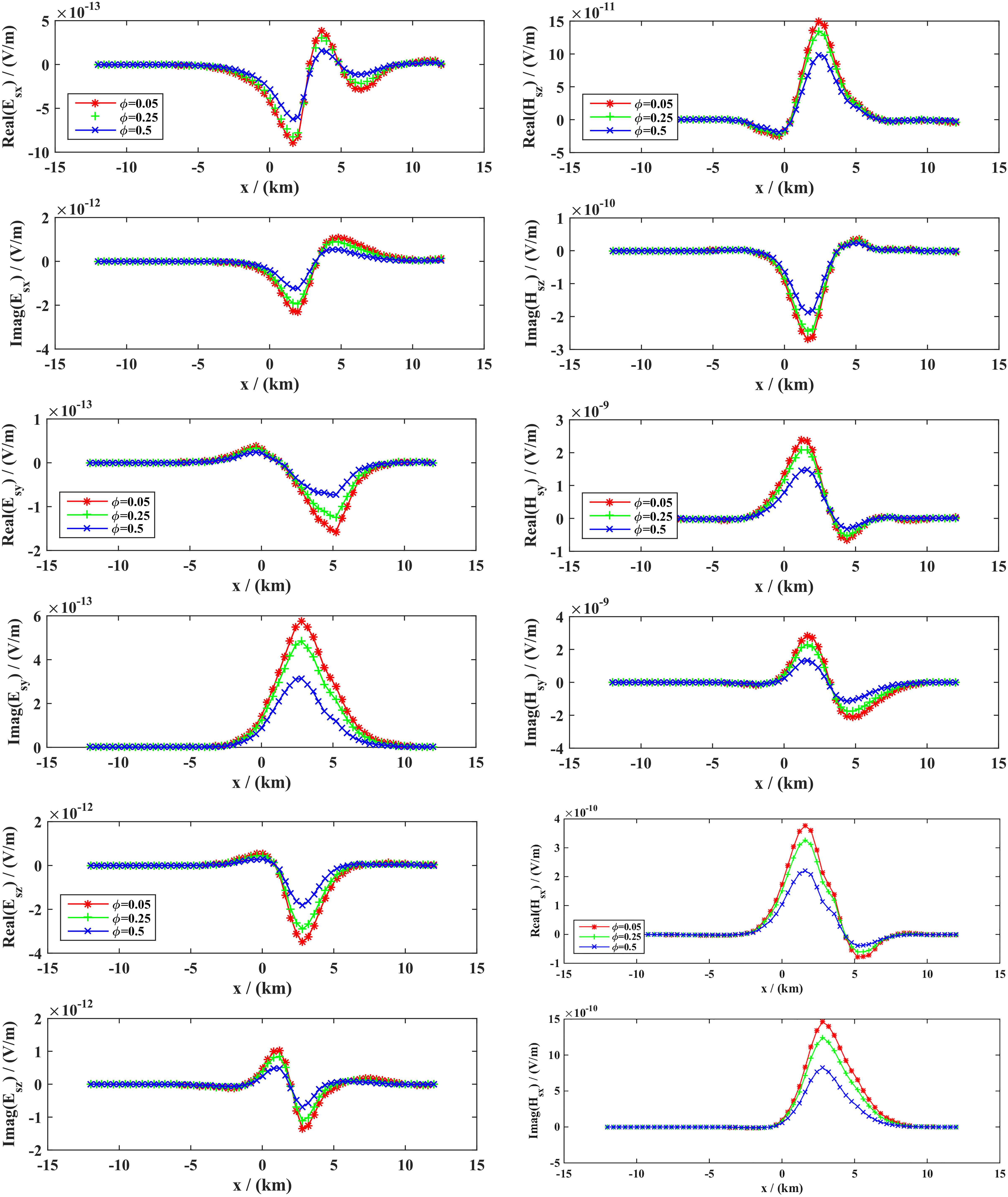
Plots of the real and imaginary parts of the secondary electromagnetic fields with varying pyrite conductivity.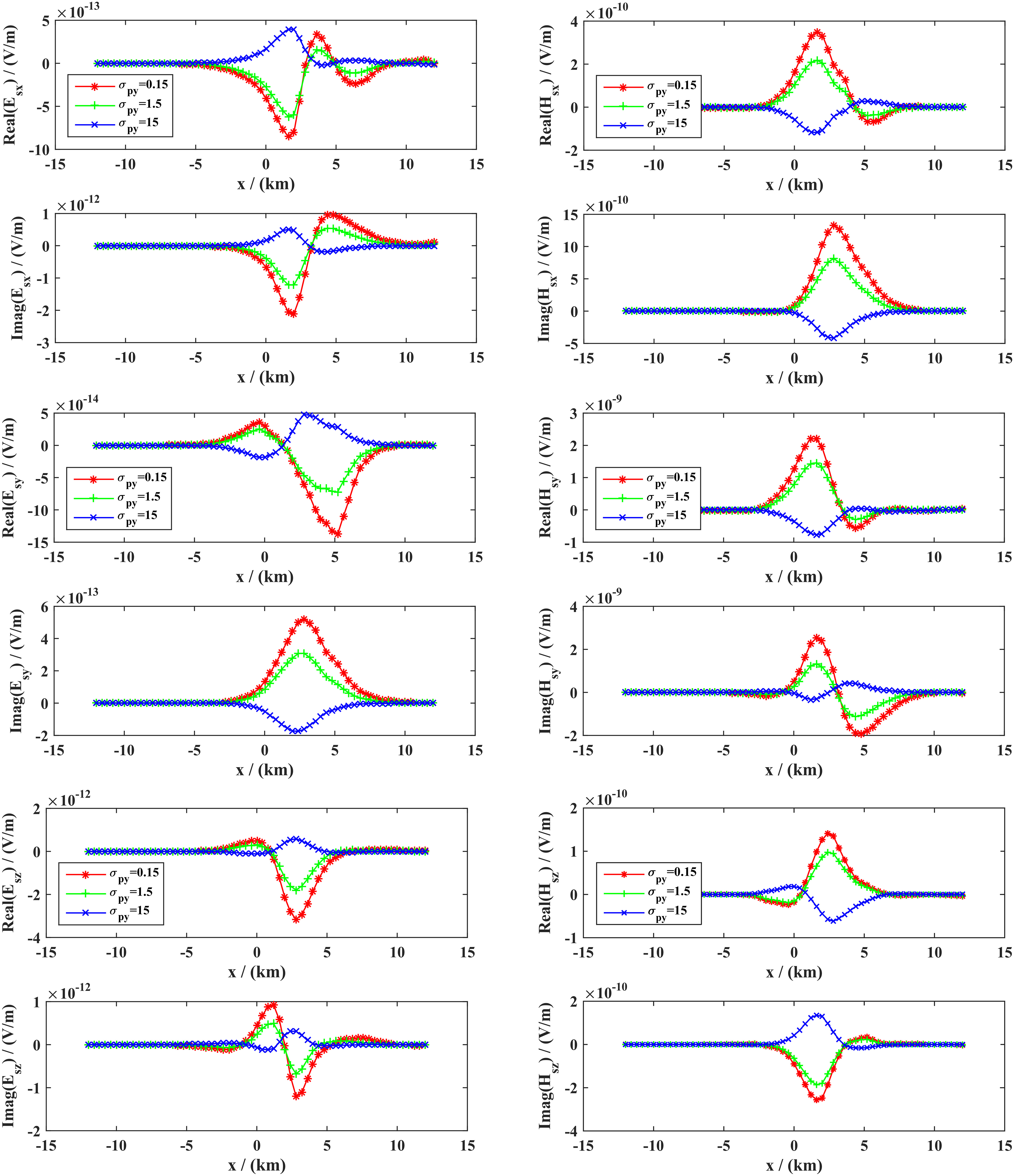
Plots of the real and imaginary parts of the secondary electromagnetic fields with varying pyrite volume fraction.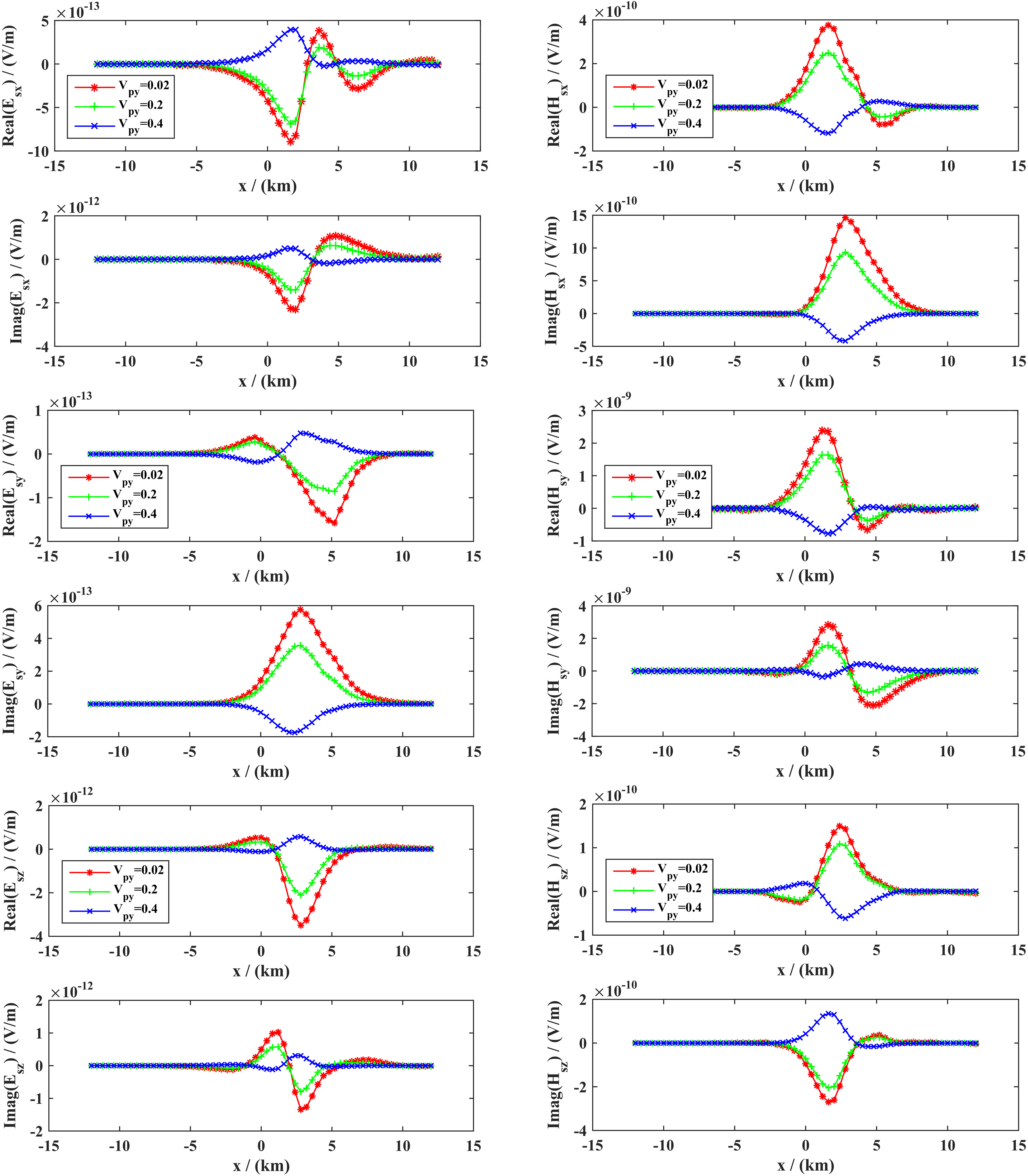
Plots of the real and imaginary parts of the secondary electromagnetic fields with varying water saturation.
Plots of the real and imaginary part of the secondary electromagnetic fields with different pyrite grain aspect ratio.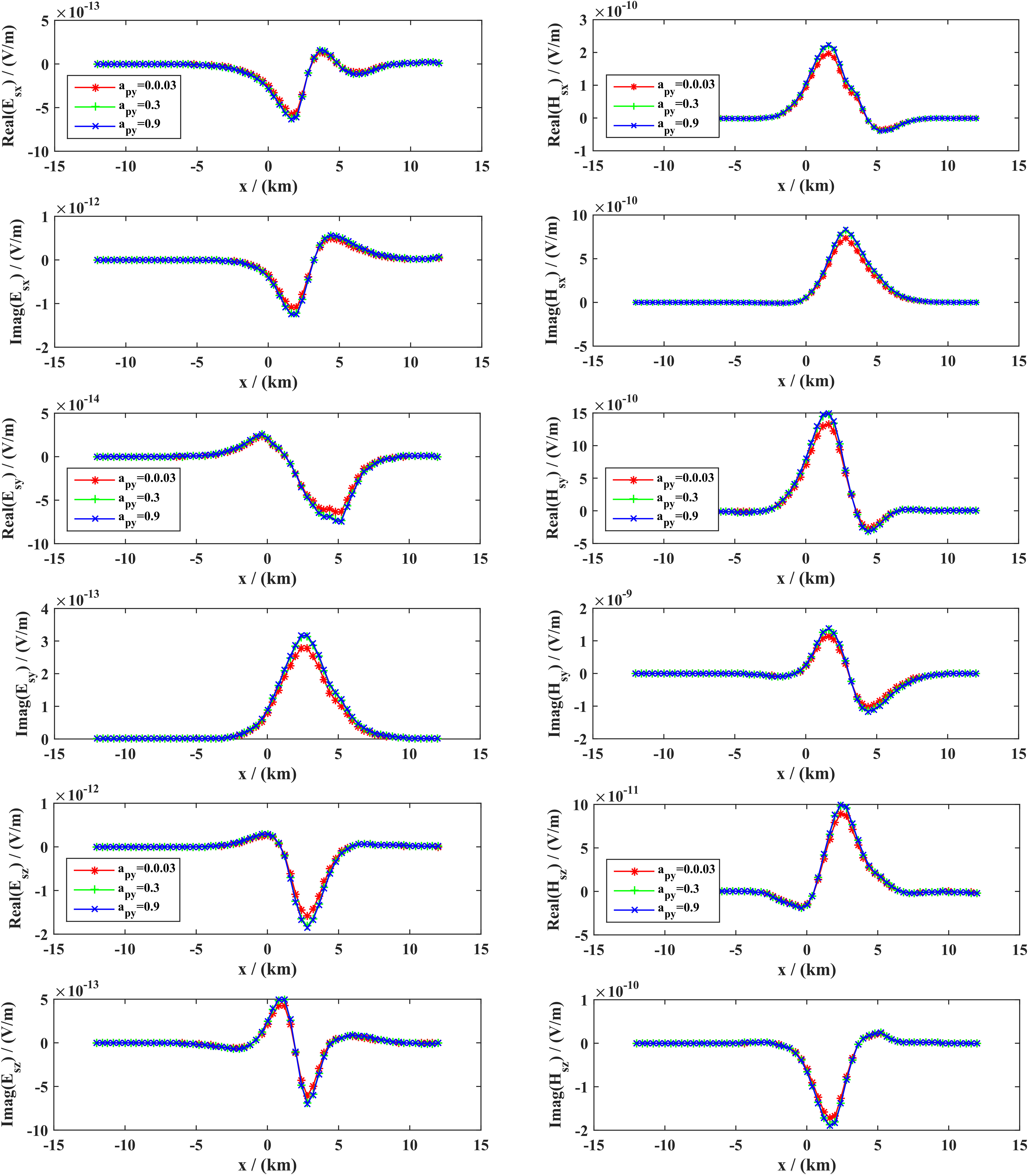
In order to analyze the effects of the various volume fraction of pyrite on the marine controlled source electromagnetic fields, we set up different volume fraction parameters of pyrite of hydrocarbon-bearing reservoirs for forward calculation. The volume fractions of pyrite
The plots of the real and imaginary parts of the secondary electromagnetic fields with various volume fractions of pyrite are shown in Fig. 9. As can be seen from the figure, the changes of the real and imaginary components of the secondary electromagnetic fields with varying volume fractions of pyrite are similar with the case of generally increasing the conductivity of the pyrite, under the condition of the same volume fraction, i.e. abnormal amplitude decreasing, followed by the shape of abnormality reversing.
Influence of water saturation on controlled source electromagnetic fields
In order to analyze the effects of varying water saturation on the marine controlled source electromagnetic fields, we set up various water saturation parameters of hydrocarbon reservoirs for forward calculation. The water saturations Sw are 0.05, 0.4 and 0.8, respectively, the porosity
The plots of the real and imaginary parts of the secondary electromagnetic fields with different water saturations are shown in Fig. 10. As can be seen from the figure, in the case of the same porosity, with the increasing of water saturation, the abnormal amplitude of the imaginary and real components of the secondary electromagnetic fields decreases, and the variation range is wide.
Influence of particle aspect ratio on controlled source electromagnetic fields
In order to analyze the effects of different particle aspect ratios on the marine controlled source electromagnetic fields, we set up different particle aspect ratio parameters of hydrocarbon reservoirs for forward calculation. The particle aspect ratios of pyrite
The plots of the real and imaginary parts of the secondary electromagnetic fields with different pyrite grains aspect ratio are shown in Fig. 11. As can be seen from the figure, with the increasing of the pyrite grains aspect ratio, the abnormal amplitude of the imaginary components and real components of the secondary electromagnetic fields decreases, and the variation range is relatively wide. However, compared with the porosity, water saturation, electrical conductivity and volume fraction of the particles, the influence of the particle aspect ratio on the electromagnetic fields is quite small.
Conclusion
In this paper, we use the increment model to calculate the effective conductivity of the multi-medium. Then we solve the 3D MCSEM modeling problem by using the vector finite element method, which is based on unstructured mesh with the secondary formulation. We analyze the influences of the parameters (porosity and water saturation) on the secondary fields of the controlled source electromagnetic fields. Below are some of the conclusions obtained.
Introducing the multi-phase incremental model to characterize electrical properties of the rocks is feasible and valid. It can provide a new way to further study the influences of the composition and structure of rocks on the conductivity. In the case of certain porosity, when the water saturation, electric conductivity, volume fraction and particle aspect ratio increase, the variation amplitude of the secondary electromagnetic fields increases. Under the condition of certain water saturation, the larger the porosity of rocks is, the lower abnormal amplitude of secondary electromagnetic fields will be. Therefore, it is helpful to further validate the accuracy of data interpretation when the factors in the data interpretation are taken into consideration. To gain a better understanding of the effects of porosity, water saturation and other parameters on MCSEM prospecting, the parameters are necessarily taken into consideration in the inversion process. Therefore, the 3D inversion of MCSEM based on the multi-phase incremental model will be completed in the future.