



Abstract
This paper presents a second order edge-based finite element method based on a new type of second order edge element for numerical modeling of 3D controlled source electromagnetic data in an anisotropic conductive medium. We adopt the anomalous potential field formulation to avoid the effect of source’s singularity. The computational domain was subdivided into unstructured tetrahedral elements. The sparse linear system was solved using the Induced dimensional reduction (IDR(s)) method with an incomplete LU preconditioner. We have applied the developed algorithm to compute a typical MCSEM response over several 3D models, we compare the numerical results from our method and FEM solution based on conventional first and second order element. The results of comparison shown that our algorithm can significantly reduce the computation cost without loss to much accuracy.
Keywords
Introduction
In recent twenty years, the marine controlled-sources electromagnetic method (MCSEM) has become an important exploration tool, which is widely used in the exploration of hydrocarbon resources, deep geological structure and so on. To achieve the purpose of quantitative imaging of complex subsurface resistivity distributions and extracting as much information as possible from survey data, it is necessary to improve the accuracy and efficiency of the 3D forward modeling of the marine source controlled electromagnetic method. There are some conventional approaches for numerically modelling EM problems: the integral equation (IE) method [1, 2, 3, 4], finite difference (FD) method [5, 6], finite volume (FV) method [7, 8, 9] and finite element (FE) method [10, 11, 12, 13, 14, 15, 16]. The IE method only need to require the discretization for the anomalous domain, which typically give rise to fully populated matrices [17, 18]. This method is more suitable for simple model and the store requirement and computation time will be obviously increases with the increasing of model complexity. Finite Difference Method is the simplest in concept, and can be easily implemented [19]. However, it can only be used in rectangular brick to discretize the modeling domain. Therefore, the Finite Difference Method is not suitable for modeling the EM response in complex geoelectrical structures [14]. The FV method approximates the field at a nodal point in space through integrating the relevant PDEs over an averaging volume surrounding that point [8, 9]. Compare to the above-mentioned methods, the FE method can easy to use the unstructured mesh to discrete the modeling domain, this advantage makes it more suitable modeling the response of complex models. What is more, it can locally refine the interest region and coarsen the area near the domain boundary [12, 13]. Therefore, the efficiency of mesh generation can be improved effectively.
There are two types of finite element method for CSEM modeling due to its geometric flexibility: nodal-base finite element method and edge-based finite element method. The conventional node-based FE suffers from spurious solutions since the divergence free condition in source free region and the tangential field continuity is not imposed [20, 21]. Compare to the conventional node-based FE method, the edge-based FE method just overcomes this obstacle and attracts many researcher’s attention and has been widely used for solving electromagnetic field problems [22]. However, these elements are built in first order. In order to further increase the accuracy of edge elements, we can use higher order edge elements to approximate. However, such elements bring a large increase in the number of variables, many of them being redundant. This will significantly increase the computational time. Therefore, how to improve the accuracy of calculation without obvious increase of computational cost is crucial.
As far as the stability of the solution is concerned, the vector Helmholtz equation, expressed solely in terms of the electric filed or magnetic field, is a partial differential equation (PDE) of second order. Solving this PDE for a situation where the EM fields are discretized using linear basis functions, and where very low frequencies are used, is not efficient [23]. However, the above problems can be avoided by using the potential in forward modeling EM problem. There are some studies using potential in 3D forward modeling of geophysical EM problems [24, 25]. Furthermore, the potential field FE approximation for wave and eddy current problems in electrical engineering [26, 27].
In this paper, we formulate the 3D marine CSEM problem using a new type second-order edge element in the anisotropic medium. In order to avoid the sources singularity, we apply the anomalous vector and scalar potential field formation to solve the Maxwell’s equations. In order to simulate the bathymetry effect, we use tetrahedral elements to discrete modeling domain. The sparse finite element system of equations is solved using an IDR(s) method with the ILU preconditioner. We validate our algorithm by several models and compare the numerical results from our method and conventional 1
Theory
Governing equations
Without loss of generality, the low frequency electromagnetic field, considered in geophysical application, satisfies the following Maxwell’s equations [17]:
Where
According to the definition of the Coulomb vector and scalar potential, the electromagnetic fields
Substituting Eqs (4) and (5) into Eqs (2) and (3), and the following Helmholtz equation can be obtained:
In order to avoid the singularities of sources. We apply the anomalous field formulation on 3D marine CSEM modeling. In the anomalous field formulation of diffusive EM field problem. The total conductivity tensor is decomposed into background conductivity tensor and the anomalous conductivity tensor.
Similarly, the total Coulomb vector and scalar potential can be decomposed into background and anomalous fields.
Where
Substituting Eqs (9) and (10) into the Eqs (6) and (7). The Helmholtz equation for the anomalous potential field can be obtained as follow:
From Eqs (11) and (12), one can see that the source term for this equation is the primary potential field, which can be computed analytically for a full-space and half-space background conductivity. For a general layered earth model, the primary potential field can be computed semi-analytically by using a digital filter algorithm to calculate Hankel transforms.
Similar to the conventional node-based finite element method, the edge-based finite element method can discretize modeling domain using rectangular, tetrahedron, hexahedron or other complex elements [21, 22]. In order to simulate complex seabed topography. In this study, we use the tetrahedron elements to discretize modeling domain. Besides, we apply second-order Edge Element approximation to improve the solution accuracy. In this section, we will introduce a new second-order Edge Element and compare to conventional second-order edge element. In this paper, geometrical edge of a finite element is called side and the location related to a vector variable is called edge. In the case of second-order elements, sides and edges are not the same but there are two edges on each side.
Conventional second-order tetrahedral elements.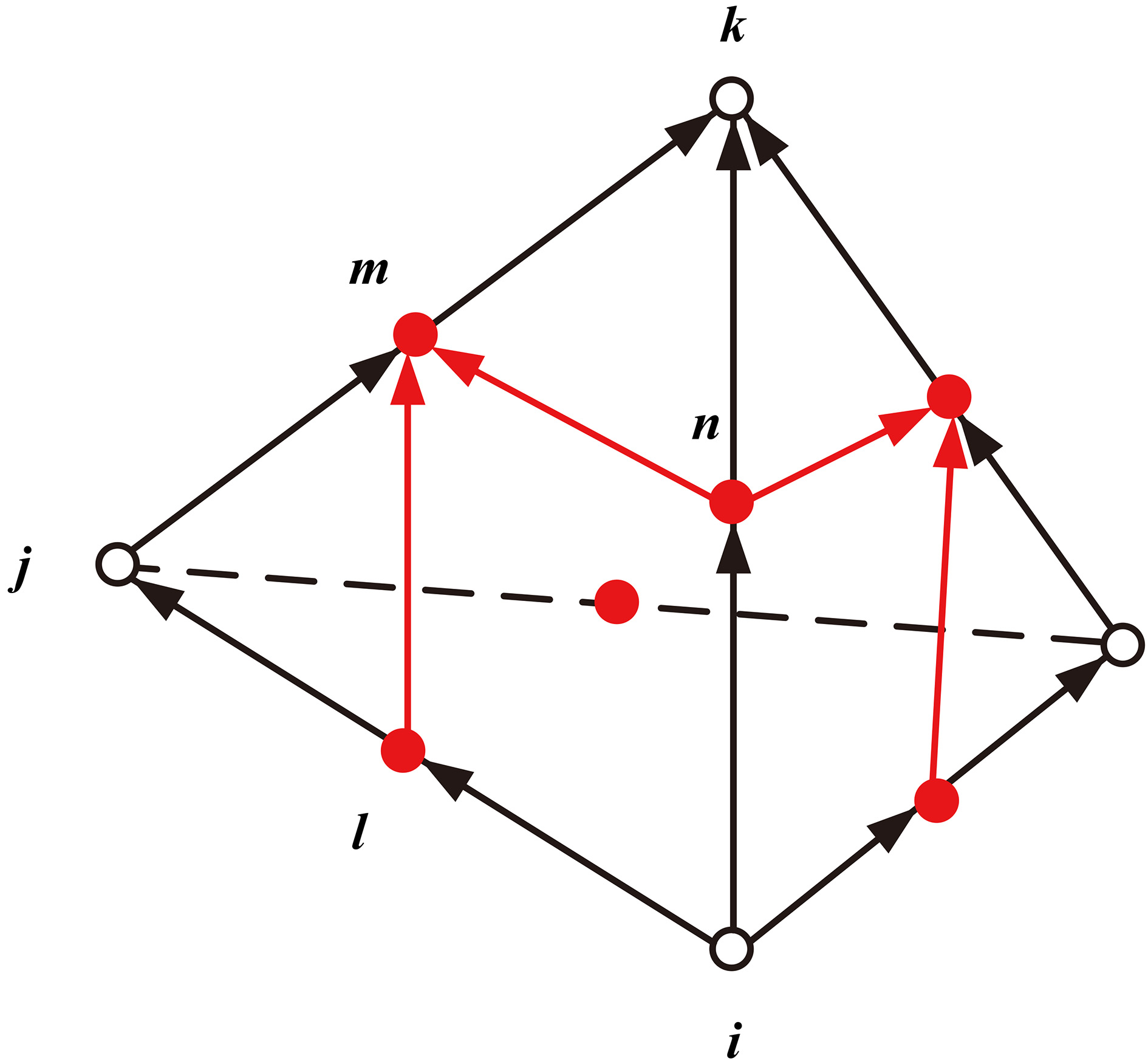
Figure 1 shows the conventional second-order edge element [28]. Form the Fig. 1 one can find that there are 10 nodes and 20 edges in the conventional second-order edge element. In general, there should be 10 nodes and 24 edges in the second-order edge element. However, since the curls of edge shape function within an edge element are linearly dependent. So, some edge variables become redundant. We can reduce them by using tree gauging method. In the potential edge-element FE schemes, the vector and scalar potentials are defined along the edges and at the nodes of the tetrahedral element, respectively. The edge shape functions
Where
The shape function of all faces has the following relation:
From the Eq. (17), we can find that one of the shape function of faces is redundant. Therefore, we can eliminate the corresponding edge variable, then the computation cost can be significantly reduced. In next section, we will discussion new method to eliminate some redundant edge variable.
Unification of two edges. (a) Two edges on the side. (b) Unified edge.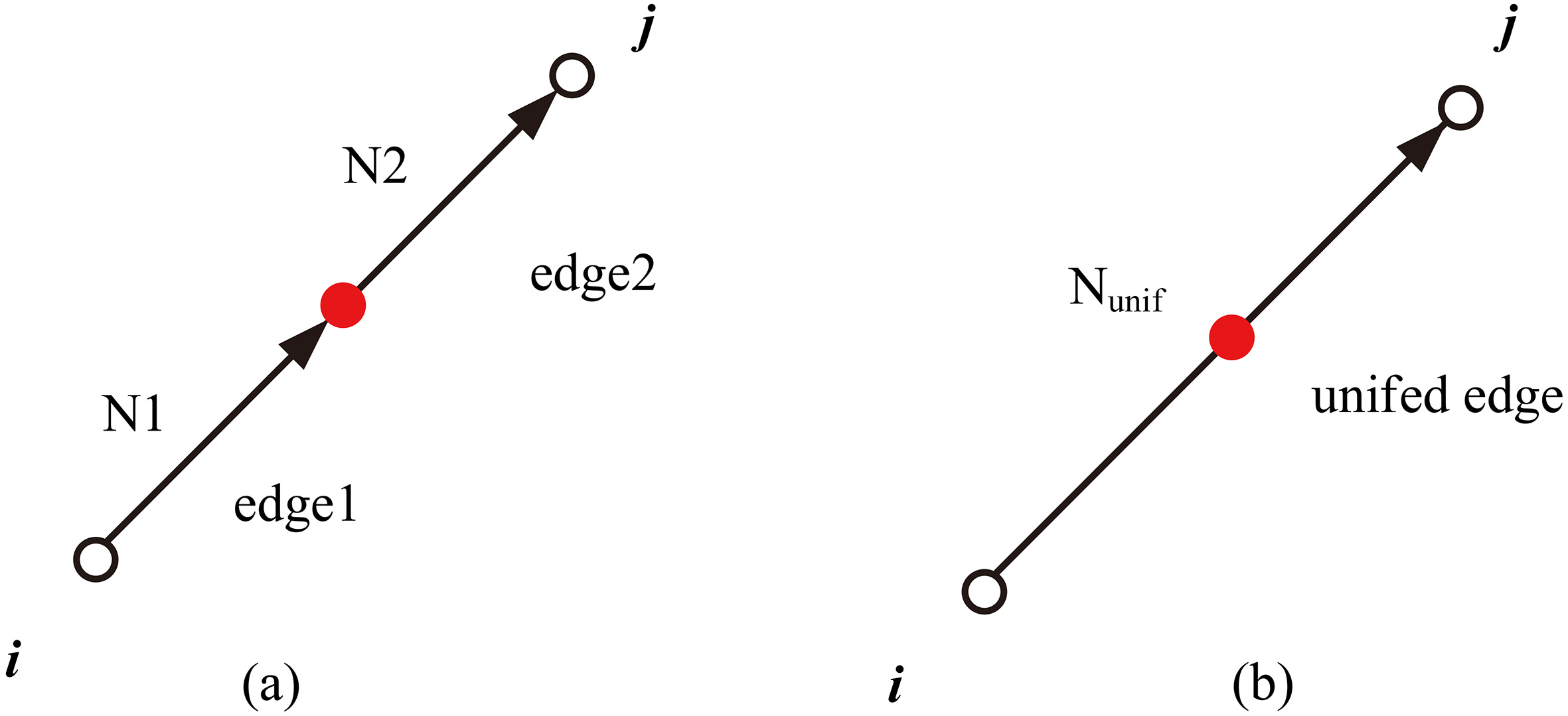
Without loss of generality, we first consider a one side of conventional second-order edge element as shown in the Fig. 1. There are two edges on the sides of second-order edge element as shown in the Fig. 2a. We named them edge1 and edge2, respectively. We assume the shape function of edge1 and edge2 is N1 and N2, respectively. And the corresponding edge variables of these two edges is A1 and A2, respectively. In this case, the one of A1 and A2 can be eliminated, therefore we decide to eliminated A2 as the redundant edge variable and consider A1
We let
Where
Then the Eq. (18) can be rewritten as follows:
Where
And the shape functions of the edges on the faces and the scalar shape functions is the same as the conventional second-order edge element. Then, we can obtain a new second-order edge element with 10 nodes and 14 edges as shown in the Fig. 3. Compare to the conventional second-order edge element as shown in the Fig. 1. The number of unknowns of new type second-order element is obviously less than those of the conventional second-order edge-element. Therefore, the computation cost can be obviously reduced.
The proposed second order element.
Using the Galerkin’s method, the weak form of Eq. (11) can be written as:
The inner product of the vector residual in Eqs (23) and (24) with a weight function
Substituting Eq. (23) into the Eq. (24) and integrating the first term
By considering the continuity of the inner boundary and also the field is prescribed in the outer boundary, the surface integral in Eq. (4) can be ignored, then Eq. (4) can be rewritten as:
Similar to vector residual of Eq. (11), the scalar residual of Eq. (11) is also minimized by calculating the product of the scalar residual
Where
By substituting the residual term Eq. (28) into Eq. (27) and applying integration by parts to the integral on the right side, the following equation is derived:
By considering the continuity of the inner boundary and also the field is prescribed in the outer boundary, the surface integral in Eq. (29) also can be ignored, then Eq. (29) can be rewritten as:
In order to solve the Eqs (26) and (30), we first use the tetrahedron elements to discretize modeling domain, and apply the new type second-Order Edge Element presented in this paper to improve the solution accuracy. Within each element, the approximated vector and scalar potentials are expressed by using the vector and scaler basis functions:
Where
The Galerkin version of the method of weighted residuals, in which the weighting function is chosen to be equal to the basis function, that is
Where
After assembling for the FEM equations, we can get a global FEM equation in matrix form as:
Where
In order to obtain the unique solution for the Eq. (37), we need to add the proper boundary conditions in to the Eq. (37). For the anomalous field algorithm, the field on the out boundary can be considered to be zero. That is called Dirichlet boundary conditions. For simplicity, we consider the Dirichlet boundary conditions on the out boundary.
Where
In order to get the solution of Eq. (37), we use the iterative solver of IDR(s) to solve the linear equation system Eq. (37) [29]. Also, the system is preconditioned using an incomplete LU decomposition approach [30]. Once the anomalous vector and scalar potential are solved numerically, the anomalous electric field can be obtained by using the Eq. (5). The magnetic field is calculated by taking the curl of the vector potential and using the edge-element basis functions.
The marine CSEM response of the examples in the study were calculated using the same platform as the parameters as follows: 2 Intel(R) Xeon(R) CPU E5-2630 2.40 GHz; 64 G of memory; Windows 7 64 bit.
Schematic diagram of 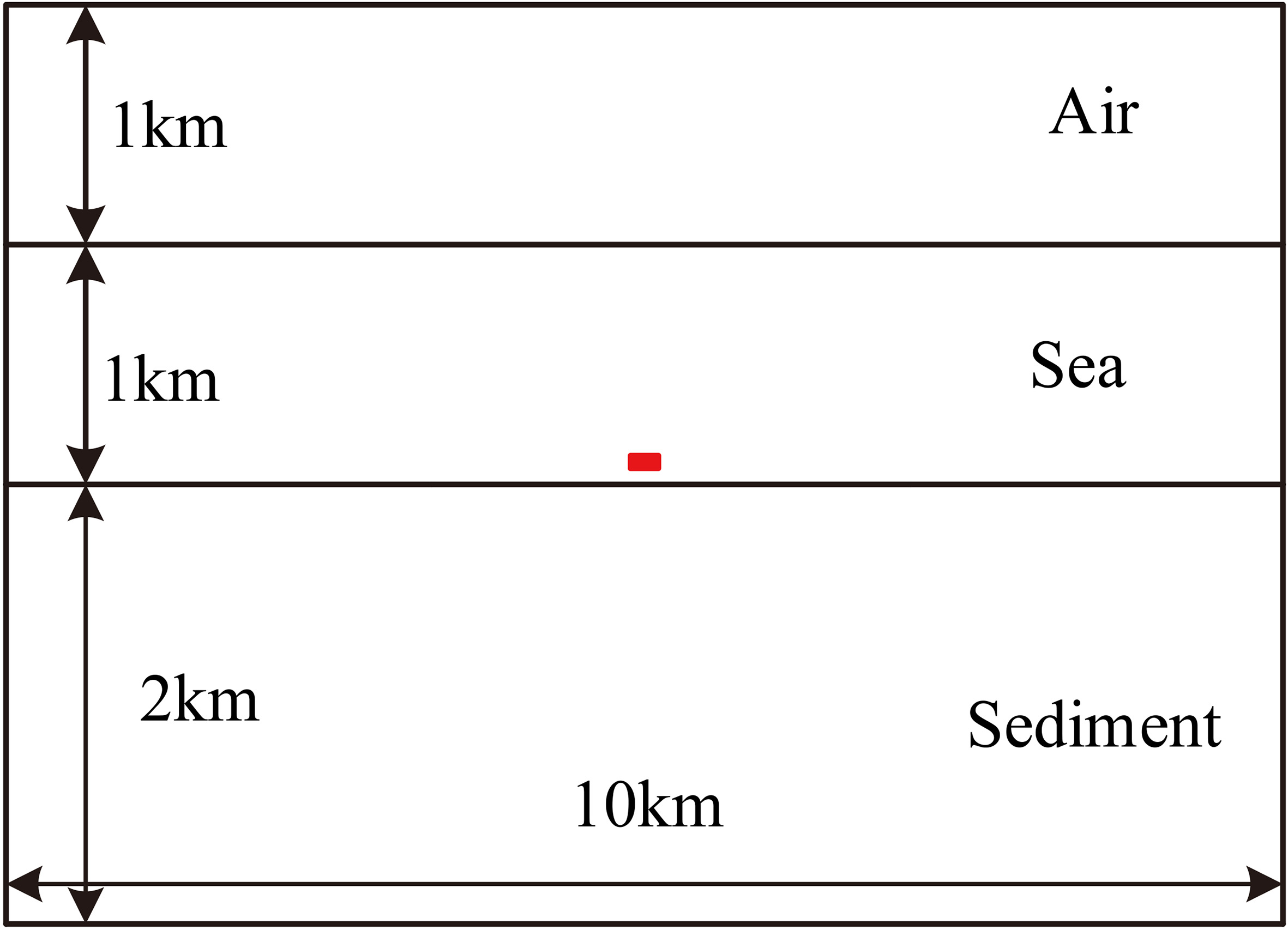
To validate our algorithm, we consider a horizontally layered geoelectrical model as shown in the Fig. 4. The depth of the air and sea is 1000 m. The conductivity of air, sea water and sediment are set to be 10
The comparison of efficiency of the different elements
The comparison of efficiency of the different elements
The size of unstructured mesh for the 1D model at 
A comparison between the FE solution with different edge-elements the analytical solution for the isotropic 1D model.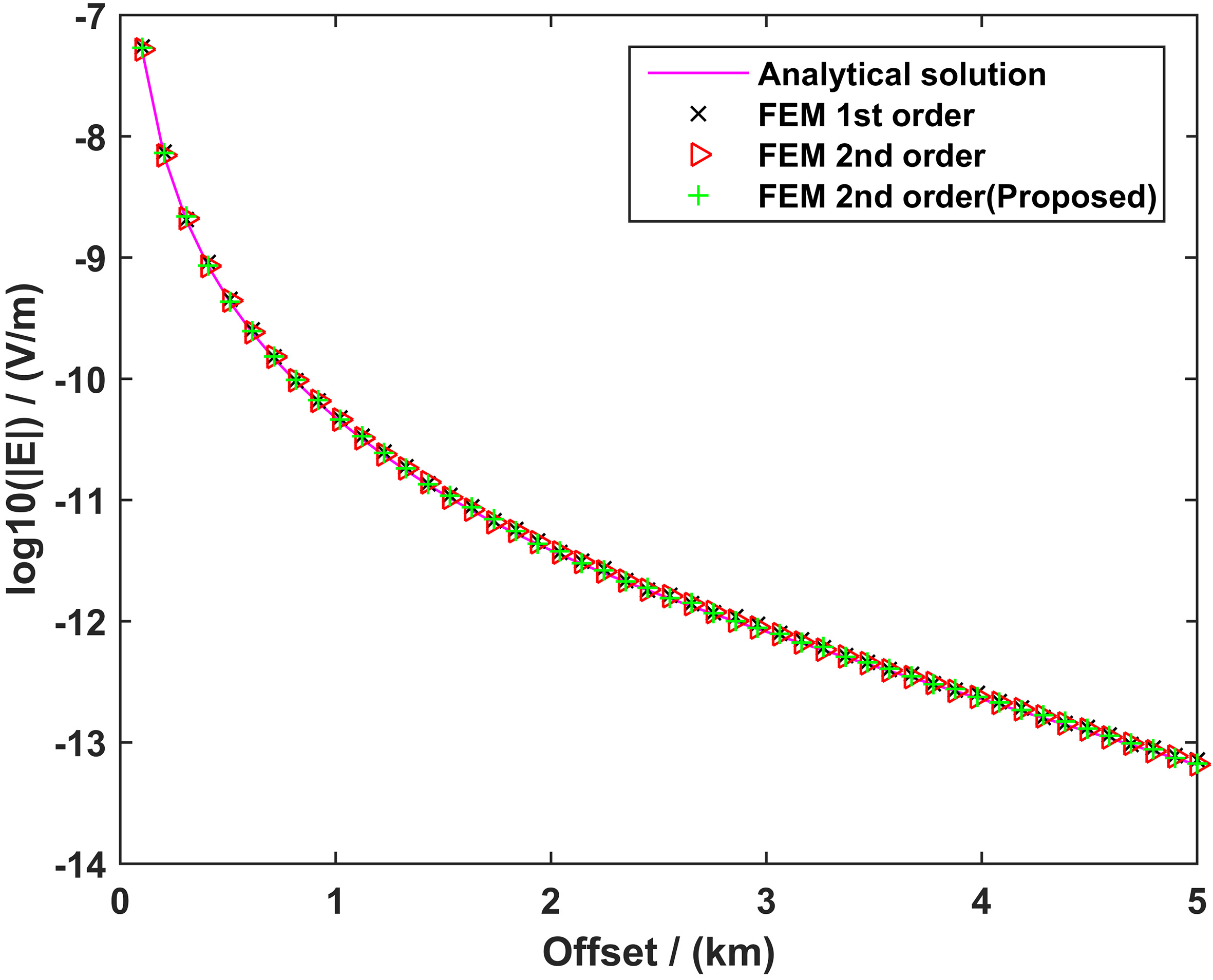
The relative error of FEM results with different kind of edge-element.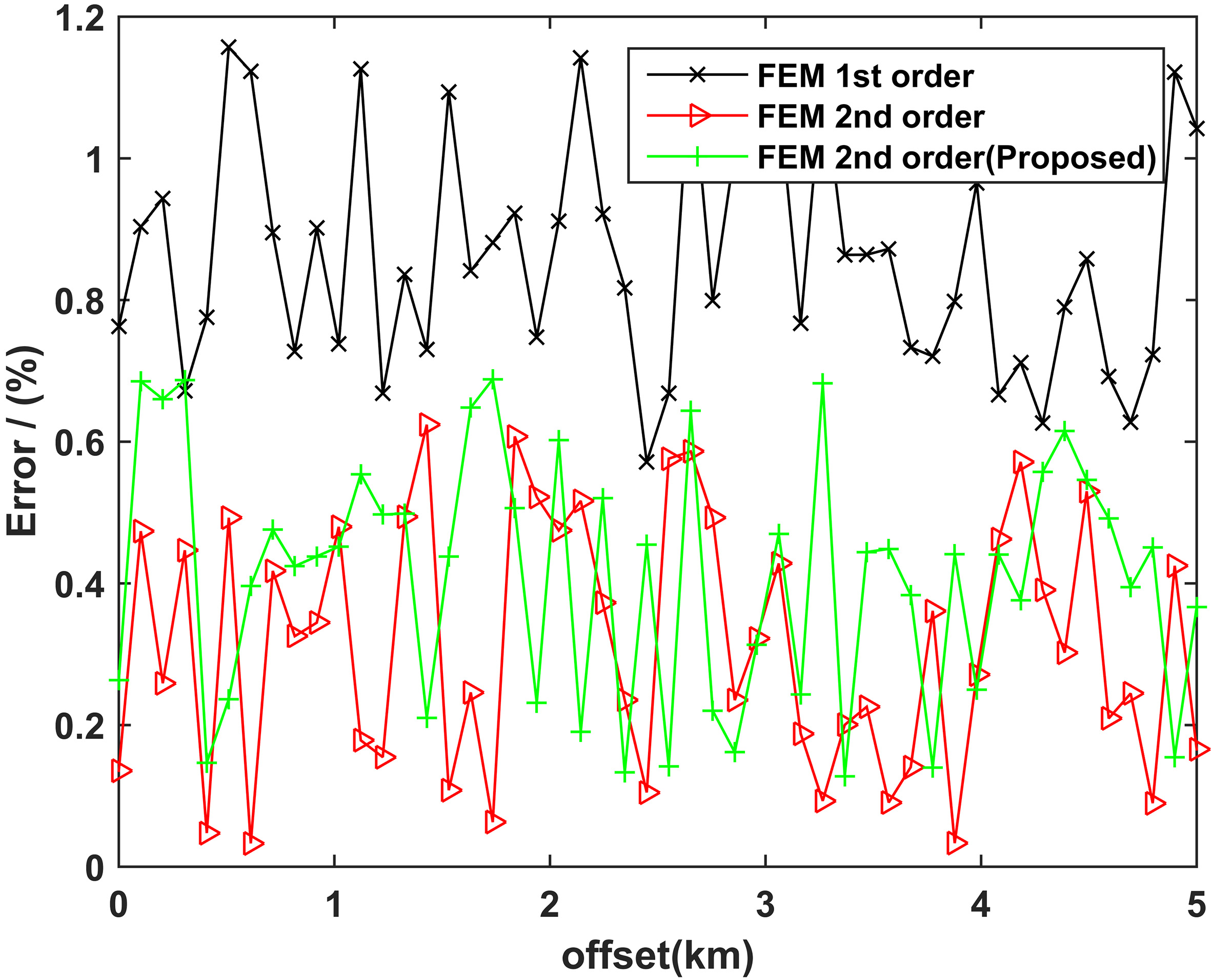
Vertical section at 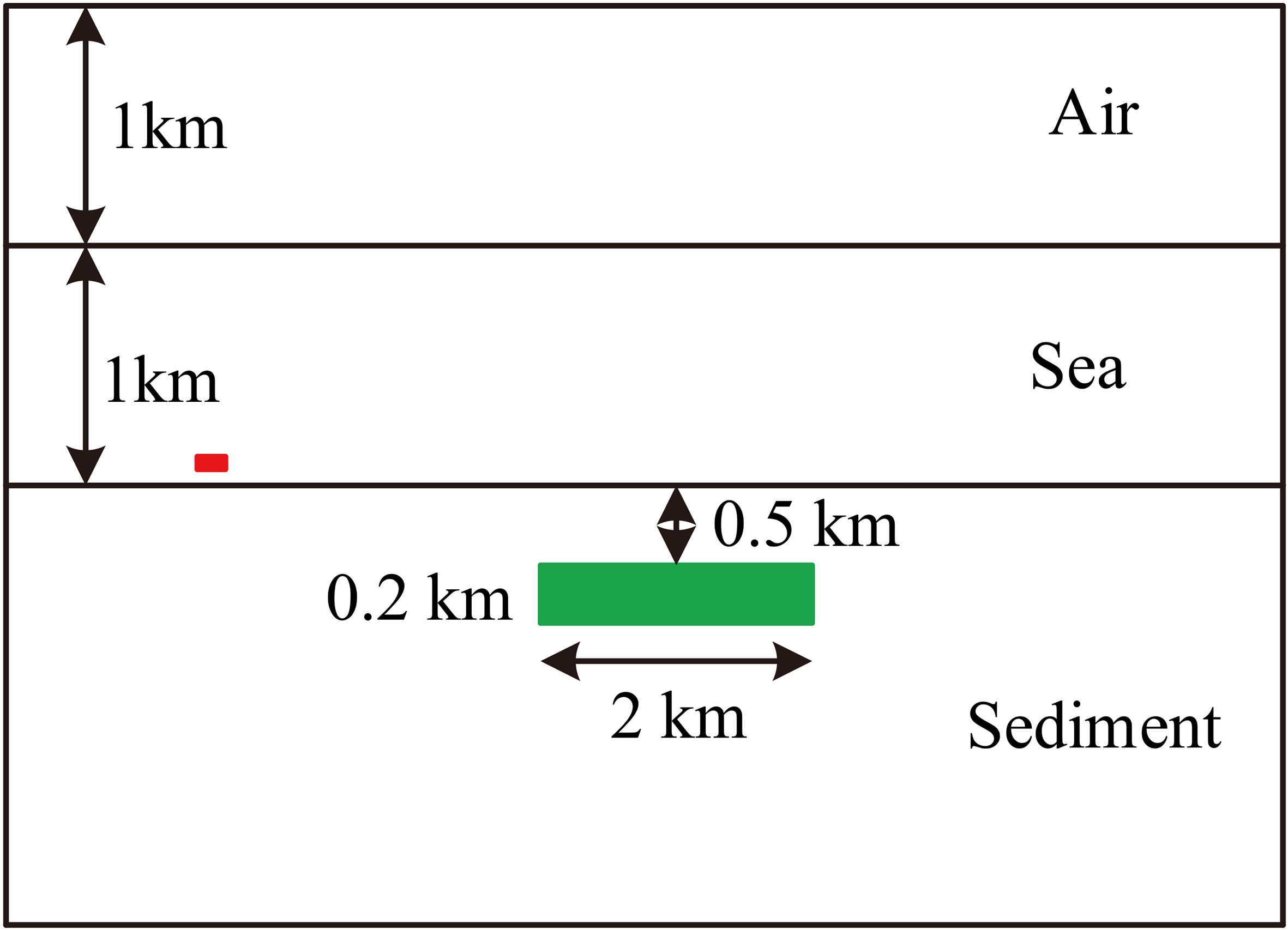
In this section, we consider a hydrocarbon reservoir model which is embedded in the sediments as shown in the Figs 8 and 9. The conductivity and depth of sea water and air are the same as the previous model. The horizontal and vertical conductivity of sediment 1 s/m and 0.5 s/m, respectively. The reservoir is isotropic with the conductivity is 0.001 s/m. The size of reservoir is 2 km
The Figs 10 and 11 show the comparison of anomalous
The comparison of efficiency of the different elements
The comparison of efficiency of the different elements
The size of unstructured mesh for the reservoir model at 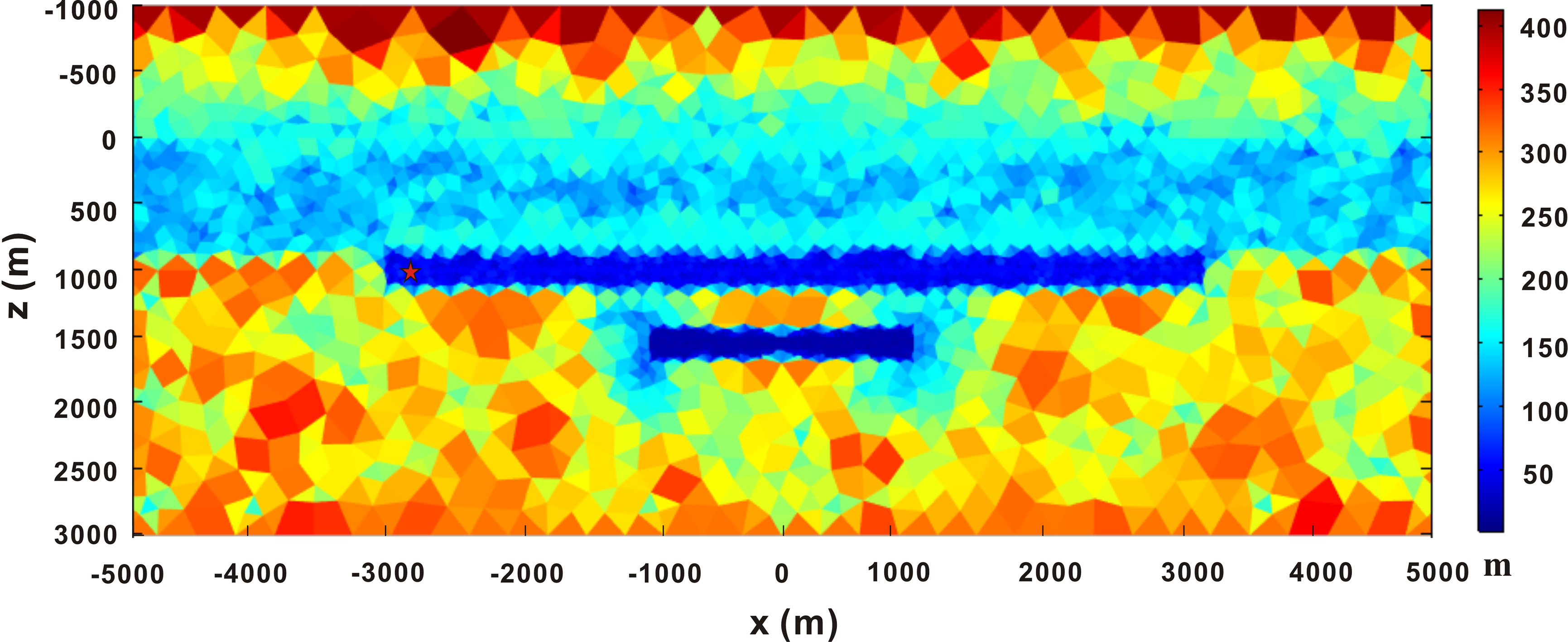
A comparison of the x-component of the anomalous electric field computed using the conventional 2nd tetrahedral elements (blue line) and proposed element for isotropic sediment.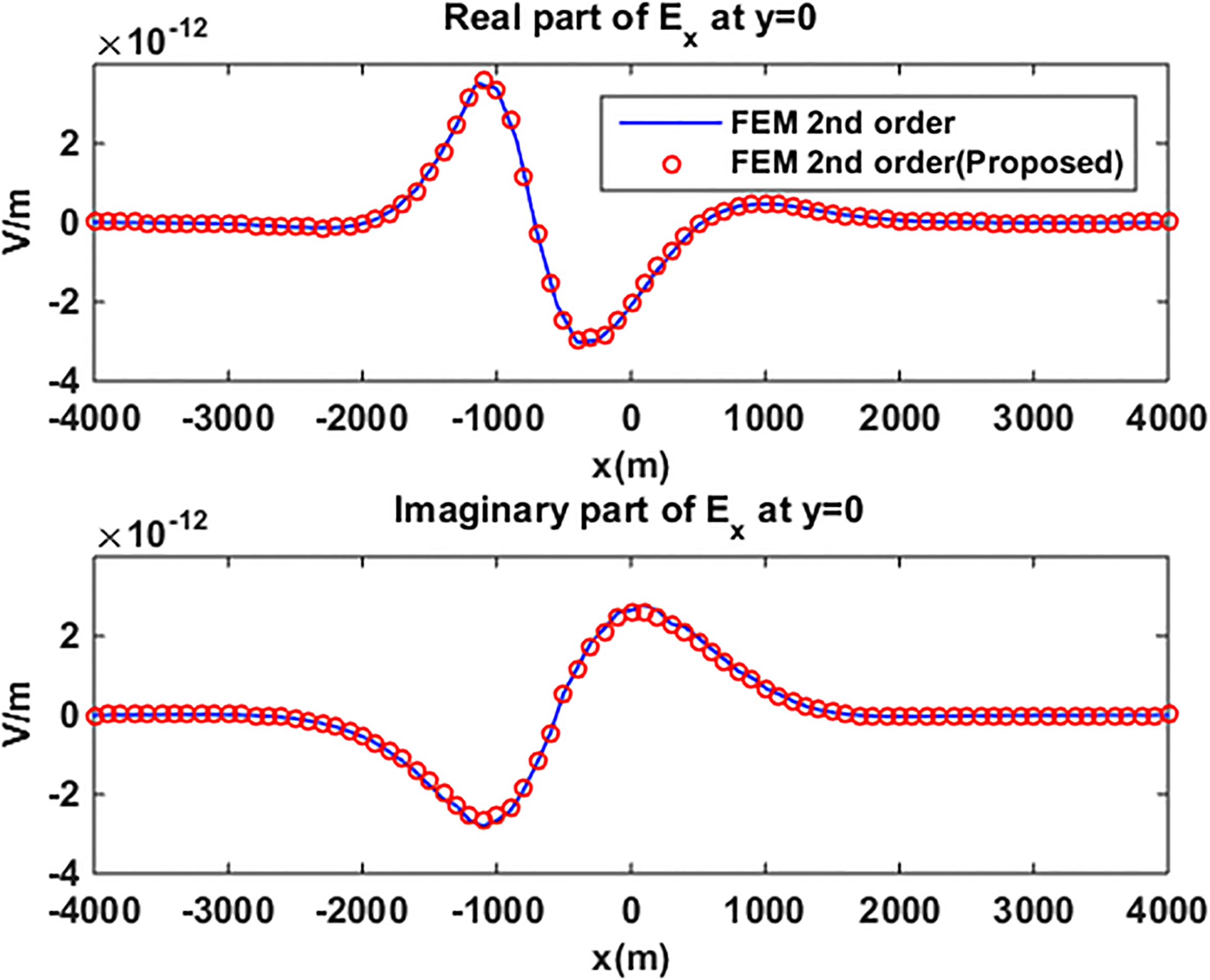
A comparison of the x-component of the anomalous electric field computed using the conventional 2nd tetrahedral elements (blue line) and proposed element for anisotropic sediment.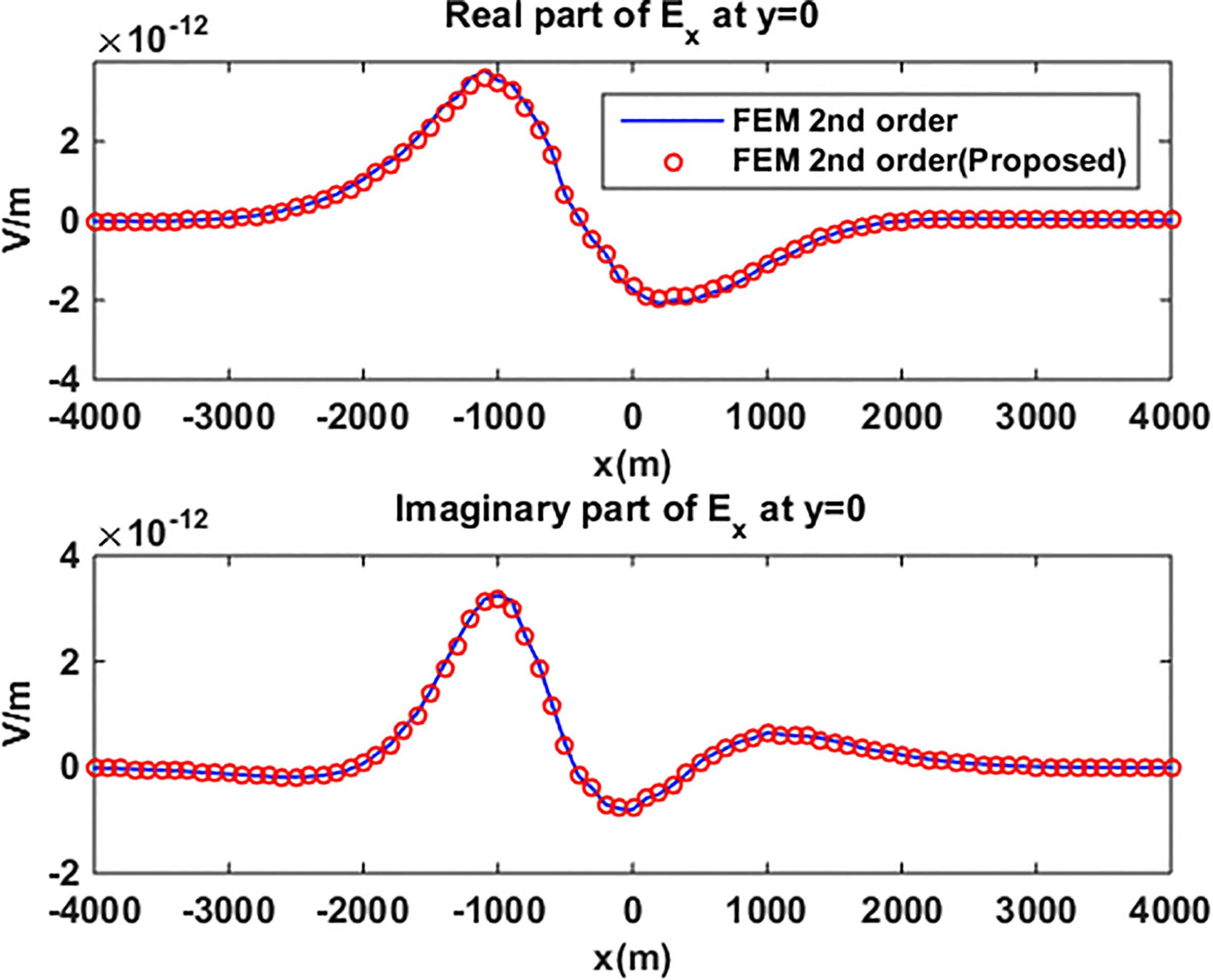
The comparison of total field and background filed for isotropic sediment.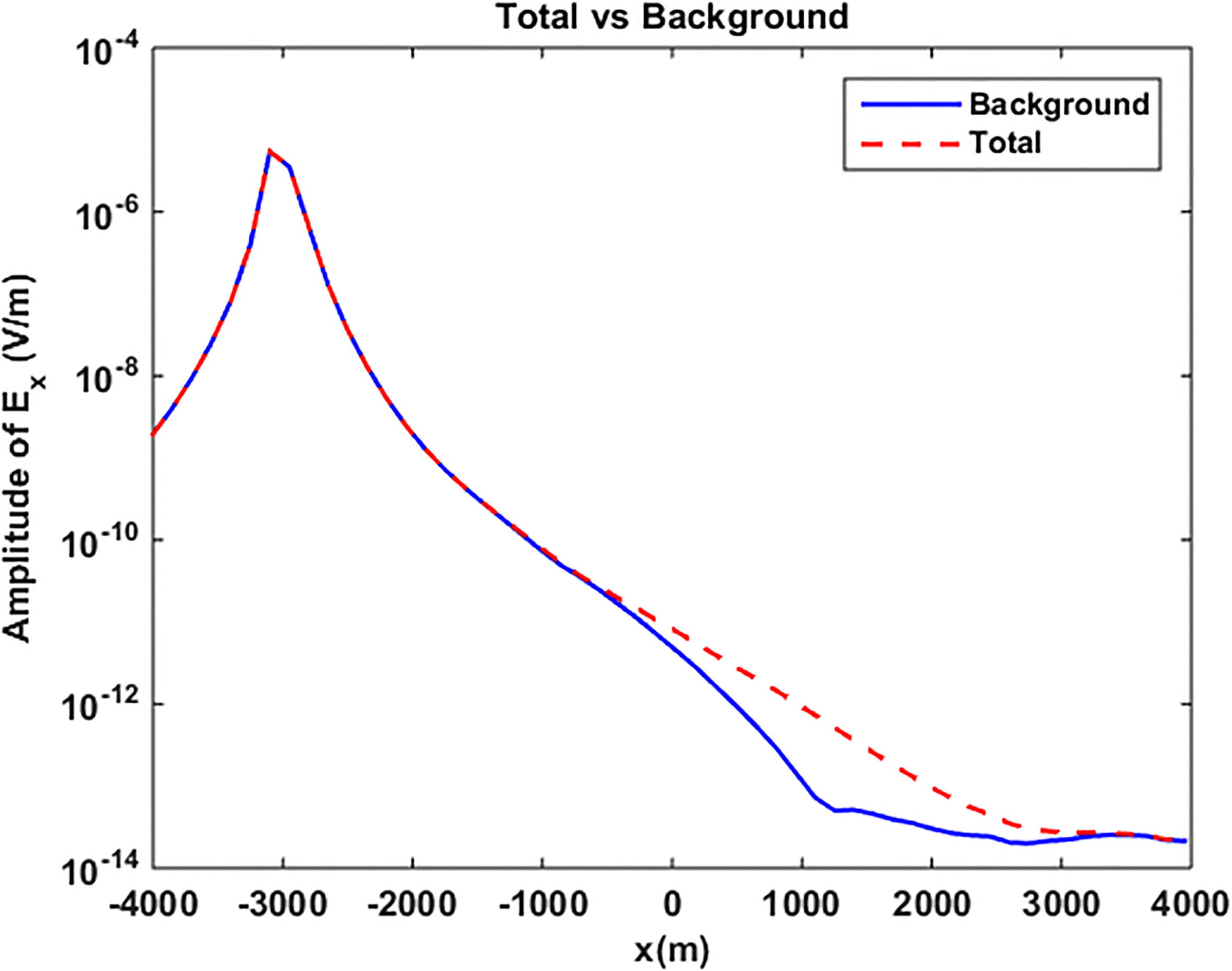
We consider a model with two reservoirs and Pyramid-hill shaped bathymetry as shown in the Fig. 14. The bottom of Pyramid-hill shaped bathymetry is
The comparison of efficiency of the different elements
The comparison of efficiency of the different elements
The comparison of total field and background filed for anisotropic sediment.
Vertical section at 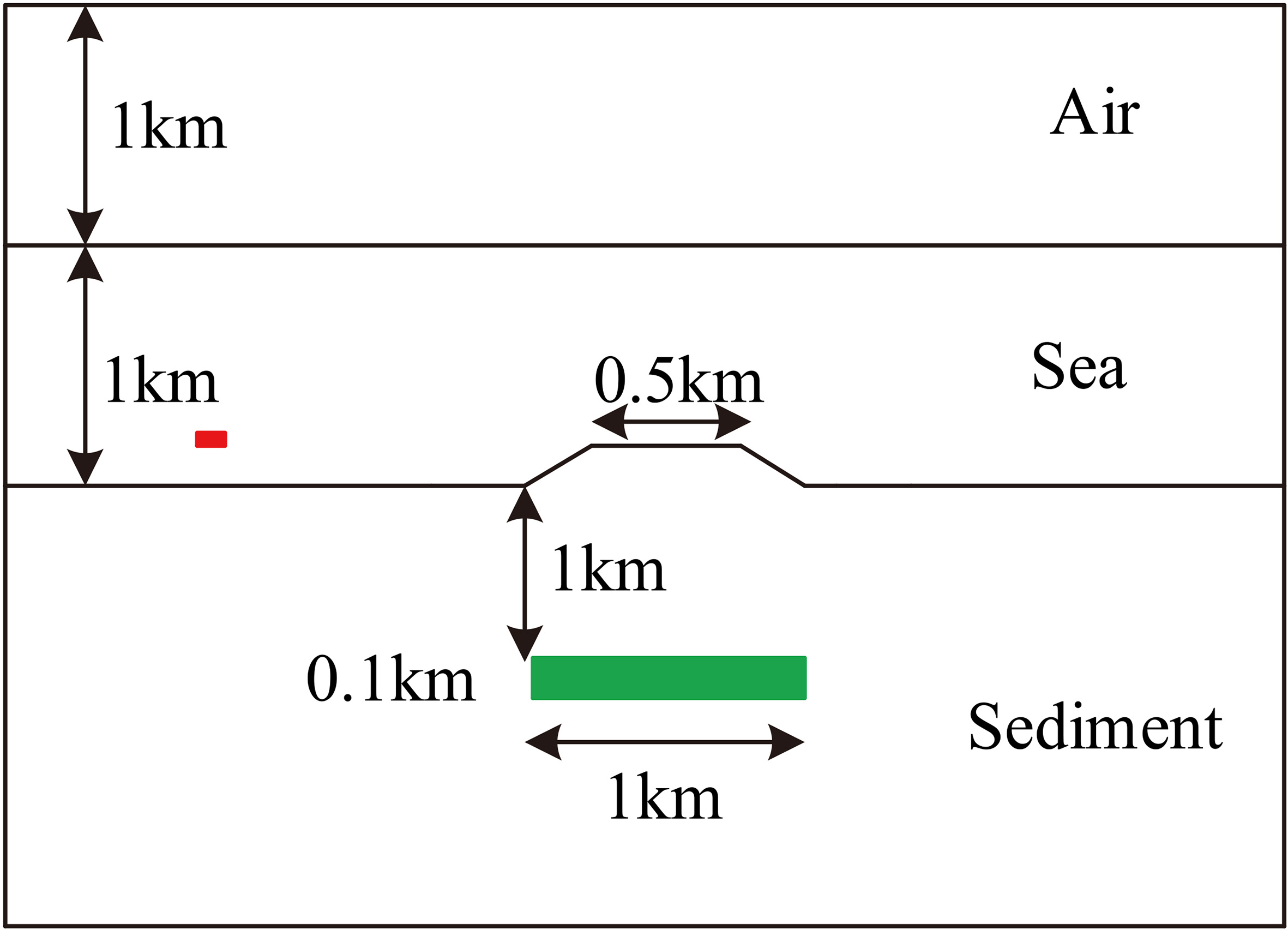
The size of unstructured mesh for the bathymetry model at 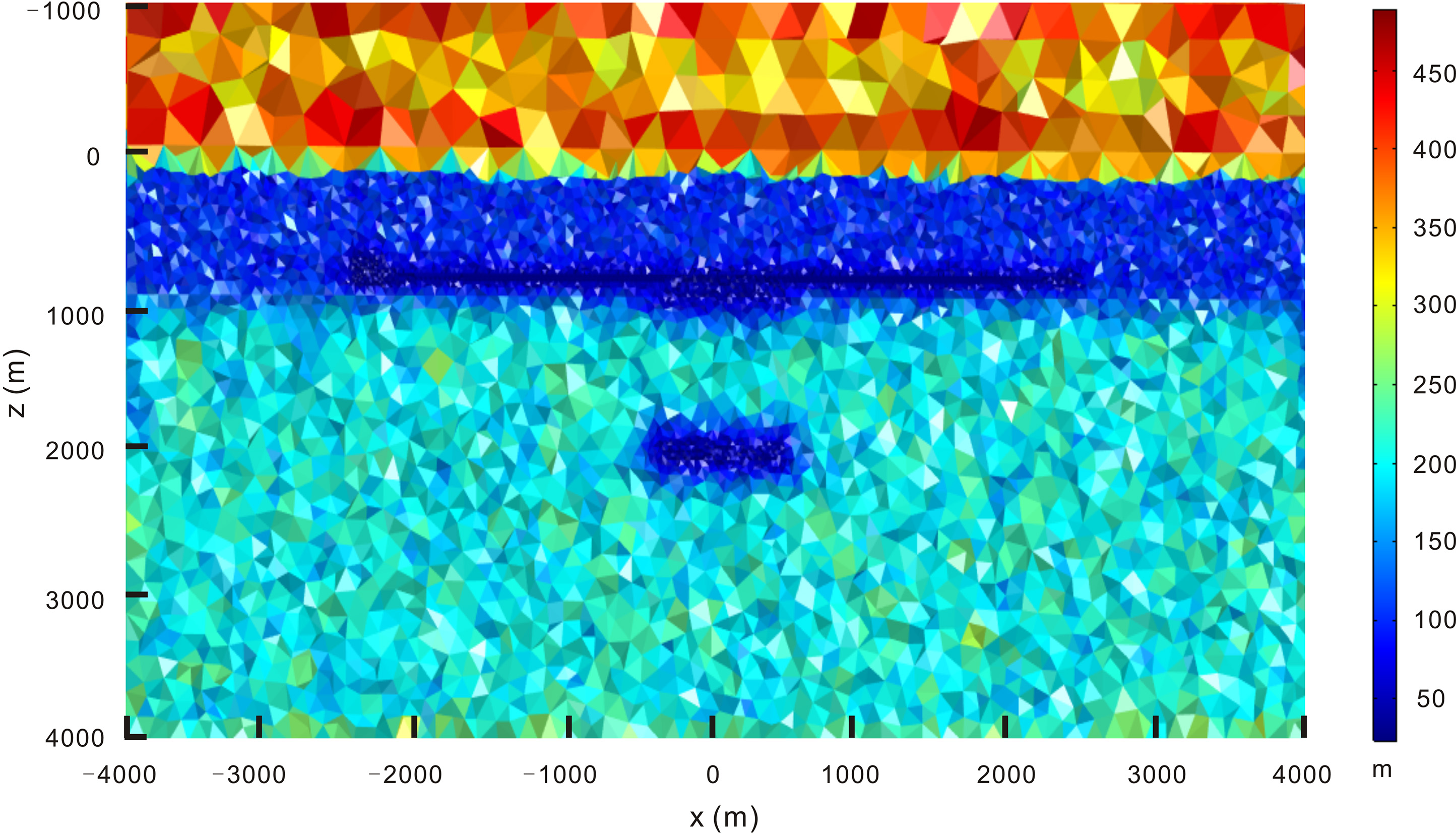
A comparison of the x-component of the anomalous electric field computed using the conventional 2nd tetrahedral elements (blue line) and proposed element for bathymetry model without reservoir.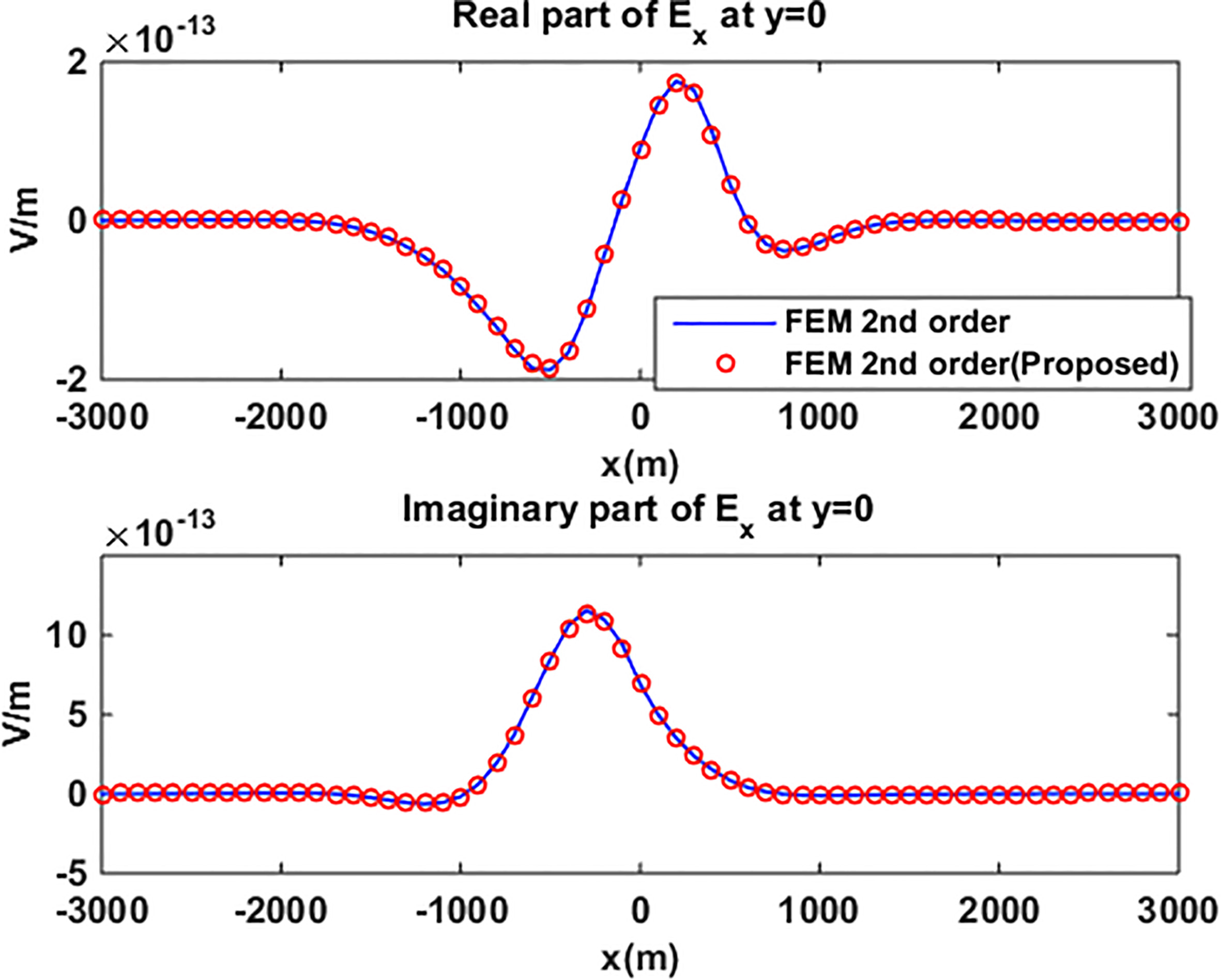
A comparison of the x-component of the anomalous electric field computed using the conventional 2nd tetrahedral elements (blue line) and proposed element for bathymetry model with a reservoir.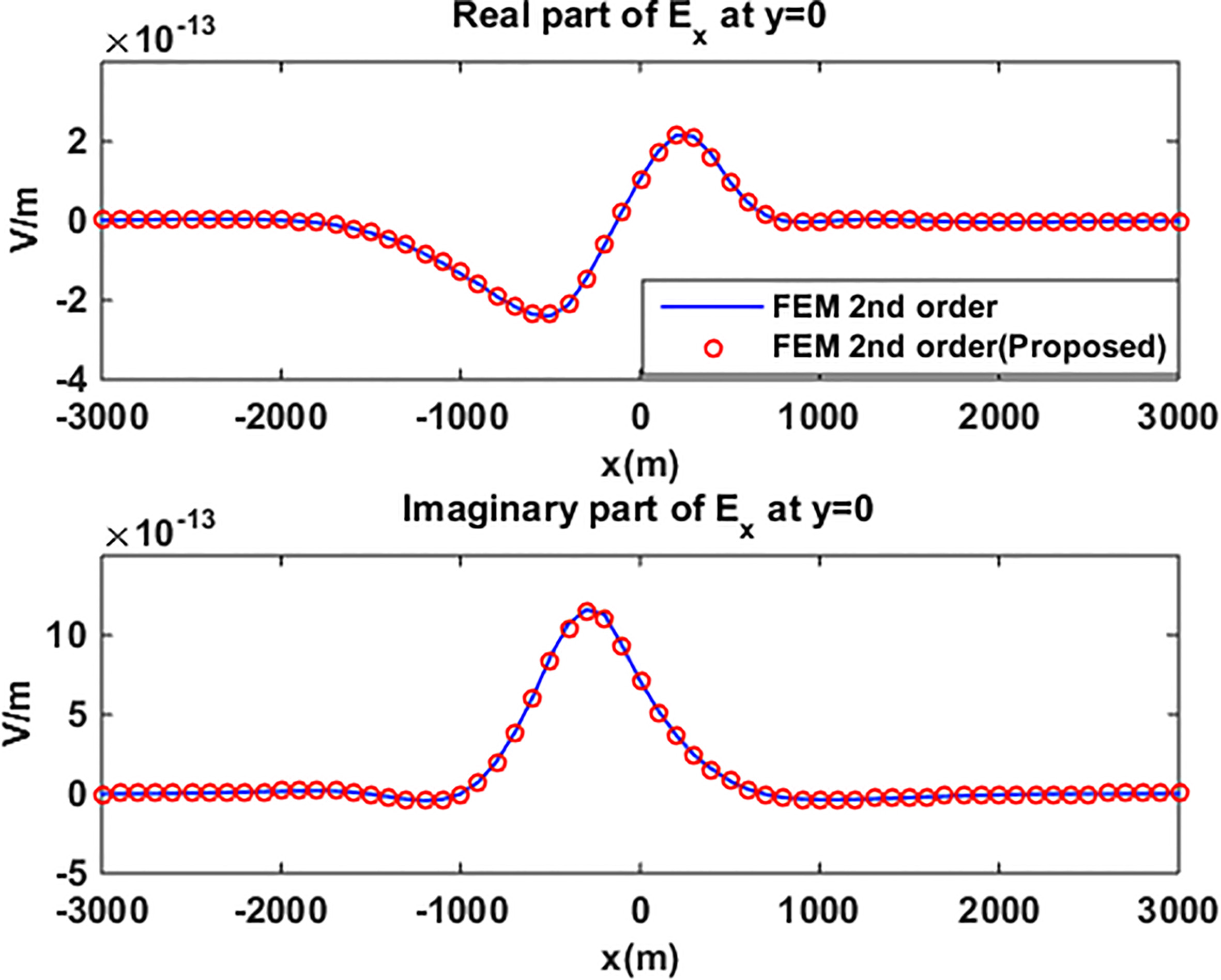
The depth and conductivity of air and sea water still the same as the previous models. The conductivity of the sediment is set to be 1 s/m. The horizontal and vertical conductivities of the reservoir is 0.05 s/m. The excitation source is a horizontal electric dipole with the coordinate of (
The Figs 16 and 17 show the comparison of the anomalous electric field computed using the conventional 2
We propose an edge finite element algorithm base on a new type of second order edge element for 3D modeling of MCSEM field. We adopt the anomalous field formulation and the source’s singularity can be avoided effectively. We solve the system of equations using the IDR(s) algorithm with the ILU preconditioner. We validated our algorithm by several models, the modeling results has demonstrated our algorithm enables considerable reduction in computational cost without any loss of accuracy when compared with the edge finite element algorithm based on the conventional first and second order edge elements. The algorithm has good versatility and can be extended for airborne and Land electromagnetic forward modeling.
Footnotes
Acknowledgments
The authors are thankful to the anonymous reviewers and the Editor, Dr. Toshiyuki Takagi for their valuable suggestions that helped to improve the presentation of the paper. The project was partially supported by the project with name “comprehensive study of seismic and magnetic cross-sections in the South China Sea” (grant code: 20162x05026007-001).