



Abstract
Energy-recycle type active suspension (ETAS) using magnetic force has been proposed and modified by MacPherson suspension, with the purpose to decrease the vibration of vehicle suspensions and recycle the energy generated by shock absorbers. This paper proposes a new type voice coil motor (VCM) embedded in the conventional shock absorber and realized its functions with two working modes. Based on the ETAS, magnetic field distribution in air gap of the VCM is analyzed by theoretical model and finite element method (FEM) analysis, which validates the accuracy of the theoretical model and preliminary optimization. Then, dynamic models of the 1/4 ETAS with two working modes are established to certificate the impact of the two modes during the vehicles operation. Finally, energy consumption and recycle are respectively simulated under the standard C-level road surface, which investigates the efficiency of the ETAS system. The simulation results show that average powers of energy consumption and energy recycle are 9.29 W and 1.81 W, the efficiency of the ETAS system is 19.5%.
Introduction
Vehicle suspensions play an important role to connect to wheels and vehicle body and mitigate vibration between them [1]. But the conventional passive suspension cannot adjust its inherent property and meet the passengers’ requirements, and a large amount of energy is consumed. Therefore, several types of active suspensions have been proposed [2], such as the rack-pinion suspension [3], ball-screw suspension [4,5], hydraulic suspension [6,7], and electromagnetic suspension [8,9]. Compared to all active suspensions, the electromagnetic suspension owns many advantages, such as concise structure, low power consumption, large range of control stress, insensitive for impurities, wide range of operating temperature, especially efficiency and cost reduction [10,11]. Therefore, the electromagnetic active suspension systems are increasingly becoming a substitute for the passive, even semi-active [12].
Compared to active control suspension, the energy recycle of vehicle suspension was late for many years and originated more than a decade ago. At the beginning, it was used as an auxiliary power source for active suspension control and then proceeded as an energy regenerator. Harada H. et al. [13] proposed an energy regenerative suspension that uses an electric actuator to regenerate power during the high speed movement of the actuator, the feasibility is verified by theoretical analysis and experiment. Suda Y. and Shiiba T. [14] validated the proposed hybrid control system in terms of vibration reduction and energy consumption by numerical simulation and basic experiment.
As we all know, McPherson suspension [15] has many advantages of good responsiveness, handling performance, simple structure, small occupancy space, low cost and light weight, and is mostly suitable for the assembly of large engines in small cars. Due to the superior performance of the McPherson suspension, this paper puts forward an active suspension combined between the magnetic device and the conventional McPherson suspension, it can effectively reduce inherent shortcomings, such as poor stability, anti-roll and weak braking nod head ability, and so on.
The ETAS using magnetic force is designed based on the conventional McPherson suspension, which not only cannot change its structure and safety, but also can achieve active controlling and energy recycle. Structure and working principle of the proposed ETAS are introduced. Then, the theoretical model and FEM analysis of the magnet field distribution in the air gap of the VCM are presented, and dynamic models of the ETAS are established and simulated. Finally, energy consumption, recycle, and efficiency of the ETAS system are explored.
Structure and working principle
Structure
As shown in Fig. 1, the proposed ETAS system consists of two modules: the conventional Mcpherson suspension and VCM. The VCM is inserted into the conventional Mcpherson suspension, which is composed of the mover and stator. The mover is connected with the piston rod and the stator is fixed on the cylinder tube of the hydraulic damper.

Structure of the proposed ETAS system.
The structure of the VCM is shown in Fig. 2. The mover moves along the axis of the VCM with vibration of the shock absorber. The stator consists of inner shell, outer shell, six magnet rings, five heat dissipated rings and fixed plug. Each magnet ring is composed of eight same pieces magnetized as S pole is inside and N pole is outside, and its material of magnet rings is Nd-Fe-B. Heat dissipated ring has contributed to dissipate heat between two magnet rings to avoid some phenomena of heat accumulation and magnet overheating. Fixed plug plays a role of fixing magnet rings and heat dissipated rings. The main parameters of the proposed VCM are shown in Table 1. When the spring is compressed to the limit, the distance between the coil and the stator must be guaranteed to be safe. It is worth noting that a safe distance is needed between the outer shell of stator and the spring.

Structure of VCM.
Main parameters of the proposed VCM
Under the premise of the ETAS, the vehicle driving mode divides into active control mode (AC mode) and energy recycle mode (ER mode), and the two modes can be switched by the driver. The proposed workflow with two modes is shown in Fig. 3.
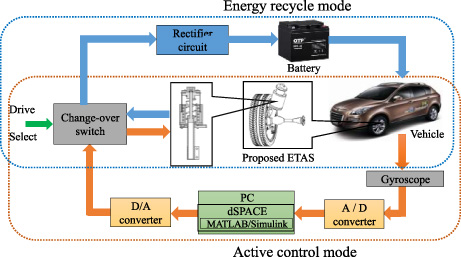
The proposed workflow of two modes.
The working principle is as follows. When the driver chooses ER mode in the relatively smooth road surface, the coil cuts the magnetic flux along with the vertical direction, meanwhile, the current is generated in the coil. By applying rectifier circuit, the output current is stabilized within a certain range. The required energy is recycled and stored in the rechargeable battery. When the driver switches AC mode, acceleration of the vehicle is detected by gyroscope. The collected acceleration signal is passed to the note PC through the A/D converter, then the control signal passes through the D/A converter and the actuator in turn, and sends the control current to the VCM, the VCM generates force to hinder or promote the motion of the shock absorber, ensuring the comfortability of vehicle driving and avoid the vehicle roll, braking nod head to a certain extent.
Therefore, switch between two modes not only collect the energy generated by the vibration of the ETAS, but also mitigates the vibration of vehicle suspension and resolves the disadvantages of the MacPherson independent suspension, such as weak braking nod head, poor stability.
Magnet field distribution in the air gap of the stator is important for general characteristics of the VCM. The theoretical model is built, and the FEM analysis is conducted by magnet field analysis.
The theoretical model of magnet field intensity B [16] is shown as follow.
Figure 4(a) shows the coil’s motion path, magnet field intensity of this path is calculated and analyzed. Figure 4(b) shows theoretical and FEM results, the displacement of the coil’s motion path is 140 mm, the initial position is from 0 mm. The results show that the magnet field intensity values of the theoretical model and FEM analysis own same trends, which own six peaks of different values for the centers of the six magnet rings, respectively, their average values are 632.8 mT and 631.8 mT, respectively. There is a difference between the two results, the theoretical trend is depression in the center, and the other one is higher, which is the reason of non-considered the existence of magnetic circuit and heat dissipated ring.

Magnet field intensity of the theoretical model and FEM analysis.
Based on the conventional suspension model, we will build the dynamic models of the ETAS and analyze the influences of different modes. The dynamic models of 1/4 ETAS is shown in Fig. 5.

Dynamic models of 1/4 ETAS.
Kinetic equations of 1/4 ETAS in the energy recycle mode and active control mode are respectively shown as below.
Interference force generated by the coil F
uc on the ER mode and total resistance of the coil R can be obtained as
Output force F on AC mode is written as follows.
Road input q with a filtered white noise for standard road conditions is given by
State space equation of 1/4 ETAS can be written as follows:
Coefficients of state space equation are obtained as

1/4 vehicle dynamic simulation.
The coil length in the air gap of the stator L
g and electromotive force E
ER are explained as follow
The power on the ER mode P
ER can be obtained as
The power on the AC mode P
AC can be expressed as
The power on the ER and AC modes is shown in Fig. 7. Figure 7(a) shows the power on the ER mode for 5 s, Fig. 7(b) shows the power on the AC mode for 5 s. The results indicate that an average power on the ER mode is 1.81 W, and the maximal power is 65.36 W for a representative period of 5 s. Similarly, an average power on the AC mode is 9.29 W, and the maximal power is 83.68 W for 5 s. The efficiency of the ETAS is 19.5% under the standard C-level road surface.

Power on AC and ER modes.
A new ETAS using magnetic force is proposed to realize active control and energy harvesting based on the conventional suspension. In this paper, structure and working principle of the ETAS is introduced, and its AC and ER modes are expatiated in detail. Theoretical model and FEM analysis of magnet field distribution in air gap of the VCM are conducted to verify the accuracy of the theoretical model. Then, dynamic models of the ETAS are built and simulated, simulation results show that three evaluation indicators of vehicle driving have been decreased for the AC mode; the ACC is high and other two are reduced for the ER mode. Finally, by means of simulation analysis, average powers of the energy consumption and recycle are 9.29 W and 1.81 W, the efficiency of the ETAS system is 19.5%.
On this basis, next step of this article is that starting from the two working modes are respectively validated by experiments to optimize the energy circulation of whole vehicle.
Footnotes
Acknowledgements
This research is supported by Liaoning Province innovative talents in Colleges and Universities support program (No. LR2017036), Doctoral Scientific Research Foundation of Liaoning Province (No. 20170520177), Liaoning province Talents Project (No. 2015-47), and Shenyang science and technology project (Z17-5-067).