



Abstract
This paper proposes a novel hybrid-excited wound-rotor synchronous machine (HE-WRSM) with asymmetrically positioned permanent magnets (PMs) to make full use of reaction torque and reluctance torque, thus to improve the machine performance, including torque, efficiency, and power factor. To highlight the advantage of the proposed HE-WRSM, the conventional WRSM and HE-WRSM are adopted for performance comparison under the same operating conditions. All machine characteristics are predicted by the finite element method (FEM) using the commercial software, JMAG-Designer. The analysis results finally demonstrate that the proposed HE-WRSM exhibits highly improved torque, power factor, and efficiency, when compared to the conventional machines. Furthermore, the proposed HE-WRSM is verified to have superior endurance against the magnet irreversible demagnetization within two times of the rated current excitation.
Introduction
In recent years, permanent magnet (PM) synchronous machines have attracted great attentions due to their high torque density and high efficiency [1–3]. However, due to the high price and limited supply of rare earth materials, the development of high-performance electrical machines with less or zero rare earth magnets becomes imperative [4–6].
As a magnet-free electrical machine, the wound-rotor synchronous machine (WRSM) is regarded as a considerable machine alternative with low cost and variable speed operation, which is suitable for a broad range applications, such as hydro, wind generators and steel mills [7–10]. However, the performance of the WRSM is difficult to be competitive to a PM machine, although extensive techniques have been presented to improve its performance [11–13]. Accordingly, the hybrid-excited wound-rotor synchronous machines (HE-WRSMs), employing both PMs and electrical excitations, are attracting increasing attentions owing to their enhanced torque density, efficiency, and good flux weakening abilities [14,15]. Nevertheless, the conventional designs for HE-WRSMs are always based on the fact the magnets and field windings are positioned to obtain a symmetrical rotor configuration such that the reaction torque and reluctance torque follow the rule that their maximum values meet at different current phase angles displaced theoretically by 45°. Hence, only a portion of each torque component is utilized to contribute to the total torque. Inspired by the design concept in [16], in which the maximum values of the torque components can occur near or at the same current phase angle by creating rotor asymmetry in a V-type interior PM machine, the utilization of the torque components in the HE-WRSM can also be improved by proper design strategies.
In this paper, a novel hybrid WRSM with asymmetrically positioned PMs is proposed to make full use of the reaction torque and reluctance torque, thus to improve the torque, efficiency, and power factor. To highlight the advantage of the proposed HE-WRSM, the conventional WRSM and HE-WRSM are adopted for performance comparison under the same operating conditions. All machines are designed with the loading distribution method and then their characteristics are predicted by the finite element method (FEM) using the JMAG-Designer.
Machine topologies and design procedure
Conventional machine models and torque characteristics
To highlight the contribution of the novel HE-WRSM, two conventional machine models, which are designed for low-power fan applications, are adopted for performance comparison as shown in Fig. 1. The conventional WRSM, designated as the basic model, is shown in Fig. 1(a). The conventional HE-WRSM with centrally positioned PMs, nominated as the conventional model, is shown in Fig. 1(b). The machines share the same stator with three-phase concentrated windings, and each phase winding consists of two stator coils connected in series. The rotor of the basic model is only equipped with DC field windings, while the rotor of the conventional model is equipped with both DC field windings and low-cost bonded NdFeB magnets. The laminated steel sheet is utilized for the stator and rotor cores, and the main machine specifications are listed in Table 1.
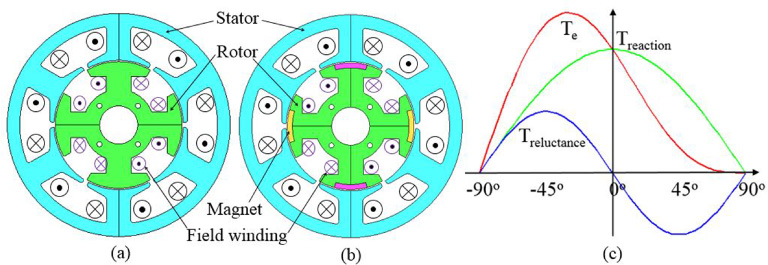
Topologies of the conventional machine models. (a) Basic model; (b) Conventional model; (c) Torque characteristics.
The main machine specifications
Essentially the conventional machine models are designed such that the rotor shape maintains circumferential symmetry such that two axes of symmetry for each rotor pole can be defined, namely the d-axis and the q-axis. These axes of symmetry are located such that the q-axis is 90° (elec.) from the d-axis. By convention, the rotor symmetry allows one to develop the d–q rotor fame equivalent circuit using the Park Transformation. The voltages in the d–q axes can be express as:
The proposed HE-WRSM with asymmetrically positioned PMs is shown in Fig. 2(a), which keeps the same machine size and magnet amounts as the conventional model. The enlarged rotor of the proposed model is shown in Fig. 2(b), and Fig. 2(c) shows the target torque characteristics where the maximum values of two torque components meet at the same current phase angle.

Topology of the proposed machine model. (a) Proposed model; (b) Rotor; (c) Torque characteristics.
The loading distribution method is utilized to determine the main dimensions of the investigated models [17]. The machine can be designed using the electric loading and magnetic loading under a given condition such as power, efficiency, and power factor. The capacity per pole can be expressed as
The electric loading will be calculated by
As to the PM position of the proposed model, the criteria can be described as:
Magnetic flux density distribution and back EMF
The machine characteristics at the no-load conditions are first predicted using the 2-D FEM. The magnetic flux density distribution of all the machine models are compared in Fig. 3. Different from the basic and conventional models which exhibit symmetrical flux density distribution, the proposed model features asymmetrical flux density distribution, thus to create the rotor circumferential asymmetry for a new superposition mechanism of torque components.
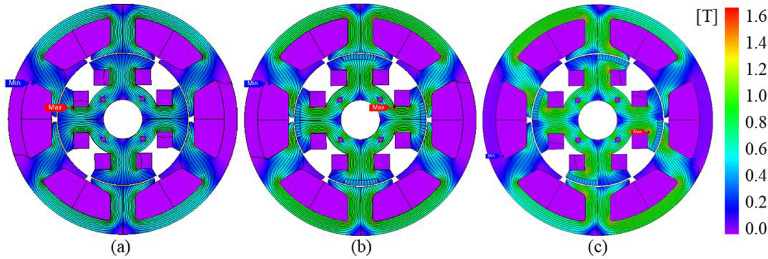
Magnetic flux density distribution. (a) Basic model; (b) Conventional model; (c) Proposed model.
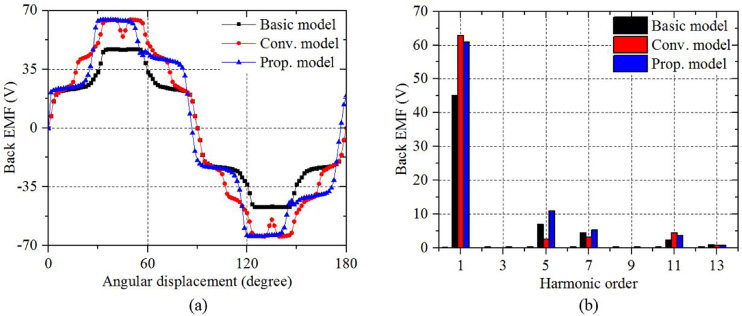
Comparison of back EMFs. (a) Back EMFs in phase; (b) FFT of back EMFs.
The back electromotive forces (EMFs) of all the machine models are compared in Fig. 4(a). Due to the asymmetric magnetic flux density distribution, the back EMF of the proposed model shows considerable distortion. However, it exhibits highly enhanced fundamental values and RMS values compared to that of the basic model, and similar values which are competitive to that of the conventional model. Figure 4(b) shows the corresponding fast Fourier transform (FFT) analysis, and the total harmonics distortion (THD) for the three models are 19.3%, 9.8%, and 20.9%, respectively.
To reveal the contribution of the proposed model, the frozen permeability method (FPM) is utilized to provide visible insights into the separation of the reaction torque and the reluctance torque. The torque segregation process using the FPM with the aid of the FEM is shown in Fig. 5. First, based on the analysis results for back EMF, the rotor position and current phase angle are initialized. Second, the total electromagnetic torque is obtained with all excitations. Then the PMs and DC field currents are removed and the reluctance torque is determined. The reaction torque is finally obtained by subtracting the reluctance torque from the total torque.

Flowchart of the torque segregation using FPM.
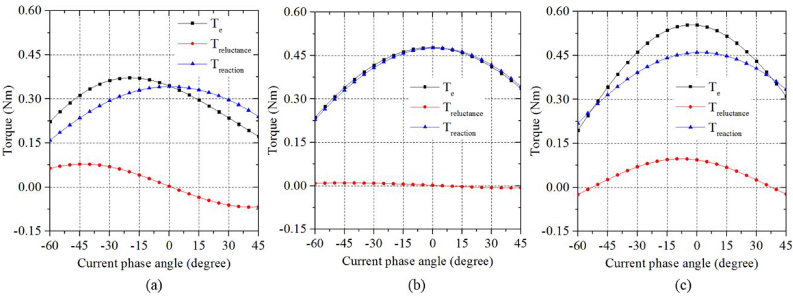
Comparison of torque characteristics. (a) Basic model; (b) Conventional model; (c) Proposed model. Te: the total torque; Trelucatnce: the reluctance torque; Treaction: the reaction torque.
Figure 6 compares the torque characteristics. It shows that the two torque components of the basic model reach their maximum values at different current phase angles by 45°, as shown in Fig. 6(a). The reluctance torque of the conventional model is negligible due to the high degradation of saliency ratio resulting from the rotor pole structure, thus the total torque is almost obtained from the reaction torque as shown in Fig. 6(b). In contrast, the two torque components of the proposed model reach the maximum values near the same current phase angle, which greatly improves the total torque as shown in Fig. 6(c). The comparison of electromagnetic torques at the maximum torque condition is shown in Fig. 7(a), and the corresponding FFT analysis is shown in Fig. 7(b). The results show that the proposed model contains higher torque ripple than the basic model, but less torque ripple than the conventional model. However, the proposed model highly improved the utilization of the reluctance torque. Therefore, the total torque of the proposed model is significantly improved by 49.2% and 16.1%, compared to those of the basic model and conventional model, respectively, as displayed in Table 2.
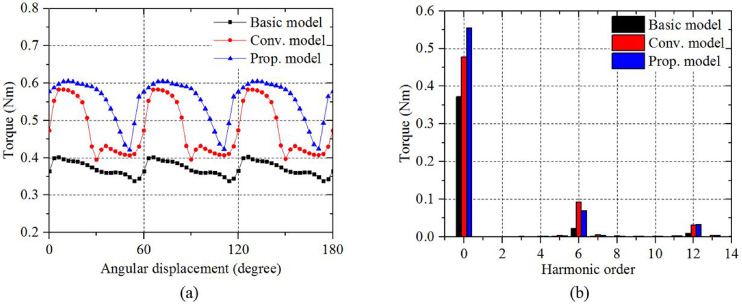
Comparison of torques. (a) Electromagnetic torque; (b) FFT of electromagnetic torque.
The outer power of the proposed model is increased with the increase of the torque. Consequently, the efficiency and power factor of the proposed model are increased by 6.4% and 1.5%, respectively, when compared to those of the conventional model, while increased by 48.2% and 5.8%, respectively, when compared to those of the basic model. The numerical analysis results are summarized in Table 2.
Comparison of the analysis results using the 2-D FEM
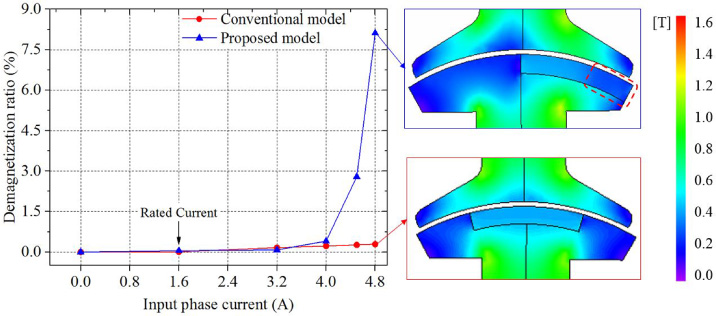
Demagnetization ratios of the conventional and proposed models.
The efficiencies are herein estimated by the ratio of the output power to the sum of the output power and losses. The losses generally include copper loss, iron loss, magnet loss, stray loss, and mechanical loss. Since the machine models utilize the bonded NdFeB magnets which have very low electric conductivity resulting in very low eddy current loss, the magnet losses are neglected. The calculation only focuses on the main losses including the calculated copper loss and the simulated iron loss [18].
The coercive force of bonded NdFeB magnets is much lower than that of sintered NdFeB magnets, which is more easily affected by the armature reaction, leading to irreversible magnet demagnetization. To assure the reliability of the designs, the analysis of magnet irreversible demagnetization for the conventional and proposed models is performed within three times of the rated input current (I
a
). A demagnetization ratio is defined as
The analysis results of demagnetization ratios are depicted in Fig. 8. It indicates that both of the conventional and proposed models have superior endurance against the magnet demagnetization within 2 times of the rated current (2I a ). From 2.5I a , the magnet irreversible demagnetization occurs to both machine models. With 3I a , the demagnetization ratio is 0.3% for the conventional model with a negligible demagnetization in magnet edges. In contrast, the demagnetization ratio of the proposed model is 8.1%, which indicates that a relatively heavy demagnetization will occur to the magnet parts that are mounted on the thin cores of rotor teeth, as illustrated in the red dashed area of Fig. 8, due to the asymmetric design strategy. Therefore, the proposed model is recommended to be operated within 2 times of the rated current which accords with the fan requirements. In the applications with heavy overloads, the magnet parts on the thin rotor teeth need to be reduced with enlarged magnet thickness.
This paper has proposed a novel HE-WRSM with asymmetrically positioned PMs to make full use of reaction torque and reluctance torque, thus for high electromagnetic performance. Based on the simulation results by the FEM, it shows that the proposed models exhibits the highly improved torque, power factor, and efficiency, when compared to the basic and conventional models. Furthermore, the proposed HE-WRSM was demonstrated to have superior endurance against the magnet irreversible demagnetization within two times of the rated current excitation.
Footnotes
Acknowledgements
This work was supported in part by the National Natural Science Foundation of China, under Grant 51707107 and 51577107, in part by the fundamental research funds of Shandong University, China, under Grant 2016TB013, and in part by the project funded by the China Postdoctoral Science Foundation, under Grant 2017M612269 and 2018T110688.