



Abstract
To suppress resonance and broaden the bandwidth for vibration absorption, a nonlinear dynamic vibration absorber (NDVA) with negative stiffness is developed in this paper. The magnetic negative stiffness spring (MNSS), the generation mechanism of negative stiffness, is composed of three magnet rings arranged in attraction, and employed to connect with mechanical spring in parallel. The magnetic force and its corresponding stiffness of the MNSS are investigated firstly. Attaching the NDVA to main mass, the dynamic equations of the coupled system is established, and the averaging method is also applied to the dynamic responses. With the aim of excellent vibration absorption performance of the NDVA, an iterative algorithm is proposed to perform the parameter optimization with the purpose of avoiding time consumption. Finally, the results show that the optimization algorithm can significantly improve the efficiency of parameter selection for the NDVA, resulting in the remarkable vibration attenuation for primary system and a larger bandwidth for vibration absorption.
Keywords
Introduction
Linear dynamic vibration absorbers (DVAs) such as traditional tuned mass dampers (TMDs) have been the common auxiliary devices to mitigate undesirable vibration in mechanical systems. However, linear absorbers can work effectively over a narrow frequency range around the resonance, which makes it difficult to absorb low frequency vibration of primary systems and hard to widen the bandwidth for vibration absorption. To overcome these dilemmas, the NDVA based on negative stiffness mechanism is an alternative solution in the field of vibration absorption.
Up to now, the negative stiffness mechanism is widely employed in the field of low frequency vibration isolation due to its high-static-low-dynamic stiffness property [1,2]. There are many ways to obtain the negative stiffness characteristics, such as oblique springs [5] and Euler buckled beam/plate [6]. However, the study of negative stiffness in the design of low-frequency DVAs is still seldom reported. Acar [3] analytically and experimentally studied an adaptive-passive DVA with negative stiffness mechanism, and found that the amplitude of system could be effectively attenuated. Shen [4] then investigated the optimal parameter selection of a DVA with negative stiffness. These studies demonstrate that the negative stiffness is benefit for vibration absorption, whereas the stiffness nonlinearity caused by negative stiffness might bring unwanted effects, such as degrading the vibration absorption of the absorber and introducing the complex dynamic behaviors. Hence, it must be careful to select structural parameters through suitable algorithms to avoid these dilemmas. Li [7] proposed a design method of a nonlinear TMD based on the jump frequency, and the vibration reduction performance is slightly improved compared to linear design method. Jordanov [8] applied a numerical algorithm to the optimal design of linear and nonlinear DVAs in terms of the objective functions. Fallahpasand [9] then optimized a nonlinear pendulum-type TMD using the H ∞ and H2 methods. As for these methods investigated above, either the vibration absorption is not enough excellent, or the parameter selection algorithm is extremely time-consuming, which means that it is necessary to develop an efficient algorithm to overcome those shortcomings.
The aim of this paper is to present a novel NDVA with MNSS and develop an algorithm to obtain optimal parameters for achieving excellent vibration absorption without the huge loss of time consumption. The section arrangement in this article can be given as follows. The configuration and its characteristic of the proposed NDVA are presented in Section 2. In Section 3, the dynamic equations are established, and the steady-state response is also obtained in virtue of averaging method. The next section presents the proposed algorithm about its principle and procedure of parameter selection. Finally, some conclusions are given in Section 5.
Modelling the NDVA
Schematic of the NDVA
As illustrated in Fig. 1, the proposed NDVA comprises a MNSS, two mechanical springs, two magnet retainers and other subsidiary parts, such as a chamber, guide pillars et al.. The MNSS consists of three magnet rings arranged in attraction, where the outer two magnet rings are fixed with magnet retainers at appropriate height to the central one mounted into the chamber. This central magnet ring vibrates along the path guided by pillars, when subjected to external excitation which is transmitted from primary system through rigid rod. The separation from the two outer magnet rings to the central one can be tuned through screwing the magnet retainers back and forth so as to obtain different characteristics of MNSS. Hence, the MNSS can be harnessed to liberally reduce dynamic stiffness by canceling positive stiffness offered by the two mechanical springs, which provides static enough supporting force balancing the weight of central magnet ring with only a small static deformation. At a result, the natural frequency of the NDVA shifts in large frequency range, which makes it easy for the NDVA to select proper structural parameters to dramatically reduce vibration of primary system. To investigate its performance of low-frequency vibration suppression, the first is to make the characteristic of the MNSS clear, which will be conducted in the following subsection.
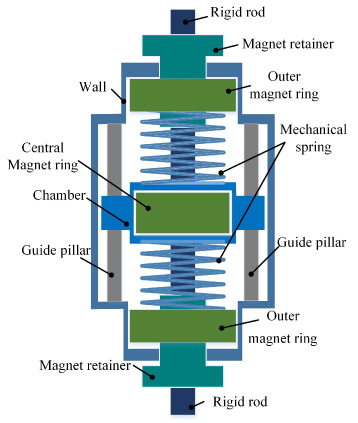
Schematic of the NDVA.
Figure 2 displays the layout of the MNSS. The magnetic force applied to the central magnet ring is derived theoretically based on the current model and the corresponding stiffness can be obtained as well, which can be expressed as [10].
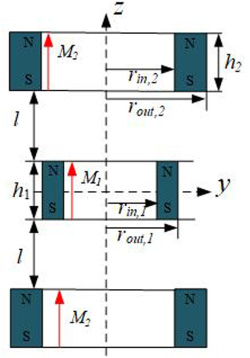
Layout of the MNSS.
Parameters of magnet rings

Stiffness of the MNSS with respect to displacement z.
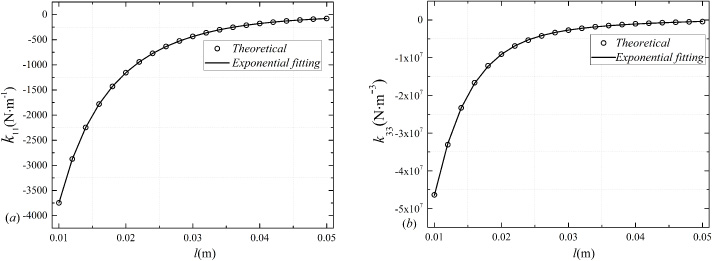
Stiffness coefficients k 11 and k 33 with respect to separation l: (a) k 11; (b) k 33.
Dynamic equations
As shown in Fig. 5, attaching the NDVA to the primary system which is supported by k
s
, c
s
and excitated with Fcos(ωt), the dynamic equations of the coupled system can be expressed as follows
With the application of averaging method, the steady-state response of Eq. (7) is assumed as Equivalent mechanical model.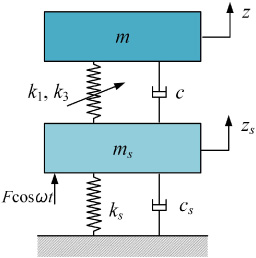
As discussed in Section 1, there are many drawbacks of optimization algorithms in existing studies for nonlinear absorber, such as the poor performance of vibration absorption and high time consumption. Therefore, it is desirable to develop a new approach with low time-consumption to obtain optimal structural parameters for vibration absorption enhancement. It is known that most of complex nonlinear dynamics including bifurcations, instabilities and jumps exist in the district of multiple responses near resonance, but optimal frequency-amplitude is a curve of single solution. Hence, the relationship between the number of solutions and structural parameters should be derived to seek for the critical condition distinguishing single solution and multiple solutions, which can be utilized to determine the optimal parameters. So the following will perform the derivation of critical condition in Section 4.1, and the parameter optimization in Section 4.2.
Derivation of critical condition
Rewriting Eq. (13) as
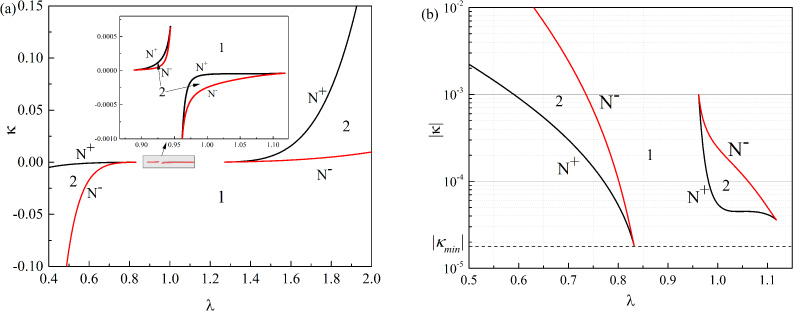
Partition of the plane of 𝜆 and 𝜅 into two domains (a) 𝜆 > 0; (b) 𝜆 > 0 and 𝜅 < 0 (parameters used here are: m s = 1 kg, m = 0. 1 kg, c s = 1 N ⋅ s∕m, c = 1 N ⋅ s∕m, k s = 1 × 10⁴ N∕m, k P = 4800 N∕m, l = 10 mm, k 11 = −3750. 7 N∕m, k 33 = −4. 58 × 107 N∕m3, F = 3 N).
From Eq. (19), it can be seen that multiple solutions should be avoid as long as the separation l between the central magnet ring and two outer magnet rings exceeds the certain range, while Eq. (19) cannot be utilized to determine optimal separation l owing to the inequality.
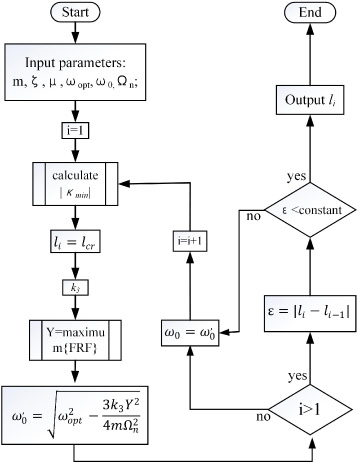
Optimization procedure.
Therefore, an iterative algorithm is developed to obtain the optimal value of separation l by means of the convergence of parameter to constant. The key of the proposed algorithm is that optimal parameters of minimizing mechanical vibration is equivalent regardless of whether the absorber is linear or not, which means that optimal parameters in the design of linear absorber can be considered as target to obtain the optimal parameters of nonlinear absorber with iteration procedure. Considering the optimal ζ
opt
and ω
opt
of linear absorber given by [11 ]
As demonstrated in Fig. 8, the separation l with respect to iterations in the optimization procedure indicates that the convergence of the proposed algorithm is so rapid that the optimization procedure can be completed with the loss of little time consumption. Meanwhile, the corresponding frequency-amplitude curves are also presented in Fig. 9, which manifests that the resonance of primary system is significantly reduced and the bandwidth of vibration absorption is simultaneously enlarged.
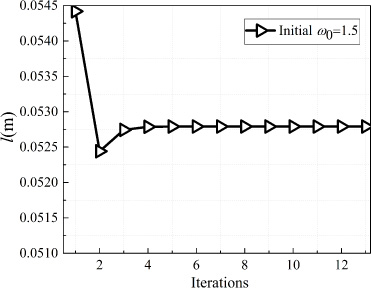
Separation l with respect to iterations.
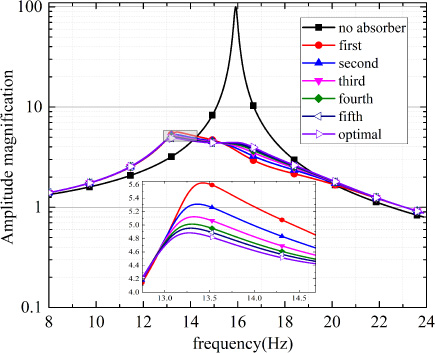
Frequency-amplitude curves in the process of iteration.
A nonlinear absorber with MNSS is proposed in the paper. The geometry of the NDVA is depicted, and the characteristic of MNSS is also investigated in detail. Employing the NDVA to primary system, the dynamic governing equations are established, and averaging method is employed to obtain steady-state responses. With the purpose of excellent vibration absorption, an efficient algorithm is developed to obtain optimal parameters without numbers of iteration. The results manifest that the proposed method is feasible in term of efficiently performing parameter optimization, and the dramatic vibration reduction of primary system is achieved in a lager frequency range.
Footnotes
Acknowledgements
The authors of the paper gratefully acknowledge the financial support from National Science Foundation of China (Grant No. 11172225).
Appendix
The expressions of 𝛼1, 𝛼2, 𝛼3, 𝛼4 are