



Abstract
In this paper, we aim at numerical validating a novel technique for 3D reconstruction of magnetic fields in tokamaks from a discrete set of magnetic measurements. The identification is based on the solution of a classical inverse problem, after modeling the direct problem by using a well-tailored expansion for the plasma and the other field sources. Suitable boundary conditions are defined on two virtual nested surfaces, one inside the plasma, the other surrounding the plasma and including the magnetic sensors. Some a-priori information on the problem, as the expected major periodicity of 3D effects and the known poloidal field sources, are also taken into account for the field evaluation. An influence matrix is calculated, to get the measurement values due to each basis function and then a classical pseudo-inverse procedure identifies the coefficients in the expansion. The reconstructed magnetic field is then available to trace the plasma boundary with conventional methods. In this way, accurate 3D plasma shape identifications are available, at affordable computational cost. A significant set of magnetic configurations is adopted as test-bed for validating the technique, allowing in particular to separately evaluate the efficiency in catching the intrinsically 2D effects and the fully 3-D ones.
Introduction
The problem of the identification of the plasma boundary in tokamaks is fundamental for the plasma shape control, which in turn is a basic crucial point to achieve the nuclear fusion. Different approaches have been proposed in the literature [1, 2, 3, 4], but still room is available for developing robust and numerically reliable techniques, when 3D perturbations are considered. In this paper we numerically validate a technique based on a specific formulation for the direct problem, which is very well-suited for the typical tokamak geometries. The reconstruction algorithm is applied, for its validation, to some significant plasma configurations.
Field representation and identification
The problem of the plasma boundary 3-D identification from a discrete set of magnetic measurements, taken in the region outside the plasma but well inside the Tokamak structure, can be seen as the reconstruction, with prescribed accuracy, of the magnetic field map in a proper hollow region fully containing the plasma boundary itself. The magnetic field within such region should be represented with a high accuracy, but with a relatively small number of free parameters, in order to reasonably match the realistic number of measurements available for a real tokamak. This obviously requires an optimal combination of a smart formulation of the problem, a well-suited expansion for the field, as well as the correct inclusion of all available a-priori information. According to such goals, we define two suitable surfaces, a Virtual Internal Wall (VIW) well inside the plasma region and along the plasma centroid, and a Virtual External Wall (VEW) well outside the plasma region but well inside the external active structures in the tokamak. A schematic draw of such surfaces is given in Fig. 1. For the reconstruction of the field map within the defined interest region it is helpful to consider the field as the combination of three different contributions:
A poloidal section of the plane of the plasma chamber, with first wall (FW) and the axi-symmetric virtual internal (VIW) and external (VEW) walls.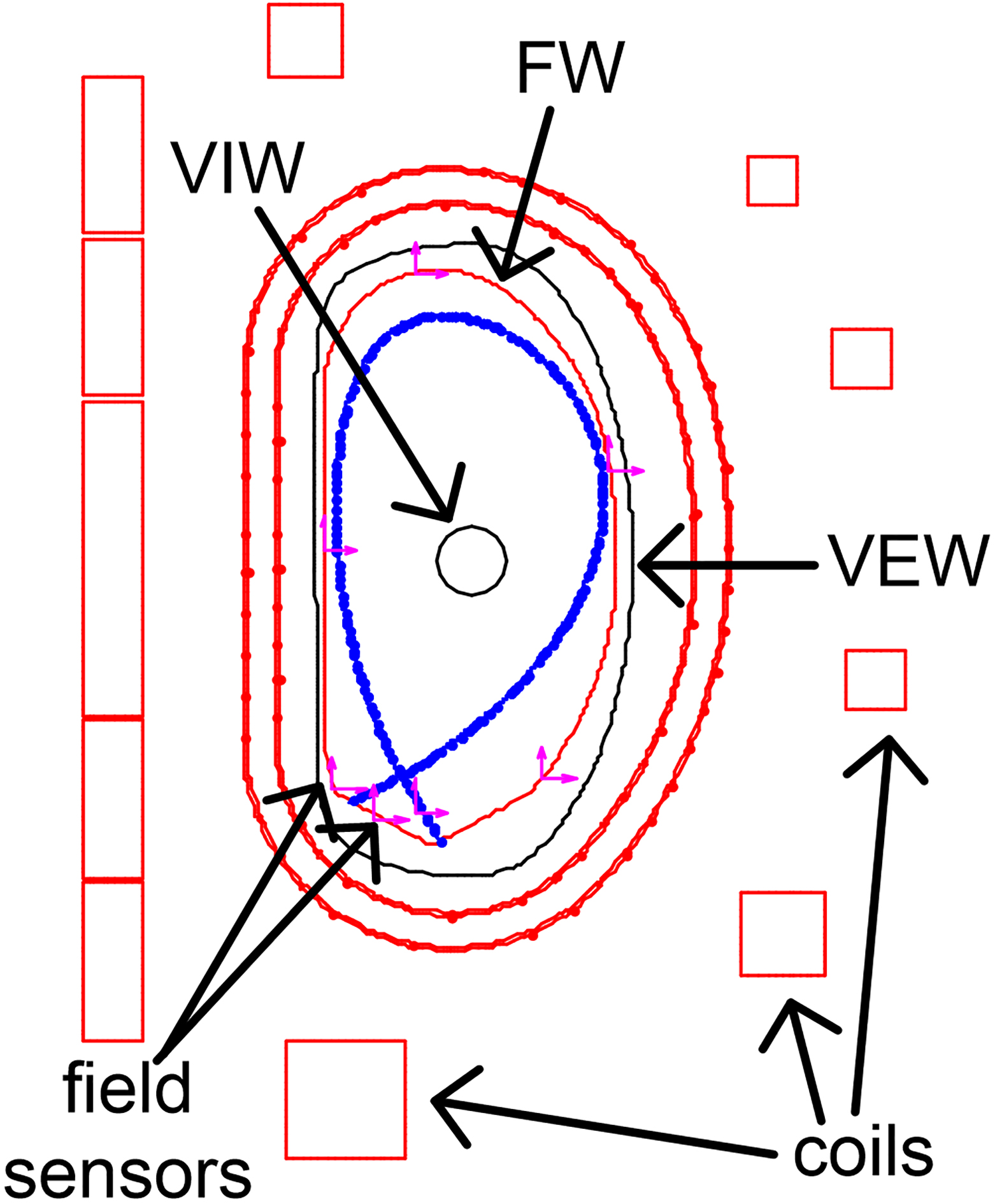
where
where
It can be noted how the assumption of Eq.fon the structure of the field perturbation is reflected intrinsically in an axisymmetric poloidal component, given by the term
According with the field structure as assumed in Eq. (2), the unknown functions
Examples of shape functions 
where
The choice of the basis functions
The recurrent numerical solution of the problem Eq. (3a),(3b) for each term of boundary conditions as in Eq. (4) allows to define an “influence matrix” whose terms
where
In this section we aim to validate the formulation by considering a significant set of different magnetic configurations referred to the typical parameters of the Divertor Test Tokamak (DTT) facility [5] summarized in Table 1.
Main parameters of the reference plasma in the DTT facility
Main parameters of the reference plasma in the DTT facility
With reference to such parameters, we define a set of test cases well suited to validate the formulation also in the presence of 3D field perturbations in a tokamak. Such cases are: i) axisymmetric single null equilibrium; ii) magnetic field of a circular kinked wire (not coaxial with the torus); iii) a set of sources with periodic (sinusoidal) distribution along circular wires coaxial with the torus; iv) 3D ripple field generated by 18 toroidal field coils.
Location of the triaxial magnetic field sensors: a) 294 (882 measurements) for cases i–iii; b) 104 (312 measurements) for case iv.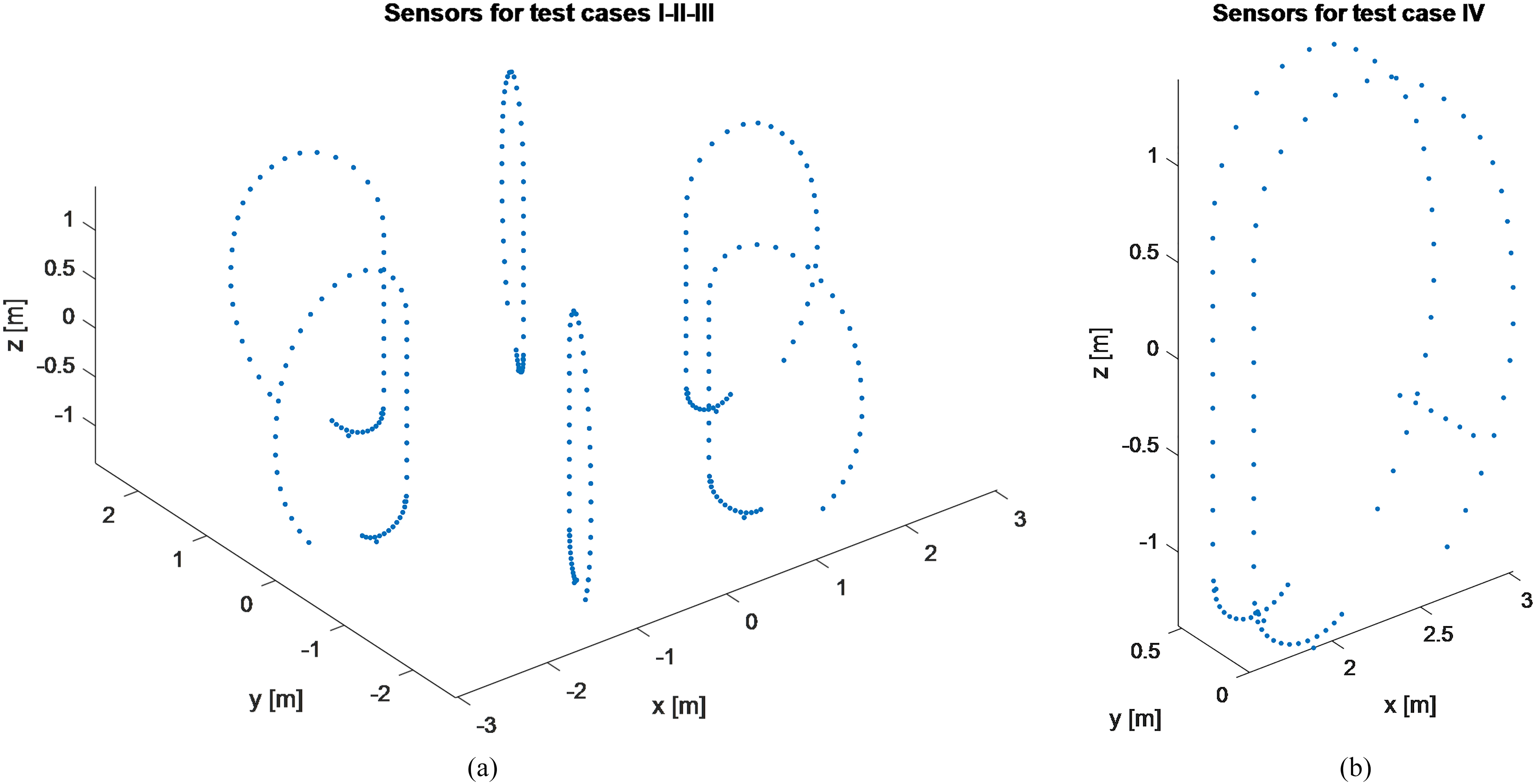
For cases i–iii we assume that 882 local measurements are available from a set of triaxial magnetic field sensors placed at 49 poloidal locations inside the vessel at six evenly spaced toroidal angles (Fig. 3a). For case iv there are 312 measurements, available from two sets of triaxial magnetic field sensors placed at 49 poloidal locations at two toroidal angles (0 and 10 deg) complemented by 6 additional triaxial sensors located at a single poloidal location evenly spaced between
Magnetic field map in the poloidal section for a single null axisymmetric configuration: (a) actual map; (b) comparison between actual and reconstructed plasma boundary.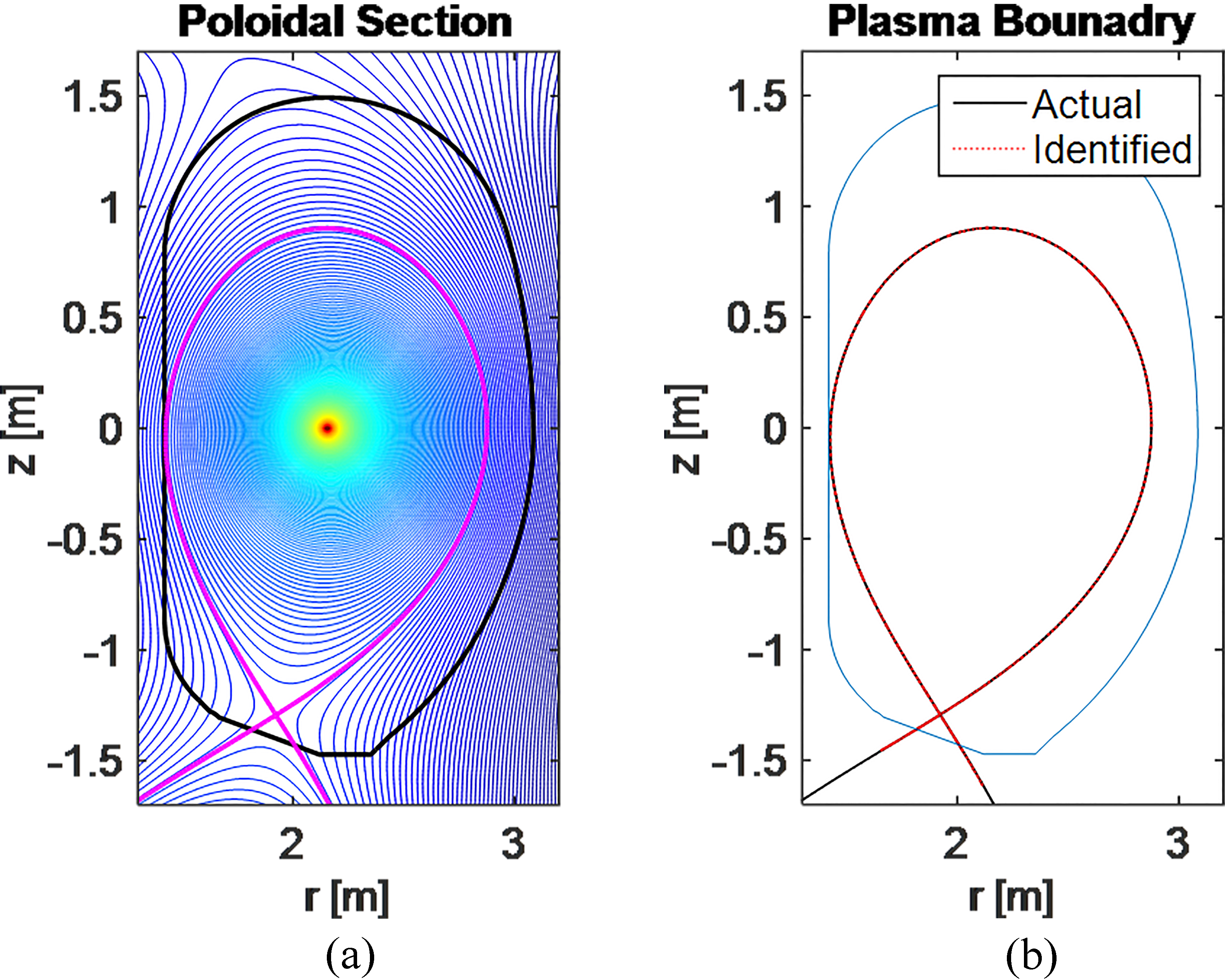
As a general consistency proof, we consider the case of a 2D axisymmetric single null magnetic configuration, referring to the DTT parameters [5]. The nominal magnetic field map in the poloidal section is reported in Fig. 4a. The expansions Eq. (4) are limited to
Single null axisymmetric configuration: (a) comparison of the actual and reconstructed field values at the sensors position; (b) absolute reconstruction error The comparison on the toroidal component of the magnetic field has been omitted because its actual magnitude is zero and the absolute reconstruction error is orders of magnitude lower than that obtained on the vertical and radial components.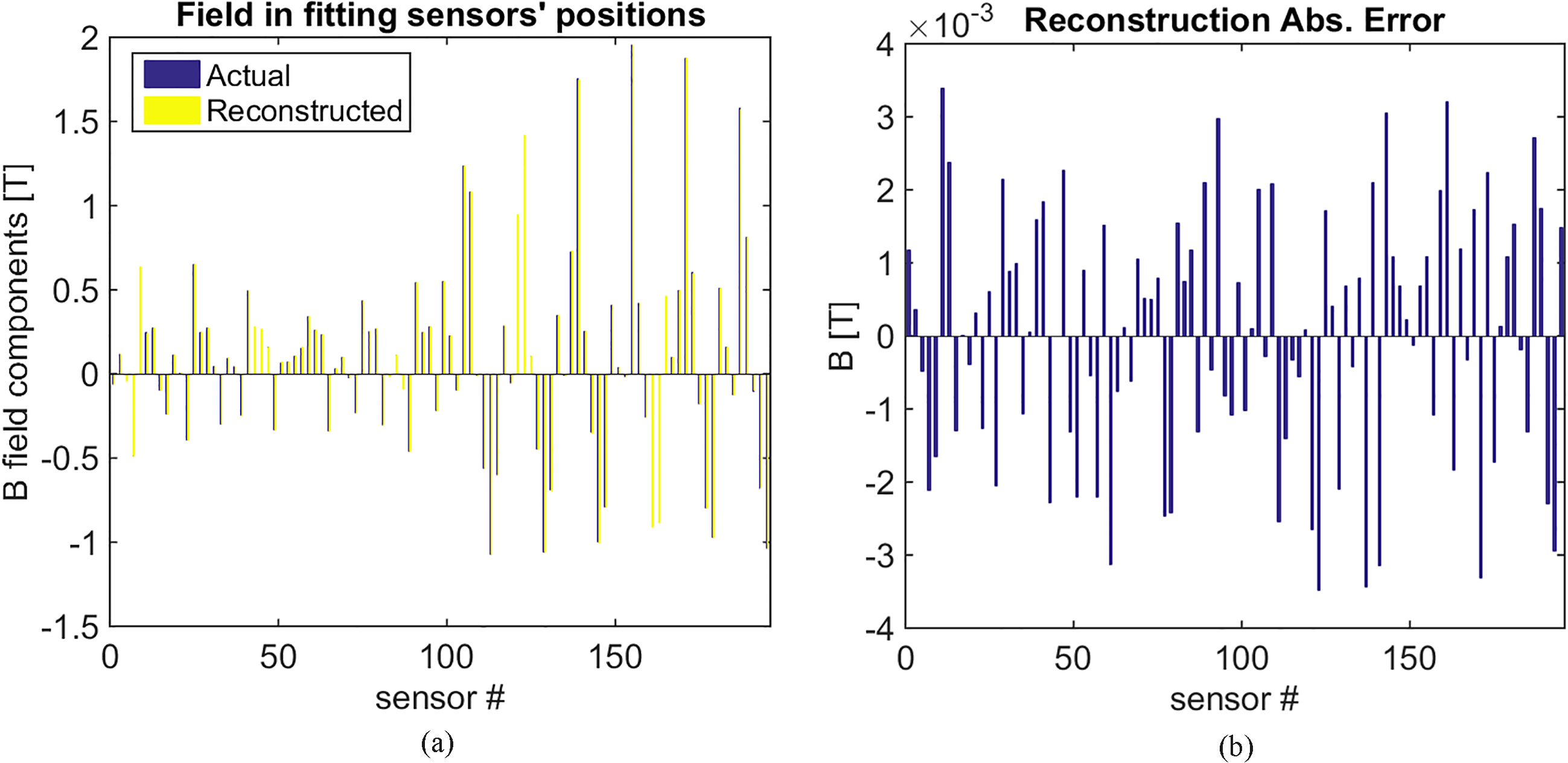
In this case, which is fully 3D in the original coordinate system, we consider a kinked circular filamentary current of 1 MA (obtained by a circular wire located at
Kinked filamentary current of test case ii (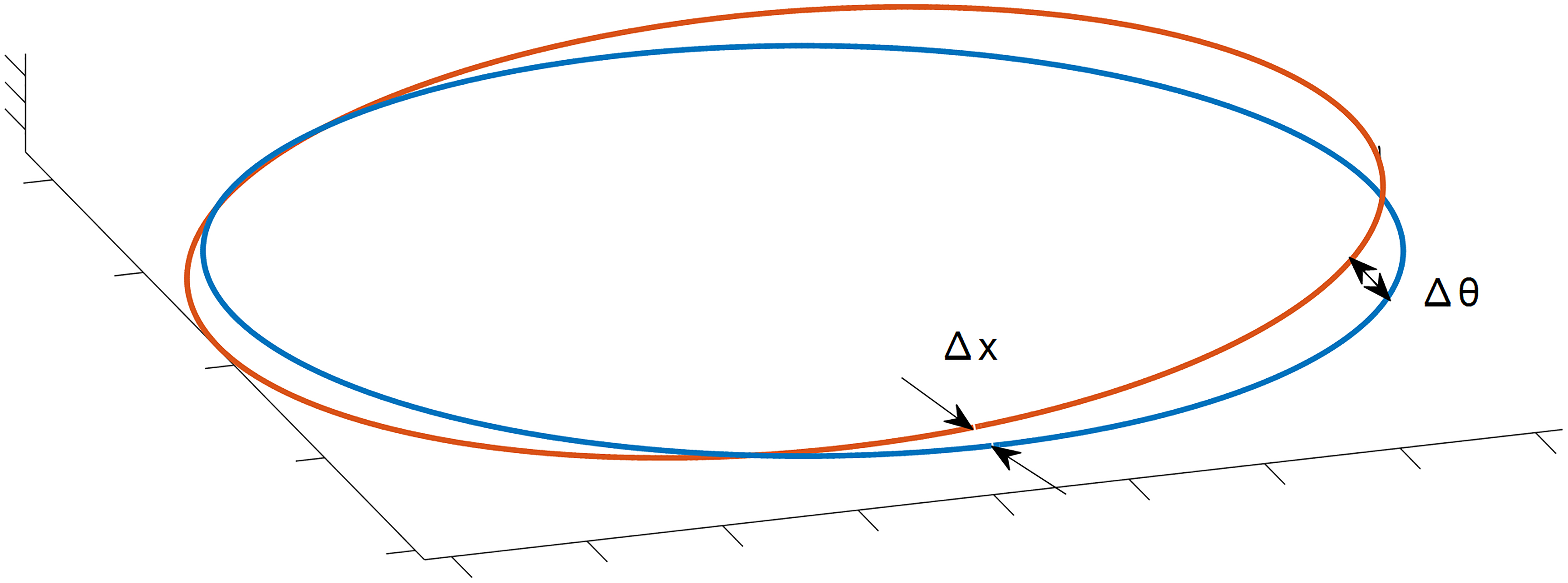
The expansions Eq. (4) are limited to
Kinked current wire: reconstructed maps of 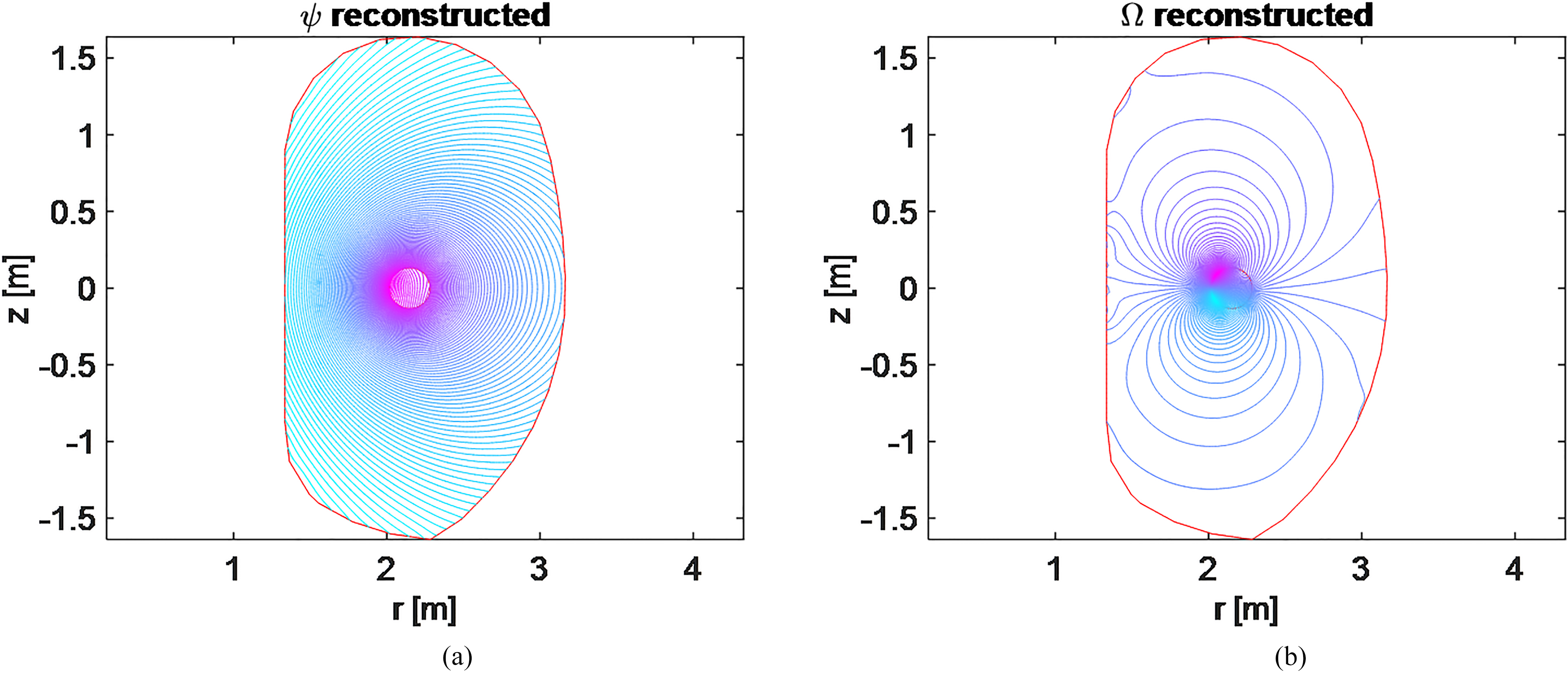
Kinked current wire: expansion coefficients for 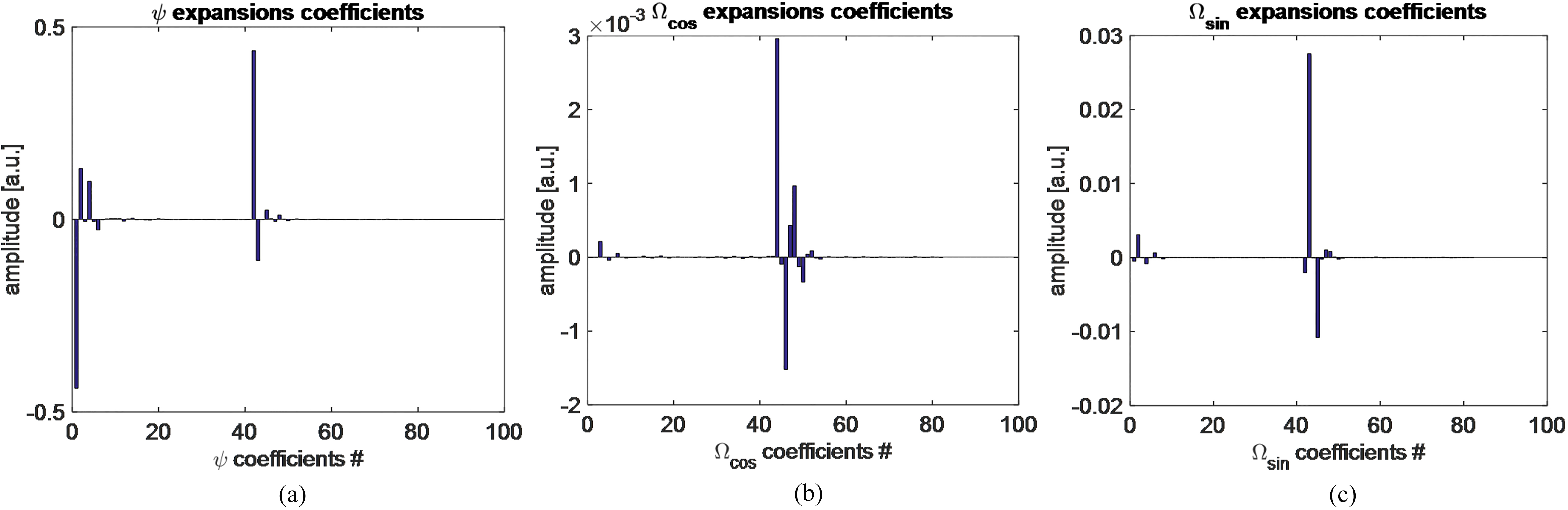
A significant test case is conceived by considering a cosinusoidal fictitious magnetic charge distribution on a ring, whose periodicity is an
Cosinusoidal fictitious magnetic charge distribution on a ring: reconstructed maps of 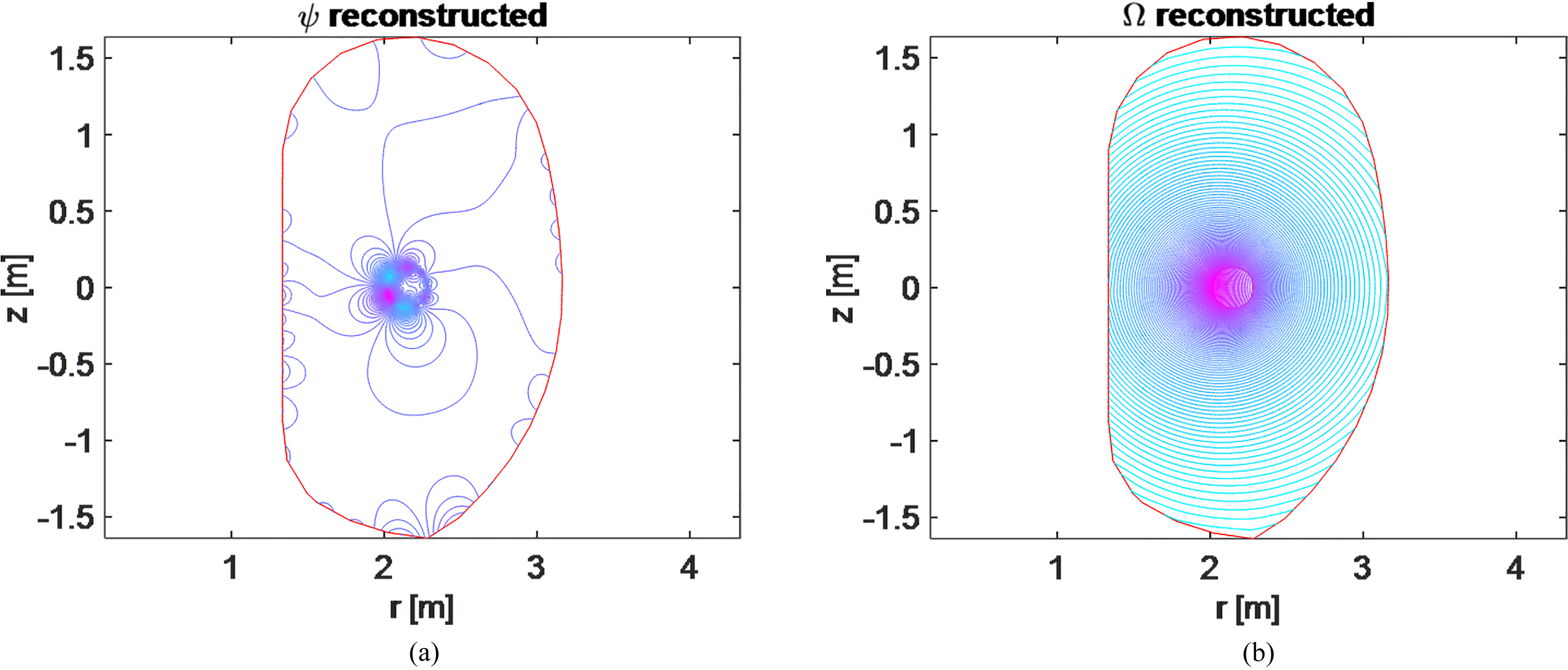
As expected, this kind of source generates only an
Finally, we consider the 3D ripple generated by the periodic structure of the toroidal field coils in a tokamak. In this case, there is only the virtual external wall VEW. With reference to the DTT parameters summarized in Table 1 [5], the expansions Eq. (4) are limited to
Conclusions
We have successfully assessed a new technique aimed to the 3D tokamak plasmas identification, which is based on the proper formulation of a classical SVD inversion after a well-suited definition of the direct problem. This technique extends to the 3D case the formulations usually adopted for the 2D axisymmetric equilibria [8, 9, 10, 11, 12]. In particular, the peculiar decomposition of the 3-D problem into the axisymmetric and non axisymmetric parts is tested with specifically designed test cases. Our analysis shows how such procedure is able to deal with a significant class of 3D perturbations, thanks to its flexibility. With a number of field sensors which is realistic for existing tokamaks the technique shows clearly its ability to reconstruct the actual field within an accuracy of 1%.
Footnotes
Acknowledgments
The authors wish to thank Profs. G. Miano and L. Verolino for providing a set of Green functions including the analytical solution for the test case described in Section 3.3.