The comparison of the enhanced integration-type E&S model and the improved dynamic E&S model of electrical steel sheet under DC-biased magnetizing condition
Available accessResearch articleFirst published online January, 2021
The comparison of the enhanced integration-type E&S model and the improved dynamic E&S model of electrical steel sheet under DC-biased magnetizing condition
This paper enhanced the integration-type E&S model and the dynamic E&S model for integrating the impact of DC-biased field and eddy current on vector magnetic properties of electrical steel sheet. B and H of electrical steel sheet are measured under DC-biased and rotating fields. Based on the measured results, the databases of reluctivity and hysteresis coefficients of both the enhanced integration-type E&S model and the improved dynamic E&S model are established for predicting H waveform under any given operating condition. By comparing the H waveform calculated by the enhanced integration-type E&S model and the improved dynamic E&S model with the experimental H waveform, it is found that both two models have good reliability and the improved dynamic E&S model has slightly better accuracy than the enhanced integration-type E&S model.
It is well known that rotating magnetic field exists in the stator core of motor and the T-joint of transformer core. Therefore, two-dimensional hysteresis model, integration-type Enokizono and Soda model (integration-type E&S model), has been proposed to describe the vector magnetic properties of electrical steel sheet under rotating magnetic field [1]. Component of magnetic field strength caused by eddy current has been studied individually and the dynamic E&S model has been developed based on the original integration-type E&S model for analyzing the impact of eddy current on vector magnetic properties.
However, the wide spread application of power electronics converters causes DC-biased magnetization in the iron core of transformers and electrical motors [2]. The iron loss, temperature and vibration of transformers and electrical motors are increased under the simultaneous AC and DC-biased excitations [3]. When electrical steel sheet is under DC-biased field, the waveform of B starts to distort and the effect of eddy current becomes evident [4]. However, two-dimensional magnetic hysteresis model for describing the nonlinear relationship between B and H under DC-biased magnetizing condition is few reported and the influence of DC-biased field on the component of H caused by eddy current is few discussed.
Therefore, in this paper, integration-type E&S model and the dynamic E&S model are enhanced for integrating the effect of DC-biased field on vector magnetic properties. The impact of eddy current on H is analyzed individually. For comparing the accuracy of the enhanced integration-type E&S model and the improved dynamic E&S model, reluctivity and hysteresis coefficients of two models are derived and the databases of the coefficient are collected. H waveform under one arbitrarily DC-biased magnetizing condition is calculated by using two models and is compared to the measured H waveform obtained under the same tested magnetizing condition.
Magnetizing condition and measured data
Magnetizing condition
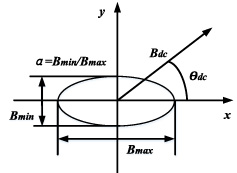
Figure 1 shows the vector magnetizing condition of electrical steel sheet, when rotating and DC-biased fields exist simultaneously. The rolling direction (RD) is defined as x axis, and the traverse direction (TD) is defined as y axis. Without DC excitation, the locus of rotating magnetic flux density is approximate to ellipse shape, which can be defined by three parameters: the maximum value of rotating magnetic flux density Bmax, the axis ratio 𝛼 which is the ratio of the minimum rotating flux density to the maximum one, the frequency f of rotating magnetic field. DC-biased field can be defined by two parameters: DC flux density amplitude Bdc and the inclination angle θdc which is the angle between DC magnetic flux density vector and x axis.
DC-biased magnetizing condition.
The measured results
The vector magnetic properties of electrical steel sheet under rotating and DC-biased fields are measured by two-dimensional single sheet tester (2D-SST) [5]. When measuring vector magnetic properties under DC-biased field, Bmax is fixed at 1.0 T, and 𝛼 is fixed at 0.5. f is set at 50 Hz. Bdc changes from 0.0 T to 1.0 T per 0.1 T step and θdc varies from 0 degree to 90 degrees per 15 degrees. The magnetic hysteresis loops of electrical steel sheet under different Bdc are show in Fig. 2, when θdc equals to 45 degrees.
Magnetic hysteresis loops of electrical steel sheet under rotating and DC-biased fields (a) Magnetic hysteresis loops of x axis (b) Magnetic hysteresis loops of y axis.
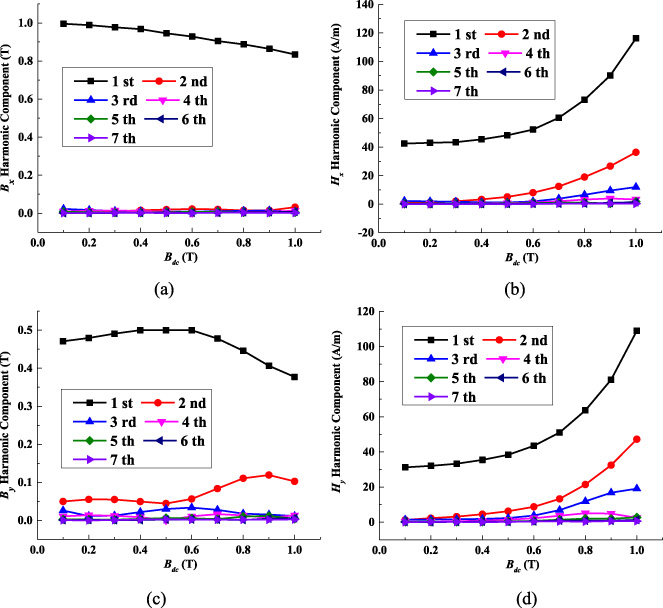
The harmonics of vector magnetic flux density and vector magnetic field strength under rotating and DC-biased fields are shown in Fig. 3. B and H consist of both odd and even harmonics. It is noticed that the fundamental component is the dominant one, while the amplitude of other harmonics decreases as the harmonic order increases. It is evident that the amplitude of 7th order harmonics is small, therefore, so harmonics higher than 7th order can be neglected.
Harmonics of B and H under different Bdc (a) Bx (b) Hx (c) By (d) Hy.
Comparison of the enhanced integration-type E&S model and the improved dynamic E&S model
The enhanced integration-type E&S model
For describing vector magnetic properties of electrical steel sheet under rotating field, the integration-type E&S model has been proposed [6]: where time variable τ varies between 0 to 2π rad, vrk represents the rotating reluctivity coefficient, vhk indicates rotating hysteresis coefficient, and the subscript k stands for x or y.
Under rotating magnetic field, the locus of B is controlled as elliptical shape and the original integration-type E&S model only takes fundamental component of B and odd harmonics components of H into consideration. After some algebraic manipulation, vrk and vhk can been expressed as following: where RB and IB correspond to the real and imaginary parts of B fundamental waveform, RnH and InH correspond to the real and imaginary parts of H waveform, and n equals to 1, 3 or 5.
When the E&S model is applied to describing vector magnetic properties of electrical steel sheet under rotating and DC-biased fields, the original integration-type E&S model should be enhanced and DC coefficient is added: where v0k is DC reluctivity coefficient, Back is AC component of magnetic flux density, Bdck is DC component of magnetic flux density. vrk and vhk are functions of (Bmax, 𝛼, f, Bdc, θdc). v0k is the function of (Bmax, 𝛼, Bdc, θdc) and is not related to time variable τ.
Under DC-biased and rotating magnetizing condition, B and H waveforms distort and consist of both odd and even harmonics. Therefore, both even and odd harmonics of B and H should be considered in the enhanced model and the coefficients vrk, vhk and v0k can be expressed as follows: where RBn and IBn correspond to the real and imaginary parts of B waveform, and Hdck is DC component of magnetic field strength. In the enhanced model, both even and odd harmonics up to 7th order are considered, therefore, N equals to 7 and n varies from 1 to 7.
The improved dynamic E&S model
For studying the impact of eddy current on vector magnetic properties under rotating magnetic field, magnetic field strength caused by eddy current is analyzed individually and the dynamic E&S model has been established by integrating the impact of eddy current. Figure 4 shows the eddy current based on one-dimensional magnetic domain structure. In this figure, d is the sheet thickness and deff is the effective thickness. The eddy current is assumed to be uniform, and the effective thickness is assumed to be as half as the sheet thickness d [7].
Excess eddy current based on one-dimensional magnetic domain structure.
The H waveform caused by the eddy current can be expressed as follows [8]: where σ is the conductivity and ω is the angular frequency. Therefore, the measured total H can be decomposed into: where represents the reduced H, which is H waveform component except for that caused by eddy current, Hexk can be rewritten as the function of time variable τ which equals to ωt. The expressions of vrk and vhk are similar to Eqs ((2)), ((3)).
However, the waveform of B distorts under DC-biased field. The harmonics of B waveform shown in Fig. 3 may introduce more evident eddy current which may affect the waveform of H [9]. In this paper, the dynamic E&S model is improved for considering the effect of DC-biased field and eddy current on B and H. The nonlinear relationship between B and H can be expressed as followings:
After Fourier expansion, vrk, vhk and v0k in the improved dynamic E&S model can be expressed as follows: where vrk and vhk become the functions of the reduced H, , instead of the functions of total H.
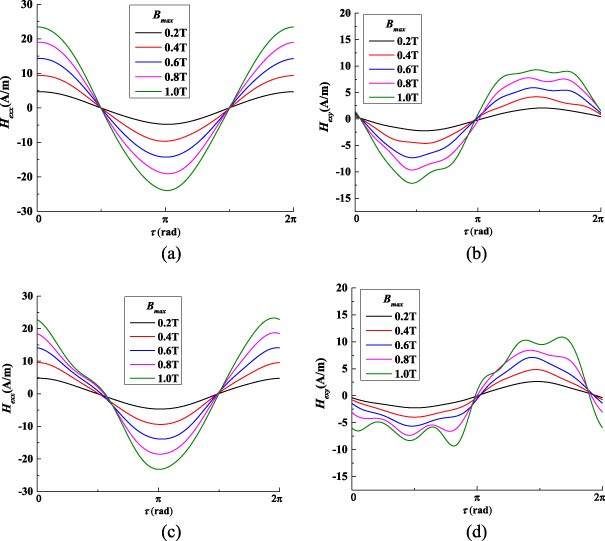
Hexk of x axis and y axis under different Bmax is shown in Fig. 5, when Bdc is set as 0.0 T or 1.0 T and θdc is set as 45 degrees. It is found that larger Bmax results in larger amplitude of Hexk. Besides, with the influence of Bdc, the distortion of Hexk waveform becomes more serious and asymmetry of Hexk waveform occurs.
Hexk of x axis and y axis under different Bmax (a) Hex of x axis when Bdc = 0.0 T (b) Hex of y axis when Bdc = 0.0 T (c) Hex of x axis when Bdc = 1.0 T (d) Hex of y axis when Bdc = 1.0 T.
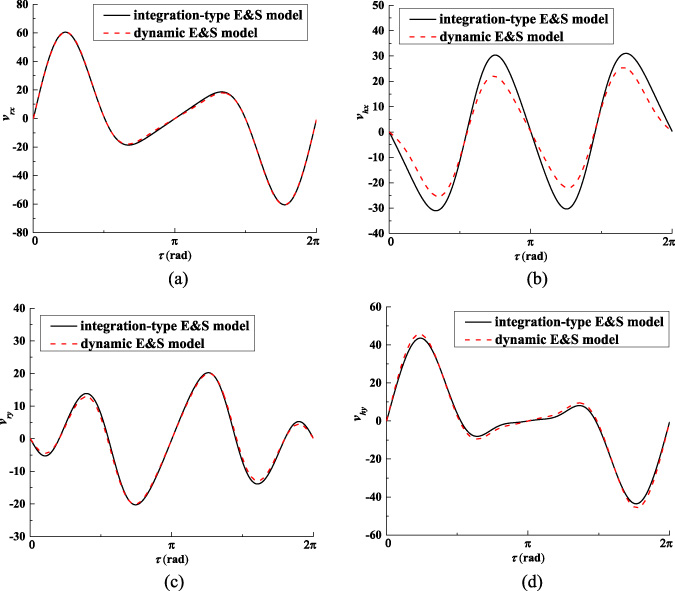
To compare the effect of eddy current on the reluctivity and hysteresis coefficients, vrk and vhk are calculated based on the enhanced integration-type E&S model and the improved dynamic E&S model and are compared in Fig. 6, when Bdc equals to 1.0 T and θdc equals to 45 degrees. It is shown that vrk and vhk change with the time variable τ. vrx of the enhanced integration-type E&S model and the improved dynamic E&S model is so similar that the difference can be ignored. Eddy current has the most obvious effect on vhx of these two models. Some insignificant differences exist between vry and vhy of the enhanced integration-type E&S model and those of the improved dynamic E&S model.
Reluctivity and hysteresis coefficients of the enhanced integration-type E&S model and the improved dynamic E&S model when Bdc equals to 1.0 T and θdc equals to 45 degrees (a) vrx (b) vhx (c) vry (d) vhy.
The verification of the enhanced integration-type E&S model and the improved dynamic E&S model
The procedure for verifying the reliability of the enhanced integration-type E&S model and the improved dynamic E&S model under DC-biased field is shown in Fig. 7. First, B waveform and the corresponding H waveform are measured by using 2D-SST. Next, the reluctivity and hysteresis coefficients are calculated based on the measured B and H waveforms by using Eqs ((5))∼((7)) for the enhanced integration-type E&S model or ((11))∼((13)) for the improved dynamic E&S model. Then, the databases about the reluctivity and hysteresis coefficients are constructed after cubic spline interpolation. The databases of vrk, vhk and v0k are functions of (Bmax, 𝛼, Bdc, θdc). Then, one arbitrarily DC-biased magnetizing condition, Bmax = 1.0 T, 𝛼 = 0.5, Bdc = 0.62 T, θdc = 22°, is selected for testing the reliability of two proposed models. The corresponding H waveform of this DC-biased magnetizing condition can be predicted by using Eq. ((4)) for the enhanced integration-type E&S model or Eq. ((10)) for the improved dynamic E&S model and the interpolation coefficients from the databases.
The procedure of the verification of the enhanced integration-type E&S model and the improved dynamic E&S model.
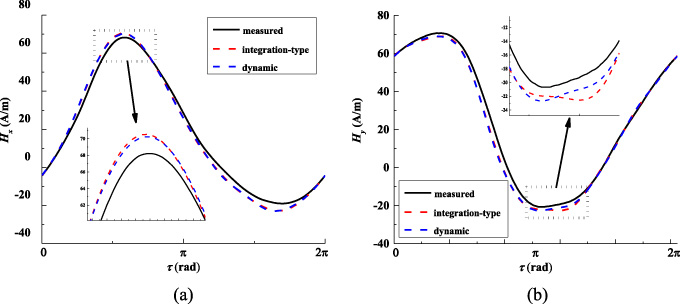
The calculated H waveform based on the enhanced integration-type E&S model and the improved dynamic E&S model is compared with the measured one, as shown in Fig. 8. It is found that H waveform becomes distorted due to the effect of DC-biased field. The calculated waveform gives good agreement with the measured one, which proves the reliability of these two models. There is some insignificant difference between H waveform of the enhanced integration-type E&S model and that of the improved dynamic E&S model. Compared to that of the enhanced integration-type E&S model, it is noticed that the calculated H waveform of the improved dynamic E&S model is more close to the measured one, which proves that the improved dynamic E&S model has slightly better accuracy for describing vector magnetic properties under DC-biased field.
The comparison of the calculated and the measured H waveform (a) Hx (b) Hy.
Conclusion
In this paper, the vector magnetic properties of electrical steel sheet have been measured by using 2D-SST. The integration-type E&S model and the dynamic E&S model are improved for describing the nonlinear relationship between B and H waveforms under DC-biased and rotating fields. The DC-biased field can lead distortion and asymmetry of H component which is caused by eddy current. By comparing the calculated H waveform of these two models with the experimental one, it is noticed that the reliability of the enhanced integration-type E&S model and the improved dynamic E&S model can be verified since the calculated H waveform agrees with the measured one. Besides, the better agreement between the calculated H waveform of the improved dynamic E&S model and the measured waveform shows that the improved dynamic E&S model is slightly more accurate than the enhanced integration-type E&S model.
Footnotes
Acknowledgements
This work was supported by the National Key R&D Program of China (No. 2016YFC0800100).
References
1.
KaiY.ZezeS.TodakaT. and EnokizonoM., Magnetic characteristic analysis and measurement of vector magnetic property of a non-oriented electrical steel sheet under high magnetic flux condition, IEEE Trans. Magn.49(5) (2013), 1981–1984.
2.
IshikawaS.YanaseS. and OkazakiY., AC magnetic properties of electrical steel sheet under two-dimensional DC-biased magnetization, IEEE Trans. Magn.48(4) (2012), 1413–1416.
3.
EnokizonoM. and TakahashiS., Two-dimensional DC-biased properties of magnetic materials, IEEE Inter. Magn. Con. (2002).
4.
SongM.YoonH.YangH. and KohC.S., A generalized chua-type vector hysteresis model for both the non-oriented and grain-oriented electrical steel sheets, IEEE Trans. Magn.47(5) (2011), 1146–1149.
5.
ShiM.ZhangX.QiuA. and LiJ., Rotating magnetic properties of electrical steel sheet under DC-biased field, Int. J. Appl. Electrom. (2019).
6.
ShimojiH.EnokizonoM.TodakaT. and HondaT., A new modeling of the vector magnetic property, IEEE Trans. Magn.38(2) (2002), 861–864.
7.
SongM.KimI.ShinP.S. and KohC.S., Finite element implementation of a generalized chua-type vector hysteresis model and application to iron loss analysis of three-phase transformer, IEEE Trans. Magn.41(5) (2011), 1544–1547.
8.
MatsuoT.TeradaY. and ShimasakiM., Representation of ac hysteretic characteristics of silicon steel sheet using simple excess eddy-current loss approximation, IEEE Trans. Magn.47(5) (2005), 1122–1125.
9.
SatoT.TodakaT. and EnokizonoM., Improvement of integration-type dynamic E&S modeling, IEEE Trans. Magn.47(5) (2011), 1126–1129.