



Abstract
Thrust performance is one of the important indexes of permanent magnet linear synchronous motors. The traditional non-oriented silicon steel sheet is used as the core material of the permanent magnet linear synchronous motor, which limits the performance of the permanent magnet linear synchronous motors. For the oriented silicon steel sheet has a higher magnetic permeability in the rolling direction, a permanent magnet linear synchronous motor with similar number of poles and slots made of oriented silicon steel is proposed in this paper. By measuring the B-H curves of the rolling direction and the cutting direction, the thrust properties of the two motors made of traditional silicon steel sheets and oriented silicon steel sheets are analyzed and compared by the finite element method (FEM) under rated load and overload conditions respectively. The thrusts under different tooth-yoke ratios are discussed in the end.
Introduction
The permanent magnet linear synchronous motors (PMLSMs) have been used widely in direct drive linear motion servo systems due to their high efficiency, high positioning accuracy, large thrust and long stroke [1,2]. Used as drive motor in servo systems, the thrust performance is the most important index, because PMLSMs are expected for the higher thrust to achieve acceleration in a very short time [3,4]. Many papers focus on the thrust analysis and optimization. The paper [5] increased thrust by changing the layer model and the motor design parameters in the model. The paper [6] analyzed the thrust of PMLSM from the aspects of yoke thickness, permanent magnet thickness and width, air gap length, etc. The paper [7] established the PMLSM finite element model with tooth-shifted double sides and obtained the influence law on thrust characteristic under different tooth-shifted distances. The paper [8] studied the thrust characteristics of PMLSM under different conditions, including different tooth-shifted distances, frequencies, air gap lengths, and pole numbers.
All the methods in the above papers are to improve the thrust performance by changing the motors parameters. Whatever how to change the structure, the thrust performances are still limited to the magnetic characteristics of the ferromagnetic material itself. Traditionally, the non-oriented silicon steel sheet is used widely in motor armature core, because isotropous magnetic characteristics can satisfy the requirements of motor magnetic circuit. However, for PMLSMs with similar number of poles and slots, the tooth magnetic circuit is main part in the whole mover magnetic circuit. Therefore, in this paper, in order to improve the thrust of PMLSM, the oriented silicon steel is applied to the PMLSM mover core. The higher permeability of the oriented silicon steel sheet in the rolling direction can restrain the magnetic circuit saturation when the larger armature current is excited. The two-dimensional finite element models both of traditional silicon steel PMLSM and oriented silicon steel PMLSM are established. The effects of different loads and tooth-yoke ratios on thrust are analyzed.
Characteristics measurement of the oriented silicon steel
The relationships between magnetic density B and magnetic field intensity H are different in the rolling direction and cutting direction for the oriented silicon steel, so the B-H curves both of the rolling direction and cutting direction are measured by the one-dimensional single-plate magnetization curve measurement instrument-Brockhaus, shown as Fig.1. The sample sheet size of the silicon steel sheet required for the measurement instrument is 100 mm × 580 mm and the 580 mm direction is the measurement direction. The PMLSM mover is designed with oriented silicon steel sheets B30P120, one type of Chinese silicon sheets. Cutting two sample sheets for measurement, one is with 580 mm in the rolling direction and the other is with 580 mm in the cutting direction. The measurement results are given in the Fig.2 and Table 1, where the magnetization curve of the traditional silicon steel sheet is derived from the ANSOFT material library.
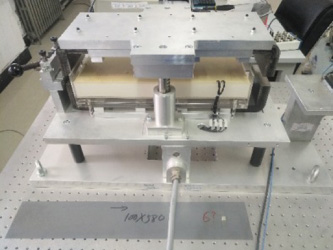
Measurement instrument.
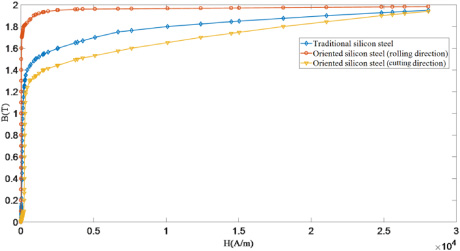
Magnetization curves.
Magnetic performance comparison
From the Table 1, the magnetic performance differences of the oriented silicon steel sheet between the rolling direction and the cutting direction are very obvious, especially at the begining of the curves. And the magnetic density B of the oriented silicon in the rolling direction is easier to increase, the B is up to 1.91 T when H is 995 H/A ⋅ m−1, but if traditional silicon steel needs to provide 1.9 T density, the H should be provided by 21045 H/A ⋅ m−1. From the whole measurement results, it can be seen that the knee point magnetic flux density of the traditional silicon steel sheet is about 1.5 T, and the knee point magnetic flux density of the oriented silicon steel sheet in rolling direction is up to almost 1.9 T.
The main magnetic circuit of PMLSM with the similar number of poles and slots are indicated in Fig. 3. The characteristics of the main magnetic circuit are that the tooth magnetic circuits are longer and the yoke magnetic circuits are shorter. In order to improve the thrust performance, the rolling direction of the oriented silicon steel sheet coincides with the tooth magnetic circuit direction, and the cutting direction coincides with the yoke magnetic circuit direction.

Magnetic circuit of PMLSM with similar number of poles and slots.
Taken 14 poles 12 slots PMLSM as example, the finite element models composed of traditional silicon steel PMLSM and oriented silicon steel PMLSM are constructed by finite element software ANSOFT respectively. The main parameters are shown in Table 2.
Main parameters of the motor
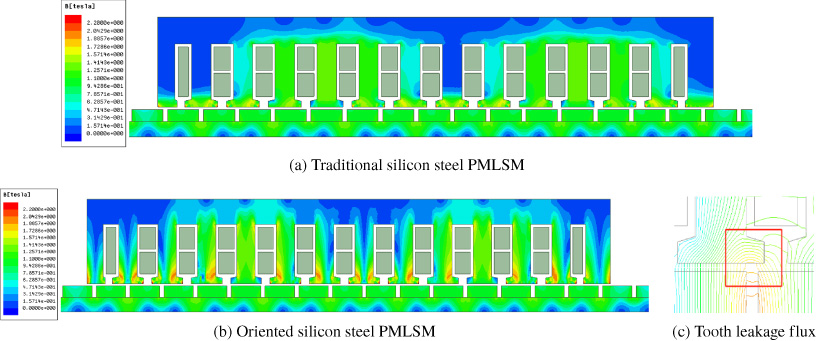
Magnetic field with no-load.
Figure 4 are some magnetic field results with no-load, where Fig. 4(a) is the magnetic field in the traditional silicon steel PMLSM, Fig. 4(b) is the magnetic field in the oriented silicon steel PMLSM, and Fig. 4(c) is the enlarged view of tooth leakage flux. Comparing Fig. 4(a) with Fig. 4(b), the tooth magnetic densities of oriented silicon steel are higher than that of traditional silicon steel. As shown in Fig. 4(c), because the magnetic path direction of the magnetic flux leakage at the tooth tops are accordance with the cutting directions of the oriented silicon steel sheets, the poor permeability increase the reluctances and weaken the magnetic flux leakage in the tooth tops of the motor.
In order to verify the thrust performance of the proposed PMLSM, the thrusts under rated load and 2 ∼ 3 times overload conditions are calculated by FEM software. Figure 5(a) is the comparation of the rated thrusts of the two models. Due to the high permeability of the oriented silicon steel sheet in the rolling direction, the permeability and magnetic density of the oriented silicon steel sheet are higher than the traditional silicon steel sheet under the same magnetic field intensity. The PMLSM of oriented silicon steel sheets can increase the thrust by 4.6% under the rated load with rated current 6.6 A.

The thrusts of different armature currents.
To compare the overload ability of the oriented silicon steel sheet, double rated current 13.2 A and triple rated current 19.8 A are also simulated in this part, and the thrust performances are given in Fig. 5(b) and Fig. 5(c) respectively. The simulation results are summarized in Table 3. The results show that the PMLSM with the oriented silicon steel sheet can reduce the saturation of magnetic circuit and increase the overload ability. When the current is up to 13.2 A, the thrust can be increased by 7.2%, and when the current is up to 19.8 A, the thrust can be increased by 7.6%, compared with the traditional silicon steel.
The thrusts of different armature currents
The application of oriented silicon steel sheets fully combines with the magnetic circuit characristics of PMLSMs with similar number of poles and slots, that is, the tooth magnetic circuits are main part. So if design condition permits, increasing the tooth-yoke ratio length can take advantage of high permeability in the rolling direction fully. In this part, setting the number of conductors per slot the same, make sure the magnetic field intensity the same, and only compare the influence of different tooth-yoke ratios. Because the mover core and slot number confirm the yoke length, changing the tooth length will change the tooth-yoke ratio. Figure 6 is the FEM results under different tooth-yoke ratios and Table 4 is the main design parameters and calculation results. The results show that with the increase of the tooth-yoke ratio, the thrust increases from 4.6% up to 8%, that is, the advantage of oriented silicon steel sheet is more abvious than the traditional silicon steel.
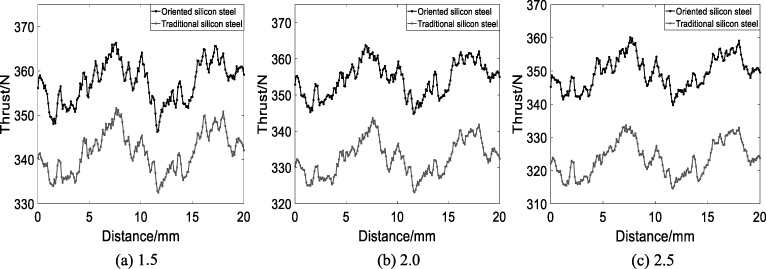
The thrusts of different tooth-yoke ratios and the same number of conductors.
The parameters and thrusts of different tooth-yoke ratios
In fact, when changing the tooth length, the slot areas are also changed, if set the number of conductors of every model the same, it is not reasonable for design of slot filling ratio. Therefore, in the next part, setting the slot filling ratio as a constant 75%, the slot parameters are same as Table 4, and then the PMLSMs thrusts results from different tooth-yoke ratio and the same slot filling ratio are concluded as Table 5 and show as Fig. 7. It can be seen that the PMLSM with oriented silicon sheet can provide higher thrust and the thrust is increased from 4.6% to 10%.
The thrusts with different tooth-yoke ratios and the same slot filling ratio
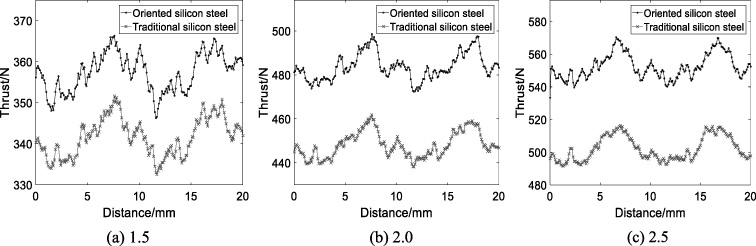
The thrusts with different tooth-yoke ratios and the same slot filling ratio.
In this paper, a PMLSM made by oriented silicon steel sheet with similar number of poles and slots is proposed. This kind of PMLSM combines the anisotropic magnetic characteristics of the oriented silicon steel sheet and the magnetic circuit characteristics of this PMLSM, in which the rolling direction of the oriented silicon steel sheet coincides with the tooth magnetic circuit direction, and the cutting direction coincides with the yoke magnetic circuit direction. The thrust analyses are completed by two finite element models of PMLSM with traditional silicon steel and oriented silicon steel respectively. The simulation results show that the oriented silicon steel for improving the thrust performance of PMLSM with similar number of poles and slots is of great significance, and compared with traditional PMLSM, the overload ability of the proposed motor is increased greatly, and if design space is permitted, higher tooth-yoke ratio constructure can take advantage of the oriented silicon sheet fully.
Footnotes
Acknowledgement
This work is supported by the National Natural Science Foundation of China under Grant “51607116”.