



Abstract
Consequent-pole permanent magnet synchronous machines (CP-PMSMs) have attracted considerable interest because they can save considerable permanent magnets and provide acceptable torque performance. The aim of this paper is to discover the full design space potential of the CP-PMSM by optimizing the topology of iron poles. ON/OFF method is used to manage the design region, finding the trade-off relationship between the average torque and torque ripple is the optimization targets. To this end, the topology of iron poles will be optimized by redistributing the iron and air material over the design region. A set of Delaunay mesh-based evolutionary operators is proposed and formulated to apply multi-objective evolutionary algorithms (MOEAs) to the formulated problem. The resulting topologies and convergence of two MOEAs are presented, and the optimization results are discussed.
Keywords
Introduction
Topology optimization (TO) technique can freely make deformation and create/eliminate holes to the shape, it can be used to explore the optimal shape of a device with little dependence on engineer’s experience and knowledge. The structural and mechanical community have been actively working TO methods since the late 60s. In the past few years, growing interest in TO techniques has been shown in the electromagnetic community for the design and optimization of electrical devices [1–6]. The TO methods used are essentially based on or further developed from existing ones. According to the topology representation method, various TO methods can be basically divided into ON/OFF Method [7–11], Density Method [12], Homogenization Method [13], and Level-Set Method [14–17]. The underlying modeling method used for the former three is generally the finite element (FE) method, while the latter one is principally used to model a time-varying high-dimensional implicit function.
Consequent-pole permanent magnet synchronous machines (CP-PMSMs) are novel machines that raised much attention along with the increasing price and unstable supply of rare-earth permanent magnet (PM). Many published literatures have pointed out that CP-PMSMs are promising especially in cost-sensitive applications because they can save approximately one-third of amount of PM while maintaining almost the same torque density as their surface-mounted PM counterparts. Although many studies for CP-PMSM’s performance enhancement design have been released [18–23], the design border of the iron poles is not meaningfully studied. The flux density under the iron pole it is mainly governed by the shape of iron poles. To put it in another way, the iron poles, which only take up a limited part in the CP-PMSMs, can be processed into various topologies to bring considerable performance dividends.
The aim of this study is to study multi-objective TO on the iron poles to unlock the full design space potential of a CP-PMSM. High average torque, as well as low torque ripple, are the optimization targets. Since the design region/variables is relatively small, and the TO is performed with some material distribution constraints, the ON/OFF method with evolutionary algorithm is used to solve this problem. In order to apply the multi-objective evolutionary algorithms (MOEAs) to the TO problem, a set of Delaunay mesh-based evolutionary operators is proposed and formulated to make modifications to the shape. Non-dominated Sorting Genetic Algorithm (NSGA)-II [24], and Strength Pareto Evolutionary Algorithm (SPEA)-II are utilized to solve the formulated problem [25]. Compared with the published multi-objective TO studies for electromagnetic devices [26–28], the multi-objective TO method in this paper is simple in both concept and practice. In addition, the Delaunay algorithm, which is the most standard method for 2D FE analysis, is used in this work to discretize the model. This makes the smoothing procedure can be easily introduced to eliminate jagged material boundaries. The Delaunay meshes also allow this TO method to be easily coupled with commercial FE analysis software.
This paper is summarized as follows. In Section 2., the specifications of the CP-PMSM to be optimized are briefly introduced. The design region is also presented and clearly identified. In Section 3., the TO methodology is elaborated, focusing on how the ON/OFF method and MOEAs work together. The numerical tools are also encompassed, explaining how they are coupled to process the solution and deliver the results. In Section 4., the optimization results solved by NSGA-II and SPEA-II are presented, the Pareto front searching ability of the two algorithms is compared and discussed. In Section 5., the performance of the optimized machines is simulated, and the reason for the improved torque is illustrated. Section 6. gives the conclusions.
Machine configuration and modeling
In a CP-PMSM, all the N poles or S poles are replaced by silicon iron poles. The iron poles can provide a magnetic path for the flux, which is passed easier than the magnetic path including PM poles. Many reported literatures about CP-PMSM’s optimization chose PMs as object for optimization. For CP-PMSMs, the iron poles, which modulate the flux in the airgap, can be easily processed into various topologies. In contrast with the released literatures, which focus on the optimization of PM, this paper will optimize the topology of iron poles in a CP-PMSM by ON/OFF method to maximize the average torque and minimize the torque ripple. Figure 1(a) shows the cross-section of the original CP-PMSM for optimization. It is a CP-PMSM that adopts 8-pole, including 4 PM poles and 4 silicon iron poles, and 24-slot. The parameters of this machine are based on a benchmark model from IEEJ [29]. Details of the machine can be found in Table 1. Considering the contribution to the output torque from the reluctance component can be neglected, the current advanced angle is set as 0°. Under this setting, the average torque and torque ripple simulated by FE method are 2.72 N⋅m and 2.17 N⋅m, respectively.
The machine is modelled by FE method. Delaunay algorithm is used for meshing. The four optimization regions, which will be managed by the ON/OFF method, are depicted in Fig. 1(b) as green color. Each region is discretized into 652 triangular elements. In the TO process, each element in these regions can freely take the magnetic characteristics of either iron or air, so as to recreate the topology of iron poles. The basis function-based material representation method is not used as this study aims to discover the best possible torque performance and design border of the CP-PMSM [30,31]. In order to reduce the time-consuming, the element material above the symmetry line will be mirrored below it, the optimized shape in one region will be copied to the other three regions. Therefore, the variables are reduced to 326.
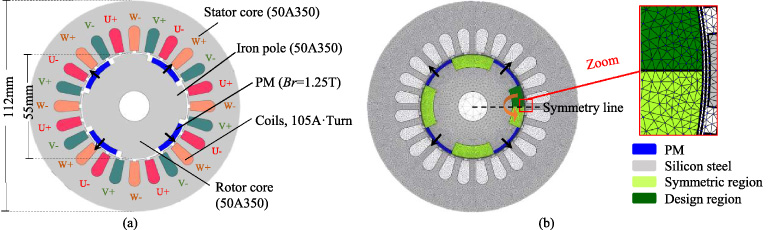
(a) Cross-sections of the CP-PMSM for optimization. (b) Finite element model for optimization.
Specification of the CP-PMSM for optimization
In this section, the numerical methodology used for optimization and simulation is elaborated. The evolutionary operators under Delaunay-based triangular meshes are proposed and formulated, the coupling flow of MOEAs and FE calculation is described.
ON/OFF method and the modeling of motor
The optimization region is discretized into numerous cells in the ON/OFF method. The material in each cell is the optimization variable, which can freely take up “ON (material)” or “OFF (no material)” to represent different topologies. By using stochastic algorithms to search a great variety of “ON”/“OFF” binary string combinations, the optimal material distribution can be found without violating constraints in the optimization region. In this paper, the Delaunay-based triangular FE elements in optimization regions are directly used as the cells in the ON/OFF method. The optimization regions cover the iron poles, “ON (iron)” and “OFF (air)” are used to represent the topology of the iron poles.
For this model, the field distribution in the design region is governed by:
The silicon iron material is modelled by JIS 50A350 (JIS: Japanese Industrial Standard). The B-H data can be found in Fig. 2.
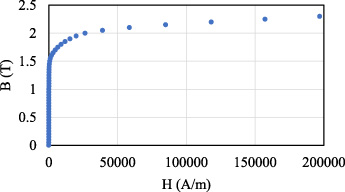
B-H data of silicon iron in FE calculation.
The ON/OFF method often generates checkerboard structures when it is combined with stochastic algorithms. Since the existence isolated material block and jagged boundary, the checkerboard structures are non-feasibility in terms of the real-world engineering realization.
Figure 3(a) depicts a checkerboard structure. For ease of illustration, it is a local area containing only a dozen meshes. In fact, it should be the design region in Fig. 1(b) containing 326 meshes.
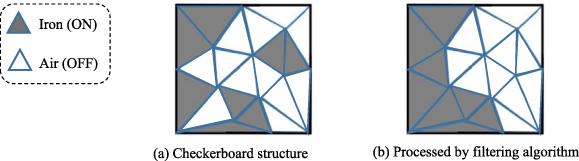
Checkerboard structure (a) checkerboard structure generated by stochastic algorithms, (b) checkerboard structure after filtering.
To deal with the checkerboard structures, a specially designed filtering algorithm for the triangular cells proposed by Watanabe [32] is adopted, which checks and fixes the checkerboard structure throughout the whole TO process. As shown in Fig. 4, the filtering algorithm includes a surface smoothing operator and a floating material removing operator.
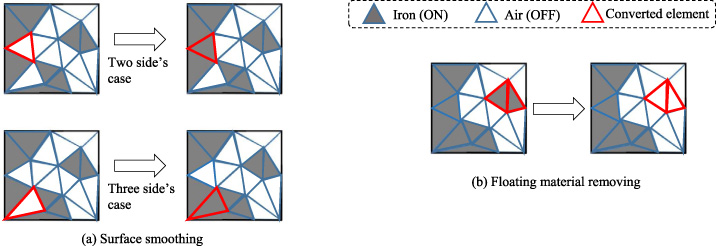
Process in filtering algorithm (a) Surface smoothing. (b) Floating material removing.
The surface smoothing operator performs the following steps to fix the jagged material boundaries: (1) Search and check the neighborhood of each element. (2) If two or three sides of an element face toward another state, the state of this element will be converted. (3) Back to Step 1 until no element can be converted.
The floating material removing operator works following the surface smoothing operator. For this model, the floating material removing operator is used to make sure the iron pole is a continuum by the following steps. (1) Check the material connection status of each element. (2) Calculate the area of each iron material block, list them up from large to small. (3) Keep the biggest iron material block, convert the others to air. (4) Back to Step 1 until only one iron block left.
The evolutionary algorithms are well-used stochastic algorithms to search the optimal topology represented by the ON/OFF method. Since the aim of this work is to find the trade-off relationship between average torque and torque ripple, two Pareto-based MOEAs, NSGA-II, and SPEA-II, are used in this work.
Evolutionary algorithms basically use crossover and mutation to generate offspring. In order to apply NSGA-II and SPEA-II to the ON/OFF method-based TO, a set of Delaunay mesh-based evolutionary operators is designed for the modification of shape. As shown in Fig. 5, the evolutionary operators including a crossover operator, a mutation operator, and a surface-mutation operator. The former plays a role in exploration, while the latter two play a role in exploitation.

Crossover, mutation, and surface-mutation operator for multi-objective evolutionary algorithms.
The crossover operator creates offspring by differential evolution. It compares each element’s state of two parental populations, then converts the elements that have different materials into air or iron randomly. This operator can make a lot of modifications to the shape while retaining the features of parental populations. The crossover operator can be formulated as:
The mutation operator randomly chooses some nodes, then converts their surrounding elements’ material into air or iron randomly. This operator can create holes inside the shape, which can be formulated as:
The surface-mutation operator randomly chooses some nodes that belongs to the boundary of iron material, then converts theirs surrounding elements’ material into air or iron randomly. This operator can make small modification on the shape boundary. The surface-mutation operator can be formulated as:
It should be noted that the mutation operator and surface-mutation operator are node-based modification in comparison with the crossover operator. This is because that node-based evolution is more efficient because it can avoid the conflict between evolutionary modification and the filtering algorithm.
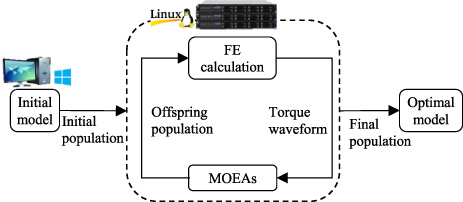
Working loop of topology optimization process.
An in-house FE calculation program, which can work in coupling with ON/OFF method and evolutionary algorithms, is used for TO. The working loop of the TO can be illustrated by Fig. 6. The MOEAs create the offspring (topologies) by the evolutionary operators and give corresponding material distribution to the FE calculation program, the FE program solve the non-linear magnetostatic field and feedback the torque performance of each offspring. Then the MOEAs perform Pareto solution sorting for this generation and create offspring by the evolutionary operators for the next generation. This looping continues until the given finish criterion is met.
Optimization results
Optimization problem formulation
As mentioned, the optimization aims to find out the trade-off relationship between average torque and torque ripple by recreating the topology of iron poles. Thus, two objective functions are defined as follows:
The torque is simulated where the condition that the rotor angle ranges from 0 to 45 degrees at 1-degree intervals. Nodal force method is used to calculate the force on the rotor.
NSGA-II and SPEA-II with the aid of the proposed evolutionary operators are adopted to manage the design region. The flowcharts of the two MOEAs are depicted in Fig. 7. Because NSGA-II and SPEA-II have different principles in Pareto solution sorting and archive length setting, for impartial comparison, the NSGA-II is performed twice with different population sizes (P). Then shape of initial populations are randomly generated. Evaluating 19200 topologies is set as stop criterion. Detailed settings of the algorithms can be found in Table 2.
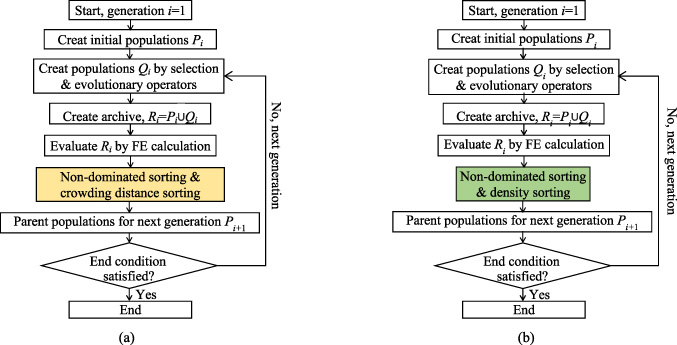
Flow diagram of NSGA-II and SPEA-II (a) NSGA-II. (b) SPEA-II.
Settings in NSGA-II and SPEA-II
Intel Xeon Gold6134 (8 Core 3.7 GHz), RAM usage: 300 MB, Intel C++ Compiler.
The resultant Pareto fronts obtained by the algorithms are plotted in Fig. 8(a), from which we can see that all the algorithms can find superior solutions compared with the original topology shown in Fig. 1(a). The NSGA-II (P = 24) finds the best Pareto fronts in comparison with the other two. The Pareto fronts searching results of NSGA-II (P = 24) and NSGA-II (P = 96) suggest that it may be more important to give each population more evolutionary opportunities than to adopt a large population size. This is consistent with a great deal of the previous work indicating that algorithms with stronger local search capability are more suitable for TO of electromagnetic devices [33–35]. On the other hand, since NSGA-II (P = 24) and SPEA-II (P = 24) have the same population size and initial populations, it can be suggested that NSGA-II has stronger Pareto fronts searching ability for the formulated problem, while SPEA-II is better in terms of the distribution uniformity. A possible explanation for this might be that NSGA-II prefers to keep the local convex solutions in the Pareto solution sorting process, these kept outstanding populations may be helpful for the searching of Pareto fronts with a little sacrifice in distribution uniformity.
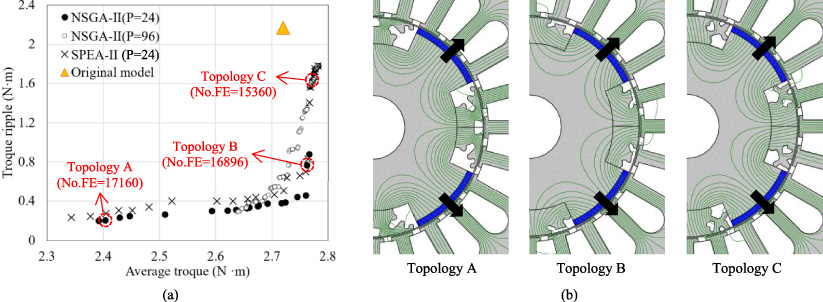
Resultant Pareto fronts and topologies (a) Resultant Pareto fronts obtained by three algorithms, (b) optimal topologies obtained by NSGA-II (P = 24).
Three representative optimal iron poles are selected from the Pareto fronts. As shown in Fig. 8(a), they are called Topology A, Topology B, and Topology C. The “No.FE” under their names means the number of finite element calculation trials required to generate the topology. The performance of the CP-PMSM with the selected optimal iron poles will be analyzed in the next section.
The role of modulator played by the iron pole
The winding function theory presented in [36] by Lipo et al. characterizes electric machines in terms of coupled magnetic circuits instead of accurate magnetic fields. Recently, a general airgap field modulation theory for electrical machines is proposed by Cheng et al. inspired by the derivation of the winding function concept [37–40]. This theory analysis of electrical machines by introducing the analogy between the electrical machine and the switching converter. According to this analogy, an electrical machine is a cascade of three elementary parts, that is, the primitive magnetizing magnetomotive force (source), the short-circuited reluctance/flux guide (modulator), and the armature winding (filter). The primitive magnetizing magnetomotive force (MMF) establishes an initial MMF. The short-circuited reluctance/flux guide modulates the initial MMF distribution to produce a spectrum of MMF harmonic components, for which they are termed as modulators. The armature winding plays the role of a spatial filter selecting effective airgap field harmonics, then receives the synchronous current to provide torque.

Models based on the airgap field modulation theory (a) surface-mounted PMSM, (b) CP-PMSM.
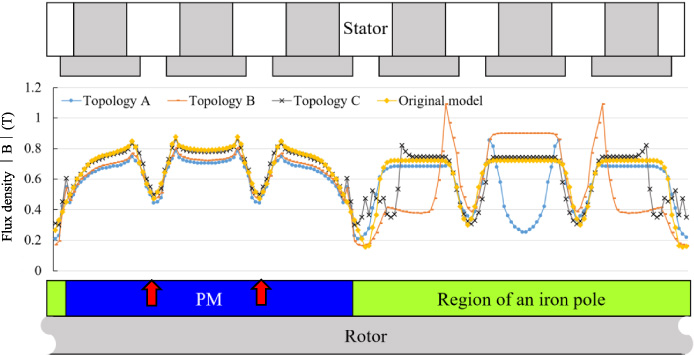
No-load airgap flux density of Topology A, Topology B, and Topology C, and the original machine (rotation angle: 0°).
By introducing this airgap field modulation theory, the structure difference between the surface-mounted PMSM and CP-PMSM can be clearly explained. As shown in Fig. 9, when we compare the rotor, for the surface-mounted PMSM, there are two sources made up of PMs, for the CP-PMSM, there is a source made up of PM and a modular made up of the salient iron pole. The salient iron pole modulates the influence of tooth harmonics, which in turn affects the airgap flux distribution. It can therefore be easily understood that the salient iron pole will have different modulation effects in different topologies and result in different torque waveforms.
The magnetostatic field of Topology A, Topology B, and Topology C under no-load condition is solved. The airgap flux density of Topology A, Topology B, and Topology C, and the original machine is plotted in Fig. 10, from which we can clearly observe how the optimized iron poles influent the tooth harmonic and modulate the flux in the airgap.
As shown in Fig. 11, to investigate the modulation effect of the optimized iron poles, the notch and holes in Topology A, Topology B, and Topology C are filled. The torque property of the CP-PMSM with the optimal iron poles and the modified optimal iron poles is simulated and summarized in Fig. 11. For all three optimized topologies, the average torque is modestly improved after the modification, while the torque ripple is greatly deteriorated. The average torque is improved due to the decrease of equivalent air-gap length, while the deterioration of torque ripple may be due to the enhanced tooth harmonics. It can thus be suggested that the optimal iron poles with wavy shapes modulate the airgap flux to better distributions, consequently achieving better balance between the average torque and torque ripple.

Optimized iron poles and the modified optimized iron poles (Unit: Nm).
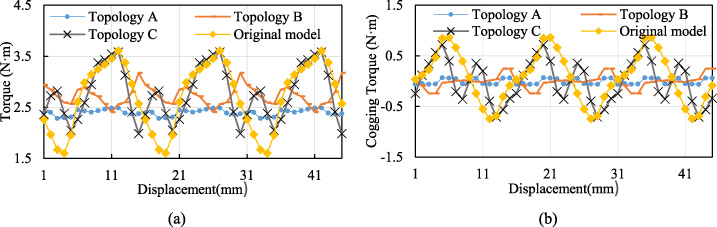
Performance of Topology A, Topology B, and Topology C, and the original machine (a) Torque waveform, (b) Cogging torque waveform.
The torque waveforms and cogging torque waveforms of Topology A, Topology B, and Topology C are plotted in Fig. 12. A comprehensive comparison is given in Table 3. Comparison results indicate that the torque properties, especially cogging torque, are surprisingly improved. It can be suggested that the multi-tooth structures modulate the airgap flux, suppress the cogging torque, and contribute a lot to the resultant low torque ripple. Meanwhile, the rotary inertia of optimized CP-PMSMs is lower than that of the original CP-PMSM, which has a benefit on the dynamic response characteristic.
Performance comparison of optimized CP-PMSMs and original CP-PMSM
Performance comparison of optimized CP-PMSMs and original CP-PMSM
This paper has studied the multi-objective TO on a CP-PMSM to unlock the full design space potential. To this end, the evolutionary operators, which can make modifications to the shapes under Delaunay meshes, are proposed and formulated. Thereby we demonstrated how to combine the ON/OFF method with MOEAs and how to apply this technique efficiently for the TO of this machine. The aiming of finding the trade-off relationship between the average torque and torque ripple has been completely fulfilled. In addition, it is numerically shown that the NSGA-II can find superior solutions in comparison with SPEA-II for the formulated problem.
Moreover, the presented multi-objective TO technique is general for the TO of other electric devices and can coupled work with commercial finite element analysis software that use Delaunay algorithm to discretize models.