



Abstract
The prosthetic socket is the key part connecting the prosthesis and the stump. It needs to be functional, safe, and comfortable at the same time. However, the volume fluctuation of the stump causes the incompatibility between the stump and the socket. This paper designs an adaptive prosthetic socket with rope-driven to fit stump volume fluctuation. The designed adaptive prosthetic socket with constant force characteristic using superelastic shape memory alloy may solve the problem of uneven pressure on the stump due to stump volume fluctuation and adapt stump volume. To obtain a good constant force range, the constant force characteristic of the socket is optimized and validated by finite element analysis. The experimental results show that the constant force mechanism using the C-shaped shape memory alloy sheets can obtain good constant force characteristics, and the socket can apply a constant force to the stump to solve the problem of uneven pressure distribution between the stump and the socket.
Introduction
According to statistics, in 2005, there were 6 million amputees in the United States, and the number of limb losses is expected to continue to increase in the following decades [1]. Amputations are primarily due to a variety of causes, including trauma, tumors, peripheral arterial disease, infections, and diabetic foot ulcers [2–4]. The poor adaptability socket is one of the main reasons for loss of function, skin disease, and limb abandonment. A survey showed that among 242 amputees, 20% of amputees gave up the use of prostheses, mainly due to the discomfort caused by wearing the socket [5]. Therefore, wearing a prosthesis is an important means to restore the daily life of amputees, and the design of the socket is a key factor in determining the daily life of amputees.
Stump volume fluctuation is an important factor affecting the comfort of the socket. Typically, the volume of the stump can vary from −11% to 7% per day [6,7]. A volume change of 3%–5% may cause discomfort to amputee patients [8]. Changes in stump volume vary with patients’ daily activity levels, dietary habits, etc. [9,10]. Studies have shown that patients can experience volume changes of approximately 0.10–0.12 ml per minute while standing and approximately 0.20–0.30 ml per minute while resting after exercise [11]. Due to the volume fluctuation of the stump, the pressure is too concentrated on the stump, which can easily lead to skin diseases and pain problems [12,13]. In recent years, many research institutions have put forward many solutions to solve the problem of stump volume fluctuation. The more common is the adjustable prosthetic socket, Daniel Candrea et al. proposed a prosthetic socket with four independent air bladders controlled by closed-loop feedback [14,15]. Richard M. Greenwald et al. proposed a smart variable geometry socket technology, which provides a dynamic volume management method [16]. Melina Mercier et al. developed a smart prosthetic socket using a fluid flexible matrix composite [17]. Atsuo Ogawa et al. designed a magnetorheological fluid socket using smart materials that can change the stiffness and volume of the socket to accommodate dynamic motion and alignment changes [18]. But these solutions also have various defects and have not passed clinical trials. The feasibility of the socket remains to be studied.
In this paper, an adaptive prosthetic socket with rope-driven is designed to adapt stump volume fluctuation. The adaptive prosthetic socket with constant force characteristic is proposed to solve the problem of uneven pressure on the stump caused by the stump volume fluctuation. The constant force mechanism is designed based on shape memory alloy (SMA). The constant force characteristic of the prosthetic socket is optimized and verified by finite element analysis, so as to obtain constant force in a large range of deformation.
Material and method
Design of constant force mechanism
A constant force mechanism is designed by taking advantage of the superelasticity of SMA, as shown in Fig. 1. It is mainly composed of an outer shell, an inner shell, limit pins, bolt pins, and four C-shaped SMA sheets. The outer shell is attached to the inner wall of the socket, so it is made of rigid material to ensure force transmission. The inner shell needs to be in contact with the stump, so it is made of flexible material. The limit pin plays the role of connecting the outer shell and the inner shell of the constant force mechanism. The bolt pins are symmetrically distributed on the inner surface of the inner shell and the outer shell of the constant force mechanism, which are used to fix the position of the SMA sheets.

Constant force mechanism (a) Overall view of the constant force mechanism (b) Cross-sectional view of constant force mechanism.
The designed prosthetic socket is composed of a socket base, the inner shell, the outer shell, knob, rope, and constant force mechanism, as shown in Fig. 2. The socket model is made by three-dimensional (3D) printing with carbon fiber. The socket base can accommodate the distal end of the stump, support and fix the socket. The base connects the outer shell and the inner shell as a whole. The inner shell places a constant force mechanism and two knobs, the outer shell places three constant force mechanisms. The knob and rope can adjust the volume of the socket. When the upper knob is rotated, the tightness of the shells on both sides of the socket can be adjusted, and the lower knob can be used to drive the constant force mechanism to compress so that the constant force mechanism can squeeze the stump, occupy the smallest possible volume, and apply a comfortable constant force to the stump.
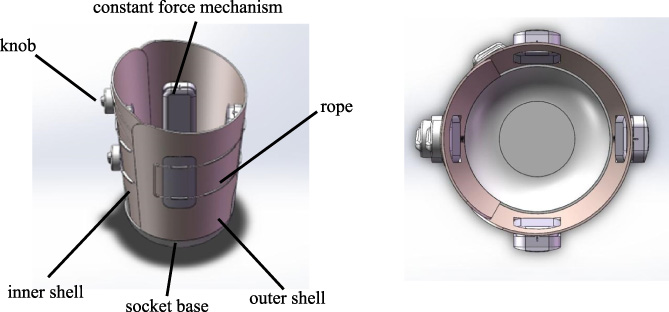
The designed socket (a) Overall view of the socket. (b) Top view of the socket.
Model building
In order to verify the constant force loading characteristic of the prosthetic socket, it is necessary to carry out finite element analysis of the mechanical interaction between the constant force mechanism and the stump. To simplify the model, the blood vessels, femur, and other structures are ignored, and the stump is constructed as a solid column. The simplified constant force mechanism model consists of two C-shaped SMA sheets and two plates, other components are ignored. The stump model has a diameter of 160 mm and a length of 200 mm. As the four constant force mechanisms are symmetrically placed in the socket, and a simplified constant force mechanism and a quarter stump are used for the analysis to reduce the computational time, as shown in Fig. 3.
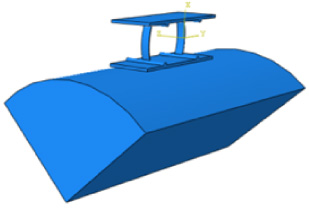
Simplified model of simulation.
In order to simulate the characteristic of large deformation, nonlinearity and superelasticity of muscles, the Mooney-Rivlin model is adopted to describe the soft tissue of the stump. The constitutive equation of the Mooney-Rivlin model is as follows.
C10, C01, D1 are intrinsic parameters, where C10 = 0.0855, C01 = 0.02138 and D1 = 0.459. SMA are set as follows: From austenite to martensite the stresses of start and finish points of phase transformation are 311 MPa and 437 MPa respectively, and from martensite to austenite the stresses of start and finish points of phase transformation are 137 MPa and 27 MPa respectively. The transformation strain is 0.067 and the ambient temperature is set to 15 °C. Young’s modulus and Poisson’s ratio of austenite were set to 67,000 MPa and 0.33. Young’s modulus and Poisson’s ratio of martensite were set to 26,300 MPa and 0.33. The Young’s modulus and Poisson’s ratio of the plate are 150,000 MPa and 0.25.
Mesh setting
The mesh sizes of the stump, plate, and SMA sheet are 5 mm, 2 mm, and 0.5 mm respectively. The mesh types of the plate and SMA sheet use eight-node linear hexahedral elements (C3D8) and the soft tissue uses eight-node linear hexahedral hybrid elements (C3D8H).
Boundary condition setting
The direction of the stump volume fluctuation is set in the opposite direction to the movement of the constant force mechanism. All degrees of freedom of the stump are constrained except for the X-direction, and a X-direction displacement of 12 mm is imposed on the upper plate to simulate the process of increasing the volume of the stump. Adhesive restraint is used between the SMA sheet and the upper plate, surface contact is used between the plate and the stump, and the friction coefficient is 0.5, as shown in Fig. 4.
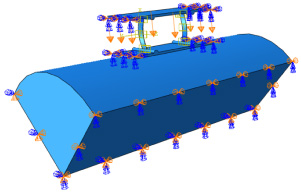
Boundary condition of simulation.
The constant force characteristic of the prosthetic socket is optimized by changing the parameter size of the C-shaped SMA sheet. The C-shaped SMA sheet has a chord length of 24 mm, a chord height of 2 mm, a width of 6 mm and a thickness of 0.2 mm, which is as a base model for optimization, as shown in Fig. 5. The chord length of C-shaped SMA sheet is as optimized design variable. An evaluation method of constant force characteristic is shown in Fig. 6. The curve is divided into the preload phase and the constant force phase. The fluctuation amplitude ΔS of the constant force phase and its corresponding displacement interval ΔD are used to characterize the constant force characteristic of the structure. The design goal is that the fluctuation amplitude ΔS of the constant force phase to be small and the displacement variation interval ΔD of the constant force phase to be large.
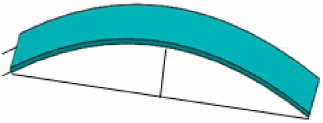
Dimension parameters of C-shaped SMA sheet.

The evaluation method of constant force characteristic.
The stress distribution of the C-shaped SMA sheet obtained by simulation is shown in Fig. 7, and the stress distribution on the stump surface is shown in Fig. 8. The 79 nodes of the main stress area on the stump surface are selected, and the characteristic curves of average stress on the main stress area of stump surface with a chord length of 21–26 mm versus the applied displacement are obtained, as shown in Fig. 9. The finite element analysis results show that the stress on the stump surface increases rapidly with the increase of displacement during the preloading stage. Then the stress decreases rapidly with the increase of displacement. When the stress decreases to a certain value, the stress fluctuations are small in a larger displacement range. According to the constant force evaluation curve, curves with chord length of 21–26 mm are analyzed. For the curve with the chord length of 21 mm, the fluctuation amplitude ΔS is 0.00024 MPa and the constant force displacement interval ΔD is 11.7 mm. For the curve with the chord length of 22 mm, the ΔS is 0.00020 MPa, and the ΔD is 11.4 mm. For the curve with the chord length of 23 mm, the ΔS is 0.00022 MPa, and the ΔD is 10.8 mm. For the curve with the chord length of 24 mm, the ΔS is 0.00016 MPa, the ΔD is 11.0 mm. For the curve with the chord length of 25 mm, the ΔS is 0.00016 MPa, the ΔD is 10.8 mm. For the curve with the chord length of 26 mm, the ΔS is 0.00015 MPa, and the ΔD is 10.1 mm. It can be seen that ΔS of the curves with chord length of 21–26 mm is not much different, so it is more inclined to choose a curve with a larger constant force area. The results show the constant force area of the curve with the chord length of 21 mm is largest. The chord length of 21 mm, the chord height of 2 mm, the width of 6 mm and the thickness of 0.2 mm are selected as the parameters of the C-shaped SMA sheet. The constant force mechanism with the C-shaped SMA sheet can obtain good constant force characteristic, and the constant force mechanism can apply a constant force to the stump.
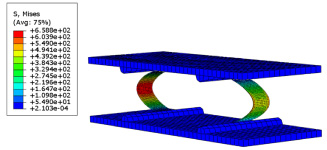
Stress cloud diagram of constant force mechanism.
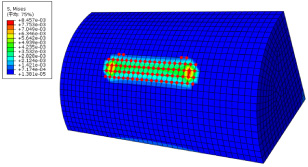
Stress cloud diagram of the stump.
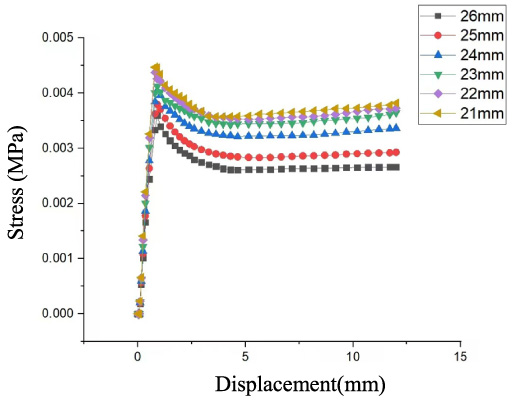
Relationship between average stress on the main stress area of stump surface of stump and applied displacement with different chord length of C-shaped SMA sheet.
The traditional prosthetic socket has a single design and a fixed volume, so the sockets must be replaced regularly to adapt to the volume change of the stump. Compared with the traditional socket, the prosthetic socket with rope-driven proposed in this paper is adjustable mechanically, and the patient can adjust the size of the socket anytime and anywhere to fit stump volume fluctuation. The interface pressure on the stump always changes due to stump volume fluctuation. The prosthetic socket with constant force mechanism designed in this paper may squeeze the stump with constant pressure within certain displacement area, which can solve the problem of uneven interface pressure and improve greatly the wearing comfort of amputees.
As we all know, the traditional manufacturing process of prosthetic sockets is time-consuming and laborious, and the waiting period for amputee patients is long. The socket proposed in this paper is made by 3D printing technology. This new manufacturing method is known for its ability to fabricate highly complex geometries, print highly individualized and customized devices, save material, allow rapid design improvements, and perform with less cost, time, and manual effort than traditional manufacturing methods. Carbon fiber is chosen as the material for making this socket. Carbon fiber can provide strength comparable to metal, and its weight is very light.
In the future, some issues need to be resolved to promote the clinical application of this prosthetic socket. Firstly, the adaptive socket needs to be further optimized, and its mass and size need to be decreased. Secondly, the high cost of carbon fiber will make it unaffordable for some patients, so the material of this socket needs to be considered. Finally, the air permeability of the socket needs to be improved by optimizing the structure.
This paper designs an adaptive prosthetic socket with rope-driven and constant force characteristic. The rope-driven socket is adjustable mechanically anytime and anywhere according to stump volume. This socket with constant force characteristic is designed based on SMA superelasticity to squeeze the stump with constant force, which may solve the problem of uneven interface pressure between the stump and prosthesis caused by volume fluctuation. The constant force characteristic of the socket with constant force mechanism is optimized and verified preliminarily by changing the chord length of the C-shaped SMA sheet in finite element analysis. The optimized C-shaped SMA sheet is embedded into the constant force mechanism placed in the socket to achieve a constant force applied to the stump. It is preliminarily validated that the adaptive prosthetic socket is a potential approach to address stump volume fluctuations.
Footnotes
Acknowledgements
The work is supported by the project supported by the National Natural Science Foundation of China (31900944) and the National Key R&D Program of China (2020YFC2007905).