



Abstract
BACKGROUND:
It is known that 1-MCP delays softening in kiwifruit. Time to ripen (eating-window) and its variability are considered useful for planning commercial strategies. However, few studies report the firmness and quality changes during long-term cold storage.
OBJECTIVES:
To study the effects on ripening and sensory attributes of different 1-MCP treatments during long (180 d) and very long-term (≥210 d) cold storage. Then, the optimal 1-MCP dose was applied to determine the time to ripen after cold storage for 30 to 240 d.
METHODS:
Kiwifruits were treated with 1-MCP: 0.0 (control), 0.5 and 1.0μL L–1. Maturity indices and sensory analysis were achieved after 180 and 210 d of storage at 0 °C. Ethylene production was also measured. Firmness and number of fruits at eating-ripe state (at 20 °C) were monthly determined after 30 to 240 d of cold storage.
RESULTS:
1-MCP (1.0μL L–1) delayed kiwifruit softening and prolonged the storage to up 180 d. Longer periods were associated to losses due to over-ripe. Eating windows of 1-MCP-treated fruits were longer than those for untreated fruits.
CONCLUSIONS:
1.0μL L–1 1-MCP extends the postharvest life of ‘Hayward’ kiwifruit and prolongs the eating window, allowing to plan different commercialization strategies.
Introduction
The kiwifruit (Actinidia chinensis var. deliciosa (A. Chev.) A. Chev. cv. ‘Hayward’) is characterized by its high productivity, large fruits and good storage life [1, 2]. Cold storage is the most widely postharvest technology used to delay fruit ripening, allowing growers to sell the fruits when the market prices are convenient. Kiwifruits have a climacteric behavior, although when stored at low temperatures (0 to 10 °C), they behave as non-climacteric [3]. Generally, ‘Hayward’ kiwifruits are harvested after reaching physiological maturity (flesh firmness around 70 N) but still unripe. Softening to reach the eating-ripe state (flesh firmness between 4 to 13 N [4]) occurs during storage and commercialization. Softening makes the fruit edible, but also implies a gradual deterioration and an increase in the amount of unmarketable fruits due to over-ripening, the major cause of losses on kiwifruit [5]. In addition, soft fruits are more susceptible to pathogens, which limit transportation, storage and shelf life, affecting directly the final cost of the product [6]. Therefore, firmness and softening rate influence postharvest operations and determine the final destination (local or distant markets).
Kiwifruit softening occurs without significant increases in ethylene production [7, 8]. However, the fruit is highly sensitive to exogenous ethylene, which does not affect the external appearance or color skin, but accelerates flesh softening [9, 10]. Therefore, ethylene concentrations as low as 5 to 10 ppb are enough to activate some physiological reactions of the fruit [11]. For that reason, an ethylene-removal system during storage is necessary [12].
The 1-methylcyclopropene (1-MCP) is the active molecule of SmartFreshTM (AgroFresh Inc., Philadelphia, Pennsylvania, USA), that irreversibly blocks the ethylene receptors avoiding ethylene action and also decreasing its synthesis rate [10, 13–15]. This technology is used in the global kiwifruit industry for the last 10 to 15 years, providing flexibility in the postharvest handling, reducing losses and improving its commercialization [16]. The ripening process resumes after a certain period of cold storage because new ethylene receptors are synthesized [4, 17–19].
Related to 1-MCP effectiveness on ‘Hayward’ kiwifruit, early reports showed that it depends on concentration (1, 10 or 100μL L–1), among other factors [14]. Some authors found 1-MCP effects on firmness when a lower concentration (0.5μL L–1) after short (28 d) and medium (56 d) cold storage periods were applied [20]. Others suggested that the most appropriate 1-MCP concentration (0.5 or 1.0μL L–1) depends on the length of the cold storage period [21]. Own preliminary studies showed that 1.0μL L–1 of 1-MCP applied before cold storage would depress ethylene production causing a delay in the climacteric peak and softening of ‘Hayward’ kiwifruits stored for 150 to 210 d at 0 °C and transferred to 20 °C [22].
Most of the research related to 1-MCP application on ‘Hayward’ kiwifruit evaluates its effects during a maximum period of 130 to 140 d (‘long period’ of cold storage) [20]. Only few publications report the effect of a single pre-storage application of 1-MCP for longer periods [21, 23]. Strategies to prolong storage life are useful to extend the commercialization period. In addition, information about the time needed to reach the eating-ripe state after different cold storage periods would be useful for marketing decisions. Moreover, it is not clear if the most studied 1-MCP doses (0.5 or 1.0μL L–1) are sufficient to completely block the ethylene action because new receptors can be synthetized during long and very long-term storage. Therefore, the aims of this work were: i) to study the effects of 1-MCP concentration (0.5 or 1.0μL L–1) on long and very long-term cold stored fruits (180 and 210 d, respectively) on ripening, quality and sensory attributes, ii) to study the 1-MCP effect on firmness changes of cold-stored kiwifruits after 30 to 240 days, as well as to determine the firmness and the time to reach the eating-ripe state of them at 20 °C (‘eating window’).
Materials and methods
Effects of 1-MCP concentration on maturity indices and sensory attributes of kiwifruit during long (180 d) and very long-term (210 d) cold storage
Plant material
Kiwifruits ‘Hayward’ were harvested in two consecutive seasons from a commercial orchard in the ‘El Dorado’ region (latitude 37° 57’ S, longitude 57° 57’ W), at the SE of the Buenos Aires Province, Argentina. The maturity and quality indices at harvest were: dry matter = 15.3 and 15.9%, firmness = 84.5 and 75.8 N, soluble solids content (SSC) = 7.1 and 7.7%, titratable acidity (TA) = 1.17 and 1.33%, for the first and second seasons, respectively. Right after harvest, fruits were cured for 48 h [24]. The kiwifruits were kept overnight at 0 °C previous 1-MCP treatments.
1-MCP treatments procedure and storage conditions
Before storage, hermetic plastic containers (140 cm H×30 cm ø) were used to expose the fruits (24 h at 0 °C) to 1-MCP (0.5 and 1.0μL L–1 SmartFreshTM powder 0.14% dissolved in warm water). Unexposed fruits were considered as control. Three containers (140 kiwifruits each) were used for each treatment.
After that, the containers were opened for ventilation. Fruits from each container were divided into two groups, placed in plastic trays and stored at two storage times: 180 and 210 d. The cold room conditions were: 0±0.5 °C, 91±5% RH, with ethylene absorbers (filters with KMnO4). After that, kiwifruits were transferred to 20±1 °C, 75±4% RH, for 7 d for further ripening (shelf-life).
Maturity and quality assessments
The kiwifruits were analyzed at 180 and 210 d of cold storage and after shelf life for: flesh color, firmness, SSC and TA. Moreover, these fruits were analyzed at the end of shelf life by a sensory panel.
2.1.3.1. Quality and ripening indices. Flesh color was determined with a Minolta chromameter (CR-300; Osaka, Japan, 8 mm ø, C illuminant) after removing the skin on one side at the equatorial zone. The color was measured by using the CIELAB* system (L*, a*, b*). Chroma (C*) and hue angle (h°) were calculated using the equations reported by [25].
Flesh firmness was measured in two opposite sides at the equatorial zone using an EFFEGI penetrometer (7.9 mm ø; Alfonsine, Italy), expressing the results in N.
Then, each fruit was transversally cut into two halves. The half from the peduncular zone (proximal) was used to obtain the juice to determine SSC and TA. SSC was measured with an aliquot of 1 mL of juice, using a digital refractometer (ATAGO CO. Ltd., Tokyo, Japan). An aliquot of 10 mL of juice was diluted in 100 mL of distilled water to measure the TA by an automatic titrator (RADIOMETER MEDICAL APS, Bronshoj, Denmark) with 0.1 N NaOH until pH 8.1.
2.1.3.2. Sensory evaluation. Remaining half of the fruit (a total of 30 per experimental unit) were peeled and cut into pieces and put into a plastic cup, labeled with a three digits’ code to evaluate its sensory properties. The descriptive analysis was performed at 20 °C by a semi-trained panel formed by 8 people [26]. Some attributes to analyze the sensory properties of kiwifruit were previously listed and defined [19]. The consistency of pericarp (texture), the intensity of flavor, and sourness (taste) were evaluated. Samples were assessed using a 1 to 5 point scale as follows: a) consistency of pericarp: from very soft to very hard; b) flavor intensity: from weak to strong; c) sourness: from weak to strong. All assessments were repeated twice.
Ethylene production
At the end of each cold-storage period (180 and 210 d), the ethylene production rate (μL kg–1 h–1) was measured during 14 d at 20 °C. The ethylene production of 8 individual fruits per treatment (n = 3) was measured in a glass jar (360 mL). Each jar was hermetically sealed during 1 h for incubation at 20±1 °C. Through a silicone septum, samples of 0.5 mL were withdrawn from the jar. A gas chromatograph (GC-17A, Shimadzu Corporation, Kyoto, Japan) equipped with an FID detector and a GSQ column (30 m×0.53 mm; J & W Scientific, California, USA). N2 was used as carrier gas. Temperatures of the column, injector and detector were 40 °C, 100 °C and 200 °C, respectively.
Firmness and the ‘eating window’ of 1.0μL L–1 1-MCP treated and control fruits cold stored for 30 to 240 d at 0 °C
Plant material
In a third season, kiwifruits ‘Hayward’ were harvested from a commercial orchard in the ‘Sierra de los Padres’ region (latitude 37° 54’ S, longitude 57° 48’ W), at the SE of Buenos Aires Province, Argentina. The values of maturity at harvest were: dry matter = 15.9%, firmness = 78.2 N, SSC = 7.7%, TA = 1.35%. Fruits were cured and kept overnight at 0 °C.
1-MCP treatment and length of cold storage
Six groups of 720 fruits each were placed in hermetic containers as described in 2.1.2. section. Three groups were treated with 1.0μL L–1 1-MCP keeping the remaining as controls. Fruits from each container were placed in 8 plastic boxes (in groups of 90), randomly assigned for 8 different storage periods: 30, 60, 90, 120, 150, 180, 210, and 240 d at 0±0.5 °C, 92±3% RH.
Firmness during cold storage and eating maturity
At the end of each cold storage period, 30 fruits per box were taken to measure firmness as described above. The remainder fruits were placed in plastic containers, divided into 2 groups of 30 units each and transferred to 20±1 °C, 73±6% RH to promote ripening. One group was evaluated at 7 d (shelf life); the other was regularly analyzed to determine the time needed to reach the eating-ripe state for each individual fruit. The consumer or eating-ripe state was analyzed according to the flesh firmness frequently evaluated by hand, making a slight pressure in the equatorial zone with all the fingers of one hand. Fruits perceived as soft enough were separated to confirm their maturity state with the penetrometer. Fruit with flesh firmness between 4 and 13 N was considered at eating-ripe. The total number of fruits at eating-ripe for every day of evaluation was determined. The cumulative number was calculated from 30 to 240 d and expressed as % to reach 50%, 75% or 100% of the fruits at the eating-ripe phase. The ‘eating window’ was defined as the total number of days needed for all the fruits (100%) to reach the eating-ripe state.
Statistical analysis
The experiment was conducted in a completely randomized factorial design. For L*, a*, b*, h°, C*, SSC, TA, firmness and for ethylene production rate the results were expressed as the mean±S.E. Statistical analysis was done by two-way ANOVA using SAS Studio 3.8 version (Basic Edition) [27]. In experiment 1, the significance of main effects and interaction of the 1-MCP treatments, cold storage durations and seasons were analyzed, both at the end of cold storage and shelf life. Sensory evaluation data were also analyzed by two-way ANOVA, considering 1-MCP treatment and cold storage duration as factors with fixed effects and season and panelist, as factors with random effects. In experiment 2, the main effects of 1-MCP treatment and cold storage duration and its interaction were analyzed, at the end of the storage and shelf life in an independent way. Multiple comparisons between means were performed using the Tukey test (α= 0.05).
Results and discussion
Effects of 1-MCP concentration on maturity indices and sensory quality of kiwifruit during long and very long-term cold storage
Flesh color, titratable acidity and soluble solids content
Regardless the 1-MCP concentration to which the fruits were exposed before storage, results indicated a significant (p < 0.0001) decrease in lightness (L*), saturation (C*) and tone (h°) in flesh color at the end of 180 and 210 d of cold storage compared to values at harvest (Table 1). Changes in h° and C* were related to an increase in a* and a decrease in b*, suggesting chlorophyll loss during cold storage in both seasons (Table 1). These changes in flesh color during cold storage were similar to those reported by other authors [20, 28].
CIELAB* color parameters of ‘Hayward’ kiwifruit at harvest and at the end of cold storage (180 and 210 d at 0 °C) in two different seasons
CIELAB* color parameters of ‘Hayward’ kiwifruit at harvest and at the end of cold storage (180 and 210 d at 0 °C) in two different seasons
1Values are the mean±SE. 2Values followed by the same letter(s) within the same column are not significantly different according to Tukey (α= 0.05).
The fruits of cv. ‘Hayward’ have green flesh due to the high total chlorophylls content, around 2 mg 100 g–1 FW, and the low total carotenoids content (around 0.1 mg 100 g–1 FW) [29]. Our own unpublished data, also for ‘Hayward’, showed that flesh color measured in terms of L*, h° and C*, did not change while the fruit is attached to the plant and reaches physiological maturity, from 134 to 176 d after bloom, in agreement with another report [30]. However, some flesh color changes in this cultivar occur during cold storage, mainly due to the chlorophyll loss [20, 31] which is quite often ignored. Particularly in kiwifruit, the decrease in the intensity of green flesh color, related to less negative a* values and lower C*, is caused by α-chlorophyll loss [32]. Thus, the flesh color is determined by the amount of the retained pigment [33].
Some reports indicate that 1-MCP may delay the loss of color intensity in ‘Hayward’ kiwifruits, although this effect was found for short and medium cold storage periods [20]. Also, higher L* and C* values in the flesh color of 1-MCP-treated kiwifruits held 30 d at 20 °C were reported [16]. During long storage, the de novo synthesis of specific ethylene membrane receptors [34] allows resuming the normal maturation and senescence processes, including chlorophyll degradation. This probably explains why 1-MCP did not has a significant effect on color changes in our experiment at the end of both cold storage periods.
Lightness was the color parameter most affected during shelf life, with a significant interaction between seasons, 1-MCP treatment and length of storage (p = 0.0136). Lower L* values, associated with more ripe fruit, were found in control respect to 1-MCP-treated fruits, without differences between 1-MCP doses. However, this difference was not found in the first season, at 180 d of cold storage (Fig. 1). Changes in a* values were not detected during shelf life, while b* depended on 1-MCP treatment (p = 0.0006), with higher values in 0.5 and 1.0μL L–1 1-MCP-treated fruits respect to control for both seasons (28.7, 28.4 and 27.0, respectively). Furthermore, significant differences between 1-MCP treatments were found (p = 0.0326) for hue, probably related to a higher b* in 1-MCP-treated fruits compared to control (hue values of 112.68°, 112.61° and 113.24° for 0.5, 1.0μL L–1 1-MCP and control, respectively). Also, the interaction between season×1-MCP treatment×cold storage duration were significant (p = 0.0032) for C*. Higher values in 1-MCP-treated than in control fruits were found after shelf life for fruits previously cold stored during 210 d in the first season (Fig. 1).
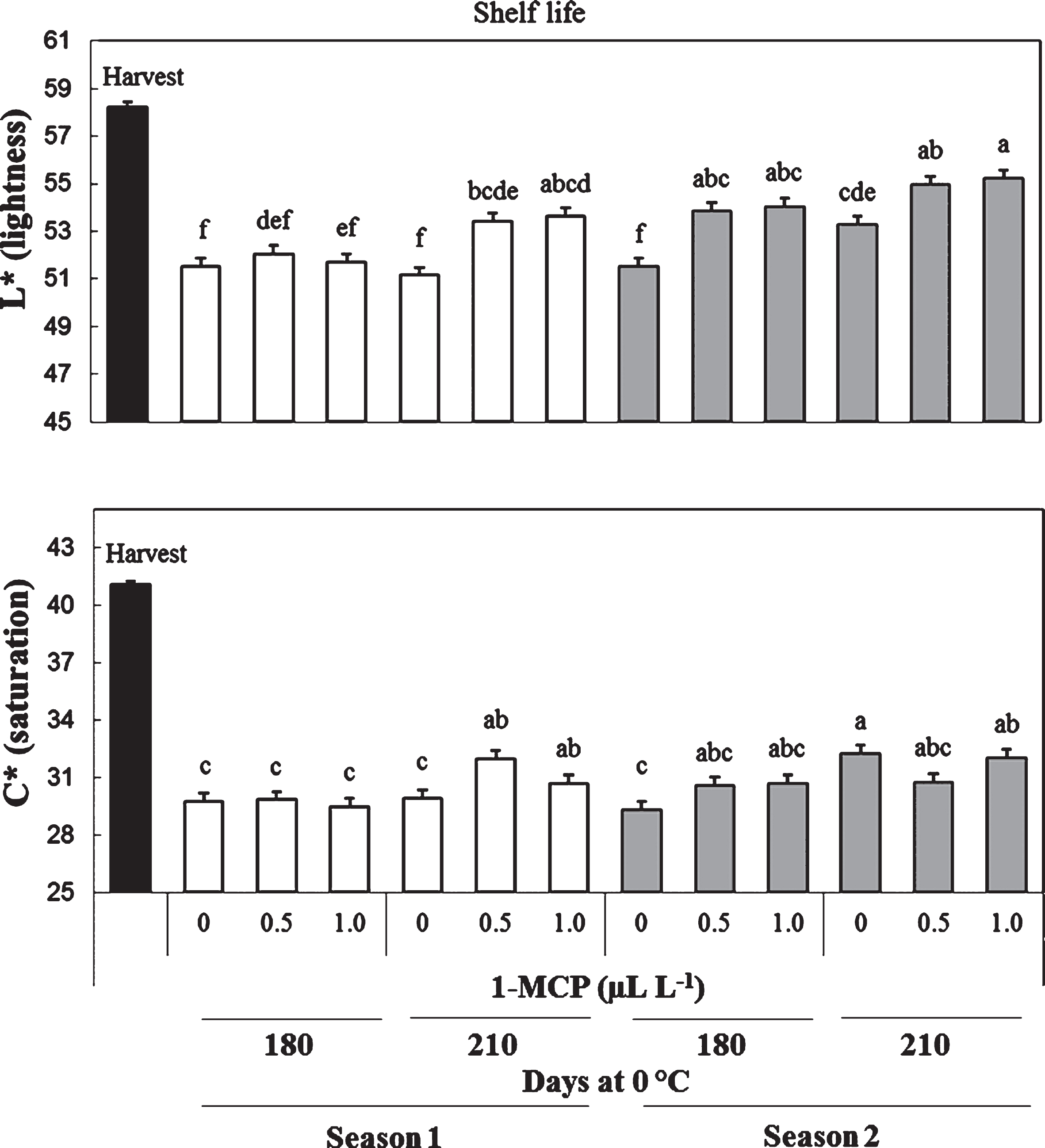
Lightness (L*) and Chroma (C*) of 1-MCP-treated (0.5μL L–1 or 1.0μL L–1) and untreated (control) kiwifruits at shelf life (7 d at 20±1 °C, 75±4% RH), after cold storage for 180 and 210 d at 0 °C, on two different seasons (1 and 2). Each point represents the mean±SE. Values followed by the same letter(s) are not significantly different according to Tukey (α= 0.05).
Usually, there is a loss of green color in the external pericarp of green-flesh fruits as ‘Hayward’, but this process is incomplete compared to many other cultivars of A. chinensis var chinensis, characterized by a yellow or red flesh when mature [31]. That could be due to a lower activity of the chlorophyllase enzyme in ‘Hayward’ or to the fact that the chloroplasts maintain their ultrastructure and remain functional during ripening [30].
On the other hand, the kiwifruit preference of consumers is determined by a balanced sugar-acid ratio [35]. The acid taste affects the perception of the sweet taste when SSC values are low (around 11%), so reducing consumers’ acceptance [36]. In agreement with that, kiwifruit with SSC values close to 11.6% presented an acceptable flavor depending on the acidity of the fruit, while those with at least 12.5% SSC were the ones that pleased the consumer [37].
The interaction between 1-MCP treatment×season for SSC at the end of the storage periods was significant (p = 0.0063). The lower SSC in 1-MCP-treated fruits corresponds to the highest dose (1.0μL L–1). It could be more related to a lower dehydration (data not shown) than to a delay in SSC accumulation. Although, this result was found only for the first season term (Table 2). Similar inconsistent results were found in TA, with a lower acidity in 1.0μL L–1 1-MCP-treated fruits compared to control in the second season but not in the first (Table 2). No differences between 0.5μL L–1 1-MCP and control were found for SSC and TA at the end of both cold storage periods.
SSC and TA of ‘Hayward’ kiwifruit at the end of cold storage (180 and 210 d at 0 °C) and after shelf life in two different seasons
1Values are the mean±SE. 2Values followed by the same letter(s) within the same column are not significantly different according to Tukey (α= 0.05).
Similarly, significant interactions between 1-MCP treatment×season (p = 0.0039) were found for SSC at the end of shelf life. The SSC was higher in the 1.0μL L–1 1-MCP treated fruits compared to control for the second season, without statistical differences between 1-MCP treatments for the first season (Table 2). The independent effects of 1-MCP treatment, storage duration and season, as well as their interactions, were not significant at the end of shelf life for TA, with a general mean value of 1.2%.
In our study, the SSC and TA reached values around 13% and 1.2–1.3%, respectively, regardless of the 1-MCP treatments. These values can be considered as adequate for consumer acceptance [37], and were more or less maintained at the end of shelf life for both storage lengths. Probably this was due to the sufficient dry matter content at harvest in both seasons. Fruits with values lower than 15% are perceived by consumers as acid and less sweet at eating-ripe state, reducing their acceptance [38].
Previous studies in kiwifruit have shown that 1-MCP treatment delays the processes associated with ripening, like SSC accumulation and acidity loss [16, 40]. Probably, the relatively long cold storage periods studied in the present work would explain the similar SSC and TA content reached for 1-MCP-treated and control fruits after most of the storage periods. In agreement with our results, other authors did not found any delay in the SSC accumulation due to 1-MCP treatment, even in a short period of 60 d [20] or 120 d of cold storage [41].
It has been shown that TA does not change [42, 43] or decreases [20, 37] during storage and ripening in kiwifruit ‘Hayward’, depending on the growing region. In Israel, California and Italy, a high TA (2 to 2.5%) has been recorded at harvest with subsequent decreases during storage (0.5 to 1.5%). In New Zealand, TA remained steady during the storage period until consumer maturity, without any change in the malic acid concentration [38]. Moreover, the proportion of each organic acid would change during ripening until the fruit reaches eating-ripe maturity. Many of these changes could vary depending on the storage temperature [43]. These authors reported that malic acid concentration increases and citric acid decreases during cold storage. Therefore, the effect of 1-MCP treatment on ripening indices such as the SSC and TA depends on the maturity state, climatic and handling conditions of the vines and genotype [43, 44], and also they change with cold storage length.
The flesh firmness is highly affected by the presence of ethylene, and softening occurs in the presence of extremely low concentrations of this gas [45, 46]. Regardless of the dose applied, 1-MCP-treated kiwifruits were firmer than control fruits at the end of 180 and 210 d of cold storage (Fig. 2a). This finding seemed to be consistent since it was found for both growing seasons. On the other hand, fruits treated with 1.0μL L–1 1-MCP were firmer than those with 0.5μL L–1 1-MCP at the end of 180 d of cold storage. However, both doses resulted similar at the end of 210 d of cold storage (significant interaction 1-MCP treatment×cold storage duration; p < 0.0001) (Fig. 2a). Regardless of the 1-MCP concentration and season, 1-MCP-treated fruits were significantly firmer than control fruits at the shelf life linked to 180 d of storage at 0 °C (Fig. 2b). When the cold storage period was prolonged to 210 d, both 1-MCP doses delayed flesh softening compared to the control in the season 1, but not in season 2 (Fig. 2b) (significant interaction 1-MCP treatment×cold storage duration×season; p = 0.0018).
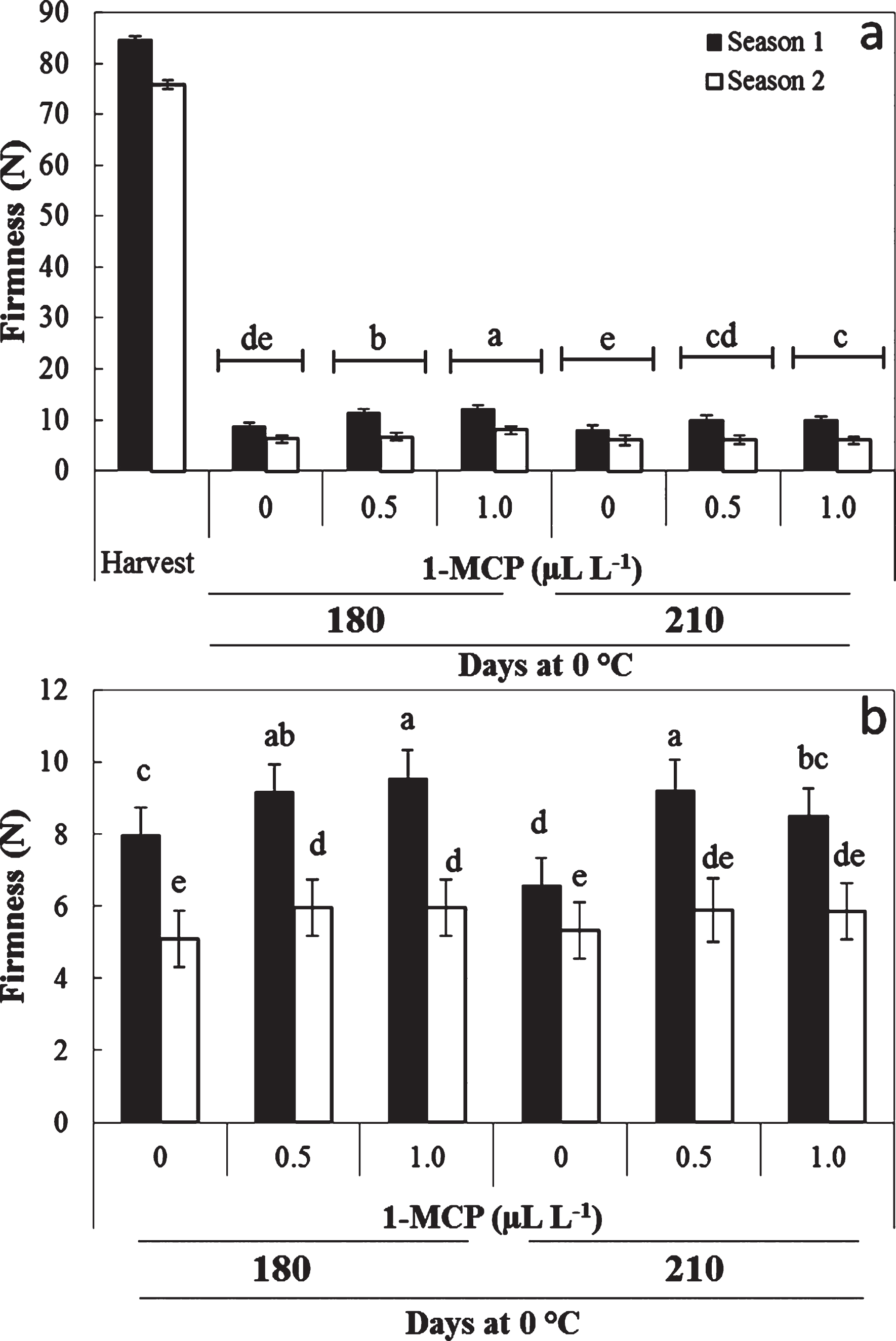
Firmness of 1-MCP-treated (0.5μL L–1 or 1.0μL L–1) and untreated (control) kiwifruits: a) at the end of cold storage for 180 and 210 d at 0 °C, b) after shelf life (7 d at 20±1 °C, 75±4% RH), on two different seasons (1 and 2). Each point represents the mean±SE. Values followed by the same letter(s) are not significantly different according to Tukey (α= 0.05).
Very few reports in the literature analyze the effect of 1-MCP for similar cold storage periods than experiments presented here [47]. In the same way, those authors found higher firmness in 1-MCP-treated fruits than in the control after 200 d of cold storage plus 7 d at 20 °C. Furthermore, our results show that all the treatments had an acceptable firmness for consumption at the end of the shelf life of both very long-term cold storage periods (Fig. 2b).
During both storage periods at 0 °C, no ethylene production was detected (data not shown). After 180 d of cold storage, the control fruits set at 20 °C showed a typical climacteric behavior, with maximum ethylene detected at days 3 and 5, in the seasons 1 and 2, respectively (Fig. 3a and 3c). The application of 0.5 and, in particular, 1.0μL L–1 1-MCP, delayed the onset of the climacteric period and also reduced ethylene production during 2 weeks at 20 °C in both seasons (Fig. 3a, 3c). The differences in the amount and time to reach the climacteric peak between control and 1-MCP-treated fruits were greater in season 1 than 2. These effects of 1-MCP on ethylene production explain in part the lower decrease in firmness detected for both 1-MCP concentrations compared to control, although the differences between them were not statistically significant (Fig. 2b). In agreement with these results, kiwifruit treated with 0.5 and 1.0μL L–1 1-MCP were firmer than the control fruits after 180 d of cold storage, maintaining the trend during shelf life at 20 °C [21].

Ethylene production (μL kg–1 h–1) of 1-MCP-treated (0.5μL L–1 or 1.0μL L–1) and untreated (control) kiwifruits at 20 °C for 14 d, after storage at 0 °C for 180 d (a, c) and 210 d (b, d). Results correspond to season 1 (a, b) and 2 (c, d). Each point represents the mean±SE. Values for the same day of analysis followed by the same letter (s) are not significantly different according to Tukey (α= 0.05). In those points where the bar is not observed is because the magnitude of the standard error was less than the size of the symbol.
After 210 d of cold storage, all treatments showed an increase in the production of ethylene after the day 3 or 5 at 20 °C, depending on the season. This behavior does not seem to be related to a climacteric pattern but could be due to the onset of senescence and decay processes. All treatments presented a higher amount of ethylene in season 2 than 1, when the same period of days at 20 °C was compared (Fig. 3b and 3d).
Nevertheless, in season 1 both concentrations of 1-MCP were effective in reducing the ethylene production compared to control during 14 d at 20 °C. However, in season 2 only1.0μL L–1 1-MCP produced a decrease in ethylene production (Fig. 3b and 3d).
The lower ethylene production in season 1 explains why 1-MCP-treated fruits resulted in firmer fruits than control even after 210 d of storage at 0 °C plus 7 d at 20 °C. As mentioned above, a more evident climacteric peak at 20 °C was detected by all treatments in season 2 than in season 1. Particular pre-harvest conditions not measured in this study possibly accelerated the flesh softening during cold storage and its subsequent shorter shelf life in season 2.
Interaction between 1-MCP treatments and seasons (p < 0.01) were found to affect all the sensory attributes. Furthermore, interaction between season and cold-storage duration was significant (p < 0.01) for pericarp consistency and sourness.
Only in season 1, regardless of cold storage duration, panelists found a higher pericarp consistency and higher flavor intensity in 1-MCP treated fruits (0.5 and 1.0μL L–1) than in the control (Table 3). Also, a lower pericarp consistency and a higher acidity were detected in fruits stored for 210 d than in those for 180 d in season 1. These differences between cold storage durations were not found in season 2. Respect to sourness, no differences between 1.0μL L–1 1-MCP treated fruits and control were found in both seasons. However, sourness detected by panelists was significantly higher in 0.5μL L–1 1-MCP-treated fruits than in control for season 1. In agreement with that, it has been reported that 1-MCP delays the texture and sourness changes associated with ripening in kiwifruit, regardless of the temperature of storage [48].
Pericarp consistency, flavor intensity and sourness at shelf life (7 d at 20 °C) of ‘Hayward’ kiwifruit
Pericarp consistency, flavor intensity and sourness at shelf life (7 d at 20 °C) of ‘Hayward’ kiwifruit
1Values are the mean±SE. 2Values in the same column followed by the same letter(s) are not significantly different according to Tukey (α= 0.05). 31 to 5, from very soft to very hard. 41 to 5, from weak to strong.
Changes in flesh firmness in 1-MCP-treated and control fruits at the end of each cold storage length and shelf life (7 d at 20 °C) are shown in Fig. 4. Significant differences between 1-MCP treatment and control were found only at the end of 90, 150 and 240 d of cold storage (Fig. 4a). Mean firmness values at the end of cold storage indicated that control fruits reached the eating-ripe state when the storage length was at least 150 d (Fig. 4a). In contrast, 1-MCP treated fruits achieved a firmness value≤13 N if the cold storage was prolonged at least to 180 d (very long-term cold storage), demonstrating the softening delay caused by the 1-MCP treatment (Fig. 4a).

Firmness (N) of 1-MCP-treated (1.0μL L–1) and untreated (control) kiwifruits: a) at the end of different cold-storage durations at 0°C; b) at shelf life (7 d at 20±1 °C, 73±6% HR) after each cold storage. Each value represents the mean±SE. Grey area corresponds to firmness for eating-ripe stage (from 4 to 13 N). Values for the same day of analysis followed by the same letter (s) are not significantly different according to Tukey (α= 0.05). In those points where the bar is not observed is because the magnitude of the SE was less than the size of the symbol.
The ripening process, including softening, is accelerated when the fruit is removed from cold storage and kept at 20 °C for 7 d. Indeed, 90 d of cold storage resulted enough for the control fruits to achieve the eating-ripe at shelf life (Fig. 4b). On the other side, the ripening process was delayed in 1-MCP-treated fruits and it took at least 150 d of cold storage to achieve the eating-ripe during shelf life (Fig. 4b).
For control fruits, firmness at shelf life resulted near the lowest value considered for eating-ripe after 240 d of cold storage, while 1-MCP treated ones resulted significantly firmer (4.1 and 6.6 N, respectively). Firmness after shelf life of 1-MCP-treated fruits was significantly higher than that of the controls for all the sampling periods after 90 d of cold storage (Fig. 4b). These results suggest that the greatest effect of 1-MCP for delaying softening in general did not occur immediately at the end of the cold storage but it happened when the fruits were transferred to 20 °C. Similar finding was reported by other authors [47].
This technical information could be useful for the industry, as it compares changes in fruit firmness with or without 1-MCP application in a wide range of cold storage durations, from short to very long. Several reports describe the 1-MCP effects on ripening, with special attention on softening, during 140 to 180 d of cold storage [18–21]. Only [47] and [49] determined the 1-MCP effects on kiwifruit after 200 and 193 d of cold storage, respectively. However, for practical and commercial purposes, it is important to consider not only the mean value for firmness but also its variability.
The cumulative total number of fruits (%) that reached eating-ripe maturity when transferred to 20 °C after a certain storage length is shown in Fig. 5. When control fruit stored for 90 to 120 d reached eating-ripe maturity at shelf life (Fig. 4b), the individual firmness assessment indicated that at least 50% of the fruits did (Table 4). In those stored for 150 and 180 d, at least 75% of the control fruits reached eating-ripe at 7 d at 20 °C, while 100% did it in very long-term cold storage (210 and 240 d) (Table 4).
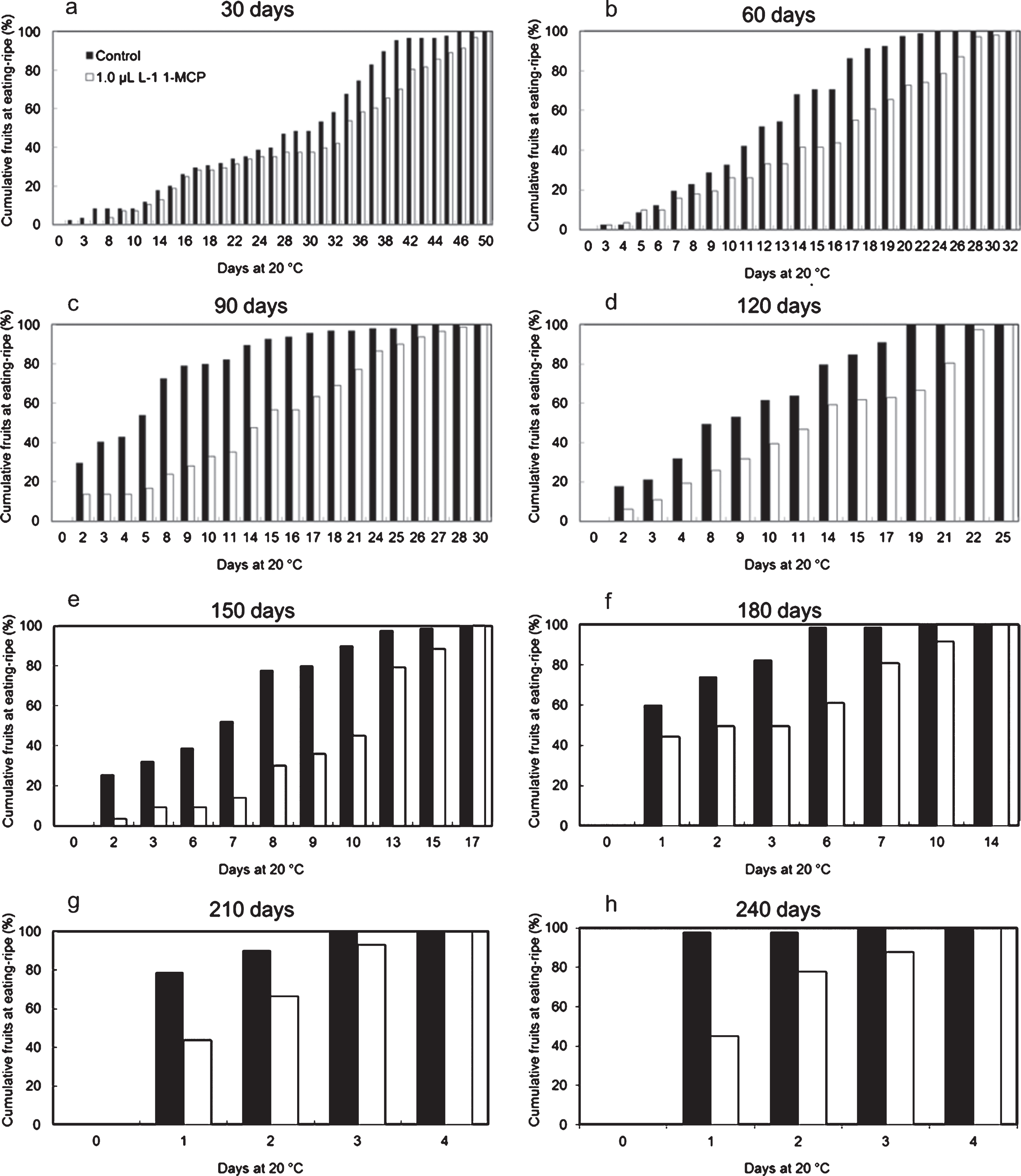
Cumulative fruits at eating-ripe (%) at 20 °C until reach 100%. Fruits were previously treated with 1.0μL L–1 1-MCP □ or untreated ■ (control) and cold stored at 0 °C for 30 (a), 60 (b), 90 (c), 120 (d) 150 (e), 180 (f), 210 (g) and 240 (h) d.
Days at 20°C to reach eating-ripe firmness for cumulative 50%, 75% and 100% (‘eating window’) in 1-MCP-treated (1.0μL L-1) and control fruits after cold storage at 0°C for 30, 60, 90, 120, 150, 210 and 240 d
On the other hand, less than 50% of the 1-MCP treated fruits achieved the eating-ripe state after 7 d when the cold storage was for 150 d. When the cold storage was for 180 d, 75% of the 1-MCP-treated fruits reached the eating-ripe state and 100%, when it was extended to 210 or 240 d (Table 4).
It is clear that the time needed to reach the eating-ripe (‘eating window’) for all the cold-stored fruits transferred to 20 °C is shorter when the length of cold storage increases (Table 4). This relationship between days to reach eating-ripe and cold storage duration is not linear, regardless the fruits have been treated or not with 1-MCP. Table 4 shows that the ‘eating window’ (100% of the fruits at eating-ripe) is achieved in an excessively long period when fruits were cold-stored from 30 to 90 d and in a very short time, for those cold-stored 210 to 240 d.
Results show that 1-MCP was effective on delaying softening, then extending the shelf-life in a wide range of cold storage duration. Likewise, 1-MCP-treated fruits kept eating-ripe state with acceptable firmness at 20 °C after 210 and 240 d of cold storage, with a higher proportion of fruits that maintain the sensory quality during such long periods of storage (data not shown). SSC and TA were higher in 1-MCP-treated than in control fruits (data not shown), even for the longer periods of cold storage. It was observed, in agreement with other authors [14, 20], that the effects of the 1-MCP treatment on maintaining the flesh firmness declined with the length of the storage, essentially in those very long-terms (210 and 240 d).
The main destinations of Argentinian, Chile and New Zealand exports are overseas markets in the Northern Hemisphere, to supply the seasonal lack of local production. The fruits are transported by sea in refrigerated containers from 30 to 40 d to different European harbors. Import markets demand high pulp firmness when fruits arrive to the logistic platform, aiming to get flexibility in distribution and commercialization The minimum firmness value for the retail and wholesale market is estimated in 9.8 N (1 kgf) and 19.6 N (2 kgf), respectively [49]. Our results on a laboratory scale indicate that flesh firmness in the control fruits was slightly higher than the minimum value for the wholesale market after 60 d at 0 °C and subsequent shelf life (Fig. 4b). This time is enough for overseas fruit exportation. However, some delays frequently occur during harvesting, cooling and packaging operations, transportation (to the departure and the arrival harbors), loading and unloading operations, distribution in the market at the wholesale and retail level. Furthermore, fruits are exposed to temperature fluctuations that induce ripening acceleration. For these reasons, the application of 1-MCP is considered strategic for many exporters to ensure adequate fruit quality at arrival, being recommended even when the distance or the time to the final destination are relatively short.
To allow the consumers to buy a kiwifruit with an appropriate maturity, the fruits cold-stored for 30 to 60 d should be treated with ethylene at destination or receive some preconditioned treatment, as proposed by [50]. However, depending on the time to destination, 1-MCP treatment could be necessary for short and medium-term cold storage. In a recent review [49] it is reported that available postharvest technologies applied to maintain the fruit quality during storage, like 1-MCP, may differ according to the destination and could vary with the specific commercial requirements of the fruit.
The 1-MCP treatment extends the period of commercialization at the wholesale market up to 90 d compared to 60 d in the control. For long-term cold storage (120 to 150 d), 1-MCP treatment resulted also effective, kept the fruit firmer and extended its shelf life, giving more flexibility to the commercial chain. The application of 1.0μL L–1 1-MCP was effective to extend the cold storage up to 180 d, enlarging the eating-ripe window and the commercialization period (Fig. 5f; Table 4). 1-MCP treated kiwifruits stored for 180 d, maintained good firmness (Fig. 4a) and adequate sensory attributes for the retail market at the end of cold storage and after 7 d at 20 °C. This long-term storage period could be applied in areas of kiwifruit production near very populated cities, with high consumption. To retain the firmness in values according to the market demand of the ‘Hayward’ kiwifruit for more than 180 d it would be necessary to consider other technologies, such as controlled atmospheres [51, 52].
‘Hayward’ kiwifruit treated with 1-MCP demonstrates a great capacity to retain the flesh firmness for up to 180 d of conventional cold storage (0 °C) and shelf life (20 °C), especially at a concentration of 1.0μL L–1. On the other hand, 1-MCP delays but does not completely inhibit the organoleptic maturation of ‘Hayward’ kiwifruit allowing the normal ripening process, resulting in fruits with excellent sensory attributes equal or superior when compared to control.
Treatment with 1-MCP might be strategic to supply firm fruits overseas markets, especially to far destinations, mitigating the effects of handling delays that could occur until the arrival to the consumer.
Very long-term cold storage (210 or 240 d), even for 1-MCP-treated fruits, result too long and imply greater risks of losses due to excessive softening and rotting.
Softening changes and eating-windows of 1-MCP-treated and untreated kiwifruits during short to very long-term cold storage reported in this paper could be useful for planning different commercialization strategies.
Funding
The authors report no funding.
Conflict of interest
The authors have no conflict of interest to report.
Footnotes
Acknowledgments
This work was financially supported by Instituto Nacional de Tecnología Agropecuaria (INTA) and Agencia Nacional de Promoción Científica y Tecnológica (ANPCYT, Argentina) (project PICT 2016/0506). The authors are grateful to Daniel Manriquez of AgroFresh Inc. (Chile) for 1-MCP (SmartFresh™, USA) supply and Ricardo Bartosik and Perla A. Gómez Di Marco for critical reading of the manuscript.