



Abstract
BACKGROUND:
Black currants are berries that attract attention due to the beneficial effects they possess. They are proven to be good antioxidants, anticancerogenic, cardio- and neuroprotective agents.
OBJECTIVE:
The main objective of this research was to evaluate the differences in the flavonols composition, antioxidant and spasmolytic activity of juices obtained from four different black currant cultivars – Triton, Tenah, Ben Sarek, and Ometa, grown over a 4-year long period on the territory of Serbia.
METHODS:
The qualitative and quantitative determination of black currants juices flavonols was performed using the HPLC. The antioxidative activity was carried out in DPPH and β-carotene systems. The study examined the impact of the main black currants flavonols and black currants juices on the spontaneous, KCl, and acetylcholine-induced ileum smooth muscle contractions.
RESULTS:
The dominant flavonol in juices of the four different black currant cultivars was myricetin, with its highest content obtained from the 2015 Triton juice (820.1±34.7 μg g–1). Quercetin was the second in abundance and the lowest yields were observed in kaempferol.
CONCLUSION:
The investigated black currant cultivars were proven to be good sources of flavonols and potential antioxidants with the significant spasmolytic activity that could be successfully used in treating gastrointestinal disorders.
Introduction
Black currant (BC) fruits (Ribes nigrum L., Grossulariaceae) are berries bred and used as food in Europe for 10 centuries. The most suitable growing conditions for plant species of this genus are the ones of moderate and continental climate, so they are cultivated in northern and eastern Europe, North America, Siberia, the Arctic, and northern Asia [1]. Since they grow in the colder climate, their health-promoting properties make them the most prominently used berries in the northern part of Europe [2].
The most abundant secondary plant metabolites in BCs are flavonoids, well-known non-nutritive phytochemicals with beneficial influence on human health [3].
Flavonoids are proven antioxidants, antimicrobial and chemo-preventive agents in vitro [4, 5], vasodilators, anti-inflammatory and immunomodulatory agents in vitro and in vivo [6], and modifiers of postprandial glucose response in vivo [7]. In addition, there is scientific evidence that food rich in flavonoids improves deficits in age-related learning and spatial memory [8].
Flavonoids have many roles in the development and reproduction of plants. They stimulate spore and seed germination and attract pollinators (9, 10, 11). Their synthesis is influenced by the genetic background of the plant but largely depends on the agroclimatic conditions (exposure to the temperature extremes, strong light, UV-B radiation, low levels of CO2, water availability, minerals deficiencies), as well as the geographic position [12, 13]. Apart from the influence that they have on the synthesis of bioactive molecules, agroclimatic factors also affect potential biomass and crop development. Furthermore, flavonoids affect gastrointestinal systems in several ways. Besides the influence on the immune system and hormones of the intestine, they defend the intestinal wall against different chemical compounds and toxins and maintain its integrity. They exhibit protective properties against colorectal cancer [14]. The gastrointestinal tract is the system where the antiradical and metal-chelating activities of flavonoids are high, which can be ascribed to the high concentration of these compounds [15].
The relevant literature has shown that flavonols, the group of flavonoids, make up over 30% of the BCs phenolic composition [16]. Black currants are rich in myricetin, quercetin, and kaempferol, the flavonols that demonstrate numerous biological activities. Apart from the antioxidant, prooxidant, and antimicrobial activity [4, 17], myricetin possesses anticarcinogen, antidiabetic and antiartherosclerotic properties [17, 18] as well as a reno- [19] and neuroprotective effects [20]. Myricetin enhances osteogenic differentiation and prevents osteoporosis [21]. Quercetin, on the other hand, exhibits heart-protective effects [22], prevents deficits in age-related learning, spatial and chronic stress-induced memory [23], and causes autophagy in various disease models such as different forms of cancer and Alzheimer‘s disease [24]. Regarding the GI tract, quercetin expressed several activities. It demonstrated spasmolytic activity on the guinea-pig ileum [25]. Quercetin, in its aglycone form, is known to induce relaxation of the small intestine, precontracted by the administration of KCl in vitro [26]. This polyphenol compound is calcium antagonists and exhibits anticholinergic activity [27, 28]. Aqueous extract of quercetin exhibits a hepatoprotective effect and inhibits deoxyribonucleic acid damage in rats that had aflatoxins contaminated diet [29]. In cholestasis, quercetin has a hepatoprotective, antifibrotic, and anti-inflammatory role [30]. Similar to quercetin and myricetin, kaempferol also has an anti-inflammatory and immunomodulatory role. All three flavonols inhibit histamine release from mast cells [31]. It should be emphasized that the spasmolytic activity of the flavonols on the rat ileum has not been determined until now.
Considering all the mentioned facts, the purpose of this paper was to determine the flavonol composition and antioxidative activity of the juices from four different BCs cultivars (Triton, Tenah, Ometa, and Ben Sarek) during four consecutive years. Furthermore, the effects that the juices and the flavonols have on the spontaneous motility and contractility on the intestinal smooth muscle of rats in vitro were determined.
Material and methods
Sample preparation
The four cultivars were bred in the experimental field in Mislodjin, near Obrenovac. The climate in that region is temperate continental, milder than Pannonian, with an average temperature of 11°C. The soil is a sandy loan with pH around 6.3 with yearly precipitation above 640 mm m–2. The integrated protection practice was applied (minimum use of chemicals). Berries were hand-picked from the end of June to the beginning of July 2015–2018, depending on the time of ripening for each cultivar (90% colored fruit), and collected from each bush of the cultivar.
One factorial experiment was set up in a random field, had 5 repetitions and each repetition included 4 bushes. All the samples from each bush per cultivar were consolidated (2500 g), thus representing the average sample for further analysis. Juices were made of undamaged berries by manual crushing so the membrane and seeds were separated from the pulp. The juices were centrifuged for 10 min at 12000 rpm and the resulting supernatants were used for further analysis. Juice samples were stored in closed vials at – 18°C for further testing.
Reagents and standards
Flavonol standards (myricetin, quercetin, and kaempferol) were purchased from Sigma Chemicals Co. (St Louis, Mo., U.S.A.), as well as 1,1-diphenyl-2-picrylhydrazyl (DPPH), α-linoleic acid, and butylated hydroxyanisole (BHA). β-Carotene and (±)-6-hydroxy-2,5,7,8-tetramethylchromane-2-carboxylic acid (Trolox, vitamin E analog) were obtained from Fluka, Buchs, Switzerland. Butylated hydroxytoluene (BHT) and ascorbic acid standard (AsA) were purchased from Supelco, Buchs, Switzerland. All the standards were stored at – 18°C. Acetonitrile and methanol (High-performance liquid chromatography (HPLC) grade) used for analysis were J. T. Baker (Mallinckrodt Baker, Center Valley, PA). The water was purified with TKA Smart 2 pure deionization system (Thermoscience, Niederelbert, Germany).
Sample preparation for the quantification of flavonols by HPLC
The hydrolysis procedure of flavonoids was carried out by dissolving 1 mL of juice in 1 mL of a solution containing methanol and hydrochloric acid in a 1:1 ratio. The dissolved samples were subjected to an ultrasound bath (10 min), and then to a water bath (15 min at 90°C). After 20 min of centrifugation (4°C, 10 000 rpm), supernatants were filtered through Millipore 0.45μm, transferred into the vials, and injected into the column.
HPLC conditions
Flavonols were quantified using Agilent 1200 HPLC (Agilent Technologies, Palo Alto, Calif., U.S.A.) with a diode array detector, an automatic sampler, and a control system. Purospher STAR RP-18e analytical column (150×4.6 mm i.d., 5μm particle size), obtained from Merck, was used for the separation. The mobile phase consisted of 0.1% aqueous trifluoroacetic acid solution (A) and acetonitrile (B). The samples were eluted with the following gradient: 85% (A) from 0 to 20 min; 65% (A) next 4 min; 50% (A) for 5 min, then 10% (A) next 2 min, and 15% (A) for 2 minutes. The injection volume was 10μl and the column flow rate was 0.7 ml/min. The column was set and thermostated at 30°C and absorbance was measured at 360 nm. The identification of the compounds was carried out based on UV signal response in comparison with reference standards, and the quantification was determined using regression analysis of peak area against concentration. The results were expressed as μg of flavonols per g of juice.
Antioxidative activity assessment
Radical scavenging activity (DPPH-method)
The impact of BC cultivars juices on the DPPH-free radical was examined using Konic-Ristic method [32] with some minor changes and is explained in detail in our previous paper [33]. The results were expressed as IC50 value that presents the inhibitory concentration of the sample that is required to scavenge 50% DPPH free radicals.
β-Carotene/linoleic acid model system
This method measures sample capability to prevent oxidation of β-carotene in a β-carotene/linoleic acid emulsion. It is a spectrophotometric based method, examined and developed by Koleva [34]. The detailed information on emulsion preparation is given in Miladinovic [33]. The results were expressed as the concentration of the sample that inhibits 50% of loss of β-carotene (IC50).
Experimental animals
Wistar rats (male, 200–250 g, 12 weeks old) were acquired from the vivarium of the Faculty of Medicine, University of Nis, Serbia. The rats were grown under standard laboratory conditions (temperature 20–24°C, with a 12 h light cycle) with free access to food and water. All animal experiments were done in accordance with the Council of Europe Directive of 22nd September 2010 (Directive 2010/63/EU) and were approved by the Animal Ethics Committee of the Faculty of Medicine, University of Nis (Decision No. 01-206-7).
Experimental design
Four segments of each rat ileum were used in the experiments. The animals were anesthetized with ether and the abdominal cavity of the rat was opened. The segments of the distal parts of the ileum were dissected out. Two cm long segments of the rat ileum were placed in a bath filled with Tyrode solution, aerated with a mixture of 5% of carbon dioxide and oxygen, and heated to 37°C. Contractions of the isolated ileum were measured using a transducer (TSZ-04-E, Experimetria Ltd, Budapest, Hungary) and analyzed using the SPEL Advanced ISOSYS Data Acquisition System (Experimetria Ltd). Once the ileum segments were placed in a bath, adaptation to conditions lasted 30 minutes before the start of the experiment. The increasing concentrations of each flavonol (0.01–3 mg/ml) were added to the organ bath directly. After each series of experiments, the tissue was rinsed with Tyrode solution and stabilized for 10 minutes. A concentration-response curve was obtained by cumulative addition of the juices that were added in 15 minutes intervals, so the tissue was exposed to the juices for 1.5 hours.
The cumulative impact of the BC juice (0.01–3 mg/ml) on the spontaneous contractions of the rat ileum was measured in the first part of the experiment. Papaverine was used as a positive control (0.01–3μg/ml). The results were presented as a percentage change of the basal tone compared with baseline values (% of inhibition of ileal contractility).
The mechanism of the relaxant effects of BC juice on ileum contractility was assessed in the second experimental series. Acetylcholine (Ach; 5–1500 nM; 0.1 ml) was cumulatively added to the bath, in the absence or presence of the juice (1–3 mg/ml). The effect of BC juice on Ach-induced contraction of the ileum is expressed as the percentage reduction of contractions compared to the control series (when only Ach was applied in the absence of juice). Atropine (140 nM), a non-selective muscarinic receptor blocking agent, was used as a positive control.
The third experimental series examined the effect of the BC juice on the calcium channel activity of the rat ileum. The smooth muscles of the ileum were contracted with a depolarizing solution of KCl (80 mM). The high concentration of K+ induced tonic contractions of the intestine, which followed the cumulative addition of the BC juice (0.01–3 mg/ml). The same procedure was repeated with verapamil (0.015–1.5μg/ml), a calcium channel blocker. The relaxation of potassium-induced contractions of the ileum by BC juice is expressed as a percentage of the reduced contraction caused by potassium ions, without the addition of the juice.
Statistical analysis
Flavonols and antioxidative activity are presented as mean values of three measurements±standard deviations. The data were analyzed for any difference in cultivars among years by the one-way analysis of variance (ANOVA) and the differences among means were compared using the Bonferroni test (p < 0.05). Correlations among flavonols content and antioxidative activity were calculated using Pearson’s correlation coefficient (p < 0.05 and p < 0.01).
Spasmolytic activities were statistically analyzed and expressed as mean±standard deviation obtained in six measurements. The effective concentration EC50 (concentration that causes 50% of maximal response) was obtained by regression analysis. Statistical significance of the inhibitory effects caused by the use of BC juice was examined by student t-test with p < 0.05 taken as significant. The significant statistical differences among EC50 were obtained by one-way ANOVA. The analyses were performed using the SPSS statistical software package (version 20.0, Chicago, IL, USA).
Results
Flavonols content
The predominant flavonol was myricetin in all the samples and its highest content was found in 2015 Triton juice (820.1±34.7μg/g). Quercetin was the second in abundance and kaempferol was detected in the lowest quantities. The highest quantity of quercetin was found in 2015 and 2016 Ben Sarek juices (73.1±4.02 and 69.8±7.04μg/g, respectively), and the kaempferol quantity was (32.4±1.69 and 29.8±5.37μg/g, respectively. Table 1. presents the flavonol content in the juices of four examined cultivars during the period from 2015 to 2018.
Flavonols content (μg/g) of black currant juices from four different cultivars from 2015 to 2018
Flavonols content (μg/g) of black currant juices from four different cultivars from 2015 to 2018
M-myricetin, Q-quercetin, K-kaempferol (μg/g). A, B, C Caps different letters within a column denote significant difference (p < 0.05) in the content of the same compound in the same variety between years. a, b, c Small different letters within a row denote significant difference (p < 0.05) in the content of the same compound in different varieties of the same years.
Ometa cultivar exhibited the highest variations of flavonols over the years. Statistical analysis determined a significant difference between myricetin, quercetin, and kaempferol in the same samples in different years (p < 0.05). HPLC separation of the identified flavonols in the selected samples is presented in the supplementary material.
DPPH – radical scavenging activity
IC50 values ranged from 0.09 to 0.44 mg/ml for juices. Ometa 2015, as well as 2016 and Tenah 2016 juices, showed the best IC50 among juices (0.09±0.01 mg/ml), although Triton AO activity in 2015 and 2016 and Tenah 2016 were not significantly different (0.13, 0.10, and 0.11 mg/ml). Ben Sarek juices exhibited the weakest ability to capture free radicals. However, it was found that the AO activity of this cultivar highly correlated with quercetin (r = –0.82) with p < 0.05.
Commercial antioxidants (BHT, BHA, AsA, and Trolox) exhibited better antioxidative activity compared to Ometa, Triton, Tenah, and Ben Sarek juices (IC50 = 22.82±2.07, 2.4±0.09, 6.15±0.64, and 4.74±0.33μg/ml, respectively). The antioxidative activities (IC50) of Tenah, Ben Sarek, Ometa, and Triton juices from 2015 to 2018 are shown in Table 2.
DPPH radical scavenging activity and inhibition of β-carotene discoloration in β-carotene/linoleic acid emulsion expressed as IC50 (mg/ml) of cultivar Tenah, Triton, Ben Sarek, and Ometa juices (2015–2018)
DPPH radical scavenging activity and inhibition of β-carotene discoloration in β-carotene/linoleic acid emulsion expressed as IC50 (mg/ml) of cultivar Tenah, Triton, Ben Sarek, and Ometa juices (2015–2018)
DPPH – 1,1-dyphenylpicrylhydrazyl radical scavenging activity, IC50 - the concentration of the juice that scavenges 50% of DPPH free radical activity or prevents 50% loss of β-carotene. A, B, C Different letters within a column denote significant difference (p < 0.05) in the antioxidative activity of the same varieties between years. a, b, c Small different letters within a row denote significant difference (p < 0.05) in the same antioxidative activity in different varieties of the same years.
The juices were active at concentrations from 0.08 to 0.63 mg/ml. Ometa 2016 juice exhibited one of the best inhibition of lipid peroxidation among cultivars (0.08±0.01 mg/ml). Cultivar Ben Sarek showed second best protection against lipid peroxidation in 2016 (0.15±0.002 mg/ml) and statistical analyses determined that it could be ascribed to the flavonols myricetin (r = –0.711), quercetin (r = –0.825), and kaempferol (r = –0.802) with statistical significance p < 0.05. The statistical analysis showed a high correlation between IC50 values of Tenah and contents of myricetin (r = –0.848) (p < 0.01), so it can be assumed that AO activity of Tenah cultivar in high percentage stems from this dominant flavonol.
Commercial antioxidants expressed better AO activities compared to the analyzed juices and IC50 in β-carotene/linoleic acid system were (BHT) = 0.03±0.00μg/ml, (BHA) = 0.04±0.01μg/ml, IC50 (AsA) = 1.69±0.11μg/ml, (Trolox) = 22.95±1.52μg/ml. Antioxidative activities (IC50) of Tenah, Ben Sarek, Ometa, and Triton juices from 2015 to 2018 are shown in Table 2.
Spasmolytic activity
All the samples showed inhibition of spontaneous contractions of the rat ileum, and the relapse effect was dose-dependent (Fig. 1). Ben Sarek 2017 had the best effect in the concentration of 1 mg/ml which relaxed the small intestine by 57.81±6.49%. The same juice in the dosage of 3 mg/ml relaxed the small intestine for 63.39±4.85% (Fig. 1). The EC50 of this juice was 0.94±0.06 mg/ml. The effective doses of juices that inhibited 50% of spontaneous ileum contractions are shown in Table 3.

Relaxant effects of the black currant (Ribes nigrum L.) varieties Ben Sarek, Tenah, Triton, and Ometa juices (2015-2018) on spontaneous and KCl-induced contractions of the isolated rat ileum. Each point represents the mean percentage values with respect to spontaneous contractions in Tyrode solution (control)±standard deviation of 6 segments. *p < 0.05, **p < 0.01, ***p < 0.001 vs Tyrode. Symbol Σ above each concentration denotes the same significance for all years p < 0.001.
EC50 values of R. nigrum varieties Tenah, Triton, Ometa, and Ben Sarek juices in different years on spontaneous ileum contractions
a, b, c Small different letters within a column denote significant difference (p < 0.05) in the content of the same variety in the same variety between years. A, B, C Caps different letters within a row denote significant difference (p < 0.05) in the content of the same compound in different varieties of the same years.
Among juices, the Tenah variety demonstrated the best inhibition of contraction induced by 80 mM KCl according to EC50 values. The Tenah 2017 juice, at the concentration of 1 mg/ml showed significant inhibition of ileum contraction and decreased the contractility by 53.82±4.38% (p < 0.01) with EC50 = 1.1±0.01 mg/ml (Fig. 1). The same variety (3 mg/ml) in 2018 inhibited contraction by 40.32±3.46% (p < 0.01), with an effective concentration of 1.79±0.07 mg/ml (Fig. 1). The effective doses of juices that inhibit 50% contraction of the small intestine caused by KCl are shown in Table 4. Relaxant effects of BC varieties Ben Sarek, Tenah, Ometa and Triton juices (2015–2018) on the Ach-induced contractions of the rat ileum are given in Figs. 2 to 5, respectively.
EC50 values of R. nigrum varieties Tenah, Triton, Ometa, and Ben Sarek juices in different years on ileum contractions induced by 80 mM KCl
a, b, c Small different letters within a column denote significant difference (p < 0.05) in the content of the same variety in the same variety between years. A, B, C Caps different letters within a row denote significant difference (p < 0.05) in the content of the same compound in different varieties of the same years.
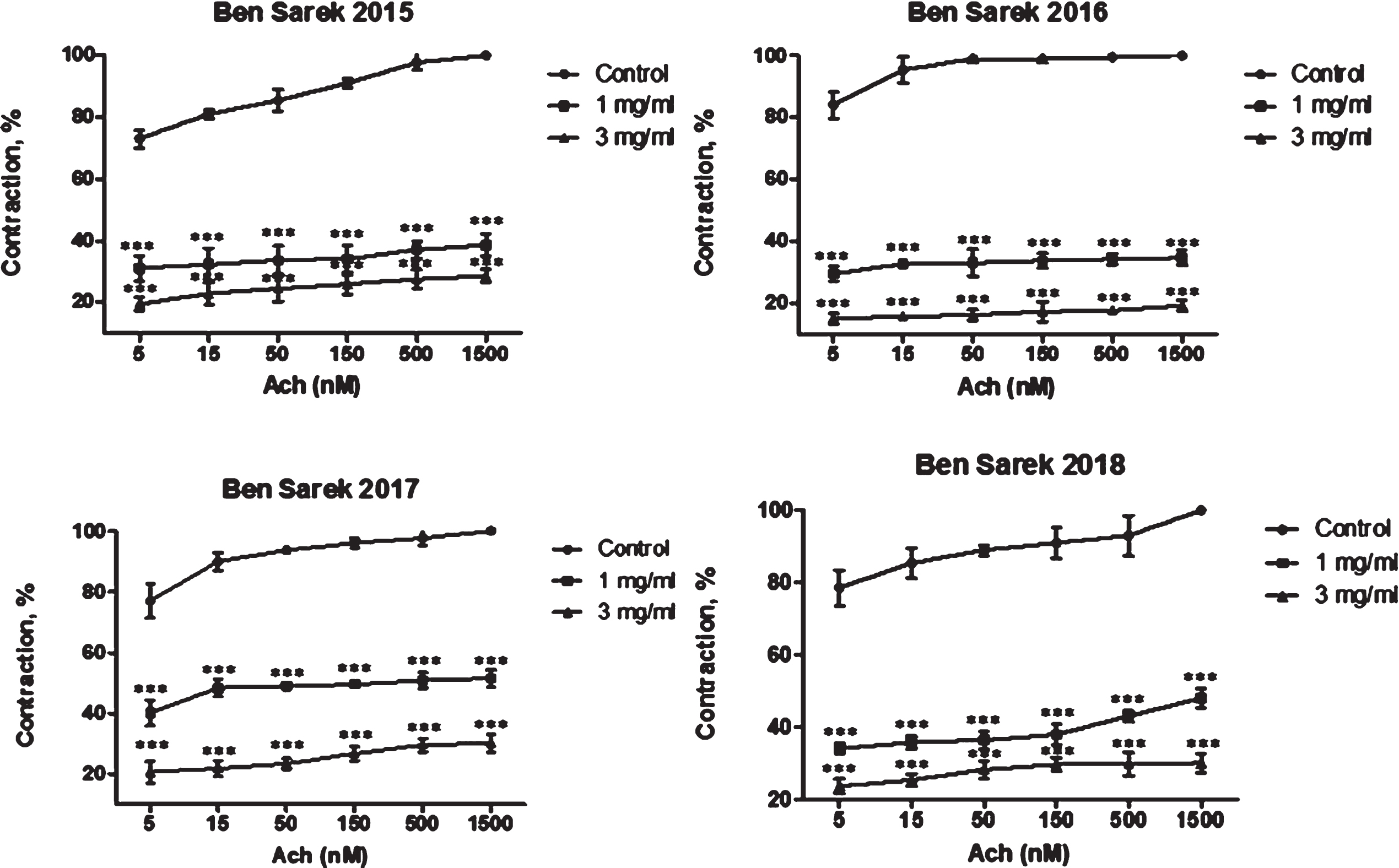
Relaxant effects of the black currant (Ribes nigrum L.) variety Ben Sarek juices (2015-2018) on the Ach-induced contractions of isolated rat ileum. Curves showing the values of control, Ach + Ben Sarek juice (1 mg/ml), Ach + Ben Sarek juice (3 mg/ml). Each point represents the mean values in percent of maximal response±standard deviation of 6 segments. ***p < 0.001 vs control.
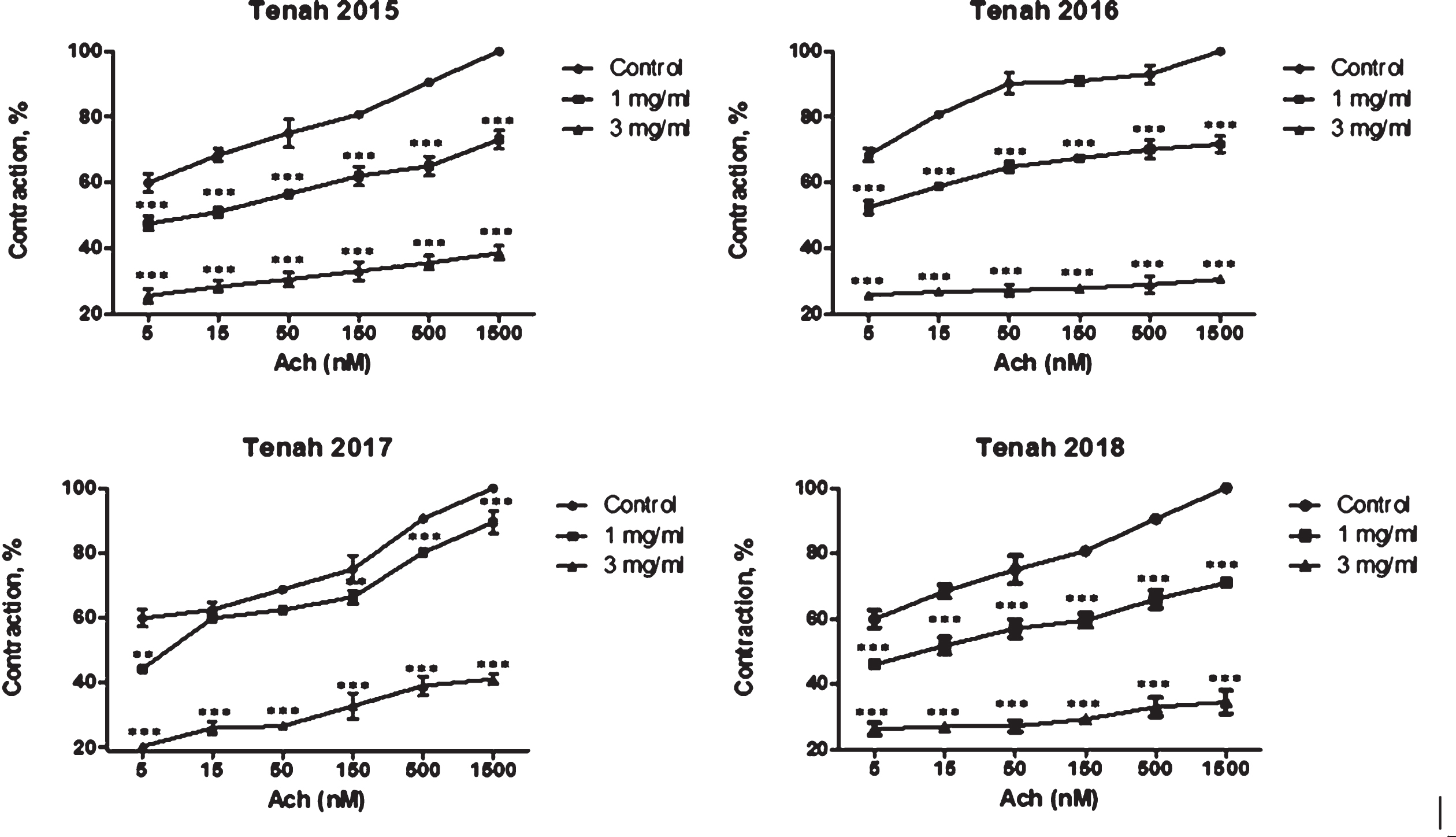
Relaxant effects of the black currant (Ribes nigrum L.) variety Tenah juices (2015– 2018) on the Ach-induced contractions of isolated rat ileum. Curves showing the values of control, Ach + Tenah juice (1 mg/ml), Ach + Tenah juice (3 mg/ml). Each point represents the mean values in percent of maximal response±standard deviation of 6 segments. ** p < 0.01, ***p < 0.001 vs control.
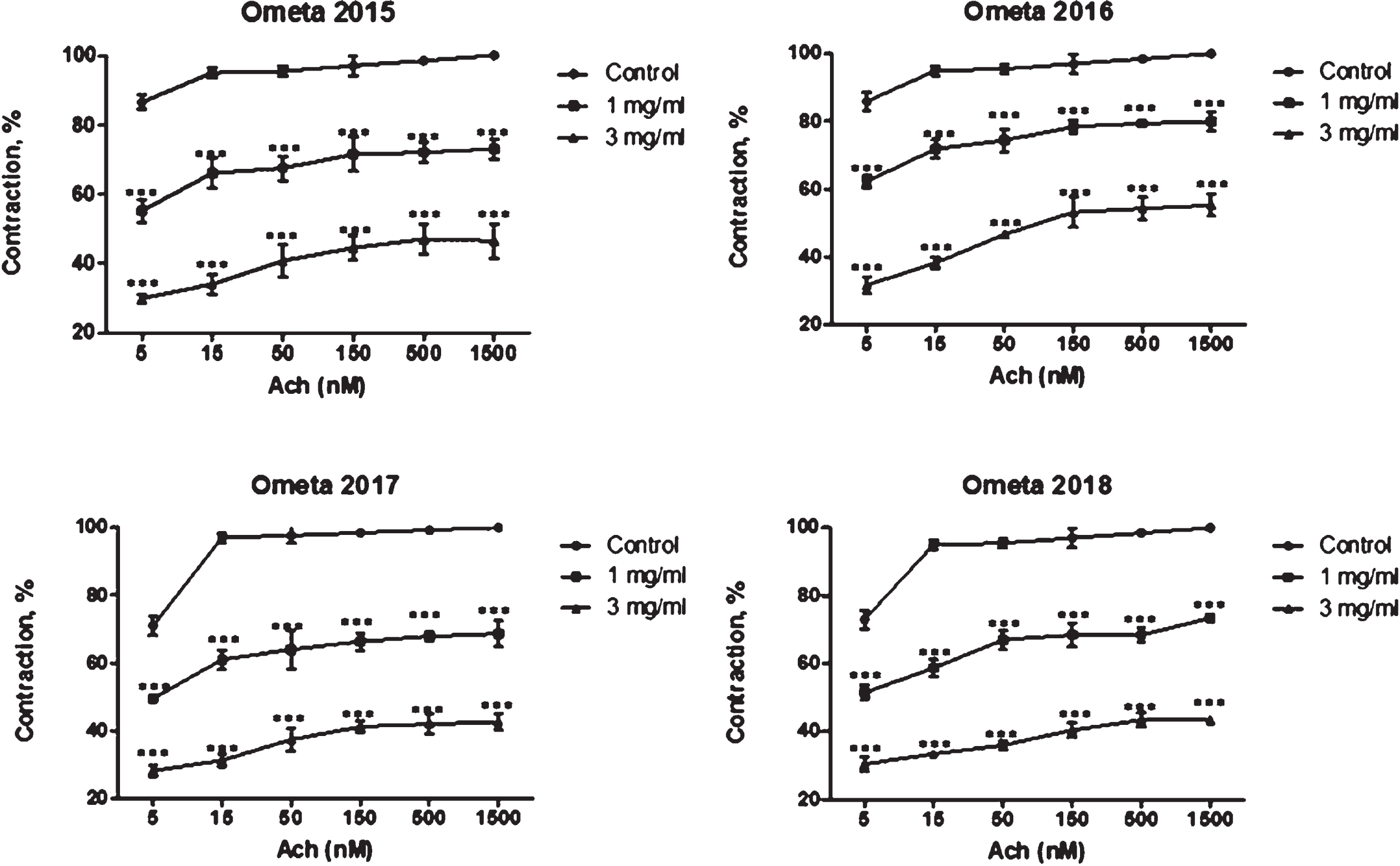
Relaxant effects of the black currant (Ribes nigrum L.) variety Ometa juices (2015–2018) on the Ach-induced contractions of isolated rat ileum. Curves showing the values of control, Ach + Ometa juice (1 mg/ml), Ach + Ometa juice (3 mg/ml). Each point represents the mean values in percent of maximal response±standard deviation of 6 segments. **p < 0.01, ***p < 0.001 vs control.

Relaxant effects of the black currant (Ribes nigrum L.) variety Triton juices (2015–2018) on the Ach-induced contractions of isolated rat ileum. Curves showing the values of control, Ach + Triton juice (1 mg/ml), Ach + Triton juice (3 mg/ml). Each point represents the mean values in percent of maximal response±standard deviation of 6 segments. ** p < 0.01, ***p < 0.001 vs control.
The experimental work showed that myricetin, quercetin, and kaempferol standards significantly decreased the contractility of ileum smooth muscle (Fig. 6), as well as BC juices. The flavonol standard that reduced the maximum ileum contraction in half and expressed the best EC50 was quercetin for both, spontaneous and KCl induced contractions (2.2±0.15 and 0.01±0.003 mM, respectively). Kaempferol acted in similar concentrations (2.9±0.05 and 0.02±0.007 mM, respectively), while myricetin was effective in much higher concentrations (9.53±0.1 and 0.15±0.6 mM, respectively).

Myricetin, quercetin, and kaempferol relaxant effect on spontaneous and KCl-induced contractions of the isolated rat ileum. Each point represents the mean values in percent of maximal response±SD of 6 segments. *p < 0.05, **p < 0.01, ***p < 0.001 versus control. Symbol Σ above each concentration denotes the same significance for all years p < 0.001.
Regarding contractions induced with Ach, flavonol standards changed the EC50 values of Ach control when added (Fig. 7). Myricetin changed the EC50 values of Ach from 79.49±2.57 nM to 119.9±5.91 nM with the addition of 0.1 mg/ml and to 164.6±6.73 nM in 0.3 mg/ml of myricetin. Quercetin altered the values from 144.2±6.12 nM to 2455±157.8 nM with the addition of 0.3 mg/ml. Kaempferol affected EC50 values most, altering them from 0.02±0.001 to 72.59±2.22 nM in 0.3 mg/ml. EC50 of acetylcholine changed from 0.1±0.001 nM to 18261.96±958.32 nM in the presence of atropine (p < 0.01).

Myricetin, quercetin and kaempferol relaxant effect on Ach-induced contractions of the isolated rat ileum. Each point represents the mean values of contractions±SD of 6 segments (in %). *p < 0.05, **p < 0.01, ***p < 0.001 versus control.
Since BCs present one of the most potent berries due to their nutritional value, researchers have started to analyze other plant organs of these berries for their beneficial properties. Tabart [35] examined acetone extracted active compounds from berries, buds, and leaves of BC and quercetin was the predominant flavonol in all three samples. This study found the significantly lower amount of flavonols (35±3μg/g of myricetin, 77±19μg/g of quercetin, and 10±5μg/g of kaempferol) from berries compared to our samples, probably due to the lower solubility in acetone. The same author emphasized that the form of the sample, temperature, pH, and many other conditions such as the cultivation site, cultivar, and harvest time, may have influenced the phenolic composition besides the type of solvent [36]. Since plants are susceptible to different climate conditions during their vegetative period over years, Nour [37] accentuated that it was difficult to determine which environmental factor was the main cause of flavonoid content fluctuations in terms of rainfall, daily temperature variation or intensity and duration of sunshine. Del Rio [38] confirmed our results that myricetin was the most prevalent among flavonols in BCs with a range from 89 to 203 mg/kg. This makes our cultivars within and even higher than the average value.
Zheng et al. [39] studied the content of flavonoids and anthocyanins of three BC cultivars which were grown in the north and the south of Finland in a 6-year long period. These authors found that the berries grown in the southern parts of the country were richer in flavonols heterosides content with dominant quercetin-3-O-glucoside in all three cultivars. The differences, compared to the values of our cultivars, may be due to the different geographical position and heterosides form of flavonoids. The amounts of flavonols varied a lot during the ripening of fruits which could have affected the results. Furthermore, flavonols were determined in ethyl-acetate extracts and the value of myricetin and quercetin were significantly lower compared with all our tested juices.
Mikkonen [40] examined the content of flavonols in BCs grown conventionally and organically. Myricetin was the most common flavonol, which is in concordance with the results of our research. Myricetin content ranged from 8.9 to 24.5 mg per 100 g of fresh fruit and it was similar or lower in comparison to the content of our Tenah, Triton, Ben Sarek, and Ometa juices. Mikkonen examined the cultivar Triton, which had the highest content of myricetin (24.5 mg per 100 g of fresh fruit), with approximately the same amount of quercetin. In our samples, cultivar Triton had a significantly higher content of myricetin in 2015 compared with the other examined cultivars of BCs, but the contents of quercetin were very low and closer to the values of kaempferol.
Laaksonen et al. [41] examined flavonoid content of five BCs cultivars juices obtained using two different methods of processing (enzymatic and non-enzymatic) and concluded that the dominant flavonol was myricetin, which corresponds to our results, considering the fact that the values of all three flavonols were significantly lower when compared to the ones of the analyzed juices Triton, Tenah, Ometa, and Ben Sarek over the four years.
Black currants’ juices exhibited higher antioxidative activity compared to other berries. The major problem of comparing the antioxidative activity results with other authors was not only the modification of the method but also the difference in the ways the results were expressed (Trolox equivalents, mg of ascorbic acid per equivalent, %). BCs were even combined with yerba mate as an instant beverage that had a good sensory score and high AO activity after simulated digestion [42]. Konic-Ristic [32] analyzed various berries juices for the antioxidative activity and BC juice expressed the best AO activity (EC50 = 0.91±0.07 mg/ml). Still, compared to our values for all the varieties in all the years, this AO activity was significantly weaker.
Lipid oxidation is one of the main causes of quality deterioration of meat and meat products resulting in loss of meat color and taste, texture deterioration, and loss of nutrients, which affects the admissibility of the consumer [43]. So far, lipid peroxidation of the extracts has been done while juices were analyzed only by Miladinovic (2014), with the same varieties in different years (2008–2010), and the results are not so significantly different [33]. Jia [44] concluded that the extracts of BC were good sources of natural antioxidants that could be used as a substitute for the BHA to protect the meat from lipid oxidation. Our samples showed relatively good activity for protection against lipid peroxidation using β-carotene/linoleic acid system, but this research did not prove that a better antioxidant activity could be obtained for each cultivar with the same percentage of ethanol as shown in the work of Jia [45] and Cacace and Mazza [46]. In particular, there are differences between the years and the cultivars, as well. Ometa 2016 juice showed the best protection against lipid peroxidation with IC50 0.08±0.01 mg/ml. Ben Sarek juice showed good protection against lipid peroxidation in the same year, while Ometa exhibited better antioxidative activity in 2016 and 2017.
There is a growing number of data about inhibitory effects on smooth muscle tissue by different plants, extracts, essential oils, and juices. The antispasmodic activity was studied on different types of tissues (small intestine and duodenum) as well as different animals (rabbits, guinea pigs, mice, and rats) [25, 47–49]. Still, the complexity of the plant content makes the precise determination of spasmolytic compounds difficult. A review of the literature showed that there were data on the effects of BC and Aronia juice on the musculature of the rat ileum [50, 51], but there was no information on the effect of the dominant flavonols alone on the smooth muscle of the rat ileum. The spasmolytic effect of quercetin was assessed solely, but on guinea pig ileum and not on spontaneous contractions [25]. In our study, black currants’ dominant flavonol is myricetin, but its EC50 was 3 times higher (9.53±0.1 mM) compared to the other two flavonols (quercetin 2.2±0.15 and kaempferol 2.9±0.05 mM) that were present in lower concentrations. It could be concluded that the third OH-group in the B ring of flavonol structure strongly affected the EC50 of flavonols and produced the decrease in spasmolytic activity. On the other hand, myricetin was present in black currants in much higher amounts compared to quercetin and kaempferol, so it could affect the relaxation of the smooth muscle of the rat ileum.
Smooth muscle contractility is caused by depolarization of the smooth muscle membrane with high concentrations of K + -ions, which opens voltage-dependent Ca2 +-channels and extracellular Ca2 + enters the cell and cause smooth muscle contraction [52]. It was previously determined that black currant juice Ometa caused inhibition of K + -induced contractions, and concluded that the spasmolytic effect occurred by blocking Ca2 +-channels. In this way, Ca2 + is reduced and the intestinal muscles relaxed. This mechanism represents the most common mode of relaxing muscle activity of plant extracts [53–55]. This research showed that Tenah variety exerted the strongest relaxation of the smooth muscle of ileum when the contraction was induced with KCl with no significant differences of EC50 among years. In addition, the Tenah variety acted strongly against KCl-induced contractions (1.1 to 2.19 mg/ml) than on the spontaneous ones (2.28 to 5.87 mg/ml) according to EC50 values.
Acetylcholine is the neurotransmitter, released by stimulation of the parasympathetic nervous system and has the significant physiological role in the regulation of bowel function. Ach interaction with muscarinic receptors leads to small intestine contractions in two ways. The first mechanism acts by activating non-selective cation channels in the cell membrane, leading to depolarization of the membrane, the opening of voltage-dependent Ca2 +-channels, and allowing Ca2 + to enter the cell. The second mechanism acts by releasing intracellular calcium [56].
The most potent variety among the tested ones was Ben Sarek 2017 juice (1 mg/ml) which decreased the contractions of the ileum smooth muscle to 65.31±12.76% and in higher concentration (3 mg/ml) almost completely abolished the contractile effect of Ach (80.62±4.44%) changing EC50 of Ach by 4500 times. Atropine, administered as the positive control, exhibited a much stronger effect on the relaxation of the contracted ileum, compared to juices. The spasmolytic effect of the juices can result from the presence of polyphenol compounds.
Conclusion
This chemical analysis and biological activity of four BC cultivars–Triton, Tenah, Ben Sarek, and Ometa over a 4-year long period exposed an individual profile for each cultivar. The research showed the powerful activity of these BCs juices against free radicals and peroxidation and demonstrated that flavonols had a significant impact on it. Triton cultivar exhibited the highest flavonol content which made it one of the preferred cultivar suitable for planting in larger areas of the temperate continental climate. Juices of Tenah cultivar proved to be the best antioxidants against free radicals and Ometa cultivar against lipid peroxidation that made them secure and desirable compounds for the food and pharmaceutical industry. Also, black currants can be used as a functional food due to their strong impact on biological activities such as spasmolytic activity. Although all varieties tested exhibited the inhibitory effect on spontaneous and induced contractions, Ben Sarek and Tenah stood out as potent relaxant varieties. The potential usage of BCs is still being acknowledged. However, the consumption of fruits, extracts, and juice on the daily basis has been confirmed to have both health and nutritive benefits.
Footnotes
Acknowledgments
This research was supported by the Ministry of Education, Science and Technological Development of the Republic of Serbia (Grant no. III 46013 and III 41018). The authors are also grateful for the financial support of the internal project of the Faculty of Medicine, University of Nis, named “Phytochemical and pharmacological investigation of selected medicinal plant species of families Lamiaceae, Rosaceae and Apiaceae”. The authors would like to thank Mr. Aleksandar Jovanovic and Mrs. Nina Randjelovic for their linguistic expertise.
Conflict of interest
The authors declare that they have no conflicts of interest.
