



Abstract
BACKGROUND:
Barberry is a valuable plant, which is useful in the treatment of different diseases. There are valuable compounds in different parts of barberry that are pruned per year and discarded as waste.
OBJECTIVE:
In this study, the amount of berberine, phenolic compounds and antioxidant activity of barberry fruits, leaves, and stems of different barberry species (B.integerrima and B.thunbergii) were investigated.
METHODS:
Central composite design of response surface methodology (RSM) were used in this study to investigate the extraction variables (time: 2–24 h, temperature: 24–70°C and ethanol concentration: 50–90%) in the extraction of berberine from the stem of B.integrrima. The responses used as criteria were the amount of berberine, scavenging radical DPPH, and polyphenol. Also, pulsed electric field-assisted (PEF) was applied as a pretreatment (Pulse strengths of 250, 1000 and 1250 Vcm–1; Pulse numbers (n) of 50 and 100; frequency (f) of 1 Hz) and then the extraction was conducted in optimum condition. PEF increased significantly the amount of berberine.
RESULTS:
The stem of B.integrrima had the most amounts of antioxidant activity and berberine content, and it was selected for more investigation. The optimum condition in the maceration method was: 90% of ethanol, 70°C, and 3.36 h (141.6 min). According to the result of PEF method, the best condition for extraction of berberine from barberry stems was 1000 Vcm–1 and n = 100.
CONCLUSIONS:
The results demonstrated that the extract of B.integrrima stem is a good source of berberine, antioxidant, and has the potential to be applied in various industries.
Introduction
Barberry (Berberis) is a valuable plant due to the presence of important compounds like alkaloids, phenolic compounds, anthocyanins, flavonoids, and vitamins. Different parts of barberry, including inflorescence, fruits, leaves, stems, and roots, have been used in the traditional medicine [1].
Berberis belongs to the Berberidaceae family includes more than 500 species. Barberry has two general types in throughout the world, seedless and seeded. The seedless barberry like B. integerrima is commercially cultivated in Iran, especially in South Khorasan province. Currently, there are 11,000 hectares of land under cultivating seedless barberry and are produced over 9200 tons of dried fruit per year [2]. The dried fruit is applied in Iranian dishes and the fresh one is used in the production of syrups, jams, jellies, sauces, concentrates and beverages. Japanese barberry (B.thunbergii DC.) is seeded barberry with commonly 2–6 feet in height. It is a spices native Japan that was brought to North America for use as an ornamental. It has spread throughout Europe to South-western Germany, Scandinavia, and other European countries. [3–6]. They are found along roadsides, fences, and often used as a garden ornamental because of the their appearance and color of their leaves [7]. It also recognized as a medicinal plant in Asia as it has biological effects [8].
Studies show that the different parts of barberry including inflorescence, fruits, stems, shoots, leaves and roots contain nutritional compounds, which have been widely applied in medical.
Industry [9–12]. A lot of stems and leaves are pruned every year and discarded as waste. These parts of barberry have nutritional compounds such as flavonoids, minerals, alkaloids, and phenolic compounds [13].
Berberine is an alkaloid with therapeutic properties like an antimicrobial, antioxidant, antidepressant, antidiabetic, anticancer, antihypertensive, anti-inflammatory, anti-diarrhea. It also has hypolipidemic activity and therapeutic effects on Alzheimer’s disease and reduces total cholesterol [14–17]. Berberine can be found in different parts of barberry especially roots and stems. However, the extraction of alkaloids from root causes irreparable losses in the plants [18]. Bioactive phenols of barberry plant are important as natural antioxidant [19]. They have anti-pathogenic, anti-inflammatory, and antiseptic activity in the treatment of infectious, cancer, cardiovascular, and renal diseases [20].
There are various ways to extract nutritional compounds of plants. Maceration is a common method. Researches have shown that concentration, temperature, and time of process play a major role in the extraction of plant compounds. Babo et al. (2012) examined berberine of coscinium fenestratum under treatment of cold (–20°C) and hot (50°C) ethanol and found that hot ethanol had better yield than cold ethanol [21]. In other research, Wu et al. (2015) considered the range of time 1–2 h, concentration 60 to % 70, and the ratio liquid-material 8 to 12 to obtain the most extraction yield of alkaloids from Berberis amurensis stem. The optimum extraction condition was reported in ethanol percentage: 67.28%, time: 1.58 h and liquid: stem: 11.24 : 1 ml g–1 [22].
Although maceration is a fast, easy, and cheap method, the purpose of this research is to obtain novel approach in the food industry. In addition, there are many pre-treatment procedures of extraction for increasing the extraction yield. Emerging technologies are based on non-thermal method; for instance, PEF (Pulsed Electric Field-assisted) has received a major development of green and sustainable extraction techniques for natural products [23, 24]. Investigation approved PEF can play a major role in extraction [25–30]. The PEF apparatus consisted of a pulsed high voltage power supply and a chamber with a stainless electrode. The effect of the PEF on inside the cell makes the leakage of intracellular compounds between the detected membrane and the cell wall [27, 31].
The advantages of PEF method are less time, energy, and water consumption. Although the initial cost and design of the system are high on an industrial scale, it is cost-effective compared to the traditional method [32].
Therefore, the objective of this research is assessment of berberine, antioxidant and phenolic compounds in fruits, stems, leaves of B.thunbergii var.atropurpurea and B.integerrima var. asperma and optimization of extraction of berberine from the stem of B.integrrima by maceration and PEF methods.
Methods and materials
Fruits, stems, and leaves of B.thunbergii and B.integerrima were collected from the botanical garden of Food Science and Technology Institute (Iran, Mashhad), which had grown in October 2018. The plant parts were chopped (IKA, German) and dried under 40°C in an oven (Memert-UF55: German) for 16 h. The length of stem pieces were approximately 0.2–0.5 mm. Fruits and leaves were completely grounded.
Chemical and reagents
Acetonitrile, phosphoric acid, and methanol of chromatographic grade were purchased from Merck Co. (Germany), and Standard of berberine was supplied from Sigma-Aldrich Co. (Germany). Ethanol was obtained from Mojalali Co. (Iran). 2,2-diphenyl-1-picrylhydrazyl (DPPH), folin-ciocalteu were supplied from Merck (German).
Preparation of samples
The extraction of berberine from barberry plant (fruits, stems, and leaves) was conducted base on Wu et al. (2015). According to this method, 15 g of the dried parts were milled by grinder (IKA: German). The extraction was done on stirrer by 68 % ethanol solvent, the ratio of liquid to powder (11:1), at ambient temperature for 24 h [22]. Extracts were filtered using Whatman paper (No. 41) and dried in an air-forced oven (Memert-UF55: German) at 40°C (24 h).
Chemical analysis
Determination of berberine content based on the dry matter (DM)
High-performance liquid chromatography (HPLC) analysis was performed for the determination of berberine by using a Shimadzo LC- 2010 HPLC system (Kyoto, Japan) with C-18 (5.9×1.81 inch) column and particle size 10 nm. The Mobile phase contained 50 % acetonitrile and 50% mix (1:1) of sodium perchlorate and (sodium) phosphate buffer, which were injected to HPLC. The flow rate of the mobile phase was 1.5 ml.min–1 at 50°C temperature. The injection volume was 40μl and the detection was carried out at 346 nm, which had a maximum absorbance [33, 34].
Determination of antioxidant activity
The ability of the extracts to scavenge DPPH was measured as antioxidant activity. 50μl of extraction was mixed 5 ml of DPPH solution (0.004 % in methanol) and put in a dark place for 30 min. After this time, the absorbance of solution was determined by spectrophotometer (Hach, USA) at 517 nm [35]. The scavenging activity percentage (AA%) was determined according to Equation 1.
A calibration curve was plotted using methanolic Gallic acid of 0, 50, 100, 150, 200 and 250 ppm, which is as a standard, and R2 was 0.995. Then 2.5 ml of folin-ciocalteu reagent 10% was mixed with 500μl of extract. Then 2 ml sodium carbonate 7.5% was added. Then it was kept in a dark place for 15 min and the absorbance of solution was measured at 765 nm by spectrophotometer (Hach, USA) [36]. The results were reported according to mg Gallic acid g–1 (mg Gae g–1).
PEF Apparatus
Investigation of effect PEF on treatments was performed with the device designed in the laboratory of novel food technologies in Research Institute of Food Science and Technology, Mashhad, Iran. Stem powder was mixed with ethanol in the ratio of 1:11 and was poured in the treatment chamber in the ambient temperature. The discharge chamber was made of Plexiglas with dimensions of 10 cm×10 cm2, and the distance between the two stainless steel electrodes was 4 cm. Electrical energy was moved to a series of capacitances by a direct current, and the energy stored in the capacitors was discharged to the electrodes and treatment chamber by a pulse key. It was used 8 microfarad capacitor in the design. The generator could create electrical from 62.5–1250 Vcm–1. The pulse intensity was set 250, 1000, and 1250 V cm–1. The pulse number (n) was adjusted on 50–100. The pulse frequency was 1 Hz for all PEF experiments. Then the extraction was conducted in the optimal condition of maceration. Extracts were filtered using Whatman paper (No. 41) and dried in oven 40°C (24 h) [28].
Experimental design
According to Table 1, the effects of different ethanol concentrations with code X1 (50–90%) times with code X2 (2–24 h) and temperatures with code X3 (25, 50 and 70°C) evaluated on berberine, total phenolic content, and antioxidant activity (Design-Expert, ver. 7). Regression analysis was carried out on the data of dependent responses to fit the experimental data. The level of statistical significance was set at 95% (P < 0.05).
Variables and experimental design levels for response
Variables and experimental design levels for response
A Complete randomized design was applied, and the data analyzed by SPSS version 11.0 using ANOVA. The significant difference was obtained by Duncan’s Multiple Range Test (P≤0.05). The curved plotted by Excel (2013 version) software. The figures were also plotted with Sigma Plot 14.0. All experiments were repeated in triplicate.
Results and discussion
Nutritional compounds of different parts of barberry (fruits, stems, and leaves)
The results showed the presence of phenolic compounds in all parts of the barberry (Table 2). The most amount of total phenol was observed in the fruits that were significant in the seedless species (B.integerrima) (P < 0.05). On the other hand, the lowest level of phenolic compounds was related to the stems (∼25 mg g–1), which were the same in two species (B. thunbergii and B.integerrima). In leaves, total polyphenols content of B. thunbergii (124.6 mg Gae g–1 DM) was more than B.integerrima (76.81 mg Gae g–1 DM).
Amount of berberine, total polyphenols and antioxidant compounds in fruits, leaves and stems of B.integerrima and B.thunbergii
Amount of berberine, total polyphenols and antioxidant compounds in fruits, leaves and stems of B.integerrima and B.thunbergii
trace: 0.001< *Values followed by the same letter are not significantly different (P < 0.05). Max amount: letter (a).
Berenji ardestani et al. (2013) reported the total phenolic content in fruit of B.integerrima is 478 mg g–1 [37]. Hassanpour and Alizadeh (2016) also investigated on three genotypes of B.vulgaris and B.integerrima and reported the total phenolic content of fruits was 261–623 mg 100g–1 of fresh fruit weight [38]. Other studies showed that the extraction method and the region of plant growth were effective on the yield.
The most berberine was found in the stems, especially B.integerrima (seedless barberry) (Table 2, Fig. 1). The berberine content of B.thunbergii leaves was 0.58 mg g–1 DM, which was more than B. integerrima (0.05 mg g–1 DM). The berberine was also 0.001 < in fruits. Karimov et al. (1997) reported the presence of berberine, thalicmidine, oxyacanthine, isocorydine, heliamine in the leaf of B.thunbergii.
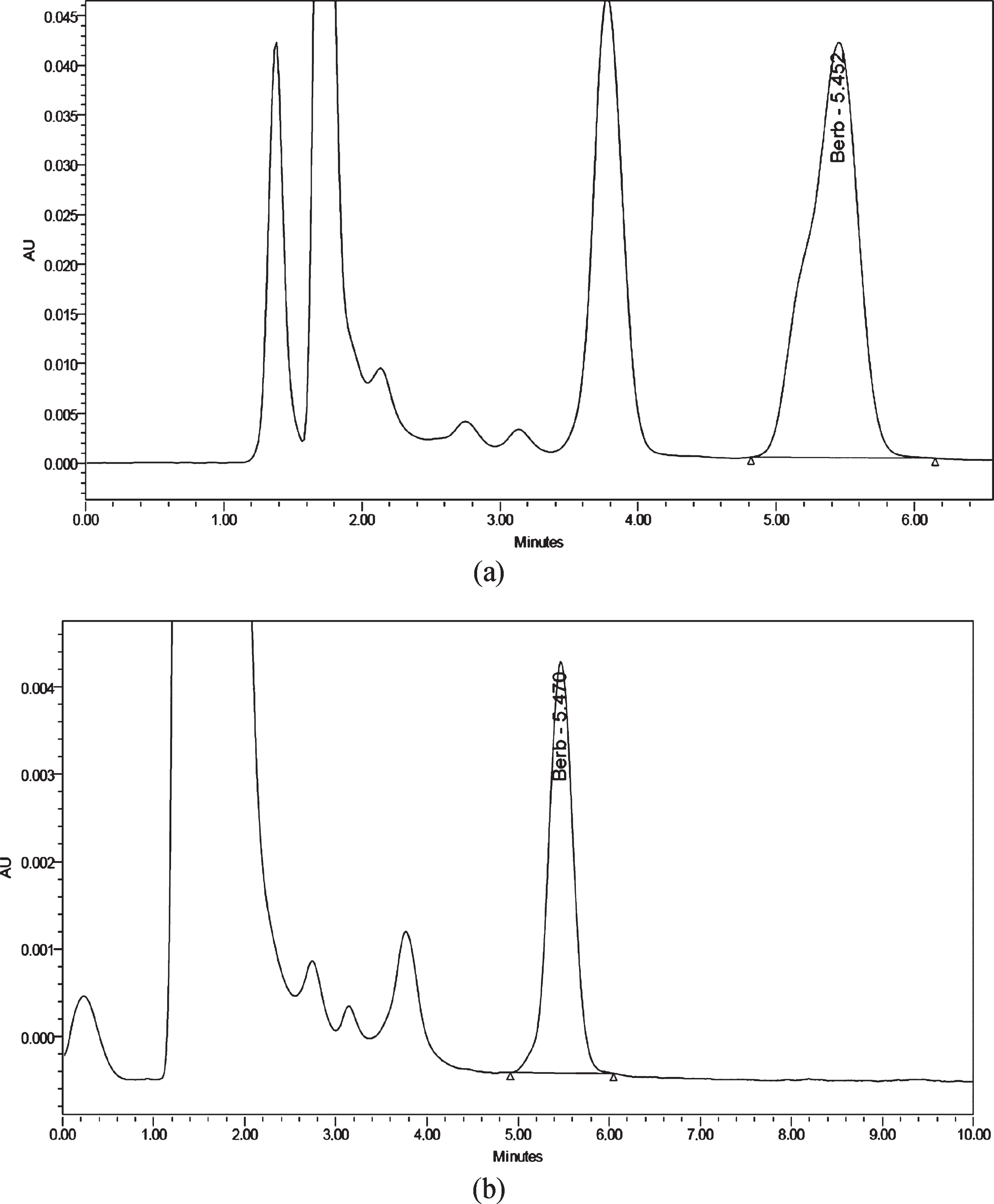
The results of HPLC chromatogram of stem extract of B.integerrima (a) leaf extract of B.thunbergii (b).
Antioxidant properties of barberries were summarized in Table (2). The results showed the types of species had a significant effect on scavenging free-radical of DPPH. The highest amount of antioxidant activity was observed in the stem of B.integrrima (82.86%). However, it had no significant difference with the stem of B.thunbergii (81.55%) (P > 0.05). The lowest level of antioxidant activity was related to the fruits of two species. The results showed that the level of scavenging radical DPPH in the leaves and fruits of seeded species was 83.42 and 70.53%, respectively. The antioxidant activity was lower in the leaves and fruits of seedless species (60.5 and 62.3 %, respectively). Famobuwa et al. (2016) investigated the antioxidant activity of the fruit and stem bark of Tetrapleura tetraptera Taub (Mimosaceae) and reported the stem bark performed better as an antioxidant agent [40]. More antioxidant activity was predictable in leaves of B.thunbergii as the amount of phenolic compounds and berberine in leaves of B.thunbergii were more than B.integerrima. Rafat et al. (2011) evaluated the antioxidant potential and phenolic compounds content in ethanolic extracts of stem, fruit, and leave of Andrographis paniculata and declared the fruit and stem had the highest phenolic and antioxidant activity, respectively [41]. The phenolic compounds and berberine can act as an antioxidant compound [42, 43]. Therefore, the presence of compounds such as phenolic compounds and alkaloids like berberine are the main reasons for antioxidant activity in barberry. Awan et al. (2014) have studied on antioxidant activity of different species of barberry. The result showed amount of phenolic compounds had no significant difference, but antioxidant activity in B.psedumbellata (80.6%) was more than B.orthobotrys (71.15%). The results showed the amount of the other compounds, which have antioxidant properties are more effective on antioxidant activity of barberry plant [44].
The stem of B.integrrima was selected as the best part for the extraction optimization as it had the most amount of berberine in comparison with other parts of two species. Also, total polyphenols, scavenging radical DPPH of the stem was more than another.
Nevertheless, some studies could not find any relationship between total polyphenols and antioxidant activity of B. vulgaris fruit extract. As the various phenolic components have different results with the Folin-Ciocalteu method that depends on their chemical structure [45]. Therefore the antioxidant activity of an extract could not be predicted based on its total phenolic content [46].
Berberine content
The yield of berberine extraction was affected by multiple parameters like temperature, time, and solvent concentration. The results were summarized in Table 3 and Fig. 2.
The results of treatments based on the central composite design
The results of treatments based on the central composite design
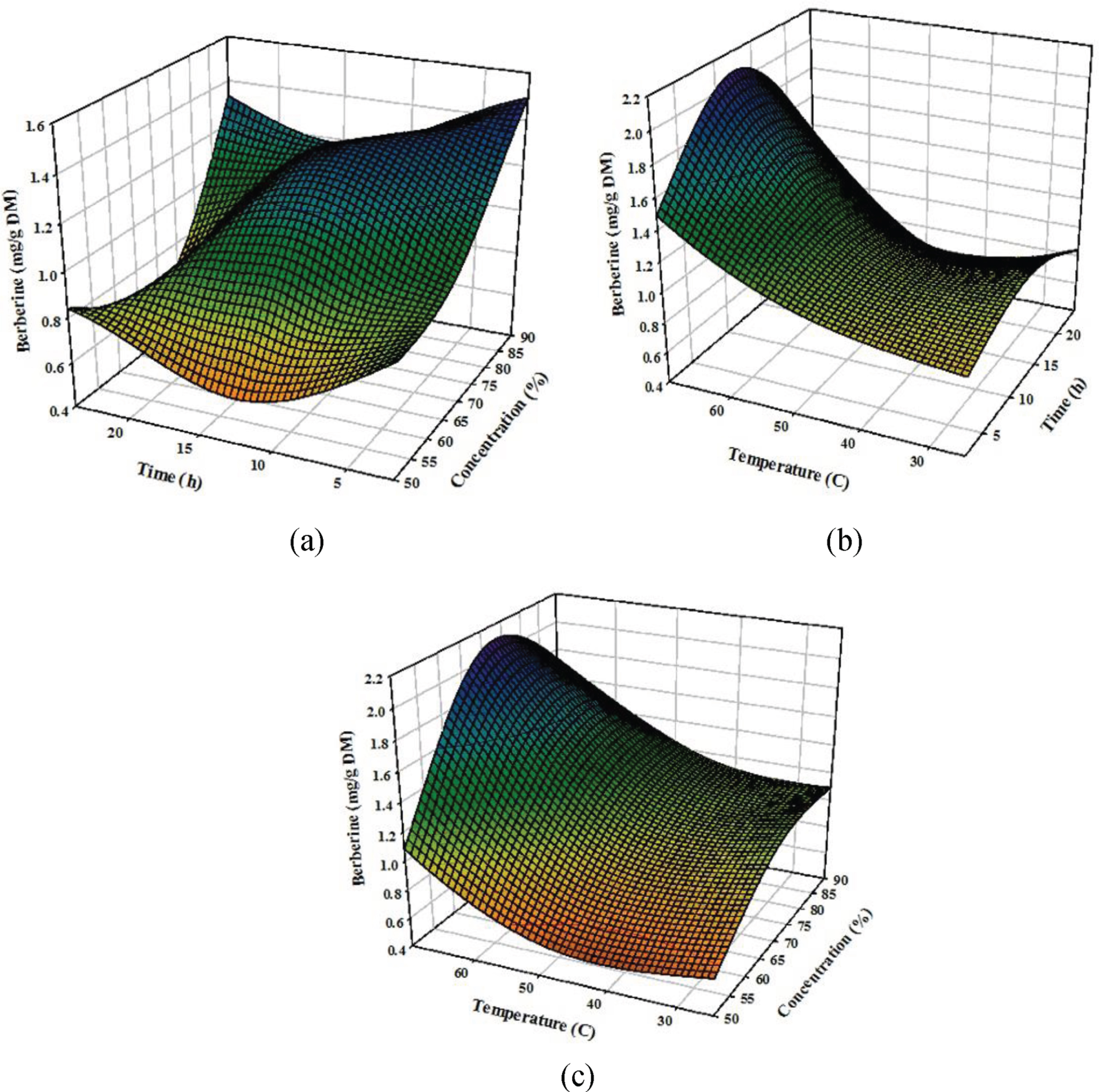
The effects of concentration (X1) and time (X2) (a) temperature (X3) and time (X2) (b) concentration (X1) and temperature (X3) (c) on berberine content of B. integerrima stem.
The different concentrations of ethanol (50, 70, and 90%) were obtained by RSM software and the effects of solvent concentrations were investigated. The ethanol concentrations had a significant impact on the yield of extraction (Fig. 2a). The berberine contents increased by increasing ethanol concentration (P < 0.05). On the other hand, the extraction increased when extraction time was more than 13 h. The best yield of extraction was related to interaction of 70% concentration and time 24 h. Rojsanga et al. (2006) studied the effect of ethanol (50 and 80%) for maceration and more percentage of ethanol result in more extract the berberine [47].
The temperature caused the most positive regression coefficient and extraction increased steadily. In addition, the berberine content slightly raised during 13 h (780 min). The best interaction of the temperature and time was observed in the highest temperature and 13 h (780 min). The effect of time and temperature on berberine extraction are shown in Fig. 2b.
Ethanol concentration and temperature had significant effects on extraction response. The berberine extraction significantly increased (P < 0.05) in the highest temperature and concentration 70% (Fig. 2c). The berberine extraction increased by increment of ethanol concentration from 50 to 70 %, after that it was constant. Furthermore, it also increased when the temperature of extraction reached >47.5°C (P < 0.05).
The results of the ANOVA are shown in Table 4. A model F-value (13.69) with a p-value (0.0003) indicated that it could be used to predict the berberine extract yield. Also, the values of R-squared (0.931), revealed that the model was sufficiently accurate and generally available. The predicted model of berberine determination was quadratic with lack of fit 3.73 and the final equation was given below:
ANOVA for response surface quadratic model analysis of variance table
The quadratic model was predicted for total phenol content (Equation 4). The below equation in coded levels for prediction of the maximum phenolic compound extracted is given:
The ANOVA table of independent variables (Fig 3a) indicates solvent concentration had the least effect (P < 0.05) on the extraction of phenolic compounds. Ethanol concentration did not have a significant effect on the extraction efficiency of phenolic compounds. The time of extraction influenced on total polyphenols considerably during first 13 h and then the trend was steady. It was observed extraction time of 13 h (780 min) and ethanol 90 % had the most effect on extracting the phenol compounds (Fig. 3a).
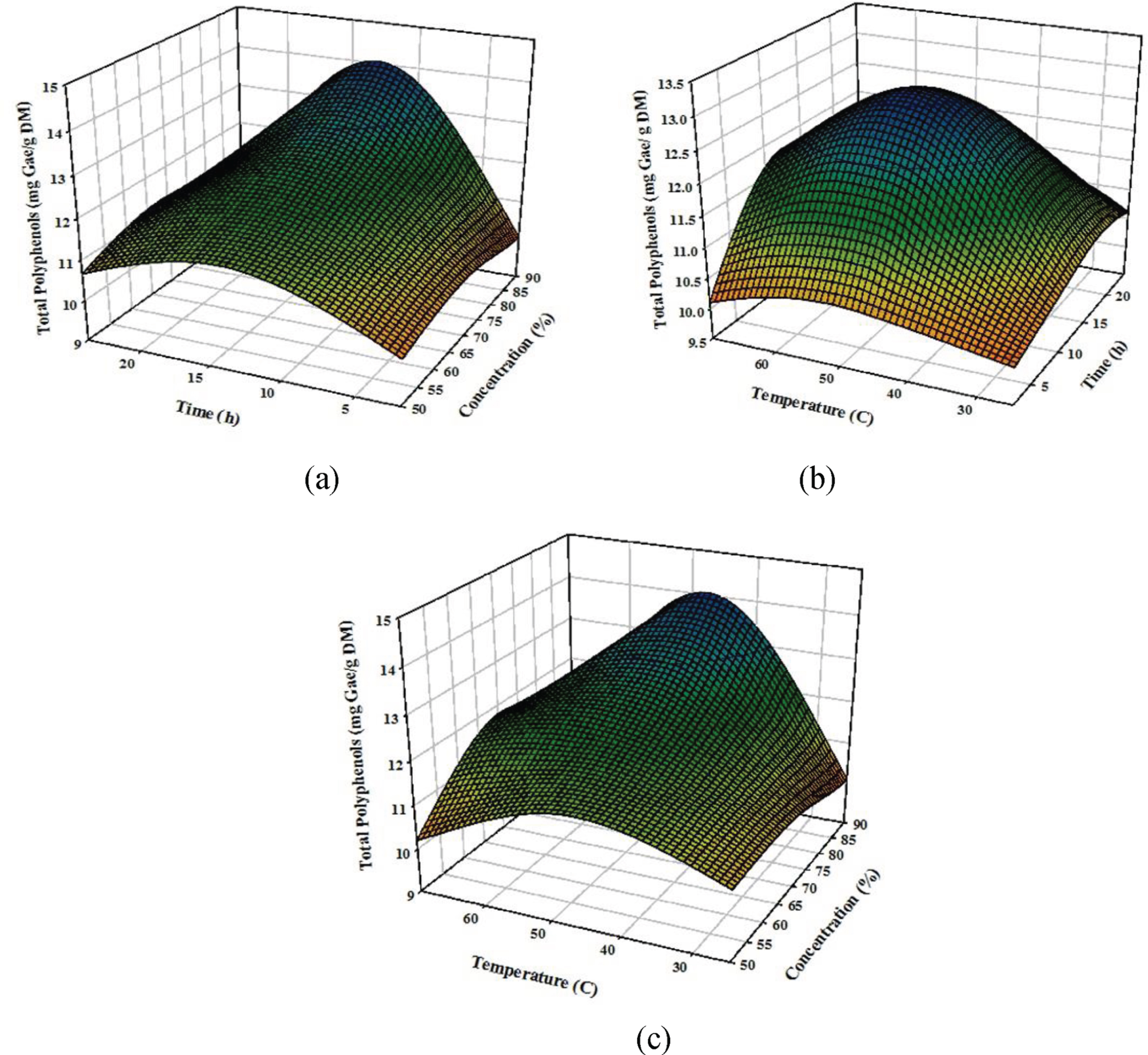
The effects of concentration (X1) and time (X2) (a) temperature (X3) and time (X2) (b) concentration (X1) and temperature (X3) (c) on phenolic content of B. integerrima stem.
As shown in Fig. 3b, the phenolic content increased during 13th h of extraction time, then there was a steady trend. On the other hand, temperature has no noticeable influence on total polyphenols content. The interaction effect of time and temperature showed 47.5°C for 13 h increased the phenol content. Duncan’s test showed the extraction time and temperature had no significant effect on total polyphenols (P < 0.05).
The extraction yield of phenolic compounds declined with increasing ethanol to 70%. However the differences were insignificant. On the other hand, the result manifested that the highest extraction of phenolic compounds was at temperature 47.5°C. Their interaction showed that total polyphenols content would reach to the highest level if temperature and concentration were 47.5°C and 90%, respectively (Fig. 3c). The responses illustrated that the model was well fitted and it was adequate to make a precise estimation in the experimental study. Lacks of fit R2 were 4.11 and 0.926, respectively.
The best model for the describing of antioxidant content was quadratic and all of the variables were effective on the response (P < 0.05) (Table 3 and Fig. 4).
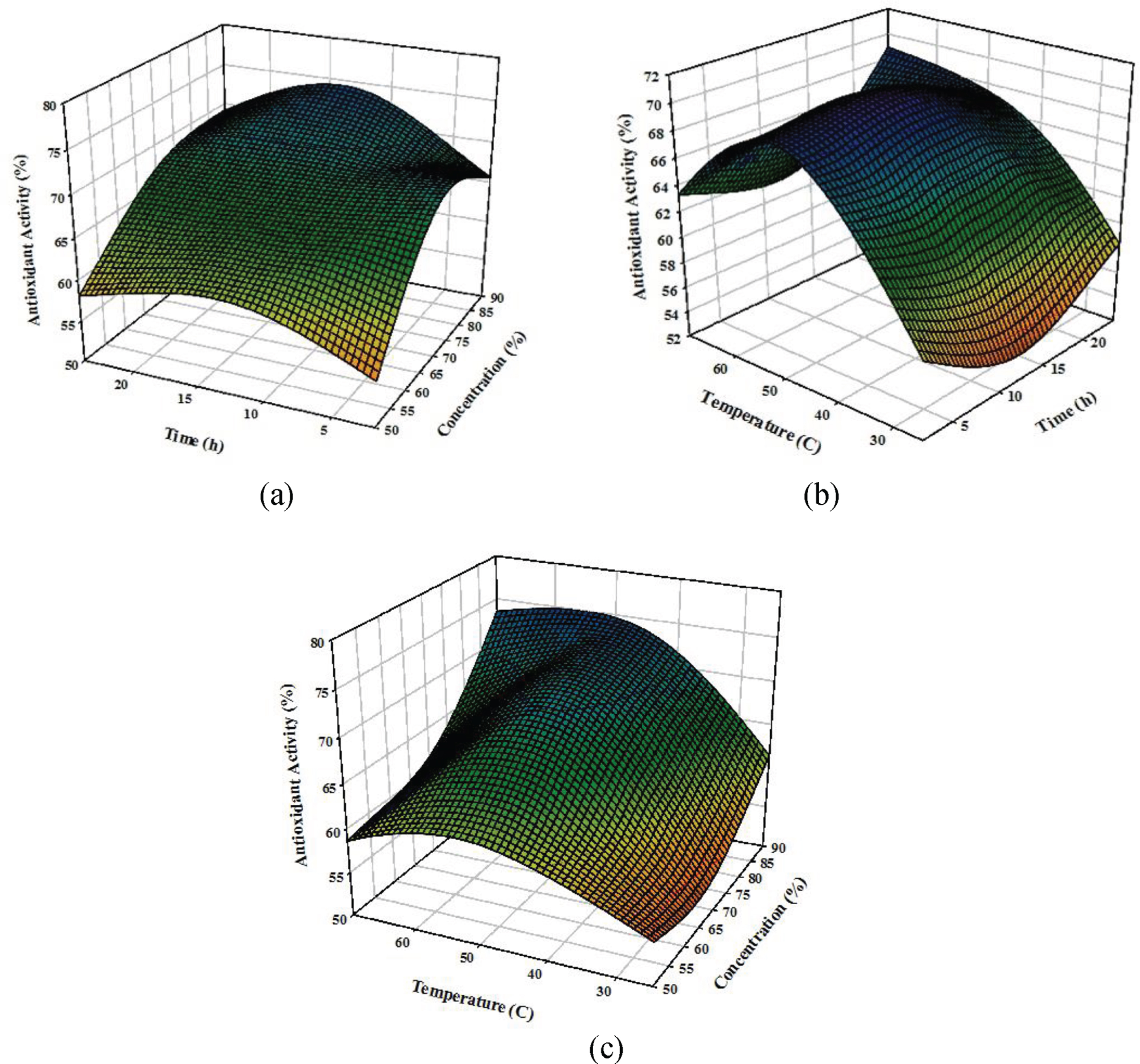
The effects of concentration (X1) and time (X2) (a) temperature (X3) and time (X2) (b) concentration (X1) and temperature (X3) (c) on antioxidant activity of B. integerrima stem.
The results scavenging radical DPPH showed an increasing trend by increasing ethanol concentration (Fig. 4a) and a slight rising trend from 2 to 13 h (120 to 780 min). Then it was constant near 60% ethanol. Antioxidant content improved by interaction ethanol of 90% for 13 h.
Fig. 4b represents the effects of time and temperature on the extraction value of total polyphenols. Both of them had positive effects on the response. The amount of antioxidant activity was evaluated ∼55% at the minimum temperature that reached to a maximum value at 47.5°C (∼68%). The increasing temperature to > 47.5°C led to reduction of antioxidant activity (P < 0.05). Time also was effective on the extraction of antioxidant compounds (13 h<). However, the highest level of extraction yield was observed at maximum temperature and time. Babu et al. (2012) found that temperature had more impact on berberine extraction in comparison with extraction time. They reported extraction with hot ethanol (50°C) was more effective [21].
The solvent concentration demonstrated quadratic effects on the responses (Fig. 4c), while the effect of temperature was linear regardless of the proportion of ethanol in the medium. Radical DPPH scavenging increased at 47.5°C, whereas the situation was constant at more temperature. The antioxidant activity also raised along with increasing concentration of 70% <. Maskooki et al. (2013) reported the highest yield was related to methanol and then the highest percentage of ethanol (ethanol 75 %) [48]. On the one hand, the purpose of extracting berberine is the use in the food industry. On the other hand, methanol is toxic in the food industry. Thus using ethanol is safer than the others.
After measuring scavenged radical DPPH, lack of fit was 1.24 and R2 was equal to 0.817. Also, the below equation in coded levels for prediction is obtained:
A second-order polynomial model is experimentally used by process engineers for optimization study. ANOVA is required to test the significance and adequacy of the model by using F-test [49]. The results of F-test in Table 4 suggest the model had a very high F value and a very low p value.
The confirmatory experimental optimum conditions were as follows: ethanol concentration of 90%, temperature of 70°C and extraction time of 3.36 h (141.6 min). Under these conditions, the experimental yield of the berberine, phenolic, and antioxidant contents from stem were 1.86 mg g–1, 11.11 mg Gae g–1, 71.84%, respectively, which was highly closed with the predicted yield value (berberine: 1.94 mg g–1; Total polyphenols: 10.76 mg Gae g–1; Antioxidant activity: 70.66%). The time had the least impact on antioxidant activity, whereas ethanol concentration was effective and ethanol 90% has the highest efficiency. The temperature of 47.5°C was also suitable to reach the optimal result. Thus the effects of independent variables showed the highest temperature, 2 to 13 h (120 to 780 min) and concentration 70% <increased berberine content. The concentration had also a slight effect on the extraction of phenolic compounds, but 90% in 47.5°C and 13 h (780 min) was optimal levels. By considering the regression coefficients obtained for independent and dependent variables, ethanol concentration and temperature were the most important factors, which significantly influence on extraction. By contrast, the highest temperature resulted in more efficiency. The replication of the test was fitted with the predicted conditions by the software, as presented in Table 5. The result shows that there is a good agreement between the model of RSM and experimental data.
Predicted and experimental values of the responses at optimum conditions
Predicted and experimental values of the responses at optimum conditions
The effect of Pulsed Electric Field-assisted on the amount of berberine, total phenol and antioxidant activity were investigated and compared with the maceration method.
Brodelius et al. (1988) reported the electroporation technique was illustrated by the release of the berberine from freely suspended [50]. As it can be seen in Fig. 5a, n = 100 and 1000 Vcm–1 had the best yield of berberine (2.79 mg g–1) in comparison with maceration without PEF (1.87 mg g–1). On the other hand, the least electric field strengths and pulse number had the lowest efficiency in the extraction of berberine content, and there was no significant difference with maceration treatment (1.86 mg g–1). The application of an external pulsed electrical field can induce the formation of pore on the cell membrane [51]. Therefore, the effect of pulsed electronic field has been observed inside the cell, so that it is responsible for the leakage of intracellular compounds between the detected membrane and the cell wall [31]. The results illustrated PEF was ineffective for creating pore on barberry stem cells at lower strength and pulse numbers. Nevertheless, as each parameter was increased, the percentage of the extraction increased, as far as there is the highest level of berberine extracted in n = 100 and 1000 Vcm–1. Then the compound decreased with increasing field strengths. On the other hand, the evidence showed that temperature increased (∼50°C) when the sample treated at n = 100 and 1250 Vcm–1. Therefore, the reduction of berberine can be related to increase of temperature. This compound is sensitive to heat and light. So it seems temperature along with electric pulse had a negative effect on berberine.

Comparison of extracted berberine (a) total polyphenols (b) antioxidant activity (c) by maceration and PEF (n = 50, field strengths = 250, 1000 and 1250 V cm–1 and n = 100, field strengths = 250, 1000 and 1250 V cm–1) in stem of B.integerrima. *Values followed by the same letter are not significantly different (P < 0.05).
As Fig. 5b shown, both parameters (n and fs) were effective on total polyphenols. The change of strengths had generally a greater effect on the extraction of phenolic compounds in comparison with the number of pulses. In addition, the electric field strengths (1250 Vcm–1) had a significant effect on the extraction of berberine at pulses of 50 and 100. In general, the amounts of total polyphenols were more (>12.03 mg Gae g–1) in all pulsed treatments than the optimum sample in the maceration method (11.11 mg Gae g–1). Boussetta et al. (2015) reported that the total polyphenols of extracts PEF-treated samples were noticeably higher than untreated ones [31].
Analysis of scavenging radical DPPH showed that the variations of strengths and pulse numbers had no significant effect on antioxidant property. Increasing pulse numbers led to a downward trend in efficiency. The results illustrated PEF treatment in n = 100 and V = 1000 V cm–1 had an optimal situation to obtain the highest antioxidant activity (Fig. 5c).
Although PEF technology increases cell membrane permeability [52], the raise of time intensity and pulse number can have negative effects on extraction. In another study, the ultrasound waves applied to pomegranate seed. They observed the amount of polyphenols and antioxidant activity decreased due to the increase in ultrasonic intensity and time [53]. It is probably related to the degradation of some active natural compounds. In addition, higher intensity and longer duration make the cell wall to break more, following that, further insoluble compounds will extract. In this research, although electric field strengths 1250 Vcm–1 resulted in the highest extraction of phenols, it led to the lowest antioxidant activity. This trend showed there was a sensitive compound in extraction. The treatment of n = 100 with 1000 Vcm–1 and 1250 Vcm–1 had the highest and lowest antioxidant activity, respectively (Fig. 5c). This can also be attributed to the polymerization reactions of polyphenolic compounds with themselves. Another reason for the decrease in antioxidant activity is oxidation due to exposure to more pulse [54]. Therefore, these compounds were extracted in the early times of the process, and the longer times did not have much effect on the extraction process of these compounds.
Comparison both methods (maceration with and without PEF) illustrated pulsed electric field-assisted method had high yield for extraction. The maceration with n = 100 and fs = 1000 Vcm–1 had the highest efficiency between methods. In the best condition of maceration, the amount of berberine, total polyphenols and antioxidant activity were 1.86 mg g–1, 11.11 mg Gae g–1 and 71.84%, recpectively. By applying PEF-assisted method, the amount of berberine, total polyphenols and antioxidant activity reached to 2.78 mg g–1, 14.57 mg Gae g–1 and 78.6 %, respectively. Guderjan et al. (2007) reported PEF was effective on antioxidative capacity of rapeseed extract and this method result in +13 and +11% increment of antioxidative capacity in non-hulled and hulled rapeseed, respectively [55]. Boussetta et al. (2015) demonstrated that the PEF had a positive impact on the yield and antioxidant properties of juice as well as on the recovery of bioactive compounds from blueberry by-products [31].
According to the presence of various nutritional compounds in the barberry plant, choosing a suitable and efficient extraction method can be very useful. The results showed that the most amounts of berberine and scavenging radical DPPH were in the stem. The best condition for extraction of berberine by maceration obtained with ethanol 90% in 3.36 h (141.6 min) at 70°C. The ethanolic concentration and temperature were two effective parameters on the extraction of berberine. The PEF treatment had a positive impact on radical DPPH scavenging and increasing yield of antioxidant content extract. The amount of berberine, antioxidant capacity and total polyphenols increased significantly when PEF is used as pre-treatment. The best condition for extraction of berberine from barberry stems by PEF treatment was 1000 V cm–1 and n = 100.
Conflicts of interest
All authors have declared that they do not have any conflict of interest for publishing this research.
Footnotes
Acknowledgments
Authors are thankful to Golshad Mashhad Food Industries Co. for financial support. We are also grateful to the botanical garden of Food Science and Technology Institute for providing plant samples.