



Abstract
BACKGROUND:
Blueberries are rich in organic and inorganic compounds, such as sugars, proteins, and polyphenols. But this fruit is highly perishable and difficult to store and transport. Currently, to increase their shelf life, blueberries are often processed into a variety of products. For example, drying is the most frequently processing method. However, the effect of the drying process on flavor and quality remains unexplored.
OBJECTIVE:
In this study, blueberries were hot air dried at 50, 60, 70, and 80°C. The effect of different drying temperatures on blueberries’ flavor substances and quality, including moisture content, color, reducing sugar, and free amino acids, were investigated.
RESULTS:
The results demonstrated a significant reduction in the moisture, reducing sugar, and free amino acid contents in dried blueberry products with the drying temperature (P < 0.05). In addition, 50°C significantly promoted the formation of free amino acids, linalool and, α-terpineol crucial flavor components present in blueberries (P < 0.05). Furthermore, minimum thermal damage was observed. In the flavor principal component analysis, the blueberry samples dried at 50°C were the closest to the raw material among all the temperatures tested. Therefore, 50°C was more suitable for blueberries hot air drying and maintaining the high-quality.
CONCLUSION:
Overall, this study could explore the influence of different temperatures on the quality of blueberry-dried products and could help optimize the future production and industrialization of blueberries.
Introduction
Blueberries and their derived products are very well accepted by the population due to their attractive taste and rich nutrients [1]. Blueberries contain a high nutritional value and are composed of several nutrients, including vitamins, amino acids, minerals, anthocyanins, flavonoids, ellagic acid, polysaccharides, and other functional ingredients. In addition, it has been described that blueberries exhibit potent antioxidant activity. Furthermore, they present several benefits to human health, such as anticancer activity, vision protection, and coronary heart disease risk reduction. Therefore, blueberry is considered one of the five healthy foods by the Food and Agriculture Organization of the United Nations (FAO) [2–4].
Blueberries are highly perishable, and because of this, fresh blueberry consumption is frequently restricted by seasonal supply [5]. Moreover, over the years, products have been developed, including blueberry vinegar, blueberry wine, blueberry juice, blueberry pulp, and dried fruit, to increase the blueberries’ shelf life. Furthermore, various processing methods can be applied to produce blueberry-based products. For example, drying is a commonly used processing method in food, promoting shelf life, increasing product diversity, and reducing product volume [6–7]. The drying process is frequently used to reduce the water content to allow long-term storage and preserve the nutrients in blueberries. Therefore, this process can promote the use as the ingredients or additives in food products, medicine, and cosmetics [8]. Furthermore, previous studies mainly focused on the extraction of active compounds present in blueberries [9], the evaluation of antioxidant activity [10], and the optimization of processing parameters. However, the effect of drying temperature on the blueberry quality and flavor remains unexplored.
On the other hand, it has been described that the processing process can directly influence the sensory quality and acceptability of blueberries. Flavor substances are the main characteristics to evaluate the quality of dried products [11]. Hot air drying is a commonly used method of food drying, showing several advantages, including low investment, low cost, and simple operation. However, the flavor substances can be affected because of a longer drying time, is adverse to the preservation of heat-sensitive substances, and induce non-enzymatic and enzymatic browning. Currently, studies demonstrating the effect of this process on the flavor substances of blueberry under different temperatures during hot air drying remain unexplored. Therefore, it is understanding the effect of processing temperature on the flavor substances present in blueberries is crucial. Moreover, this understanding could be essential to improve the quality of blueberry-dried products. Therefore, this study aimed to investigate the changes in flavor substances and related quality of blueberries using different hot air drying temperatures (50, 60, 70, and 80°C). For that, a headspace solid-phase microextraction (HS-SPME) combined with gas chromatography-mass spectrometer (GC-MS) was performed to determine and quantify the presence of volatile compounds. Furthermore, the principal component analysis (PCA) evaluated changes in these flavor substances.
Overall, this study can provide a deep insight into the formation pathways of flavor substances during the drying process, which is an essential guideline for adjusting the production conditions to control the formation of blueberry flavor substances.
Materials and methods
Materials and reagents
Blueberries were purchased from Anqing Blueberry Agricultural Technology Co., Ltd. (Anhui Province, China). The blueberries were uniform in size, moderate in maturity, with no decay or damage. After, blueberries were packed in different woven bags and stored at –20°C for further use. Finally, all the chemicals were of analytical grade and purchased from Sinopharm (Shanghai, China).
Sample preparation
First, the frozen blueberry fruit was thawed at the room temperature, rinsed with running water, and the water was drained. After, 50 g of blueberries (50 g) were spread in the drying dish to avoid overlapping blueberries and imbalanced heating during the drying process. Then, the samples were dried to obtain a constant weight at different drying temperatures (50, 60, 70, and 80°C) in a hot air drying oven (DHG-9140A, Shanghai Yiheng Scientific Instrument Co., Ltd., China). In this study, the weight difference between the two samples was below 2 mg. Finally, the dried blueberries were sealed in a polythene bag and stored at –4°C for further testing.
Quality characteristics evaluation
Moisture content
In the study, the moisture content of blueberries was determined using the direct drying method described previously in the State Standard of the People’s Republic of China (GB 5009.3-2016) [12]. Furthermore, all the samples were evaluated in triplicate, and the moisture content was calculated by the weight of water lost as a percentage of the initial weight.
Color analysis
Dried blueberries obtained from different drying temperatures were ground and the color was determined as described by Diane M. Barrett and collaborators [13]. For this assay, a hand-held colorimeter (CR-400, Konica Minolta, Japan) was applied for color measurements. Then, the equipment was standardized with a white plate (
Where
In this study, the color parameters L*, a* and b* were averaged over 15 measurements.
Amino acid analysis
Additionally, the free amino acids content was determined according to a previous method with slight modifications [14]. Briefly, fresh and dried blueberries were ground, and 0.4 g of blueberry pulp or 0.1 g of dried blueberry powder were mixed with 5 mL of sulfosalicylic acid (40 g/L). After shaking, the mixture was extracted using an ultrasonic extractor (KQ-700 V, Kunshan Ultrasonic Instrument Co., Ltd., Jiangsu Province, China) for 35 min and resting for 10 min. Then, the samples were centrifuged at 12000 r/min for 15 min at room temperature using a high-speed freezing centrifuge (Multifuge X1 R, Thermo Fisher, Germany). After, the supernatant was collected and filtered through a 0.22μm aqueous phase filter membrane. Finally, the filtrate was analyzed using an amino acid automatic analyzer (L-8900, Hitachi, Tokyo, Japan). This assay was performed in triplicate.
Determination of reducing sugar content
In this study, the reducing sugar content was evaluated by the national standard GB 5009.7-2016 for reducing sugar in food [15].
Extraction and analysis of flavor substances
Extraction of flavor substances
Flavor substances from blueberry samples were extracted using the HS-SPME method described by Kaixuan Li and collaborators [16] with minor modifications. Briefly, 10 g of blueberry pulp or 5 g of blueberry powder were transferred into 20 mL headspace vials and sealed. Before the extraction procedure, the samples were incubated at 60°C in a water bath for 10 min. Then, as described previously, the flavor substances were adsorbed by a solid phase microextraction fiber (50/30μm DVB / CAR / PDMS, Supelco) for 40 min. Finally, the fiber was incorporated into the GC-MS injection port (QP2010, Shimadzu, Tokyo, Japan), and the thermally desorption process was performed at 250°C for 5 min.
Flavor substances analysis
In this study, the flavor substances were performed using a GC-MS system with an SH-Rxi-5si MS column (30 m×0.25 mm×0.25μm, Shimadzu, Tokyo, Japan) [16]. Therefore, the column temperature for this experiment was defined as 40°C for 5 min, followed by an increase to 180°C at 10°C/min, increased to 210°C at 5°C/min (and maintained for 5 min). Finally, the temperature was increased to 250°C at 20°C/min. Therefore, the total drying time used in this study was 40 min. Finally, the ionization energy was defined as 70 ev, and the mass scanning range of mass spectrometry (MS) ranged between 45.0∼450.0 amu.
Flavor substances identification
After extraction, the blueberry flavor substances were identified by comparing their mass spectra with those in the mass spectra of the National Institute of Standards and Technology (NIST) 11 library. Therefore, only the volatile components exhibiting similarities higher than 80% were used for this study as qualitative results. The area of each peak was integrated and reported as an indicator of flavor substances from 5 blueberry samples.
Data statistics and analysis
Data were expressed as the mean±standard deviation (SD). The significant differences (P = 0.05) were determined using a one-way analysis of variance (ANOVA) and t-test. The analysis was performed using the statistical software SPSS 26.0 (IBM Corporation, Chicago, USA).
Results and discussion
Drying temperatures affect the moisture content in dried blueberry products
In food, water has a great influence on food structure, appearance, taste, and biochemical reactions rate. In this study, the effect of different drying temperatures on the moisture content present in blueberries is shown in Fig. 1. The results demonstrated that the moisture contents decreased from with the temperature. In addition, no significant differences were detected in the water content when the temperature ranged between 60°C and 80°C (P > 0.05). However, a significant reduction was observed when compared to 50°C (P < 0.05). This result indicates that lower temperatures could delay the water diffusion in the blueberry. Furthermore, drying may cause significant the skin layer shrinkage, which limits heat and mass transfer phenomena [7].
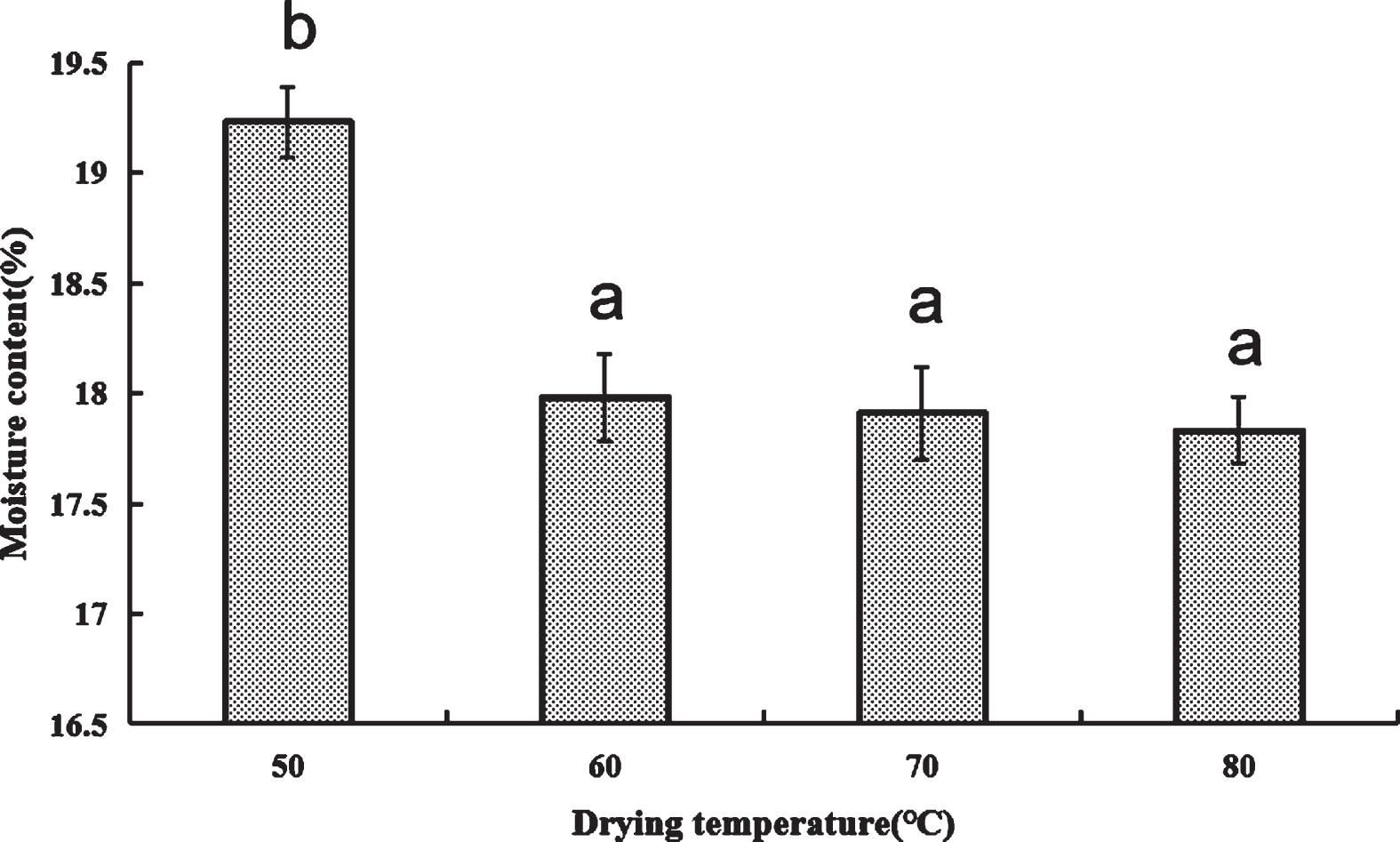
Moisture content results of dried blueberry products at different drying temperatures. a–bin the column indicates that the different letters are significantly different (P < 0.05).
In addition to moisture content, this study also aimed to evaluate changes in the color of blueberries under different drying temperatures, and the results are shown in Table 1. The results revealed significant changes in the redness a* and brightness L* under the four drying temperatures compared to fresh blueberries (P < 0.05). On the other hand, no significant differences were detected in the Δb* parameter (P > 0.05). Furthermore, no significant change were observed in the color a*, b*, and L* under the tested temperatures (P > 0.05). However, the brightness L* value reached the maximum at 50°C, while the brightness of fresh blueberries was the lowest. Additionally, the redness a* value was significantly lower than in fresh blueberry at 50°C, reaching the minimum at this temperature (P < 0.05). These results do not agree with previous results obtained by Magdalena Zielinska and collaborators [7]. On the other hand, when the samples were heated and dried, anthocyanins can be exposed to oxygen molecules participating in some biological pathways, such as oxidation, hydrolysis, enzymatic and nonenzymatic degradation, resulting in the reduction of the a* value [17].
Color results of dried blueberry products at different drying temperatures
Color results of dried blueberry products at different drying temperatures
Note: a–cin the column indicates that the different letters are significantly different (P < 0.05). L*: brightness; a*: redness; b*: yellowness. Control: fresh blueberry.
In this study, an additional parameter, free amino acid content, was analyzed under different drying temperatures (Table 2). As a result, it has been possible to identify 14 free amino acids in the blueberry samples. Furthermore, the highest content in fresh blueberries was observed for the arginine (Arg), accounting for 75.32% of the total free amino acids. γ-Aminobutyric acid (GABA) was the second most prevalent element (216.89±2.74 ug/g), accounting for 6.58% of the total free amino acids. Additionally, 6 essential amino acids, including threonine (Thr), valine (Val), isoleucine (Ile), leucine (Leu), phenylalanine (Phe) and histidine (His), were detected in fresh blueberries (116.42 ug/g), corresponding to 3.53% of the total free amino acids.
Effect of drying temperature on free amino acid content in blueberry samples
Effect of drying temperature on free amino acid content in blueberry samples
Note: Different superscript letters (a–e) in the same row indicate statistically significant differences at P < 0.05. “–” Not detected. “*” Essential amino acids. Control: fresh blueberry.
This study detected significantly differences in the free amino acids content when the temperature ranged between 50°C to 80°C. Furthermore, a significantly higher free amino acids content was obtained than in the fresh blueberries at a low temperature of 50°C. In addition, a significant decrease in the content of free amino acids was observed when the drying temperature increased. These results suggest that during these lower temperatures, the pyrolysis of proteins or the continuous release of amino acids increasing the amount of free amino acids in blueberries. However, when the drying temperature was increased, the Maillard reaction of free amino acid and sugar could accelerate, and the loss of free amino acid exceeded the production of these compounds, resulting in a significant reduction in the free amino acid content [18]. Moreover, a similar trend was observed in the total amount of essential amino acids. Therefore, when the temperature increased, the essential amino acid content in blueberries decreased. Compared with fresh blueberries, it decreased by 7.32%, 36.19%, 43.90% and 64.17% at 50, 60, 70, and 80°C, respectively.
It has been reported that amino acids have physiological functions being essential sources of taste substances in food products. Therefore, during the food thermal treatment process, the content and change of free amino acids are closely related to the formation of food flavor. According to the taste intensity of fresh, sweet, sour, bitter, and astringent, a previous study classified amino acids into fresh, sour, sweet, bitter, and salty amino acids [19]. For example, glutamic acid (Glu) and aspartic acid (Asp) are considered fresh amino acids, and GABA belongs to the sour amino acids. On the other hand, sweet amino acids include alanine (Ala), serine (Ser), threonine (Thr), glycine (Gly), and proline (Pro), and bitter amino acids comprise Ile, Leu, tyrosine (Tyr), tryptophane (Try), and valine (Val). Finally, salty amino acids contain cysteine (Cys) and methionine (Met). As shown in Fig. 2a, the sour amino acids content was significantly increased with the temperature than in the fresh blueberries (P < 0.05). Contrarily to fresh amino acids, sweet and bitter amino acids increased at 50°C, but a significant decrease was observed when the temperature was higher than 50°C (P < 0.05). Therefore, the results indicate that free amino acids can modulate the flavor quality in blueberry products.

Effect of drying temperatures on free amino acid content in fresh, sour, sweet, bitter, and salty taste (a) and reducing sugar content (b). a–ein the column indicates that the different letters are significantly different (P < 0.05). Y: fresh blueberries.
The content of reduced sugar was also evaluated in this study (Fig. 2b). The results demonstrated that the content of reducing sugar in fresh blueberries was 14.81±0.72%, higher than total sugar content obtained by Aliman and collaborators [20]. This may be caused by different types of raw materials. Furthermore, a decrease in the reducing sugar content was detected when the drying temperature increased. The result suggest that the Maillard reaction occurs in reducing sugar and free amino acids during the drying process, leading to a significant decrease in this content. Therefore, considering these results, the Maillard reaction between reducing sugar and free amino acids needs to be explored in future experiments.
Effect of different drying temperatures on flavor substances of dried blueberry products
As shown in Tables 3 4, several flavor substances were detected under different drying temperatures, including alcohols, aldehydes, ketones, acids, hydrocarbons, and esters. Furthermore, as shown in Table 4, different types and quantities of flavor substances were obtained, and alcohols were the most abundant substance in blueberries. In addition, when the temperature was changed to 50°C, 60°C, 70°C, and 80°C, a significant increase was detected in the number of flavor substances from 20 in fresh blueberries to 49, 40, 55, and 51 flavor substances, respectively.
Changes of some flavor components of blueberry under drying temperatures
Changes of some flavor components of blueberry under drying temperatures
Note: Different superscript letters (a–e) in the same row indicate statistically significant differences at P < 0.05. “–” Not detected.
Types and quantities of flavor substances in blueberry under drying temperatures
The results presented in Table 3 indicate that some flavor substances found in fresh blueberries were detected in the dried blueberry products (Furfural, (Z)-2-Nonenal, 2-methyl-Butanoic acid, Pantolactone). On the other hand, the same pattern can be described for dried blueberry products since some substances present in these products were not identified in fresh blueberry (Pantolactone, 5-methyl-2-Hexanol, 1-Hexanol). These results indicated that the initially volatile substances detected at the beginning of the drying process were lost, but new volatile substances were produced. Therefore, the results agree with previous results obtained in garlic drying [31]. These significant changes in flavor substances before and after drying results can be explained by the degradation of macromolecules the interaction between several biological components and the Maillard reaction [32].
On the other hand, several alcohols were detected, such as 1-hexanol, linalool, 2,3-butanediol, 1-octanol, geraniol, nerol, providing a “flowery”, “fruity”, “sweety” and other aromas to the blueberry sample. It has also been found that linalool and α-terpineol have a relatively high flavor substance content in fresh blueberry (P < 0.05), which is consistent with some research results on key aromatic compounds linalool and α-terpineol in blueberries [28, 33–34]. It has been reported that the aroma recombination of blueberry (E)-2-hexenal, (E)-2-hexenol, (Z)-3-hexenol and linalool expresses the unique flavor of blueberry [28]. Whereas, only linalool was detected in 5 blueberry samples. On the other hand, (E)-2-hexenal and (E)-2-hexenol have not been detected in fresh blueberry. However, (E)-2-heptenal and (Z)-2-nonenal were identified in dried blueberry products. The results may be caused by the long time frozen of raw materials used in this study, resulting in the loss of some flavor substances. Furthermore, after drying at different temperatures, a significant change in the amount of alcohol content in blueberries was identified. On the other hand, at 50°C, new alcohols were detected, including 3-methyl-1-butanol, 1-hexanol, 2,3-butanediol, and 2-pentadecanol. However, some alcohols were lost during the drying process, such as (E)-2-octen-1-ol. Furthermore, the relative contents of cis-linalool oxide, 1-octene-3-ol, linalool, α-terpineol, and phenylethyl alcohol were significantly higher than in fresh blueberry. Moreover, some substances, including 1-methyl-4-(1-methylvinyl) cyclohexanol, L-(-)-menthol, and cedrol, were detected at 60°C and 70°C. Finally, 2-furanmethanol was identified when the temperature reached 80°C. Overall, the results suggest that the temperature could significantly modulate the alcohol content in blueberries during the drying process.
The results in Tables 3 4 showed that two types of aldehydes and ketones were detected in fresh blueberry, such as (E)-2-heptenenal, nonanal, and 6-methyl-5-hepten-2-one, nerylacetone. However, an increase was observed in aldehydes and ketones in dried blueberry products in the presence of different temperatures. On the other hand, the relative content of furfural increased significantly with the temperature, reaching the highest value in flavor substances. The nonanal content was second only to furfural. It has been described that 1-octene-3-ol, linalool and nonaldehyde present high odor activity values, playing a crucial role in the blueberry aroma [27]. Furthermore, furfural is considered one indicators of thermal damage during certain stages of production process [35]. Therefore, it is possible to conclude that furfural change according to the drying temperature and higher temperatures can lead to significant thermal damage in blueberries. Furthermore, aldehydes and ketones reached the maximum value at 80°C, and new substances increased. For example, some new aldehydes were identified at this temperature, including 5-methyl-2-furancarboxaldehyde and 1-h-pyrrole-2-carboxaldehyde. On the other hand, several new ketones, such as furyl hydroxymethyl ketone, were also detected in blueberry samples at 80°C. It has been reported that these substances can be produced during the Maillard reaction [36]. When the drying temperature reached 80°C, the Maillard reaction rate increased, and several new aldehydes, ketones, pyrroles, furans and their derivatives can be created by polymerization and heterocyclization processes [36–37].
This study also detected acetic acid and hexanoic acid in fresh blueberries (Tables 3 4). It has been reported that the acids, including hexanoic acid and 2-Methylbutyric acid, were detected in blueberries [28]. This difference may be due to the different raw materials used. In the present study, 2-Methylbutyric acid was not detected in fresh blueberries, but a higher content of this acid was detected after the drying process since the frozen blueberry raw materials can delay the removal of 2-Methylbutyric acid. In addition, this explanation could also be applied to justify the small amount of hydrocarbons and ester in fresh blueberries.
In this study, PCA was performed to explore the changes of flavor substances in the dried blueberry and to determine the link between free amino acid, reducing sugar, and main flavor substances (including 2-ethyl-1-hexanol, linalool, α-terpineol, nonanal, furfural, and acetic acid). Therefore, Fig. 3a shows the scoring and loading diagram for 5 blueberry samples. As observed, the plot results demonstrated that PC1 and PC2 accounted for 89.15% of the total variance (70.69% and 18.46%, respectively). In addition, the results also revealed that the blueberry samples were distinctly separated in the score plot. Therefore, the results presented here indicate that the effects of temperature on flavor quality can be determined using PC1 and PC2 parameters. Furthermore, it is possible to infer that drying temperature can significantly modulate the flavor substances in blueberries (P < 0.05). Additionally, a significant difference was detected in the flavor quality in the presence of lower and higher temperatures. Furthermore, the results showed that the original flavor could be efficiently retained when 50°C was applied to blueberry samples. Previous studies performed on coffee [38] and tomato [39] exhibited similar results. However, no significant differences were identified in flavor substances between 60°C, 70°C and 80°C were tested in the blueberry samples. On the other hand, significant differences were observed in flavor substances when compared to fresh blueberries (P < 0.05). These results indicate that some chemical reactions, including the Maillard reaction, can occur during the drying process, leading to these differences in the flavor substances [39].
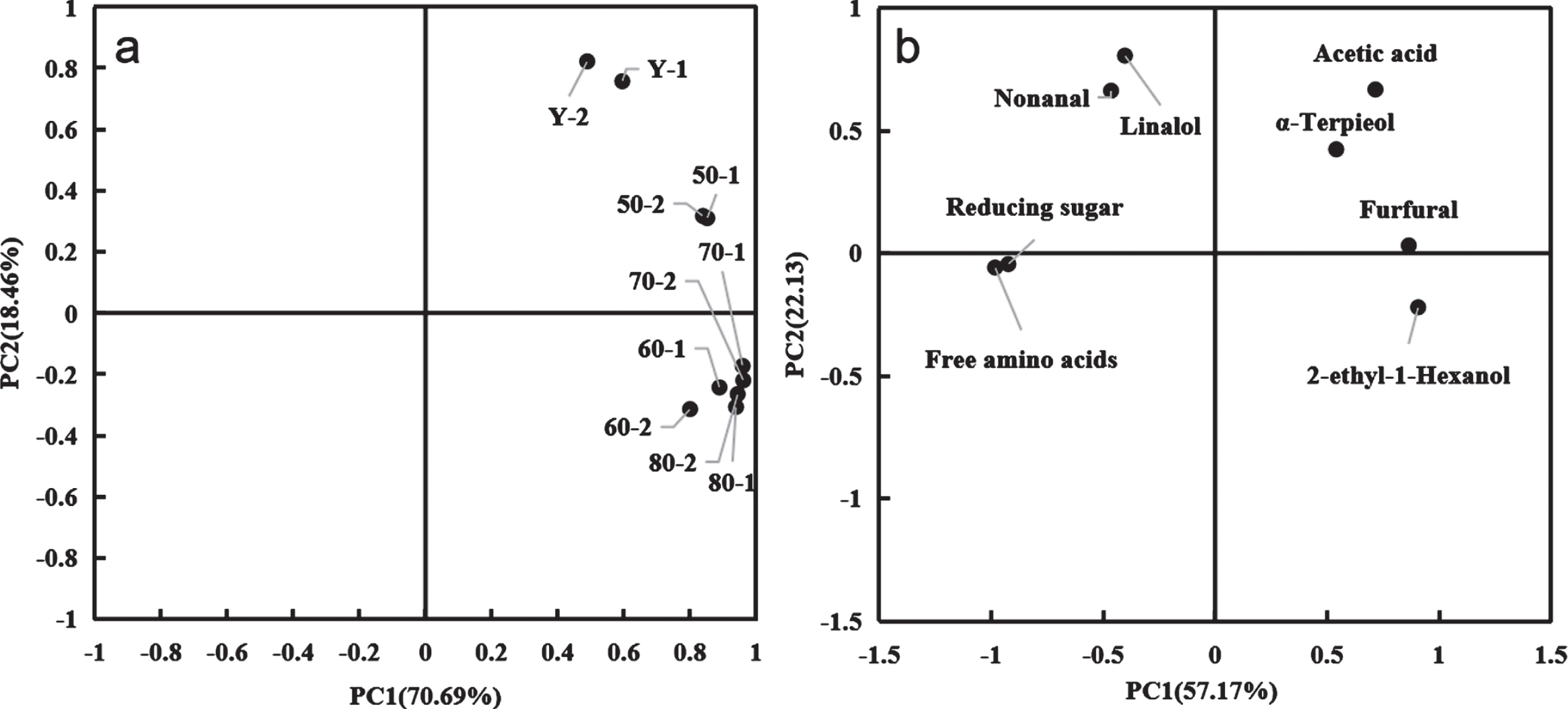
The PCA plot of 5 blueberry samples (a) and main material compositions (b).
In this study, the PCA of free amino acids, reducing sugars, and main flavor substance were also evaluated, and the results are shown in Fig. 3b. The results demonstrated that PC1 (57.17%) and PC2 (22.13%) account for 79.30% of the total variance. Moreover, the free amino acids and reducing sugars were positively correlated with 6 main flavor substances (2-ethyl-1-Hexanol, Linalool, α-terpineol, nonanal, furfural, and acetic acid), indicating that the alterations in blueberry flavor substances could be related to the Maillard reaction that occurs between free amino acids and reducing sugars [36].
Overall this study indicates that the drying temperature significantly affected the quality and flavor of blueberries. For example, a gradual decrease was observed in the moisture content, reducing sugar and free amino acids when the temperature increased from 50°C to 80°C. In terms of color characteristics, a significant change was detected in redness Δa* and brightness ΔL* but not for the yellowness Δb* parameter. Additionally, after the drying process, a significant alteration in the flavor of blueberry occurred. The contents of linalool, α-terpineol and furfural were high in all samples, contributing to different flavors in the dried blueberry products. In conclusion, this study suggests that lower temperature (50°C) can be used to improve the quality of dried blueberry produce and the formation of flavor substances. It can be concluded that changing the drying temperature could be used as a processing method to regulate and control the flavor formation of dried products. At present, there are still many unclear problems, such as the increase mechanism of GABA, which will be studied in the future.
Footnotes
Acknowledgments
This work was supported by grants from the Natural Science from Education Department of Anhui Province (KJ2020A0667), Hefei University Scientific Research and Development Fund (20ZR08ZDB), the Talent Foundation of Hefei University (20RC47) and the Key Research and Development Plan of Anhui Province (No. 202204c06020013).
Conflict of interest
The authors have no conflict of interest to report.