



Abstract
A vertical flat-type bioreactor consisting of transparent polyethylene (food safe) was constructed, which is characterized by a flexible design and allows the adjustment of a light path of 1 cm – 8.5 cm and a working volume of 1.5 l – 4 l. To characterize the performance of the bioreactor, cultivation experiments were performed with the cyanobacterium Arthrospira platensis (AP). The growth was assessed continuously by monitoring optical density and intermittently by measuring the dry weight of the AP biomass. An on-line measurement technique for estimating biomass production rate in a photosynthetic microalgae culture was developed. The oxygen produced by AP in the culture medium was flushed out sparging using a mixture of air and CO2 (1%). Factors which might influence the AP growth were monitored: pH, temperature, oxygen concentration and the filling level were corrected automatically to compensate evaporation losses.
As an example, the huge influence of the light intensity on the AP growth was tested. The increase of the photon flux density of 15 to 1200μmol/(l · d) led to a 22-fold increase of the productivity and a 3.1-fold shorter doubling time.
Using an online measurement technique - together with the control of the growth process via a wireless local area network (WLAN) router and virtual private network - allows monitoring the growth of Arthrospira platensis remotely.
Introduction
Arthrospira platensis (AP) microalgae have been part of the human nutrition for centuries. Because AP grows in saline and brackish water, those microalgae are an opportunity in the fight against hunger [1]. The world population (7.67 billion people in 2019 [2]) is expected to grow to about 9.7 billion people in 2050 [1]. One of the greatest global challenges in times of climate change is to supply the growing world population with food. This situation is exacerbated by the overfishing of the world’s oceans. For example, the drastic collapse of cod stocks off Newfoundland since 1992 has not been able to recover until today - despite an absolute fishing ban and rearing measures. The ecological balance has obviously already shifted permanently. A similar catastrophe seems to develop for the cod stock in the North and Baltic Seas [3]. Similarly, the climate-induced loss of valuable arable land, especially in the global South, is also leading to food security problems.
A neglected option for the production of proteins as a renewable raw material is the cultivation of AP, which can take place without competing with agricultural land. Microalgae such as AP enable protein-rich products for food and feed supplementation [4]. AP is considered the “food of the future” because it contains over fifty healthy nutrients, including vitamins, minerals and amino acids. Compared to other foods or by weight, AP is one of the most nutritious foods in the world: rich in protein, containing all essential amino acids, rich in B vitamins, iron, magnesium, and in antioxidants as well [5, 6]. AP has a high protein content (55–70 percent of dry weight), which is higher compared to other common plant sources such as dried soybeans (35 %), peanuts (25 %) or cereals (8–10 percent) [5]. Therefore, AP was declared the best food of the future by the United Nations World Food Conference as early as 1974. The World Health Organization called Spirulina one of the best superfoods in the world [5]. Unlike macro or green algae, the cyanobacterium AP has only a thin cell wall similar to that of Gram-negative bacteria that is relatively easy to break down [8], so that AP is easy digestible.
Here, we introduce a lab-scale bioreactor, which can be used to analyze and optimize the main influencing factors on biomass production [9] or on certain ingredients (e.g. carotenoids, exopolysaccharides, phycocyanin ω-3/ω-6 fatty acids, etc.) which are: the strain of AP used, light intensity (photonic flux density, PFD) and quality, light exposure time (day-night cycle), culture medium composition and temperature, pH value, aeration flow and composition (air-CO2 mixture), bubble diameter of the aerating gas mixture as well as the optical density of AP suspension during growth.
Material and methods
Microalgae strain and growth medium
AP used for cultivation was obtained from the „The Culture Collection of Algae at Göttingen University“ (strain: SAG49.88). The stock suspension of AP was cultured in Zarrouk medium according to Zarrouk [10] consisting of (per liter): 16.8 g NaHCO3, 0.5 g K2HPO4, 2.5 g NaNO3, 1.0 g K2SO4, 1.0 g NaCl, 0.2 g MgSO4 ·7H2O, 0.04 g CaCl2, 0.01 g FeSO4·7H2O, 0.08 g Na2EDTA and 1.0 ml of trace metal solution. The trace metal solution consisted of (per liter): 2.86 g H3BO3, 1.81 g MnCl4·4H2O, 0.22 g ZnSO4·4H2O, 0.0177 g Na2MoO4, 0.079 g CuSO4·5H2O. All the reagents used were of analytical grade. The growth medium was initially sterilized at 121 °C in a HV-50 autoclave (SYSMEX VX-95, Sysmex, Norderstedt, Germany) for 15 minutes.
Design of the bioreactor
AP were cultured in a flat-type (2 cm) vertical transparent bioreactor consisting of a flexible polyethylene (PE, food safe grade) sleeve with 1.7 l of working volume. The PE sleeve was pressed between two adaptable polymethyl- methacrylate plates (see the green reactor in Fig. 1). The bioreactor was thermostated to 25°C and externally illuminated by LED lamps with adaptable photon flux densities from 0 to 5000μmol/(m2 · s) applied at a photoperiod 24/0 h.
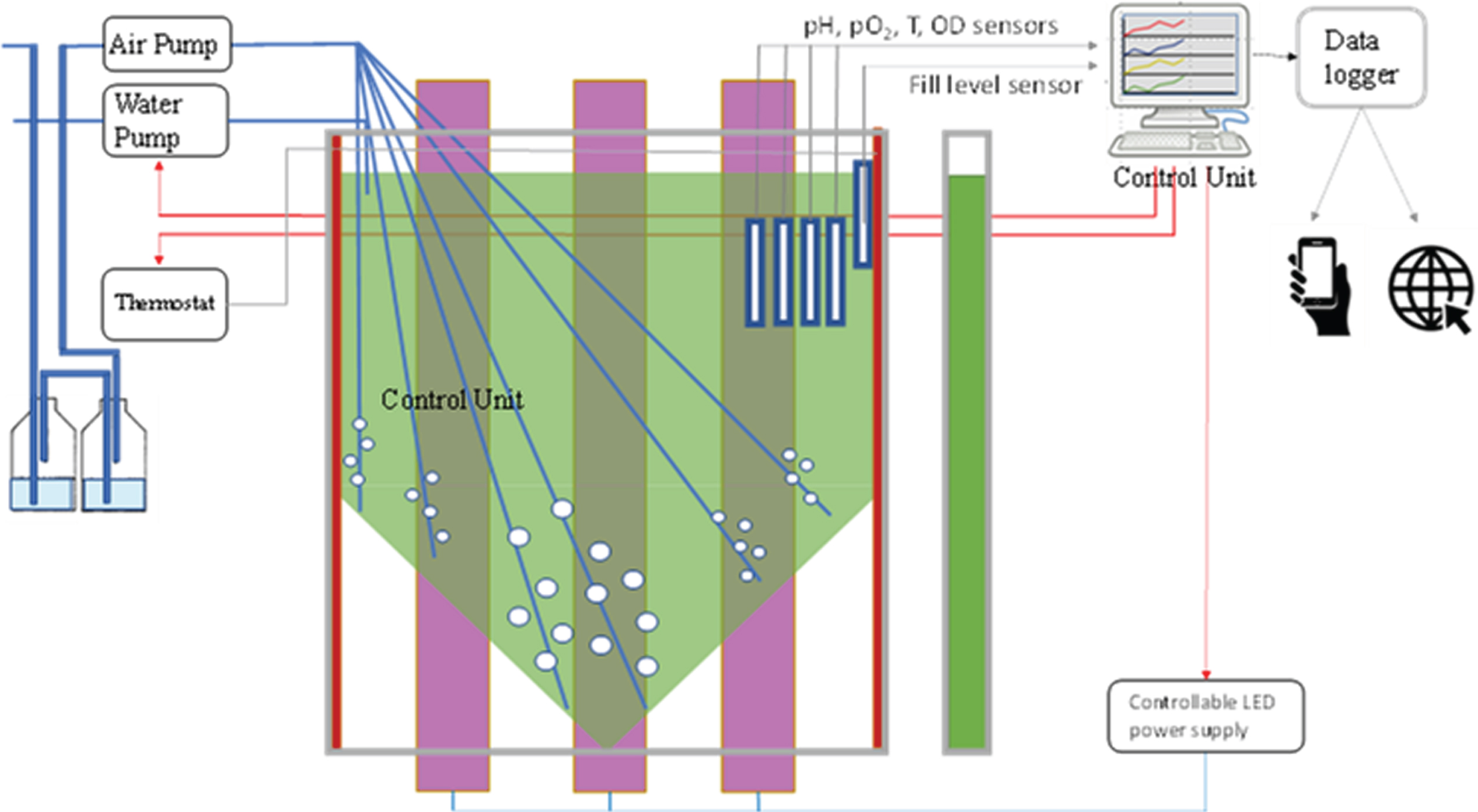
Sketch of the bioreactor for photoautotrophic production of Arthrospira platensis.
The AP starter culture was taken from a back-up bioreactor and washed with autoclaved culture medium to reduce contaminations. After filtration the concentrated cell mass was resuspended in sterilized Zarrouk medium. The bioreactor was started with AP at dry biomass concentration of 0.2 g/l.
Stirring of the culture suspension was carried out by air injection supplemented with CO2 gas (1% v/v) using 6 tubes so that sufficient mixing of the culture medium was achieved. Air was pumped through a membrane filter (Millipore; 0.45μm pore size, 10 cm diameter) and moistened by passaging it through distilled water, with an appropriate flow rate between 50 l/h and 200 l/h, respectively, and with an air bubble diameter of about 3 mm. The gassing rate (ambient air) was adjusted using area flow meters. The appropriate air volume flow was measured in pre-tests so that the pH value of the growth medium was maintained between pH 9 and pH 10.0 for the duration of the experiment. The filling level was kept constant to compensate evaporation losses.
The temperature in the bioreactor was maintained at 25 °C. The photonic flux density (PFD) was 15 –1200μmol/(m2 · s) at the bioreactor surface using a blue-red LED light spectrum (AP673L Valoya, Helsinki, Finland). The air volume flow was set to 100 l/h with a bubble diameter of around 3 mm. The light intensity was measured using a LI-250 light meter with a LI-190SA pyranometer sensor (LI-COR, Inc., Lincoln, Nebraska, USA).
The filling volume of the culture medium was controlled and kept constant by adding sterilized water, which was adjusted to a CO2 content of 0.04 % by sparging with ambient air previously.
Optical density (Thermofisher, Genesys 100 Bio, Waltham, MA, USA), temperature (PT1000, Wernberg, Germany), pH values (EGA 133, Sensortechnik Meinsberg, Meinsberg, Germany) and oxygen concentration (FDA120, Hamilton, Bonaduz, Switzerland) of the culture medium were monitored continuously during the cultivation time.
A sketch of the bioreactor is shown in Fig. 1.
The dry weight of the biomass was determined according to the following protocol: Centrifugation at 17,000 x g Discarding the supernatant Resuspension of the pellet in distilled water Centrifugation at 17,000 x g Discarding the supernatant Resuspension of the pellet in distilled water Transferring in a pre-weighed glass vial Drying for 24 h at 103°C
After subtracting the tare weight of the empty vial, the biomass dry weight was determined.
In addition, the productivity and the specific growth rate of AP were calculated.
Productivity of AP
The productivity of AP was calculated according to the following equation:
where,
Px = productivity (g · l–1 · day–1),
Xi = initial biomass concentration (g · l–1),
Xm = maximum biomass concentration (g · l–1),
tc = cultivation time related to the maximum biomass concentration (days).
The specific growth rate (μ) of AP was calculated according to the following equation:
where,
Xi = initial biomass concentration (g · l–1),
Xm = maximum biomass concentration (g · l–1),
ti = initial cultivation time (days)
tm = cultivation time related to the maximum biomass concentration (days).
Also, the doubling time (td) was calculated according to the equation:
Using the mass balance, the formation of 1 kg of bio-dry matter results in a calculated consumption of 1.8 kg of CO2 [11]. This factor was used to assess the quantity of CO2 bound in AP dry mass.
All measurement parameters were continuously recorded in a database, which can be accessed via internet.
Results
As an example, the influence of the light intensity on the growth of AP is shown in Fig. 2.

Growth of AP measured as optical density (OD in blue) or as dry weight of the AP biomass (DW in red). After inoculation of the culture medium with 0.2 g/l AP up to day 20, the bioreactor was illuminated with 15μmol/(m2 · s), then the illumination was increased to 1200μmol/(m2 · s).
After 20 days of cultivation - starting with an initial biomass concentration of 0.2 g DW/l and an illumination of 15μmol/(m2 · s) - the optical density increased from 0.2 to 1.45 measured at 760 nm. The productivity was 52.4 mg/l · d, the specific growth rate 0.092 d–1 and the doubling time 7.53 d. For this growth, 94.0 mg/l · d CO2 were consumed.
Thereafter, the illumination was markedly increased to 1200μmol/(m2 · s). Seven days later, the optical density at 760 nm had risen to 9.18. The productivity was 1135.9 mg/l · d, the specific growth rate 0.286 d–1 and the doubling time 2.42 d. For this growth, 2045 mg/l · d CO2 was consumed.
There is a plethora of studies concerning the culture of AP or other microalgae in different kinds of bioreactors and under various production conditions [12, 13]. However, a direct comparison of the results achieved is difficult. Therefore, we designed and constructed a flexible bioreactor consisting of food safe polyethylene, in which the main influencing factors (e.g. temperature, light path, volume, mixing rate) can be adjusted and controlled. This allows to vary the production conditions so that the algae biomass produced is maximum or that certain ingredients are increasingly produced under otherwise controlled conditions.
As an example, the influence of the illumination was investigated. By increasing the light intensity under the described conditions, the productivity and the growth rate of the AP could be substantially amplified by 22-fold and threefold, respectively. However, the prerequisite is that sufficient
Conflict of interest
The authors have no conflict of interest to report.