



Abstract
BACKGROUND:
There are red blood cells (RBCs) of different ages in the circulating blood. At the same time, old cells have reduced deformability and increased RBC aggregability. With an increase in the number of old RBCs, especially in pathology, this can significantly affect tissue oxygenation. It is known that the gaseous mediators: nitric oxide (NO) and hydrogen sulfide (H2S) have a positive effect on the RBC microrheology and quite possibly differently on old and young red blood cells.
OBJECTIVE:
The purpose of this research work was to study the capabilities of the H2S donor and substrate of its endogenous production, L-cysteine to change positively the microrheological characteristics of RBCs of different ages to varying degrees.
METHODS:
Whole blood samples (9 mL) from healthy donors (n = 24) were drawn vacuum tubes. RBCs were separated from plasma by centrifugation and washed three times. Red blood cells were density fractionated, according to the method described by Murphy and were separated into three main age subpopulations by Percoll density gradient centrifugation. RBCs of all three age fractions were incubated for 30 min. at 37°C with: NaHS (100 μM), L-cysteine (500 μM), clotrimazole as Gardos channel blocker (50 μM). After RBC incubation, their deformability (RBCD) and aggregation (RBCA) were recorded and compared with the corresponding cell suspension to which the drug was not added.
RESULTS:
The results of the study showed that both compounds NaHS and L-cysteine moderately and significantly increased RBCD in all age subpopulations of RBCs and significantly reduced aggregation. It was found that the magnitudes of these microrheological responses were significantly greater in old RBCs. Analysis of the results showed that Gardos channels may be one of the molecular targets for the action of H2S on red blood cells.
CONCLUSION:
Old RBCs significantly increased deformability and decreased aggregation than mature and young cells in response to exposure to NaHS or L-cysteine. In general, we can conclude that a donor of hydrogen sulfide and a substrate for its synthesis, L-cysteine can be considered as a promising drug for restoring impaired RBC microrheological characteristics and contribute to the preservation of the function of old RBCs.
Keywords
Abbreviations
hydrogen sulfide
nitrogen oxide
sodium hydrosulfide
NO-syntase
ATP- dependent potassium channels
Ca - dependent potassium channels
red blood cell
young red blood cell
mature red blood cell
old red blood cells
red blood cell deformability
red blood cell aggregation
Introduction
It is known that blood rheology is an important determinant of blood flow [1–3]. However, it is probably one of the most neglected areas in the clinical literature and practice [4]. Blood viscosity changes according to shear rates and depends on cellular and plasma factors. At the same time, the microrheological red blood cell behaviour affects not only the overall fluidity of the blood [3, 5] and its oxygen transport, as well as on microcirculation and tissue perfusion [6, 7]. There is evidence that the deformability of human red blood cells (RBCs) decreases with aging [8, 9]. However, when interpreting these data, it is necessary to take into account the fact that red blood cells have a life of their own, lasting about 120 days [10]. Throughout their life, RBCs undergo morphological and physicochemical changes [11]. This complex of age-related changes leads to an increase in the density and rigidity of old red blood cells and a decrease in their deformability in general [12, 13]. Since RBCs have a functionally active endothelial-type NO synthase [14], they can produce NO, which by an autocrine mechanism has a positive effect on their microrheological characteristics [15]. Moreover, there is evidence that old red blood cells (obtained by separation in a density gradient) responded more effectively to the action of NO than young cells [16].
In addition to NO and CO, hydrogen sulfide (H2S), synthesized enzymatically from L-cysteine, is a third gaseous mediator. It is involved in the regulation of many physiological processes, including vascular tone and blood cells. Although it was initially thought that H2S was synthesized in the vascular wall only by smooth muscle cells, more recent studies show that H2S is also synthesized in endothelial cells [17]. Therefore, this gasotransmitter is available to blood cells. Based on the above, we assume that red blood cells (RBCs) positively change their microrheological characteristics under the influence of the H2S donor and the substrate for its synthesis.
The purpose of this research work: to study the capabilities of the H2S donor and substrate of its endogenous production to change the microrheological characteristics of RBCs of different ages to varying degrees.
Methods
Patients and study design
Whole blood samples (9 mL) from healthy donors (n = 24) were drawn (via venipuncture), into EDTA vacuum tubes. The study was approved by the local Ethics Committee of the University (protocol No.8 dated September 14, 2023), and an informed consent of all the subjects were obtained according to the recommendations of the Declaration of Helsinki (The WMA’s Declaration of Helsinki on Ethical Principles for Medical Research Involving Human Subjects, as amended by the 64th WMA General Assembly, Fortaleza, Brazil, October, 2013).
RBC preparation
RBCs were separated from plasma by centrifugation (15 min, 3000 rpm), washed three times in isotonic NaCl solution. Red blood cells were density fractionated, according to the method described by Murphy [18] and were divided into three main age subpopulations by Percoll density gradient centrifugation. At the end of centrifugation, the top 10% of the packed cell column, RBC-top (termed “young” RBCs), the bottom 10%, RBC-bot (termed “old” RBCs) and the middle part, RBC-mid (termed “mature” RBCs) were separately harvested and washed in the appropriate medium. The RBCs were finally suspended in the Ringer solution (with addition of dextran 130 (10% HAES-steril, Fresenius Kabi, Germany), to stimulate RBC aggregation, at 40±1% hematocrit (Hct) for its measurement and ∼0.5% Hct for RBC deformability studies.
Registration of RBC microrheological responses to gasotransmitter donors
To study the red blood cell sensitivity to gasotransmitters (GT) in in vitro experiments, their suspension was divided into 4 aliquots and the cells were incubated at 37°C for 30 min with each of the following compounds: H2S donor, sodium hydrosulfide (NaHS, 100 μM); H2S synthesis substrate – L-cysteine (500 μM); clotrimazole – Gardos channel blocker (50 μM); Only in Ringer’s solution (without any compounds) – control samples.
The effectiveness of GT donors in three age subgroups of RBCs assessed by microrheological responses: RBCD and RBCA changes. RBC suspension was incubated the someway (duration and temperature) but in a drug-free Ringer’s solution was used as a control sample. All compounds were purchased from Sigma-Aldrich (USA). They were dissolved in distilled water or DMSO. Preliminary experiments with incubation of RBCs in isotonic Ringer’s solution containing DMSO did not reveal significant differences in RBCD and RBCA compared to control samples (without DMSO).
Statistics and data presentation
Statistical processing included obtaining the mean (M) and standard deviation (SD). The sampling distribution was tested using the Shapiro-Wilk test. Nonparametric statistics of the program Statistica 10.0 (StatSoft Inc., USA) was used. When conducting paired comparisons of indicators within groups during repeated measurements, the Wilcoxon test was used. Differences at p < 0.05 and p < 0.01 were taken as statistically significant. The data correlation hypothesis was tested using Pearson’s correlation coefficients.
Results
Effect of the hydrogen sulphide on the RBC microrheology of different age cell fractions
As can be seen from the data given in Table 1, deformability, under the influence of NaHS, positively changed in all age-related RBC subpopulations. However, the increase in RBCD was noticeably greater in old cells.
Changes in the microrheological characteristics of RBCs of different age under the influence of the hydrogen sulfide donor, NaHS (M±σ, n = 24)
Changes in the microrheological characteristics of RBCs of different age under the influence of the hydrogen sulfide donor, NaHS (M±σ, n = 24)
Notes: RBCD – red blood cell deformability; RBCA – red blood cell aggregation; RBC-top – young red blood cells; RBC-mid – mature red blood cells; RBC-bot – old red blood cells. *p < 0.05, vs. control; **p < 0.01, vs. control.
H2S donor significantly affected the red blood cell aggregation of all age fractions (Table 1). At the same time, the decrease in RBCA was significantly greater in old RBCs. The deformability of red blood cells is a critically important microrheological characteristic, especially when cells pass through exchange capillaries. In this regard, it should be noted that after incubation with NaHS, the increase in deformability of old RBCs was 0.24±0.03 units, which is more than twice as much as in the subpopulation of young cells, where the change was only 0.09±0.04 units (Fig. 1).
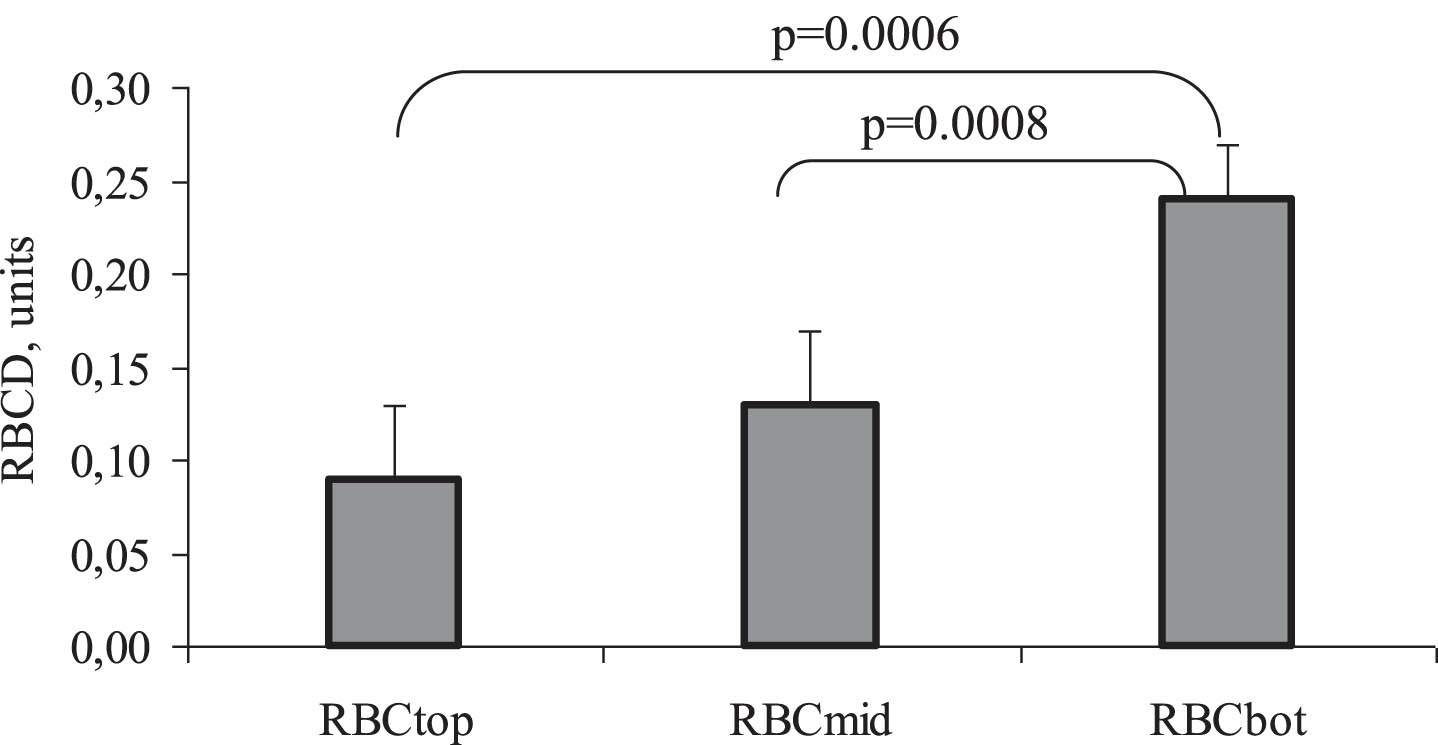
Difference in the increase in deformability (RBCD) in red blood cells of different age fractions after their incubation with NaHS (100 μM). Notes: RBCtop – young red blood cells; RBCmid – mature red blood cells; RBCold – old red blood cells.
A similar picture of changes in the RBC microrheology of three age fractions was observed under the influence of L-cysteine. It was found that after L-cysteine treatment an increase of RBCD in the fractions of young and mature cells by 4 and 6%, respectively (Table 2). This was significantly less than in old cells, where the increase in RBCD was 12% (p < 0.01). The RBCA demonstrated the same dynamics: RBC-bot had a greater decrease, by 20%. RBC-mid and RBC-top had 5% and 8%, respectively (Table 2).
Changes in the microrheology of the RBC age fractions under the influence of a stimulator of endogenous synthesis of H2S, L-cysteine (M±m, n = 24)
Notes: RBCD – red blood cell deformability; RBCA – red blood cell aggregation; RBC-top – young red blood cells; RBC-mid – mature red blood cells; RBC-old – old red blood cells. *p < 0.05, vs. control; **p <0.01, vs. control.
L-cysteine, like NaHS, increased the deformability of old RBCs largely, by 0.22±0.04 units, compared with young (0.11±0.04 units) and mature (0.14±0.05 units) cells (Fig. 2).

Difference in the increase in deformability (RBCD) in red blood cells of different age fractions after their incubation with L-cysteine (500 μM). Notes: RBCtop – young red blood cells; RBCmid – mature red blood cells; RBCold – old red blood cells.
Although data are provided indicating that the molecular targets of H2S in different cells may be KATP channels [19], or highly conductive calcium-dependent K+ channels [20], however, only calcium-dependent potassium channels are considered to be precisely established on RBCs intermediate conductivity channels or Gardosh channels [21, 22]. To determine the role of Gardos channels (KCa3.1) in the microrheological responses of RBCs to H2S, cells were incubated with the channel blocker clotrimazole (50 μM). Under the influence of the H2S donor, a significant increase in RBCD by 6% was observed in the population of mature RBCs (Fig. 3, p < 0.01). While cell preincubation with clotrimazole (Clo) eliminated the effect of the hydrogen sulfide donor. There was even a slight decrease in RBCD by 3% (p < 0.01) compared to control (Fig. 3).

Change in RBCD under the influence of NaHS separately and against the background of preincubation of cells with clotrimazole (Clo+NaHS).
In the fraction of young RBCs, a significant increase in RBCD under the influence of NaHS by 6% (p < 0.01, Fig. 4a) was completely eliminated by preincubation of cells with clotrimazole.
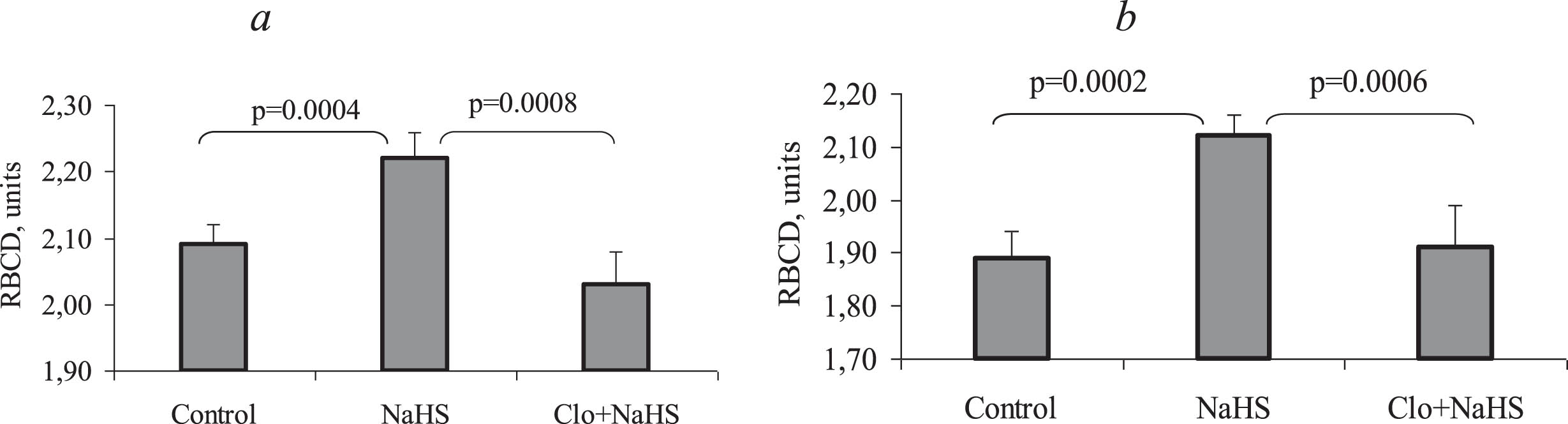
Changes in RBCD in young and old RBCs under the influence of NaHS and the combination of the Gardos channel blocker clotrimazole (Clo) and NaHS (“Clo+NaHS”). Notes: RBCD – red blood cell deformability; a – young red blood cells; b – old red blood cells.
As for the deformability of old RBCs in contrast to the fraction of young and mature cells, where there was a slight, 3% decrease (p < 0.05) in this microrheological characteristic, their deformability increased slightly, from 1.87±0.05 to 1.91±0.05 units. However, when Gardos channels were blocked with clotrimazole, NaHS practically did not change RBCD, as in other age fractions (Fig. 4a, 4b).
In addition, as shown above, NaHS significantly reduced RBCA, and clotrimazole moderately increased it. Whereas with the addition of the H2S donor, aggregation did not decrease. (Fig. 5).

Changes in red blood cell aggregation (RBCA) of the mature RBC fraction under the influence of NaHS, clotrimazole (Clo) and their combined effects (“Clo+NaHS”).
It is known that with aging of RBCs there is a decrease in their deformability and an increase in aggregation [11, 23]. In our experiments the deformability of old RBCs was 16% (p < 0.01) less than that of young ones, and compared to mature RBCs, it was 10% (p < 0.01, Fig. 6a). As for aggregation, it was 91% in old cells (p < 0.01), more than in young ones, and compared to mature cells the difference was 57% (p < 0.01; Fig. 6b).

Differences in deformability (a) and aggregation (b) of red blood cells of different age subpopulations. Note: Data are presented as median (Me) [Q25:Q75].
Under the influence of incubation with NaHS RBC deformability significantly increased in all age fractions. However, the rise of this characteristic was more pronounced in older cells (p < 0.01) than in young and mature ones. When old RBCs were incubated with NaHS, their deformability reached an average of 2.08±0.05 units. This value was greater than in mature cells in the control period before incubation with the drug (2.00±0.06 units) and only 6% less than in young cells (Fig. 7a).

Comparison of deformability (a) and aggregation (b) of old RBCs after incubation with NaHS and the same microrheological characteristics of young and mature RBCs without exposure to an H2S donor. Note: Data are presented as median (Me) [Q25:Q75].
A similar pattern of restoration of the deformability of old RBCs was observed when they were incubated with L-cysteine (Table 2). The decrease in red blood cell aggregation of all age RBC subpopulations was significant under the influence of NaHS and L-cysteine. At the same time, the reduction in aggregation of old cells under the influence of the above compounds was significantly greater and its value practically did not differ from the level of mature RBCs in the control period before incubation with the drugs.
The data obtained on the influence of the H2S donor and the substrate for its synthesis on RBC microrheological characteristics raise two questions: 1) what cellular molecular targets are affected by the compounds under discussion that cause positive microrheological responses in all three age-related subpopulations of RBCs; 2) what is the mechanism for a significantly greater increase in deformability and a decrease in aggregation of old RBCs. Regarding the first question, it is generally accepted that the main molecular target for H2S in most body cells is KATP channels [24]. However, it was shown that when they were blocked with glibenclamide, the microrheological effects of H2S donor, NaHS were not eliminated [25]. On the other hand, it is known that inhibition of soluble guanylate cyclase and/or NOS eliminated the positive effect of NaHS on RBC microrheology [25]. Inhibition of e-NOS or protein kinase G-I abolishes the H2S-stimulated angiogenic response, and attenuated H2S-stimulated vasorelaxation, demonstrating the requirement of NO in vascular H2S signaling [26]. Therefore, it can be assumed that H2S may use the NO-mediated signaling cascade [27]. It was shown that highest RBC-NOS activation and NO production in old RBC, possibly to counteract the negative impact of cell shrinkage on RBC deformability. It is further suggested that highly produced NO only insufficiently affects cell function of old RBC maybe because of isolated RBC-NOS in old RBC thus decreasing NO bioavailability. Thus, increasing NO availability may improve RBC function and may extend cell life span in old RBC [16].
At the same time, another signaling pathway associated with the microrheological responses of RBCs to H2S can be considered. It is known that the functions of RBCs change under the influence of Ca2 +, especially in old RBCs, since their sensitivity to Ca2 + increases with age [28, 29]. Calcium-dependent potassium channels of medium conductivity (type KCa3.1) or Gárdos channel are well represented on the RBC membranes [21, 22]. This signaling pathway can begin with the opening of mechanosensitive calcium channels of RBCs (Piezo1, [30]) and subsequent activation of the Gárdos channel [31]. It is believed that the entry of calcium into red blood cells leads to the outflow of potassium and water and to a change in the RBC rheology [32]. Therefore, KCa3.1 channels make a certain contribution to changes in cell volume, and probably, their participation in cell deformability. It has been suggested that the Ca2 +-induced decrease in RBC deformability is eliminated due to equalization of the potassium ion gradient or treatment of cells with a blocker of these channels [33]. With aging, there is a gradual accumulation of oxidative damage, loss of membrane in the form of microvesicles, redistribution of ions and changes in cell volume, density and deformability [34]. We compared the effect of clotrimazole blocking Gardos channels in RBCs of different ages and found that young cells completely abolished the subsequent positive microrheological effect of NaHS, whereas old cells partially retained it. Perhaps old red blood cells under the influence of H2S reduce the activation of Gardos channels and their stimulating effect on the accumulation of Ca2 + in cells. It is known that the accumulation of Ca2 + and/or ATP depletion themselves cause a decrease in the RBC deformability [32].
Taken together the obtained data that may indicate that hydrogen sulfide has a modulating effect on the K(Ca2 +) channels of the erythrocyte membrane and with age, erythrocytes increase sensitivity to Ca2 + [34]. This may create conditions for greater sensitivity of these regulatory targets of old erythrocytes to endogenous gaseous mediators, including H2S, and thereby improve red blood cell functions and increase their lifespan.
The results of this study indicate that red blood cells of different ages differed in the values of deformability and aggregation and responded similarly to the action of the H2S and to L-cysteine with an increase in RBCD and a decrease in RBCA. However, old RBCs significantly increased deformability and decreased aggregation than mature and young cells in response to exposure to NaHS or L-cysteine. In general, we can conclude that a donor of hydrogen sulfide and a substrate for its synthesis, L-cysteine can be considered as a promising drug for restoring impaired RBC microrheological characteristics and contribute to the preservation of the functions of old RBCs.
Footnotes
Acknowledgments
This work was supported by the Russian Science Foundation (Grant No. 22-15-00120).
Author contributions
A. Muravyov, A. Priezzhev, supervised the experimental study design, interpretation and wrote the article;
I. Tikhomirova included the patients and conducted the experiments;
A. Lugovtsov conducted the experiments and interpretation performed the data analysis.
A. Volkova, conducted the experiments
All authors read and approved the final manuscript.
Conflict of interest
The authors have no conflict of interest to report.