



Abstract
In order to solve the security problems of university laboratories, a human body pyroelectric infrared induction circuit based on DM365 platform is proposed and applied in the prewarning security system design scheme. The design scheme is based on TMS320DM365 platform and embedded with ARM926EJ-S as kernel. In addition, chip BISS001 and its peripheral circuit is used to realize human body thermal source sensing and support Zigbee communication RF module. The system adopts Linux kernel and NET Framework4.0 development environment as well as uses C# as the development tool. Besides, the video control named CMTechVideo is used in the system to communicate with the video gateway. The system test results show that this system can control and collect the staff entrance/exit data in real-time mode correctly, and realize the function of taking photos and prewarning when the staff entrance/exit data are beyond the normal range; furthermore, this system possesses excellent extensibility.
Introduction
As major premises for university experimental teaching and scientific researches, the university laboratories play a significant role in talents cultivation and technological innovation as well as serve as a key support in the university teaching process. Currently, the Chinese university laboratories are subject to problems of first-class experimental facilities and second-class management method. Nowadays, the major measure to solve this problem is to adopt access control system to carry out real-time monitoring. However, the security hazards still exist, especially at nights. On one hand, the management staff neglect to take precautions; on the other hand, the effective material which the video control can provide is scarce. As the universities open up the laboratories more and more, all the laboratory management staff will guarantee the security of experimental equipment assets and the integrity of research outcomes and materials which the scientific researchers have achieved. Based on above reasons, TMS320DM365 is adopted and the ARM9 is integrated inside the chip as the kernel to establish embedded Linux system platform and improve the reliability and time efficiency of data collection. In addition, the system can cooperate with the access control system to handle security issues in emergent environments.
Overall design of security prewarning environment
A prewarning system can be developed and applied in university laboratories. The management staff can set up the laboratories to be monitored and monitoring period in advance inside the monitoring system. Within this monitoring period, if the human body infrared system detects the infrared signal from the human body, it is indicated that someone has broken in illegally and the alarm system will be raised. The alarm system can send text messages or multimedia messages automatically to inform the management staff while the management staff can judge the faulted laboratory room right away by the notification from the remote monitoring system.
The whole system consists of four components: sensor, NVS, cloud server and client. The alarm information can be looked up from the client. Figure 1 shows the overall system framework.
Security prewarning system structure.
In Fig. 1, NVS serves as the network coordinator for the video gateway and is mainly used in monitoring system and anti-theft alarm system to deploy defense and emergency call system. The input adopts 2.4 GHz wireless mode and the type of supported WIFI network interface card is Tenda W311U
The terminal node adopts the passive pyroelectric infrared sensor whose kernel is BISS0001 chip. The sensor is made by materials with high pyroelectric coefficient and contains two major components, respectively filter glass and impedance-matching field-effect transistor. The components are applied in a non-contact mode to convert the infrared radiation from human body into electric signal output within the detection range. Other interference radiations, such as sunlight and lamplight, and their reflected lights can be suppressed effectively. It can be applied in security prewarning of laboratories at night.
The side-wall infrared sensing node is fixated on a wall about 1.8 m–4.5 m high to form an infrared defensive region with a detection distance of 5 m–10 m and a defensive angle of 110
BISS0001 detection range.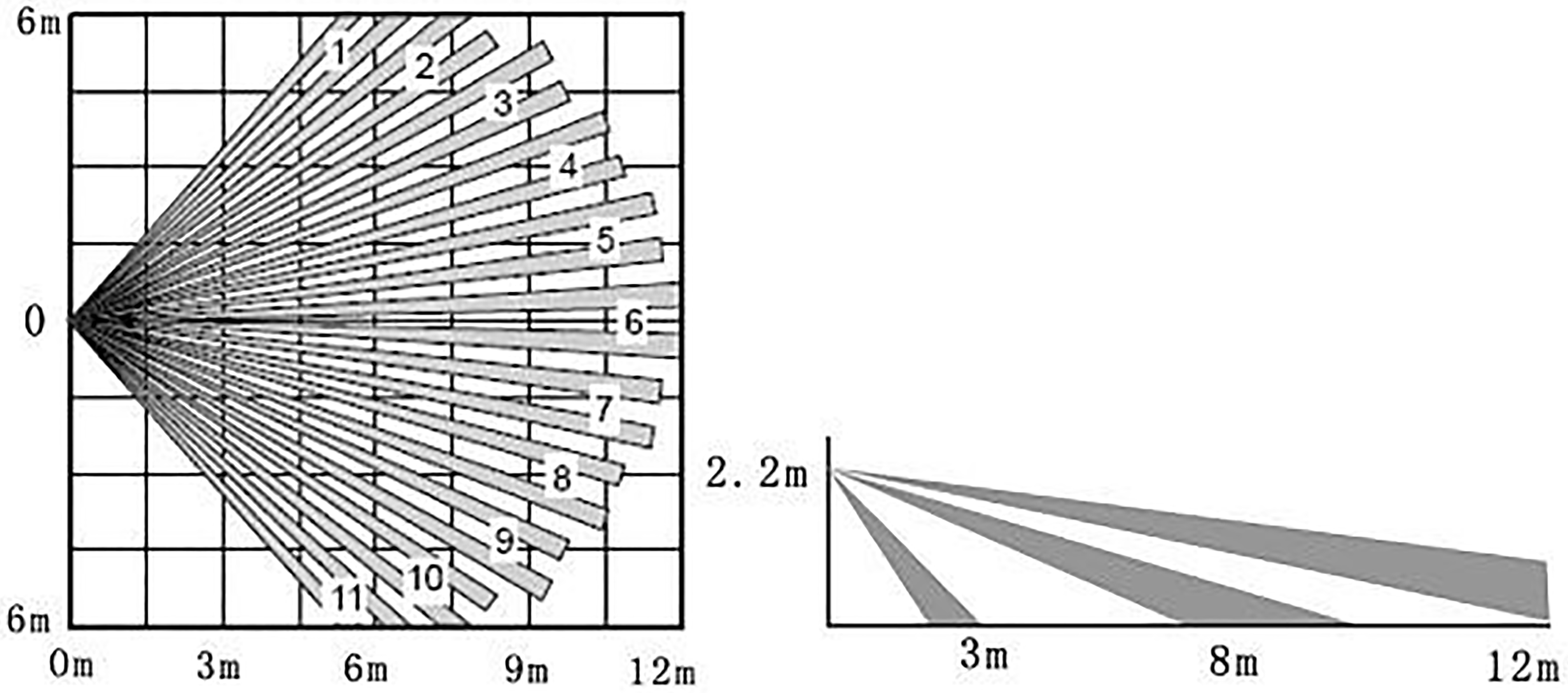
Infrared sensor structure.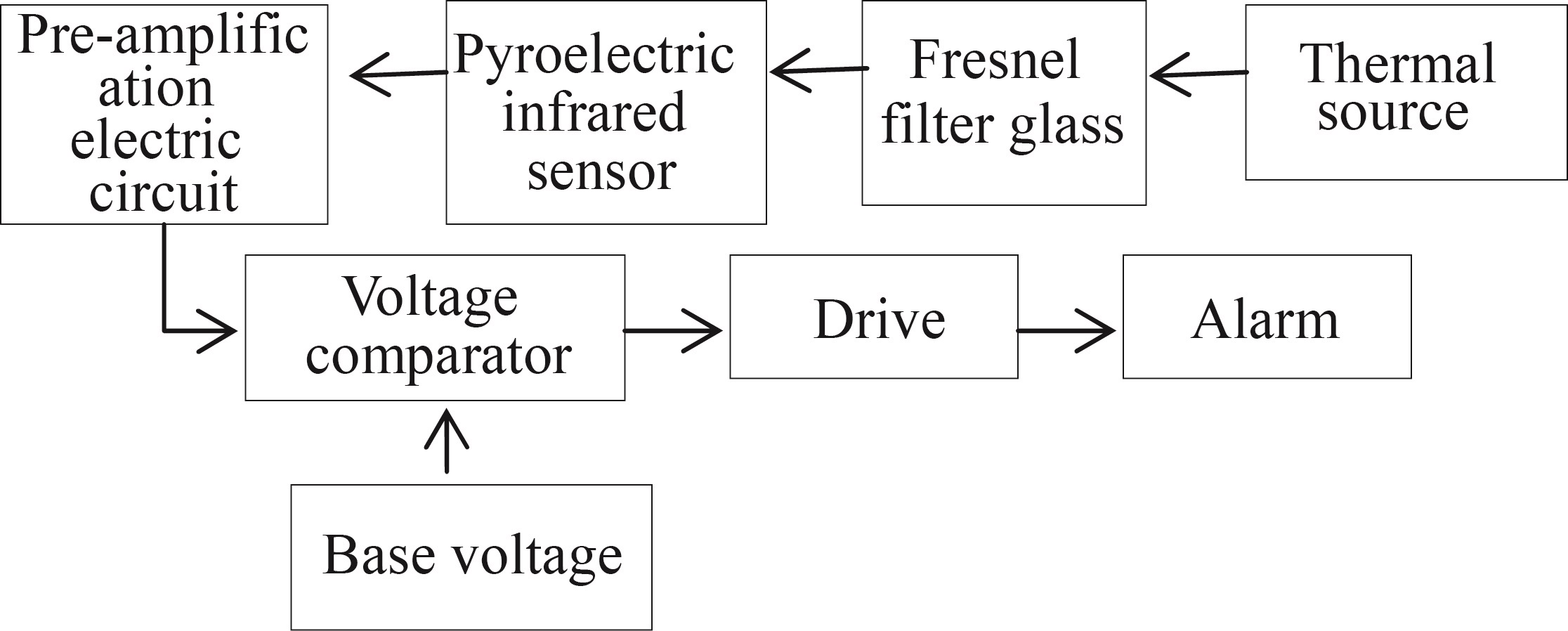
Design of infrared collector
The kernel chip of infrared sensing node is BISS0001 and can be widely applied in multiple types of sensors and delay controllers. The screen equipped with filter glass is adopted and its white-light interference resistance is larger than 20000 Lux. SMT and screen are adopted and their radio frequency interference resistance is larger than 10 V/m (20 MHZ–1000 MHZ). The area of sensitive element is 2.0
The central wavelength of the infrared ray emitted by human body thermal source ranges between 9
When the sensor cannot detect an infrared ray signal with a central wavelength about 9
Design of pre-amplification electric circuit
The pre-amplification electric circuit adopts the design scheme in Fig. 4. The infrared signal collection component collects information from the sensor RE200B element automatically. The detected signal in the system is analog and should be converted into digital quantity through BISS0001 conversion in order to realize control over single chip computer or other chips.
Pre-amplification electric circuit.
NVS gateway configuration
NVS (Network Video System) gateway adopts TI DaVinciTM high-definition processor TMS320DM 365, shortened as DM365, which can support high-definition D1 video format and provide clear and smooth videos through the network. In addition, CMRTP or RTSP is adopted as the special protocol type for remote smart processor. The network transmission code stream is 300 kbps or VBR dynamic switch. ZigBee coordinator ad hoc network adopts standard RS485 bus port, supports WiFi and 3G network interface card, receives the data uploaded by network nodes and forwards the commands from the mainframe. The communication frequency is 2.4 GHz, the emission current is 25 mA, and the reception current is 20 mA. This platform integrates ARM926EJ-S inner kernel with a 600 MHz main frequency and is embedded with Linux operation system as shown in Fig. 5.
DM365 structure.
NVS video gateway configuration flow chart.
In ZigBee wireless ad hoc network, the gateway is initialized firstly and then CMRTP or RTSP is adopted as the special protocol type for remote smart processor. In Fig. 6, the system gateway supports local area network, special line, and 3G. The parameter mode in the router should be set up. The security type is WPA and the encryption methods are TKIP and AES. In the linkage setting, the alarm period can be set up according to actual situation and range between 0 and 60000 ms. Only when the smart algorithm and infrared detection are triggered at the same time will an alarm message be produced. In other words, the linkage decides whether the alarm and multimedia module respond when the alarm is raised. When all the infrared sensing nodes connected to the wireless gateway coordinator receives data, the gateway judges whether they are newly added. If they are, add the ID number of the node into the gateway and bind the allocated room number. If they are control requests, set up defense system and authorize parameters, including monitoring access and defense period. If multimedia message function is selected, the ID number (701) of the multimedia message module should be added. If the permanent defense mode is selected, whether this node requires defense is not controlled anymore and the defense system at this node is always open. Then, the control request processing function is called to process the data. After the data are processed, the coordinator returns back waiting request and monitors the state.
NVS gateway node configuration interface.
In ZigBee wireless ad hoc network, first initialize the gateway, and then make the protocol specific to the intelligent processor for the remote drawing line. In Fig. 6, the system gateway supports LAN, private line and 3G. You need to set the parameters of the router mode. The security type is WPA and the encryption method is TKIP and AES. In the linkage setting, the alarm duration can be set according to actual needs, within the range of 0–60000 ms. When the intelligent algorithm and infrared are triggered at the same time, an alarm will be produced, that is, linkage or not, which determines whether the alarm and MMS module will response. When all the infrared perception nodes accessing the wireless gateway coordinator, the gateway will determine whether it is a new node; if it is, it will add the node ID and the assigned room number to bind in the gateway. If it is the control request, it will set the arming and authorize parameters, including monitoring authority, arming time; if you choose MMS function, you need to add MMS module ID (701); if it is set as the permanent arming mode, the node will no longer control but in the open state. Call the control request to handle the functions and data. After data handling, the coordinator returns to wait for the request to listen.
The side-wall infrared sensing node is to set the sensor location and add ID numbers and equipment names onto the corresponding equipment ID & equipment locations under the premise that NVS gateway operates normally. Figure 4 shows its working process. Firstly, judge whether there are two or more detectors in the same detection region in order to avoid mutual interference. Judge whether the sensor can communicate with the gateway. If the communication is not smooth, judge whether the sensor location and the corresponding equipment ID exist. Then, obtain ID certification at the gateway, detect whether the user access, NVS equipment, and nodes comply with system security standards. After successful configuration, configure the nodal attributes at the server. Figure 7 shows the configuration interface.
System program design
The major designed function of user control system is to realize the side-wall infrared information sensing and real-time notification of online nodal states. In addition, the data collected at each laboratory node should be able to be uploaded in time and specify the nodal location for convenience of quickly locating the laboratory with abnormal security state. While raising the alarm, the system can send the abnormal information to the laboratory management staff in the form of text messages or multimedia messages in order to solve the security hazards in the shortest period. The client can be connected to Internet in a wireless mode to realize remote system monitoring. The system development is based on NET Framework 4.0 and Visual Studio 2010 as well as adopts C# as the development tool.
The design of basic interface function is the premise for normal system operation. Before corresponding operations are executed, this function must be called to carry out early-stage initialization. There are 5 basic interface functions designed in the system as shown in Table 1.
Library function description
Library function description
Node configuration effect.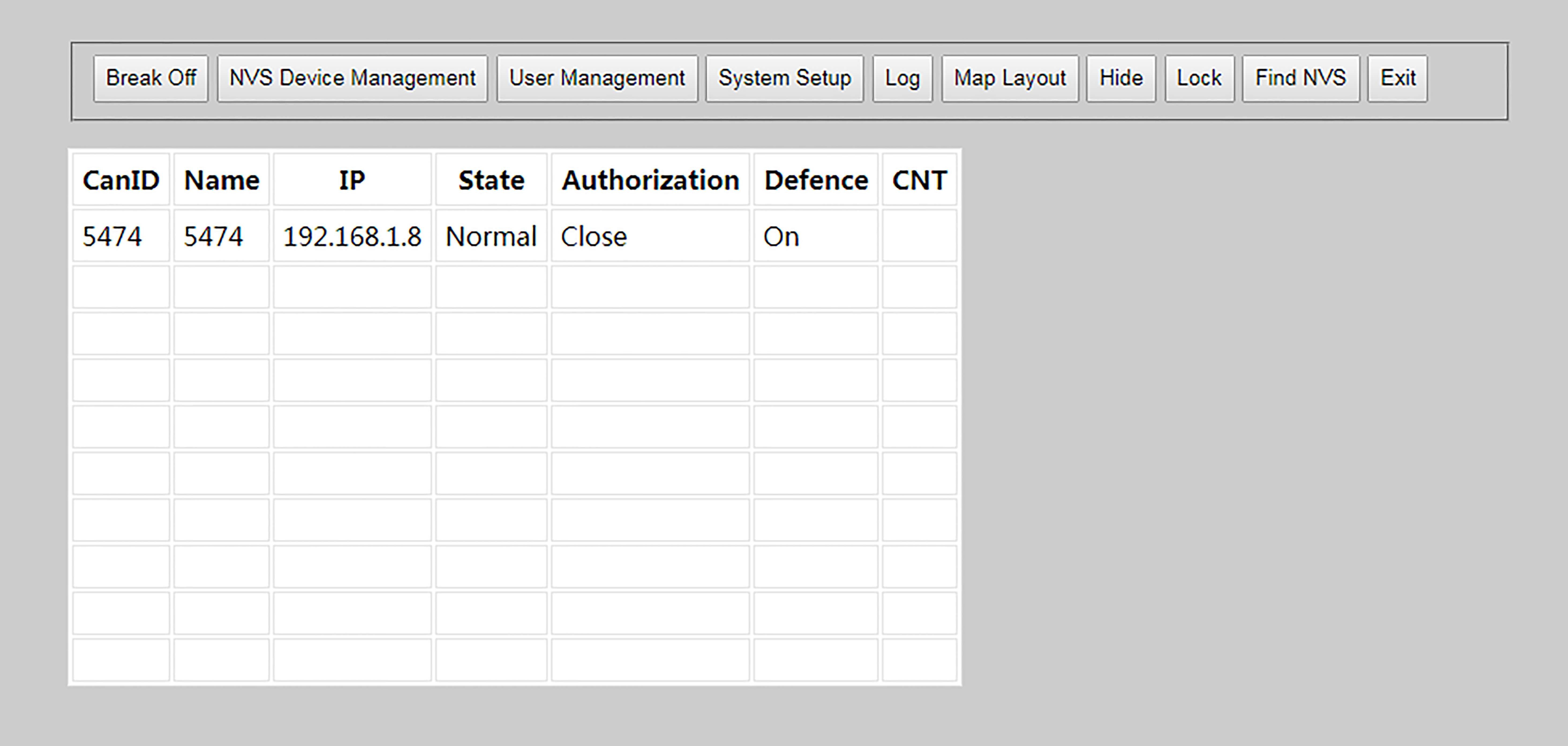
The initialization function CM_Init is used to finish module initialization and the returned handle is the necessary parameter for other functions. Subsequent operations can only be carried out when the returned handle is not empty; CM_Free is used to close the connection and release the resource. It is used in pair with CM_Init. When the module is not used any more, this interface must be called to release the resource. Or otherwise, inner leakage will be caused; CM_SetNVSXmlPath is used to set the path of XML file containing information returned from NVS gateway and the nodes; CM_Login is used to log onto the server. The server address is in character string format and supports dotted decimal IP address and domain name format. After connecting with the server, this function should be called to obtain the user access; CM_SetNotifyUDPPort is used to set the reception UDP port number for event notification and choose the message destination among CM_SetNotifyWindow, CM_SetNotifyUDPPort, and CM_SetNotifyThreadID.
Testing flow chart.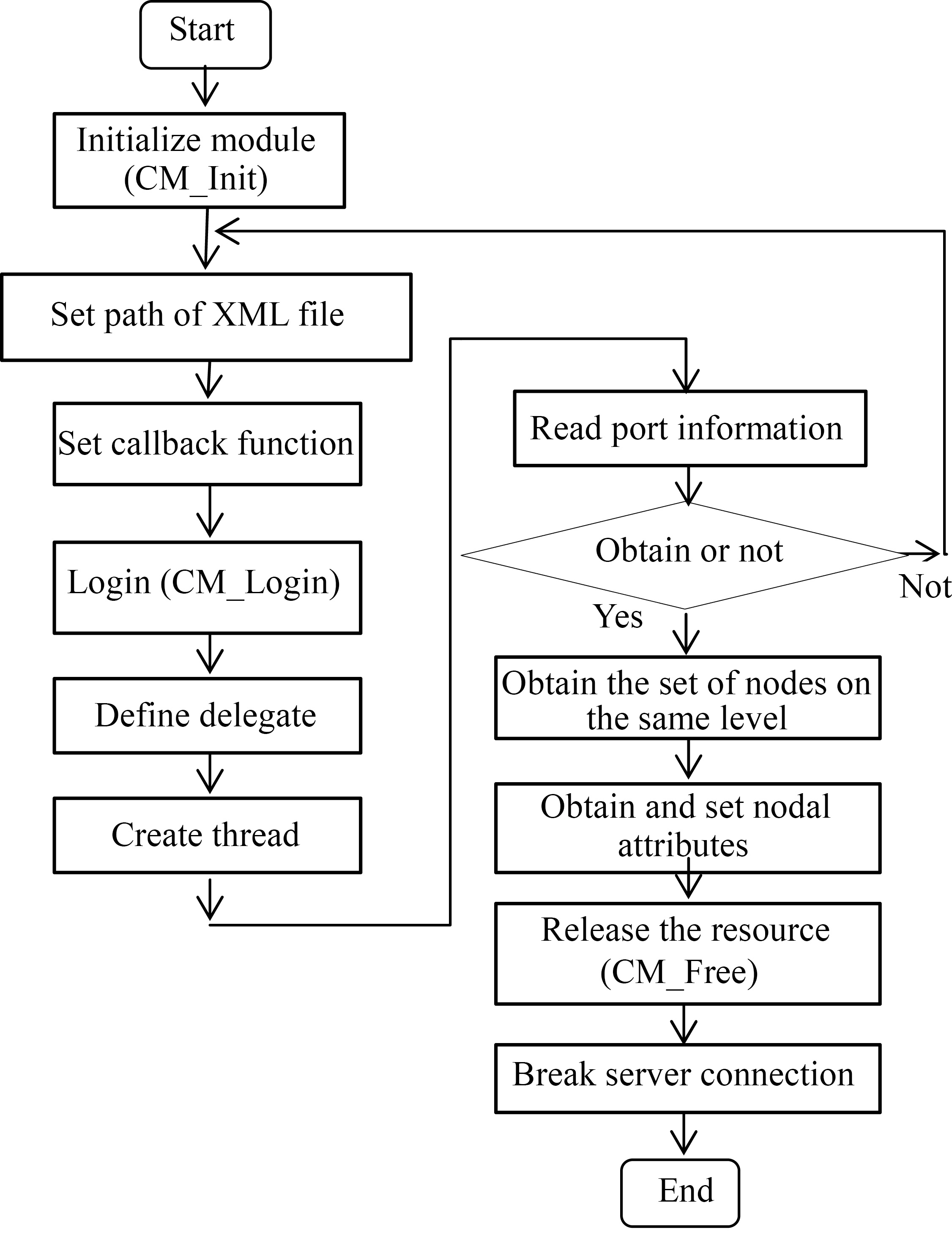
Firstly, the NVS server is started and the terminal nodes are configured (Fig. 8 shows the configured effect). After the system is initialized as shown in Fig. 9, the designated XML file which saves the nodal information is imported, and the application program exchanges data with the module through XML file. After receiving the messages, the application program reads data and notifies messages from XML file. In addition, it contains ID information and locations of nodes on the same or lower levels. The application program uses the functions provided by the module through calling interface. The module notifies that application program that the data have been updated through messages. Besides, the setting is used to mark whether the handle of server has been connected, define and declare delegate, create a thread to be used for constantly reading alarm messages, receive the message port number and prevent conflicts with other programs. The alarm message read the last time should be marked if it has been displayed before. If the information of the designated node is obtained, judge whether this node has other nodes on the same or lower levels. If it has, the display of each message should be set as about 3 s before the next message is shown. The nodal attributes obtained, such as number, time, and contents, can be set up. For example, the system can be paused for 2 s after each alarm message is found. If the information of the designated node cannot be obtained, the contents of XML file should be re-set in the form of new node and the program should be re-initiated. Before the program is exited, the resource release module should be operated. Figure 10 shows the program operation effect.
Operational effect.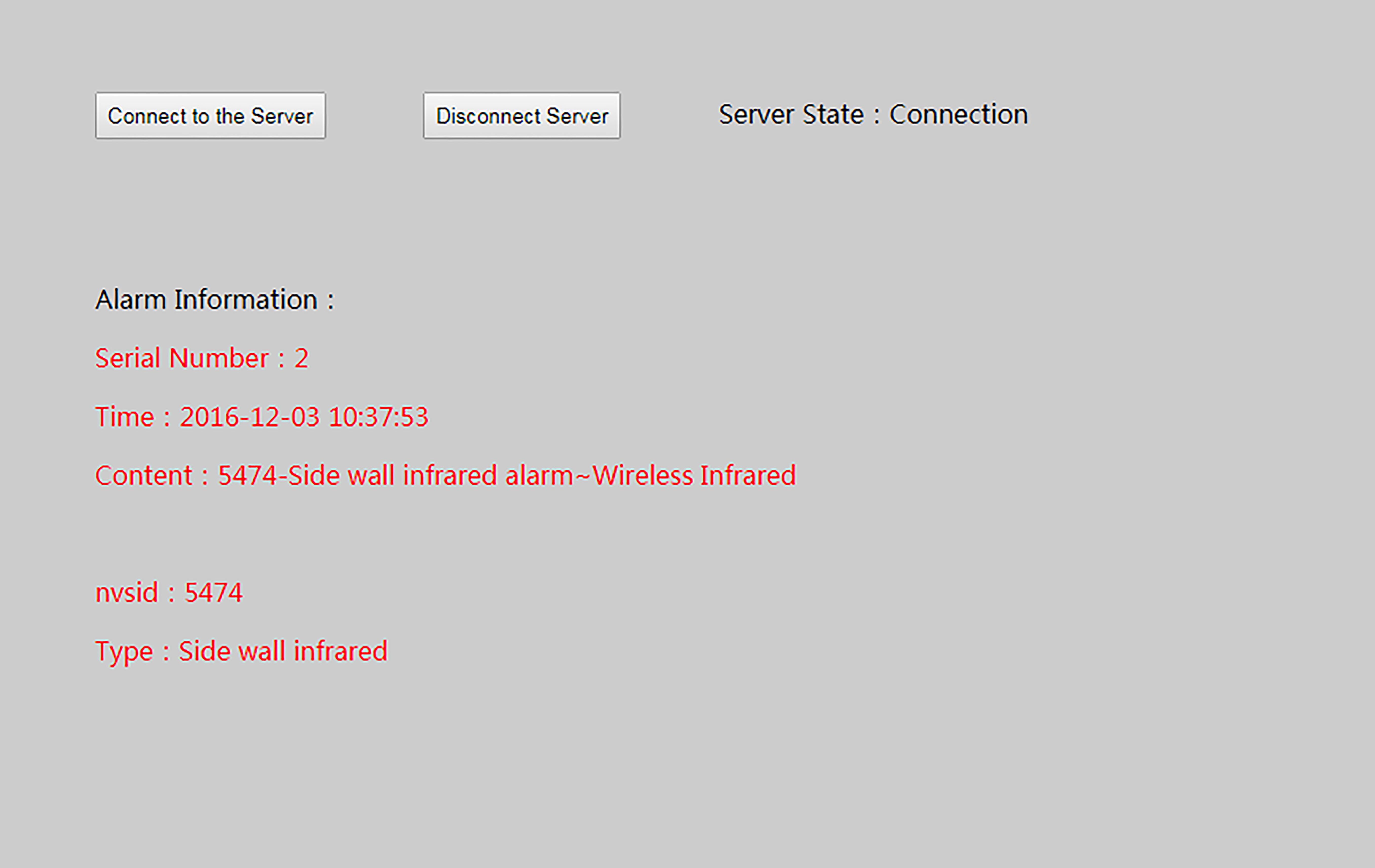
Contrast of temperature imaging of the ice bucket.
To verify the feasibility and effectiveness of methods and systems described here, experimental study was conducted on the infrared imaging with NVS as the video server. Figure 11 shows the contrast of infrared imaging of temperature of the ice bucket. Firstly, the NVS server was started and later serial assistant was initiated on the terminal PC for remote connection. The address of NVS server was set as 192.168.1.8, while the infrared monitoring ports were 5000 and 2006 respectively. The imaging effects were tested on PC and the images recorded all the heat information at all point locations (PTs) within the viewing coverage. In the standard mode, the redder color represents the higher temperature, while the blacker color indicates lower temperature. The heat energy display supports presentation of multiple hues, better distinguishable, and shows the heat energy of target PTs more precisely.
Wireshark was used to filter and monitor the RTP data packet of the infrared monitoring system in the experiment and a RTP analytical statement was produced (as shown in Fig. 10). It is clear in Fig. 10 that the statement was a statistical statement created according to the grouping No. and the serial No. of the data packet and based on the arrival time, delay, joggling, and packet size, etc. At that time, the packet loss probability was 0 without error and thus resulted in no influence on the monitoring system. What was transmitted was the coded and compressed audio/video data stream, thus the network pressure was reduced significantly. The audio data size (each packet has fixed 160 Byte only) was smaller than the video data size and required no re-synthesis, thus the number of decoded frames was greater than that of video frames. Video frames received shall be re-synthesized into NALU before encoding and playing and the audio was the main line at the time of synchronization. Therefore, the number of shown frames was greater than that of decoded frame, which indicates that some frames were repeat played due to pull-ahead video. The front server packed and sent while acquired, which reduced pressure of the synchronous procedures of the receiving end. A lot of tests were conducted, during which no re-application for server due to impossible synchronization appeared.
RTP stream analysis by Wireshark.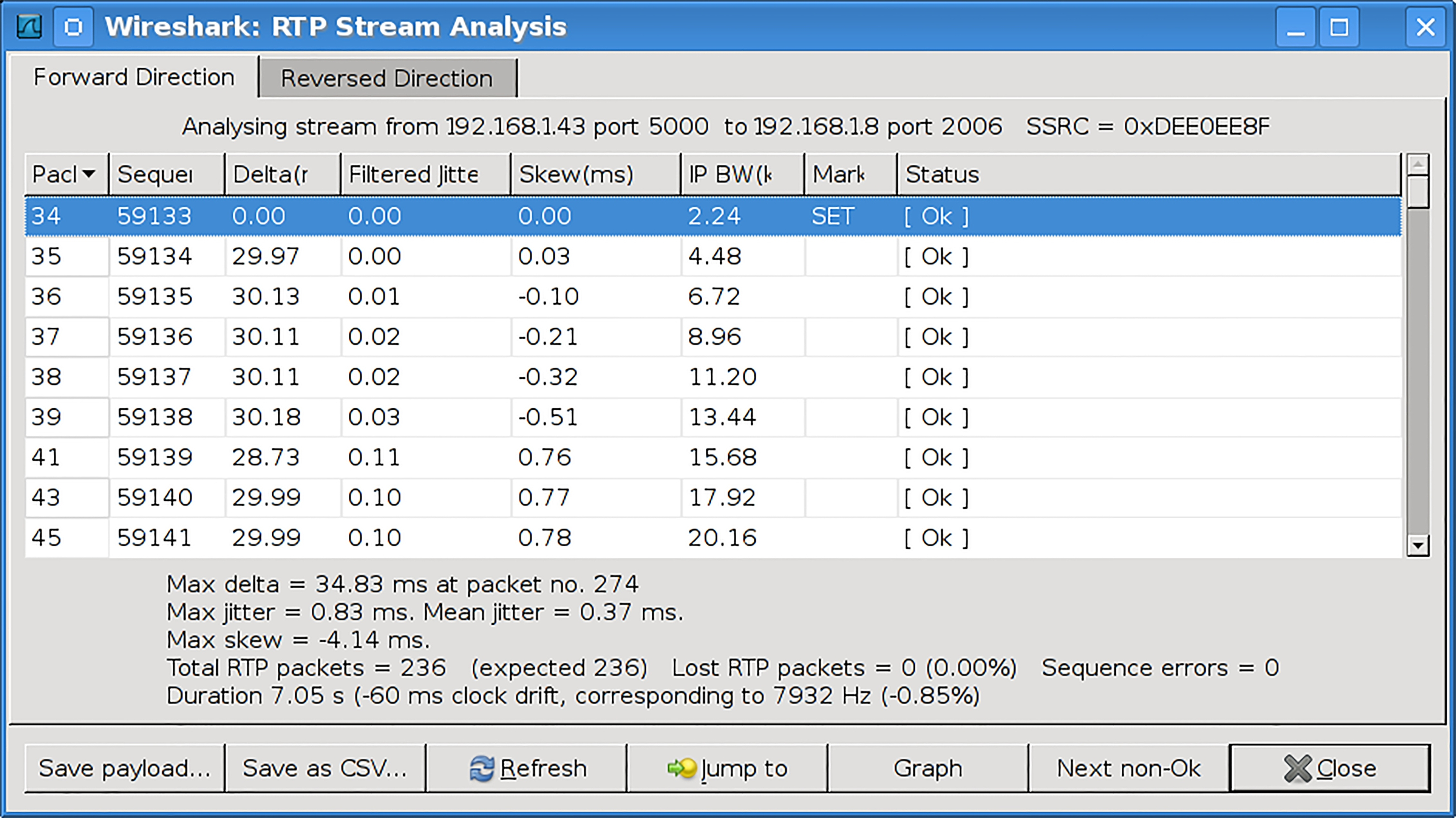
Considering that human body emits infrared ray with a certain wavelength, the system utilizes this characteristic to adopt infrared sensor to detect the change in this wavelength and sends the signal to NVS video gateway after amplifying the signal. Then, the Internet sends the prewarning notice to the servers or mobile devices of supervision staff. The system will apply the human body pyroelectric infrared induction circuit into security prewarning of university laboratories. After repeated system adjustment and multiple experiments, this system makes full use of the powerful functions of ARM9 process Linux operation system embedded into TMS320DM365. The system is characteristic of strong system stability and quick communication speed and can cooperate with the access control system to guarantee security issues of experimental equipment.
Footnotes
Acknowledgments
Design and realization of WiFi based ad hoc smart power plug, the Science and Technology Research Project of Department of Science and Technology of Henan (Code: 172102210554); Development of ARM based embedded industrial smart real-time monitoring system, the Key University Scientific Research Project of Henan (Code: 15A520110).