



Abstract
According to the requirement of practical application in environment detection, intelligent transportation, military and other fields, this paper proposes a network mode of mobile network with double-layer fixed cluster structure. Based on the clustering routing protocol CBRP of Ad hoc networks, a CBRP
Introduction
Mobile ad hoc network supports wireless transmission of data, voice, image and graphics services between mobile nodes in various environments through automatic networking. It can form multi-hop network, effectively expand the coverage of traditional network, and has broad application prospects in industry, transportation, military and other fields [1].
Mobile ad hoc networks have two kinds of topologies: plane topology and Clustering structure. When the network size is relatively small, a planar topology can be used. In large-scale networks, Clustering structure is often used [2, 3]. Layered cluster mobile ad hoc networks have flexible and diverse networking modes [4]. According to the requirements of practical applications in environmental monitoring, intelligent transportation, military and other fields, we propose a double-layer fixed cluster mobile network networking model. Different from the commonly defined Clustering structure mobile ad hoc network, the double-layer fixed cluster mobile network is divided into application layer and convergence layer. The cluster structure of application layer nodes is relatively stable, and the convergence layer is composed of application layer cluster head nodes. In fact, the double-layer fixed cluster mobile network is a simplified model of Clustering structure ad hoc network in general sense, so it can also be called simplified Clustering structure mobile ad hoc network. There are many routing protocols for Clustering structure mobile ad hoc networks, but the general Clustering structure routing protocols cannot be directly used in the double-layer fixed cluster mobile network. It needs to be modified according to the characteristics of the double-layer fixed cluster mobile network [5].
In this paper, according to the practical requirements of networking in environmental monitoring, intelligent transportation, military and other fields, the networking scheme of mobile network with double-layer fixed cluster structure is given. The related clustering routing algorithms are studied, and the routing protocols suitable for mobile networks with double-layer fixed cluster structure are analysed and designed. The simulation analysis is carried out to verify the feasibility and validity of the routing protocol for the mobile network with double-layer fixed cluster structure, which lays the foundation for the practical application of the mobile network with double-layer fixed cluster structure.
Network model
As shown in Fig. 1, the networking mode of the mobile network with double-layer fixed cluster structure is that all the nodes participating in the networking can move in a certain area, and the communication network is divided into two levels. The lower level network (or application layer network) consists of several relatively independent mobile communication subnetworks. Each mobile communication subnetwork corresponds to a cluster structure. One of the nodes in a cluster is the cluster head node, the other is the cluster member node. The superior network (or convergence layer network) consists of cluster head nodes of each mobile communication subnetwork and a mobile communication centre, forming a mobile cluster communication network.
Mobile network model with double-layer fixed cluster structure.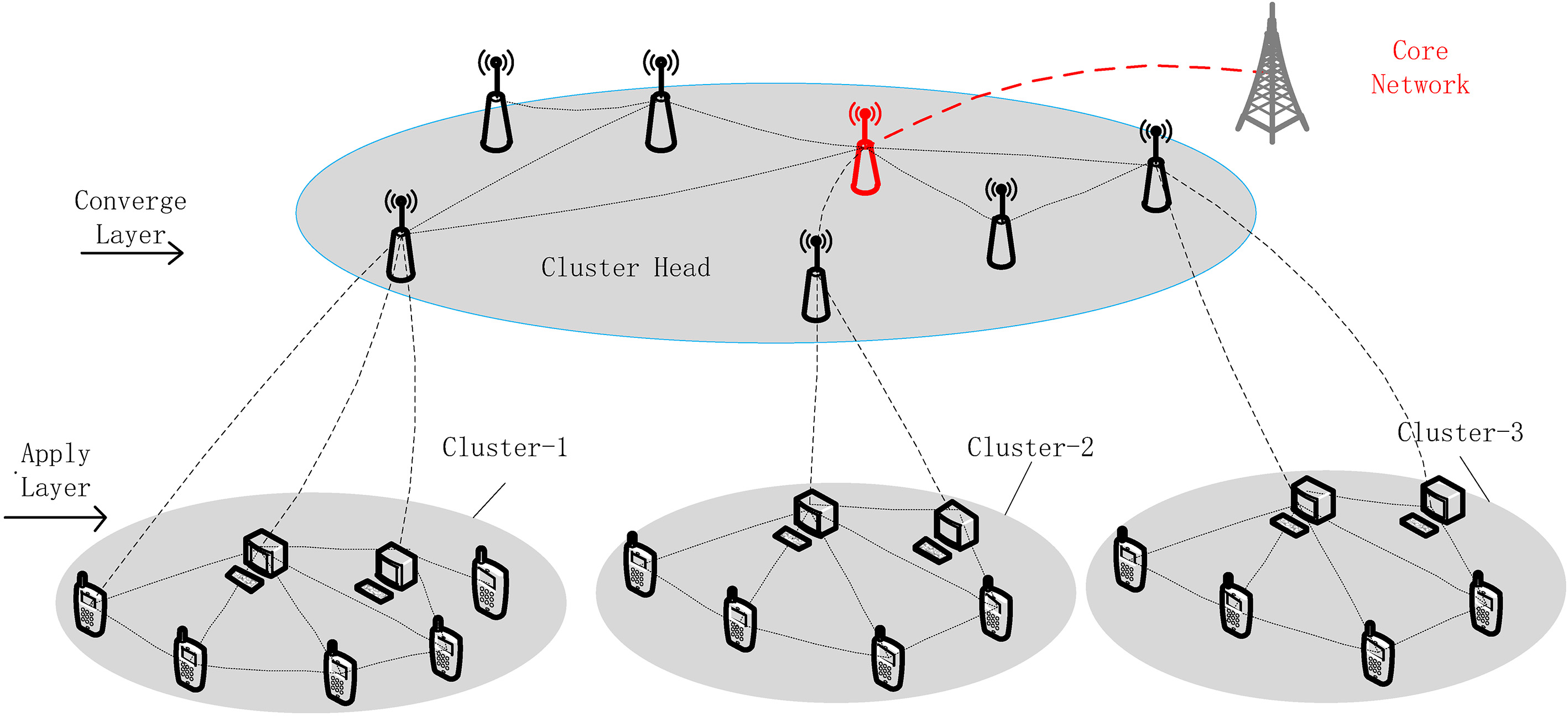
The double-layer fixed cluster mobile network belongs to hierarchical distributed control network, which combines the advantages of distributed and hierarchical centralized network. It not only overcomes the disadvantage of centralized network routing control, but also reduces the network information exchanged between nodes in the network. It can satisfy the practical application of networking in environmental monitoring, intelligent transportation, military and other fields. Request [6, 7]. Under the same network scale, the routing overhead is less than the fully distributed control structure, and the network scale is easy to expand. For large-scale networks, the network scale can be expanded in different application scenarios by increasing the number of clusters or network hierarchies.
In order to improve network robustness and reduce energy consumption, the cluster structure of application layer network is relatively stable to reduce the additional energy overhead caused by network reconfiguration. Considering that the cluster head node undertakes the data forwarding task of other nodes in the cluster, it may fail prematurely due to heavy tasks and high energy consumption, which will shorten the network life cycle [8]. Therefore, it is necessary to rotate the cluster head periodically among all the nodes in the cluster.
CBRP (Cluster Based Routing Protocol) is a source routing on demand routing protocol based on clustering structure. It is a comprehensive routing algorithm that combines the advantages of table-driven routing protocol and on-demand routing protocol, but it cannot be directly used in mobile network with double-layer fixed cluster structure [9, 10]. On the basis of CBRP protocol, we design a routing protocol CBRP
Cluster formation and maintenance
When the network is initialized, the cluster is constructed according to the minimum ID clustering algorithm, and the cluster head is elected.
Set the ID of all nodes in the network. In a certain range of nodes, the node with the smallest ID number is the cluster head. If the distance between a node and the cluster head is less than one hop, the node will act as the member node of the cluster and will not participate in the cluster head election.
When a new cluster head is generated, it is identified in the cluster head node routing table and broadcast message Hello Message. At the same time, the cluster head node identifies the neighbour node with two-way links as the cluster member node.
It should be pointed out that when a member node is in the overlapping area of multiple clusters, it will receive the broadcast message Hello Message of multiple cluster head nodes at the same time, that is, the node will belong to multiple clusters. At this point, the main cluster heads are implicitly listed in the broadcast message Hello Message.
Because cluster structure is identified by cluster head nodes, the number of cluster head elections should be minimized to reduce the overhead of cluster head rotation. If the cluster head must be re-elected, the following three principles must be followed:
In the case that cluster heads already exist, member nodes will not strive to act as cluster heads. When the duration of two cluster head nodes is longer than the set time, one of them must give up the identity of cluster head. When the two-way link connection time of two cluster head nodes has exceeded the set time, the smaller ID will continue to act as cluster head, the larger ID number will give up the identity of cluster head, and the cluster structure will be reassembled.
For the double-layer fixed cluster networking scheme, a fixed cluster structure is adopted to reduce the additional energy consumption caused by network reconfiguration. In the network, cluster head node is responsible for collecting environment data and forwarding data from other member nodes. Because of heavy tasks and high energy consumption, cluster head nodes terminate in advance, which shortens the life cycle of the network. Therefore, it is necessary to rotate the cluster head in the nodes that can act as the cluster head.
The cluster head rotation of the network includes the following steps:
The current cluster head selects the next cluster head in the candidate node. Define cluster head marker vectors:
The cluster head flag vector is stored in all the nodes in the cluster, if node is the cluster head, For nodes far away from the aggregation or nodes that are already cluster heads, their ID is stored in the temporary variable
The current cluster head sends a rotation notification to the selected candidate. The selected candidate header replies to the current cluster header acknowledgment message when it receives the rotation notification. When an acknowledgment message is received from the selected candidate, the current cluster head will respond to the acknowledgment message to the selected candidate and wait for its reconfirmation. If the selected candidate is not reconfirmed during the overtime, the current cluster head stores it in and initiates a new selection. Otherwise, the current cluster head broadcasts the new cluster head to all other nodes. All other nodes in the cluster specify a node to mark corresponding to the new cluster head. Therefore, the cluster head rotation is completed.
The routing request is broadcast to all nodes in the network. After receiving the routing request, the node forwards the routing request directly to the neighbouring node. If the node is the intermediate node of a pre-determined cluster, the routing request is forwarded to the cluster head node; otherwise, the routing request is discarded [12].
When a cluster head receives a routing request, it immediately checks whether it has received the routing request: if it has received, discard the routing request, otherwise, record its address information in the cluster address list.
Any cluster head node can only forward routing requests once, and will not forward routing requests to nodes that have generated routing. When a node receives a routing request, it sends back the routing response according to the route in the cache.
When a node sends a routing request, if it fails to receive a routing response within a specified time, the delay will be conceded until the routing request is re-sent. Usually, a node in the network can record every source route that has been acquired in the routing cache. When it needs to send data, it will query its own routing cache and use the stored routing directly.
Link state monitoring and connection state monitoring
When the cluster head node is in normal working state, each node will send Hello Message to the cluster head node continuously to determine whether the cluster head node is in normal working state, so as to ensure that when new nodes join or original nodes withdraw, the cluster head can be notified at the first time.
Neighbour lists are linked to timers. If the node fails to receive Hello Message information at a set time, the list item will be removed. If the adjacent topology of a node is stable, whether Hello Message information arrives in one-way or two-way links within a certain period of time, all information of each node in the network arriving at this node will be stored in the neighbour list.
Hello Message broadcasts every interval for a period of time. Not only does it maintain the list of neighbours of all nodes, but also any node can receive all the information of each two-way link within the distance of two hops by receiving broadcasting, and write the information into the two-hop database.
Simulation analysis
To verify the conclusions of the above analysis, we use OPNET simulation tool to simulate and analyse the network mode and the improved CBRP
Simulation model
The simulation area is set in a rectangular space of 5000 m
Simulated network model.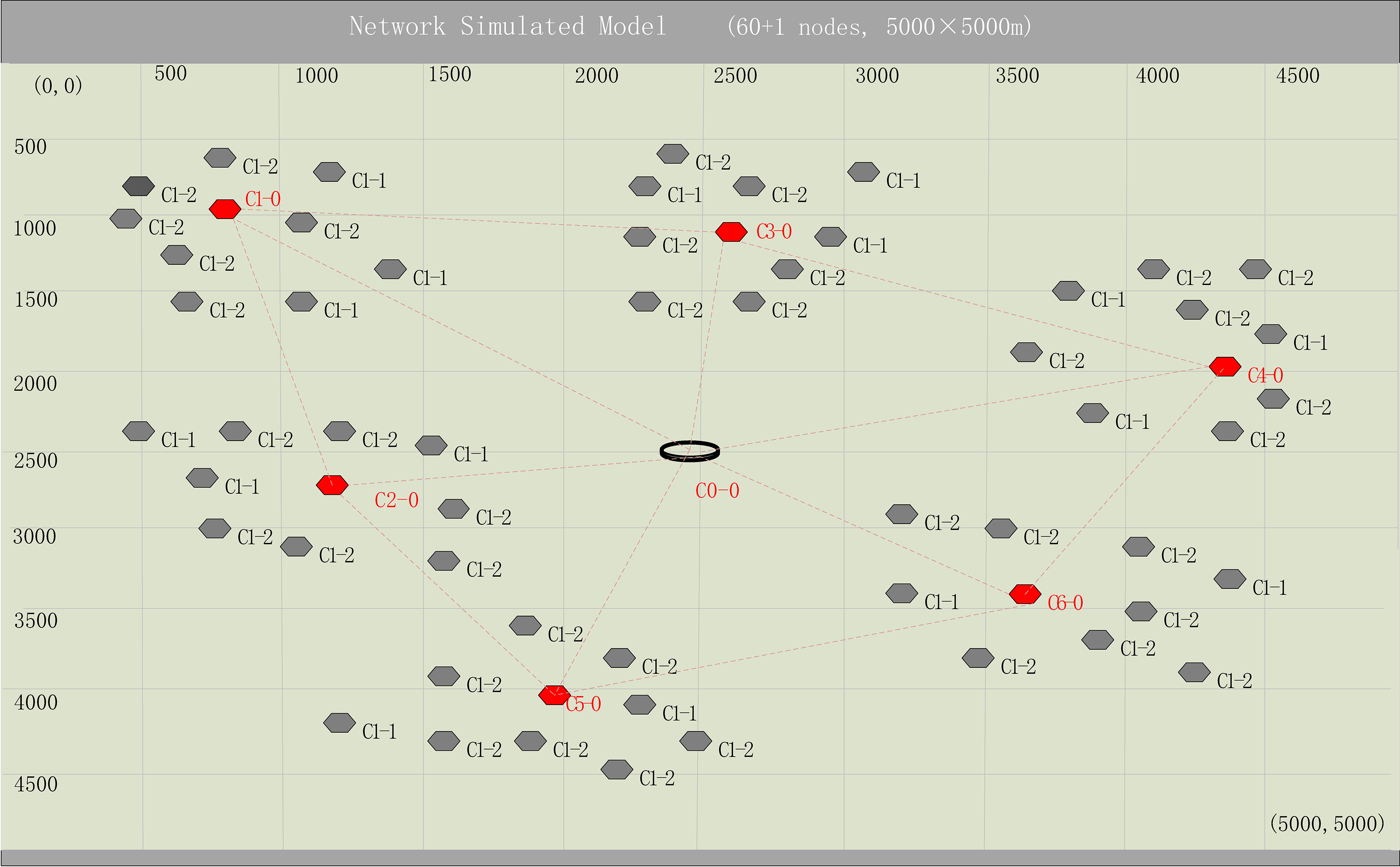
The central node of the convergence layer is located in the centre of the simulation area, and the maximum moving radius is 500 m. The cluster head nodes of each cluster are distributed around the central node and can move randomly in the simulation area. Each cluster member node moves randomly around the cluster head, and the distance between the cluster head node and the cluster head node is kept within 1000 meters.
The node model is divided into six layers, traf-src, cbrp-intf, cbrp-routing, manet-mac-intf, manet-mac, manet-port-rx/manet-port-tx, respectively, from high to low, as shown in Fig. 3.
Node model.
State transition diagrams of cbrp-intf process.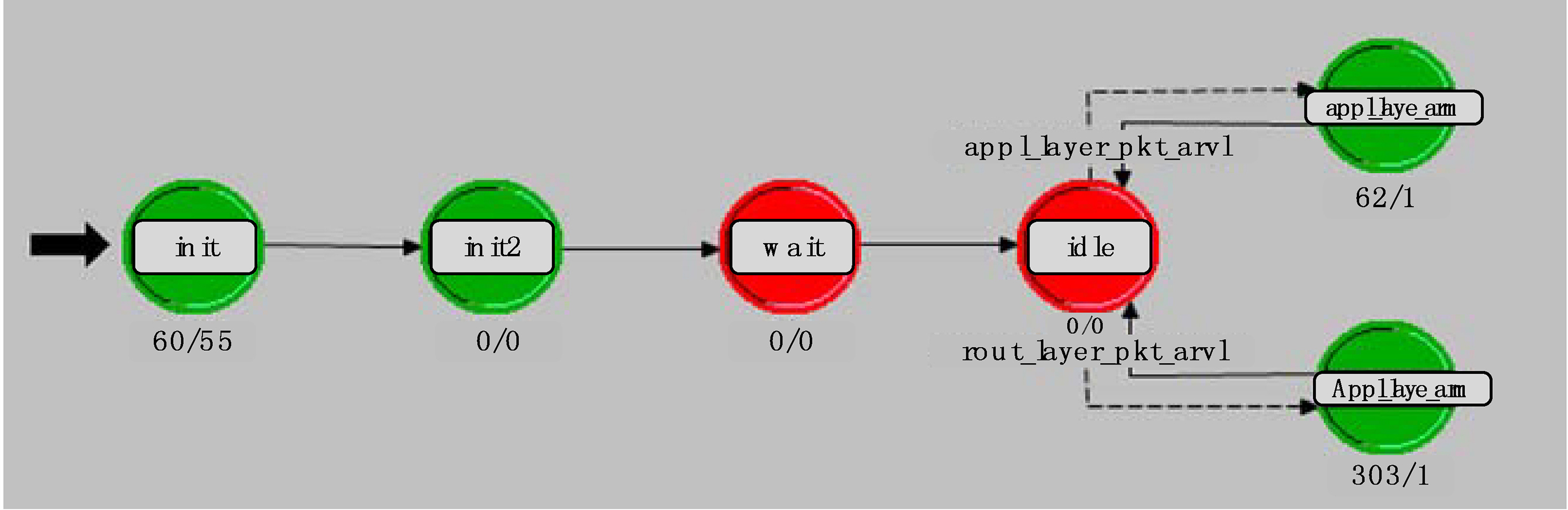
State machine transition diagram of cbrp-routing process.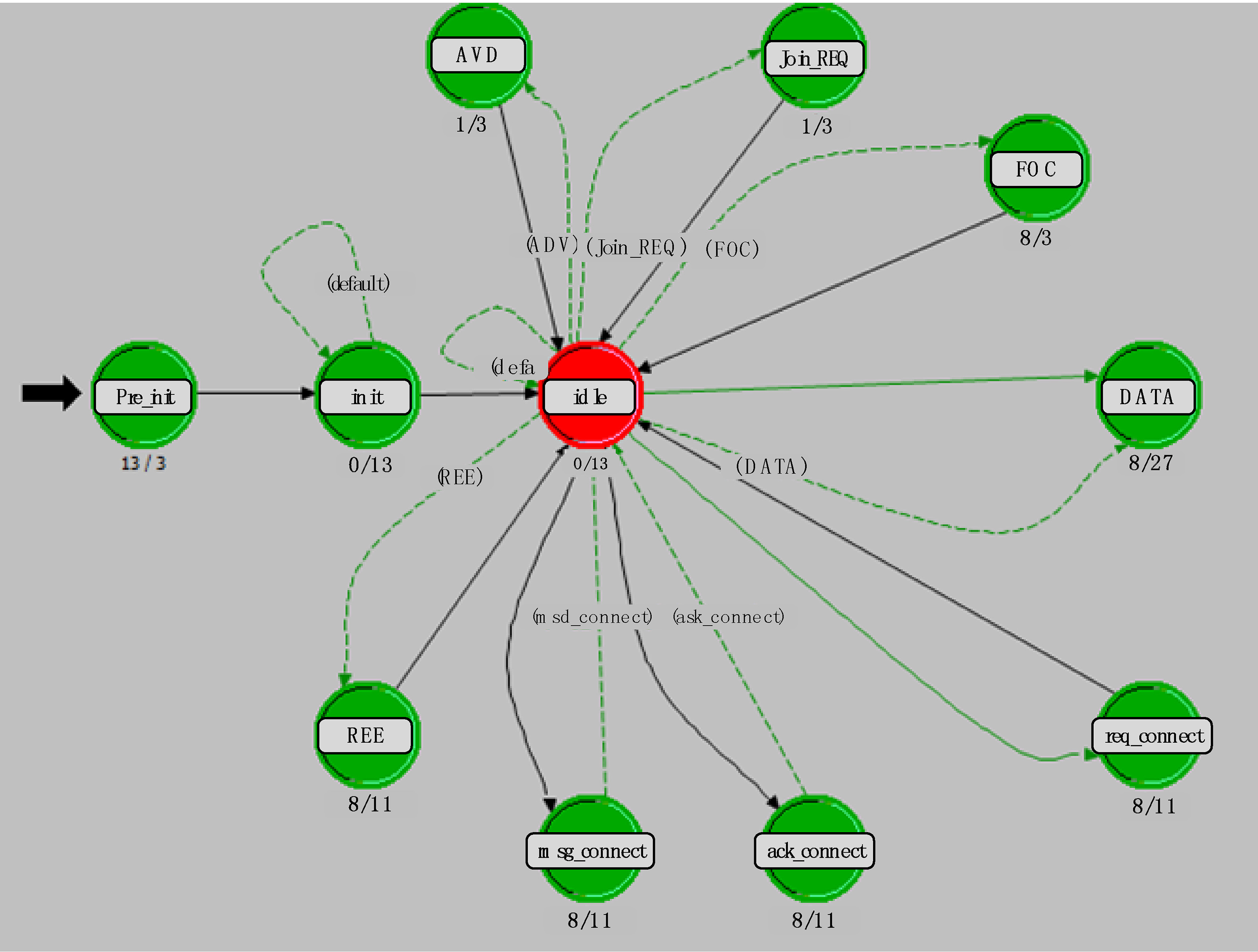
The transport layer traf-src has two main functions: one is responsible for forming data packets, handing them to the lower layer for processing and sending; the other is responsible for destroying the data packets received by the lower layer and processing them well. In traf-src, the relevant parameters of communication data generation are set: the start time of simulation is Start-Time, the length is 100 s; the generation interval of data packet conforms to Exponential (1) Distribution; the length of data generation conforms to Exponential (1024) Distribution; and the stop time of data generation is End of Simulation.
The network layer is composed of cbrp-intf and cbrp-routing process module. The cbrp-intf process module is responsible for assigning the destination address to the data packet to be sent, and its state transition diagram is shown in Fig. 4. The cbrp-routing process module is set up according to the CBRP
The data link layer consists of two process modules, manet_mac_intf and manet_mac, in which manet_mac_intf is the interface module between the data link layer and the network layer. The process module manet-mac is used to implement various functions of the data link layer, including correlative processing of data packets transmitted from the upper layer, and corresponding processing of various situations of the transmitting module or receiving module.
The physical layer is composed of the wireless transmitter module manet-port-tx and the wireless receiver module manet-port-rx. The module manet-port-tx and manet-port-rx modules set the wireless channel attributes according to IEEE802.15.4 standard. In the frequency band of 2400–2483.5 MHz, the bit rate is 250 kbps, including 16 channels, the channel bandwidth is 5 MHz, the channel modulation mode is MSK, and the spread spectrum is 8.
Based on the above simulation model, we simulate the whole network and its communication subnetwork respectively, and compare and analyse the performance indicators of the network, such as packet delivery rate, average end-to-end delay, throughput and so on. After many simulation experiments, the results are as follows.
Packet delivery rate (PDR)
Packet delivery rate of mobile ad hoc networks is directly related to the speed of node movement. The simulation results show that the packet delivery rate of mobile network with double-layer fixed cluster structure decreases with the increase of the node’s moving speed, as shown in Figs 6 and 7. When the node moving speed is 7.5 m/s, the packet delivery rate of application layer and convergence layer is about 95%. Because of the large amount of data transmission in convergence layer, when the node moving speed of convergence layer is more than 25 m/s, the packet delivery rate drops below 85%, as shown in Fig. 7.
Application layer packet delivery rate.
Convergence layer packet delivery rate.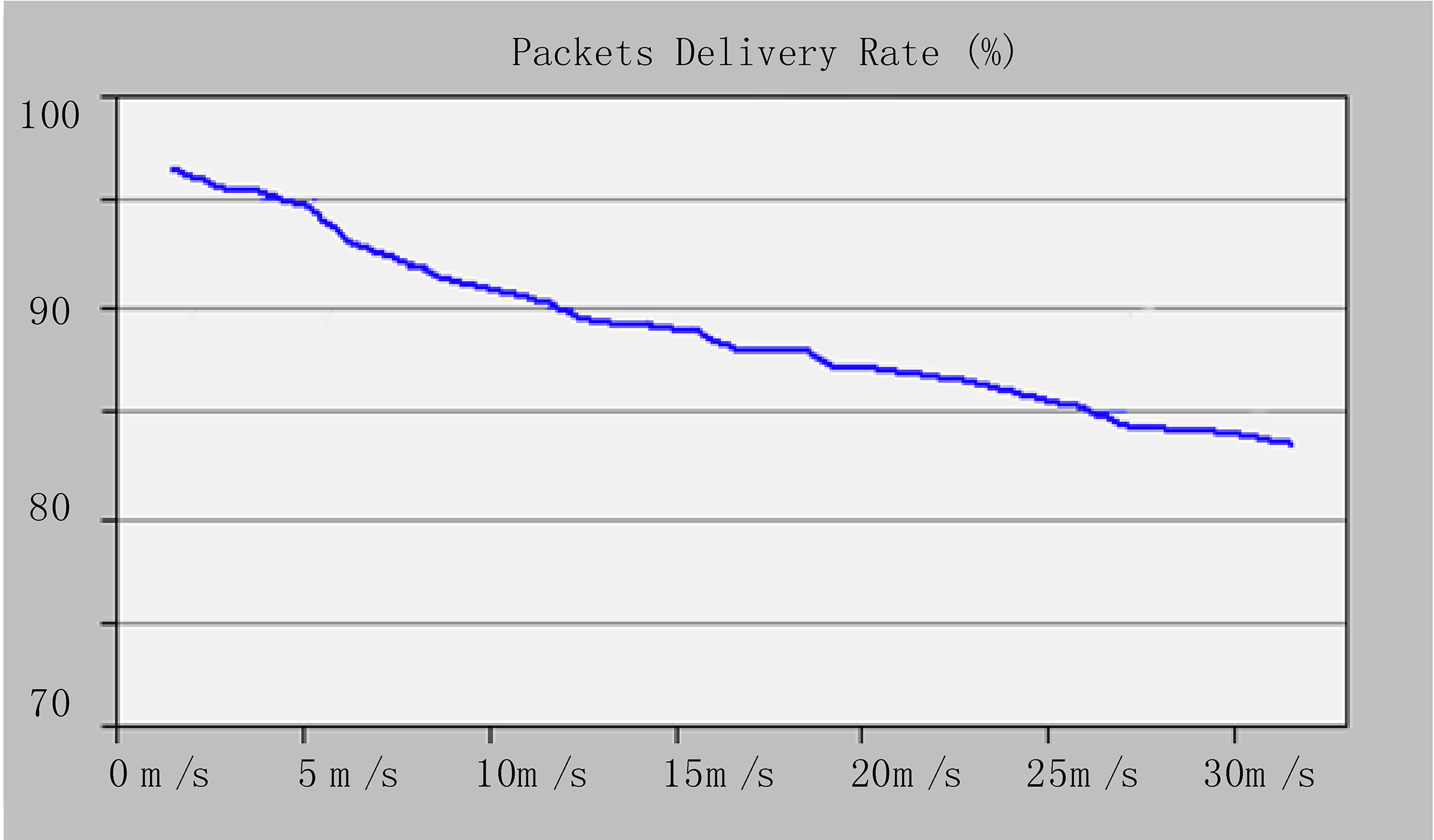
Application layer network delay.
Convergence layer network delay.
Cluster head node throughput of application layer network.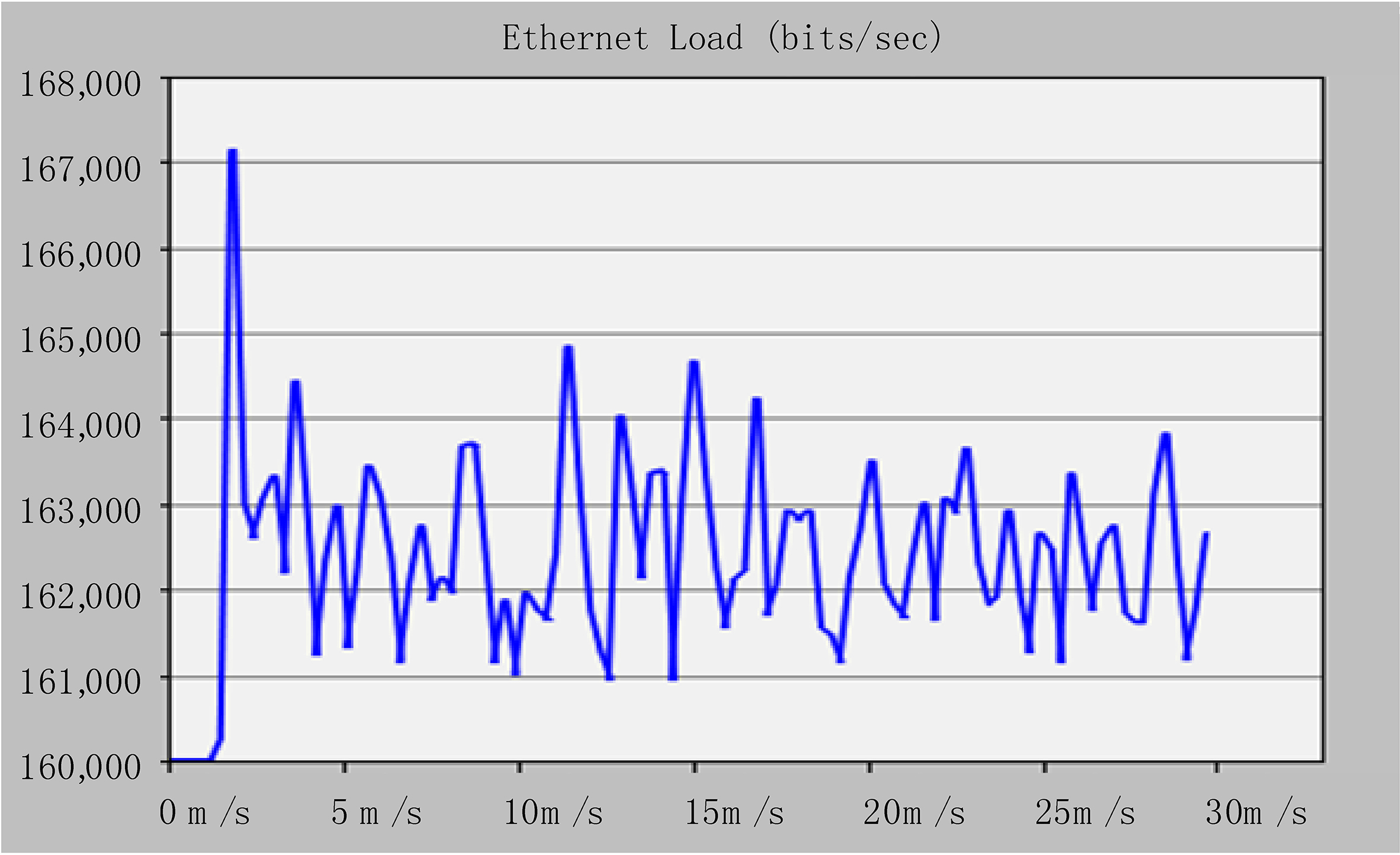
Throughput of central node in convergence layer network.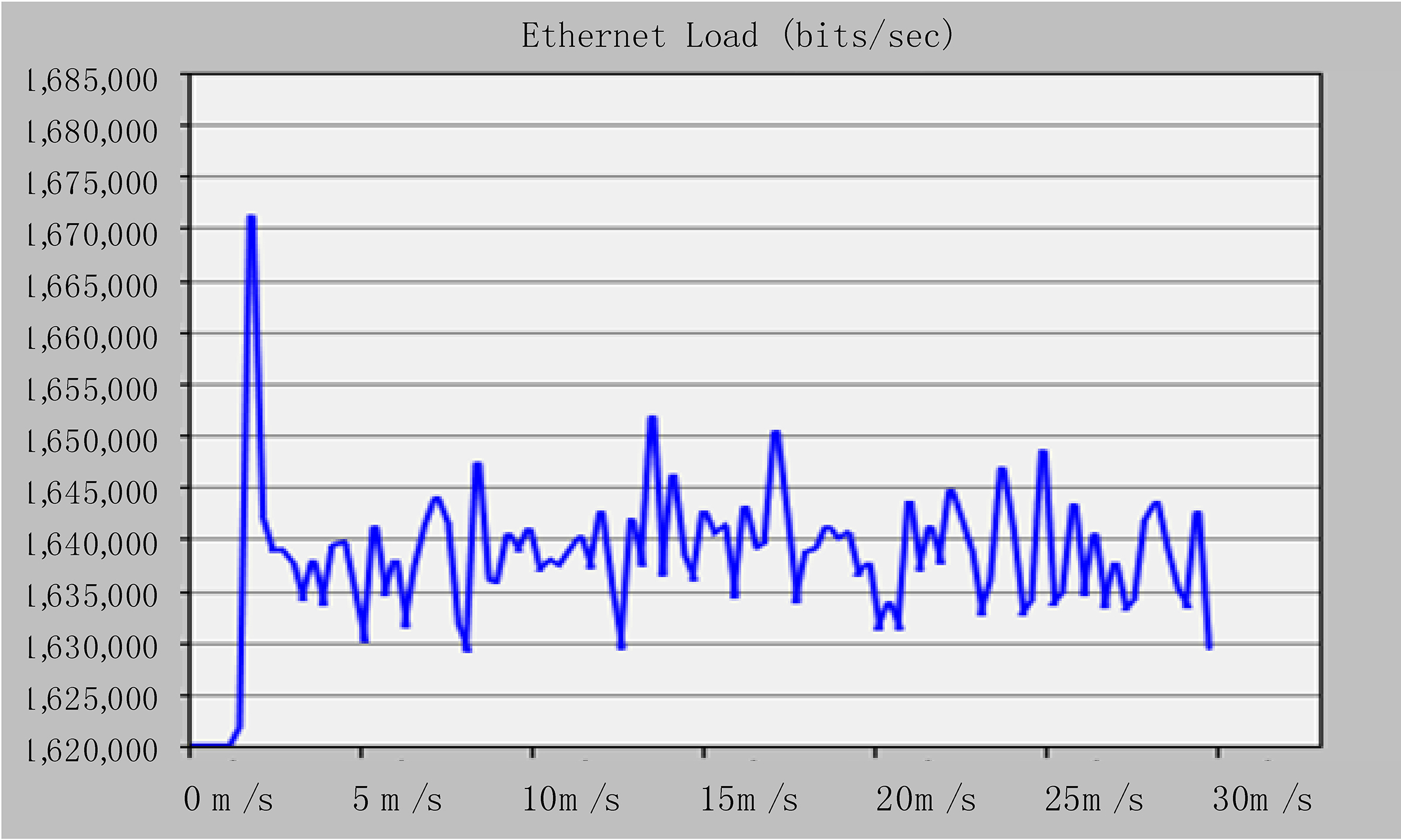
The average end-to-end transmission delay of the network is independent of the node’s moving speed, and the transmission delay is small, as shown in Figs 8 and 9. The time delay of network application layer is about 0.4 Ms, and that of convergence layer is larger than that of application layer, reaching 0.45 Ms.
Network throughput
In order to analyse the communication capability of the network, we simulate and test the throughput of cluster head node of application layer network, get the result as shown in Fig. 10, and the throughput of central node of convergence layer network, get the result as shown in Fig. 11. Among them, the throughput of cluster head node in application layer network is more than 150 kbps, and that of central node in convergence layer network is more than 1500 kbps.
Based on the analysis of network performance parameters such as end-to-end delay, packet delivery rate and throughput obtained from simulation experiments, the double-layer fixed cluster mobile network can meet the communication requirements of practical applications in the fields of environment detection, intelligent transportation, military affairs and so on. The improved clustering routing protocol CBRP
Conclusion
According to the requirements of practical applications in environment detection, intelligent transportation, military and other fields, we propose a double-layer fixed cluster mobile network networking model. The mobile network with double-layer fixed cluster structure belongs to hierarchical distributed control topology structure, which is different from the commonly defined hierarchical cluster structure of mobile ad hoc network. The mobile network with double-layer fixed cluster structure is divided into application layer and convergence layer. The cluster structure of application layer is relatively stable, and the convergence layer is composed of application layer cluster head nodes. CBRP (Cluster Based Routing Protocol) is a source routing on demand routing protocol based on clustering structure. It is a comprehensive routing algorithm that combines the advantages of table-driven routing protocol and on-demand routing protocol, but it cannot be directly used in mobile network with double-layer fixed cluster structure. Based on ad hoc network clustering routing protocol CBRP, we design a routing protocol CBRP
Footnotes
Acknowledgments
The Natural Fund of Guizhou Provincial Science and Technology Department “Research on Wireless Sensor Network System for Environmental and Security Monitoring” (Qiankehe J [2013] 2204) supported the project.