




Abstract
The Ad Hoc networks solves the problem of quickly establishing a temporary Ad Hoc network without the need for fixed facilities. However, problems such as network performance degradation, delay increase, and link interruption are endless. Aiming at the problem of shortening the survival time of Ad Hoc networks nodes, this paper proposes an improved AODV routing algorithm EC-MAODV (Energy Consumption-Modification AODV) based on energy consumption. EC-MAODV takes energy as the starting point, determines the time extension based on the residual energy of the current node, balance the power consumption of each node, and extends the networks lifetime. The effectiveness of EC-MAODV routing algorithm is proved by network simulator NS-3. The simulation results show that compared with the AODV routing protocol, the algorithm in this paper has more than 7% improvement and 19% increase in average delay and node lifetime. It can effectively prolong the life of the network, reduce the number of dead nodes, effectively solve the energy consumption problem of the wireless Ad Hoc network, and improve the overall performance of the network.
Keywords
Introduction
With the explosive growth of network scale, the diversified development of new services and the continuous upgrading of intelligent terminals. Wireless Ad Hoc networks have begun to enter a period of rapid development. The mobile Ad Hoc network [1] defined by the standard has become a research hot spot in the network field. Researchers have studied Ad Hoc routing protocols from different perspectives [2, 3, 4, 5]. Liang et al. [2] proposed a routing protocol based on direction prediction and energy perception. The protocol predicts the optimal path of the network to the target node by calculating the adaptive forwarding probability of the network. Yang et al. [3] proposed a secure routing protocol for ad Ad Hoc networks based on a reliable backbone network, and introduced a trust evaluation mechanism to evaluate network nodes. This protocol can achieve better network performance while meeting security requirements. Mohammad et al. [4] proposed a new Ad Hoc on-demand distance vector routing protocol, which uses a combination of genetic algorithm and learning automata to select the optimal path. Elhoseny et al. [5] Proposed a secure routing protocol and signcryption model to encrypt the digital signature, which can improve the overall efficiency and confidentiality. Among them, Ad Hoc on-demand distance vector routing (AODV) has attracted extensive attention of re-searchers because of its low routing overhead, simple routing control and good scalability [6, 7, 8, 9]. Li et al. [6] Proposed a highly reliable fuzzy logic assisted AODV routing algorithm, which realizes the selection of low delay, high link connectivity and long-life routes through the fuzzy system. Mohit et al. [7] Proposed dual methods of energy supplement and load balancing to improve AODV protocol, effectively improving network performance and operation. Liang et al. [8] Proposed an improved AODV routing protocol based on adaptive scheme, which has better adaptive performance for dynamic wireless adaptive networks. Mostafaei [9] proposed an algorithm based on distributed learning automata to solve the end-to-end reliability, delay and other quality of service requirements. However, AODV protocol still has some problems, such as long route discovery time and short network lifetime. Meanwhile, the source node only discovers routes when the protocol requires routes, and only maintains active routes.
In recent years, many scholars have optimized AODV routing protocol in different aspects [10, 11, 12, 13, 14]. Liu [10] proposed a straight-line routing protocol that combines model parameter estimation and remaining useful life predictions to generate more accurate results even when the system suffers from hard failures. Huang [11] proposed a bidirectional route repair method based on the AODV protocol, which uses a density-based approach to minimize the number of hops in the repair path, thereby improving the success probability of the repair path. An AODV improvement path based on energy balance and density is proposed by Chen [12], this further improves routing performance, but if nodes on the network move badly, the nodes with less energy will be discarded. Ghori [13] proposed a mesh network packet forwarding mechanism based on AODV, which is optimized in terms of protocol overhead and end-to-end delay. However, frequent use of packet forwarding may result in insufficient node energy. Zou [14] proposed an improved AODV routing protocol that prioritizes nodes with high energy and high signal strength. Even if the original route is broken, the backup route will be activated immediately, but the possibility of route breakage will increase. Therefore, with the purpose of prolong network lifetime and reduce node death, a path selection algorithm based on energy consumption EC-MAODV is proposed by this paper. By balancing the power of each node, it solves the problem of small nodes being discarded, insufficient node energy and routing broken and other issues. The main contributions of this paper are summarized as follows:
We propose a path selection algorithm based on energy consumption. By calculating the remaining energy of the node, the algorithm conducts reasonable node routing, effectively prolonging the network life and reducing node death. The EC-MAODV algorithm can balance the power of each node, and solve the problems of small nodes being discarded, insufficient node energy, and routing interruption. Through experimental simulation, we found that the EC-MAODV algorithm is superior to the AODV algorithm in terms of average delay, packet delivery rate and node survival time.
The remainder of this paper is organized as follows. Section 2 is an overview of the research background. Section 3 is the principle of EC-MAODV routing algorithm. Experiments and performance analysis are discussed in Section 4. Conclusions are drawn in Section 5.
Ad Hoc networks
Ad Hoc network is a multi-hop wireless network, self-organization and centerless [15]. It can communicate without any fixed network facilities. Compared with traditional wireless networks, Ad Hoc networks have the following features [16, 17, 18].
Dynamic topology. Because Ad Hoc networks has no control center, the random movement of host nodes and the arbitrary switch of nodes, the network topology changes have unpredictable randomness, which makes it impossible to predict the network topology.
Centerless. All network nodes are in the same location, and no need to manage communications on a network via a core device. Communication on this network is through the cooperation of nodes to complete the outgoing data packets, so it has a natural advantage in invulnerability and robustness.
Multi-hop routing. Any node in an Ad Hoc network can used for a route or a host to send and receive messages. Unlike traditional networks, which need routers to complete forwarding, only intermediate nodes are required to transmit data [16].
Self-organization. Ad Hoc networks use the mutual cooperation of nodes to quickly establish an automatic network without relying on fixed network communication equipment, thus achieving the communication requirements in special environment [17].
Limited transmission bandwidth. Ad Hoc is limited by the physical characteristics of wireless channel, which makes the throughput of wireless communication smaller than that of wired communication. At the same time, the transmission bandwidth is smaller than the theoretical transmission rate due to the influence of channel interference, attenuation and competition.
Limited security. Because Ad Hoc uses wireless transmission, and there is no security access control equipment in the traditional network, it cannot use access control, intrusion detection and log management and other preventive measures, and it is more vulnerable to various security attacks [18].
AODV protocol
AODV protocol adopts new on-demand routing, so that each node in the network will not maintain a routing table containing the entire network routing, and only initiates the route discovery process when data transmission is needed but there is no available route [19]. Compared with the same type of DSR protocol, each node in AODV has a routing table, so that the packet header can no longer add the entire transmission node and route to reduce the amount of information transmission and the channel occupancy rate. Therefore, AODV protocol has high utilization of wireless bandwidth and can respond to the changes of network topology quickly.
However, AODV protocol also has the following disadvantages:
Two-way transmission channel. Because the route discovery process requires the establishment of a reverse route for two-way communication, the using environment must be able to send data in both directions. Frequent changes affect performance. To prevent loops, the node routing table has only one path to the target node. Therefore, every time the network topology changes, a new approach needs to be found. Timeout deletion. Because the AODV protocol uses a time-out deletion mechanism, the transfer path should be deleted whenever it times out, regardless of whether it is corrupted or not. Regardless of energy consumption. Because the protocol does not calculate energy consumption, key nodes are prone to death, resulting in large-scale network topology changes. Therefore, power consumption needs to be increased to improve AODV protocol.
Problems in Ad Hoc routing protocol
How to improve the energy consumption of AODV has already become the current hot topic [20]. At present, there have been some route optimization and improvement algorithms based on energy efficiency. Foreign countries also have some basic research on how to reduce energy consumption. By consulting domestic and international literature and journals, the development direction can be divided into:
Minimum full power of transmission data: this method selects the link with the lowest total transmission power as the transmission path, so that the whole power of the entire path is the lowest. Extend the network lifetime: this method is to protect the nodes with low energy. Select the node with higher energy as the first path selection target to ensure that the energy loss of all nodes in the network is relatively average. Reduce the power loss caused by protocol work: a novel high-speed local link recovery mechanism is provided which reduces routing frequency and reduces the power consumption of the protocol itself.
To sum up, the current research at home and abroad is mainly from the transmission power minimization to reduce the energy loss of the system and from the working process of the protocol itself to reduce the energy loss. Although these methods can increase the utilization of energy, they still fail to solve the problem of premature death of key nodes. Therefore, this paper mainly protects node energy, ensure the balanced use of energy of each node of the network, and prolong the service life of the network.
AODV routing protocol algorithm EC-MAODV based on energy consumption
Node energy consumption model
In the process of Ad Hoc node transmission, energy consumption mainly comes from data transmission and reception. At the same time, node energy will also be consumed as the communication distance increases.
Energy consumption for sending data
When the source node is sending data, in the case of a data transmission process where the transmission distance is d and the amount of data sent is s bits, two different transmission modes can be set: when
The calculation method of sending data energy consumption is as follows:
In Eq. (1):
When the destination node receives data, when the transmission distance is
In Eq. (3):
In the process of forwarding route request messages, frequent use of route discovery will result in insufficient node energy, resulting in a waste of node energy. Therefore, it is inevitable to consider the node energy factor. By selecting nodes with large remaining energy for routing message forwarding, the problem of insufficient node energy can be effectively solved.
The calculation method of the remaining energy at time
In Eq. (4):
The calculation method of the remaining energy consumption ratio is as below:
In Eq. (5):
When the node presses the RREQ message, if the node receives the message for the first time, it will decide whether to delay forwarding it to the next node ground on the remaining energy loss ratio of the node’s
In Eq. (6):
At present, in Ad Hoc networks, there are two main routing algorithms that can reduce energy consumption: (1) sending data with the least energy as much as possible; (2) trying let the network survive longer.
The first routing algorithm idea is to use the routing with the smallest transmit power to save the energy consumed by sending data. The disadvantage of this algorithm is that if the network topology has not changed or there are uncompleted data packets, this path will be reused. Some key nodes die due to energy exhaustion, leading to network fragmentation, which will affect the timeliness and stability of the routing network to a certain extent.
The second routing algorithm idea is proposed to solve the above problems, by protecting nodes with less remaining energy to prolong the network survival time and reduce the probability of network fragmentation.
The algorithm is based on the above two points, combined with minimizing the cost of each packet and minimizing the energy level difference of nodes, and proposes a routing algorithm based on energy consumption, EC-MAODV. This routing algorithm is suitable for use on Ad Hoc networks. The algorithm adopts an on-demand query method, which can effectively reduce node energy consumption and prolong node survival time.
EC-MAODV algorithm design
When the node gets the RREQ message, it detects the neighbor node list around it, and if the neighbor node is the destination node, it immediately forwards the RREQ message. If the surrounding nodes are not the destination node and cannot directly reach the destination node, they will not forward the RREQ message immediately, and judge whether to forward the RREQ message according to the node residual energy. If the residual power is If the surrounding nodes are not the purpose node and they can reach the destination node directly, the RREQ message will not be forwarded immediately, but the delay will be dynamically increased according to the current energy consumption value of the node, and then the message will be forwarded.
The algorithm flow pseudo code, as illustrated in the Table 1.
EC-MAODV algorithm flow pseudo code
When the source node needs to send packets to the target node, it must first consider if there is a valid route directly to the final destination node. If without valid routes, a route discovery process needs to be started. The flow chart of route discovery is shown in Fig. 1. The route discovery steps are as follows:
Suppose that the source node After the neighbor node If there is a direct path to the target node, send RREP control packets directly to source and destination nodes. Otherwise, add the remaining energy information of its own path to the RREQ routing request packet and forward it until RREQ is sent to the target node. If the above conditions are not met, the route discovery process will continue until RREQ is sent to the target node.
Route discovery flowchart.
Simulation environment
The parameters in the script are set as follows: The required (default 40 nodes) of the experiment are generated in the script. The random direction-2d-mobility-model is used to determine the movement direction and speed of the nodes. It’s 500 m by 500 m. The initial energy is 10 joules. In the script, 4 packets are sent per second, the packet size is 1024 bytes, and the bandwidth is 6 m; and the node sending radius is 200 m by default.; free space energy consumption model is accepted.
Other settings: The wireless model uses the basic IEEE 802.11 DFC (Distributed Coordination Function) with Ad Hoc mode, and the channel is Wifi Channel.
Experimental environment: VM virtual machine, LINUX system, NS-3, eclipse C
Experimental results and discussion
First, under the same conditions as other environments, by setting the number and initial energy of different nodes, the effects of the new algorithm on average delay, packet delivery rate, and network lifetime are investigated. Secondly, compare the source codes of different routing protocols in the Ad Hoc network and use the gprof performance analysis tool supported by the NS3 simulation platform to compare and analyze the performance of our improved protocol and other different routing protocols.
Average delay comparison
As shown in Fig. 2a, the fixed initial energy is 10J, the simulation step is 20, and the number of nodes is increased from 20 to 100, and the average delay change is measured. To be able to see that if the number of nodes is few, the network topology does not change in time, and the time delay between the two tends to be close; when the random movement of the node causes the network topology to dynamically change, because the EC-MAODV algorithm takes into account the energy consumption of the node, With the enhance in the number of nodes, the average delay of the EC-MAODV routing protocol is slightly higher than that the original AODV routing protocol.
The number of fixed nodes is 100, and the simulation simulated scenarios with initial energy of 10, 15, 20, 25, 30, 35, and 40 respectively. When the residual energy of the node is high, the improved protocol is no different from the original protocol, so the delay of the lower initial energy and the higher initial energy is basically the same; when the remaining energy is low, the key node dies and rerouting causes the delay to increase; At other times, the EC-MAODV protocol preferentially selects paths with longer hops to protect key nodes, resulting in increased delay, but the increase in delay is still controlled at a relatively low level. As is shown Fig. 2b.
(a) Effect of number of nodes on average delay (b) Effect of initial energy on average delay.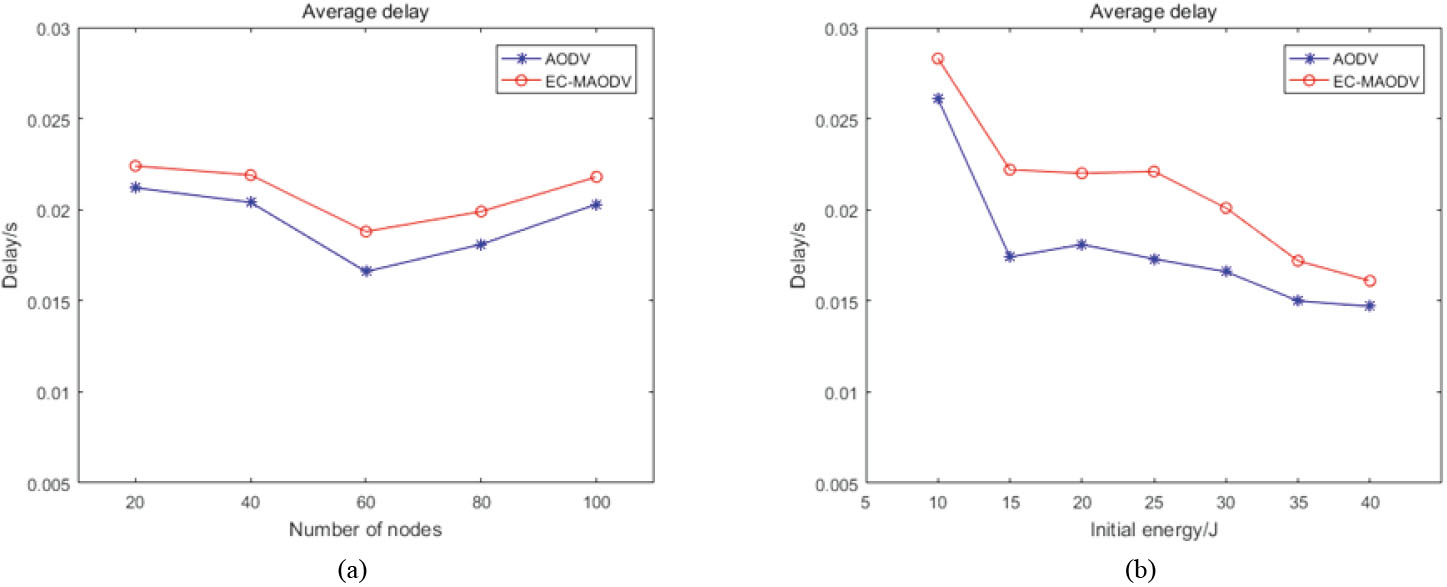
The selection and comparison of the packet delivery rates of the two protocols under different numbers of nodes are selected. As shown in Fig. 3a. If the number of nodes is 20 and 40, the delivery rates of the two tend to be equal. With increasing number of nodes, the changes in network topology become more obvious. The growth rate of EC-MAODV protocol is gradually faster than that of the original AODV protocol. When the number of nodes is 100, the packet delivery rate of the EC-MAODV protocol is compared to the original AODV agreement has increased by 0.66%.
The packet delivery rates of the two protocols under different initial energies are selected and compared. When the initial energy is 10 and 15, because we use the EC-MAODV algorithm, the EC-MAODV protocol will execute the algorithm to protect the key nodes so that they will not die soon and effectively increase the packet delivery rate. Therefore, the transmission rate of the EC-MAODV protocol is much higher than that of the original AODV protocol. With the increase of the initial energy, the delivery rate showed an upward trend before and after the improvement, and finally stabilized at 100% delivery rate. As shown in Fig. 3b.
(a) Effect of number of nodes on packet delivery rate (b) Effect of initial energy on packet delivery rate.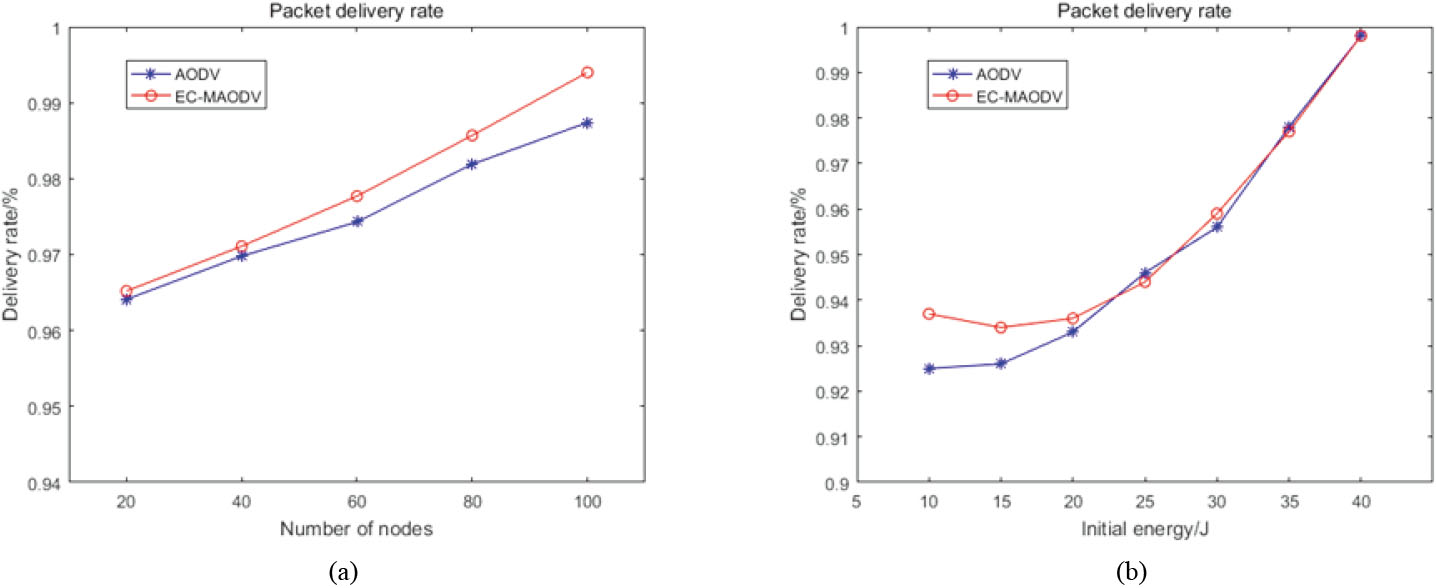
The experiment selected 5 nodes with different numbers for comparative analysis. The consequences show that if the number of nodes is 20, 40, 60, 80, 100, the network survival time of the improved protocol using the EC-MAODV algorithm is significantly upper than that of the original AODV protocol. Simultaneously with increasing number of nodes, the difference in network survival time between the EC-MAODV protocol and the premier AODV protocol becomes more and more obvious. As shown in Fig. 4a.
The experiment selected nodes with initial energy of 10, 15, 20, 25, 30, 35, and 40 for comparative analysis. The experiment found that the overall life span of the EC-MAODV routing protocol is better than that of the original AODV protocol. This is because the EC-MAODV algorithm protects key nodes, makes the energy loss for all nodes in the networks as even as possible, and effectively extends the network life cycle. As shown in Fig. 4b.
(a) Effect of number of nodes on network lifetime (b) Effect of initial energy on network lifetime.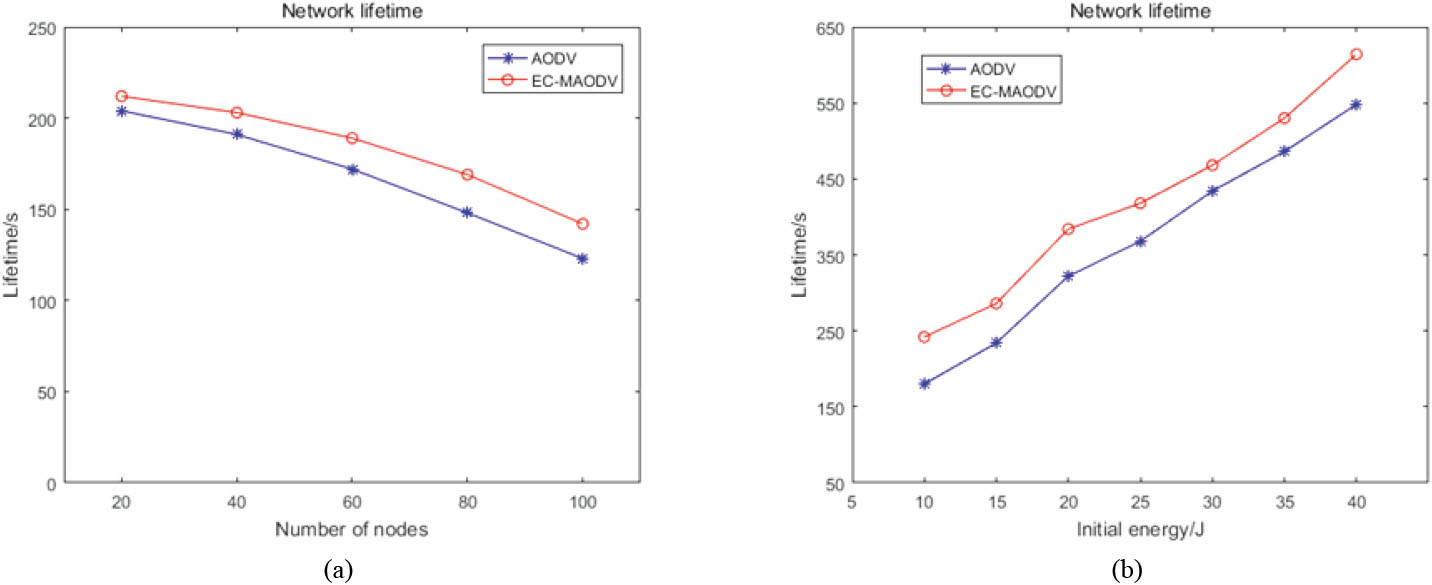
Test conclusion: From the comparison of average delay, packet delivery rate and network survival time, as the number of nodes and initial energy increase, The EC-MAODV protocol achieves the purpose of saving energy and prolonging the network lifetime while sacrificing part of the average delay. During data transmission, the EC-MAODV algorithm adopts an energy-saving strategy. First, the intermediate nodes with lower energy are protected. When the energy is lower, the packet delivery rate can be effectively guaranteed, and the energy of all nodes can be balanced, which fundamentally extends the overall survival of the network time.
Comparison of various performance indicators of different protocols
This paper analyzes the performance of the proposed protocol and other different routing protocols by observing the source codes of the different routing protocols and using the gprof performance analysis tool supported by the NS3 simulation platform.
Table 2 lists 7 performance indicators of 6 different routing protocols, namely: overall complexity, overhead, loop-free, multipath support, routing location, route reset method and routing metric. Among them, the overall complexity represents: the amount of computer resources required by the algorithm to run. Time cost means: the time complexity of the algorithm when it is executed. Loop representation: When calculating new paths, loops may be caused, and loops will prevent traffic from arriving and failover paths, so a protocol with good performance should have loop-free characteristics. Multipath support means: During route discovery, multiple paths can be supported. Routing address selection means: whether the routing protocol performs routing according to routing table or routing cache. The route reset method indicates which method is supported for route repair when the link is broken. Routing metric representation: what metric is used by the routing algorithm to determine the best path. According to the seven performance indicators listed in Table 2, the comprehensive performance of the EC-MAODV protocol is the best. The performance is close to AODV’s DSR routing protocol, the main difference is that DSR supports multi-path routing, but the overhead is slightly increased. Other protocols have other higher defects, are not as versatile as the first two protocols, and can only be used in specific environments.
Conclusion
In order to protect key nodes from dying quickly, this paper proposes an energy-constrained routing algorithm EC-MAODV, which detects the power loss of each node in the networks at all times, and maintains the life time of the networks by protecting low-energy nodes. The emulation experiment results reveal that compared with the original AODV protocol, the algorithm successfully prolongs the networks survival time, reduces the number of dead nodes, and better optimizes the energy consumption problem of Wireless Ad Hoc networks. However, this article does not take into account the location of key nodes in the topological networks. The follow-up work will continue to study the use of this technology to solve the problem of topology location and prediction of nodes under the condition of ensuring the stability of the network link.
Footnotes
Acknowledgments
This work is supported by National Natural Science Foundation of China (Grant: 62072416), Zhongyuan Science and Technology Innovation Leadership Program (Grant: 214200510026), Key Technologies R&D Program of Henan Province (Grant: 212102210429, 222102210170, 222102210322), and The Fourth Batch of In-novative Leading Talents of Wisdom Zhengzhou 1125 Talent Gathering Plan (Zhengzhou[2019] No. 21).