



Abstract
A fuzzy support vector machine kernel regression decision method of reliability probability distributions is presented aiming at the complexity of reliability probability distributions and disadvantage of the other regression model. The comprehensive decision model of probability distributions is built by the network design and feature extraction of the fuzzy support vector machine algorithm. A example is give for inward stress probability distribution type of a stem structural member by the model, the recognition result is Weibull distribution, the total recognition rate achieves 98.75%. The fuzzy support vector optimized algorithm has strong ability of nonlinear mapping and functional approach, it avoids availably partial minimum and overfitting, and gains high precision by comparing the numerical value of the network output with the numerical value of experiment.
Keywords
Introduction
Reliability analysis is important research subject in the field of mechanical engineering. In reliability analysis, it is difficult to decide probability distributions of design parameters, various hypothesis and mathematic model are presented to decide probability distributions of design parameters [1, 2]. According to stress-strength interference theory, the probability distribution law of all parameters must be definited to calculate structural member reliability and execute reliability design. Traditional method is to obtain a quantity of datum by loadable testing for parts or structural member, and then probability distribution type and probability distribution parameters are decided by processing the datum using probability theory, the method will take a long time and lack of accuracy. In this paper, a comprehensive decision method of the reliability probability distribution model based on the fuzzy support vector machine of probability distribution laws is presented aiming at traditional method disadvantage. The comprehensive recognition model of the probability distribution is built by fuzzy-SVM algorithm realization, network design and feature extraction, inward stress probability distribution type of a stem structural member is recognized by the model, the recognition result is Weibull distribution, the fuzzy support vector optimized algorithm has a good generalization ability and clustering ability by comparison between the network recognition result and recursive analysis, it avoids availably partial minimum and overfitting, and gains high precision by comparing the numerical value of network output with the numerical value of experiment. It provides an important new and feasible approach for reliability analysis.
Fuzzy support vector mixing algorithm
Fuzzy support vector machine (F-SVM) is built by combining fuzzy algorithm and SVM based on statistical learning theory, the kernel function provides important module for support vector machines [3, 4, 5, 6].
Given samples
Where
The original space
The fuzzy membership degree of sample
The original space
Where
Restriction expression is obtained by introducing to relax variable
The original quadratic programming problem is translated into fuzzy decision-making restriction programming as follows:
Where
Lagrange multipliers
According to the saddle point theorem, the partial derivative is calculated to
Restriction condition is:
Decision function is obtained:
Where
Feature extraction
Probability distribution decision is a classification of probability distribution types, distribution types include mainly normal distribution D1, exponential distribution D2, Weibull distribution D3, logarithm normal distribution D4. Feature parameter must be extracted firstly before the classification, namely, feature information is obtained from output datum of simulation system [8]. Output datum are described by the experiential distribution, let
Let
Let
Probability distribution feature is obtained by Eq. (12) [9]
Feature value of probability distribution simulation datum
Classification accuracy rate of probability distribution (%)
Classification topology structure is shown in Fig. 1, four feature parameter D1–D4 is used as F-SVM network input layer, probability distribution type D1–D4 is used as output, input and input neural unit number is four [10]. Extracted feature value and goal value
Stress and distribution function value (stress value: 10
Mpa)
Stress and distribution function value (stress value: 10
Probability distribution classification result of the pole stress
F-SVM network topology structure of probability distribution classification.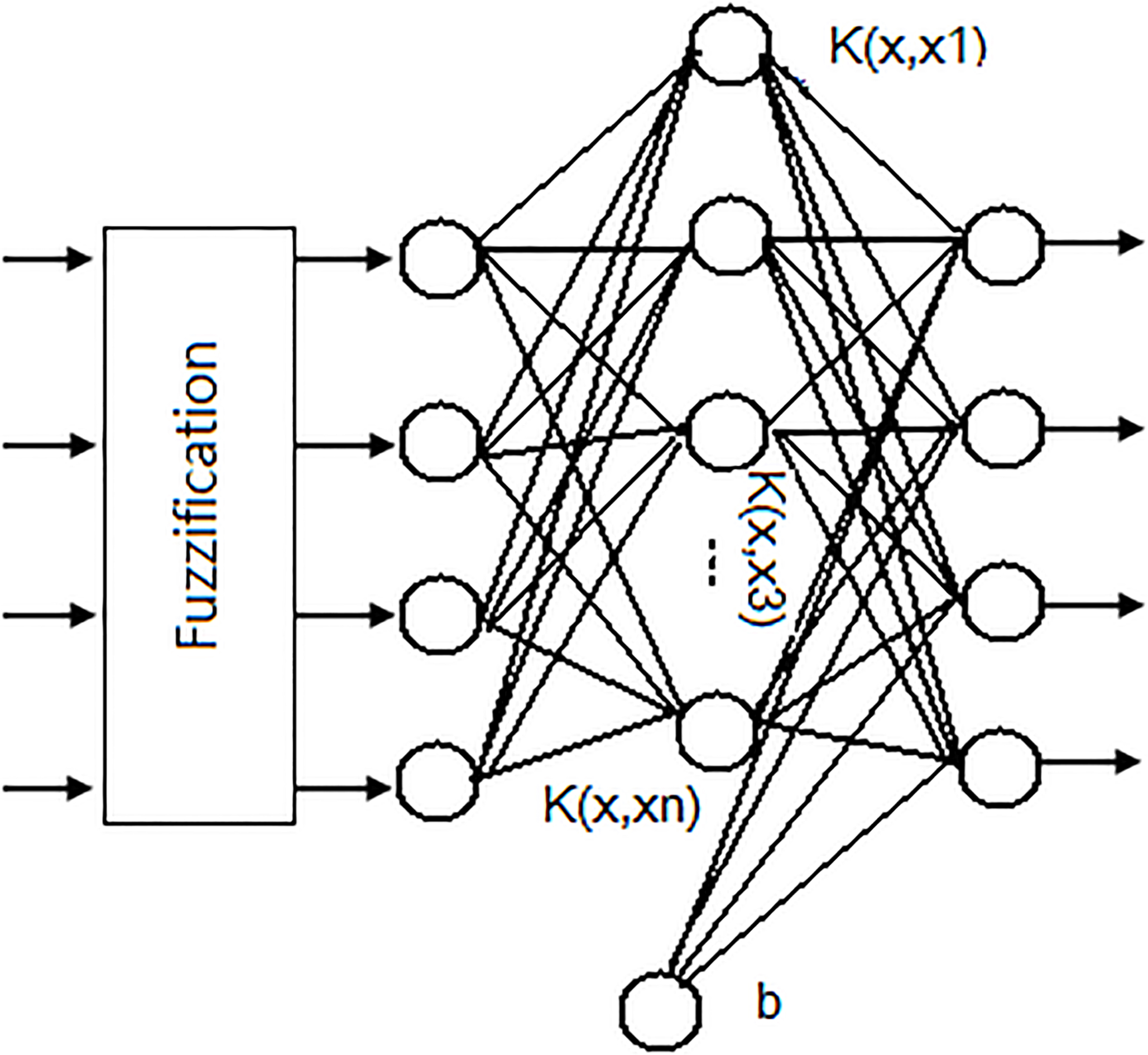
F-SVM classification
Probability distribution of inward stress of a pole arm is classified by the comprehensive decision model, the pole inward stress is random variable, 50 groups of parameters are generated according to distribution law of each factor, each group of parameter corresponding maximal stress in the dangerous section is calculated by finite element, and 40 groups of parameters are used as samples, these samples is arranged from small to large, and corresponding stress distribution function value is calculated according to experience distribution [9, 10], the result is shown in Table 3.
The pole stress distribution of in the dangerous section is recognized by the above trained F-SVM decision model, classification result of stress
Result verification
The comprehensive decision method of reliability probability distribution model based on the fuzzy support vector machine is compared with regression analysis of probability distribution, the regression correlation coefficient of normal distribution, exponential distribution, Weibull distribution, logarithm normal distribution are 0.8669, 0.7534, 0.9730, 0.8510 respectively.
Calculating datum and linear regression are shown in Fig. 2, it is clear that stress distribution confirms best to Weibull distribution and very little likelihood to the exponential distribution.
Regression fitting of Weibull distribution.
So the regression analysis result is consistent with F-SVM decision model classification, the comprehensive decision method of probability distribution is accurate.
Probability distribution type of reliability parameter in the reliability analysis is classified to use F-SVM decision model in this paper, F-SVM has good learning ability and rapid convergence speed, the classification result is accurate by simulation experiment, total recognition rate reach 98.75%. It provides a feasible and useful method for the reliability analysis.
Footnotes
Acknowledgments
This work is supported by Natural Science Foundation of Zhejiang Province in China (LY14F020013), and supported by technology plan public project of Zhejiang Province in China (No. LGG18F040002). The authors thank the members of the reliability research team for their support of this work.