



Abstract
Geological disasters as earthquake, often accompanied with the landslide collapse. Although the earthquake is unpredictable, while the relief can be the most optimal. The earthquake area, often due to earthquake, lead to instability of rock and soil mass, the rescue route is blocked. Time equals life, how to choose a best way to rescue, is extremely important. The manuscript is a kind of measure to determine the rescue route based on fuzzy analytic hierarchy process (AHP), mainly aimed at the geological disaster area, involving the instability of rock and soil mass under seismic action lead to traffic jams, establishing the best rescue route. Considering the stability of rock and soil under earthquake inducement, this manuscript establishes the model of optimal route selection; determines the influence of earthquake on slope stability through analytic hierarchy process, and establishes the corresponding model; combines matlab programming, establishes the influencing factors of earthquake on slope stability, and combines probability model to realize the choice of optimal rescue route.
Introduction
Taking the point of view of stability mechanism into account [1, 2], the geological structure and lithologic [3] of rock and soil area should be checked, and the causes affecting rock and soil stability can be analyzed qualitatively, and the mechanical parameters of rock and soil are determined. Field investigation, indoor parameter test, model simulation, finite element calculation [4, 5] and other methods are selected to evaluate the stability of rock and soil. And the influence of different inducements on the stability of rock and soil, such as earthquake and rainfall, should be taken into consider as well.
The accidental factors of rock and soil stability has been quantitatively analyzed by calculating the permeability characteristic [6] and dynamic response of rock and soil, so the the stability condition of rock and soil under the most dangerous situation can be obtained. As for the parameters, combined with the failure mechanism of rock and soil and computer programming [7], the corresponding treatment methods are established.
There are many factors affecting the stability of rock and soil, including the engineering geological properties of rock and soil itself, as well as the causes of rainfall, earthquake, slope excavation and so on. Scholars have established the corresponding model and statistical method for the evaluation of various factors, but the model combined with the project monitoring data, quickly transformed into scientific research results to guide the construction, but often show lag. Therefore, how to effectively transform the field monitoring data into results through comprehensive evaluation method is very important.
Technology roadmap for this article.
The monitoring data of soil, such as the results of stress, deformation and displacement monitoring of soil slope, can only be used to analyze the stability of soil independently. Even a single monitoring data result still needs to be combined with a certain theory and then determine the corresponding data processing method in order to obtain the final scientific research results that can guide the construction. However, the point is its timeliness. Although the later scientific research results can be used to sum up experience and guide practice, it is lagging behind for this project. The scientific research results are discounted to guide the construction. Though the accuracy of the results of soil stability analysis is important, the timeliness is also a key problem that can not be ignored.
Fuzzy mathematics is a mathematical fuzzy system theory that transforms absolute yes or no into quantitative description and decision-making by membership degree [8, 9, 10, 11]. It originates from theof the concept [12] of fuzzy. And continue to develop rapidly in the two directions of theoretical research and applied research [13, 14]. By using the basic principle of fuzzy mathematics and computer program, the fuzzy recognition [15] based on membership function is realized.
Fuzzy mathematics is often used in mining excavation, slope stability research and so on. According to the influencing factors of rock and soil stability, the set of influencing factors of fuzzy evaluation is determined, and the evaluation set of fuzzy evaluation is determined by quantitative statistical calculation results. And combined with the importance of each influencing factor, the corresponding weight vector is determined, and then the comprehensive method of fuzzy evaluation is determined, the corresponding program interface is compiled, and the comprehensive evaluation can be carried out.
Analytic hierarchy process (AHP) is a method often used for comprehensive evaluation of multiple factors [16, 17, 18], which can realize the comprehensive quantitative analysis [19, 20] under the influence of many factors. Based on the independence of evaluation factors, the principle is to establish the hierarchical relationship [21, 22] of each factor, and to compare the importance of evaluation model by each element at the same level and construct judgment matrix [23, 24, 25]. Through the judgment matrix to establish its weight vector [26], and carry on the consistency test [27, 28, 29], finally realizes the hierarchical analysis comprehensive evaluation [30].
From the above research status, basically all the study of slope stability is based on the specific study of the slope stability in the region under the seismic inducement. From the significance of research, earthquake is an important factor that induce the rock and soil instability, and its short time and serious impact, requiring quantitative analysis of it. From the perspective of research methods, combined with the stress model of rock and soil body, analyze the impact of earthquake on the stability of side slope, analyze the yield, soil mechanics and stability coefficient of rock and soil body, and can make quantitative statistical calculation. From the perspective of research technology, theoretical analysis modeling and programming can effectively solve the tedious mathematical computation, and can be optimized combined with remote sensing and statistical methods.
As shown in Fig. 1, considering the influence of seismic inducement on slope stability, the factors affecting slope stability are determined, mainly considering rock formation occurrence, rock and soil stability coefficient and seismic force, and determining the weight matrix and determining the corresponding weight vector. After consistency test, the stability of slope is calculated. Combined with the parallel series of slope and road, the expected value of final passing time is calculated. In order to determine the optimal rescue route.
Probability calculations
As shown in Fig. 2, Two routes are compared from M point to N point.
Definition: the probability of soil stability at
Then the probability that the left line can pass is:
The probability that the right line can pass is:
Calculation model of route selection probability.
For the stability of rock and soil, the rock and soil at any point can be transformed into the model of Fig. 3.
Stress analysis of rock and soil stability.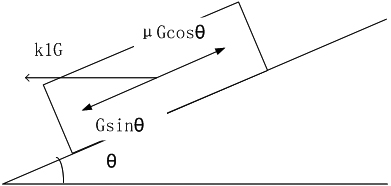
The downside is:
The skid resistance is:
Then the stability coefficient:
Because the coefficient of friction is uncertain in different rock and soil, the Eqs (3)–(5) are eliminated:
Elements of the set of influencing factors include:
1) Formation of primary rock mass (
Considering the seismic force, only the shear wave is calculated here.
There are:
The
Especially, when
While
Similarly, it can be concluded that the smaller the
2) Seismic intensity (
The seismic intensity horizontal force coefficient:
While
While
Then the fuzzy membership function can be described as:
It can be assumed to be an exponential function:
And
When
The parameters to be determined:
Therefore, the dip angle of rock strata directly affects the seismic force and can give greater weight.
3) The stability coefficient (K) of the original rock and soil is obtained by test or empirical statistics.
The weight vector matrix is determined according to the importance of each influencing factor, and the eigenvector corresponding to the maximum eigenvalue of the weight vector matrix is obtained and normalized, and the result is taken as the weight vector. Then the probability of rock and soil stability is obtained by matrix multiplication.
Matlab programming interface is shown in Figs 4 and 5.
AHP is one of the coupling methods to analyze the effects of different factors on the results, whose core is in determining the influence weight of the different factors, and finally obtaining a quantitative result.
Using analytic hierarchy process (AHP) to quantitatively analyze slope stability, focusing on the stability of rock and soil under earthquake inducement, determining the influencing factors and weights of rock and soil stability under earthquake inducement, fill in the weight matrix (Fig. 4) and click on the weight vector and consistency test in turn to determine the stability coefficient.
The program is divided into two parts. The first part uses analytic hierarchy process to calculate the probability of rock and soil stability under earthquake action. The second part combines the probability calculation to select the best rescue path.
User interface for hierarchical analysis and calculation of rock and soil stability.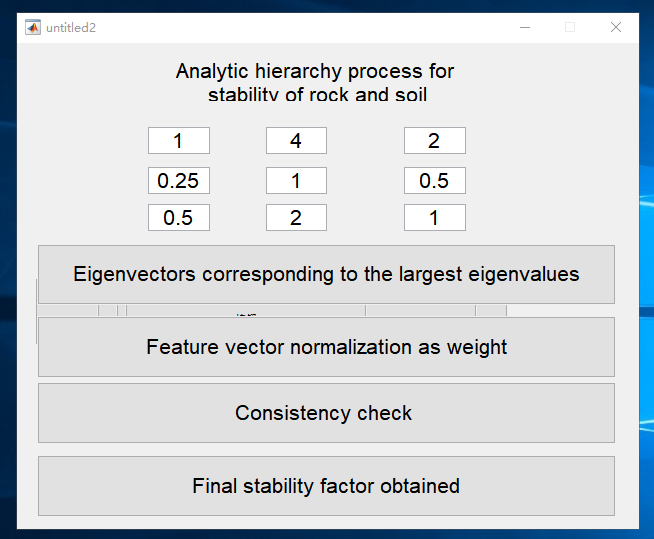
User interface of road routeing probability calculation model.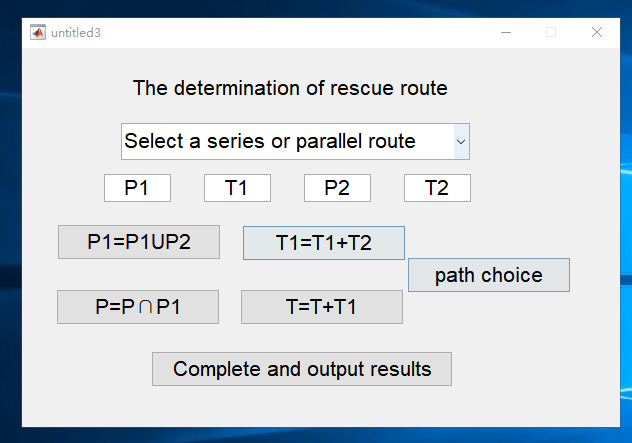
1) The quantification of the set of influencing factors.
Earthquake intensity horizontal coefficient K1, obtained according to the measured earthquake.
K, the stability coefficient of rock and soil is calculated according to the actual measured stability, if there is no measured data, the value of stability coefficient of rock and soil is calculated.
2) Determine the weight matrix.
The weights are determined according to Table 1.
The weight is determined according to Table 1 and is divided into 9 levels. By pairwise comparison, fill in Table 2. This table is the editable data that the program interface (Fig. 4) needs to fill in.
Determination of matrix by analytic hierarchy process
Determination of matrix by analytic hierarchy process
Determination of the weight matrix
According to the analysis results of the influence of different influencing factors on the stability of rock and soil under earthquake inducement, the importance of different influencing factors is determined. According to the way of pairwise comparison, the weight matrix is obtained, as shown in Table 2.
3) The eigenvector corresponding to the maximum eigenvalue of the weight matrix is obtained.
After filling the result of step 2 in the blank matrix of the program, click on ‘the eigenvector corresponding to the maximum eigenvalue’ to obtain the corresponding eigenvector.
4) Normalization.
The result of step 3 is normalized as the required weight vector. Here only click on “feature vector normalization as weight”, the program can automatically calculate the weight vector.
5) Consistency test.
Consistency test is mainly used to determine the transitivity of important relationships between evaluation factors. First of all, according to the judgment matrix to obtain the consistency index CI value:
Among them, the
Calculate the consistency ratio CR, its formula is as follows:
The value of the RI is related to the number of evaluation factors, as shown in Table 3.
Value of RI test for consistency
Click “consistency check”, if the pop-up consistency check does not pass, repeat steps 2–5 until the test results pass.
6) Obtain the stability coefficient.
After the consistency test of hierarchical analysis is passed, click “get the final stability coefficient” to obtain the final stability coefficient. A result is stored in the result.txt file (Fig. 6) and in the corresponding folder.
Storage format of result files.
Among them, the T1 represents the time of unstable rock and soil, and the iterative calculation results. T2 means after each time. P1 represents the probability of passing through unstable rock and soil, iterative calculation results, P2 the probability of passing through each unstable rock and soil. P represents probability and is used to iteratively calculate the final probability. S represents the comprehensive evaluation results.
7) According to the actual situation, select series or parallel lines.
From the point of line, when there is unstable rock and soil in front, see if it is the only path, corresponding to choose series or parallel mode.
8) Combined with step 6 and site data to determine the value of the P1, T1, P2, T2.
If it is a series path, there is only one set of parameters, filled in the P1, T1, click
If it is a parallel path, P1, T1, P2, T2 two sets of parameters should be completed, click
9) Repeat steps 7–8 until all routes are calculated.
10) Click path selection to get the best path.
Final results are stored as result.txt files, as shown in Fig. 6.
The P1, T1 is the intermediate iterative parameter, the possible value is the stability and time of the final input, or the result of the calculation of the parallel rock and soil;
The P2, T2 for the last input of parallel rock and soil stability and passage time required;
The S is a comprehensive discriminant result, according to the following formula:
In fact, the program selects the best path by comparing the S value. The smaller the S value, the more priority the section is. The result.txt file stores the final value of the S repeatedly superimposed.
The last line describes the chosen path. In repeated input of rock and soil stability and passage time, the program remembers the corresponding input times. And then through the S value to judge. The final output results correspond to the corresponding rock and soil, that is, the final selected path.
Based on the analytic hierarchy process (AHP) method, the stability of rock and soil under earthquake inducement is considered synthetically, and the model of optimal route selection is established by combining mathematical probability calculation. Through the analytic hierarchy process, the influence of earthquake on slope stability is determined, and the influence of various factors on stability under earthquake inducement is quantitatively analyzed, and the corresponding model is established. Combined with matlab programming, the influencing factors of earthquake on slope stability are established, and the corresponding program interface is compiled in combination with probability model to realize the choice of optimal rescue route.
Footnotes
Acknowledgments
This project was financially supported by Talent Introduction Project of Putian College (Grant NO. 2018076).