



Abstract
Multi-attribute decision-making (MADM) is an important part of modern decision-making science. Fuzzy Analytic Hierarchy Process (Fuzzy AHP) is a popular model to deal with the issue of MADM for its flexible and effective advantages. However, The traditional Fuzzy AHP with some limitations does not consider the preference (attitude) of decision makers (DMs). In addition, some ideas of combining Ordered Weighted Average (OWA) and Fuzzy AHP don’t investigated the MADM well. Some programs are only applicable to a few examples, and more general cases do not result in effective decision making. Considering these shortcomings, an OWA-Fuzzy AHP decision model using OWA weights and Fuzzy AHP is proposed in this paper. Our contribution is that the proposed method can handle situations where the degree of fuzzy synthesis is not intersected. Moreover, the loss of information can be reduced in the process of applying the proposed method, so that the decision result is more reasonable than the previous methods. Several examples and comparative experimental simulation are given to illustrate the effectiveness and superiority of the proposed model.
Keywords
Introduction
MADM is an important part of modern decision-making science, which has been used in many fields such as engineering design, economy, management and military [1–14]. AHP is a popular model to deal with the issue of MADM. Since the advent of AHP[15], many scholars have expanded AHP to deal with the uncertain environment [16–21]. For instance, Van Laarhoven and Pedrycz [22] proposed a method that uses triangular fuzzy numbers and fuzzy logarithmic least-squares methods (LLSM) to express fuzzy comparison judgments. Buckley [23] extends hierarchical analysis to the case where the participants are allowed to employ fuzzy ratios represented by trapezoidal fuzzy numbers in place of exact ratios. Csutora et al. [24] used Lambda-Max methods. Wang et al. [25] proposed the linear goal programming (LGP) method. Chang [26] introduced a new range analysis method for processing the synthetic range values of pairwise comparisons of fuzzy AHPs. Xiao et al. [27] developed a new framework to address personalized individual semantics (PIS) and consensus in large-scale group decision making (LSGDM) using linguistic distribution preference relations (LDPRs). Huang et al. [28] applied linguistic distribution assessments to represent FMEA team members’ risk evaluation information. Kahraman et al. [29] used fuzzy analytic hierarchy analysis for domestic supplier selection. However, the scholars mentioned above only proposed a good decision-making method, using fuzzy quantifiers to expand the application scope of AHP. It increases computational complexity while proposing new ideas. Nor does it take the preferences of decision makers into consideration. In real life, the decision-making problems need to reflect the preferences of the decision-makers, so that the decision-makers’ wishes can be expressed more accurately and the modeled data can reflect the implicit information in the decision-making process. Yager and Kelman [30] combined OWA and AHP very well, but it studies the exact number, which cannot deal with uncertain environment, and the result will be biased. Zhao et al. [31] combined weighted ordered weighted averaging (WOWA) with Fuzzy AHP, the method did not consider the information loss. Aggarwal et al. [32] proposed MEMV-OWA(Maximum Entropy Minimum Variance) operator to get the model parameters, then combine with Fuzzy AHP, and finally get the weight. it simply used OWA operator and Fuzzy AHP, but did not combine them well. Malczewski [33] applied the OWA operator to the results by AHP and get the final weights for each program. However, the results are greatly affected by the weights obtained by OWA, and did not make good use of the OWA operator for the loss of informaiton. Some work with the similar idea includes land suitability determination using OWA-Fuzzy AHP [34]. These methods simply apply the two elements of OWA operator and Fuzzy AHP, and do not solve the problems encountered in the process of combining the both. They can’t handle situations where the degree of fuzzy synthesis is not intersected. In addition, many scholars use the method of combining Fuzzy AHP and OWA for practical applications. Khaledi et al. [35] used the Fuzzy AHP method to apply a vast range of values to the decision makers. And it combine OWA method to model mental qualities of decision makers and to choose the best location which is constructing power plants. Bao et al. [36] used Fuzzy AHP evaluate the employee satisfaction of mine occupational health, and construct a path based on OWA. This method ensures the authenticity of the language evaluation information. Sabzevari et al. [37] took into account the decision-makers’ risk-taking and risk avoidance in the decision-making process, and also carried out the interaction between the rule ordering and the rules. Gorsevski et al. [38] used the Fuzzy AHP and OWA to evaluate the suitability for landfill site selection in the Polog Region. OWA scenario aims to quantify the level of risk-taking (i.e. optimistic, pessimistic and neutral) fuzzy analytic hierarchy process for obtaining attribute weights. Aggarwal et al. [39] proposed a method which combine Fuzzy AHP and OWA to research the budget allocation question. It is helpful to handle multiple attributes at the same time through the opinions of industry experts and use simple proportion rules to allocate budgets to make management decisions. Although these methods are very effective in dealing with decision-making problems, they do not consider using OWA operators to take the preferences of decision makers into account.
We attach the weights obtained by the OWA operator to the calculation of each level, which not only reflects the preferences of the decision makers but also the influence of various factors on the results. The use of OWA operators in conjunction with Fuzzy AHP is to obtain the weights in the case of different decision preferences. The shortcomings of the previous method, i.e. limitations of the classical Fuzzy AHP, loss of information of the idea of the classical OWA-FAHP are overcome by the proposed methodology of OWA-Fuzzy AHP in this paper. In addition, we solved situations where the degree of fuzzy synthesis is not intersected. A relatively complete method combining OWA and Fuzzy AHP is proposed.
The rest of the paper is framed as follows: Some related concepts about fuzzy set theory, synthetic extent fuzzy number in Fuzzy AHP are briefly reviewed in Section 2. In Section 3, an improved OWA-Fuzzy AHP decision model is proposed. In Section 4, a simple application is given to simulate the process of the proposed model. The results of some comparative experimental simulations are given in Section 5. Finally, concluding remarks are given in Section 6.
Preliminaries
In this section, some preliminaries are briefly introduced.
Fuzzy set theory
Uncertain information is a pervasive phenomenon in the real world [40–43]. Fuzzy logic, invented by Professor Lotfi Zadeh of UC-Berkeley in the mid-1960s, provides a representation scheme and a calculus for dealing with vague or uncertain concepts. It provides for the facile manipulation of such terms as “large,” “warm,” and “fast,” which can simultaneously be seen to belong partially to two or more different, contradictory sets of values. Zadeh originally devised the technique as a means for solving problems in the soft sciences, particularly those that involved interactions between humans, and/or between humans and machines. [44–47].
Triangular fuzzy numbers (TFNs) are proposed to solve problems in uncertain environments for its simplicity. In a triangular fuzzy number, assuming that the domain is U, a fuzzy set on a given universe U means that for any x ∈ U, there is a number μ (x) ∈ [0, 1]. Correspondingly, μ (x) is called the membership of x to U, and μ is called the membership function of x. If s and u are the lower and upper limits of the fuzzy number, respectively, and m is the largest possible value, then the fuzzy number is represented by (s, m, u). A fuzzy number
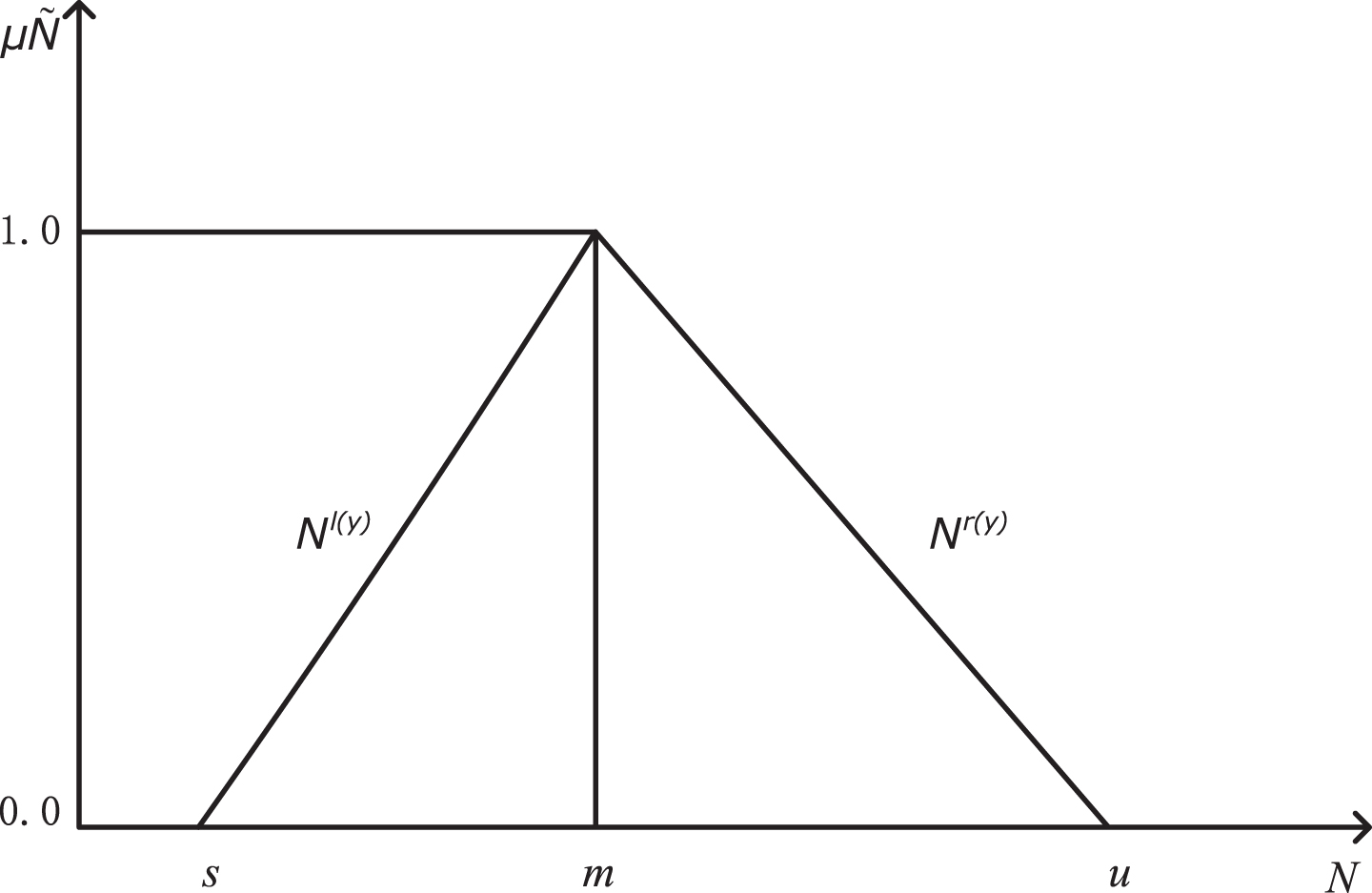
A triangular fuzzy number,
The results obtained by the fuzzy sum operator ⊕ and the fuzzy subtraction operator ⊖ of any two triangular fuzzy numbers are a triangular fuzzy number, but the result obtained by multiplication operator ⊗ of any two triangular fuzzy numbers is only an approximate triangular fuzzy number. Take two triangle fuzzy numbers
If the object set is represented as X ={ x1 , x2, ⋯ x
n
} and the goal set is represented as U ={ u1 , u2, ⋯ u
m
}, according to the method of extent analysis [1],each object is analyzed for each target to obtain the following variables:
The value of
AHP [49] is a simple, flexible and practical multi-criteria decision-making method for quantitative analysis of qualitative problems. It is characterized by dividing various factors in complex problems into interrelated and orderly levels, making them organized, and based on the subjective judgment structure of certain objective reality, the expert’s opinions and the objective judgment results of the analysts are directly and effectively combined to quantitatively describe the importance of comparing one level of elements. Then, the feature vector of the largest eigenvalue are used to calculate the weights that reflect the relative importance order of the elements of each level and the relative weights of all elements are calculated and sorted by the total ordering between all levels. Finally, a solution is obtained. However, classical AHP cannot deal with the situation of fuzzy uncertain environment. Hence, several generalized AHP, such as Fuzzy AHP [26] are presented.
Representation method of fuzzy numbers of AHP pairwise comparison matrix
One step in the Fuzzy AHP is to compare the pairwise comparison matrix. Each element in the fuzzy pairwise comparison matrix A = (a ij ) n×m represents the degree of importance of element i to element j. If a ij = (s, m, u) is a fuzzy number, where s and u represent a fuzzy degree judgment. The greater u - s, the fuzzier the degree.
When filling in the pairwise comparison matrix{construction matrix, elements on the diagonal are a ii = (1, 1, 1). Then filling in the elements in the upper right corner, the elements in the lower left corner are the reciprocals of their corresponding elements, such as a ij = (s, m, u), and a ji = (1/u, 1/m, 1/s).
The elements of the pairwise comparison matrix have the following properties [50]:
The concept of OWA operator
The OWA operator [51–54] is a F associated with W: the mapping of R
n
→ R, among them
The mapping is defined as follows:
As a simple data fusion method, OWA operator is one of the commonly used methods in multi-attribute decision making based on OWA operator [55, 56].
The Orness measure is a method proposed by Yager [51] to measure the preferences (attitude) of decision makers, which is defined as follows:
(2) Positive preference: if we choose W, its assignment is
(3) Neutral preference: if we choose W, its assignment is
Adopting a strategy with DMs’ preferences makes decision making more rational and flexible.
Here, α represents the desired degree of optimistic. The larger α, the more optimism and α = 0.5 stands for a neutral stance. When the decision-maker’s attitude is more positive, the value of α is greater than 0.5, otherwise, the value of α is less than 0.5.
Some scholars have investigated the analytic solution of the optimal problem [57–59] to get the approximate weights. In this paper, we use the special optimization tool (i.e. genetic algorithm) to deal with this optimal problem.
The previous model used the triangular fuzzy numbers to pairwise the fuzzy analytic hierarchy process and applied the extent analysis method to process the composite range values of the pairwise comparison. Then, the weight of each element under the standard is obtained by using the principle of fuzzy number comparison. The basic steps are as follows:
Proposed improved OWA-Fuzzy AHP decision model
We have made new improvements to the original model [26] by adding DM preferences, and obtained a more complete new method that can be applied to different decision-making situations. Fig. 2 (a) shows the framework of our improved method. Fig. 2 (b) demonstrates the original model. Fig. 2 (c) [33] demonstrates a recently proposed improved model. The proposed OWA-Fuzzy AHP decision model including four steps are established as follow:
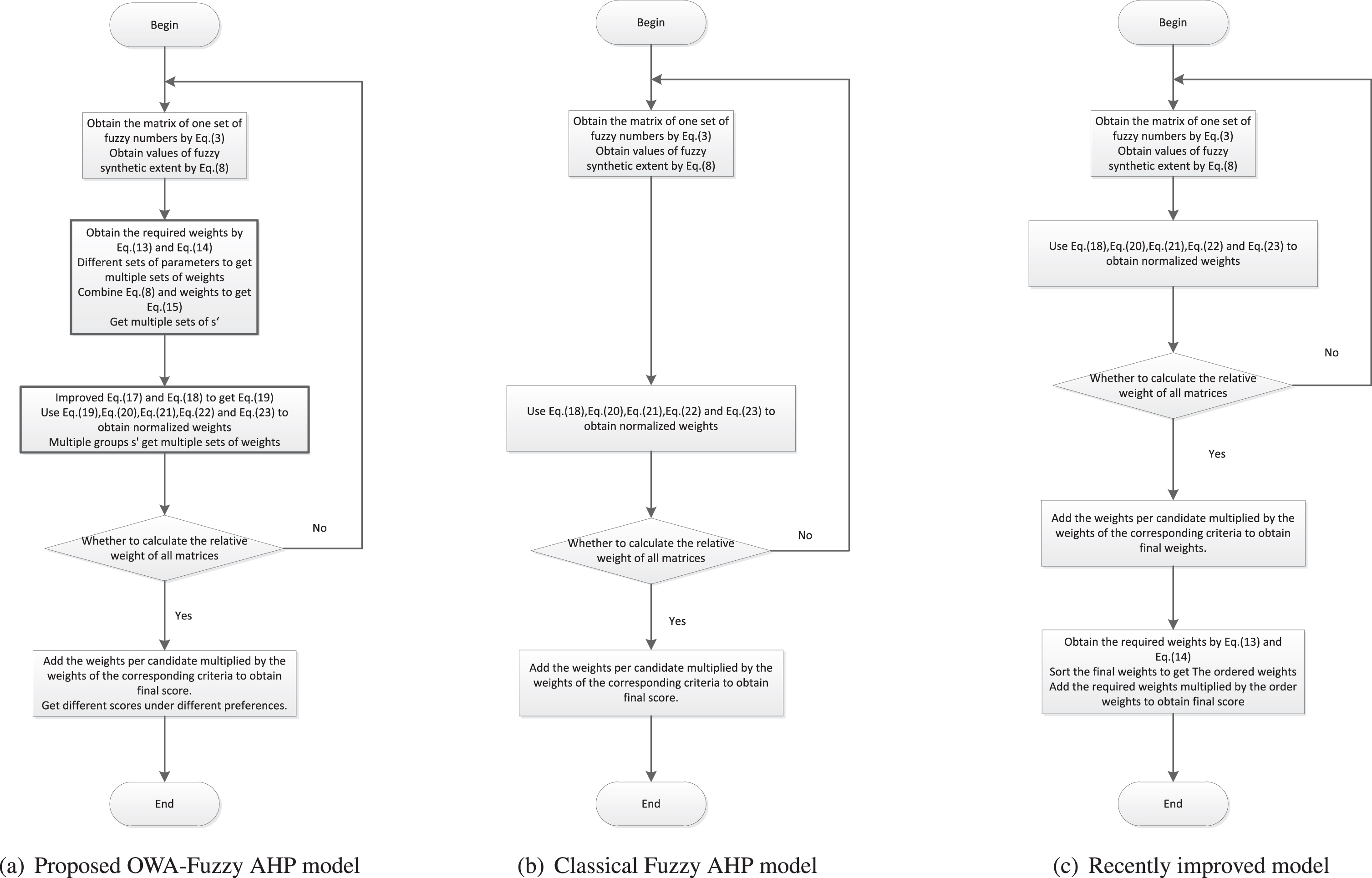
Proposed OWA-Fuzzy AHP model classical idea of OWA-Fuzzy AHP and the improved model of recently proposed.
Assuming that a pair comparison matrix of performance criteria is given. Average the multiple sets of fuzzy numbers so that they all have only one set of fuzzy numbers by using Eq. (3) and weighted average. Then, values for the fuzzy synthetic extent is obtained by applying Eq. (8).
The genetic algorithm Eq. (13) and Eq. (14) are used to obtain the required weights, which represent different DM’s preferences according to the different values of the parameter α. The obtained result is applied to the Eq. (8). Get the following Formula (15).
The previous operation only used the following Eq. (18). The formula has been expanded, then the specific information is as follows.
The following definition gives the comparison method of fuzzy numbers.
Because N1 and N2 are convex fuzzy number we have that
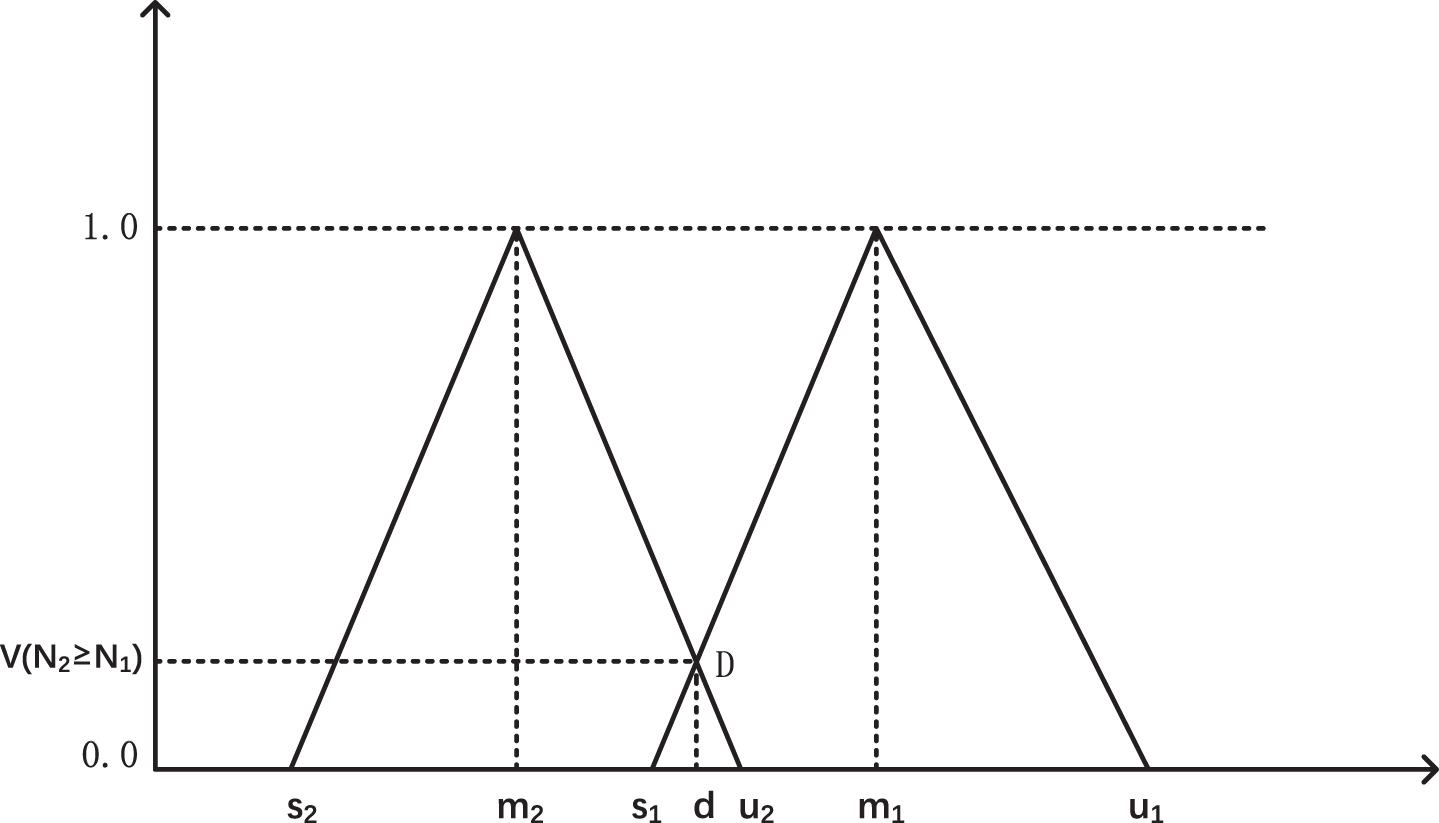
Comparison of two triangular fuzzy numbers.
When N1 = (s1, m1, u1) and N2 = (s2, m2, u2). the ordinate of D is give by Eq. (13).
For the comparison of N1 and N2, both the values of V (N2 ≥ N1) and V (N1 ≥ N2) are required.
When the weight of the individual preference is added, V (N2 ≥ N1) and V (N1 ≥ N2) may be negative for the synthetic extent fuzzy numbers. The two fuzzy numbers are not crossed, as shown in Fig. 4 (a). However, the weight cannot be negative. Therefore, We adjust the x-axis so that it moves down to ensure that all data is positive. As shown in Fig. 4 (b). At the same time, we need to improve the formula to make it suitable for various situations. The modified equations are as follows.
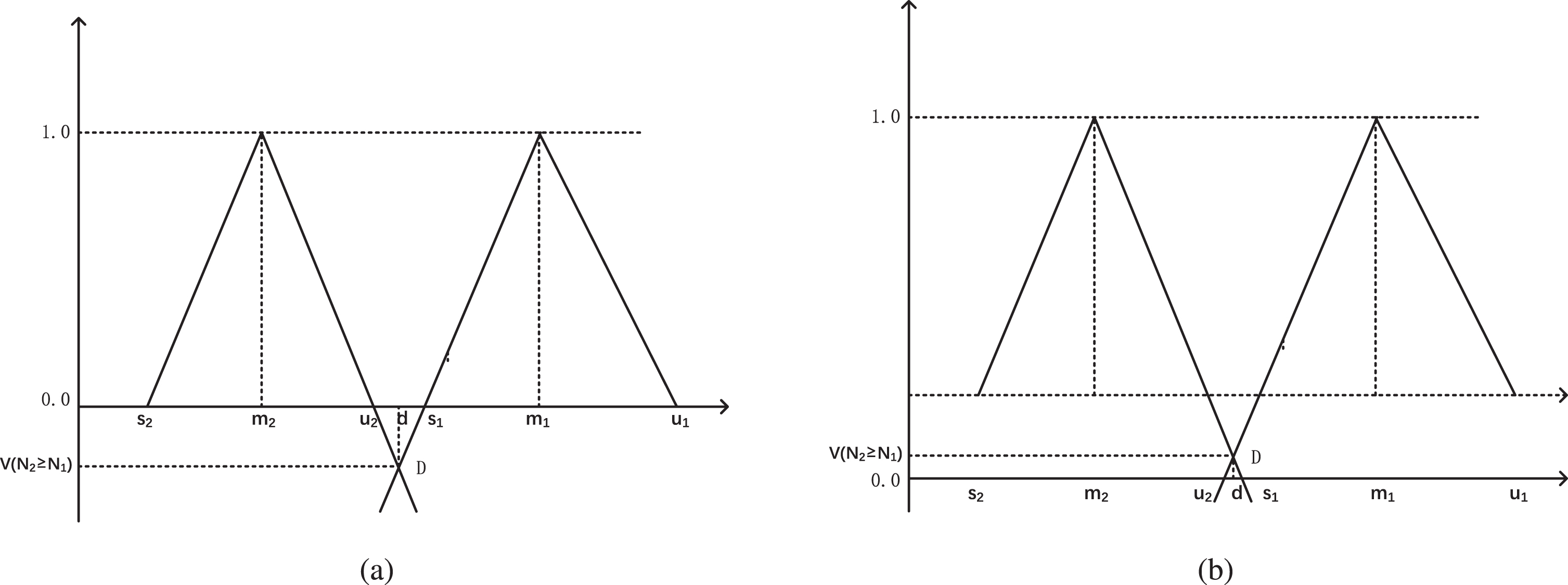
Improved method of comparison for two triangular fuzzy numbers.
When the weight of the individual preference is added, V (N2 ≥ N1) and V (N1 ≥ N2) may be negative for the outside of the synthesis. The two fuzzy numbers are not crossed, as shown in Figure 4(a).
The degree possibility for a convex fuzzy number to be greater than k convex fuzzy numbers N
i
(i = 1, 2, …, k) can be defined by
The weight vector is given by
Then, we get the normalized weight vectors
Finally, according to the weight of the corresponding criteria, the ranking weight process of all factors of each layer for the relative importance of the total target is determined. We get different weights according to different parameter values, and finally give the results under different preference values.
We use the example of the data in paper [26] to apply our method. Suppose there are vacancies in the operation research professor at the university, and there are three candidates, A1, A2, A3. A committee have identified the following decision criteria for deciding which applicant is the best qualified for the job:
(1) mathematical creativity (B1);
(2) creativity implementation (B2);
(3) administrative capabilities (B3);
(4) human maturity (B4).
Next, the proposed OWA-Fuzzy AHP is used to deal with the decision-making as follows step by step.
First step: Organize the data of Table 1, Average the elements with multiple sets of fuzzy numbers so that they all have only one set of fuzzy numbers by using Eq. (3).
The pairwise comparison matrix of performance criteria (refers to [26])
The pairwise comparison matrix of performance criteria (refers to [26])
Then, we obtain values of fuzzy synthetic extent by applying Eq. (8).
Second step: Using Eq. (13) Eq. (14) and Eq. (15), to make the S1, S2, S3, S4, we get the result S1′, S2′, S2′, S4′ by orness measure. When α = 0.5, w
i
= 1/4, take α = 0.5 as an example, we obtain
Using Eq. (16), Eq. (17) and Eq. (18), we obtain
Using Eq. (20), we obtain
Then,
After normalization, we gain the weight vectors with respect to the decision criteria B1, B2, B3 and B4.
The matrix and the weights of the criteria layer is shown in Table 2.
The matrix and the weights of the criteria layer
Third step: Solution layer A is compared under each of the criterion separately by following the same procedure as discussed above. Perform step 2 of Table 3 (a) -3 (d) to obtain Table 4 (a)-4 (d). the weights of all matrices are organized as shown in Table 5.
The matrix of pairwise comparison of performance solution
The matrix of pairwise comparison of performance solution
Hierarchical single sorting summary
Finally, according to the weight of the corresponding criteria, the ranking weight process of all factors of each layer for the relative importance of the total target is determined, and the final result is shown in Table 6. Based on the final score, we can choose the candidate.
Final weights
Comparing with the method of Chang [26], the proposed OWA-Fuzzy AHP can be used to investigate the attitude of the DM when using the Fuzzy AHP to make the decision. Set different α values and repeat the above operations to get candidate results with different preferences.
When α is taken as 0.1, the single order of each layer and the total order of the levels are as follows(Table 7):
Summary combination of priority weights
When α is taken as 0.3, the single order of each layer and the total order of the levels are as follows(Table 8):
Summary combination of priority weights
When α is taken as 0.7, the single order of each layer and the total order of the levels are as follows(Table 9):
Summary combination of priority weights
When α is taken as 0.9, the single order of each layer and the total order of the levels are as follows(Table 10):
Summary combination of priority weights
First, compared to Chang’s [26] solution, we refined his results and calculated the results with different preferences of the decision maker.
According to the data from Table 10, the weights of the final schemes are also shown in Figure 5. As shown in the Figure 5, when α = 0.5, the result is the same as that obtained by Chang [26]. In addition, our method can get the result of α taking different values, where α represents the attitudes of the DMs, while the method of Chang [26] can only give one result, which can’t deal with the influence of the different attitudes of the DM. As is shown in Figure 5, we give different results. When α is taken as 0.1, we choose option 3. When α is taken as 0.3, we choose option 3. When α is taken as 0.5, we choose option 1. When α is taken as 0.7, we choose option 1. When α is taken as 0.9, we choose option 1. Another advantages of the proposed approach compared to Chang’s approach [26] is that the inherent limitations of the Chang’s approach is overcome. As is shown in Figure 4, when the fuzzy synthetic extent by Eq. (8) does not intersect, Chang’s approach [26] can’t deal with it. We have improved his approach by Eq. (19) to enhance the compatibility for different situations.
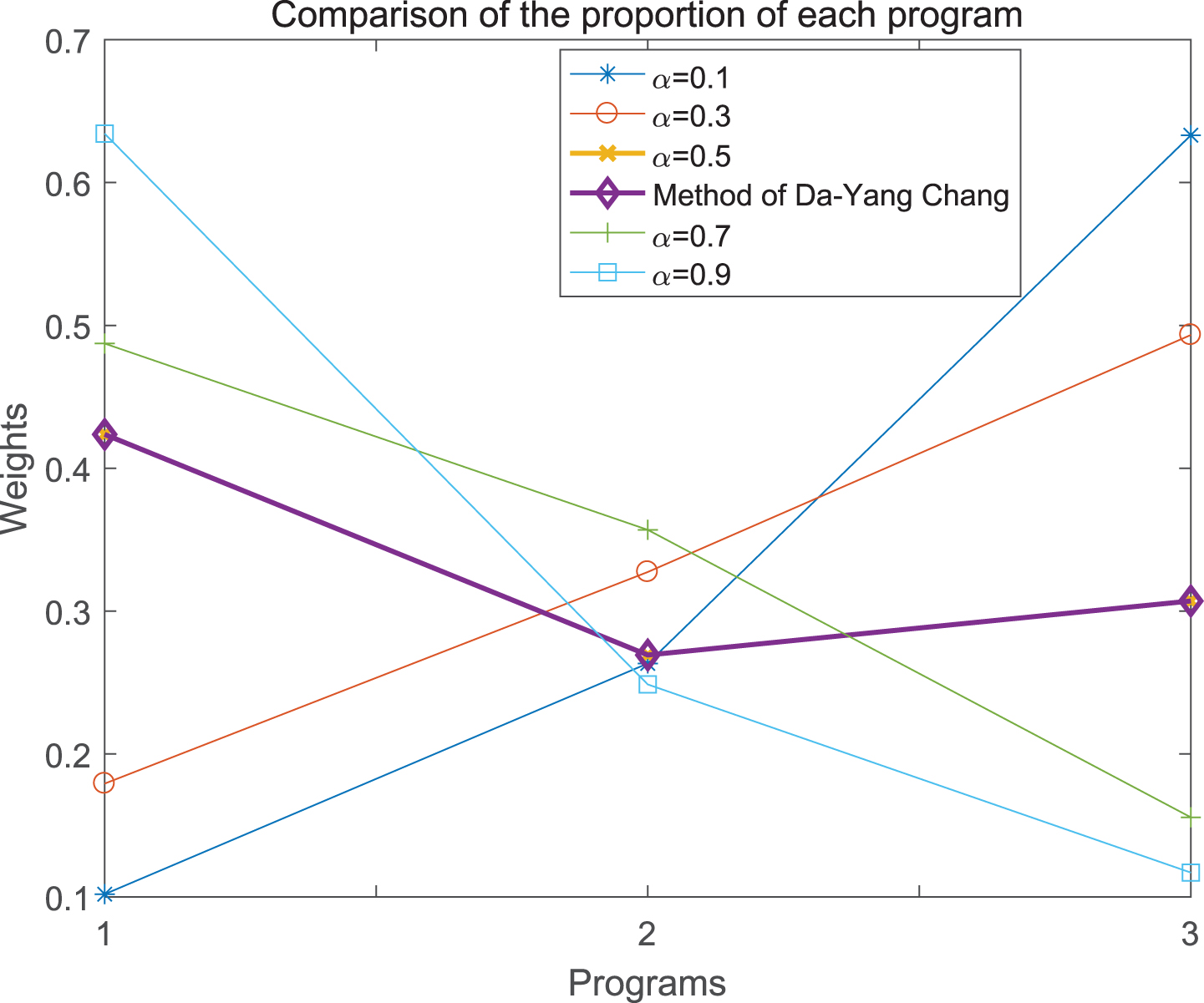
The weight of each attribute comparing with Chang’s method [26]
Second, we consider the loss information of the method of Malczewski [33]. The method of Malczewski [33] obtains the weights by OWA from the final result using AHP. Previous methods [34] as the thought of Malczewski [33], considering the attitude of the DM in the final result instead of the fuzzy synthetic extent by Eq. (8) may loss information for the decision maker. The proposed OWA-Fuzzy AHP consider the different attitudes of the DM in the level of the fuzzy synthetic extent by Eq. (8), which remain all the information of the fuzzy synthetic extent to generate the weights of the alternatives. Compared with the previous scheme, we saved more information and got more accurate results.
Take the weight obtained by Table 2 as an example. As is shown in Figure 6. Our method has obvious advantages compared with simply applying the OWA operator to the final weights obtained at each level. From the figure we can see that our method is closer to reality, and the results obtained by Malczewski’s [33, 34] method are greatly influenced by the weight of the OWA operator, which leads to information loss. We process the Symthetic extent fuzzy number and save the amount of information. Our approach is more closely linked to the example and the results are more convincing. At the same time, we can see from the figure that the weight of each of our schemes is quite different, the decision result is more obvious and it is easier to select the most suitable one from a pile of schemes.
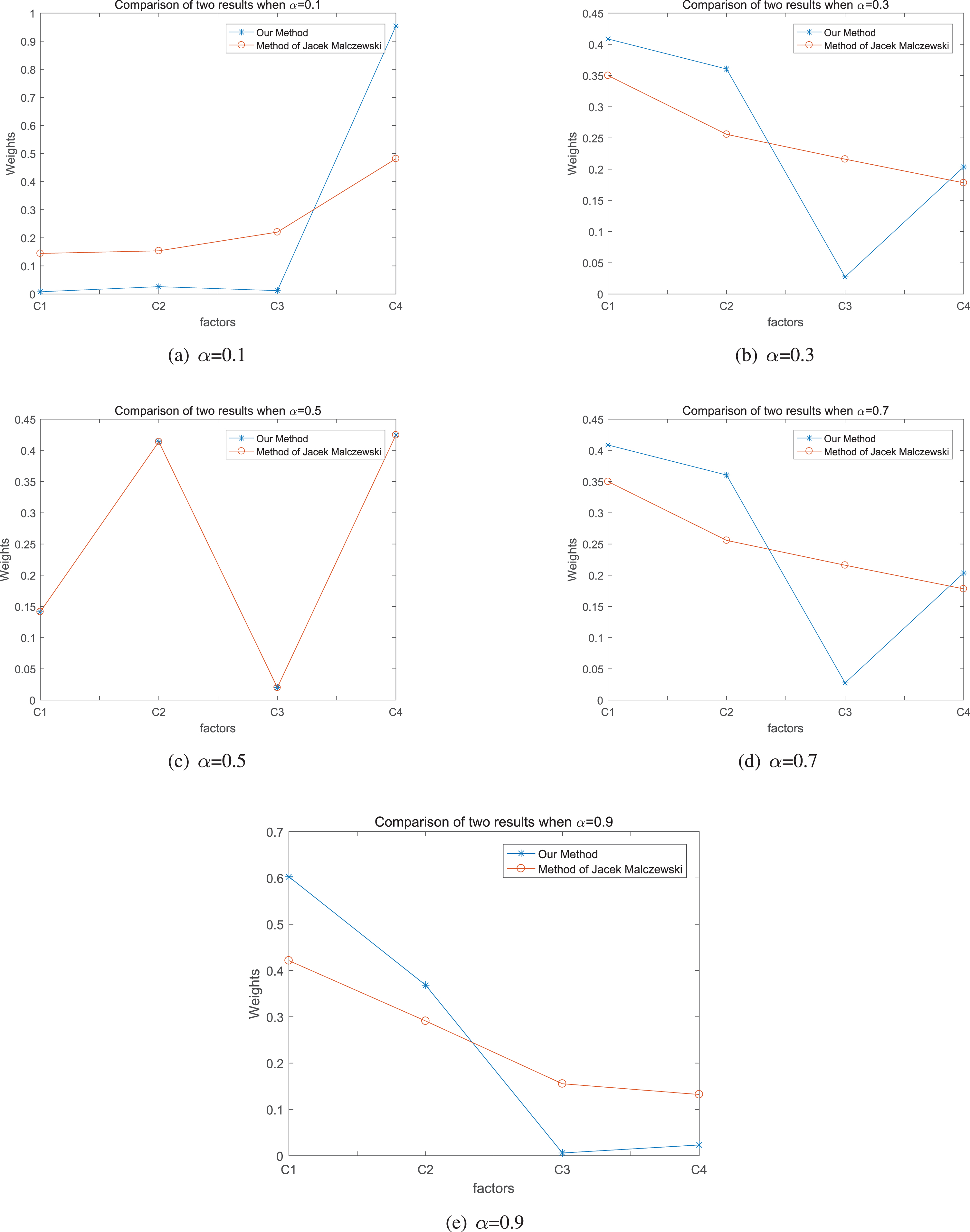
Comparing with the classical idea of OWA-FAHP in [33]
In the future, the living environment will become more intelligent and informative. Therefore, it is important to improve the level of decision-making. In this paper, we propose an OWA-Fuzzy AHP decision model using OWA weights and Fuzzy AHP to deal with the attitude of the DM and loss of information in the classical thought of OWA-Fuzzy AHP. Our program has four main advantages. First, the decision results under different policy maker preferences can be given. The second is that it can retain more information. Then, our improvements can handle situations where the degree of artificial synthesis is not intersected. Finally, our weighting differences for different scenarios are more obvious and decisions can be made more easily. Some examples and comparative experiments are used to illustrate the effectiveness of the proposed OWA-Fuzzy AHP decision model. In summary, our method is able to give higher quality decision results and its high adaptability reflects its potential for practical application. After that, we intend to use this decision-making method in the decision-making research of applied robots.
Conflict of interest
The authors declare that they have no conflict of interest. This article does not contain any studies with human participants or animals performed by any of the authors.
Footnotes
Acknowledgment
The work is partially supported by the Fund of the National Natural Science Foundation of China (Grant No.61903307), China Postdoctoral Science Foundation (Grant No. 2020M683575), the Startup Fund from Northwest A&F University (Grant No. 2452018066), and the National College Students Innovation and Entrepreneurship Training Program (Grant No. S202010712135, No. S202010712019, No. X202010712364).