




Abstract
The big data era has ushered in huge transformation in the form of major media, with WeMedia nowadays becoming the mainstream. As is witnessed, WeMedia has achieved a rapid and widespread growth in both dissemination and influence, which has posed a series of challenges to the Emergency Intelligence Service System for Think Tanks, including changes to the subject, content, form, and connotation of platforms. Based on big data, this study makes an investigation into the Emergency Intelligence Service for the modern think tanks and applies the method of factor analysis to draw the conclusion on what kind of factors will influence the performance of the Emergency Intelligence Service for Think Tanks. Then, from the perspective of the life-cycle theory, this research not only optimizes the work process of the Emergency Intelligence Service for Think Tanks, but also constructs a multi-dimensional Emergency Intelligence Service System based on the concept of “Data Driven
Introduction
The coming of the era of big data has ushered in a major transformation of time. The rapid development of new computer technology and network technology, such as block-chain, internet of things, artificial intelligence (AI) and visualization, have been constantly changing people’s way of thinking and lifestyle. All levels of society are moving ahead in the direction to become networked, digitized, and intelligent. Moreover, in the Internet, with massive data resources, the data structure, ever more diversified, is distributed both dynamically and statically. Furthermore, communications methods of new media have changed, with a widespread growth in power and influence of platforms like Weibo, WeChat, official accounts, forums/BBS, and online communities. Traditional emergency intelligence services for think tanks mainly rely on the subjective judgments of experts of the think tanks based on their previous knowledge and experience on emergent events, or provide services based on existing thematic databases. However, as the situation is constantly changing and developing, with regard to the changes mentioned above, under some certain scenes where there exists strong public opinion, the experts may not be able to acquire comprehensive information to help them make decision in a complete and systematic condition and meanwhile, experts and the public might view emergencies from different perspectives, easily leading to subjective decision-making. Therefore, using artificial intelligence and other big data technologies to identify, collect, analyze and process, evaluate and utilize emergency intelligence from the entire process of detection, early warning, monitoring description, and damage assessment, expanding the connotation and extension of emergency intelligence services that displays methods with dynamic and static features, and finally, forming a collaborative and innovative full-process coverage system to effectively avoid the decision-making risks of think tank experts themselves are key areas for future development and research.
Because of this, based on the big data environment, this study will analyze the new connotations and new demands of emergency intelligence services and by combining the current research results on emergency intelligence services for think tank summarize the factors affecting the improvement of emergency intelligence services and then will optimize the emergency intelligence work process for think tanks according to the life-cycle theory. Finally, it will improve the quality of decision-making process and effectiveness of the emergency intelligence service for think tanks and enhance the power of influence and communication for agencies of emergency intelligence service in the context of multi-dimensional emergency intelligence service system featuring “Data Driven
Overview of the existing studies
With the advances of big data technology, construction of think tanks has become a trend. Generally speaking, there are a large number of studies on Big data, Decision-making support systems, and Think Tanks as a whole object [1, 2, 3, 4, 5, 6, 7, 8, 9, 10]. Based on the research directions these studies could be classified into four categories in details, including The Application of Big Data Technology in the Emergency System, the Basic Theoretical Research of Emergency Intelligence, Emergency Application for Emergencies, Emergency Intelligence System Specification Norm and Case study, and the contents are mainly described as the following.
The application of big data technology in the emergency system
Prospects on the future development of big data technology in emergency systems are brought forth from different research directions. Emergency management is an attractive area for research as it can effectively put forward suggestions on reducing potential damages to people, facilities and the environment. It will become a heated area for research in the future and by looking into the emergency systems in different industries, it could project prospects for future development as well as provide references for research. Computing intelligence is one of the fastest growing areas in the field of computer technology today and will play a crucial role in the emergency management lifecycle in the context of big data [11], and Ma and Zhang [12] noted that current social media, the Internet, the Internet of Things and big data provide great opportunities to improve emergency information management systems. A single method and a hybrid method can be applied. Especially in big data and urban emergency management applications [13], how to cope with emergencies is the key to emergency decisions which is a challenge for future research. Therefore, big data technology might be used to collect and analyze information from different areas, establish a knowledge and decision-making system and track crisis both in the physical world and the cyber space to serve emergency management and intelligence services that will be a great value in the future.
The basic theoretical research of emergency intelligence
These articles have mainly discussed based on different perspectives of the theory of big data technology, analyzing the historical evolution of the emergency decision intelligence system in a method of social networking, including the specific time and space analysis, as well as systematically examining the formation and development of the system. Some scholars even have rethought the system, pointing out that it is necessary to construct and improve the emergency decision intelligence system in the background of big data, enhancing and increasing innovative emergency intelligence theory research [14], such as geography, knowledge base and other theories related to emergency management technology. For example, in the prevention and control against global COVID-19 epidemic, geography has made great contribution in helping understand the spread of the epidemic, data decision and support. In order to further optimize the risk prediction model and to strengthen the emergency planning and governance, the basic geographical theory is used to provide scientific support for spatial governance [15]. By extracting relevant information from heterogeneous documents using the NLP system and RDF triples, and then mapping the RDF ternary to the ontology in the disaster management domain, we realize the integration of heterogeneous data and the scientific prediction of disaster emergency management [16].
Emergency application for emergencies
Specific applications of emergency intelligence are achieved through computer-related technologies, such as high-performance computing, deep learning, multi-source data fusion, etc., which are critical components to help people timely acquire a social perception to understand processes and response of emergencies [17]. Emergency intelligence system can be applied in different areas, such as urban emergencies, natural disaster early warning (flood, wildfire, typhoon, etc.), social rescue emergency response, etc. [18, 19]. Taking China-Shanghai bund event as an example, Zeng and Wang [20] has discussed the specific application of the intelligent intelligence service system in Shanghai bund event by constructing an intelligent intelligence service system based on key technologies such as social sensing network and No-SQL, cloud computing. For disaster management, Simoes-Marques et al. [21] proposed UCD intelligent design to create a distributed system sharing the status information and managing the geographic information of the emergency events, thus providing a map-based and augmented reality navigation assistance for mobile devices. In flood emergency management cases, using high-performance computing environment (Cyber GIS-Jupiter) and multi-standard decision analysis model, a multi-standard spatial decision support system based on network GIS can be established, and a multi-standard spatial decision support system based on network-geographic information system can be proposed, which solves the decision problem of evaluation standards in flood emergency, and can support rapid decision making during emergency management [22].
Emergency intelligence system specification norm and case study
Such articles mainly explore the development mode and its elements of the emergency intelligence needs in the big data environment, and put forward the promotion strategies from the disciplinary perspective and the government perspective [23]. By analyzing the key elements of emergency intelligence and big data coupling relations, a research paradigm can be provided for emergency intelligence. Open-source intelligence information and geographic information in virtual space can be used to detect anomalous mode and spatial agglomeration, the system establishes the key elements of social emergencies and coupling relations at all levels, so as to reveal the space-time law [24]. Based on the existing research results, it is found that the research on the subject of this topic has not yet formed a comprehensive standard in terms of the amount and the content of the research.
According to the research results above, the existing research indeed has provided a good reference for future research, but in terms of the number and the content of research, there has not formed a large-scale research system, most of which belongs to technology application, mainly reflected in the help of computer technology to provide technical support for emergency intelligence. The ontology is put forward in the basic theoretical research only to build emergency data module, such as using geographical system to establish space-time connection. The research paradigm only addresses one aspect of the topic, and is far from being unified, comprehensive and systematic. Therefore, this paper believes that emergency intelligence has much space for exploration in theoretical and systematic research, especially in terms of the construction of emergency intelligence services for the think tanks in the background of big data. In the current research, the authors propose the application of computer intelligent technology based on emergency management life-cycle theory, which provides a good direction and an idea for this research. We can integrate emergency intelligence services with the think tank platform to provide convenient and diversified emergency services, which is an innovative point of this research.
The main subjects of this paper are two: (1) Under the background of big data, emergency intelligence service system is established through think tank platform; (2) The future application of emergency management will center on personalized user demand, standardized data processing, coordinated service mode and diversification of service subjects, and think tank emergency intelligence service system can meet this demand. This study here puts forward the emergency management design system framework combining big data technology from the perspective of think tank, which is conducive to optimizing the emergency management process, improving the emergency management efficiency, and minimizing the losses caused by emergent events.
Connotations and characteristics of emergency intelligence services for think tanks in the era of big data
Connotations of emergency intelligence services of think tanks in the era of big data
Think Tank realizes the rapid appreciation and conversion application of knowledge capital by the operation of intellectual capital in the ways of production, learning, research, use, etc. [25], giving full play to the functions of advice and suggestions of “brain tank” and “think tank”. In 2015, Opinions on Strengthening the Building of a New Type of Think Tank with Chinese Characteristics (Opinions) was published by General Office of the State Council and pointed out that it is an urgent need to improve the decision-making support system with Chinese characteristics, vigorously strengthen the building of think tanks, support scientific decision-making with scientific consultation, and lead scientific development with scientific decision-making [26]. Since then, the building of think tanks has been enhanced and has become an important force for decision consulting service. Moreover, think tanks have become a bridge and pillar of intelligence services as they meet the needs of various intelligence users and present information to users in the most valuable form by giving full play to the decision-making advantages of group experts and providing intelligence services covering the entire information process from information resources to information services [27].
The connotations of emergency intelligence services for think tanks are that based on the building of think tanks and with the intelligence needs in emergencies of intelligence agencies at different levels and of different types for government, enterprises and society, think tanks will use the data collection, method system, tool model, expert wisdom and other resources collected by themselves to carry out the corresponding intelligence process (see Fig. 1), such as intelligence collection, intelligence handling, intelligence processing, intelligence analysis and evaluation processing, to put forward views and opinions for references with regard to the four stages of events, including mitigation, prevention, response, and recovery to the incident, and finally produce intelligence deliverables such as research reports, proposals, newsletters, series books, etc. to provide scientific and effective support for the government, enterprises and society to make emergency decisions in the event [28].
Emergency intelligence processing stage.
In big data era, information intelligence resources are characterized by massive, high growth, diversification and complexity while information features structured and unstructured data, which leads to a relatively difficult processing of intelligence [29]. So, emergency intelligence services need to be comprehensive, integrated, intelligent and collaborative, and only with these characteristics can the decision-making capability and insights of think tank platforms be tapped into to better deliver emergency services in all kinds of scenarios [30].
Comprehensive
Big data technology has changed people’s lifestyle and facilitated a rapid development of the new media [31]. Meanwhile emergency intelligence services for think tanks have also witnessed changes in their form and content. While traditionally it requires on-site emergency handling, now big data technology combined with a thinking ability is applied to gain insight and identify massive information resources. This is a huge change to emergency intelligence services for think tanks as now they need to be comprehensive, including not only the on-site emergency handling but also the big data processing technology, and need to be able to put forward integrated emergency plans by intelligent data management and handling in a scientific and reasonable fashion.
Integrated
The think tank platform is not built on the experience of experts in one field any more, for its expert database gathers a group of senior and experienced experts from various fields to make decisions together. Independent from the empiricism, it has reduced the uncertainty of the capabilities of think tanks to respond to emergencies, making its emergency plans to be more scientific and reasonable [32].
Intelligent
Big data processing technology mainly adopts algorithms such as perception of IoT, GPS, GIS positioning, cloud computing, etc. [33], which can quickly identify effective information from the massive amount of information resources to assist experts in making decisions, and the methods of intelligent processing are prominent and show strong relation to data, which are inducive to improving the efficiency of emergency services.
Collaborative
Establish a collaborative emergency intelligence processing platform that could initiate intelligence emergency services from online and on-site simultaneously and that could break the situation where the governances of enterprises, governments and other departments are separated from one another, facilitating the co-construction and sharing of intelligence resources and the making of research on the same resource platform for collaborative innovation and joint provision of intelligence emergency services.
Influencing factors of capability improvement for emergency intelligence service for think tanks
Based on the analysis of changes of connotation and characteristics of emergency intelligence services for think tank, some well-known think tanks were chosen as the samples of one online investigation (see Table 1).
Online investigation on connotation and characteristics of think tanks
Online investigation on connotation and characteristics of think tanks
The factors influencing the capability of emergency intelligence service are evaluated and summarized from mainly four aspects, including resources and scale, expert composition, influence and communication power in society, and the data processing technology and capability of the think tank (see Table 2).
Capability indicators for emergency intelligence services for think tank
The building of think tanks can be diversified. Any organizations or agencies can establish a think tank according to their own conditions. There are a variety of think tanks, including governmental think-tanks, university-affiliated think-tanks, civilian think-tanks, social group’s think-tanks and so on (see Table 1). Because of this diversity, different types of think tanks have different functions and the quality of their service offering varies considerably. In providing emergency intelligence service, different types of think tanks need to coordinate and work to solve problems collaboratively by sharing information without reservation and gathering a large and comprehensive scale of effective resources, playing as an integrated role in the decision-making process.
Experts and panels
Experts and panels play an important part in the provision of emergency intelligence services for think tanks and the capacity of the experts usually represents the handling capacity of emergency intelligence services. In the identification and selection of experts, think tanks will generally take into accounts various factors such as caliber and abilities, knowledge reserves, scientific research, and professional ethics to ensure the precision of handling emergencies and minimize errors.
Social influence and communication of think tanks
Generally speaking, except for products produced by think tanks, their social influence and communication are also important indicators on the assessment of think tanks [34, 35]. In the provision of emergency intelligence services, the social influence of think tanks decides the service level and their communication leads where the public opinions go in the cyber space, which directly decide the stability, loyalty and trust of the public.
Data processing technology and capabilities of think tanks
Big data technology has brought innovation of information technology with mature technologies such as visualization, data digging and intelligent analysis and processing technologies widely applied on the Internet [36]. A large amount of information resources and data needs to be processed, especially during emergency events where the sensitivity to data is supposed to be improved to collect effective and useful information. Therefore, it is necessary to consider those four factors mentioned above to improve capabilities of emergency intelligence services for think tanks. The services out to master the change patterns in big data and optimize the emergency intelligence service process on think tank platforms, ensuring the rapid improvement in the capabilities of emergency intelligence services for think tanks and its emergency response level.
The construction about emergency intelligence service system for think tanks: Taking the aspect of big data
The meaning of the construction about emergency intelligence service system for think tanks
Optimized the working process of emergency intelligence services for think tanks
The working process of traditional think tank emergency intelligence needs to be improved, for it only stays on a decision-making stage by relying mainly on the knowledge and experience of experts and panels, and has a long cycle of the current intelligence collection and analysis process, causing a poor coordination function and a single release channel of intelligence. In the context of big data, emergency intelligence services for think tanks, featuring complexity, effectiveness and relevance, is a multi-link, coordinated and dynamic process, and thus, there will be higher requirements for the capabilities of their emergency intelligence services and under such conditions, working processes and emergency development conditions are supposed to be combined and integrated closely. The life-cycle theory is used to describe the complete process of a thing from its emergence to its extinction and the construction of emergency intelligence service system for think tanks conforms to this theory. Therefore, according to the life-cycle theory, the think tank emergency intelligence working process is re-optimized from the three dimensions of time, space and content.
Constructed an emergency intelligence service system for think tank from the perspective of big data
In the era of big data, the rise of new technologies has brought both opportunities and challenges for think tanks’ emergency intelligence services as emerging computer technologies and network technologies represented by block chain, Internet of Things, artificial intelligence, and information visualization have witnessed rapid development. Emergency intelligence services for think tanks must break through the original data and information isolated island problem to achieve cross-departmental, cross-institution, cross-field, and cross-disciplinary communication and collaboration, while making predictions, identification and integration on the data quality of the emergency departments. It is urgently needed to establish a “comprehensive, multi-level, multi-dimensional” emergency intelligence service system for think tanks that integrates “collection, analysis, exposure, and decision-making” of intelligence in one system, making it possible to choose the most optimized big data technology at different levels to achieve the goal of “providing appropriate emergency intelligence services for think tanks at the right time and by using the right technology”, and opening up the think tanks’ emergency intelligence service path to increase the correlation between each link and build a think tank’s emergency intelligence service system from a big data perspective.
The construction model of think tank’s emergency intelligence service system
Life-cycle theory
Originated in the 1960s and proposed by American economist Raymond Vernon in “International Investment and International Trade in the Product Life Cycle” in 1966, the life-cycle theory’s widely applied in a variety of areas, involving social, political, management and other fields. Its definition can be divided into broad and narrow senses, and generally speaking, it refers to the birth, growth, maturity, decline and death of things, mainly represented by the life cycle of products and documents. Raymond Vernon believes that a product has a life cycle from entering the market to finally exiting the market, experiencing five different stages: introduction period, growth period, maturity period, standardization period and decay period [37, 38, 39].
The life cycle of emergency intelligence services for think tanks are extended on the original basic life-cycle theory, which refers to the whole development process of emergency intelligence services from the beginning to the end after the establishment of the think tanks. The focus is on the relationship between the attributes of emergency intelligence and the behavior of emergency managers handling emergency incidents and provides an objective description and scientific abstraction of the entire emergency intelligence process and patterns. In the environment of a think tank, based on the development history of emergency intelligence and combining with five stages of the life cycle, the system includes early warning and identification, detection, processing, utilization, and assessment and feedback of emergency intelligence. The system must enable multi-agent collaboration to realize the entire development process of emergency intelligence services for think tank from prevention to management in four stages and to achieve efficient emergency handling capabilities (see Fig. 2).
Life cycle process of emergency intelligence services.
The emergency intelligence service system mainly relies on the process and life cycle of think tanks’ emergency intelligence services to collaboratively construct an emergency intelligence service platform for think tanks from technical and theoretical levels.
At the theoretical level, the emergency intelligence service system directly faces users. When an emergency event occurs, combined with the life-cycle theory and referring to the development trends of the emergency event, emergency intelligence services are divided into five parts, including early warning and identification, detection, processing, utilization, and assessment and feedback of emergency intelligence. At each service stage, think tanks’ experts work with big data to promote each other. Think tank staff can dig out valuable intelligence information from the massive data and provide references for the experts. The establishment of deliverable database for think tanks, as well as the deep integration between men and machines, promote the sound development of emergency intelligence services for think tanks, and provide references for the decision-making of the government and social groups. At the technical level, based on the original construction of think tanks, integrate big data thinking and big data technology into the construction of think tanks and provision of intelligence services. The big data technology is adopted to construct emergency intelligence information resource library, including data layers, technology layers and application layers, to make collection, identification, storage, analysis and pre-processing of emergency intelligence information and finally display by using visualization technology on the Internet. In the building of the think tanks’ emergency intelligence platforms, the integrated database processing will be finished and submitted to the experts’ database who are selected in the construction of think tank (see Fig. 3).
Construction of a theoretical model of an emergency intelligence system for think tanks.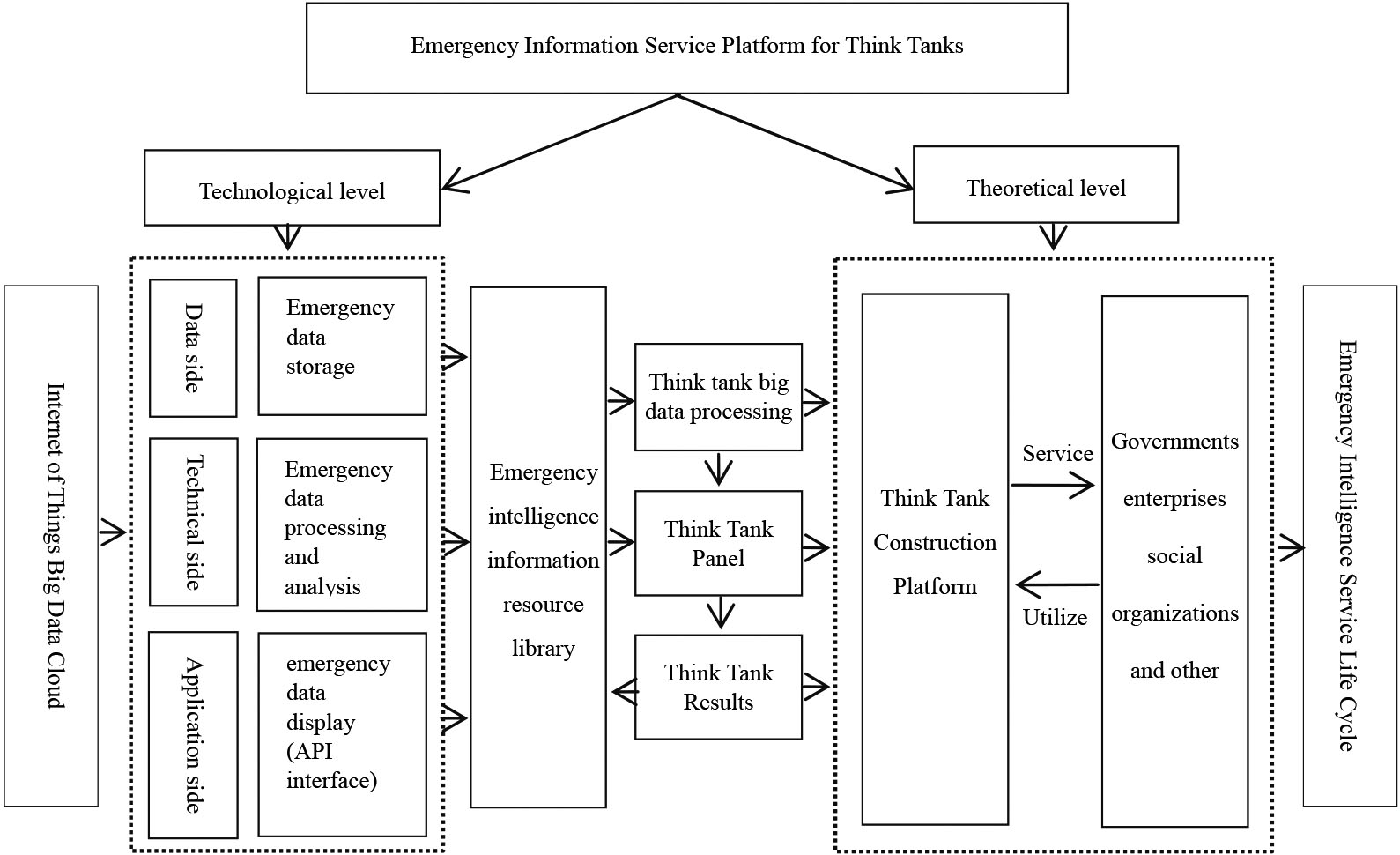
Experts and panels will conduct reasoning through big data display and analysis along with their own knowledge and experience, then combine data and knowledge and through demonstration, discussion and integration of wisdom, they finally produce the deliverables of think tanks such as decision-making consultation reports which are to be displayed on the think tanks’ emergency intelligence service information platform to provide intellectual support and safeguard to the government, enterprises, social organizations and other institutions at all levels in handling emergency incidents [40, 41, 42, 43, 44].
The content of the think tank’s emergency intelligence service system mainly includes four stages: prevention stage, responding stage, reflection stage and management stage.
Prevention stage
Government, enterprises, and social organizations in the emergency intelligence system need to strengthen their ties with each other., the main service content is to conduct the big data technology detection for the think tank platform before any emergent events occur, by identifying the emergency information, establishing an early warning mechanism and constructing an emergency event analysis database to provide an intelligence guarantee and an objective support for emergency practice. And once an emergency occurs, it will immediately enter the responding stage.
Responding stage
In the emergency intelligent service system, the responding stage is supposed to, based on the information acquired in the prevention stage, integrate the information resources of relevant departments of the think tanks by promoting the sharing of intelligence resources among various departments and compare the case of emergencies in library to ensure rapid emergency decision-making response so as to reduce the range and extent of damage caused by emergencies.
Reflection stage
In the stage of reflection, the emergency intelligence service system for think tanks mainly serves the government and other agencies to make decisions on emergent incidents, which includes the operation mechanism of the think tanks’ expert database. When dealing with emergencies, various departments will use big data technology to work orderly and collaboratively for effectively delivering information and information services and will establish a decision-making database for the think tank to ensure the rationality and effectiveness of emergency responses, thus improving the decision-making efficiency.
Management stage
In this stage, it mainly highlights the tracking management in emergency intelligence services and reorganizes the intelligence of think tanks, including the re-evaluation of effects of emergency handling as well as the implementation of specific decisions. It also needs to adjust the emergency decision-making plans continuously according to the emergency handling situations to improve the efficiency and quality of emergency decision-making.
Application of think tanks’ emergency information service system: Public health emergencies
Public Health Emergencies (PHE) are referred to as sudden and unpredictable events, including an outburst of a serious contagious disease, colonial disease of unknown causes, important alimentary or occupational toxicosis that has caused or may cause severe effect on the health of the general public and to other incidents that severely affect the health of the general public.1
Regulation on the Urgent Handling of Public Health Emergencies [Revised].
On the whole, the EISS can be divided into two parts for the public health emergencies:
In the first part, big data is used to provide real-time analysis, early warning and regular prediction, intensive research as well as pattern prediction of public health emergencies. It is mainly carried out by the construction of the think tank platforms with the big data thinking at their core where PHE will be classified and a large-scale data collection and analysis system will be established, which are aimed to fully protrude the important values on the think tank system platform for public events, such as the impact on public health, by collecting event-related theme concepts and attributes, carrying out long-term accumulation of relevant themes of critical illness treatment and developing a thematic database. And it tries to establish a public health event case database as large as possible, including a series of non-structured data such as videos and pictures, and to sort out the relations between databases and various cases, to establish intelligence specifications, to form a complete intelligence service chain, and to provide scientific data research and judgment standards for the intelligence services in the next period. In addition, a pre-decision application system can be created through visual analysis and information integrated by text extraction, ontology construction and knowledge fusion. And machine learning algorithms such as classification and clustering, and complex network analysis techniques can be applied to realize data analysis of some related elements, such as public health incidents, their carriers and emergency managements, etc., and to mine the data to provide a basis for scientific decision-making.
The second part is to create a profile for the public health event. On the basis of big data analysis, the experts from think tank can make professional predictions depending on the development of emergencies, and respond to the public in a timely manner in order to provide accurate emergency references and minus their loss for people who might suffer from the incidents.
In order to state clearly about the characteristics of the think tanks’ EISS, see case as follows: the public health incident of food poisoning. The model of EISS application process of PHE is shown as follows (see Fig. 4).
The EISS model of the think tanks for the PHE.
Before a food poisoning incident occurs, it is generally in the preventive stage, and the focus should be placed on the establishment of a semantic knowledge base regarding food poisoning emergencies. By describing the concepts of food poisoning in a network structured manner and combining with previous cases of food poisoning incidents, a correlation is established between the objects and their characteristics, such as the space, structure, logic and process. The ontology method in the field of food poisoning is used to build the connection between the data layer and the application layer. A think tank platform about food poisoning database is established that includes various types of data, structured, semi-structured, and unstructured, such as the types of food poisoning, symptoms, causes, treatment countermeasures, and later diet adjustments, etc. With the help of the think tank platform, it’s easier for the PHE to construct an information database similar to knowledge cards, linking knowledge relevance and atlas, and to visualize presentation for relevant information in a timely manner after a food poisoning event occurs, assisting think tanks’ experts to make proper decisions.
In-event response and reaction stage
After a food poisoning incident occurs, the think tank platform would query rapidly the information regarding food poisoning right away, comparing the thematic database and case database collected in the prevention stage, and using the information to identify of the type of the public health incident. The existing data will return feedback to relevant experts in fields of research on food, public health and hygiene. Through analysis and actual situations from the think tank, the data is compared repeatedly, including the causes and characteristics of food poisoning, the original incident handling and rescue situation, etc., from which the knowledge extraction will be carried out, and multi-dimensional information resources such as the time, space and events are diversified and integrated as well. Through all-round reasoning of the food poisoning event process, a series of situations of food poisoning are simulated in the model, and a food poisoning data map is constructed gradually in a visual form to predict the development trends of the public events. In this way, the use of pre-judgement of data from the think tank will provide an intelligent basis for decision-making and resolution of the public health incidents.
Evaluation index system of EISS for food poisoning incidents
Evaluation index system of EISS for food poisoning incidents
Once the emergency plan is activated, the post-event handling and management work should begin immediately. Think tank will adopt big data technology to track and investigate people poisoned and by detecting and recording public health in real time as well as providing timely feedback to experts in this field, some problems would be discovered in the handling of public health incidents in time. The think tank also makes timely changes to the unreasonable parts of the plan, such as: the development trends of online public opinion after a food poisoning emergency. Further handling of food poisoning incident needs to be coordinated and predicted by combining with specific intelligence information so as to achieve consistency between government decision-making and actual rescues, establishing a community among the government, the public and the media, rescue organizations and hospital systems, and forming an efficient emergency think tank intelligence service system.
The impact of food poisoning in public health incidents on cities is becoming more and more serious, and it has become a research hotspot in academic field. Through the stages of “re-prevention, In-event response and reaction as well as Post-management”, this paper designs a set of emergency model for PHE to ensure that managers can grasp the status of the incident in every section, and uses big data to comprehensively realize a coordinated decision-making system. The PHE management system can realize the rapid utilization of information, providing users with customized emergency information services and effective support for emergency management decision-making.
Details of evaluation index system are displayed as below (see Table 3). In application of the hierarchical analysis method, the judgment matrix is constructed in 4 dimensions and 9 indexes. With paired comparison, the index weight is obtained by using Yaahp software and takes the consistency test on the judgment matrix. The result of CR value is 0.0439
Conclusion
In the era of big data, the rise of new technologies has brought both opportunities and challenges for think tanks’ emergency intelligence services as emerging computer technologies and network technologies represented by block chain, Internet of Things, artificial intelligence, and information visualization have witnessed rapid development. Emergency intelligence services for think tanks must break through the original data and information isolated island problem to achieve cross-departmental, cross-institution, cross-field, and cross-disciplinary communication and collaboration, while making predictions, identification and integration on the data quality of the emergency departments. It is urgently needed to establish a “comprehensive, multi-level, multi-dimensional” emergency intelligence service system for think tanks that integrates “collection, analysis, exposure, and decision-making” of intelligence in one system, making it possible to choose the most optimized big data technology at different levels to achieve the goal of “providing appropriate emergency intelligence services for think tanks at the right time and by using the right technology”, and opening up the think tanks’ emergency intelligence service path to increase the correlation between each link and build a think tank’s emergency intelligence service system from a big data perspective.
Therefore, with an attempt to study the emergency intelligence service system for think tanks and based on the analysis of the new requirements and new connotations of emergency intelligence services, this paper tries to carry out beneficial explorations from both the theoretical and technical perspectives, designing an emergency intelligence system for think tanks against the backdrop of big data era and forming a unified, optimized and effective path. On the one hand, it meets the demands of emergency intelligence services for think tanks in the context of big data, stimulating the potential values and improving the efficiency and capabilities of think tanks’ emergency intelligence services, as well as giving full play to the values of think tank’s decision-making. On the other hand, it has practical application values in the formation of a think tank emergency information service system with “system-management-decision” at its core, providing theoretical references for the decision-making of the country, of the enterprises or of the societal organizations. This EISS provides scientific references for
Footnotes
Fund project
Humanities and Social Science Research Project (General): Study on the Construction of Emergency Intelligence Service System for Think Tanks in the Context of Big Data (2021-ZZJH-289), from Education Department of Henan Province; Soft Science Research Program of Henan Province: Research on talent mechanism construction of science and technology innovation think tanks in high-quality development stage (212400410480).