



Abstract
Power battery SOC (state of charge, SOC) is one of the important decision-making factors of energy management. Accurate estimation plays an important role in optimizing vehicle energy management and improving the utilization of power battery energy. The key to accurate estimation of SOC is to determine circuit model parameters and estimation methods. The research object of this article is lithium manganese oxide battery for mining (LiMn2O4). The experiments of multiplying power, temperature and HPPC (hybrid pulse power characteristic, HPPC) are carried out. A self-tuning calculation method of dynamic system is proposed, and the dynamic self-tuning model based on second-order RC is established. At the same time, in view of the shortcoming that the UKF (Unscented Kalman Filter, UKF) algorithm cannot estimate the noise in real time, In order to improve the accuracy of battery SOC estimation, an adaptive square root unscented Kalman filter (ASR-UKF) algorithm is proposed, which can make the noise statistical characteristics follow the estimation results for adaptive adjustment. Finally, the constant current and dynamic conditions are tested. The results show that the maximum change rate of model parameters with magnification is 76%, and the maximum change rate with temperature is 73.7%. The analysis of dynamic characteristics is a key factor to improve the accuracy of SOC estimation; ASR-UKF Compared with the UKF algorithm, the error is reduced by 78% under constant current conditions and 85.7% under dynamic conditions. The reliability and real-time performance of the algorithm can be obtained by comparing the simulation data with the actual data. The conclusions of this paper can be used as a theoretical basis, which can be used for model analysis of lithium batteries for mining and estimation of internal state variables.
Keywords
Introduction
The rapid development of industry has brought new problems, such as energy shortages and environmental pollution. This is already a problem that the world urgently needs to solve [1]. Therefore, various countries have accelerated the research and development of electric vehicles and hybrid vehicles, and at the same time, power battery technology has also been rapidly developed, and major breakthroughs have been made [2]. Since 2008, the power density of power batteries has reached 3 KW
State of the art
According to the “Technical Requirements for Security of Lithium-Ion Batteries for Mining”, the accurate computation of SOC of lithium-ion power batteries for mining and the design of safety management system can refer to the standard of lithium-ion batteries for electric vehicles (GB 31241-2014). Therefore, the current research status of SOC computation of lithium-ion batteries for mining can refer to power batteries for automobiles. At present, the methods of studying the SOC estimation of automotive power batteries at home and abroad can be roughly divided into three categories: ampere-hour integration, characterization parameter-based and model-based [11, 12, 13].
The ampere-hour integration method is also called the Coulomb counting method, which is convenient to use, easy to implement, and easy to cause accumulated errors when the current accuracy is not high. Zhang et al. proposed an improved model of the SOC initial value estimation of the dynamic multi-parameter method, considering the relaxation effect [14]. The dependence of the initial value of SOC on the ampere-hour integration method is effectively reduced. The error caused by charge accumulation is not described.
The methods based on characterization parameters can be divided into impedance spectroscopy and open circuit voltage, mostly by establishing the correlation between characterization parameters and SOC. This method is considered to be the most direct method to determine the SOC of power battery, but the relative relationship is difficult to determine, generally with the model Online identification methods are used in combination. Wang et al. used the constant current mode electrochemical impedance spectroscopy method to obtain the ohmic impedance, charge transfer impedance and ion diffusion impedance of the battery, and carried out the research of the SOC and temperature on the impedance features of the lithium iron phosphate battery, and concluded that the battery is in different SOC and the impedance characteristic under temperature effectively reflects the internal polarization state of the battery, so that the functional state of the energy storage battery can be judged according to the above three parameters; Xing et al. established a temperature-based SOC estimation model [11], combined with open circuit voltage (OCV) and SOC, a table of three variables is made, and the model parameters of each sampling step are optimized by the method of unscented Kalman filtering (UKF), which explains that the method may effectively build up the SOC estimation; Krishna’s method of estimating the state of charge of a battery is to combine Coulomb counting and open circuit voltage, and verified the whole system in real time with a semi-physical experimental device. The results showed that the method is efficientand accurate.
The estimation algorithm based on models such as electrochemical model, equivalent circuit model, and black box model is a fusion of multiple algorithms. These algorithms include ampere-hour integration method, open circuit voltage method, neural network method. Kalman filter based on the model, the state equation is established, and the filtering method and observer are used to complete the SOC estimation. Hu et al. proposed a robust Kalman filter method to solve the uncertainty and non-linear error involved in the battery modeling process of the extended Kalman filter method to compensate, so that the root mean square error of the SOC estimation is reduced, and the noise statistics are reduced [15]. Shows strong robustness; Bizeray et al. used an orthogonal configuration method to solve the thermal-electrochemical P2D model [16], and used an improved extended Kalman filter algorithm to achieve SOC estimation, which ensures accuracy and reduces computational costs; Luo et al. proposed a temperature-corrected estimation model for SOC estimation at lower temperatures, and used Sigma-based unscented Kalman filtering to accomplish SOC estimation [8]; Zhang et al. had access to a nonlinear complementary model to capture the open circuit voltage the hysteresis effect [17]. One method uses the time to modify the integral and multi-channel voltage combined battery state SOC, and solves and completes the SOC accumulation problem caused by the initial value through the battery capacity and Coulomb growth temperature change. Established an EKF uses the open circuit voltage method to determine the initial value of SOC when estimating SOC, so that it can converge to the true state more quickly [18, 19]. It is considered that the capacity loss of the battery and arranged the ADKF (Adaptive Double Kalman Filter) algorithm based on the fractional-order model, which realized the accurate estimation of the SOC of the battery under the condition of capacity loss; The hysteresis neural network algorithm realizes the joint estimation of the SOC and SOH of the battery [20]. This algorithm compensates for the non-linear part of the battery and does not need to know the external parameters of the battery in advance; Chen et al. proposed a method based on RBF (Radial Basis Function), which estimated the battery SOC by the nonlinear observer of the neural network [21, 22, 23, 24, 25]. This method uses the neural network to estimate the uncertainty of the battery model online [26, 27], and proves that the SOC estimation error is ultimately bounded and the error can be arbitrarily small.
From the above research, it can be seen that the ampere-hour integration method is simple to operate, but cumulative errors will occur with the accumulation of charge, and it is more dependent on the initial value of SOC, which is not suitable for working conditions the battery; Choosing an accurate model and filtering algorithm has become the research focus. Literature uses different equivalent models, identification methods and SOC estimation algorithms under different environmental conditions to analyze measures to further the accuracy of SOC estimation. However, there is no relevant literature to carry out research on mining LiMn2O4 under the special environment of Northwest coal mines. Therefore, this paper takes LiMn2O4 as the research object, carries out HPPC experiments with charge-discharge rate and temperature as the research content, establishes a dynamic self-correcting model based on second-order RC, uses adaptive square root unscented Kalman filter method to estimate SOC, and the influence of adaptive correction model on the accuracy of real-time SOC estimation.
The third part expounds the battery model and parameter identification process, determines the dynamic self-correcting model parameters of the second-order RC; expounds the idea and calculation process of the ASR-UKF algorithm. The fourth part is based on the model and algorithm of this paper to conduct tests under constant current and dynamic conditions, and analyze the test results.
Methodology
In this experiment, a 50AH/4.2V LiMn
Characteristic parameters of LiMn
O
battery
Characteristic parameters of LiMn
The recent rate and temperature of the battery have an impact, internal resistance, terminal voltage and SOC of the battery. The experiment analyzes its influence on the SOC by grasping the battery’s current rate and temperature change characteristics, and lays a solid foundation for the determination of the parameters of the second-order RC dynamic self-correcting model. The test results are shown in Figs 1 and 2.
R0 under different discharge rates.
R0 under different temperatures.
Figure 1 shows the variation of the internal resistance Ro of the second RC model with SOC under different magnification conditions; Fig. 2 shows the variation of the internal resistance Ro of the second-order RC model with SOC under different temperature conditions. Similarly, the open circuit voltage Uoc, polarization resistance Rs and Ru, polarization capacitance Cs and Cu, and energy storage capacitance Cb can be plotted against SOC.
Dynamic working condition method, HPPC test, self-discharge test and energy efficiency test, etc. Among several test methods, HPPC measures the cost. Low, simple measurement equipment used, high measurement accuracy, mainly used to test battery dynamic characteristics. In this test, according to the requirements of HPPC, the LiMn
Battery voltage curve in HPPC test process.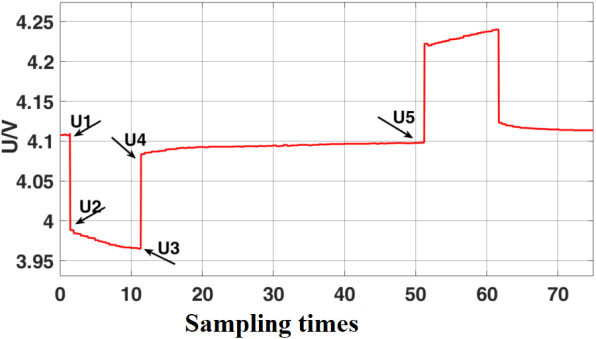
Circuit diagram of second-order RC model.
Figure 4 is a second-order RC model. The test of 3.1.2 is designed for this model, and the meaning of the parameters Uoc, Ro, Cb, Rs, Ru, Cs and Cu in the circuit are described, UL is the terminal voltage. The following is the identification of parameters based on the obtained HPPC curve (Fig. 3).
Uoc is the stable voltage of the positive and negative poles of the battery when the battery is in a static state. After measuring the Uoc of the battery when the SOC is 1, discharge the battery at a constant current rate of 1C for 6 minutes to reduce the SOC by 0.1 to obtain the Uoc value in different states. After the value of the voltage is stable, repeat the measurement to get the average value of Uoc. The purpose of leaving the battery for a long time is to completely eliminate the influence of polarization effects on battery performance and ensure the accuracy and reliability of the measurement.
Ohm internal resistance: The polarization of the battery has not yet occurred at the beginning and end of discharge. The battery voltage suddenly drops or rises due to the ohmic internal resistance, as shown in the U1–U2 and U3–U4 segments in Fig. 3. It uses Ohm’s theorem to get the value of internal resistance, and the equation is shown in Eq. (1):
Energy storage capacitor:
Polarized internal resistance and polarized capacitance: The polarization phenomenon reflects how fast the battery reaches a steady state after charging and discharging. To identify the resistance and capacitance in the two RC links in Fig. 4, first identify the discharge direction. From Fig. 4, the model output equation can be obtained as Eq. (3):
Figure 3 is the U4–U5 section of the voltage change curve 40 s after the end of the discharge pulse. The current input is 0. At this time, it is the zero input response of RC.
where
In the U2–U3 section, since the U2 point has been put on hold for a long time, its internal polarization effect has basically disappeared, and the polarization voltage can be considered to be zero. The U2–U3 section is regarded as the zero-state response of the RC link, and the voltage across the polarizing capacitor is:
The instantaneous battery polarization voltage from point U3 to point U4 is basically unchanged, which can be obtained:
where
Substituting the already calculated
Considering the identification accuracy and the computational complexity, the 7th fitting is finally selected, and the fitting polynomial is as follows:
Parameter fitting results
The operating conditions of mining batteries are very complicated, and their state of charge is affected by many factors, mainly including charge and discharge rate, temperature, self-discharge, cycle times and aging, etc., among which the charge and discharge current rate and temperature are more important.
Therefore, according to the experimental data of different magnification and temperature in 3.1.2, combined with the identification parameters, the improvement of the dynamic self-correcting model of the second-order RC that changes with the current magnification is proposed. The specific method is as follows: Set Ro under 1C magnification as the reference parameter, and the ratio of Ro to the reference parameter under other magnifications is called Ro correction coefficient, and Dro is used to represent the correction coefficient. In the same way, the correction coefficients of Uoc, Rs, Ru, Cs, Cu, and Cb can be obtained, which are represented by Duoc, Drs, Dru, Dcs, Dcu, Dcb in Table 3. It can be seen from the table that the maximum change rate of model parameters with magnification is 76%.
Correction coefficients of dynamic system parameters under different multiplying powers
It can be seen from Fig. 2 that Ro changes at the same SOC and at different temperatures, while the fitting result is fixed. Therefore, an adaptive improvement with temperature changes is proposed. The specific method is as follows: Set Ro at 25
Correction coefficients of dynamic system parameters under different temperatures
The previous article analyzed the parameters and SOC influencing factors in the battery equivalent circuit model, and then combined the model to establish a space equation to study the SOC estimation method.
According to Fig. 4, select SOC and three-dimensional variables as the state variables of the system, and the battery terminal voltage as the observed variables of the system.
Initialization: The initial value belongs to the state variable and the error covariance is determined.
UT transformation: Approximate the Gaussian distribution with a fixed number of parameters.
where
Time update: According to the state
According to the one-step prediction of the sampling point, the error covariance of the state variable is QR decomposed, as shown in Eq. (15).
Considering that the values of
Equations (17) to (20).
State update: The cross-covariance between the state variable and the observed variable is shown in Eq. (21), and its value directly affects the size of Kalman gain, and the accuracy of Kalman gain will affect the estimation effect of SOC. Its calculation method is as Eq. (22), the system state variable update and its error covariance update are shown in Eq. (23),
This algorithm introduces noise adaptive covariance matching, and automatically cyclically updates and transmits the noise covariance matrix to make it closer to the real noise situation. In the algorithm, the innovation of the observed variable at time
Noise update is presented as below:
The SOC estimation flowchart of ASR-UKF algorithm is shown in Fig. 5.
SOC estimation flowchart of ASR-UKF algorithm.
In the ASR-UKF algorithm, the observation equation plays a vital role, and accurate observations can ensure the accuracy of SOC. In the cause of verify the accuracy, reliability and real-time performance of the model, the second-order RC model is selected for comparison, and experimental analysis is carried out under constant current and dynamic conditions.
Constant current working condition: Fully discharge LiMn2O4 at a constant current of 1C at a discharge rate of 1C in an environment of 10
Comparison of terminal voltage under constant-current discharge.
Terminal voltage error under constant-current discharge.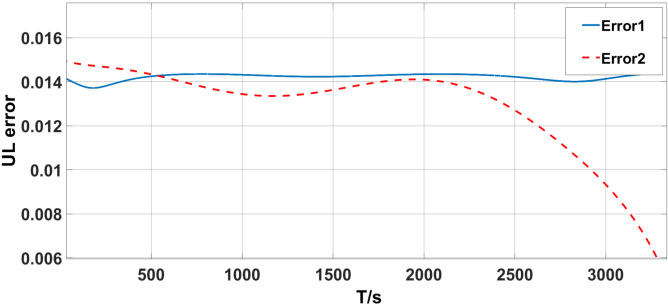
Dynamic working conditions: Charge and discharge the battery under 10
Comparison of terminal voltage under dynamic working condition.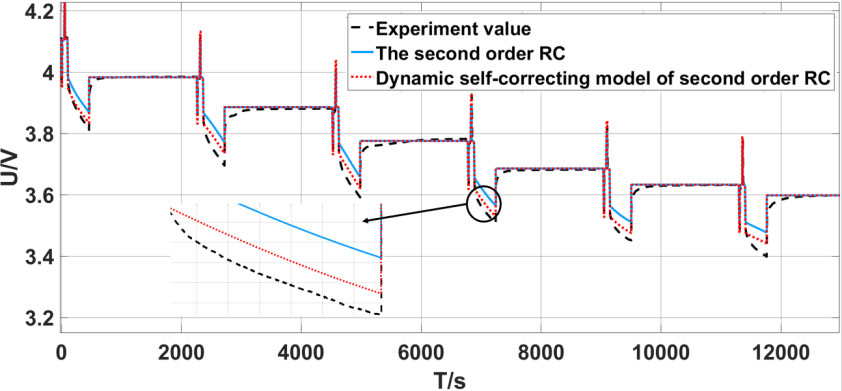
Terminal voltage error under dynamic working condition.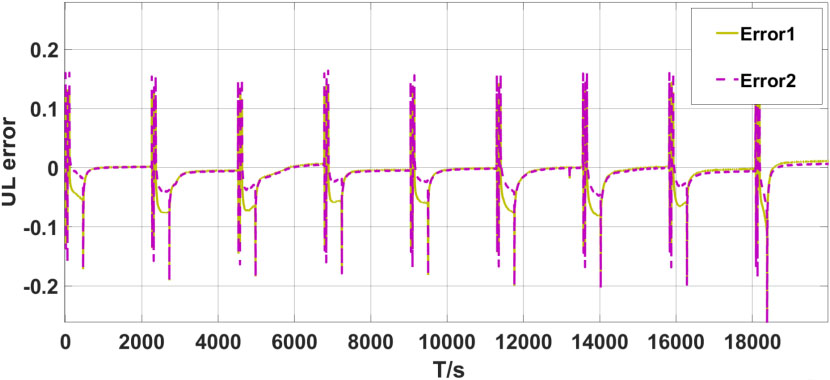
The condition is about constant current: Full discharge of LiMn2O4 at a constant current of 1C at a discharge rate of 1C in an environment of 10
Comparison between the two algorithms in SOC estimation.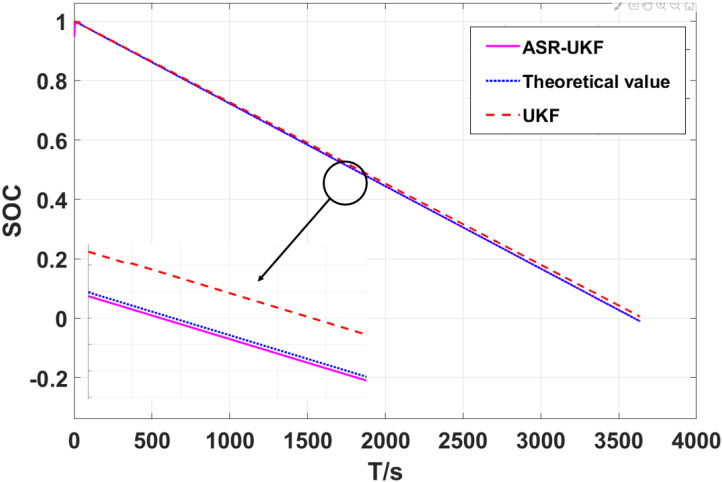
Error oscillograms of the two algorithms.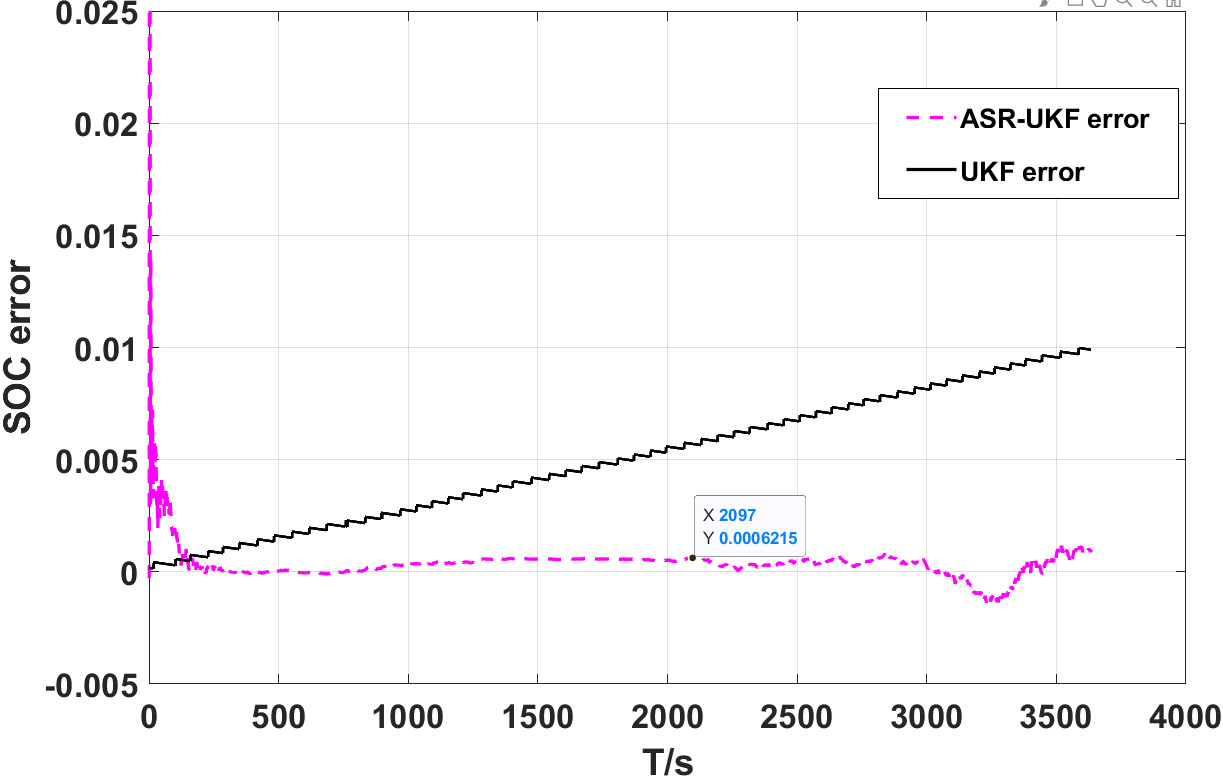
Comparison between the two algorithms in SOC estimation under dynamic working condition.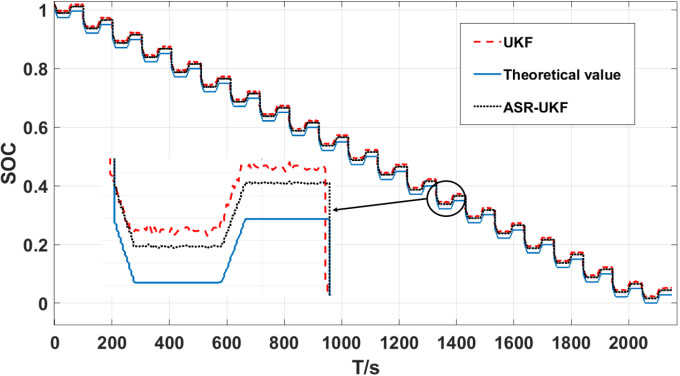
Comparison between the two algorithms in SOC estimation error under dynamic condition.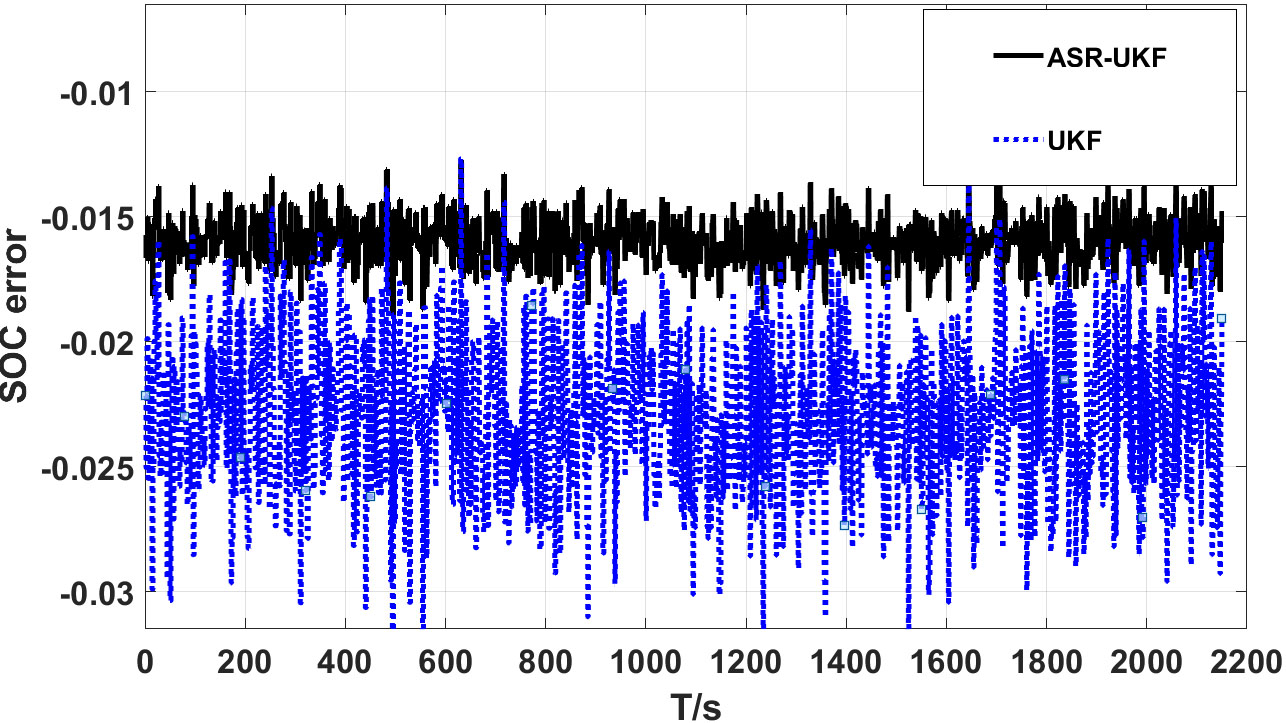
Dynamic operating conditions: Charge and discharge the battery under a 10
Mining power batteries are more and more widely used in mining transportation vehicles. In order to further study the performance of power batteries, this paper selects the commonly used mining power battery LiMn
Determine the second-order RC dynamic adaptive model based on the internal characteristics of the battery such as ohmic polarization, steady state change, active polarization, concentration polarization, etc., combined with the external change characteristics of the battery such as temperature and rate; Compared with the second-order RC model, the error of this model is reduced under constant current conditions and dynamic conditions. Shows that the model has a strong self-correction function. Based on the square root unscented Kalman filter algorithm, combined with the characteristics of the model, the three-dimensional state variable is used as the state equation, the battery terminal voltage is used as the observation variable, and the accuracy of battery SOC estimation is improved by real-time prediction and correction of noise, and the adaptive square root unscented Kalman filter algorithm is finally determined. Compared with the Unscented Kalman Filter algorithm, the error of the algorithm in this paper is reduced under constant current conditions and under dynamic conditions. The result of this algorithm shows the characteristics of fast convergence speed and high accuracy.
In general, the algorithm in this paper has the advantages of simple structure and strong adaptability of parameters; the proposed SOC algorithm is easy to implement and has high estimation accuracy, which lays a foundation for further analysis of the application of lithium-ion batteries in mining power systems. However, the SOH the battery is not considered in the SOC estimation process, and the joint estimation algorithm of SOC and SOH will be studied in the later stage.
Footnotes
Acknowledgments
This work was supported by the Natural Science Foundation of Education Department of Anhui Province (No. KJ2019A0692, No. KJ2020A0640) and the Natural Science Foundation of Huainan Normal University (No. 2018xj17zd).