



Abstract
Large scale sports events bring all kinds of opportunities, but also contain huge risks. Therefore, risk management measures in the operation of sports events is important, and risk assessment is a significant part of risk management. It is indispensable to select risk factors that have a greater impact on the event risk and analyze their impact on the event risk and the degree of impact. In this paper, the fuzzy analytic hierarchy process is used to study the risk assessment. Through the identification of risk factors, the modeling of analytic hierarchy process, the construction of fuzzy evaluation matrix and the ranking of risk factors, the importance ranking of risk factors in the operation of large-scale sports events is realized. Aiming at the fuzziness of people’s judgment reflected by fuzzy analytic hierarchy process, a research method of risk assessment of large-scale sports events based on fuzzy analytic hierarchy process is proposed. Through a series of steps of risk identification and risk assessment of sports events, the risk assessment of sports events is realized, event risk factors, modeling of AHP structure, building of fuzzy judgment matrix and ranking of event risk factors, importance ranking of risk factors. The experimental results show that the consistency ratio CR
Introduction
Holding large-scale sports events will greatly promote the development of a city or even a country [1, 2, 3]. Large scale sports events bring all kinds of opportunities, but also contain risks. Sudden international, interfere with or even hinder of the event, and make all efforts of the event organizers to naught [4, 5]. Therefore, taking risk management measures in the sports events, and risk assessment plays a significant role in risking management [6]. The main tasks are to select the risk factors that have a greater impact on the event risk and analyze their impact on the event. Now, most of the relevant domestic literatures use qualitative methods to evaluate the event risk [7, 8, 9, 10]. However, there are few systematic and complete researches on the risk assessment of sports events with the method of quantitative research. Due to the lack of necessary data support in the risk assessment process, the event organizers can only make decisions based on their own experience, which to a certain extent affects the accuracy and effect of the decision, making the research less convincing. FAHP is a qualitative and quantitative method. The idea and method of fuzzy mathematics are introduced into analytic hierarchy process, which is a decision-making tool instead of magnetic bearing analysis. Its main advantage is that it can better reflect the fuzziness of human judgment [11, 12, 13]. Fuzzy analytic hierarchy process is inestimable. However, in sports management, there are few applications [14]. On this basis, through the comparison of the two, judge the relative importance of each level of elements, and get the weight of each element in the comprehensive evaluation. Finally, the comprehensive evaluation is carried out according to the membership degree.
In this paper, the fuzzy analytic hierarchy process is introduced into the risk management, and a risk assessment method based on the analytic hierarchy process is proposed, which verifies the feasibility of this method in the risk assessment. Through the identification of risk factors, the modeling of analytic hierarchy process, the construction of fuzzy evaluation matrix and the ranking of risk factors, the importance ranking of risk factors in the operation of large-scale sports events is realized. Aiming at the fuzziness of people’s judgment reflected by fuzzy analytic hierarchy process, a research method of risk assessment based on fuzzy analytic hierarchy process is proposed. Through a series of steps of risk identification and risk assessment of sports events, the risk assessment of sports events is realized, event risk factors, modeling of AHP structure, building of fuzzy judgment matrix and ranking of event risk factors. Importance ranking of risk factors. The experimental results show that the consistency ratio CR
And the innovation of this paper is shown as: At present, there are few systematic and integrity studies on the risk assessment of sports events, and the event organizers can only make decisions according to their own experience in the past, which maybe influence the accuracy and effect of decision-making to a certain extent, and will make the research lack of persuasion. Therefore, based on the literature on risk assessment of sports events, this paper introduces fuzzy analytic hierarchy process into risk management, and puts forward a risk assessment method based on fuzzy analytic hierarchy process. As the application effect of this, compared with traditional methods, can more effectively identify the main factors of event risk and rank them. The research results of this paper accurately identify the main risks of large-scale sports events, can effectively reveal the main influencing factors of risk management of large-scale sports events, and can effectively improve the risk control level of large-scale sports events and improve the operation efficiency of events, which have important theoretical significance and practical guiding value.
Proposed method
Related work
Ramin identified and ranked factors affecting the development of military hospital beds, and established the model by analytic hierarchy process. The application study was conducted in 2016 using a hybrid approach in Iran. The sample includes experts in the field of military medical systems. The acquired data was analyzed using MAXQDA 10.0 and expert selection 10.0 software [15]. Geographic location, demographic status, economic status, health status, medical institutions and organizations, financial and human resources, laws and regulations, and the military nature of employees all have an impact on the development of military hospital beds. The client’s military objectives (
In the process of building bridges, there are many potential sources of risk, which may lead to the destruction of bridges, resulting in a large number of economic and personal losses. Therefore, during the construction process, bridge risk assessment should be strictly carried out to avoid bridge accidents and casualties. Cheng et al. [17] proposed a fuzzy logic-based method that combines three-point scale fuzzy analytic hierarchy process (FAHP) with fuzzy logic and fuzzy set theory to form a single integrated method. The method uses the three-point scale FAHP method to identify and rank different risk factors, and uses fuzzy logic and fuzzy set theory to process inaccurate data sets with non-statistical information. After expounding the concept and steps of the FAHP method based on the three-point scale, it is applied to the risk assessment of the Azhai Suspension Bridge with a main span of 1176 m. The results show that the method is more effective in bridge construction risk assessment.
Occupational health and safety involves systematic research designed to protect employees from the harmful conditions that can be caused by various causes when working in the workplace. Unlike the literature, Ilbahar et al. [18] adopted a new comprehensive evaluation method: The Pythagorean fuzzy proportional risk assessment (PFPRA), including Fine Kinney method, the Pythagorean fuzzy analytic hierarchy process and fuzzy inference system. The main difference between these methods is that the integration of these methods provides a more accurate risk assessment. The method is applied to the risk assessment of the excavation process at the construction site. It was compared with the Pythagorean fuzzy failure mode and impact analysis (PFFMEA). The results show that the method can reflect the ambiguity of the decision process and produce reliable information results.
Analytic hierarchy process
Analytic hierarchy process
The overall process of AHP is to treat a more complex target as a system, and divide it into appropriate levels through layer-by-layer decomposition. On the basis of establishing the comparative judgment matrix, the fuzzy method is used to process the qualitative indicators, and the results of single item sorting and total sorting at each level are obtained, which is convenient for the next objective problem work or evaluation behavior selection and evaluation.
Basic steps of the analytic hierarchy process
1) Establish a hierarchical analysis structure model
On the basis of in-depth understanding of the problem to be analyzed, the factors affecting the target problem are divided into the target layer, the criterion layer and the factor layer from top to bottom. The sublayer affects the parent layer, and the factors in the same layer should not interfere with each other. The target layer is the target problem that needs to be analyzed. The criteria layer is a decomposition of the target problem and can be divided into several small levels. The factor layer is the last layer, which is mainly based on the formation of more specific factors in the criteria layer to describe the problem [19, 20]. The accurate judgment of the target problem cannot be separated from the appropriate hierarchy. The levels determined according to different target issues are slightly different. The relationship between the levels should be very clear, and the number of factors at each level should be controlled. Otherwise, when constructing the judgment matrix, the calculation amount will affect the construction result. The hierarchical analysis structure model is shown in Fig. 1.
2) Constructing a comparison judgment matrix
According to the judgment experience of the subject, the T.L. Saat 1–9 scale method is used to compare the indicators of the same level, and the scale value is determined according to the relative importance, and the comparison judgment matrix is constructed, as shown in Table 1. The 1–9 scale method is shown in Table 2.
Pairwise comparison judgment matrix
Pairwise comparison judgment matrix
Scale measurement table
Hierarchical model diagram.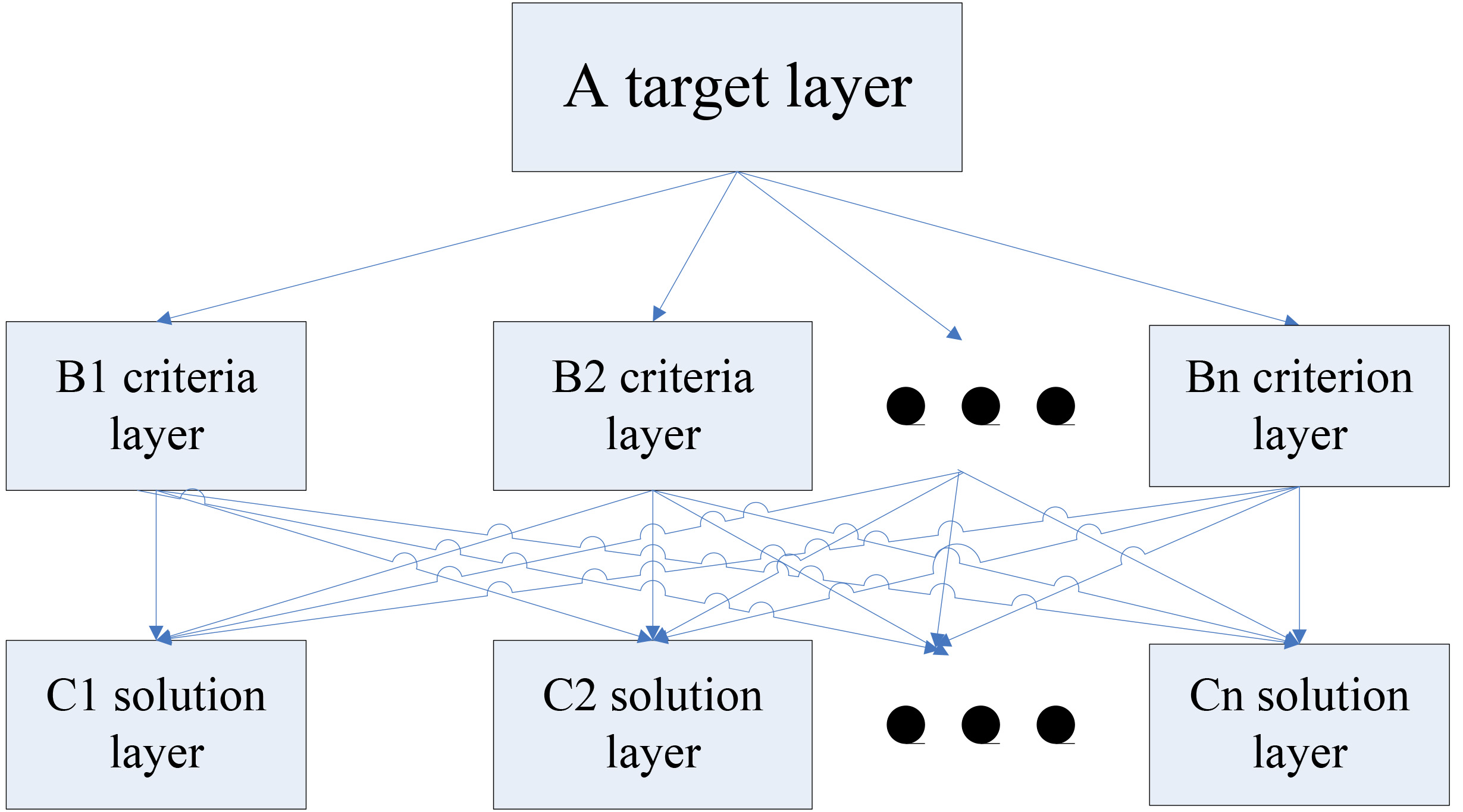
In the matrix shown in Table 2, the values of all elements are greater than 0, and the values of the upper and lower triangles corresponding to the matrix transposition are reciprocal. For the nth order judgment matrix, the elements on the main diagonal are all 1. In general, the entire decision matrix can be obtained by finding the scale values of n (n-1)/2 elements.
3) Calculation weight vector
The maximum eigenvalue of the judgment matrix and the corresponding eigenvector are calculated, and the eigenvector corresponding to the largest eigenvalue of the matrix is used as the weight vector by consistency [21]. First, the largest feature,
Calculate the product of the elements of each row of the judgment matrix:
Calculate the nth root of each
Feature vector
4) Consistency test
The purpose of the consistency check is to determine whether the constructed matrix is recognized by the evaluation subject, so that the degree of deviation of the matrix from a certain criterion is within an acceptable range, and the consistency check indicators CI and RI are used to judge whether the matrix deviates from the corresponding criterion. More, the specific steps are as follows:
Calculation of the maximum eigenvalue of the judgment matrix:
Computational consistency evaluation index:
Indicator RI corresponds to the value shown in Table 3.
RI value
If CR
5) Calculate the total order of the hierarchy
The total ranking of the hierarchy refers to the weighting coefficient of the indicators of each level relative to the importance of the total target, and the consistency of the obtained combined weights needs to be tested. The formula is:
If CR is less than 0.1, the overall arrangement indicating the hierarchy passes the consistency check. Otherwise, the value of the element with higher consistency ratio in the judgment matrix needs to be re-adjusted.
The affiliation between the levels is determined. Suppose the above element
It is worth noting. Since fuzzy analytic hierarchy process (AHP) is a method. A few experts (3–5 people) can construct a representative matrix. Therefore, representativeness and try to choose more scholars in sports events. There are methods for dealing with the group pair judgment matrix: To determine and combine the group weight; To integrate judgment matrix.
Hierarchical single item ordering refers to calculating the weight of the order of importance of each factor related to the level according to the fuzzy complementary judgment matrix. Hierarchical single order can be attributed to the calculation of the eigenvalues and eigenvectors of the judgment matrix. Using the single-item sorting results at the same level, you can calculate the weight of the importance of each factor at that level. The weight vector is calculated by the least squares method (LVM) using the following formula:
where
The problem needs to be fed back to the expert to re-determine.
The ultimate goal of establishing a hierarchical model of risk factors for large-scale sports events is to obtain a ranking of the relative weights of each risk factor at the lowest level and the overall target level, that is, the order of importance of each risk factor. Thereby highlighting the importance of different risk factors and adopting measures. Ranking of risk factors is to use the results to calculate the weight of each factor of the level to the importance of the previous level. The weights should be synthesized layer by layer from top to bottom to get the final ranking of the highest level.
Average random consistency indicators for 1–8 order matrices
The first step is to make a single hierarchy. The hierarchical single ordering is based on the fuzzy complementary judgment matrix, and calculates the weight of the order of importance of each factor related to the level. The calculation of the eigenvalues and eigenvectors of the judgment matrix can be attributed to the summation problem. In this paper, the eigenvectors and eigenvalues of the matrix are calculated using Matlab7.10.0. First, the matrix eigenvectors and the largest eigenvalues are calculated. Third, in order to test their consistency, the consistency index CI needs to be calculated:
When the judgment matrix has complete consistency, CI
When the matrix order is greater than 2, the ratio of the consistency index CI of the judgment matrix to the same-order average random consistency index RI is the random consistency ratio of the judgment matrix, and is recorded as CR. When:
The judgment matrix has satisfactory consistency, otherwise the judgment matrix should be adjusted.
Data set acquisition method and experimental data set
Questionnaires were used to investigate the risk factors of the international marathon. First, 100 samples were distributed on the spot as a common sense survey, and the sample was appropriately modified to form a final questionnaire. A total of 309 questionnaires were distributed and 267 valid questionnaires were issued.
Data reliability and validity test
Reliability and reliability test of data
Data reliability refers to the degree of reliability of measurement data and conclusions. This paper chooses retest reliability as the criterion for reliability testing. The new retest method is to measure the same object twice before and after using a unified measurement method, and then use SPSS17.0 software to calculate the correlation coefficient based on the measured value. Through two measurements, the analysis was performed using SPSS statistical software, and the correlation coefficient r
Data Validity and Validity Test Data validity test uses content validity, which refers to the suitability and logical consistency between measurement indicators and measurement targets. In order to ensure the validity and credibility of the data, the relevant experts are asked to analyze whether the test project is consistent with the original content and scope, and make a judgment to see if the test project better represents the original content. Organize according to expert opinions.
Summary of experts for verifying data content validity
Summary of experts for verifying data content validity
According to the five criteria (suitable for 10 points, more suitable for 8 points, generally 6 points, not suitable for 4 points, very unsuitable for 2 points), the validity of the surveyed data is tested from three aspects: Content design, structural design and difficulty. The result is ideal.
(1) Using fuzzy AHP to determine the weight of network financial risk indicators, the first is to establish a hierarchical structure. The hierarchy generally includes a target layer, a criteria layer, an indicator layer, and even a sub-indicator layer.
(2) Construct a fuzzy judgment matrix. The fuzzy judgment matrix refers to the matrix formed after the establishment of the hierarchical structure. It is necessary to determine the importance of the factors at the next level that affect a certain factor, and determine the importance score by comparing the two factors and fill in the matrix. The model is assigned in a 1–9 scale, as shown in Table 6.
1–9 scale method
1–9 scale method
(3) Check the consistency of the fuzzy judgment matrix. Corresponding adjustments are made to the fuzzy judgment matrix that does not satisfy the consistency. According to the nature of the fuzzy consistent matrix, the specific steps for checking and adjusting the consistency of the matrix are as follows:
In order to determine an element with high precision and accurate importance score, such as factor
(4) Overall layout of the plane. On the basis of hierarchical single ordering, the relative importance weights of each factor in the index layer relative to the target layer are calculated. The weight value is the product of the weight of each indicator relative to the criteria layer and the weight of the criteria layer relative to the target layer.
Data survey results
Through the comparative analysis of the survey results, we can find that the most significant impact of the international marathon is the destruction of the surrounding environment around the island road, the chaos caused by many people and the chaos of the streets; The second is that the city is located on the hot and humid sea, and the climate is rainy, giving the game Inconvenience; Third, the bicycle collided with the running crowd during the game. See Fig. 2 for details.
Schematic diagram of the risks that the general public believes in the international marathon.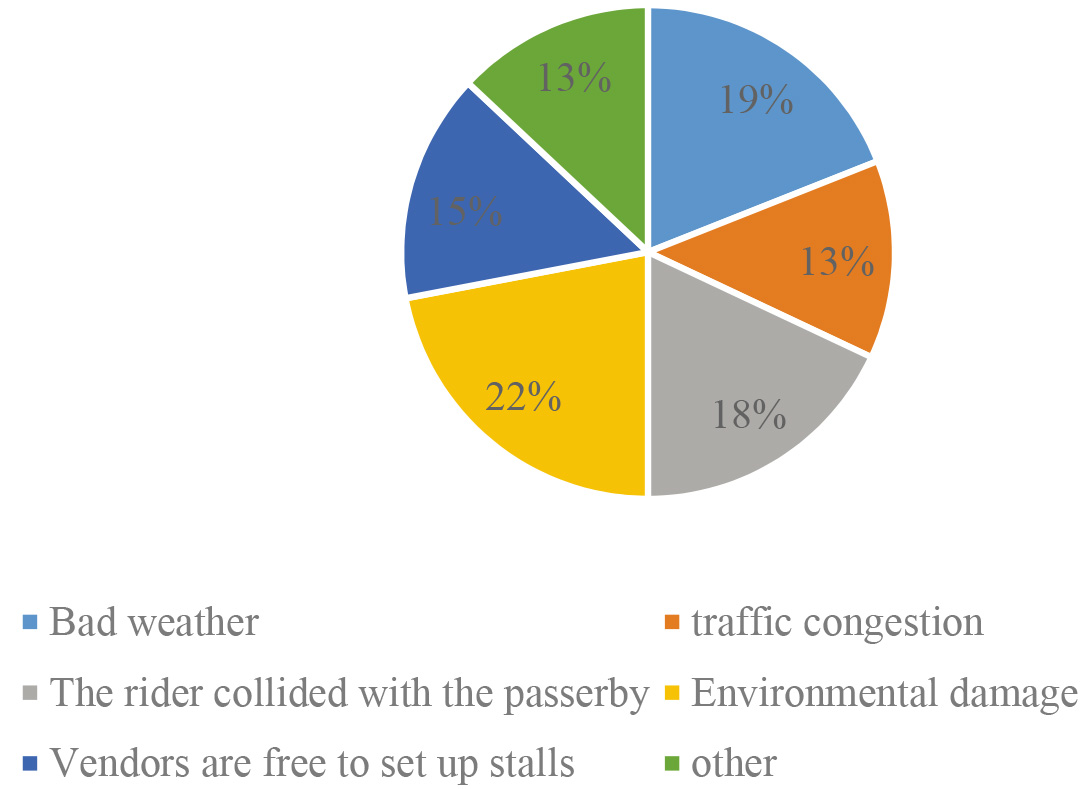
During the investigation, it was found that in the crowded competition, it was the high incidence of criminals. Some viewers or tourists who are concerned about the game suffered losses during the course of watching the game. Although the media reported fewer such incidents, the existence of these human factors did undermine the normal and orderly development of the game.
On the other hand, according to the data of the questionnaire survey, experts and scholars mostly summarize the risks of international marathon events as: Organizational risk, operational risk, personnel risk and so on. See Fig. 3 for details.
Experts’ opinion on the risk of international marathon.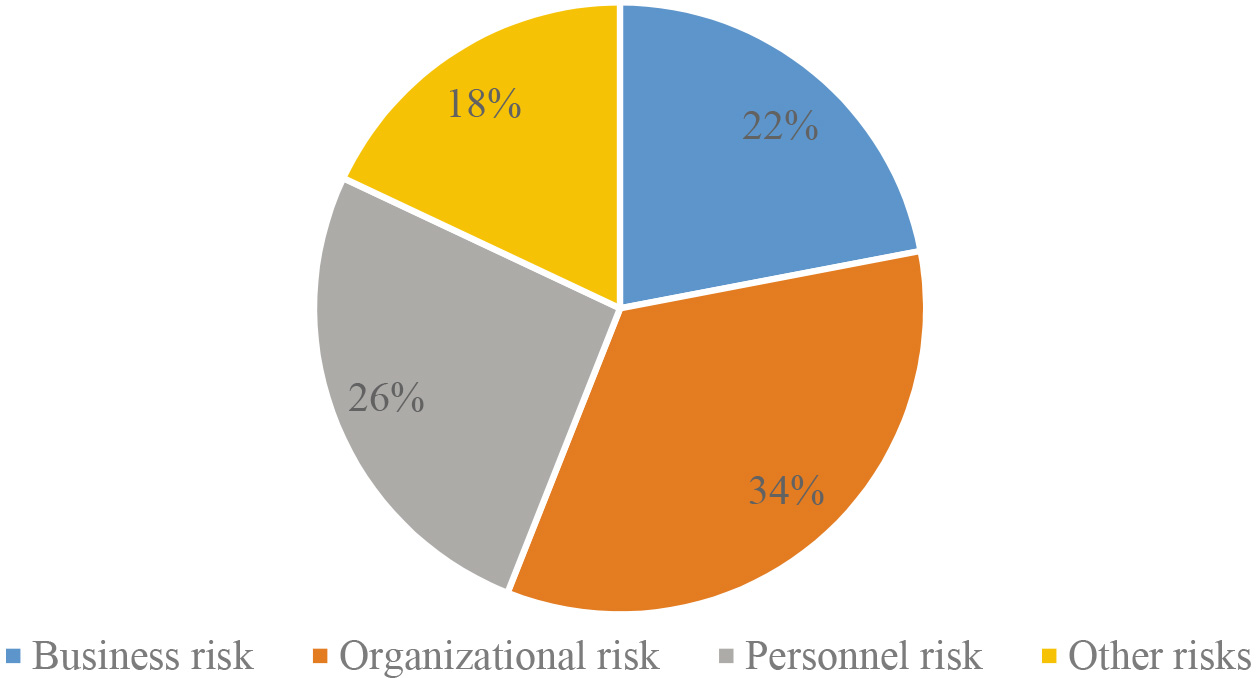
The organizational risk in the so-called event is the time of the marathon, the venue arrangement, and the command and dispatch of the relevant personnel. The reason why it is listed as a risk is because there are both professional long-distance runners and non-professional runners who participate in the international marathon. During the game, the distance, time and rhythm of the game are different. Although professional marathon runners and non-professional athletes were placed separately during the competition, the collision between them was inevitable, resulting in collisions and crowding, which made the game unsuccessful. In addition, the marathon is a long-time exercise involving distance coaches. In addition to testing the athlete’s competitive level, there are technical problems in the water supply for the athletes during the long-distance running. It is not advisable for staff to open the water bottle too early or too late to pour water for the athletes. This will cause unnecessary trouble for the athletes’ competition, such as not adding water in time. Some staff even handed the whole bottle of mineral water to the athletes. The athletes ran while drinking during the game. Finally, the water bottle and the remaining water were discarded on the beautiful runway, which not only damaged the urban environment, but if the athletes did not careful stepping on it can also cause an accident. The operational risk of the marathon is mainly the economic loss caused by the disobedience of the organizing committee in the event financing process. Prior to the previous marathon, due to the subjective reasons of the company, there was also a situation in which the sponsorship agreement was not fulfilled. The risk of personnel is not only the management and office staff of the marathon itself, but also the athletes and marathon participants of the international marathon. For example, an entrant fails to arrive at the scene in time or suffers an accidental personal injury. In the process of sports competition, sprains, equipment damage, bruises and other problems will inevitably occur. The athletes’ body cannot adapt to the hot and humid climate and cannot withstand heatstroke or collapse. Because in addition to a few professional runners, most international marathon runners are marathon enthusiasts, have not received marathon training, and some do not even have the physical and psychological qualities of marathon running. Because the international marathon has strong national participation, if the group project happens, it will hinder the whole process of the event. Other risks involve a wide range of issues and will have a corresponding impact on the event, but the probability of occurrence is low. For example, with the increasing influence of the international marathon world, more and more international friends come to participate in competitions and sightseeing tours during the event. Due to ethnic and geographical differences, if the problem cannot be dealt with in a timely and effective manner, it will have a very bad impact on the event and the entire city. Through the questionnaire survey of various international marathon participants, we can simply summarize the risk factors of marathon and construct a hierarchical structure model of international marathon risk factors.
Finally, based on the above analysis of the international marathon, the specific problems existed were analyzed in detail, and the risk factor model of the hierarchical structure was re-analyzed and constructed under the overall basic framework of the international marathon. As shown in Fig. 4.
Evaluation of key risk factors in the international marathon.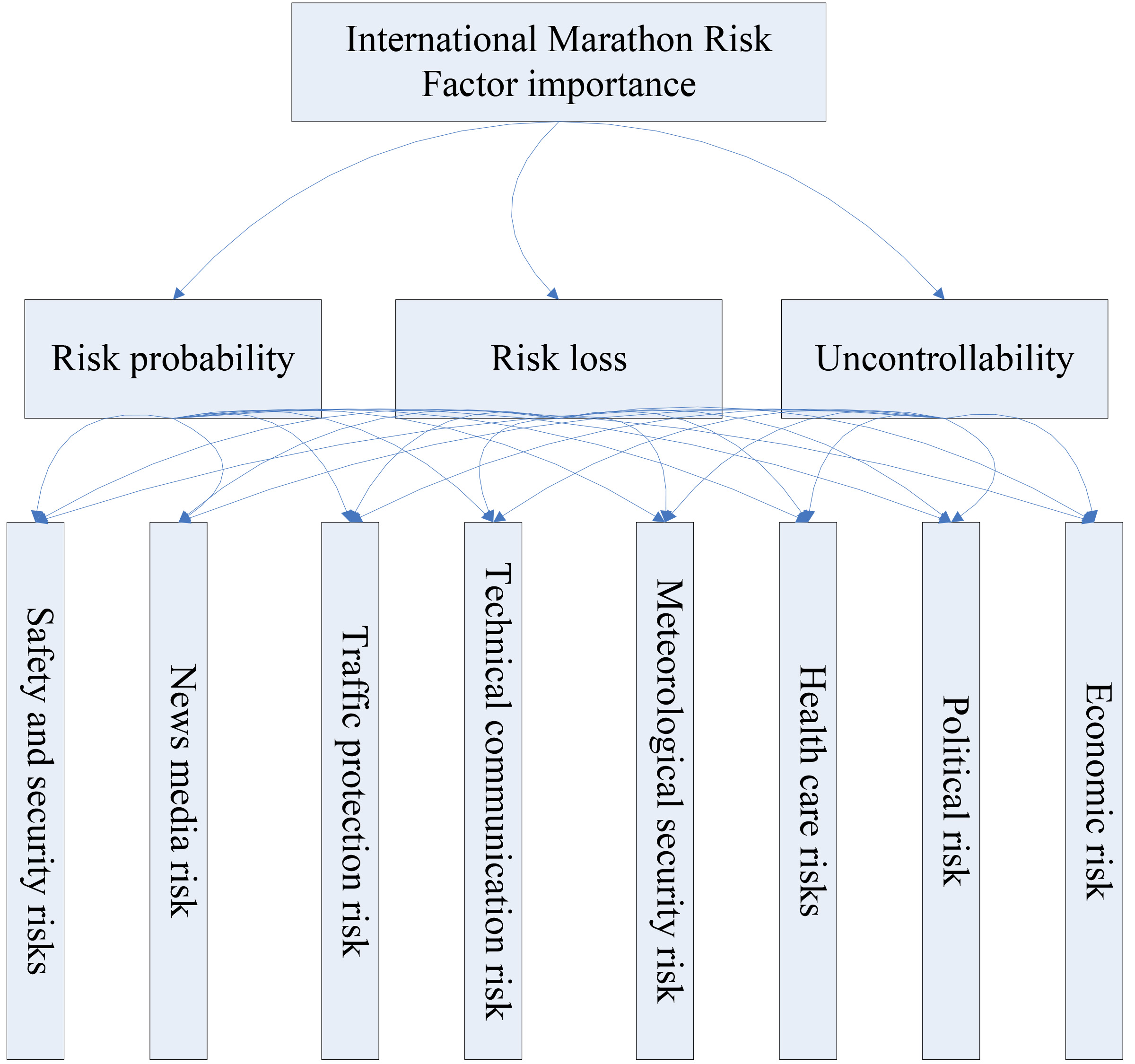
According to the hierarchical analysis structure of the risk factors of international marathon in Fig. 4, 10 experts and scholars were surveyed and interviewed, and the 1–9 scale method was used to obtain the matrix. When solving the fuzzy judgment matrix and hierarchical sorting, the data is processed by the mathematical software Matlab7.10.0, and the calculation module is obtained. The eigenvectors and the largest eigenvalues of the fuzzy judgment matrix and their corresponding weights are calculated, and the consistency index CI and the consistency ratio CR are calculated to check whether they are consistent.
In the matrix given in Fig. 5, the maximum eigenvalue can be calculated by mathematical software, and the consistency index can be calculated by using the formula:
Then, the consistency ratio CR
Matrix between risk probability B1 and primary risk factor C and its weight
A-B fuzzy judgment matrix and weight.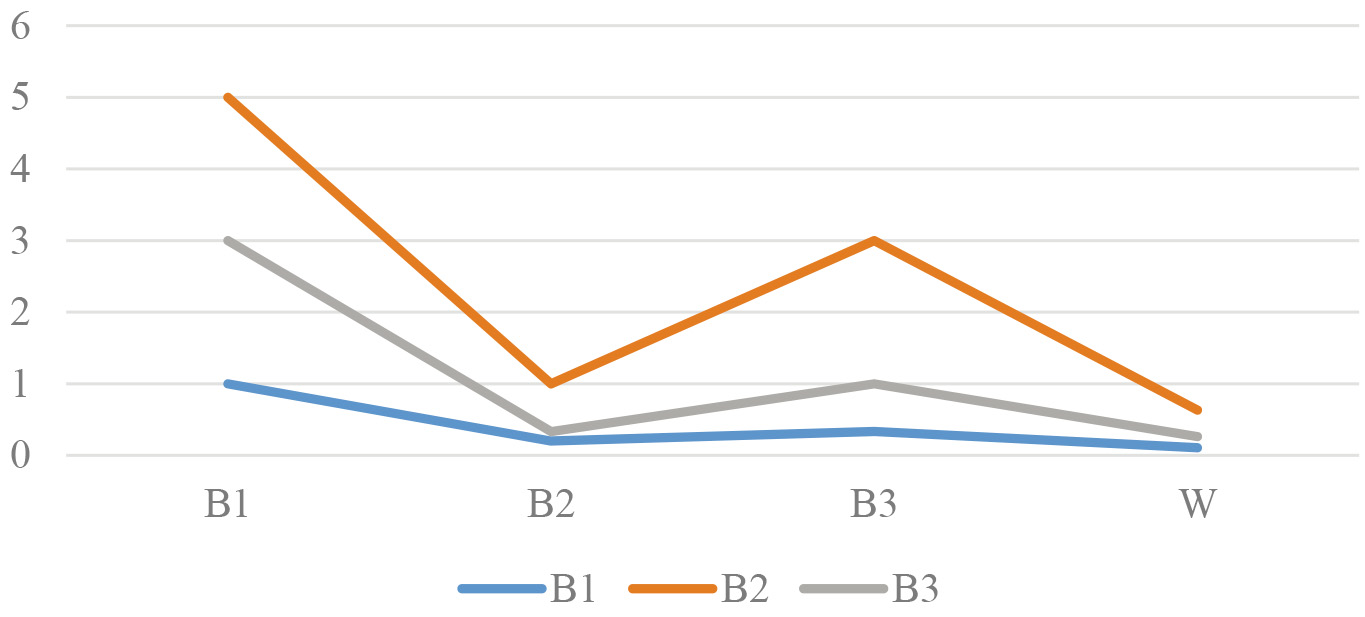
In the matrix given in Table 7, the maximum eigenvalue can be calculated by mathematical software, and the consistency index can be calculated by using the formula:
Then the consistency ratio CR
Obtain the fuzzy matrix between risk loss b2 and risk loss b3 and first – level risk factor c, as shown in Tables 8 and 9.
Matrix between risk loss B2 and primary risk factor C and its weight
In the matrix given in Table 8, the maximum eigenvalue
Then the consistency ratio CR
Matrix between risk loss B3 and primary risk factor C and its weight
In the matrix given in Table 9, the maximum eigenvalue
Then, the consistency ratio CR
In Fig. 4, the ranking of standard layer B relative to target layer A is actually the result of the overall ranking. The importance of the first – level risk factor C layer to the B layer is shown in Fig. 6.
Primary risk factor C-level importance ranking.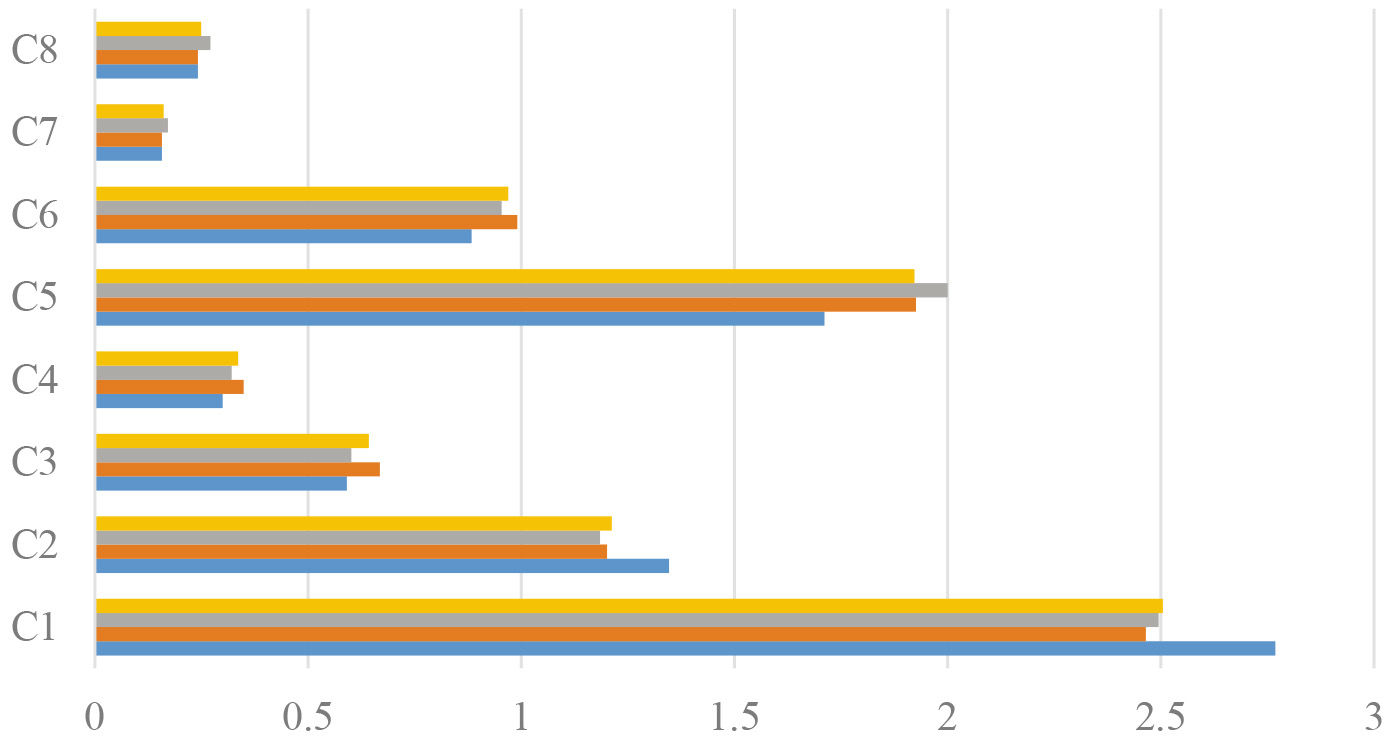
The calculation of the weight of the i-th factor of the C-layer to the total target requires the use of a formula:
In order to calculate the importance of the C layer, as shown in the above table, according to the different weights of the B-layer criteria, the order of importance of the first-level risk factor C is formed. It can be seen from the table that the main risks of the international marathon are still very important in the C1 safety category, the C5 level meteorological support category, and the C2 news media category. The last category is political and economic risk. Judging from China’s current stable social and economic environment, it does not constitute a key factor affecting the international marathon, but it still needs to pay attention to these risks.
As the development of sports events, especially large-scale sports events, has become the core of the commercialization and marketization of the sports industry. However, in the process of commercialization and marketization, risks may occur at any time, and risks are invisible and ruthless. Based on this, it is necessary to deeply analyze the risk types of large-scale sports events and correctly evaluate the risk, so as to better prevent and avoid the risk and establish an effective risk early warning mechanism.
Based on the above analysis, this paper, to deeply analyze the risk factors that may occur in the process of large-scale sports events. Following the basic principles of objectivity, fairness, feasibility and scientificity, combined with the methods and theories of risk assessment, and the theoretical content of fuzzy analytic hierarchy process is introduced in detail, and according to the theory of fuzzy analytic hierarchy process, the risk evaluation model of large-scale sports events is established. And the hierarchical analysis structure model of risk factors of sports events is established on the basis of identifying the risk factors of sports events. It can be concluded that the FAHP method can more effectively identify the main factors of event risk compared with traditional methods.
Footnotes
Acknowledgments
This work was supported by Anhui Soft Science Foundation Project (NO. 201806a02020043).