



Abstract
The engineering project warehouse can combine various sensor devices and smart devices under the Internet of Things technology to realize the convenient management of the warehouse. The Internet of Things technology combined with the machine learning model can make various industries transform to intelligence. The use of IoT technology and machine learning models for warehouse management can achieve an unattended warehouse effect. The Internet of Things has gradually developed into the intelligent technology that attracts the most attention in various industries with the advancement of electronic components required by various sensors. Combining various sensor devices and smart devices under the Internet of Things technology to achieve convenient management of warehouses, its intelligent management of warehouse security, environment, fire protection, energy consumption, etc. can save a lot of manpower and material resources, and improve the project warehouse, Utilization of supplies. Machine learning technology is a new type of computer self-learning technology produced along with artificial intelligence technology, which can combine the corresponding algorithm and the definition of the developer to realize the learning of the defined transaction. Because the way of this operation is similar to the human learning ability, machine learning Warehouse management for engineering projects will maximize the unattended effect of the warehouse. The research adopts a combination of questionnaire survey and modeling analysis. At first, analyzes the current demand points of engineering project warehouse management in various industries through a questionnaire survey, and designs the Internet of Things auxiliary scheme for engineering project warehouse management according to the demand points. The IoT-assisted machine learning model compares the IoT engineering project warehouse management solution without machine learning model with the IoT engineering project warehouse management solution with machine learning. It is found that the solution with machine learning model can effectively improve the engineering project warehouse management. abilities in all aspects including the effective utilization rate of necessities, manpower saving and safety accident control, which proves that the research has high use value.
Introduction
Project warehouse management
Warehouse management of engineering projects usually refers to the storage and management of necessities during operations in construction, communications and other industries. Usually engineering projects represent a large amount of construction, which involves a lot of operating equipment, requiring larger warehouses to store engineering project equipment, materials, materials and various necessities. Engineering means new development, and it often operates in harsh environments [1, 2]. The management of engineering project warehouses will also involve issues such as security, environment, fire protection, energy consumption, and efficient recycling of necessities inside the warehouse. Traditional engineering projects warehouse management will arrange older engineers as warehouse administrators for independent management, but in fact, warehouse management personnel are only required to operate during warehouse necessities scheduling and warehouse security inspections [3, 4, 5]. Warehouse management personnel are idle most of the time and arrange management. Personnel on duty 24 hours a day is not good for the health of warehouse managers, and it also wastes labor costs. There are the following problems in the warehouse of the traditional manual management mode: (1) The inventory quantity cannot be updated in real time, and it is inconvenient to control the goods; (2) It consumes a lot of labor costs, high management costs, and is prone to errors; (3) It is impossible to finely manage a large number of goods; (4) The warehousing and warehousing operations are done manually, and the efficiency is low, and the goods cannot be put in and out of the warehouse quickly. Therefore, the trend of intelligent management of engineering project warehouses will accelerate. The agency predicts that the trend of intelligent management of engineering project warehouses will accelerate in the future. The specific situation is shown in Fig. 1.
Intelligentization of project warehouse management.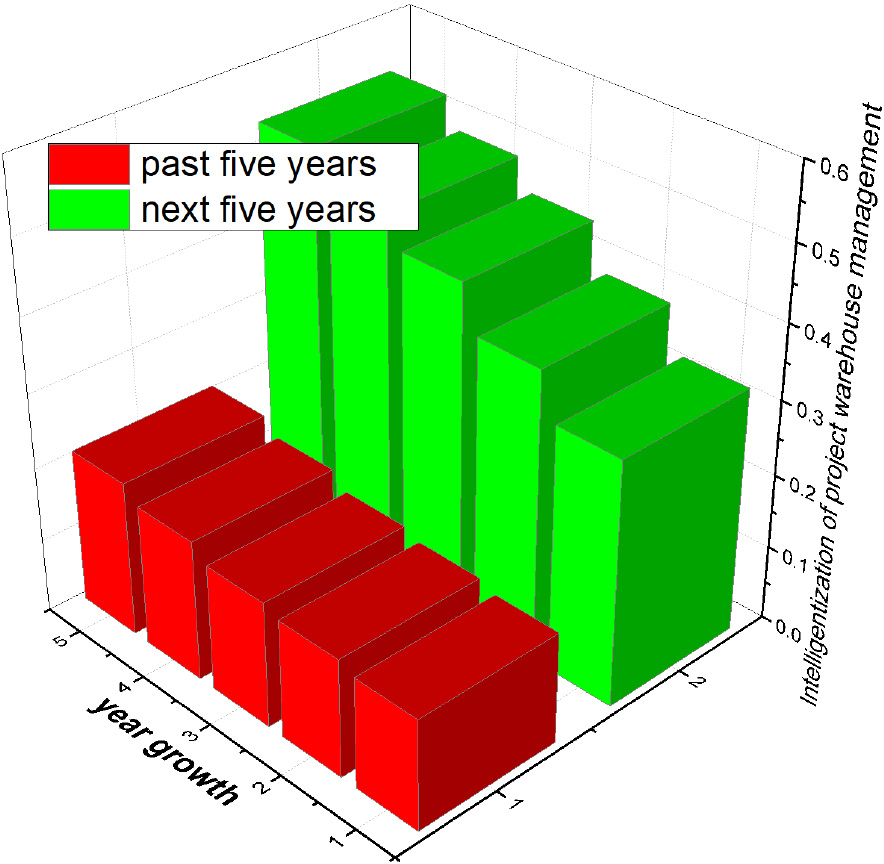
According to Fig. 1, the degree of functionalization of warehouse management is increasing year by year. At the same time, Fig. 1 shows that the degree of intelligence in warehouse management will increase year by year in the next five years. And the rate of increase will be significantly higher than in previous years.
IIoT, known as the Industrial Internet of Things, is part of a larger concept of the Internet of Things (IoT). IIoT will achieve the manufacturing revolution more effectively than before by acquiring and accessing more data at a higher speed [6, 7]. IIoT can greatly improve the connectivity, efficiency, scalability, and save time and cost of industrial organizations. Due to predictive maintenance, improved security and other operational efficiencies, the company has benefited from IIoT through cost savings. The IIoT smart device network enables industrial organizations to break the data island and connect all personnel, data and processes from the factory floor to the executive office [8, 9]. Business leaders can use IIoT data to fully and accurately understand how the enterprise operates, so as to help them make better decisions.
Machine learning models
As a key branch of artificial intelligence technology, machine learning provides key algorithms in the fields of clustering, classification, and prediction. Machine learning is another way of thinking about artificial intelligence, which can provide various algorithms. Similar to support vector machines, analogy learning, machine learning, deductive learning, and inductive learning. Machine learning means that the computer does not refer to specific codes and data to perform all actions. It allows the executor to enter a specific project to learn, but according to the initial set of basic code, the executor continues to improve the processing power, so as to be infinitely close to the truth human behaviour [10]. When we examine machine learning problems, we basically start with three areas of performance improvement: feature design, parameter optimization, and model selection. With the improvement of the computing power of key chips and the emergence of big data, the application of machine learning is becoming more and more extensive. Machine learning techniques have become part of our daily lives. Applying machine learning to project warehouse management can effectively improve the efficiency of project warehouse management and reduce the cost of manual operations [11, 12]. Institutional forecasting machine learning model usage rates are shown in Fig. 2. Machine learning is another important research field of artificial intelligence application after expert system. Existing computer systems and artificial intelligence systems have very limited learning capabilities at most, so they cannot meet the new requirements of technology and production. The discussion of machine learning and the progress of machine learning research will surely promote the further development of artificial intelligence and the entire science and technology.
Machine learning model usage.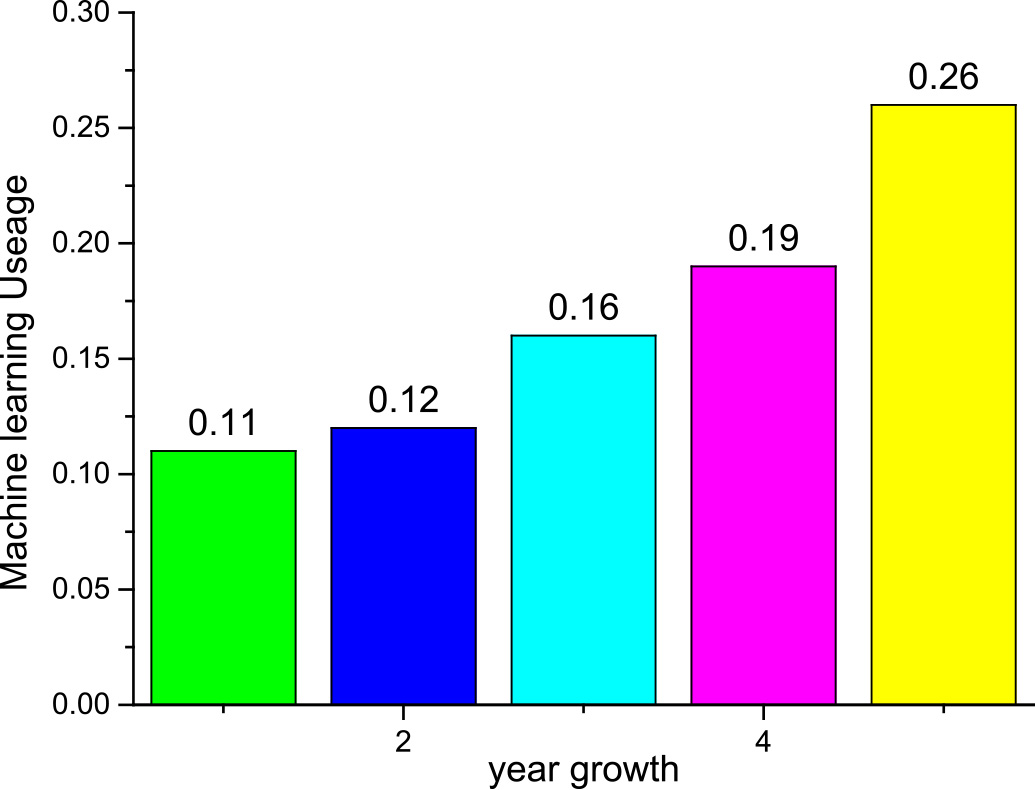
It can be seen from Fig. 2 that the usage rate of machine learning models is increasing year by year, which are 0.26, 0.19, 0.16, 0.12, and 0.11 respectively. Although the growth rate of machine learning model usage rates has decreased, the usage rates of machine learning models are still increasing year by year.
In order to design effective machine learning and IoT solutions to facilitate the management of engineering project warehouses, it is first necessary to investigate the current situation of engineering project warehouse management. The main survey industries are the projects of engineering companies such as construction and communication construction, and the actual survey objects are 35 project managers of construction and communication companies. 70 questionnaires were distributed, and the effective recovery rate reached 100%. The content of the investigation mainly involves the technical use of the current engineering project warehouse management, the objects on duty, the security management plan, the fire management plan and the effective utilization of the necessities in the warehouse [13, 14]. Among them, the technical usage of engineering project warehouse management is related to the management efficiency of the warehouse and the intelligence level of the warehouse.
Technical usage of warehouse management in engineering projects
Technical usage of warehouse management in engineering projects
Table 1 shows that in the process of warehouse management at this stage, the utilization rate of big data technology is relatively low. The on-duty objects of project warehouse management can display the intelligence level of the warehouse from the side. In order to determine the current on-duty objects of each factory project warehouse management in detail and their corresponding proportions, a detailed investigation of the on-duty status of each project was conducted this time, and the data are shown in Table 2.
On-duty objects of project warehouse management
Table 2 shows that in the process of warehouse management at this stage, most warehouses still adopt the manual management mode. Safety is the key element of all engineering projects, and security is the key to warehouse management of each engineering project. The purpose of arranging warehouse administrators to be on duty is to realize the security of the warehouse, and deal with specific affairs in case of abnormal situations [15]. The data collected in this survey on warehouse security management of each project are shown in Table 3.
Project warehouse security management
It can be seen from Table 3 that in the process of warehouse management at this stage, some large warehouses have adopted certain scientific and technological monitoring methods, while the monitoring methods of small warehouses are still relatively traditional. Fire management involves the long-term existence of building facilities, as well as the safety of people and property around the building. The fire protection management of the project warehouse includes various types, among which the fire protection management of the project warehouse involved in this questionnaire is shown in Table 4.
Fire management of project warehouse
It can be seen from Table 4 that in the process of warehouse management at this stage, the importance of fire management is generally low. The effective use of necessities in the warehouse can maximize the resource utilization of engineering enterprises. For example, some enterprises may have multiple branches, and the engineering projects of branch companies may also have poor geographical conditions. Suppose that branch A particularly needs branch B. C necessities in the warehouse to complete the project. However, the C necessities in the engineering project warehouse of branch B have been in an idle state. At this time, if the idle state of C necessities can be obtained through the management of the engineering project warehouse of branch B and disclosed within the company, the enterprise will be more effective. resources, reduce the repeated purchase of materials, and make various projects within the enterprise go more smoothly [16, 17, 18]. The survey data on the effective use of necessities in the project warehouse is shown in Table 5.
Effective utilization of necessities in project warehouses
It can be seen from Table 5 that in the process of warehouse management at this stage, the effective utilization rate of various items has a lot of room for improvement.
With the gradual popularization of concepts such as intelligent manufacturing 4.0 in various industries, the warehouse management of various traditional engineering projects is developing in the direction of intelligence. The characteristics of high speed, ultra-low latency, ultra-reliable connection and ultra-large-scale connection defined by 5G technology meet the demand for network transmission speed in the intelligent transformation of engineering project warehouse management. Important functions such as optical fiber connection, enhanced fixed bandwidth, and reliability assurance are also the key to realizing the intelligent transformation of project warehouse management [19, 20]. Cloud services have become the first choice for back-end data storage and support of various system platforms due to their easy hosting and distributed access features. At present, the intelligent construction direction of warehouse management in engineering projects in China is mainly to build an information collection system combined with RFID, and combine the corresponding reader of RFID to transmit warehouse data and warehouse out information to the background system for management [21]. In addition, there is also an IoT gateway system that uses the OPC standard of Modbus/TCP to realize data communication to realize intelligent on-site and remote monitoring of engineering project warehouse management. Complete product handling and assembly line operations in the warehouse, but because robots process data, the network transmission rate is high, and most warehouse networks still rely on GPON/EPON and other technologies for transmission, resulting in high latency, which cannot meet production intelligence. Some factories use 5G network to improve the network speed of the factory area, but the coverage of a 5G base station is only less than 300 meters, and the full network coverage in the warehouse cannot be guaranteed without the cooperation of wired transmission technology, and the management system of each project warehouse [22]. The traditional IT management system is still used, and it is impossible to check the warehousing status of necessities, the number of people on site, the location, the operating status of machinery and equipment, and the automatic identification of hazards through the project warehouse management system. Foreign countries have always attached more importance to the research related to warehouse intelligence. After Germany proposed the concept of intelligent manufacturing 4.0 earlier, European and American countries have been able to realize the intelligent operation of warehouses through technologies such as the Internet of Things, artificial intelligence and cloud. In recent years, combined with 5G technology, the smart warehouse intelligent control system developed abroad has been able to achieve 720 hours of unattended operation. Staff only need to use its smart warehouse platform to check the production status of the factories under the jurisdiction of the company. The warehouse can also realize automatic alarm and automatic operation and maintenance [23]. From a narrow sense, it is the management and profitability of individual enterprises, and in a broad sense, it is a problem of the competitiveness of different countries’ production and economic directions. In view of the development speed of foreign smart warehouses and the difficulties encountered by domestic smart warehouses, in order to improve the warehouse management efficiency of various engineering projects in my country, it has become the current trend to develop a smart factory management system combined with IoT technology. Through the comprehensive analysis of the situation obtained by the questionnaire, the intelligent management of the IoT information of the project warehouse management can be realized by combining 5G
The IoT auxiliary solution for project warehouse management can help staff to check the production situation of the factories under the jurisdiction of the enterprise, and some warehouses can also realize automatic alarm and automatic operation and maintenance, improve the warehouse management efficiency of various engineering projects in China, and realize the fire management of warehouses. Project warehouse management can improve the efficiency of warehouse management, save human resources, and promote the development of enterprises.
Although engineering project management has achieved certain results at this stage, it has realized the automation of warehouse management and greatly improved the efficiency of warehouse management. However, at this stage, my country’s engineering project management is not intelligent enough. Although the warehouse is informatized, the analysis ability and decision-making ability of the engineering system are not enough.
IoT-assisted machine learning model for engineering project warehouse management
The main algorithms of machine learning algorithms include decision tree algorithm, naive Bayesian algorithm, and random forest algorithm. These algorithms have great benefits in informatization problems of engineering project management and intelligent decision-making problems. Machine learning plays an important role in promoting the development of engineering project management and the development of enterprises.
With the help of the well-established project warehouse management scheme assisted by the Internet of Things, adding machine learning can further solve the problem of effective utilization of the project necessities involved in the questionnaire, and can also realize the security and fire protection of project warehouse management by training computers. And the operation of the on-duty mode, and the current machine learning technology can identify the possible risks of the warehouse by learning the temperature, smoke concentration, vehicle entry and exit and other abnormal data obtained by the sensing equipment, and even the necessary maintenance of the necessities in the warehouse situation is predicted [24, 25]. In addition, it can also intelligently classify the engineering necessities that enter the warehouse, and can also optimize the storage and transportation process of engineering projects through device correlation analysis, graphic recognition and other capabilities.
Bayesian network is a kind of machine learning, and engineering project management involves complex decision-making problems and various influencing factors, and the successful identification of influencing factors is an important basis for effective warehouse management. Through the previous investigation, it was found that the influencing factors of engineering project warehouse management are mainly technology, environment, personnel and necessary supplies. Bayesian network designed the above influencing factors as its network nodes. By reading a number of engineering project warehouse management emergencies and cases, set the node scoring rules of the Bayesian network, and use the expert knowledge to score the SQL SERVER data storage path of the samples required by the Bayesian network, and combine the algorithm to self-learn the data, and use the learned ability to carry out engineering projects. The practical application of warehouse management to complete the real and valuable model construction. The specific model situation is shown in Eqs (1)–(5).
This model mainly uses the Yebes naive model. Given a sample data set D
The specific situation is shown in Fig. 3.
Effective utilization of warehouse necessities.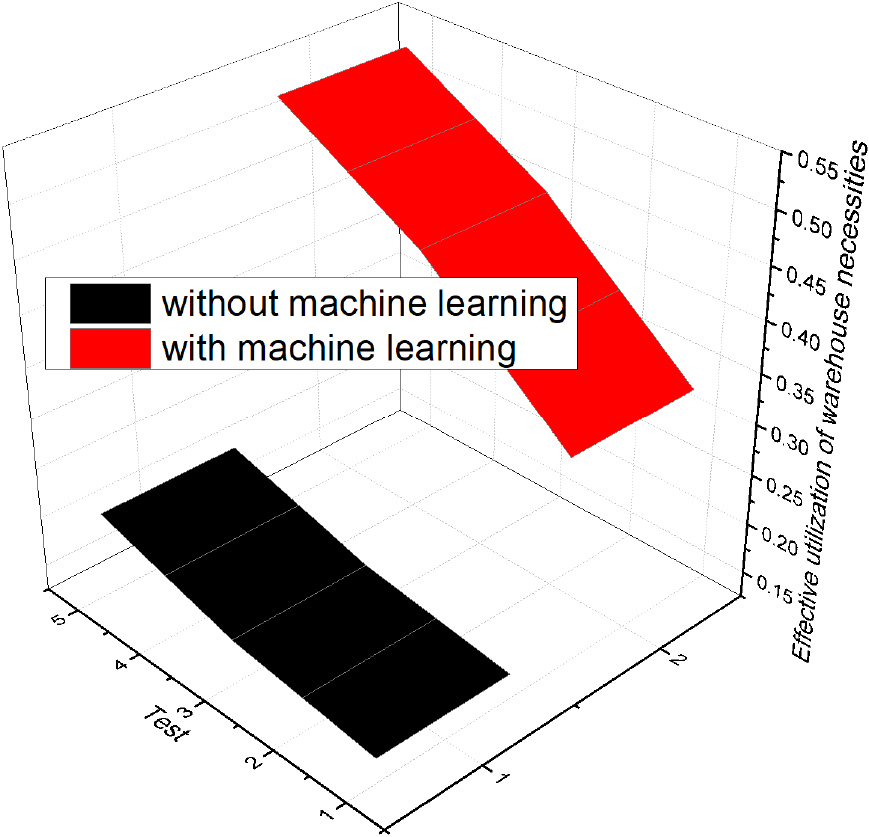
Comparison of labor cost input.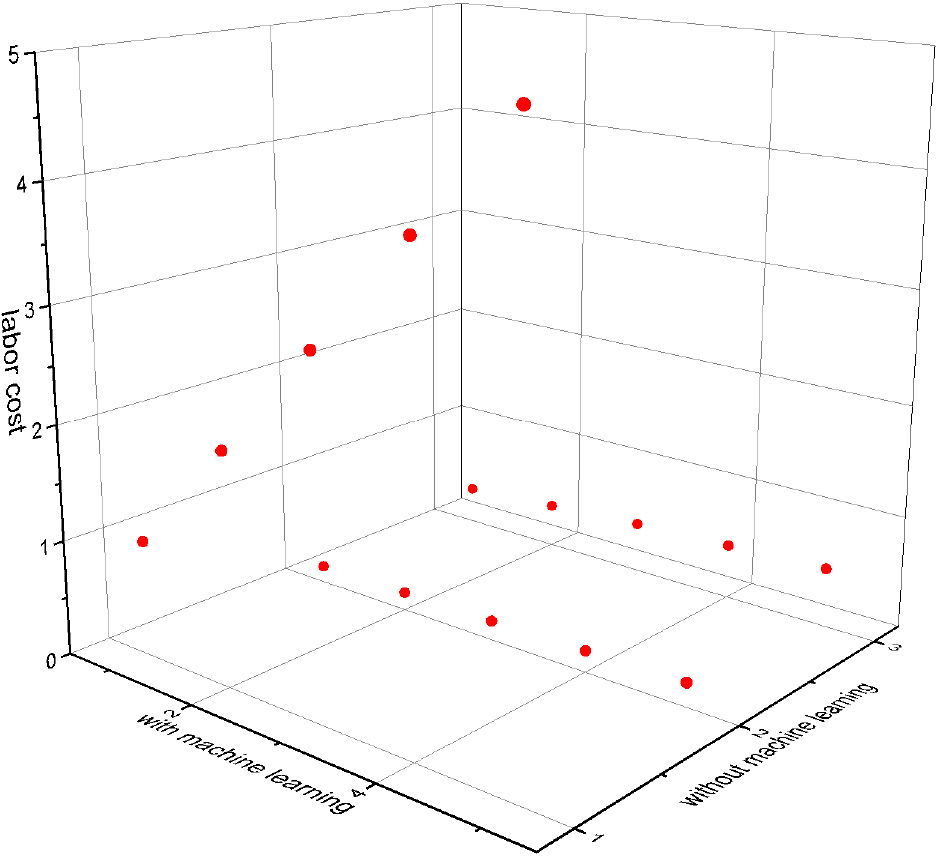
As can be seen from Fig. 3, after the introduction of data management, the effect of warehouse necessities management has been greatly improved. The Bayesian network itself is an uncertain causal relationship model, which visualizes the multi-knowledge diagram, and appropriately contains the causal relationship and conditional correlation between network node variables. Bayesian network has a strong ability to deal with uncertain problems. It expresses the correlation between various information elements with conditional probability, and can carry out knowledge learning and reasoning under limited, incomplete and uncertain information conditions. Bayesian network can effectively express and fuse multi-source information, and can incorporate various information related to fault diagnosis and maintenance decision into the network structure, and process it in a unified manner according to the node.
Combined with the machine learning technology of the Bayesian network type, the warehouse management of engineering projects can basically achieve an unattended state. Compared with the labor cost input without the machine learning model, as Fig. 4 shows.
It can be seen from Fig. 4 that after the introduction of IoT technology and machine learning technology, the incidence of warehouse security incidents has been significantly reduced. It can be seen that the intelligent project-oriented warehouse management mode plays a great role in improving warehouse safety and improving the efficiency of warehouse management, and can also promote the development of warehouse intelligent management mode. Combined with the machine learning technology of the Bayesian network type, the warehouse management of engineering projects is truly manageable and controllable, and the probability of safety accidents is greatly reduced. The specific situation is shown in Fig. 4.
With the rapid development of electronic components and data science and technology, IoT technology has gradually entered the lives of citizens. The concept of the Internet of Everything is no longer empty talk, and smart homes have become a must-have smart device for most homes. The Internet of Things is mainly based on devices such as sensors and electronic tags, and uses the communication protocol arranged by the International Telecommunication Union to connect different types of objects to achieve intelligent identification, positioning, tracking, monitoring and management. An item interconnection scheme. The Internet of Things technology has been widely used in various factories and buildings, and it has relatively mature experience in the management of engineering project warehouses. Machine learning means that the computer does not refer to specific codes and data to perform all actions. It allows the executor to enter a specific project to learn, but according to the initial set of basic codes, the executor continues to improve the processing power, so that the final wireless is close to reality. Engineering companies can use machine learning technology to improve the forecasting and management capabilities of engineering project warehouse work, and reduce the workload of engineering project warehouse managers. In order to design effective machine learning and Internet of Things solutions to facilitate the management of engineering project warehouses, this paper first analyzes the current demand points of engineering project warehouse management in various industries through questionnaires, and designs the Internet of Things assistance for engineering project warehouse management according to the demand points. Then, combined with the continuous learning ability of machine learning, an IoT-assisted machine learning model for engineering project warehouse management was designed. Through the IoT engineering project warehouse management scheme without machine learning model and the IoT engineering project warehouse with machine learning. By comparing the management schemes, it is found that the scheme containing the machine learning model can effectively improve the ability of engineering project warehouse management in all aspects.
The advantage of this article is to build a model based on the Internet of Things technology and machine learning model, which can improve the management efficiency of warehouse management and reduce the cost of human and material resources. However, this article lacks core data support, and the model part of the article needs to be further improved.
The innovation of this article lies in the integration of IoT technology and machine learning technology into project engineering management. The topic of the article is very novel. The innovation of the article is to combine the Yebes model with the Internet model. The future development direction of the article is to deeply apply the machine learning model to engineering project management, further promote the intelligent development of engineering project management, improve the efficiency of warehouse management, and promote the development of enterprises.