



Abstract
With the rapid development of 5G sensors, the development of low cost, low power consumption, and miniaturization is also constantly progressing, and 5G sensor networks have achieved great development. Node positioning technology is an important support for 5G sensors, so it has been a hot research direction in recent years. This article has carried on the basic discussion to the speech broadcasting technology, and introduced the speech broadcasting coding in many aspects, including the development history, the current situation and the compression coding algorithm. This article has launched a basic analysis and discussion on the voice broadcast algorithm, such as its basic principles and classification. In order to minimize the property losses and casualties caused by urban fires and improve the efficiency and success rate of urban fire emergency systems, it is necessary to be able to query fire information in a timely and effective manner and formulate emergency protection. As we all know, China’s current economic development is in a period of steady improvement, and the process of urbanization is gradually accelerating, especially the number of high-rise and super high-rise buildings has increased significantly. Therefore, once a city fire occurs, it will not only cause huge losses of property, but also may cause a large number of casualties. Although the current fire protection system in Chinese cities is relatively complete, there are still some problems that have not been resolved in actual work, such as insufficient technical equipment and insufficient response speed in some areas due to economic constraints. Therefore, it is very necessary to establish an efficient urban fire emergency information system, not only to be able to query fire information in a timely and effective manner, but also to be able to formulate emergency support plans for specific actual situations.
Introduction
Great achievements have been made in the field of urban fire emergency system broadcast, but the research in this field is mostly theoretical research and lack of practice. Based on the voice broadcast technology of 5G sensor, this paper constructs relevant models and implements the theory, which plays a great role in the development of urban fire system.
In order to minimize the property losses and casualties caused by urban fires, improve the efficiency and success rate of the operation of urban fire emergency systems, timely and effective query of fire information, but also to be able to develop emergency protection. The iterative speed of mobile networks has accelerated significantly in the past 20 years. The upgrade of mobile networks has given birth to new application modes, such as live video, online meetings, online diagnosis and treatment, and short videos. New applications have brought about explosive growth in the amount of mobile business data. However, network resources are limited, so the demand for air interface technology with higher spectrum utilization has become increasingly urgent [1]. The widespread application of the Internet of Things means a massive increase in the number of terminals [2]. By then, the network resources that are already stretched will face greater pressure. Therefore, in order to meet the needs of the deployment of 5G sensor networks in the Internet of Things, it is necessary to use the air with higher spectrum utilization [3]. Interface technology. With the development and progress of the times and the emergence of voice chips, voice reporting has been widely used in many industries and fields, such as station announcements, bank queue machines, etc., and has begun to be extended to families and individuals, and it is becoming more and more humane [4]. Automatic voice broadcast prompt is a regenerative synthesis technology. With the development of large-scale voice broadcast processing integrated circuits, this technology has also begun to be popularized in the traditional control field [5]. Although current communication and information technology have achieved unprecedented development, voice broadcast communication is still one of the main ways of information exchange. People are the main carrier of information, not only producing information, but also acquiring information, and the communication technology used is mainly voice broadcasting [6]. The development of electronic technology is to realize the transformation from ordinary sound signals to electrical signals, and the symbol of the development of the digital age is the digital processing of voice broadcast signals. Such processing makes the storage and transmission of signals more convenient [7]. It can be seen that compression coding technology has very important value, not only in the transmission of voice broadcasts, but also in the storage of numbers. The current urbanization process is gradually accelerating, which brings about increasingly complex urban management problems, and more factors that may cause fires appear, so urban fire emergency response needs to do more work to deal with sudden fires problem [8]. Therefore, the urban fire emergency information system came into being. This system is a new technology that combines geographic information system technology to achieve the goal of improving the level and ability of fire fighting. Generally speaking, it is a comprehensive application of multi-disciplinary and technological software through computer software and hardware, including software engineering, urban geography, and spatial positioning technology [9]. The function of the system is relatively comprehensive, not only can improve the command and decision-making level of the fire department, but also contribute to the improvement of the overall combat capability, and it can also make a faster response in the event of a fire emergency [10].
There are also many problems in traditional fire protection, mainly reflected in the lack of management, large hardware consumption and poor signal penetration. Therefore, in the event of a fire, many people have suffered greater economic losses and seriously threatened people’s lives and health. Based on this, urban fire emergency information system came into being.
Voice broadcast has the following problems in the application of emergency fire protection system: In a single 4G network environment, 4G link can not guarantee the quality of voice, video, data transmission, there may be signal loss, packet loss and so on. Poor network environment, including poor disaster site signal, lack of network coverage, network congestion. Under 4G single-link video transmission, video delay, jam and black screen may occur, which seriously affects the judgment of commanders and the implementation of decision-making. In order to improve these problems, 5G sensors should be used as the technical background to promote the development of emergency fire protection systems.
Related work
The literature designs the urban fire protection information system and realizes multi-functional management, mainly to realize the efficient management of basic geographic and fire protection information, that is, to add, modify and delete [11]. In the event of a sudden fire accident, you can accurately locate the fire location through this system, and quickly grasp the surrounding situation of the fire place and fire control configuration information, so that you can quickly deploy the firefighting team, equipment, etc., and formulate an effective emergency response the plan realizes the optimal allocation of resources and avoids the loss of life and property to the greatest extent [12]. The literature pointed out that the design of traditional wireless data transmission products needs to be restricted by many factors, not only need to master certain radio expertise, but also must be equipped with expensive professional equipment, so there are unavoidable problems such as cumbersome circuits and difficult debugging [13]. ARM is a microprocessor, which has been widely developed and applied. Among them, ARM7, ARM9, ARM9E and ARM10E are four general-purpose processor series, each of which provides a relatively unique set of performance to meet the needs of different application fields. ARM9 microprocessor has become the mainstream of embedded system development. Which not only leads to the reduction of user satisfaction, but also slows down the development of new products [14]. This paper points out a new method based on ARM9 and KH-WKTKIE-465PV modules, which can realize short-distance voice broadcast, because it has obvious advantages in design, including low transmitting power, high receiving sensitivity, etc., so it can meet the requirements of wireless control, and it does not require a license. It is a better choice for low-power wireless data transmission [15]. The literature first introduces the current development status of mobile 5G sensor networks, and then focuses on some key 5G technologies such as NOMA and Cache technologies [16]. Finally, it introduces the traditional MBMS network architecture and resource scheduling, and several of them are classics. Systematic analysis of resource scheduling schemes has been carried out, and the advantages and disadvantages of these schemes are explained through analysis and comparison [17]. At present, the traditional structured data has been transformed into more complex and diverse semi-structured and unstructured data, and the difficulty of data processing is increasing. In order to solve this problem, it is necessary to improve the efficiency and accuracy of fire processing information system. The literature shows the importance of urban data. The realization of urban fire emergency information system functions must be based on a large amount of data, not only to ensure the reasonable organization of the data, but also to have a reasonably designed database structure [18]. Only when these conditions are met can it be better. Realize the storage and management of urban fire safety information. The literature introduces that in the traditional information system of 5G sensor information, the storage and application of data only need to pass through the ordinary relational database, because it basically uses attribute data [19]. However, because of the emergence of DSS, the current development form has been changed, and it has been difficult to meet current actual needs only in the form of text tables [20]. The literature mainly explains the research, analysis and application of the urban fire emergency system. The urban fire emergency system often involves two terms: information and data [21]. There are differences in meaning between the two, that is, the urban fire emergency system is a representation of information. The fire emergency system information is the content of the data, and the urban fire emergency system data is the design and establishment of the information system [22]. Data and information are interrelated; data is a record of the attributes of objective things, is the concrete manifestation of information; data after processing, it becomes information, and information needs to be digitized into data in order to store and transmit; there is a close relationship between data and information, and an important factor in the design of page number information system.
5G network sensor algorithm and voice broadcast system
The sensor algorithm of 5G network
5G network architecture
This article introduces the basic transmission model of the cooperative multicast system. As shown in Fig. 1, in the first stage, the edge users in the multicast group are usually far away from the base station, and the received SINR is lower due to the large fading experienced by them. The signal cannot be successfully demodulated, but the repeater can generally receive the signal successfully.
Two-stage cooperative multicast model.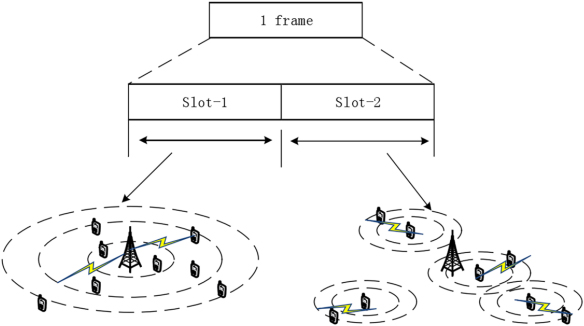
The received SINR of the central user
The access rate of the central user
That is, the outage probability of the center user
The access rate of the repeater station is shown in Eq. (4):
The channel capacity is generally greater than the base station’s signal transmission rate threshold.
In the second stage, the multicast signal sent by the base station in the first stage is relayed to compensate the edge users in the multicast group.
The access rate of high-edge users.
The SINR of the relay transmission signal received by the edge user
Edge users can also use Maximum Ratio Combining (MRC) technology to decode multicast data. SINR and access rate are shown in Eqs (6) and (7):
In the second stage, the outage probability of the edge user
It can be seen that the cooperative multicast mode can significantly increase the channel capacity of edge users, thereby increasing the throughput of the multicast group while improving user fairness among users in the group.
The network node algorithm has the following advantages. A testnet node needs to synchronize and store less data, about 10 GB, depending on the network. A testnet node can typically be fully synchronized within a few hours. Deploy a contract or trade just by sending a test ether, available for free from ‘tap’. The test network is a public blockchain with many other users and contracts running (different from private chains). It has important applications in the process of sensor positioning.
Schematic diagram of node positioning process in wireless sensor network.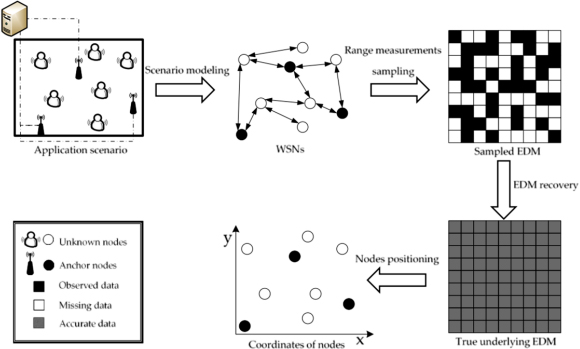
3.1.2.1. Sensor network node location algorithm
As shown in Fig. 2, in a typical application scenario,
Figure 2 shows the process of the node location algorithm proposed in this paper, which mainly involves two steps: EDM completion and node location. The first step is to use the RRMD model proposed in this article to estimate the missing distance measurement to obtain a complete and accurate EDM. This matrix is also called the potential true EDM. At the same time as this step is completed, the abnormal nodes have been detected; the second step is to locate the unknown node. Based on the estimated complete and accurate EDM, the MDS method is used to estimate the coordinates of each unknown node.
This paper still uses the classic EM method to optimize the solution of the proposed RRMD model, and let
Among them,
Calculate EDMD through Algorithm 1;
The singular value decomposition of
Calculate relative coordinates, as shown in Eq. (13):
Among them
Calculate the node coordinate transformation matrix
Calculate and output the coordinates of all unknown nodes, as shown in Eqs (15) and (16):
The equation can be rewritten, as shown in Eq. (17):
Then, the optimization of Eq. (17) can be realized by solving the three sub-problems.
Update
Obviously, as a typical weighted low-rank matrix factorization problem, there are many mature solutions.
Update
Where
Update
Where
Simulation parameter table
3.1.2.2. Experimental design and analysis
This paper selects the following four evaluation indicators to evaluate the performance of node localization algorithm, namely recovery error, node localization error, a recognition accuracy and the cumulative distribution of positioning error.
(1) Evaluation indicators
This article selects the following four evaluation indicators to evaluate the performance of the node location algorithm:
1) EDM recovery error, as shown in Eq. (21):
Where
2) Node positioning error, as shown in Eq. (22):
Where
3) The anomaly recognition accuracy rate, as shown in Eq. (23):
Among them,
Among them,
4) Cumulative distribution of positioning error, as shown in Eq. (26):
Sampling the EDM with different proportions, the four algorithm results obtained are shown in Fig. 3. In this application scenario, even if the sampling rate is high, the EDM recovery error and positioning error of the SVT-based algorithm and the OptSpace-based algorithm are still relatively large, which indicates that the two methods cannot handle complex noise well.
Performance comparison under scenario 2.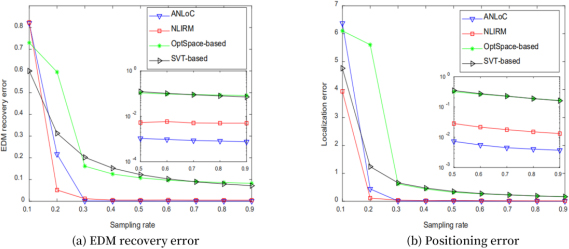
As shown in Fig. 4, when there is an abnormality in the EDM, the EDM recovery error and positioning error of the four algorithms increase. However, compared with the other three methods, ANLoC can achieve better performance at a lower sampling rate (0.2). In addition, ANLoC can also detect abnormal nodes. Specifically, Fig. 4 shows that when the sampling rate reaches 0.2, the recognition accuracy of abnormal nodes can reach 100%. Therefore, when some sensor nodes are abnormal, ANLoC has the best performance, which can accurately locate unknown nodes and detect abnormalities.
Performance comparison under scenario 3.
Figure 5 shows the cumulative distribution of the positioning errors of the four algorithms when the sampling rate is 0.5 in this application scenario. The probability that the positioning error of ANLoC is less than 0.5 is 98%, the probability of less than 1 is 100%, and the other three methods are all less than 30%. In addition, when the sampling rate is 0.5, the actual positions of all nodes in this scenario and the node positions estimated by the ANLoC algorithm.
Performance comparison under scenario 4.
All experimental results are shown in Fig. 6. Due to the influence of complex noise and anomalies, compared with the previous ideal scenario, the algorithm’s EDM recovery error and node positioning error are both reduced, but still at a lower level.
Regularization strategy experiment.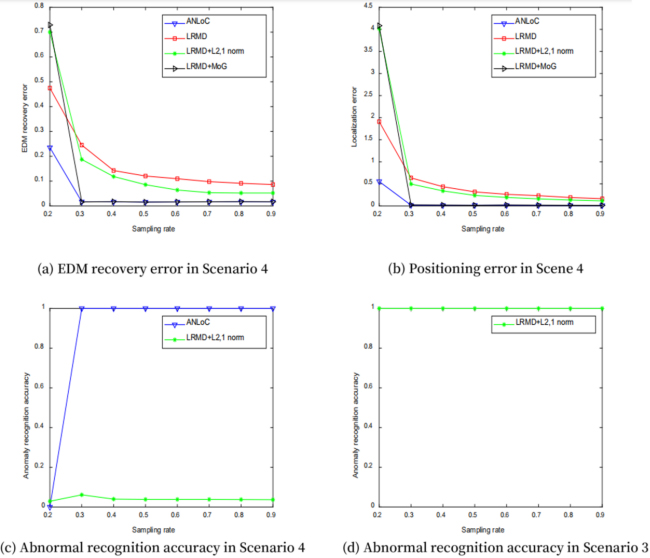
The sampled EDM matrix based on distance measurement will be very sparse, which causes the performance of the method proposed in this paper to deteriorate. To solve this problem, this paper proposes a large-scale positioning method. In order to facilitate the discussion, this article simplifies the application scenarios. As shown in Fig. 7.
(1) ARM system structure
Generally speaking, the working state of ARM microprocessor can be divided into Thumb and ARM, and it can also realize the free switching of different states:
(2) The storage format of ARM architecture can be divided into little-endian format and big-endian format. The difference between the two formats is that the storage locations of high byte and low byte are different.
(3) Generally speaking, the working mode of the processor can be summarized into 6 kinds, as shown in Table 2.
The processor model used by the CPU core module is AT91RM9200, and the specific parameters are shown in Table 3.
ARM processor operating mode table
ARM processor operating mode table
Large-scale positioning diagram.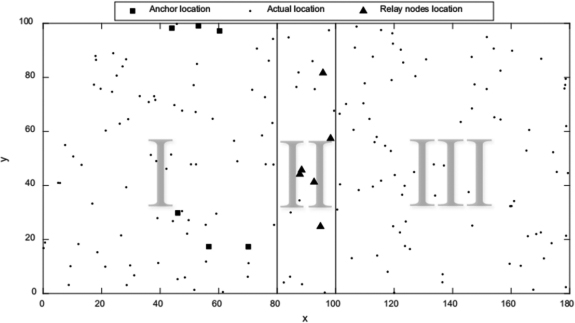
AT91RM9200 parameter table
Overall design of urban fire emergency system
At present, China’s socialist modernization process has gradually accelerated, and the fast economic development is synchronized is the expansion of urban scale. Therefore, the importance of fire security tasks is more obvious, and this work must also achieve scientific, reasonable, modernization. Because the urbanization process has accelerated, the number of high-level and ultra-high-rise buildings has also increased significantly. Once the fire will lead to huge losses, it has put forward higher requirements for the fire command center, especially in command decisions and scheduling. To achieve fast, accurate, efficient.
Traditional fire alarm processing is manual alarm, personnel, vehicle, and route scheduling is carried out in accordance with the experience of the police dispatcher. In general, the dispatcher must pass professional training before entering, master enough expertise, and the ability to process the emergency, and master the road conditions of the area. However, even if these conditions have these conditions, different scheduling people will have different processing methods for the same emergency, and the different ways of handling the same alarm schedule in different scenarios [23]. Therefore, it is necessary to make the operating efficiency of the fire protection, you need to innovate and improve traditional fire alarm, urban fire emergency information systems come to life, it is supported by computer software and hardware and multi-disciplines, multiple technologies Combination, including systemism, software engineering, urban geography, database technology, etc., this system can launch more scientific management and efficient integrated analysis.
Design goals of city fire emergency information system
Urban fire emergency information systems need to have many functions, such as fire alarm acceptance, navigation positioning, report output, etc., the main purpose of designing the system has the following aspects:
(1) Must be able to efficiently, accurately perform the scheduling and decision of firefighter work, eliminate fires in the shortest possible time, so that people’s live property is minimized.
(2) Must be able to efficiently, conveniently develop the management of firefighting files and the processing of daily firefighting, maximize work efficiency.
(3) You can release the related fire information, daily work, etc., realize the modernization and intelligence of fire protection.
Design principles of city fire emergency information system
In accordance with the actual urban fire command work needs, it is necessary to follow a variety of principles when designing the city fire emergency information system, including the following aspects.
(1) Advanced principle
At present, the linkage mechanism of China’s urban fire protection and other emergency rescue agencies is not mature enough, independence is obvious, including public security, health, etc., various emergency rescue agencies. Therefore, although the fire can support each other to some extent, there is no real-world sharing, and there is no best resource configuration. In general, in the design of the city fire emergency information system, we must consider many factors. Not only should refer to the current urban fire safety management situation, but also to see the future development trend, so that the system’s design is more scientific and advanced nature. In terms of technology, the system must be selected when designing the system to ensure that the design is more reasonable and advanced.
(2) Practical principle
Urban fire emergency information system is an actual application system, so it must have high efficiency, practicality not only has a big impact on the operation of the system, but also affects its vitality, so practicality is designed to design the system. The principle of unconditional follows. In response to system-based planning, it must be based on the actual situation. It is necessary to meet the current needs of the current users, and must also take into account the current data and device conditions to achieve the full use of saving investment and resources. The urban fire emergency information system is based on user needs, so it is necessary to analyze user needs. On this basis, the data is better, and the data information and function modules can eventually match more. Be sure to make a simple operation when designing, using the human computer dialog interface to increase the convenience of users.
(3) Reliability principle
Reliability is an important index to verify the effectiveness of urban fire emergency information system. The most basic requirement for applications is reliability. City fire emergency information system is no exception. The primary requirement is to ensure the reliability of information, strictly limit rights management, prevent data from being leaked, modified or destroyed by criminals, and must also back up the data.
(4) High efficiency principle
In the design of urban fire emergency information system, many factors must be considered, including technical services, maintenance capabilities, so that the development of the system can have both high performance and minimum failure rate. In the design, but also to ensure the dynamic development of data, system changes synchronized, so the database structure is open (excluding some basic database), database is conducive to the improvement and upgrading.
(5) Intelligent principle
The intelligent principle is an important principle to improve the efficiency and stability of the urban fire emergency information system, by optimizing the internal control procedures to achieve the purpose of intelligent.
According to the actual needs of urban fire command work, in the design of urban fire emergency information system need to follow a variety of principles, with reliability as the basic principle, with high efficiency and advanced as a necessary condition, in order to realize the intelligent as the goal, promote the urban fire emergency information system.
Database design of city fire emergency system
Urban fire emergency system database design process
Fire protection design is the basis of architectural design. Fire protection design refers to building fire protection design. In architectural design, the purpose of fire protection design is to adopt necessary technical measures and methods to prevent building fires, reduce building fires, and protect the personal and financial safety of the public. Fire protection design is necessary for any building project. In order to improve the efficiency and success rate of fire work, fire fighting system should be designed.
Making the Urban Fire Emergency Information System Design Apply Improved Neworleans Method, the safety planning and emergency database design process of the emergency database design process includes the following aspects:
(1) Demand analysis phase
Data: Data Dictionary, data stream, data storage description.
Processing: Description of Processing Process in Data Dictionary.
(2) Concept structure design phase
Data: concept model, e. R diagram, data dictionary.
Processing: System Manual.
(3) Logical structural design phase
Data: Select the data model, namely the relationship or non-relational model. In the logic design phase, try to make the database paradigm to reach the third paradigm, or even the fourth paradigm. To ensure the efficiency and stability of database operation.
Processing: System Structure Diagram.
(4) Database physical design phase
Data: Storage schedule, method selection, access path is established.
Process: Module Design IIPO Table.
(5) Database implementation phase
Data: Writing mode, load data, database trial operation.
Process: Program Coding, Compile Connection, Test.
(6) Database operation and maintenance phase
Data: Performance monitoring, dump and recovery, database reorganization and reconstruction.
Treatment: New and old system conversion, operation, maintenance.
In the design of the database to do: limit the number of indexes on each table, it is recommended that a single table index of not more than five each Innodb table must have a primary key, do not use frequently updated columns as the primary key, do not use multi-column primary key does not use UUID, MD5, HASH, String column as the primary key, the primary key is recommended to choose the use of self-increment ID value, the highest degree of differentiation of the column on the left side of the joint index, as far as possible to put the small field length of the column on the left side of the joint index, the most frequently used column on the left side of the joint index, improve the efficiency of table queries.
Database composition and data quality logical structure
The basic information data of the city can be divided into 4 parts, and the specific data structure is designed as follows:
(1) City basic information, as shown in Table 4.
City basic information field table
City basic information field table
(2) Traffic conditions
Basic traffic conditions include railways, roads, water transportation and shipping, and require the same field content, respectively, respectively, as a separate layer. The design field is shown in Table 5.
Traffic conditions field table
(3) Weather hydrology
Meteorological hydrological conditions should be carried out separately, and the specific field design is shown in Table 6, respectively.
Meteorological hydrological status field table
(4) Terrain features, geological features and geographic characteristics
The terrain, geological and geographic feature data required by the system do not require the design of the attribute field, and only the elements class is established. The basic information data required for fire safety can be divided into two, namely the basic scale of the city and the fire safety information.
5G technology breaks the ‘information island’, and intelligent firefighting can be better realized. As the cornerstone of intelligent fire protection construction, 5G is an indispensable connection technology for intelligent fire protection. The intelligent fire-fighting cloud platform adopts the Internet of Things technical means such as ‘sense, transmission, knowledge and use’, combined with 5G
The less the construction of the city fire emergency information system is, the higher the efficiency of the implementation of the fire emergency plan, and the urban fire emergency information system in the fire emergency system is in the center. The application of the system is conducive to operational mechanisms and advances, and the ability to improve, including predictive warning, high-efficiency and accurate reactions, comprehensive monitoring and monitoring of sudden fires. The system can not only be used in urban fire emergency management, but also can be applied in other fields, such as urban public safety comprehensive emergency command centers.
In general, the technical characteristics of the emergency information system have the following aspects:
(1) Designed and developed the corresponding urban basic geographic information system, implementing unified management of basic data, mainly including digital topographic, spatial attribute information, and place name. In addition, there is also a real-time map update performance.
(2) Efficient management of information on urban fire emergency resources, and to the library management of many related information, including dangerous sources, rescue power, surrounding environmental information, etc., can accommodate data from nearly 30 departments and institutions. Mainly the fire department, in addition to this, including public security, transportation, environmental protection and other relevant departments. At the same time, it also has data query and update performance, and more closely and spatial data can be combined to make a more precise space positioning.
(3) For the sudden fire events, comprehensive emergency plan management. Not only can I achieve classification entry and management of a textual emergency plan, but also to develop editing, modification, and storage. To a large extent, the digital process of urban fire emergency plans is largely deployed. Once a sudden fire event occurs, you can query and adjust the relevant information directly in the system’s emergency plan.
The system is composed of a basic information data system and internal complex procedures. From the perspective of advancement and efficiency, the intelligent fire protection system can not only improve the command and decision-making level of the fire department, but also help to improve the overall combat capability. In the event of an emergency, it can also make a faster response. The system uses a variety of models including fire prediction simulation and explosion analysis, which not only makes a prediction of the development trend of fire accidents, but also to research and analyze the loss of the explosion, and then combined with the geographic information system. Make more accurate maps, which is conducive to decision makers to accurately estimate the loss of fires that can be caused by fire, which is conducive to efficient deployment of rescue power.
City fire emergency system function
The core goal of the firefighting basic emergency information system is to monitor, predict, and dispose of some emergencies, such as fire, explosion, etc. to ensure the precision, rapid and efficient efficiency of these operations. The system’s function is not just a simple integration of emergency information, but a comprehensive monitoring, efficient plan optimization, etc., providing better support for dispatching decisions and accident disposal, whether in scientific levels, or technical level It is possible to achieve a significant increase in the technical content of fire emergency and improvement in emergency response, so that the capacity of emergencies such as fires, explosions, etc. are overall. The construction of fire information system can store accurate fire information, geographic information, rescue measures, etc., to help the system run faster and better. Making more accurate maps is helpful for decision makers to accurately estimate the possible fire losses caused by fires and is conducive to the efficient deployment of rescue forces.
City fire emergency function module and realization
The function of the system is more comprehensive, not only can improve the command and decision-making level of the fire department, but also help to improve the overall combat capability, in the event of emergencies can also make a faster response. Usually, urban fire emergency information systems can be divided into twelve functional modules, including system maintenance and management, information query and maintenance. The specific module is configured as shown in Fig. 8.
This system can realize comprehensive monitoring, efficient plan optimization, and improve the fluency of the system. In practical applications, it can minimize the property losses and casualties caused by urban fires, improve the efficiency and success rate of the operation of the urban fire emergency system, and be able to query fire information in a timely and effective manner. It is also possible to formulate emergency guarantees.
System function module composition.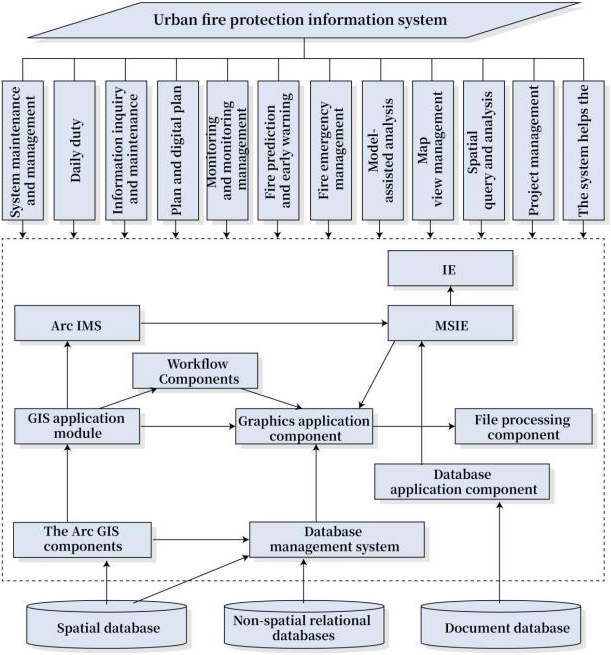
On the basis of predecessors, this paper absorbs the essence of predecessors’ knowledge and puts forward the concept of building fire information system, which is a major innovation of the article. However, the deficiency of the article lies in the lack of research depth.
In recent years, the 5G sensor network has shown a sharp development. It is that the amount of mobile service data is increased. The problem of insufficient network resources in 5G sensor networks is getting more serious, and MBMS is a highly utilization of spectrum resource utilization. It provides high-speed multimedia multicast services. Based on the existing 5G sensor technology, this paper proposes some of the disadvantages, and the 5G sensor network node positioning is intended to be accurate and low by positioning algorithm. Get position information of the node. As one of the key technologies in the field of 5G sensor networks, the node positioning has been widely favored by researchers and has born a lot of excellent positioning algorithms. As 5G sensor network application is more widely popular, accurate positioning techniques are more important. However, the traditional positioning algorithm often does not adapt to the new environment and new applications in terms of precision, cost, anti-noise. The existing positioning speech broadcast algorithm is often limited by ranging information is not complete and inaccurate, and the positioning accuracy is often not guaranteed. Therefore, in the face of complex application environments, how to design high precision and good anti-noise performance is also a small challenge. This paper first introduces the relevant development of the voice broadcast technology, and briefly describes the origin and development history of the technology, and detailed discussion on compression coding, mainly introduces some of the frequently used compression coding algorithms. This paper has pointed out a voice broadcast transmission system, which illustrates its design goals and detailed schemes, and then further expands research and analysis of embedded systems, making software’s hair, realizing the basic functions of voice transmission broadcast. China’s urbanization process has gradually accelerated, and the high-rise buildings and ultra-high-rise buildings have increased significantly. Sex, it is closely related to the national planning of people’s livelihood, so the construction of urban fire emergency information systems is to achieve the improvement of China’s fire system and the improvement of the work efficiency of fire department. This paper studies the overall framework of the city fire emergency information system, mainly clarified its design principles, system functions, database design processes. Urban fire emergency information systems are combined with multidisciplinary and various techniques, involving computers, geographic information technology, etc. With the acceleration of economic development, science and technology will become more and more improved and mature, and the fire emergency information system will also improve, and the improvement of China’s fire protection system is increasing.
In order to improve the development status of the fire emergency system, there should be many problems, which requires units at all levels and the public to jointly promote fire prevention and fire prevention work, do a good job in fire prevention and fire prevention management measures, improve their fire safety awareness, implement fire prevention work responsibilities, strengthen prevention, remediation of urban buildings left or new fire hazards, lay a solid foundation, and jointly escort the safety of life and property of the collective and the masses.
The limitations of the article have the following three points. First of all, the article lacks relevant content of epistemology and methodology, and the discussion process lacks basis. Secondly, the progress of the article lacks order. Finally, the research depth of the article is not enough, not completely solving the research vacancies in this field, there is room for improvement.
Outlook: This paper describes the application of voice broadcast in fire emergency system under the background of 5G sensor. Future research direction is to solve other problems of fire emergency system, and the article’s fire emergency system for systematic speculation to determine its effect.