



Abstract
At present, car ownership is expanding, and parking facilities are insufficient. This problem has plagued people’s lives and hindered the development of cities. The stereo garage has become the main way to solve the parking problem. But the existing stereo garage is low in intelligence and low in vehicle entry efficiency. Therefore, in this study, a new vehicle entry strategy for the road stacking stereo garage is designed. GA algorithm is innovatively improved and applied to vehicle strategy optimization. By taking the dual objective function as the fitness function of the algorithm, the access strategy is optimized. Using MATLAB software to simulate and verify each access strategy and its improvement effect. This study provides guidance and data support for seeking the best vehicle access strategy. It has good practical application value for vehicle access in 3D garage.
Introduction
With the rapid economic development, people’s living and consumption levels continue to improve, and the number of car ownership is also increasing year by year [1]. While cars bring a lot of convenience to public life, they also lead to problems such as urban traffic congestion and shortage of parking spaces, which are particularly prominent in large cities [2]. Some cities have begun to implement measures such as traffic restrictions. Although the pressure of vehicle traffic has been relieved to a certain extent, the problem of parking has not been effectively solved [3]. The emergence of the three-dimensional warehouse provides an effective way to solve the problem of urban parking. Compared with the traditional flat garage with one car and one seat, the three-dimensional garage has the advantages of high degree of automation and large volume, so it can better meet the urban parking needs and improve the parking efficiency. At present, most of the three-dimensional garages are tunnel-type stacker garages, and the development is not mature, and there are problems such as high operation difficulty, low access efficiency, and low degree of automation [4]. Reasonable optimization of the vehicle access strategy of the three-dimensional garage can reduce the access time of the stacker, effectively improve the operation efficiency of the three-dimensional garage, reduce the energy consumption of operation, and improve the user experience.
Related works
In the context of the rapid development of computer control technology and electromechanical automation technology, the application of stackers in automated stereoscopic warehouses is becoming more and more extensive. The aisle-type stacker controlled by Programmable Logic Controller (PLC) is the most common stacker at present. Its main function is to store the items to be transported into the corresponding storage location, or transport the items to be taken out from the storage location to the entrance of the roadway. In addition, stackers are also widely used in cargo lifting or storage in docks, workshops, shelves and other scenarios. Some scholars have discussed the design of three-dimensional warehouses and the operation of stackers. Chang and Li [5] combined the banker’s algorithm and the principle of time window to design an operation blocking and deadlock strategy for handling vehicles to improve the operation safety of the plane mobile stereo garage. The actual verification results show that the control strategy can effectively improve the security of the operating system and the operating efficiency to a certain extent. Li et al. [6] used genetic algorithm to optimize the travel path of the stacker crane in the roadway stacking stereo garage, thereby shortening the movement path and travel time of the stacker crane, and improving the operation efficiency of the garage. The simulation results show that under the stacker operation strategy optimized by the genetic algorithm, the average time of vehicle access is significantly shortened, and the stacker’s running distance is improved to a certain extent, and the overall operation efficiency of the three-dimensional garage is improved. Ma et al. [7] conducted an in-depth discussion on the energy feedback link of the motor control system of the automatic three-dimensional garage, and integrated the shared DC bus technology, energy consumption braking and other motor regeneration energy processing methods in this link, and designed a more reasonable The feedback energy processing control strategy. The results show that the control system of the three-dimensional garage under this strategy has good energy-saving effect and convenient operation, which has important practical significance for promoting the maturity of the three-dimensional garage technology. Chen et al. [8] introduced genetic algorithm and simulated annealing algorithm respectively to improve the early and late search stages of particle swarm optimization, so as to improve the global and local optimization capabilities of particle swarm optimization, and then apply it to the optimization of the scheduling strategy of the three-dimensional garage. Stereo garage access efficiency. The results show that the efficiency of the access strategy optimized by the improved particle swarm algorithm is 24.5%–36.07% higher than that of the traditional algorithm, and the access efficiency of the three-dimensional garage is significantly improved.
Zhang et al. [9] analyzed five stacker cart positioning technologies, including magnetic nail positioning, Gray bus positioning, laser ranging positioning, BPS positioning, and DGPS positioning, and designed a magnetic nail
From previous studies, it can be found that many researchers have conducted in-depth research on stackers and their applications in stereo garages, but there are few related researches on roadway stacking stereo garages, and there are few studies on roadway stacking. Research on the access strategy algorithm of three-dimensional garage. Therefore, the research discusses the access strategy of the roadway stacking three-dimensional garage, and then uses the improved genetic algorithm to optimize the selected access strategy, so as to improve the operation efficiency of the three-dimensional garage.
Design and optimization of automatic access strategy for PLC stacker
PLC stacker access strategy and model design
An efficient and reasonable access strategy can effectively improve the operation efficiency of a three-dimensional garage. In this regard, queuing theory is an important theoretical condition for designing an access strategy. Queuing theory, also known as random service theory, is an important branch of operations research, which is used to analyze the operating state, mode and optimization of queuing systems [15]. In a queuing service system, the service process takes a certain amount of time, and there is a certain time interval between the arrival of different service objects. According to the principle of queuing theory, on the basis of statistical service time and arrival interval, certain parameters such as service rate and arrival rate can be set to obtain the corresponding indicators, and then the service system can be improved in a targeted manner to improve the satisfaction of users as service objects degrees [16]. The typical structure of a queuing system usually includes three parts: service object input, queuing rules and service output. Detailed analysis of the indicators involved in these three aspects is an important prerequisite for establishing a queuing model. One is the input part of the service object. The number of service objects is limited or infinite, the arrival form of the service object is single or multiple, and the time when the service objects arrive in succession is random. The usual time interval distribution is fixed-length distribution and Poisson distribution. There are two distributions [17]. Denotes the
In Eq. (1),
In Eq. (2),
In Eq. (3),
Simplified model of stacker transport vehicle.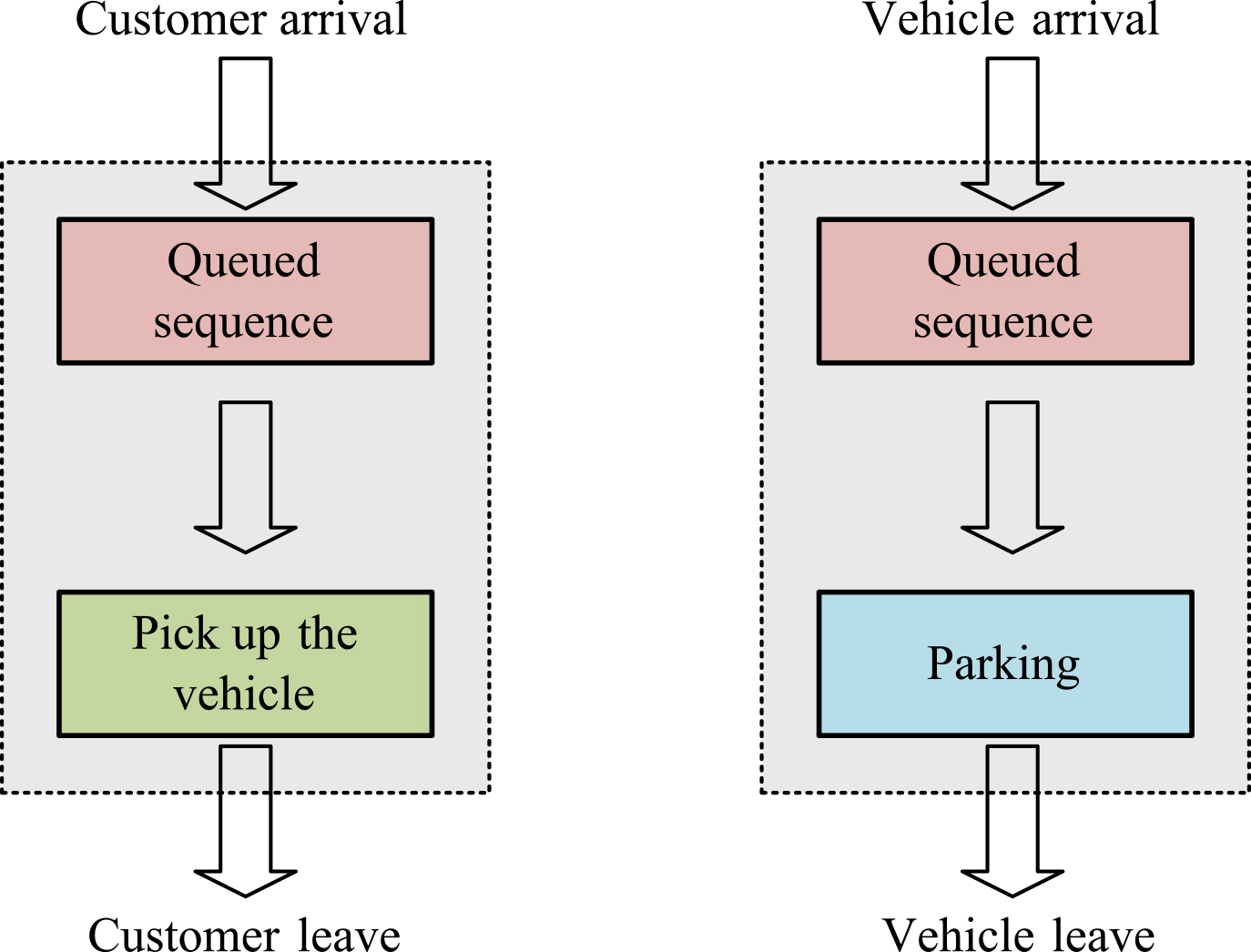
In the design of the simplified model, customers arrive to choose the stacker according to the queuing sequence, and then leave. When returning the stacker, park according to the queue sequence and leave. According to the random characteristics of vehicle access time, Poisson distribution is used to represent random variables, as shown in Eq. (4).
In Eq. (4),
Random access is a common access method for stacking garage vehicles. In this method, the stacker returns to the original position after performing a single access task, and executes a new access task after receiving the next command. The stacker using this method has low access efficiency and weak flexibility. Therefore, it is necessary to optimize on this basis. If the running speed is simply accelerated, the loss rate will be increased to a certain extent, and it is more reasonable to improve the access method itself. Firstly, a simplified model of the stacker access vehicle is designed according to the actual operation process of the stacker, as shown in Fig. 2.
Simplified model of stacker transport vehicle.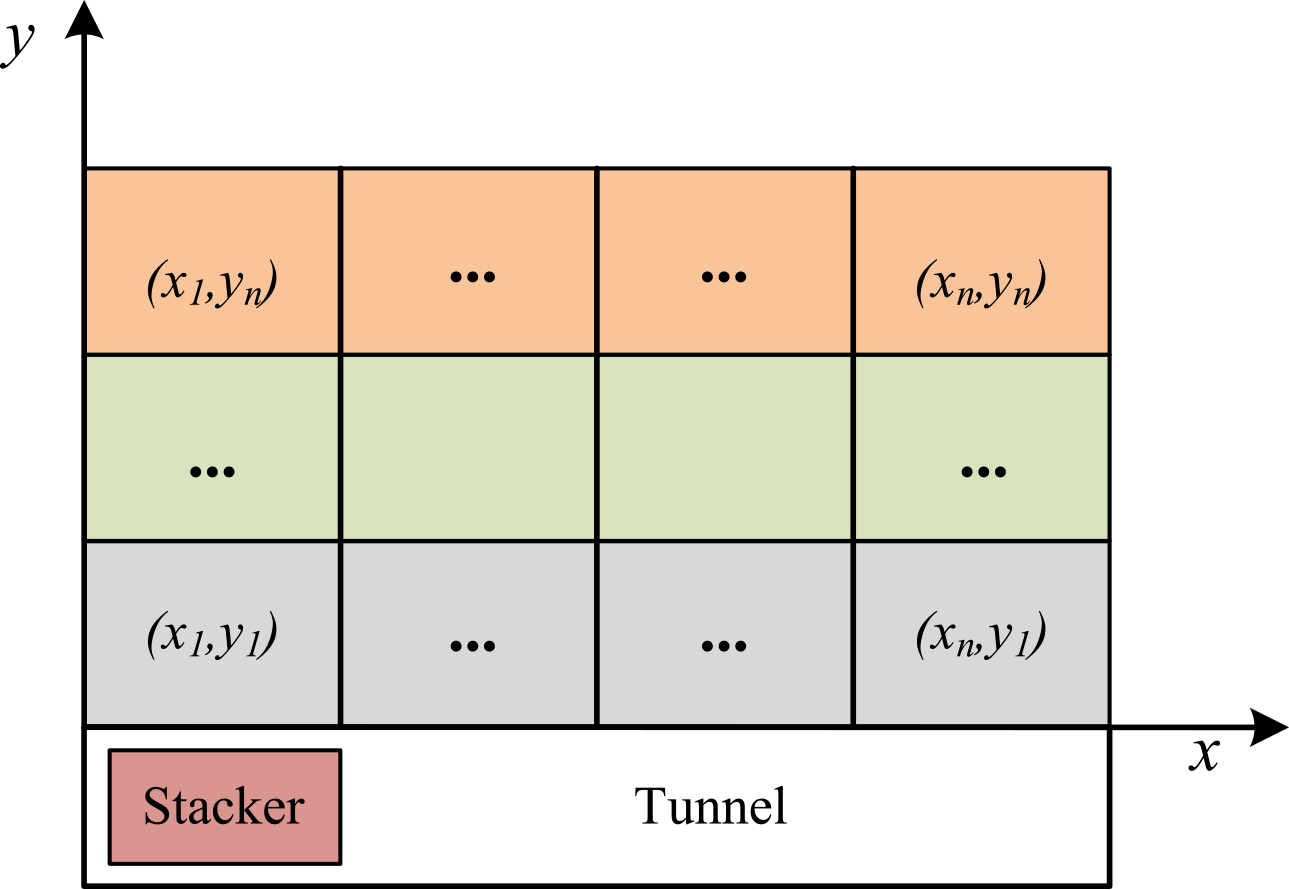
Three optimization strategies are adopted: parking first, stand by and cross transport. Parking first means to find vehicles in and out of the stereo garage, according to the order of parking priority. Stand by means when vehicles enter and exit, vehicles that need to park need to wait outside the garage until a space is available. Cross transmission indicates that two policies are executed simultaneously. First, the parameters of the stacker access mathematical model are set
In Eq. (6),
In Eq. (7),
In Eq. (8),
In Eq. (9),
In Eq. (10),
Genetic algorithm (GA) is an efficient, random search and global optimization algorithm. It can recombine well-adapted strings through random and organized information exchange [19]. It is suitable for solving complex nonlinear and multidimensional space optimization problems [20]. Therefore, the access strategy of the stereo garage can be optimized to get the optimal solution more quickly. The GA algorithm simulates the evolution process of genetic individuals formed by chromosomes on the basis of simulating the coding of chromosomes, and finally generates new genetic individuals with high fitness. Genetic algorithm research mainly includes coding, mutation, crossover, selection and fitness evaluation, and its specific operation process is shown in Fig. 3.
Flow chart of GA algorithm.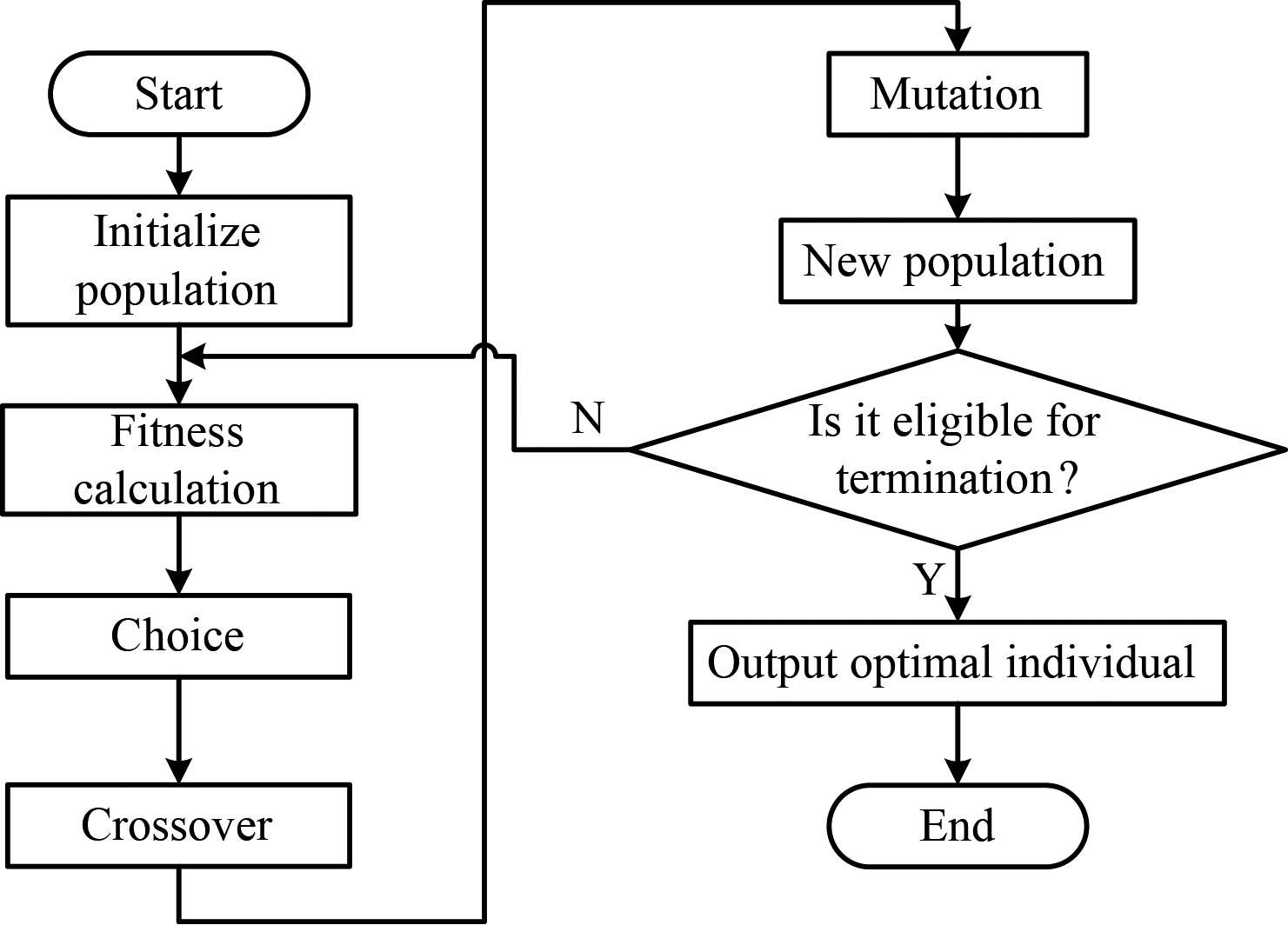
In order to ensure that the GA algorithm meets the practical application needs of the stacker, the binary coding of the GA algorithm is first improved. In the traditional GA algorithm, the coding is usually in binary form [21]. After gene mutation, the parameter value of the binary string will be mutated with a greater probability due to the difference in gene weight, which is difficult to apply to multi-dimensional or high-precision continuous variable optimization problems [22]. The use of integer coding can shorten the decoding conversion time to a certain extent, and overcome the reduction in calculation speed and accuracy caused by sudden changes in parameter values [23]. Integer coding is integrated on the basis of binary coding. The operation code of the genetic individual adopts binary coding to represent the access of vehicles; the operand adopts integer coding to represent the parking number. The mutation probability
In Eq. (11),
In Eq. (12),
After the improvement is completed, the GA algorithm can be used to integrate the access strategy for optimization. The parking space distribution and number of the research design are shown in Fig. 4.
Parking space distribution and number.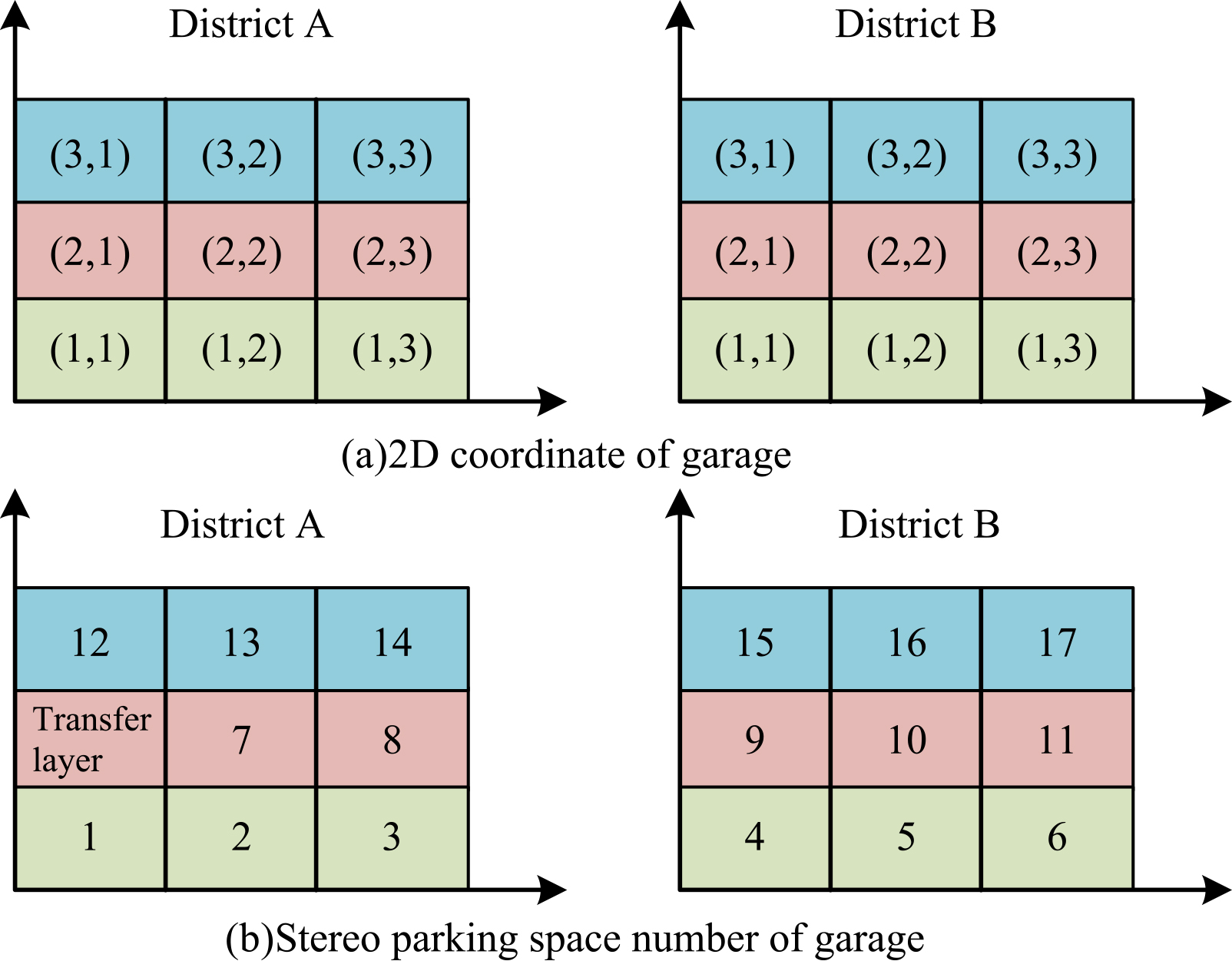
According to the actual application situation, the initial population number of GA algorithm is set to 20, and the method of integrating integer coding and binary coding is used to code the population individuals. The odd-numbered bits represent the opcode of the genetic individual, and the even-numbered bits represent the operand of the genetic individual. The former is a binary code, which takes the value of 0 or 1, and the latter is an integer code, and the value is an integer in the interval. The occupied parking space can only be picked up in the next operation. The priority of the service is determined by the position of the object relative to the conversion layer. The closer the position is, the higher the priority. In the fitness calculation stage, due to the large number of service objects in the garage, multi-objective optimization needs to be performed to shorten the time-consuming of service objects and improve the access efficiency of the garage. To this end, the preference-based weighting method is adopted, and the multi-objective optimization is transformed into the optimization solution of a single objective function by using different dynamic weights of multiple objective functions, as shown in Eq. (14).
In Eq. (14),
In Eq. (15),
Simulation analysis of different access strategies of stacker cranes
Taking the stacking stereo garage as a service object, the input time interval is Poisson distribution service organization. The mathematical models of three different access strategies, namely parking priority, standby and cross transportation, are constructed in MATLAB simulation engineering software. The computer uses Intel Core i5 CPU of 2.60 Hz, memory of 3.90 GB, and operating system of Windows10. According to the distribution characteristics of the input time interval of the service object, firstly generate the input time series
Time consumption of transport vehicles when the number of parking and picking up is equal.
It can be seen from Fig. 5 that when the number of vehicle storage and the number of vehicle retrievals are equal, the access time of the stacker under the three access strategies increases gradually with the increase of the number of vehicles, and the time-consuming of the priority strategy for vehicle storage increases. The fastest and most time-consuming, the average time-consuming is about 62.14 s; the time-consuming level of the in-situ standby strategy is slightly lower than that of the parking priority strategy, and its average time-consuming is about 57.56 s; the interleaving access strategy has the lowest time-consuming level, and the average time-consuming About 48.73 s, the time consumption is reduced by 21.58% compared with the vehicle storage priority strategy and 15.34% compared with the in-place standby strategy. Therefore, when the number of times of car storage is similar to the number of times of car retrieval, the access time of the interleaving access strategy is the shortest, and the access efficiency is higher than that of the parking first and the in-place standby strategy. When the number of times of car storage is greater than the number of times of car retrieval ( ), the operation of the garage is simulated
Time consumption of transport vehicles during the peak period of parking.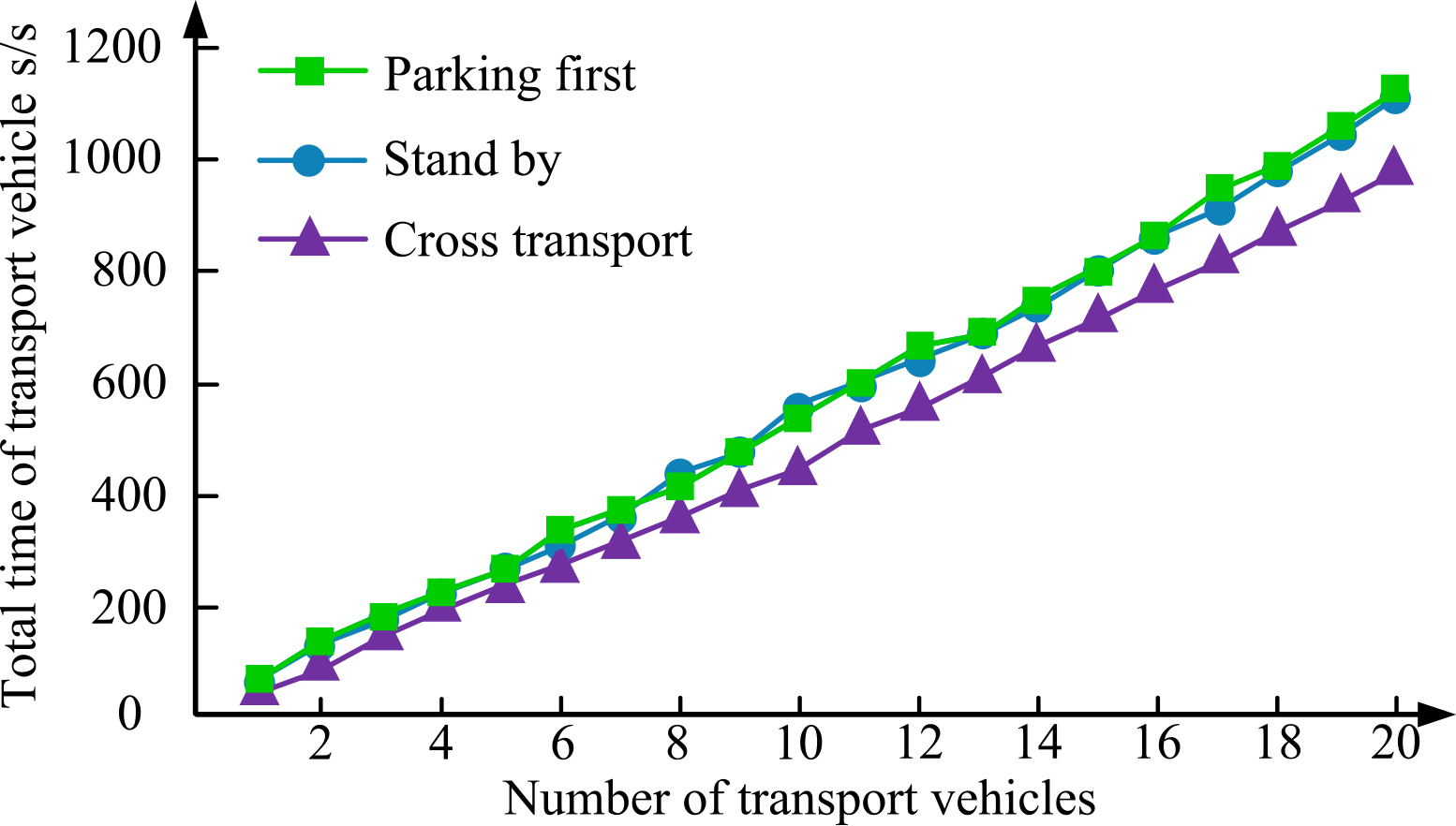
It can be seen from Fig. 6 that when the number of times of car storage is greater than the number of times of car retrieval, the time-consuming level of the car-parking priority strategy and the on-site standby strategy is approximately equal, and the average time-consuming level is about 59.52 s; the time-consuming level of the interleaving access strategy is still the lowest. The average time is about 50.18 s, which is 15.71% less than the parking first strategy and the in-place standby strategy. Therefore, the access time of the interleaving access strategy is still the shortest when the number of times of parking is greater than the number of fetching, and the access efficiency is higher than that of the parking priority and in-place standby strategies. The operation of the garage ( ) is simulated when the number of times of car retrieval is greater than the number of times of car storage
Time consumption of transport vehicles during the peak period of picking up.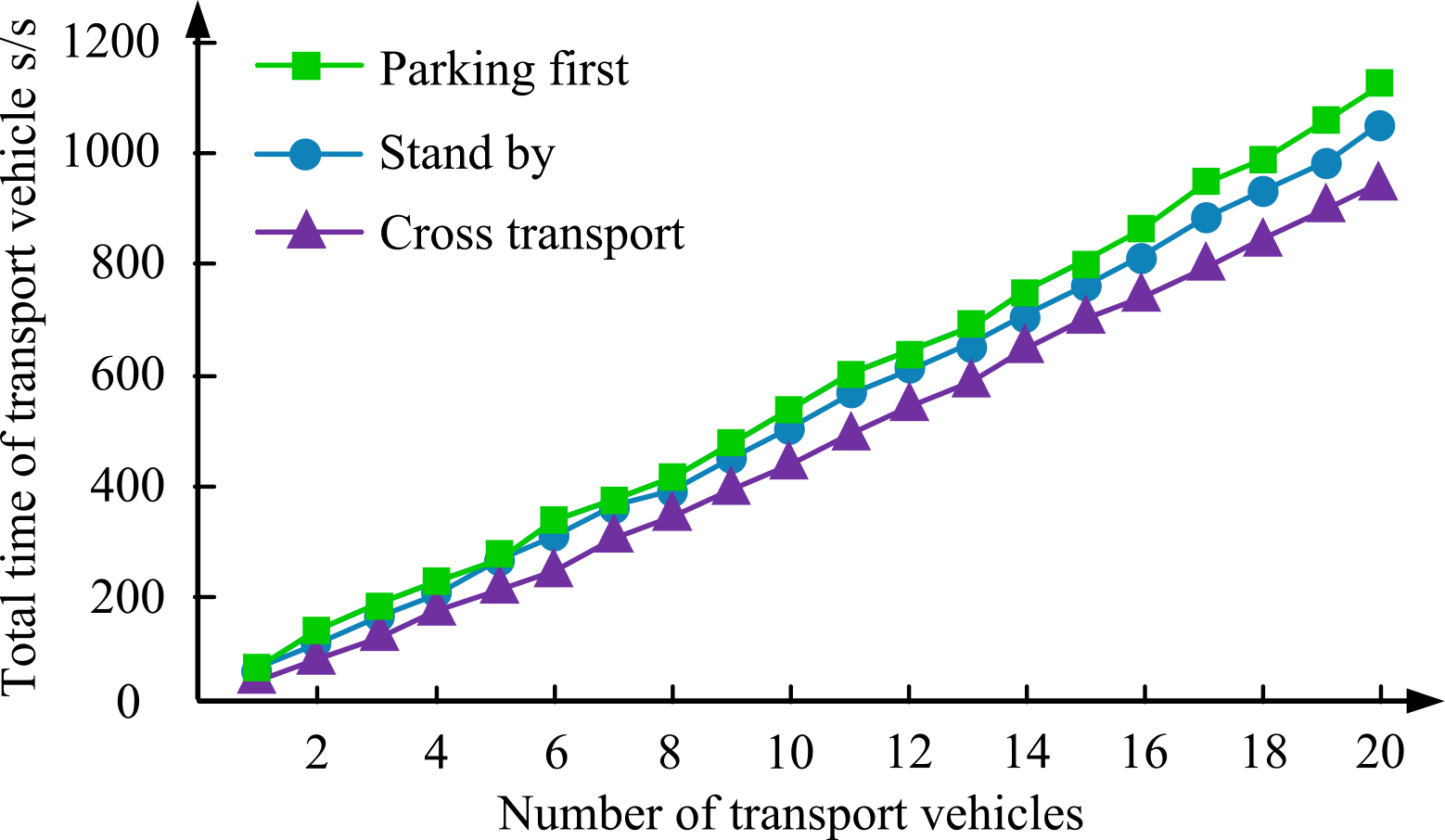
As can be seen from Fig. 7, when the number of times of car fetching is greater than the number of times of car storage, the vehicle storage priority strategy takes the most time, with an average time of about 60.58 s; It takes about 57.62 s; the time-consuming level of the interleaving strategy is the lowest, with an average time-consuming of about 47.16 s. When the number of times of car storage reaches 20, the time-consuming of the interleaving strategy saves 105 s compared with the in-situ standby strategy, and it saves priority over car storage. 178 s. Therefore, under the three different situations that the number of times of car storage is equal to the number of times of car retrieval, the number of times of car storage is greater than the number of times of car retrieval, and the number of times of car retrieval is greater than the number of times of car storage, the access time of the interleaving access strategy is the shortest. In the process of multiple consecutive access operations of vehicles, the stacker crane may travel without load under the vehicle storage priority and in-situ standby strategy, which increases the probability of invalid operation, while the crossover strategy avoids occurrence of this situation to a certain extent. However, in actual operation, it is necessary to select an appropriate strategy according to the actual access situation. For example, when the number of times of car storage is significantly greater than the number of times of car fetching, the access efficiency of several strategies is relatively close, and due to the large number of cars in storage, the priority of car storage can be selected. Compared with the common entrance and exit strategy of the stereo garage at the present stage, the time consumption is reduced a lot [24].
Using the GA algorithm and direct search toolbox (Genetic Algorithm and Direct Search Toolbox, GADS) that comes with the MATLAB software, the automatic access vehicle strategy optimized by the improved GA algorithm is simulated and verified, and the strategy to be optimized is selected according to the actual situation. In the first simulation time period, 8 parking spaces are deposited and 9 parking spaces are withdrawn, and the interleaving access strategy is selected. In this case, the change of the access time and energy consumption with the number of iterations is shown in Fig. 8.
Iterative curve of time and energy consumption under parking-first.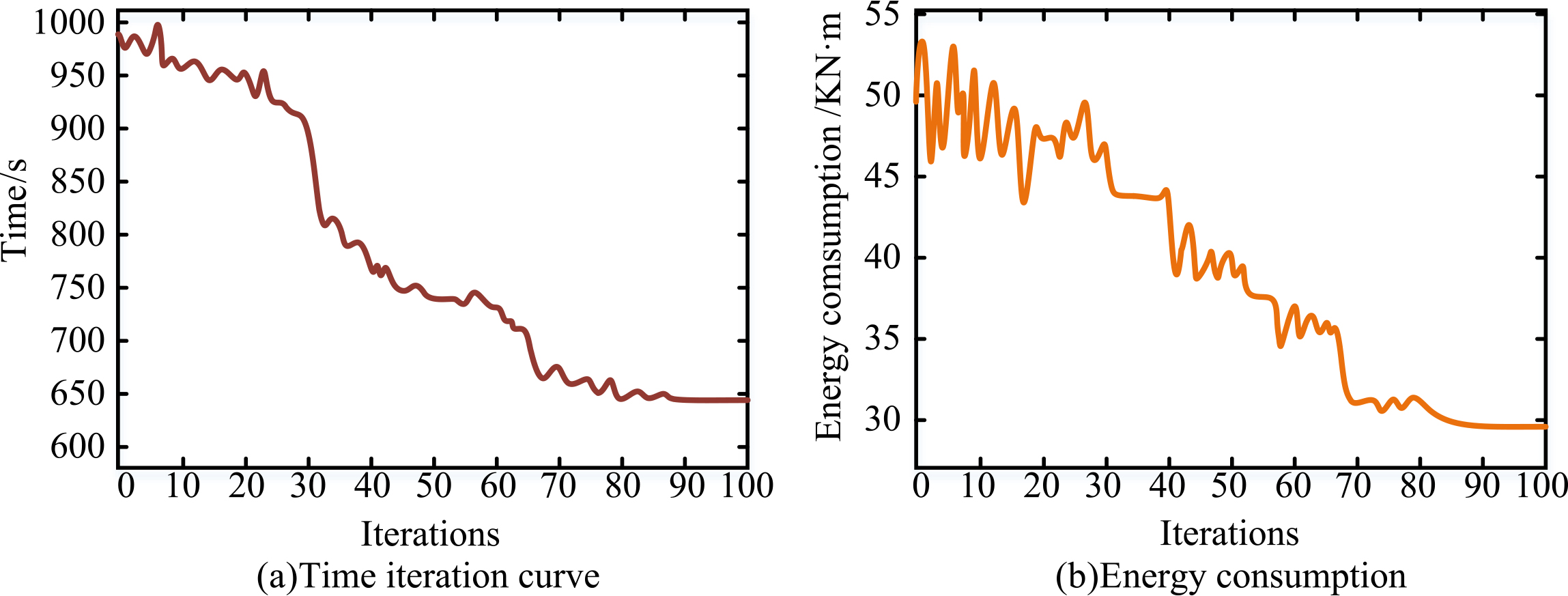
It can be seen from the time iteration curve in Fig. 8 that the optimal individual is obtained when the number of iterations reaches 88, and the required time is 645 s; it can be seen from the energy iteration curve that the optimal individual is obtained when the number of iterations is 90. Its energy consumption is 29.5 KN
Iterative curve of time and energy consumption under cross transport.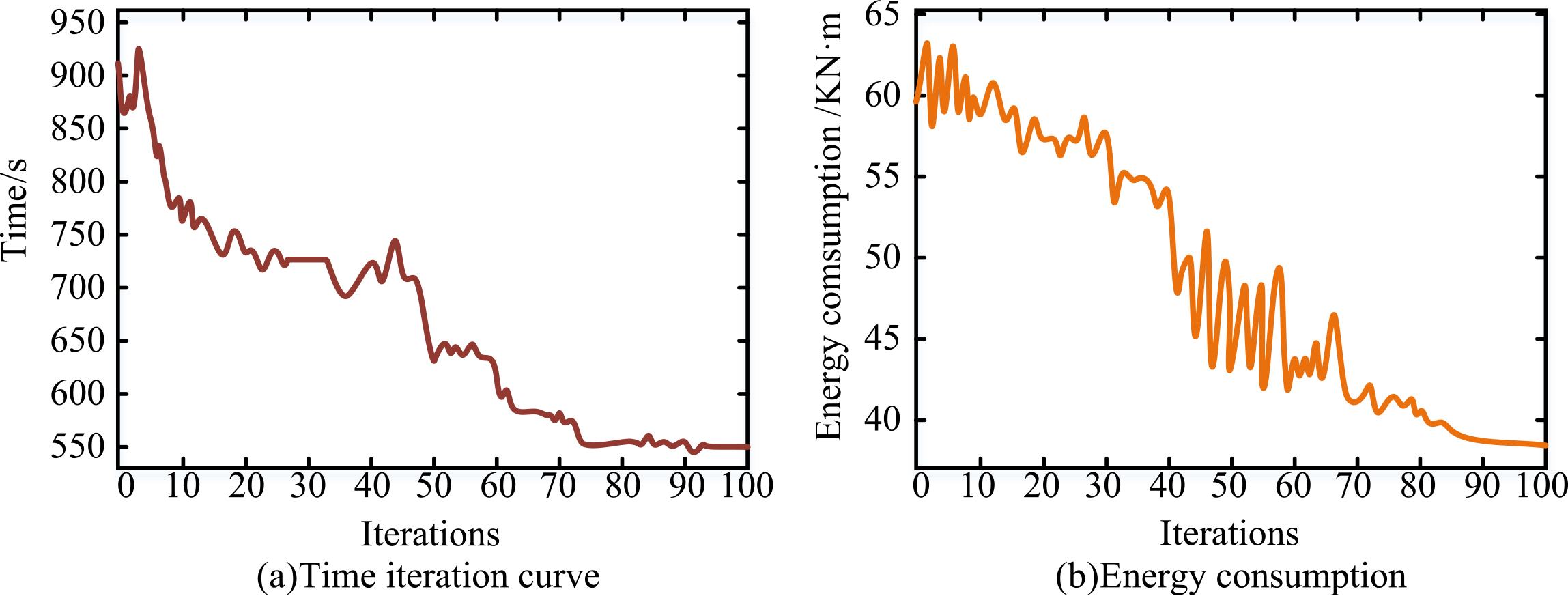
It can be seen from the time iteration curve in Fig. 9 that the optimal individual is obtained when the number of iterations reaches 93, and the required time is 551 s; it can be seen from the energy iteration curve that the optimal individual is obtained when the number of iterations is 95. Its energy consumption is 37.6 KN
As shown in Fig. 10, in the third simulation period, 10 parking Spaces are placed and 7 parking Spaces are withdrawn, and the entry strategy is on-site standby. It can be seen from the time iteration curve in Fig. 10 that the optimal individual is obtained when the number of iterations reaches 81, and the required time is 875 s; it can be seen from the energy iteration curve that the optimal individual is obtained when the number of iterations is 84. Its energy consumption is 51.8 KN
Comparison of optimization results and random strategies
Iterative curve of time and energy consumption under cross transport.
It can be seen from Table 1 that in the time period of different access conditions, the time consumption and energy consumption of the optimization strategy are significantly lower than those of the random access strategy. The time consumption of the optimization strategy in the first time period was reduced by 32.8% and the energy consumption by 26.3% compared with the random strategy; the time consumption of the optimization strategy in the second time period was reduced by 32.4% and the energy consumption by 20% compared with the random strategy; In the third time period, the time consumption of the optimization strategy was reduced by 30.3% compared with the random strategy, and the energy consumption was reduced by 10.7%. Therefore, compared with other optimization strategies at the present stage, the access strategy proposed in this paper can meet the actual demand of three-dimensional garage vehicle access, and significantly improve the efficiency, energy saving and convenience [25].
With the increase of car ownership, the parking space problem is becoming more and more prominent. Aiming at the problems of long time and high energy consumption of stacking stereoscopic garage in roadway, the optimization strategy of stacking stereoscopic garage access is put forward. The time change of different access strategies under different conditions is compared by MATLAB simulation, and the effectiveness of different access strategies is verified. The simulation results show that the optimal time-consuming of the interleaving, parking priority and in-place standby strategies optimized by the GA algorithm are 645 s, 551 s and 875 s, respectively, which are reduced by 32.8%, 32.4%, and 30.3%, respectively, compared with the random access strategy. The optimal energy consumption is 29.5 KN