



Abstract
The method of surface displacement prediction of tunnel convergence displacement is used to make up for the failure of tunnel convergence displacement monitoring in the construction process, to supplement and verify the tunnel monitoring data, and to guide the construction. Firstly, some sets of systolic displacement and surface displacement data are obtained by field monitoring, which is used to calculate the parameter vector to be determined. The corresponding mathematical model is established and the systolic displacement of tunnel is predicted according to the monitoring data of surface displacement. Combined with field tunnel displacement monitoring and surface displacement monitoring, the correlation of displacement curve is analyzed, and the corresponding mathematical model is established. Combined with Matlab programming, the corresponding program language is written, the user interface is compiled, and the method of predicting tunnel convergence displacement by the ground displacement is realized.
Research status
Tunnel engineering, generally divided into tunnel and tunnel of soil, generally use the medium structure model to analysis soil tunnel, considering weight of soil and its side pressure, so the stress is clear, but according to the theory of load is determined, the whole construction process of protection has a high budget. Analysis for rock tunnel, by New Austrian method, both as a load of surrounding rock, also as a protective structure, which greatly reduce the cost of the tunnel support, but how to determine the surrounding rock pressure, and determine the optimal supporting time, is one of the most core problem of the tunnel support, its basic basis lies in the surrounding rock stress and displacement monitoring. But due to the complex geological structure, rock mass structural plane and water distribution, lead to some monitoring data is missing, the tunnel excavation is an urgent need to solve the problem.
Subway tunnel excavation process, due to the complex geological structure and difficult construction conditions, Arrangement of stress and displacement monitoring is often because of the large deformation and even led directly to the monitoring data loss. Especially the more complex geological conditions, The more important monitoring data, the more prone to loss of data, this is due to the urgency of the complicated construction conditions and construction, is now a big problem in the underground engineering construction. Used for prediction of surface displacement convergence displacement of underground engineering is feasible in theory, by the data analysis, obtain the correlation degree, has guiding effect to the construction of underground engineering.
Technical route for this article.
Due to the construction of tunnels, the monitoring data of some points are often invalid or error, which leads to the lack of monitoring data [1, 2, 3]. Because of the tunnel lining, it is difficult to monitor again [4, 5, 6]. The purpose of this paper is to calculate the vertical systolic displacement of tunnel by using surface displacement monitoring, and to supplement the corresponding data for tunnel monitoring [7, 8, 9, 10].
The displacement monitoring of the tunnel can be measured by five-point method, and five monitoring points can be designed on both sides of the arch bottom, on both sides of the arch shoulder and on the vault. By analyzing the displacement of each point, the systolic displacement of the tunnel is calculated [11, 12]. The disadvantage is that the systolic displacement meter is located near the tunnel construction, which often results in the failure of the displacement meter or the unavailability of data due to the construction. Second, with the construction of the tunnel, the supporting lining should be done in time, and the displacement monitoring points can not be arranged again. Because of the above two reasons, there are still technical problems in tunnel monitoring, so it is necessary to supplement the monitoring data with corresponding methods.
Surface monitoring is mainly used in geological hazard monitoring, such as landslide displacement monitoring. Surface displacement monitoring, according to the monitoring range, can choose a small range of displacement monitoring methods, or use satellite positioning to analyze the displacement of large landslides [13, 14]. Or according to the requirements of monitoring objectives, conventional displacement monitoring or micro-physical methods [15], such as grating monitoring [16], to achieve more accurate displacement monitoring.
Tunnel displacement prediction model, starting from the new Austrian method, analyzes the change of tunnel stress (or displacement) with time, scholars begin to study the relationship between displacement and time curve, and establish a mathematical model [17, 18, 19]. After that, considering the mechanical properties of rock, the corresponding physical model is established from the aspects of elasticity, plasticity and viscosity of rock [20, 21].
As for programming C, Matlab, IDL and other programming languages can be realized. With the complexity of prediction model and the improvement of accuracy and shortcut of parameter fitting, programming has gradually become a necessary result of model implementation.
As shown in Fig. 1, combined with field tunnel displacement monitoring data and surface displacement data, the relationship between tunnel convergence displacement and surface displacement is established, and the corresponding two mathematical models are established from two angles: displacement at different positions at the same time and displacement at different times at the same position. Combined with Matlab programming, the corresponding programming language is written, and the user interface is compiled to realize the method of predicting tunnel convergence displacement by land displacement.
In the excavation of the tunnel, the stress redistribution caused by the excavation produces the corresponding displacement inside the tunnel. Correspondingly, the surface of the tunnel will also produce the corresponding vertical displacement, especially the shallow buried tunnel. According to the mechanical properties of rock and soil, the surface land subsidence is caused by underground space excavation, which is positively correlated with the vertical convergence of the tunnel.
In the process of tunnel excavation, the convergence displacement meter buried inside the tunnel is often affected. Therefore, the relevant mathematical models of surface displacement settlement and tunnel convergence displacement can be established by using the monitoring of surface subsidence, and the model parameters can be determined by combining the existing monitoring data of the region or project. The first is to verify if there is a clear correlation between the surface displacement and displacement of underground engineering, which is the premise of using surface displacement displacement prediction of the underground structure. For the wrong data points of displacement monitoring, the Systolic displacement calculated by surface displacement can also be used as the corresponding parameters for construction reference. To make up for tunnel construction, monitoring data can not be re-acquired defects.
Displacement, two cases are generally considered, one is the change of tunnel convergence displacement with time, which is used to analyze the stress state and displacement of tunnel surrounding rock with time, and then to determine the corresponding supporting mode and the best supporting time. Accordingly, the surface displacement monitoring data are also considered from these two angles, and the summary form of field monitoring data is shown in Tables 1 and 2.
Changes of surface displacement over time
Changes of surface displacement over time
As shown in Table 1, the variation of surface displacement with time is obtained by using monitoring data, and a set of Systolic displacement data of tunnels are needed to obtain model parameters.
Surface displacement monitoring data at different locations
Similarly, monitoring Systolic displacement at different locations of the tunnel can directly monitor the tunnel vault, arch shoulder, arch bottom for analysis (as shown in Table 2), and can also consider the convenience of surface displacement monitoring, taking points at the same spacing to facilitate later data processing, such as finite element analysis. The position and displacement corresponding to each point in Table 2 are shown in Fig. 2.
Tunnel displacement prediction and correlation analysis
Prediction of convergent tunnel displacement using surface displacement.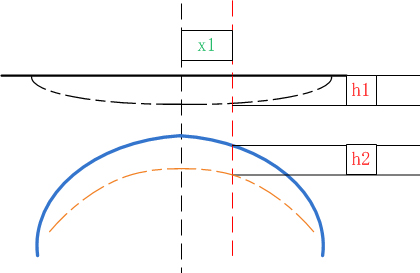
Using monitoring data of Tables 1 and 2 for correlation analysis, found that the vertical displacement of tunnels and the surface displacement were positively correlated, but the horizontal below of tunnel and the surface displacement show little correlation, it is because the different location of the tunnel, the influence of different time of the surface vertical displacement are positive correlation. But the two on the influence of the horizontal displacement is the opposite. Therefore, it should be in the same position of different time (or different position for the same time) to analyze the surface displacement and horizontal tunnel below of the correlation of tunnels.
Summarize the surface displacement in Tables 1 and 2. In fact, for the points in the monitoring range on the surface, the displacement is monitored at different times. Convert the above displacement data into. Txt format for later calls, as shown in Fig. 3.
Surface subsidence data monitored and converted to dat file format.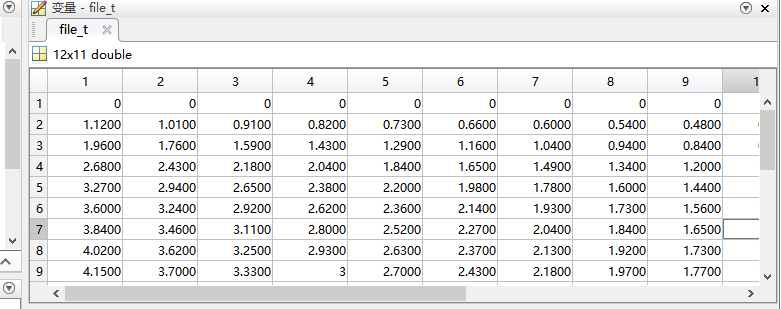
Then the surface displacement monitoring data can be regarded as a two-dimensional matrix:
Definition of a constant parameter matrix
We found out that:
Matrix
Called matrix A as tunnel displacement fitting time parameter vector.
The model can be simply written as:
In the same way, a constant parameter matrix is defined
We found out that:
Called matrix B as the tunnel displacement fitting position parameter vector.
Matrix
Similarly, the model simply reads:
A, B constant parameter matrix is a parameter matrix fitted by monitoring data. Not only the results of fitting different tunnels are different, but the data used in the same tunnel are different, and the fitting parameters are different. The physical meaning of displacement corresponding to the corresponding calculation results is also different. Considering the practical engineering and for the convenience of model application, the fitting data of model parameters are determined as follows:
The monitoring data corresponding to column
The above two models respectively analyze the change of the tunnel displacement at the same point over time and the tunnel at the same time, so as to obtain the spatiotemporal displacement change of the tunnel.
The model has the following advantages:
The time model parameter is 1* t column vector, the position model parameter is 1* x column vector, the model parameter is many, can reduce the fitting error. The model takes into account both time and position factors, and the calculation of the model is large. The calculation is simplified by programming, and all the monitoring data are used to ensure the reliability of the fitting results. Among the fitting parameters, the
Access to monitoring data
In order to obtain the model parameters, at least one set of known data is needed. The data include surface displacement and tunnel convergence displacement. The surface displacement includes the displacement of each point at different times, and the unit mm, is listed as a x*t two-dimensional matrix data. dat format storage for calls. At the same time, the corresponding tunnel convergence displacement is needed. Because the tunnel monitoring is more complicated, the model is most simplified, only a set of Systolic displacement of each point of the tunnel at any time, and a set of Systolic displacement corresponding to different time of dome. Two sets of data combined with the surface displacement monitoring data in (1) are used to obtain the time parameter vector A and the position parameter vector B. respectively two sets of Systolic displacements are stored as one-dimensional column vectors. The model is based on the surface parameters to fit the Systolic displacement of the tunnel, so the data of multiple sets of surface displacement are also stored dat text format.
Open the program interface (Fig. 4), click Import data acquisition parameters, and select known monitoring data, including surface displacement data and tunnel convergence displacement data, in the pop-up dialog box. Only one file can be opened at a time, according to the program, the first double-click to open the surface displacement monitoring data, the program will pop up again open file interface (Fig. 5), the second time to select the tunnel monitoring data used to obtain parameters. At this point, the two sets of displacement data are stored in the Matlab as matrices. Two sets of parameter matrices can be obtained by clicking on the time parameter vector A “and the position parameter vector B”, respectively. If only the maximum displacement of the dome is required, only the time parameter vector A is obtained It should be noted that if only one parameter is given here, the model can only be called for later computation, otherwise it can not be calculated and an error is prompted.
Program Interface.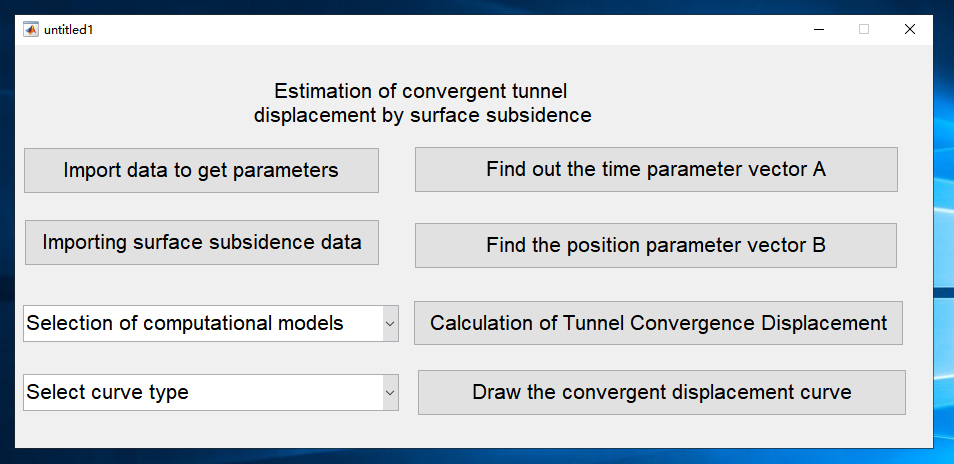
Monitoring data.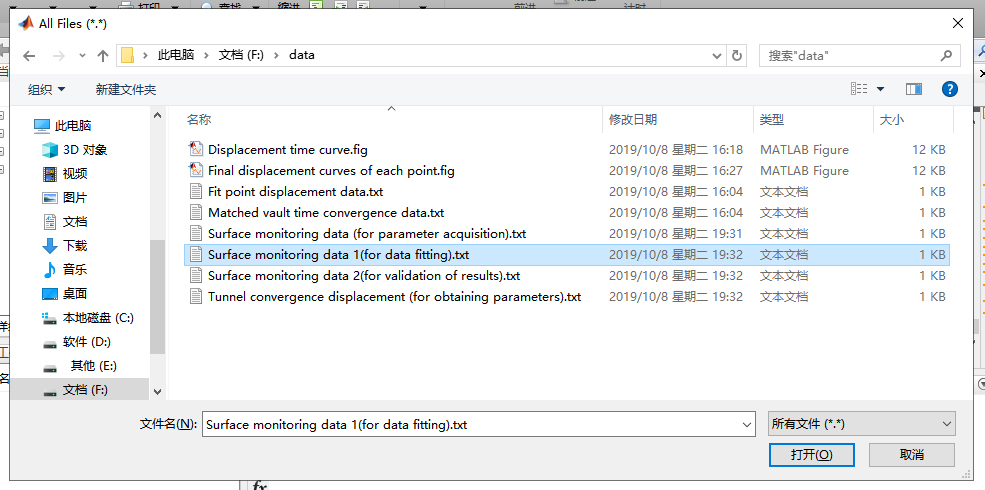
Click on the select calculation model drop-down menu, select the model
The displacement of the center of the tunnel is fitted with the change of time
Similarly, click on the selection calculation model drop-down menu, select the model
The curve fitting of tunnel points
The Systolic displacement distribution of the whole tunnel can be seen by connecting the displacement at different points of the tunnel into a curve. In the “Select Curve Type” drop-down menu, select “Systolic displacement curve at different positions” and click “draw Systolic displacement curve” to draw the corresponding position displacement curve (Fig. 6). Curve to. Fig form, stored in the corresponding folder.
Displacement of tunnel points at 
Dome displacement-time curve of tunnel.
Three-dimensional diagram of vertical displacement of tunnels at different times.
In the ‘select curve type’ drop-down menu, select ‘convergence displacement curve at different times’ and click ‘draw convergence displacement curve’ to draw the corresponding time displacement curve (as shown in Fig. 7). The graph is the same. Fig form, stored in the corresponding folder. It should be noted that when this software is written, considering that the surface displacement is positively correlated, it is mainly vertical displacement, so the convergence displacement varies with time, but in fact it is only the vertical displacement curve of the dome. Of course, if the Systolic displacement of arch shoulder is required, it can be solved by the same theory. In addition, the tunnel displacement involved in the whole model also refers to the vertical displacement convergence.
Self-validation of the model
Since the
The vertical displacement of the tunnel at different times is compared, in which the x axis is perpendicular to the direction of the tunnel, and the y axis indicates the direction along the tunnel. z represents the vertical direction and is used to record the vertical displacement of the tunnel. The displacement of tunnel arch at the same time and different position is drawn in the same drawing, the displacement of tunnel at different positions is analyzed and compared, and the three-dimensional map of tunnel space at different time is analyzed together to compare the different displacement of tunnel at different time,as shown in Fig. 8.
Conclusion
Combined with field tunnel displacement monitoring and surface displacement monitoring, the correlation of displacement curve is analyzed, and a method of using surface displacement to predict tunnel Systolic displacement is established.
The corresponding two mathematical models are established from two angles: displacement at different positions at the same time and displacement at different times at the same position. model parameters are variable and can be used for self-validation.
Combined with Matlab programming, the corresponding program language is written, the user interface is compiled, and the method of predicting tunnel convergence displacement by the ground displacement is realized. The calculation is simplified by programming, and all the monitoring data are used to ensure the reliability of the fitting results.
Footnotes
Acknowledgments
This project was financially supported by Fujian province department of project (Grant NO. 2022J05252); Putian city technology bureau project (Grant NO. 2022SZ3001ptxy02); Using the method of surface displacement prediction of underground engineering settlement research (Grant NO. 2022AHX116(L)); Colleges and universities in Fujian province engineering research center of The southeast coastal engineering structures of disaster prevention and mitigation, Putian college institute of civil engineering.