



Abstract
With the continuous emergence of new technologies and the efficient and convenient development of people’s daily life and work, the topic of intelligent building is becoming more and more hot. There are two kinds of data in intelligent building, namely static data and dynamic data. The digital expression of intelligent building is realized through the fusion and interaction of these two kinds of data. The building information model (BIM) stores a large amount of static data, including size, material, color and other data, while the Internet of Things (IoT) collects real-time dynamic data, including temperature, humidity, light and other data, through sensors in every space within the building. The related problems of building data management in the design and operation and maintenance stages mainly include data collection relying on manual work, low data processing efficiency, scattered and disorderly data storage, difficult data interaction, slow speed, and low data visualization. In order to solve these problems, this paper combines the characteristics and advantages of BIM and IoT technology, analyzes the interaction and application value of BIM and IoT technology in the design and operation and maintenance stage of intelligent buildings, and constructs a data management system based on the Internet of things, a 3D visualization technology based on BIM, and an operation and maintenance management platform based on BIM and IoT. The application of BIM and IoT technology in the design and operation and maintenance stage of intelligent buildings has promoted the development of the construction industry. The Internet of Things can provide many functional services, such as real-time monitoring, remote tracking, automatic update, plan management and a series of personalized services and management, to achieve the management, control and detection of various things, and ensure the high-speed and effective operation of the system. The emergence of the building system of modern communication network technology has brought many conveniences to people, and there is still a broad space for development. The combination of new Internet of Things technology and intelligent buildings will certainly be an important development direction.
Introduction
With the development of the times, buildings are becoming more and more intelligent and the setting of intelligent systems is becoming more and more abundant, and the concept of smart building is born. Smart building is to provide a safer, more convenient and energy-saving building environment for users by optimizing the combination of the four elements of structure, system, service and management through network technology. Building data visualization and cloud-based is the current trend of development, with the development of BIM technology, the storage and management of static data in the building has been well solved, but the dynamic data generated in the process of operation and maintenance does not give full play to its value, which leads to the BIM technology and the upstream and downstream links can not achieve effective data transfer and closed management, how to achieve real-time interaction of static data and dynamic data [1, 2]. This has become a problem faced in the development of building wisdom. As a popular emerging technology, Internet of Things (IoT) can provide a large number of technical methods in data collection, management, storage and interaction, which can make up for the shortage of BIM in data processing and provide new opportunities for the management of building data [3]. At present, the development direction of intelligent building mainly includes intelligent environment control and realization of building structure adjustment. Intelligent environmental control, in order to achieve energy saving and emission reduction and intelligent adjustment as the goal, the use of sensors, analysis and processing of environmental conditions, development and promotion of environmental adjustable technology, to achieve environmental control. Realize the independent adjustment of building structure, and use the ‘intelligent building’ technology and equipment system to realize intelligent services such as automatic adjustment of structure, adaptive simulation, and self-assembly of structural functions, so as to improve the dynamic and static availability, system performance and safety of building structure. The Internet of Things can provide many functional services, such as real-time monitoring, remote tracking, automatic update, plan management and a series of personalized services and management, to achieve the management, control and detection of various things, and ensure the high-speed and effective operation of the system. The emergence of the building system of modern communication network technology has brought many conveniences to people, and there is still a broad space for development. The combination of new Internet of Things technology and intelligent buildings will certainly be an important development direction.
Theoretical foundation
Building Information Model (BIM)
Building Information Modeling (BIM) technology is a data-based tool applied to engineering design, construction and management. Through the integration of data-based and information-based models of buildings, it can be shared and delivered in the whole life-cycle process of project planning, operation and maintenance, so that engineers and technicians can make correct understanding and effective response to various building information, and provide the design team and all construction subjects including construction and operation units to provide a basis for collaborative work and play an important role in improving productivity, saving cost and shortening construction period.
Internet of Things (IoT)
Internet of Things (IoT) refers to various devsices and technologies such as various information sensors, radio frequency identification technology, global positioning system, infrared sensors, laser scanners, etc., to collect any object or process that needs to be monitored, connected and interacted with in real time, and collect its sound, light, heat, electricity, mechanics, chemistry, biology, location and other needed information through various possible network access, realize the ubiquitous connection between objects and things, and things and people, and realize the intelligent sensing, identification and management of objects and processes [4].
The reason why data visualization is difficult to achieve is that the dependence of data visualization screen on emerging technologies exposes the shortcomings of traditional reports. Data visualization makes the relationship between the audience and the enterprise change fundamentally, and can feel the phenomena and laws that traditional reports are difficult to reveal. Of course, it should be noted that we believe in the power of data but cannot rely solely on data, data may also have errors. To avoid data bias and data distortion, we must learn to remove noise data interference and continuous correction methods. In addition, the long production cycle and high labor cost of data visualization large screen need to be further developed in the future to improve the quality of data processing and shorten the development time. In addition, although mainstream data analysis companies and new applications have made a lot of data visualization attempts in large-screen applications, their development still faces problems such as low audience attention, limited data source development, and lack of relevant professionals. Therefore, China’s data visualization still has a long way to go.
Problems related to building data management in the design and operation and maintenance phases
Data collection relies on manual
A perfect BIM model can help project participants efficiently obtain the required project information, but the premise is that each participant needs to continuously enter and update a large amount of information into the model, which not only consumes a lot of human resources, but also ensures its accuracy and timeliness in the process of manual entry, which is difficult to ensure in the face of large or complex projects. On the other hand, in the operation and maintenance management stage, some equipment status data in the building also needs to be regularly checked and collected by operation and maintenance personnel on site, this data collection method invariably increases the management costs and labor costs [5].
Data processing efficiency is low
Building operation and maintenance stage, there are many work scenarios data are required to record and update the operation and maintenance staff in the work process, such as maintenance and repair records, personnel access records, equipment maintenance records, etc., but the traditional way of recording are recorded in paper documents, resulting in these data often can not be entered into the management system in a timely manner, the management and find data will be very inconvenient. Paper data can also lead to data omissions and errors due to manual operation in the recording process, and the accuracy of data is poor, which can lead to an increase in the error rate when processing data later [6].
Data storage is scattered and disorganized
The building information model of the intelligent building contains almost all the information generated in the whole life cycle of the building, including not only static data such as spatial dimensions, material properties and color patterns in the building, but also dynamic data generated in the process of operation and maintenance, such as environmental changes, personnel flow and equipment status [7]. Most of the dynamic data are multi-source heterogeneous, plus the data of traditional building management system are collected in stages, resulting in the final data recording and storage are scattered and messy, and the reuse rate for building data is low, making these data easily lose their potential value [8, 9].
Data interaction is difficult and slow
In the design process of the building, BIM designers will enter a large amount of static data in the BIM model, which basically lose their usefulness after the construction of the building is completed, and are often only used for display in the subsequent building operation and maintenance process, unable to give full play to their value [9]. In building operation and maintenance, there are still many data need to rely on human to collect, for some urgent parameters cannot be obtained in time, increasing the difficulty of work. In terms of data storage, there are still a lot of paper-based data, which are difficult to enter and prone to missing data, making it difficult to achieve efficient data interaction [10, 11].
Low visualization of data
Building data visualization and cloudization is the current development trend, with the development and change of building information model technology, the static data cloudization of the building has been well solved, but the display of dynamic data generated by building operation and maintenance still has great limitations, only a very few environmental state data, such as temperature, humidity, light, etc., for personnel flow, equipment management and other complex data is often difficult to present [12]. The reason why data visualization is difficult to achieve is that the dependence of data visualization screen on emerging technologies exposes the shortcomings of traditional reports. Data visualization makes the relationship between the audience and the enterprise change fundamentally, and can feel the phenomena and laws that traditional reports are difficult to reveal. Of course, it should be noted that we believe in the power of data but cannot rely solely on data, data may also have errors. To avoid data bias and data distortion, we must learn to remove noise data interference and continuous correction methods. In addition, the long production cycle and high labor cost of data visualization large screen need to be further developed in the future to improve the quality of data processing and shorten the development time. In addition, although mainstream data analysis companies and new applications have made a lot of data visualization attempts in large-screen applications, their development still faces problems such as low audience attention, limited data source development, and lack of relevant professionals. Therefore, China’s data visualization still has a long way to go.
Technical architecture
IoT-based data management system
To solve the problem of dynamic data heterogeneity in the operation and maintenance management of traditional buildings, a data management system based on a relational database is built through IoT technology, as shown in Fig. 1 [13]. The dynamic data in smart buildings have many sources and different data structures, and the data management system needs to classify the data from different sources and process the heterogeneous data after receiving the data. In order to improve the efficiency of data management and reduce the read and write load of the database, master-slave database is used to separate the reading and writing of data, i.e., the master database is responsible for writing and the slave database is responsible for reading, which realizes the massive storage and efficient invocation of data. As time advances, real-time data will be continuously transformed into historical data, and the slave database will be divided into real-time database and historical database, and the real-time database will be cleaned regularly and synchronize its own data to the historical database after synchronizing with the master database, so that these historical data can be preserved for a long time and provide help for later operation and maintenance management [14, 15].
Schematic diagram of data management system.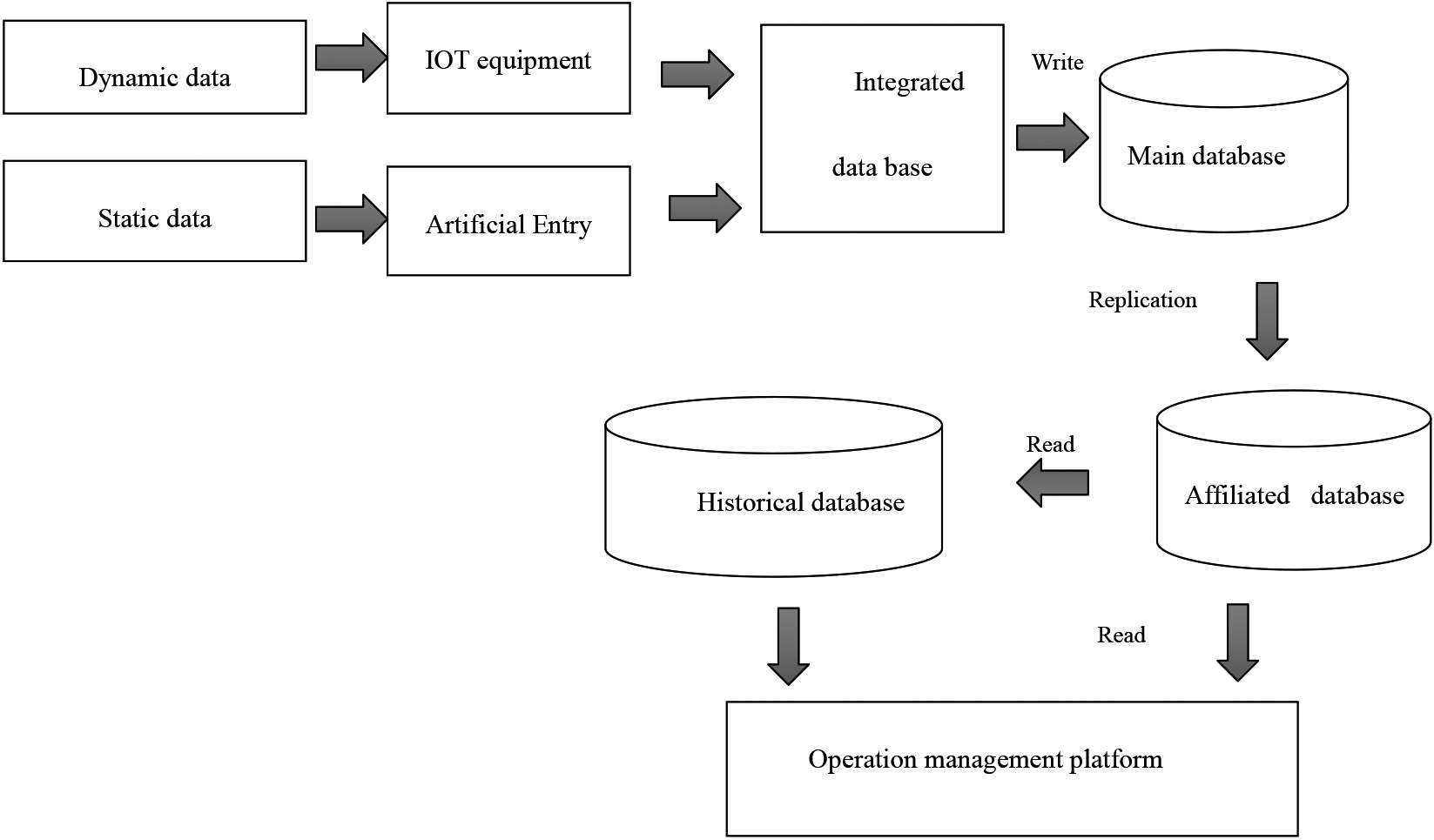
Each layer of the IoT architecture must manage IoT data throughout its life cycle. The IoT data life cycle starts from the physical layer (devices and gateways) of the collected data, through the communication layer of data transmission, and then through the platform service layer of data storage and data processing, and finally to the application layer of data visualization or data reporting. In the process of data capture, the quality of data should be considered, including consistency, integrity, timeliness and reliability. Consistency: Data consistency refers to the correlation between a series of data points reported by the same sensor in a short time. Integrity: the integrity of data refers to whether all supporting data points are available; timeliness: Since so much IoT data is real-time data or near real-time data, it is crucial to determine whether the sensor data or derived data arrive at the point needed in the network on time. Reliability: In order to ensure reliability, sensor measurements must be accurate and repeatable over a given sensor lifetime. When the data is detected to exceed the threshold, that is, the quality of the data does not meet the requirements, it is necessary to discard this part of the data and delete the data of the corresponding master database and slave database.
Based on the most advanced three-dimensional digital design and engineering software to build the “visualization” of the digital model, and three-dimensional visualization is one of its characteristics, the so-called visualization refers not only to we see a simple three-dimensional model, so that any three-dimensional software can be implemented, we described the "visualization" specifically refers to our three-dimensional model with architectural information, and we need to know, can use the building data. Visualization is the most significant difference between traditional CAD and BIM. Visualization based on BIM can improve the communication environment, improve the viewing and reading ability of the project, create a good sense of authenticity and experience of the whole building, give an impression to the management or construction personnel and the owner, and even develop in a good direction according to our preview in the construction process.
IFC or Industry Foundation Class is an open source international standard for BIM data exchange. IFC files are copies of the original files that can be used to browse models, measurement data, simulation tests, collision detection and cost estimation, etc., providing specifications for data exchange and information sharing between BIM software. The IFC standard uploads the original BIM model to the server for data parsing and processing to realize the 3D model presentation in the web page, as shown in Fig. 2 [16, 17]. The interface realizes the fusion of 2D interface and 3D scene by superimposing 2D drawings on 3D scene. The 2D interface realizes the responsive presentation of mobile phone and computer through the mechanism of automatic layout. The spatial positioning of community, building construction and various professional facilities and equipment (including hidden works such as pipelines) can be accurate, intuitive and convenient to find.
3D visualization effect of a pump room site.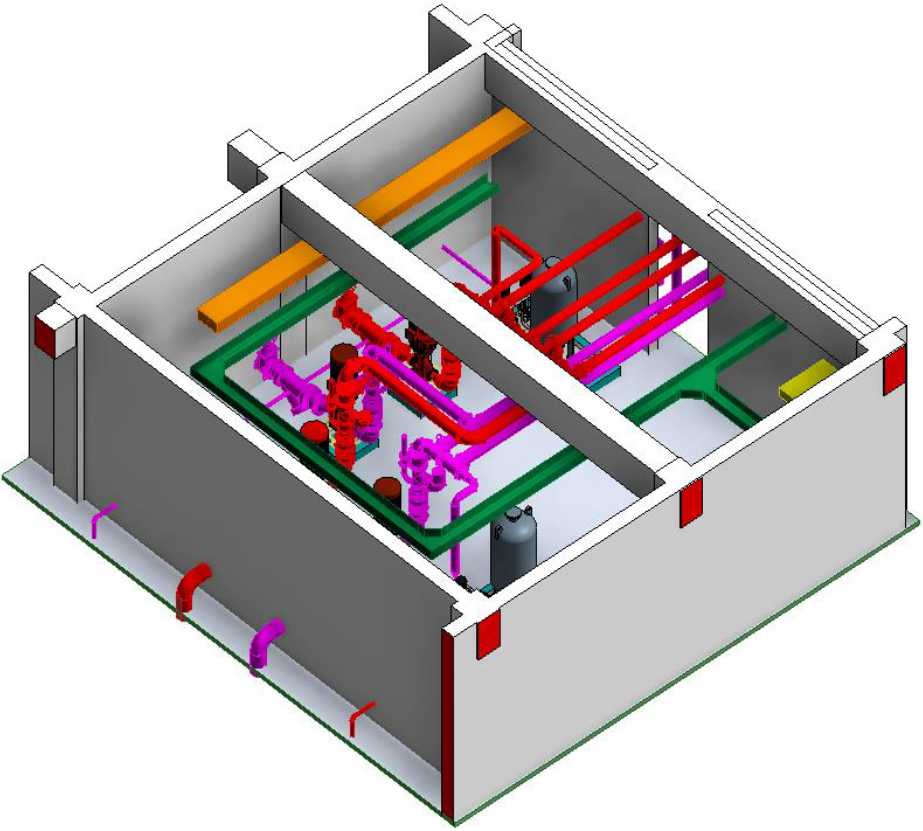
The participation of BIM technology in each stage of the whole life cycle of the project makes it possible for all participants to obtain the basic data related to the project quickly and accurately, especially the application in the construction stage, which provides data basis for managers to make decisions. BIM technology can help many participants in the project work together in the BIM information management platform, which is conducive to the progress management, quality management, safety management and cost management of the project, greatly improving the efficiency of project management and reducing the construction cost. Secondly, with the support of Internet technology, artificial intelligence technology and big data technology, BIM technology improves the information exchange mode and reduces the communication cost.
The operation and maintenance management architecture of a smart building is mainly divided into five layers, namely, collection layer, network layer, data layer, platform layer and application layer, as shown in Fig. 3. Based on BIM and IoT technology, this paper builds a smart building operation and maintenance management platform, which mainly realizes the functions of three-dimensional visualization of data, equipment operation and maintenance management and humanized space [18, 19]. The Internet of Things can provide many functional services, such as real-time monitoring, remote tracking, automatic update, plan management and a series of personalized services and management, to achieve the management, control and detection of various things, and ensure the high-speed and effective operation of the system. The emergence of the building system of modern communication network technology has brought many conveniences to people, and there is still a broad space for development. The combination of new Internet of Things technology and intelligent buildings will certainly be an important development direction.
Intelligent building operation and maintenance management architecture.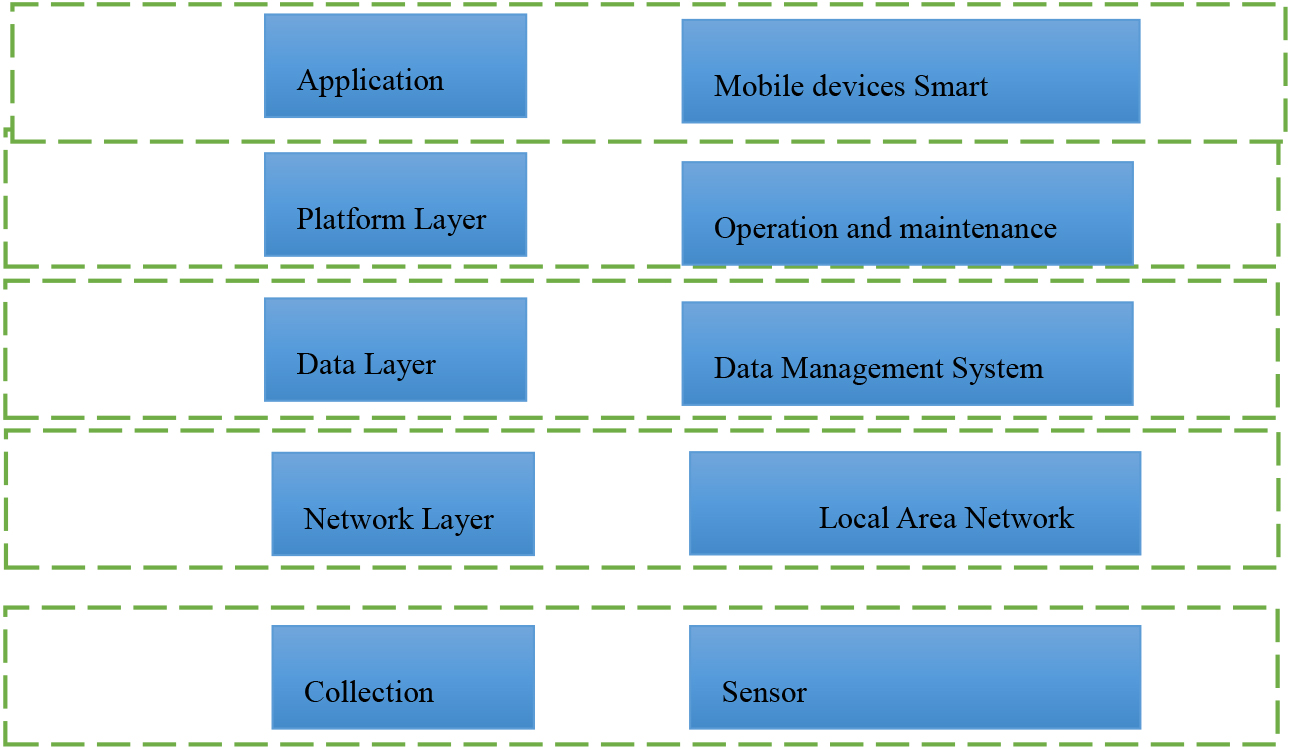
The platform stores the BIM 3D model, in which the information of the whole life cycle of the building is saved. The platform not only makes the integrity of this information guaranteed, but also makes this information available for quick access and invocation. The platform also stores the IFC model file of the building, and the 3D display model of the smart building is obtained through rendering, and users can browse it directly through the cloud [20].
The equipment in the smart building needs regular maintenance and servicing, and the faulty machines also need to be repaired and replaced. The maintenance records, repair records and replacement records of the equipment have significant reference value for the stable operation of the equipment in the building. The operation and maintenance personnel can upload the operation and maintenance records of the equipment directly to the platform, and the platform can generate the operation and maintenance history records of the target equipment after processing the data, which provides data support for the later operation and maintenance work. And in the operation and maintenance work, the platform can give the operation and maintenance personnel to provide detailed information about the equipment and accurate equipment positioning, significantly improving the efficiency of operation and maintenance [21].
The main service object of intelligent buildings is people, so the design of the building operation and maintenance management platform needs to take into account the user experience, so that users can work and live in a comfortable space. The first thing that needs to be solved in the humanized space is the environment in the building, to ensure that the space has a pleasant temperature and humidity, air quality and light conditions, etc. The second is to solve the problem of equipment control, providing users with remote control solutions to effectively increase management efficiency and reduce resource waste [22, 23].
In the design and operation and maintenance stage of intelligent building, the problems related to building data management are (1) data acquisition depends on manual (2) data processing efficiency is low (3) data storage is scattered and messy (4) data interaction is difficult and slow (5) data visualization is low. In order to solve these problems, we build a smart building design and operation and maintenance model.
Management of static data
Static data management is a relatively unchanged working procedure, rules and regulations and a traditional atmosphere that people determine according to the law of activity and management. Static management can make the work carried out by the society institutionalized and standardized, so that there are rules to follow, there are rules to follow, develop a relatively unified work habits and management methods, to achieve the purpose of improving work efficiency.
In the design phase of the smart building, the building information model is constructed by BIM related software, and the data in the building is edited and recorded during the modeling process. The details are shown in Fig. 4. The positioning, size, and material of the windows in the building are shown in Table 1 to ensure consistency with the built model [24].
Parameter data
Parameter data
Window editing in BIM model.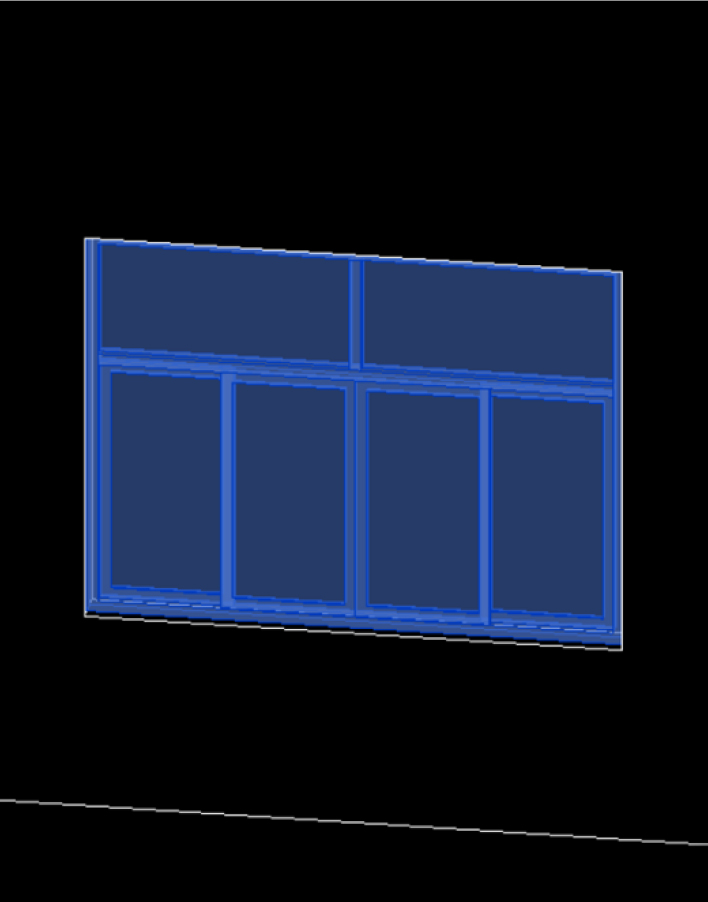
In terms of electromechanical modeling, BIM can also model bridges, water pipes, air ducts and related electromechanical equipment. The material, size and positioning of pipelines can be edited and recorded, and pipeline synthesis through BIM models can effectively avoid pipeline collisions, as shown in Fig. 5 [25].
Electromechanical pipeline synthesis in BIM model.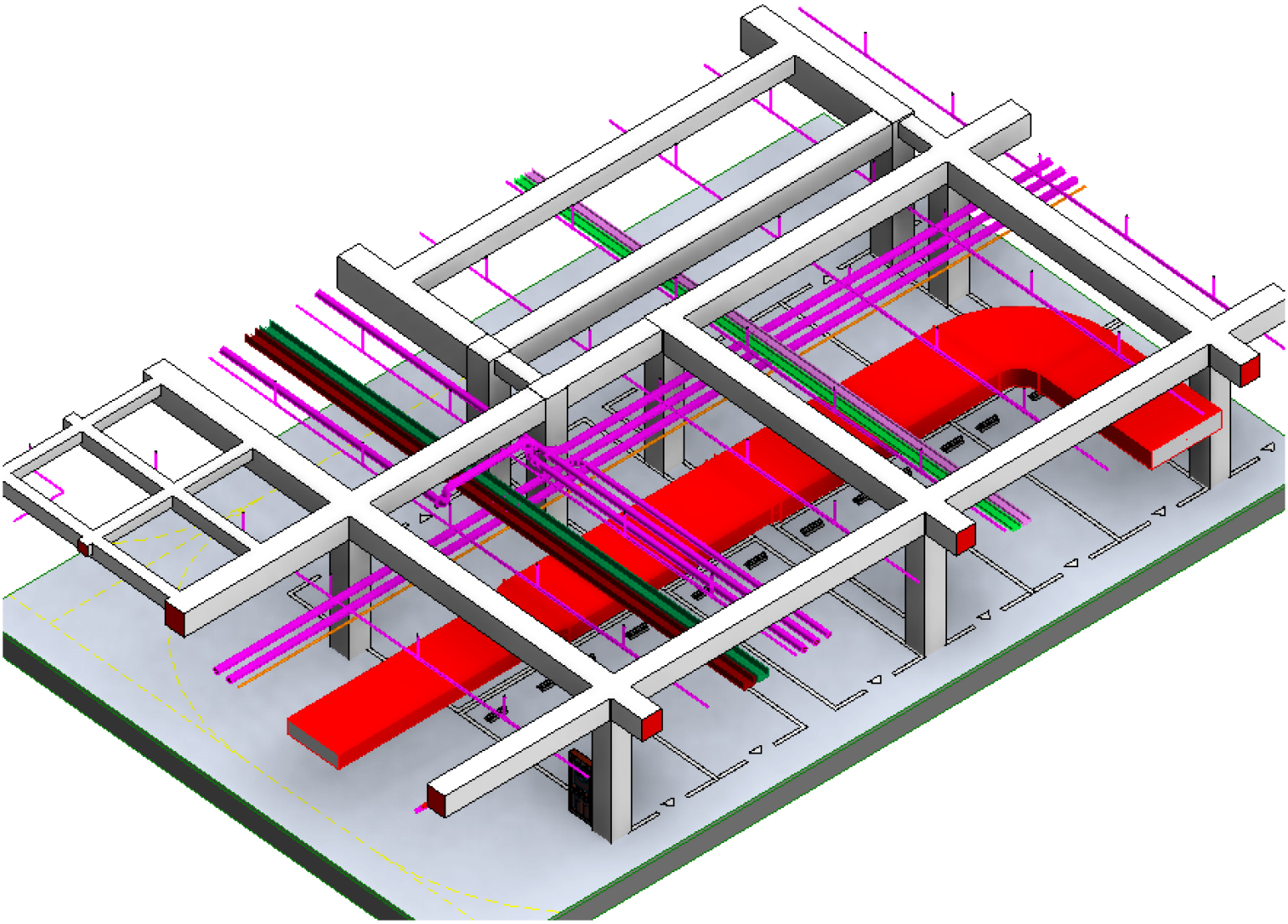
A project from the beginning of the preliminary design to the completion of acceptance, often there will be multiple design changes, through the BIM model can record and store the data generated by each design change for later search and call.
IoT technology needs to rely on a large number of sensing equipment, communication equipment and storage equipment to collect, transmit and store data, and there are many kinds of dynamic data in the building space, and there are many kinds of sensing equipment needed. These equipments and their supporting pipeline bridge and data room need to complete the positioning and layout in the design stage. Through the three-dimensional visualization technology of BIM model, a more reasonable layout can be found for sensor equipment and data room. The specific implementation of the planning and layout of the Internet of Things equipment needs to use the cloud platform. The Internet of Things equipment reports data to the cloud Internet of Things (IoT) platform, and then the cloud Internet of Things (IoT) platform stores the reported data in DB. Of course, the data reported by the device can also be synchronized to the user’s server through the AMQP service. When the user manages the device, the open API is called to pass the control instructions to the user. In this way, through the planning of the line of the Internet of things, in the process of BIM pipeline synthesis, the intelligent pipeline bridge can also be optimized to ensure the functional requirements and avoid pipeline collision. As shown in Fig. 6 [26].
Layout of intelligent pipeline bridge in BIM model.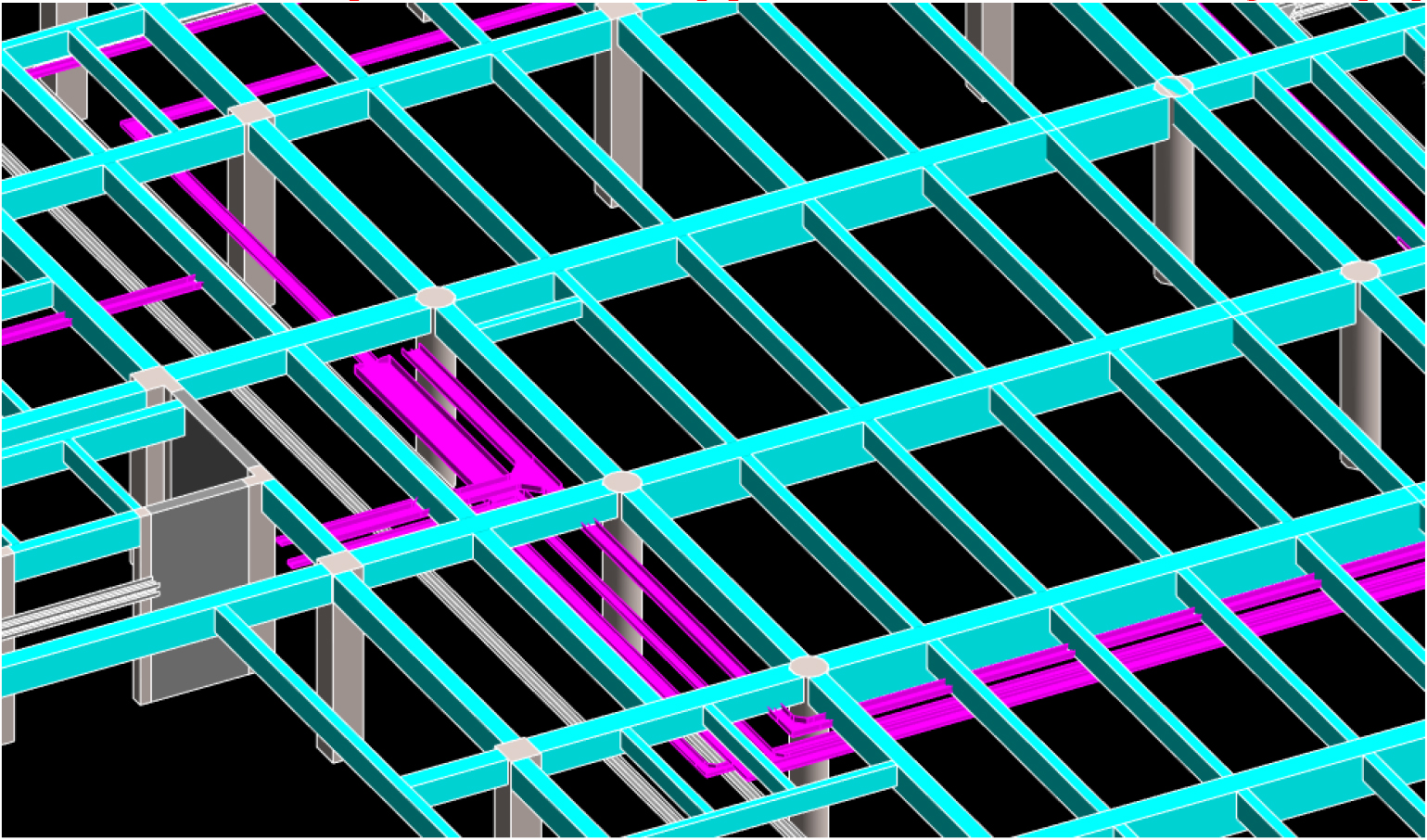
This model is mainly achieved by the Eqs (1)–(4).
In this model,
Starting from the preliminary design stage of the smart building, the BIM model is created, and each design change before the completion of the project is recorded to continuously deepen the BIM model. For the equipment information in the smart building, it is necessary to cooperate with the equipment supplier to enter the parameters of the equipment as detailed as possible, such as size, material, function and maintenance information. Through the continuous updating and improvement of the BIM model, the final completion model is formed, which is almost consistent with the state of the project at the time of completion, as shown in Fig. 7. The completion model is imported into the management platform without damage, and the visual management of data in smart buildings is realized through the combination of BIM and IoT technology. The three-dimensional visualization of data can integrate various monitoring data information, create a unified monitoring dialog box, change the state of the monitoring data island, and maintain a dedicated monitoring tool. The use value and profit maximization of the monitor data information. The page design is vivid, and the graphics are watched immediately. Non-room monitors are easy to operate and start. Three-dimensional visualization of data can also achieve multi-data source access to directly connect background data. Data sources such as crawling network data are more conducive to the analysis of data rules. And the visual effect is diverse, more beautiful atmosphere, use more simple [27].
BIM completion model display.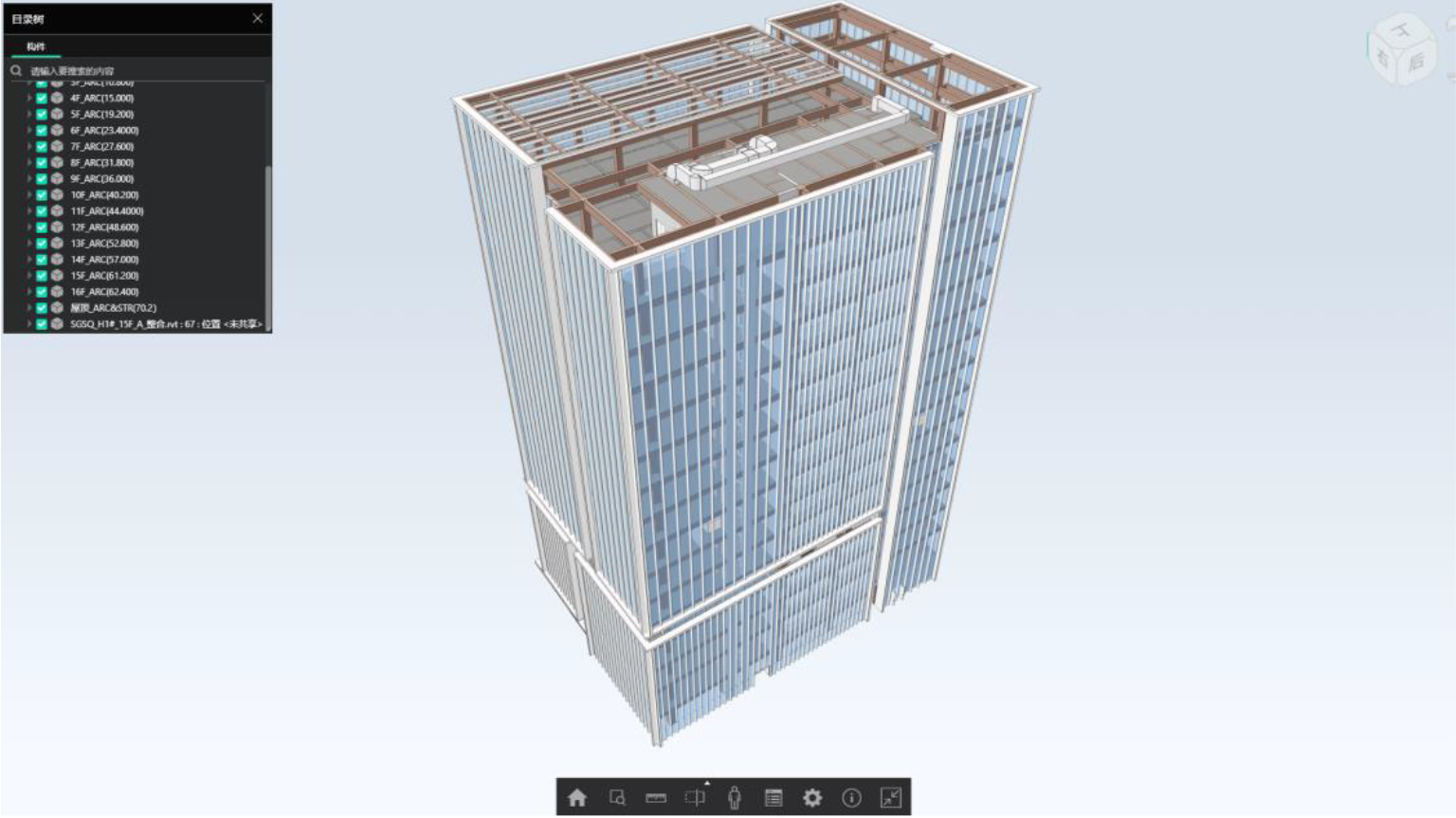
Management of dynamic data
Through IoT technology, various sensing devices arranged in smart buildings (shown in Fig. 8) can realize real-time monitoring of various dynamic data in building space, including environmental data, equipment operation data and personnel flow data. These data will be uploaded to the data management system through the network. When some data exceeds the threshold, the corresponding device will be triggered to adjust or send an alarm signal to the manager.
Sensors.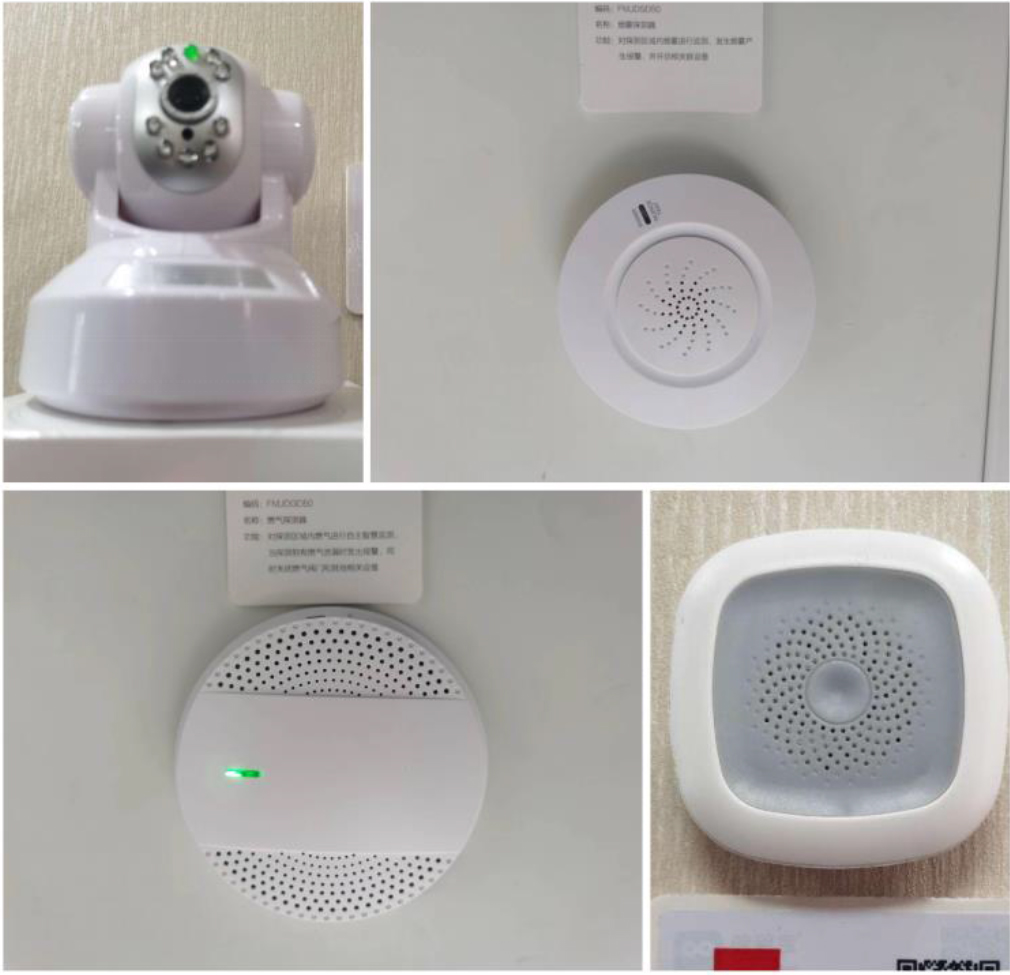
The completion model generated during the design and construction of smart buildings often loses its value after the completion of the project, and the model data is difficult to be fully utilized. In the process of building use and operation and maintenance, sometimes we will encounter the transformation of the existing spatial structure. The completion model can provide accurate building data for the transformation plan. In the process of project transformation, it is also necessary to update the generated change data to the model in time to ensure that the model information is always consistent with the current situation of the building.
Many equipment in smart buildings need to replace new equipment when they reach the working life or damage. The manufacturer and model of the original equipment can be directly obtained in the model data, and directly purchased and replaced. If you need to replace different types of machines, you can also select the appropriate equipment for replacement through the interface information, equipment power, pipeline position, space size and other data in the model data. Regardless of whether the device model is replaced, the data information for the new device needs to be updated to the building model for subsequent operational management.
Three-dimensional visualization of data
In the operation and maintenance process of smart buildings, BIM technology can provide users with a three-dimensional visual space model, allowing users to more intuitively view the layout structure in the building space, overcoming the problem that the traditional two-dimensional drawings are too abstract in spatial expression, as shown in Fig. 9.
However, the BIM model can only view the static data in the building, and lacks the means of collection and management of real-time dynamic data. The data storage framework based on IoT can effectively solve the problem of multi-source heterogeneous data. With IoT database as the core, various dynamic data in smart buildings are collected by sensors and displayed in BIM three-dimensional model in real time.
Three modules of intelligent building management system based on BIM+ IoT
By refining the module of the intelligent building management system, the management content of the environmental management module is clarified. Through the setting of parameters, the influence of environmental factors including temperature and humidity management on the construction of intelligent buildings is expounded, so as to refine the intelligent building management system and implement the model constructed in this paper [28].
Parameters
Parameters
Three-dimensional visualization of a basement.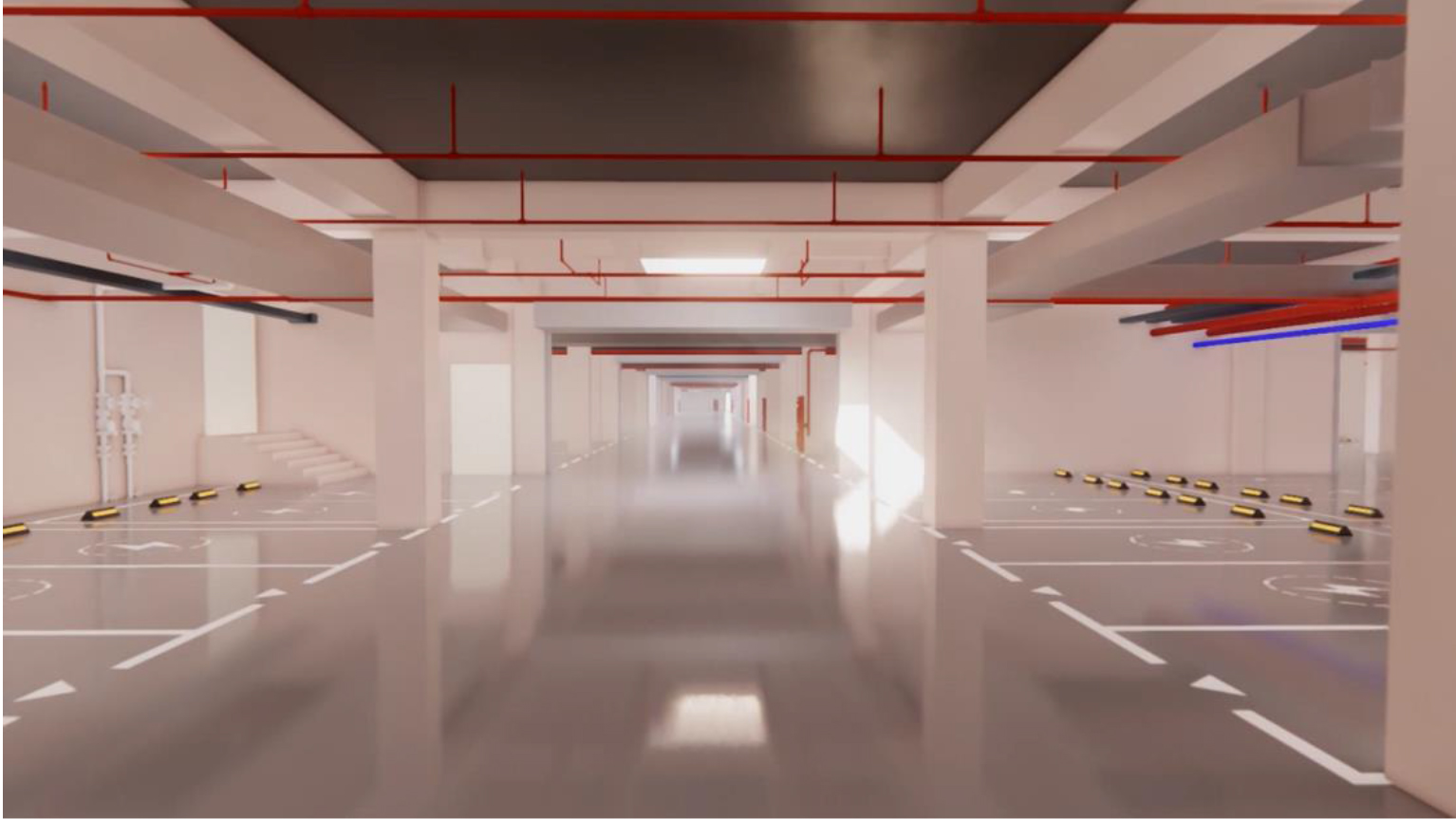
In the operation and maintenance process of smart buildings, it is very important to provide users with a comfortable and healthy environment. Through IoT technology, various sensors related to environmental monitoring are arranged in the building to monitor the environmental changes in the building in real time. At the same time, intelligent linkage of fresh air, air conditioning and heating equipment for environmental management. [29].
The specific parameters are shown in Table 2.
In Table 2, both air quality and lighting quality are A+. The researchers divided air quality and lighting quality into three levels, namely A-, A, and A+. In this experiment, both air quality and lighting quality are A+.
Temperature and humidity management: through the temperature and humidity sensor to monitor each space in the intelligent building, and upload the monitoring data to the data management system, combined with air conditioning equipment control module to the temperature and humidity in the building space linkage control. For areas with dense personnel activities or mechanical equipment, real-time monitoring of temperature and humidity is required, and other areas with lower temperature and humidity requirements can be manually adjusted. Light management: There are unstable fluctuations in ambient light changes in smart buildings, which are not only affected by day and night, but also by factors such as season, weather and building orientation. Ambient light monitoring indicators are mainly illuminance, brightness and color temperature, etc., through the different indicators of data [30].
The difference between the model constructed in this paper and the general building model is that (1) Intelligent buildings improve the energy efficiency, availability, safety and accessibility of building space. (2) The introduction of new control systems and automation technologies makes it possible to develop buildings that reduce energy consumption, improve the environment, safety of occupants or users who frequently use their facilities, and reduce environmental impacts through the responsible use of resources. (3) Through the integration of artificial intelligence, machine learning and the Internet of Things, a self-management program that can control advanced security devices and systems is developed. In short, the emergence of intelligent buildings has improved the problems existing in the traditional construction industry [31, 32].
With the development of the times, the degree of intelligence of buildings is getting higher and higher, and the setting of intelligent systems is becoming more and more abundant. The concept of intelligent buildings came into being. Problems related to building data management in the design and operation and maintenance stages of smart buildings (1) Data collection depends on manual work (2) Data processing efficiency is low (3) Data storage is scattered and messy (4) Data interaction is difficult and slow (5) Data visualization is low. In order to solve these problems, we have realized the design model of intelligent building based on IoT data management system, BIM three-dimensional visualization technology, BIM and IoT operation and maintenance management platform. In the application process, we tested the static data and dynamic data respectively, and obtained good structure. Finally, we put forward the three modules of intelligent building management system are environmental management module, equipment management module, personnel management module, build a complete intelligent building management system.
The innovation of the article is reflected in the following three points. (1) The article integrates BIM and IoT technologies into the smart building and design and operation and maintenance stages, and the theme is novel and commendable. (2) The smart building and design and operation and maintenance model based on bam and IoT technology shows the professionalism of the article. (3) The article first points out the problems existing in the design and operation and maintenance stage of the smart building, and then solves the problem. According to the idea of asking questions to solve problems, this is also one of the innovations of the article.
In the future, intelligent buildings will change towards the trend of intelligence. The specific trends are (1) automatic operation of building functions (2) energy-saving operation of buildings (3) automatic communication (4) automatic security.
Footnotes
Fundings
This study was supported by the Shaanxi Provincial Social Science Foundation project 2020: Digital protection and inheritance of traditional Embroidery art of Qiang nationality in southern Shaanxi under the background of “One Belt and One Road” (NO: 2020J042); Xi’an Social Science Planning Fund project 2021: Digital application and promotion of Shaanxi Qiang Embroidery art in Xi’an Cultural and creative product design (NO: YS16); Humanities and Social Science Project of Ministry of Education 2018: Research on digital Protection of Qiang Traditional Costume Art under the Background of Belt and Road (18XJC760008).