



Abstract
Today, intelligent building includes real information systems based on a large number of sensors and actuators interconnected through communication networks. However, their complexity is also growing. The arrival of the Internet of Things (IoT) paradigms can take an increasingly important place in building energy management, and greatly improves its ability to collect, analyze and render data as knowledge. This complexity and growing data require powerful computing resources that can be provided by the cloud computing paradigm. Despite the widespread use of cloud computing, it presents some problems, such as unacceptable latency, lack of mobility, and localization support. As a result, fog computing has emerged as a promising infrastructure for providing elastic resources at the edge of the network. This paper presents a new Fog and location based smart building energy management framework, an integrated structure in which applications running on objects compute, route, and communicate together via the IoT devices installed in the building. This holistic framework decreases latency and improves energy saving and the efficiency of services among things with different capabilities. In addition, the location of users used in our framework, rationalizes energy consumption in buildings. To demonstrate the effectiveness of the proposed framework, we conducted our experiments in an appropriate virtual scenario describing the details of this approach.
Introduction
Buildings are important components of smart grids, their energy efficiency is vital to the environment and global sustainability. A building energy management system (BEMS) is essential to control energy production and consumption. Thus, energy efficiency and cost savings in smart buildings depend greatly on monitoring and control methods used in the installed BEMS. Improved technology, cost and feature size, devices enabled everywhere, to be connected and interactive, such as IoT, is the most recently emerged technology in the scientific area. Smart building can be considered as one of the main areas of IoT application [17, 21].
Growing complexity and data, due to the growing number of devices such as sensors, actuators in an environment like smart building, requires powerful computing resources that must be provided by cloud computing. In a real world or one second delay can make a huge difference, communicating objects will need to exchange huge amounts of data and in a faster way. Although cloud computing has been achieved through storage and sharing services that users can store and access to any connected terminal in the world, this paradigm shows some weaknesses compared to the two needs mentioned above.
Another competing or complementary paradigm is more suited to IoT, it is the fog computing, which is referred to a decentralized infrastructure where computing and analytics resources are distributed in the most effective places [18]. Instead of processing everything, and therefore of sending everything to the Cloud, it is a matter of storing and processing the data locally, directly on the connected object which will increase the communication value and reduce the latency in the network. Architectures in cloud computing will not be able to handle the communication requirements of the IoT; that is why we can trust that the future will make a huge place to fog computing.
Early work on this topic focused on providing smart mechanisms and architectures for energy management systems in smart buildings. After the emergence of the new technology of the IoT, all researchers went to use and apply this technology in this area. Despite its imperfections, most of these proposed solutions are based on the cloud computing paradigm. Recently, some of them proposed to use the new paradigm of fog computing, but these solutions remain partial because they do not cover all the problems related to this field. In this sense, we have thought of proposing a holistic solution to all the problems related to the intelligent management of energy use in buildings.
The methodology used in this work is based on a selection of the most relevant recent developments published in the literature covering the field of IoT, cloud computing, smart grid and energy management in the smart building. On this basis, we have proposed a holistic framework for energy management in smart buildings that not only included the main features of this literature review, but that applies, as novelty, this modern fog computing paradigm.
Fog computing is the appropriate platform for a number of critical IoT services and applications, such as smart grid, smart building and even smart cities, and, in general, Wireless Sensors Networks (WSNs). Therefore, we consider Smart Building as a WSN representing the environment in which our Fog framework is applied. This has led us to deliberately separate, in this work, fog computing, that plays the role of a paradigm to be applied, from WSN, that play the role of application environment. In addition, we introduce the technique of user’s location in this repository in order to rationalize the use of energy in the building. The fog computing paradigm has greatly facilitated the use of this technique.
To model this framework, we identified the abstract concepts that compose it and the relations between them in an UML1 class diagram. In order to demonstrate the effectiveness of this solution, we used this framework in a virtual scenario with two types of buildings, home and office. Of course, we have focused so much on the technique of user location. Finally, we compared energy consumptions of these buildings with those related to other buildings don’t exploiting this solution; the results were very positive.
This paper is organized as follows. In Section 2, relevant previous works are discussed. Section 3 presents our contributions by proposing a new and holistic framework; it is an IoT Fog location based framework. Section 4 presents a virtual scenario for the application of the corresponding framework to show the effectiveness of the proposed idea. Section 5 discusses what we have added to the literature through a comparative study of our contributions with some related works. The last section concludes this paper and offers future work.
Literature review
In this section, we present the relevant literature attempts identified by our work. The documents discussed here semantically fall into a category concerning solutions based on IoT, cloud computing, and fog computing for the smart building, mainly from the neighboring fields of home or building automation, or computing applications based on user’s location.
In the scope of IoT, research aims to increase the value of smart buildings by giving them another ability to offer new levels of insight and control. In Bao et al. [14], authors present the challenges and issues in smart buildings identified over years of research in real buildings. To address these challenges, a decentralized service-oriented architecture based on message-oriented middleware has been implemented. This architecture facilitates device abstraction, protocol adaptation, scalability and maintainability. However, no scheme of a framework or system has been presented in this work, thus compromising the effectiveness of the proposed solution. Increasing complexity and data, due to the growing number of IoT devices, requires the powerful computing resources which are available in the Cloud. In this range, several efforts have been performed to integrate IoT with cloud computing for the issue of energy management in smart buildings. In Risteska Stojkoska and Trivodaliev [5], the authors propose a holistic framework that incorporates the different components of IoT architectures and frameworks proposed in the literature, in order to effectively integrate smart home objects into a cloud-based solution. The effort in Carrillo et al. [7] presents a framework used to provide the needed computational power to the smart building by using cloud computing. The idea is to have all the computational power as well as control and monitor capabilities in the Cloud. A facility which is intended to be a smart building integrated to the IoT is provided. Most of these solutions are non-exhaustive and are designed to solve partial problems of this theme. In addition, the problems existing in cloud computing are almost all supported in the new paradigm fog computing that is not mentioned in these works. There are presently little existing works about fog computing platforms for smart buildings. Nevertheless, we will discuss some work related to this topic in the remainder of this section.
The effort in Faruque and Vatanparvar [15] presents fog computing as a new platform for home energy management. The scalability, adaptability, and open source software/hardware are featured in this platform allowing the user to implement the energy management with the customized control-as-services, while minimizing the implementation cost and time-to-market. To demonstrate energy management as a service over this platform, the authors implemented and experimented with two prototypes: Home and Micro Grid. However, shifting the processing of high-power central processing nodes to smaller devices on the edge of the network requires careful description and needs to be well detailed. It is therefore necessary to better describe how the calculation and the analysis can be done closer to the data entry site to complete the analysis that would be undertaken at the data center. For this, authors in Javed et al. [1] describe how the fog computing paradigm can be utilized to support this requirement, extending the capability of a data center to take charge of energy management within the building. Further, the work suggested in Naranjo et al. [22] presents a Fog-supported smart city network architecture called Fog Computing Architecture Network (FOCAN). The main objective of this architecture is energy consumption minimization, improvement in intra fog communication and wired/wireless communication by the overall framework. FOCAN allows effective communication and transmission in small regions, hence providing the energy aware Fog supported system. The authors have proposed a model to implement their framework but it is difficult to know the effectiveness of its implementation on a real city. Also, the study of the ubiquitous mobile Internet and computing applications based on Smartphone presents particular research interest. In Pan et al. [11], the authors proposed a smart framework with user location-based energy control, which uses Smartphone platforms and cloud computing technologies, including the energy proportionality of the building and the user. On another hand, the authors in Luan et al. [25] propose a system architecture allowing to take advantage of the fog computing paradigm for applications based on the user’s location. Fog computing is used to respond to service requests on location information. Because the fog computing makes the service closer to the user, by taking advantage and inspiring of what these two works bring, we can emphasize that by applying the idea proposed in Pan et al. [11], which consists of the adjustment of energy consumption policies in buildings, we can get a framework that is smarter in terms of performance, faster in terms of reaction and less cost in terms of implementation.
Summarizing, the above references reveal some issues related to how the current trends address the critical need to use IoT technology in these solutions to improve performance, while recognizing that energy management in smart buildings should extend to an IoT based on the new paradigm of fog computing. To the present time, all these great efforts have not exhausted all what can be done by applying the IoT technology based on the new paradigm of fog computing, for the benefit of smart building. This is the main motivation for the Fog location-based framework that we propose in next section.
Fog location-based framework
In this section, we present our framework for automated control of energy in smart buildings based on the location of users. This framework can be considered as a modified version of the most general model we found in the literature proposed by the authors of [5], augmented with fog computing, user location, and compatible middleware. More specifically, it is an envelope or a generalization of all the key features of IoT solutions integrated with fog computing for smart buildings. Figure 1 illustrates its general architecture.
This framework is distinguished by the fact that it is designed on the basis of the following contributions:
Fog location-based framework.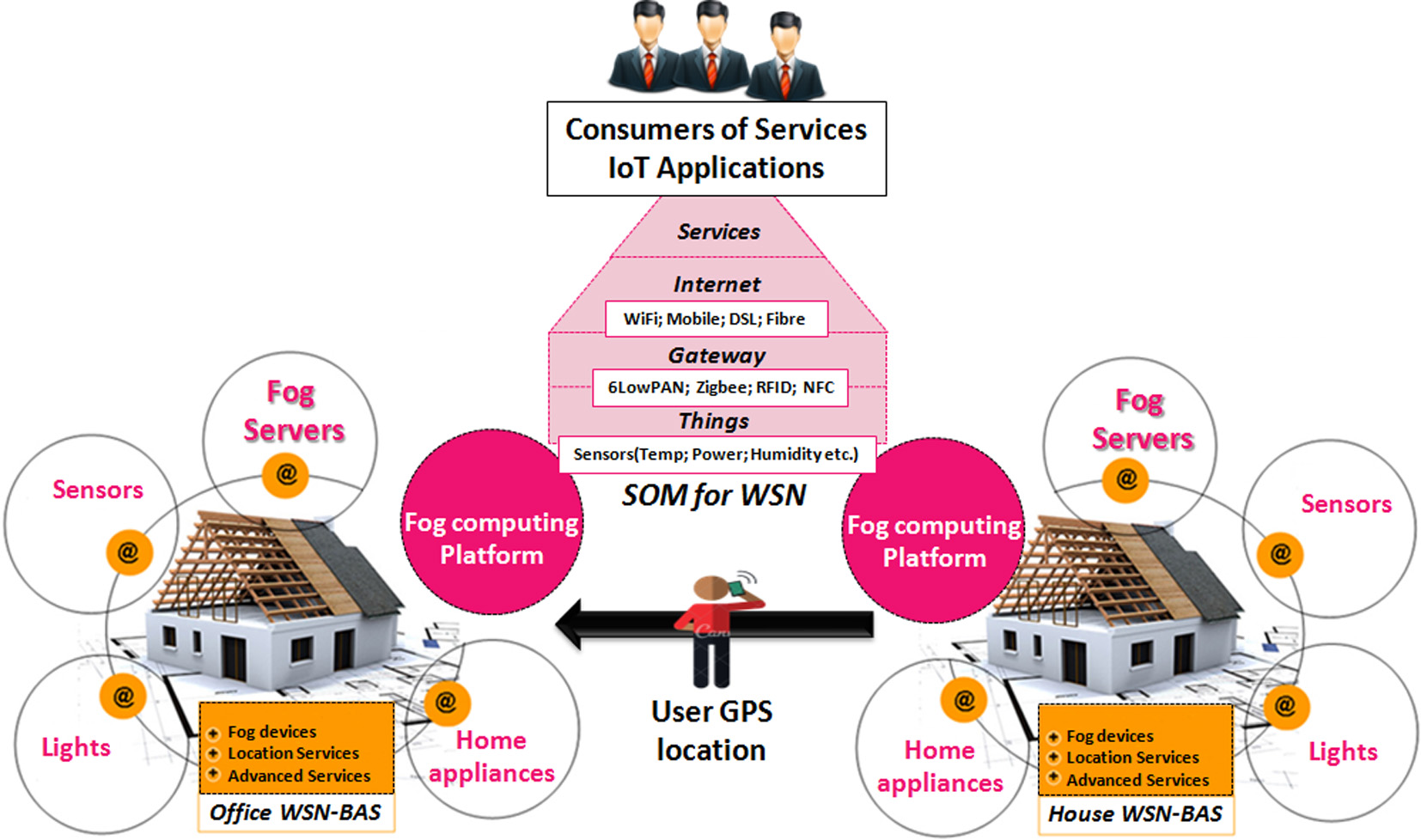
Wireless Sensor Network for Building Automation System (WSN-BAS), Service Oriented Middleware for WSN (SOM for WSN), Fog Computing Platform, And GPS2 location of users.
Framework class diagram.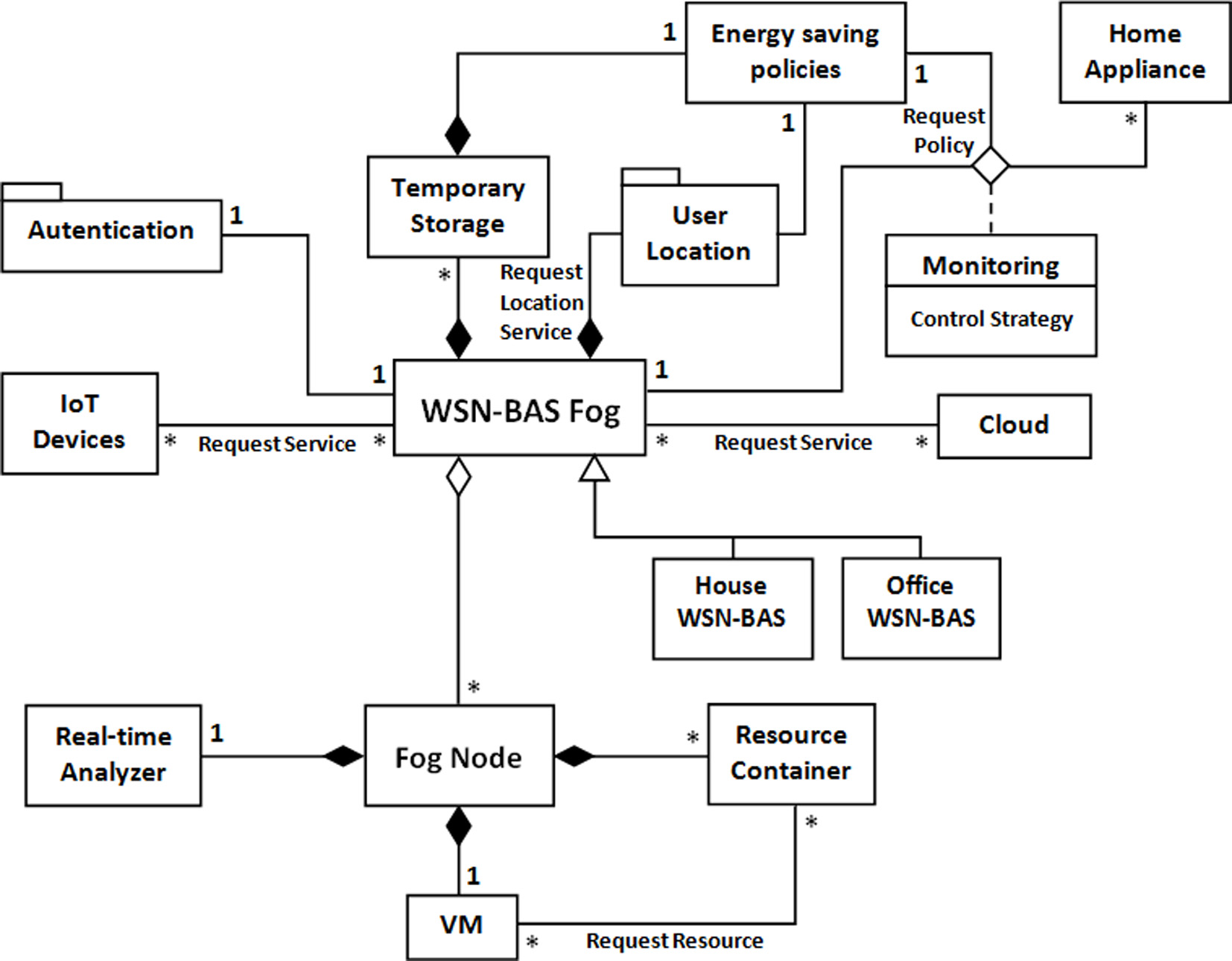
Our current work also includes modeling fog computing. Indeed, fog computing is a highly virtualized platform that provides computing, storage, and networking services between end devices and cloud computing data centers. Fog computing systems are key systems for IoT, they can intelligently control smart buildings and even smart grids [8].
We have completed a pattern for our fog location-based framework. Figure 2 shows its class diagram. As we know, fog computing is an interface layer between end users/end devices and distant cloud data centers, with the aim of satisfying mobility support, locational awareness, geo-distribution, and low latency requirements for IoT applications. In this case, our Fog layer is the Wireless Sensor Network for the Building Automation System (WSN-BAS Fog). This WSN-BAS Fog is a collection of several distributed tiny Clouds called Fog Nodes. A Fog Node has resources which include hardware (compute, networking, and storage). They can be resource-rich servers, routers, access points, mobile devices, etc.
A WSN-BAS, either at home (House WSN-BAS) or at the office (Office WSN-BAS) will monitor the behavior of Home Appliances, and depending on the User Location, a control strategy triggers an Energy Saving Policy based on collected application data and relevant metadata. This real-time information must be used as quickly as possible before it leaves the Fog to be stored permanently in the data centers of the cloud layer. A distributed database temporarily stores this application data and the necessary metadata for service orchestration. WSN-BAS Fog can use the services provided by the Cloud to fully satisfy connected IoT device service requests; service orchestration is rules-based.
Fog also provides Authentication services. It provides real-time analytics using what is called a Real-time Analyzer. Applications can be hosted in Fog nodes using virtualization, that is, with the creation of VMs and/or Resource Containers.
Building automation is the automatic centralized control of a building’s heating, ventilation and air conditioning, lighting and other systems through a building automation system (BAS). Most BASs use wired connections, and these wired networks show good efficiency, but wired systems are difficult and expensive to install and update [13]. For this reason, wireless connections are emerging and provide new topologies and mechanisms for building automation (WSN for BAS). In this work, we will focus at home and at the office and this is because they are more used in our general life. Then we consider two types of WSN-BAS:
House WSN-BAS, And Office WSN-BAS.
These are two different environments, but our goal is common: to control the equipment that consumes energy in these two buildings from its local networks; we also want to separate the operation of the complete process of this control of the Cloud and this to respect the new doctrine imposed by the paradigm of the fog computing. We will rely on Fog servers that should be closer to the data collection points.
Figure 3 depicts a wired network and an equivalent wireless network. An area describes a small local physical within a building, typically a room. BAS uses sensor and actuator networks in the building halls to control their heating, ventilation and air conditioning, while ensuring high comfort with low energy consumption [12]. Controllers deployed in an area are most often stand-alone devices that provide the necessary functionality without additional support from the upper layers of the architecture. Common sensors feeding area controllers include temperature, occupancy, ambient lighting load, home appliances loads, and smoke detectors. Actuation includes temperature set point, airflow adjustment, light, home appliances and other building features.
Examples of application zones
Wired and wireless topological hierarchy of BAS.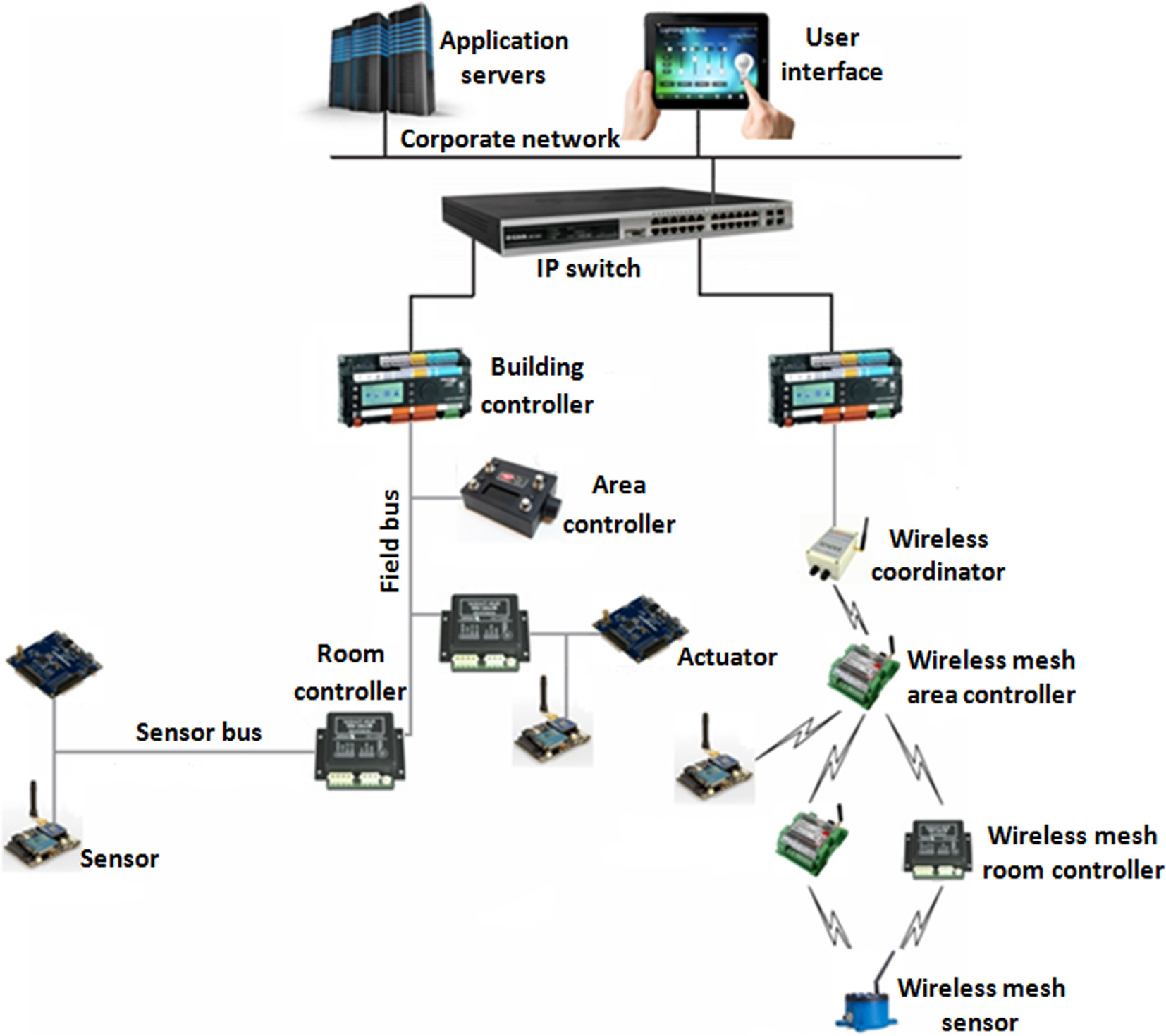
Zone control supports a similar set of characteristics as the area control, albeit to an extended space. A zone is a logical grouping or functional division of a building that is mapped to a physical environment, such as a floor. A list of zone controller characteristics is defined in Table 1.
Building controllers provide the overall orchestration of the system, while sensors and area controllers provide real-time focused applications. The building controllers also provide the view ports into the embedded real-time systems for the operator, integrators, and building control applications including the building energy consumption.
Figure 4 shows the components that can exist in a fog computing platform for buildings energy management, which are WSN-BAS fog node, sensor node, local user and the Cloud [24]. In the WSN-BAS fog node, the most critical components are: the communication service and cloud support. Communication service is responsible for communication between the local user and the BEMS. The communicated messages can be of authentication to access the platform, as of management to adjust policies for managing energy consumption in the building. Cloud support delivers services that are not present in the Fog liner.
In addition to the above, we explain some other necessary components of the WSN-BAS fog node, which may be platform services or platform infrastructure components:
Platform services
The following are the essential services that the platform must provide to cover its task of managing energy in smart buildings:
Components for fog computing platform.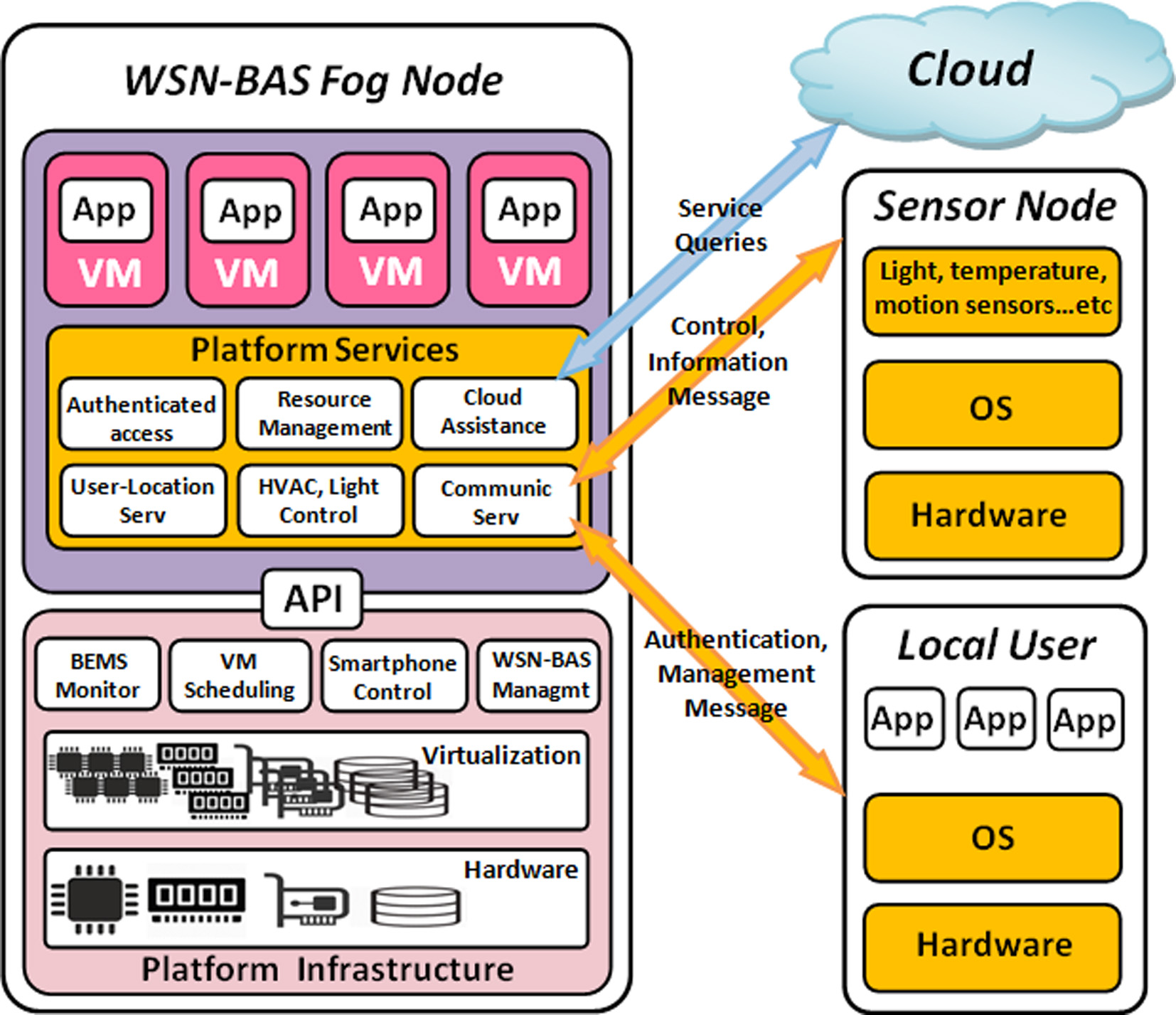
Authentication access: Like any other environment, the management of energy consumption in buildings requires its own access control system [6]. Therefore, we must support a model to ensure that the fog computing services and resources from our platform will not be obtained only through a correct authentication. HVAC, lighting control: Building automation is the automatic and dynamic centralized control of a building’s HVAC, lighting and other systems through a building management system (BMS). The main challenges in HVAC and lighting control in the fog computing shell are how to deal with dynamic. The dynamic has three fold: (1) radio/wireless network access is highly dynamic, (2) nodes in the Fog network are highly dynamic, (3) resources in the Fog are highly dynamic [23]. Resource management: The functions of this component are resource discovery, resource allocation and dynamic resource pooling, as well as ensuring access and exit from the fog node, in addition to providing them in a timely manner and storing them in ways that they can be easily retrieved. We must also support a storage resource management model that needs to be built on the top. User-Location Services (ULSs): ULSs must track mobile end-users, and share location information between the fog nodes involved. It also calculates the distances between end users and their buildings by mapping network locations to the physical locations of their cell phones. As a result, end users can turn lights and appliances on/off from their cell phones wherever they are right with WeMo
The following elements are the supports, the essential basis of the platform, its maintenance or its operation:
BEMS Monitor: This component provides useful information to monitor the BEMS itself. This information concerns the workload, the use of the BEMS, the power required, etc. This information helps the organization’s decision-making and even serves the proper functioning of other components of the platform. Virtual Machine (VM) Scheduling: Due to the need for fog computing, VM scheduling requires a brand new design. New emerging concepts in fog computing; namely the use of the system, the work load, the location information and the mobility scheme; require a complete rethinking of the solution. New planning strategies are needed to provide an optimal solution for VM Scheduling. Control by Smartphone: We live in a time when home appliances are becoming more “smart" and even where we can use our Smartphone to manage them. These devices have more powerful computer chips installed in their plastic/stainless steel cases and they can communicate with each other and with the Smartphone through Wi-Fi connectivity. Without a mandatory return to the Cloud, fog computing can guarantee this control just with the equipment of this communication locally. WSN-BAS Management: The WSN-BAS Management will be an obstacle for fog computing unless we reap the benefits of applying SDN5 and NFV6 techniques. SDN technology is a novel approach that can facilitate our WSN-BAS management and enables programmatically efficient network configuration in order to improve performance and monitoring of this WSN-BAS [4]. NFV is a network architecture concept that uses the technologies of IT virtualization to virtualize entire classes of fog node functions into building blocks that may connect to create communication services.
By seeing the complexity of the scenario due to large amounts of connected objects and circulating data, and for ease of developing applications and services that must be provided by the fog computing platform, the solution is to model our environment (home or office) with a higher level of abstraction, interfacing and interoperability. From a service-developer perspective, the middleware is the only way that can ensure the need for abstraction of data sources [10].
A Middleware is a communication software that allows multiple processes running on one or more machines to interact across a network. One of the recent approaches for using middleware is to support service-oriented architecture (SOA), where researchers have advocated for using SOM over traditional middleware that connects diverse components and systems, and provides multiple channel access to services. Therefore, there is a strong need for services that provide good abstractions to hide the heterogeneity of the underlying sensor environments [16]. These services should be also interoperable with a variety of devices. Middleware services should be transparent to the client applications. In addition, as we rely on fog computing technology, this middleware must finish its task outside the Cloud, that is, at the edge of the network of connected objects (by providing virtualized resources and engaged location-based services to the edge of the mobile networks).
Middleware structure.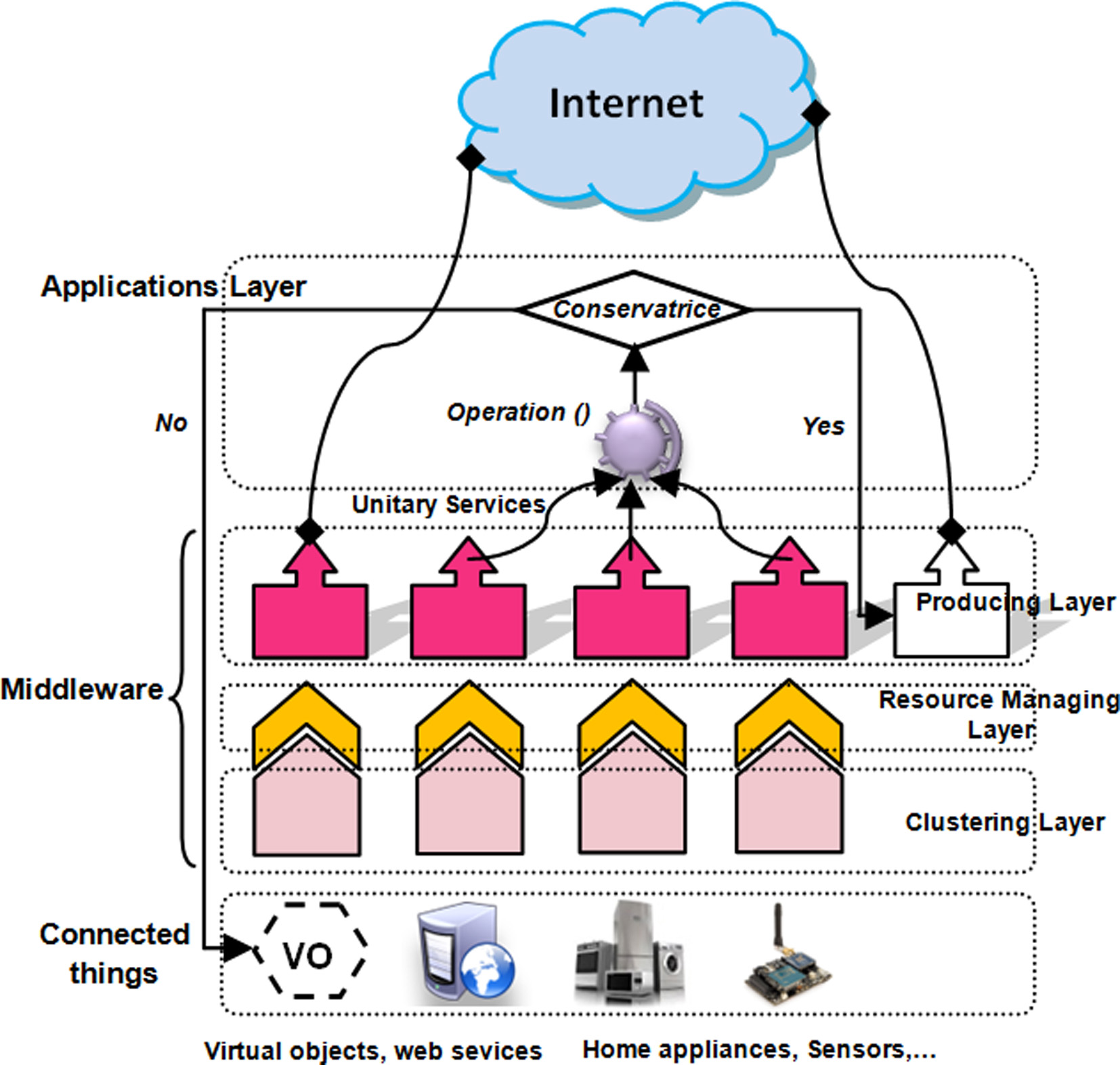
Based on the above, and taking in the mind that this SOM is for WSN, the middleware will be designed to have three layers of services [19, 20]: Cluster Service Layer, Resource Management Service Layer, and Advanced Services Layer that provide direct services to applications such as QoS, security, discovery, reliability, etc. Each layer provides services to the upper layers. For example, applications can use advanced services layer to meet their needs. The advanced services layer will use the resource management layer to effectively use the resources available for performing different services by providing effective mechanisms for allocating and adapting resources. And, the resource management layer uses the services provided by the cluster layer to efficiently process cluster resources (see Fig. 5).
As depicted in Fig. 5, the underlying “Connected Things” (sources of data) comprises sensors, actuators, controllers to home appliances, virtual objects, APIs, classical web services, etc. The “Middleware” comprises three layers; Clustering layer, Resources managing layer, and Producing layer. In addition to that producing layer aims to provide a different set of homogeneous services, perform operations on these product services will form a set of applications, which can be used by services consumers via an authenticated internet connection, at the level called “Applications Layer”.
UML sequence diagram of services transformation.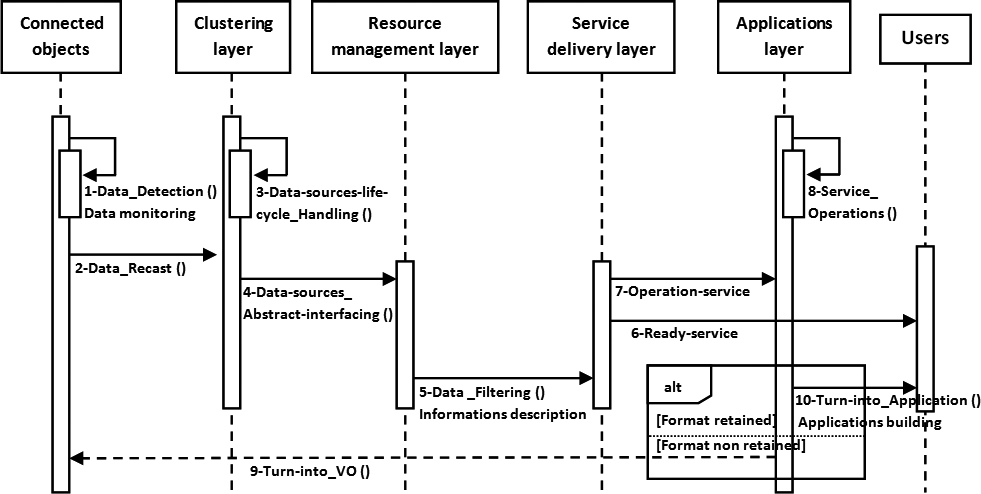
Figure 6 shows the components of the sequence diagram that shows the interactions of the actors in our middleware. The actors presented are: Connected objects, responsible for capturing data; Clustering layer, which grants an abstract interface with the underlying data sources; Resource Management layer, responsible for standardizing filtered data; Service Delivery layer, responsible for providing services; Applications layer, responsible for building applications; and Users presenting the consumers of the services offered by these applications.
The sequence diagram is described as follows (see Fig. 6):
Connected objects monitor building’s functionalities by detecting the corresponding information, Connected objects rethink the detected raw data to perform an ideal exploration of useful information for the intelligent management, The clustering layer, in addition to its task of gathering the detected data at each fog node, it manages the lifecycle of the data sources in the WSN-BAS, The Clustering layer grants an abstract interface to the underlying data sources, The resource management layer is responsible for filtering the data to describe the information needed to build services for optimizing energy management in the building, The service delivery layer offers a unified and homogeneous view, aiming the standardization of the filtered data, and the resulting good data is presented as a construct of services that can be used directly as a ready application, Ask for an operation service, An operation can be a transformation, an aggregation, a composition, etc., of one or more services, A non conservative operation results in a new data format, and the result is presented as a new Virtual Object (VO), The format resulting from a conservative operation belongs to the set of data format of the already defined unit services, and the final result is ready to be used as a Fog application for the optimization of energy management in buildings.
The applications achieved within this scenario are facilitated by wireless sensors deployed to measure the temperature, humidity or levels of various gases in the building’s atmosphere. In this case, the information can be exchanged between all the sensors of a stage, and their readings can be combined to form reliable measurements. The sensors will use distributed decision making and activation on Fog devices to react to data. The system components can then work together to lower the temperature inject fresh air or open the windows. Air conditioners can remove moisture from the air or increase humidity. Sensors can also trace and react to motion (for example by turning on/off the light). Fog devices could collaborate at a higher actuation level. With fog computing applied in this scenario, smart buildings can maintain their internal structure and environments to save energy, water and even other resources [9].
Scenario description
In our work, we study two types of building, house and office. Each of them can have their own policies and requirements that must be taken into account in the control of energy consumption. This control is performed using a system based on local WSN, that is, outside the Cloud. The intermediate Fog layer is composed of geo-distributed Fog servers which are deployed at the local premises of mobile users, that is, in their homes or offices. By providing targeted localized services that are submitted to deployment sites, the Fog server installed inside the building can quickly pre-load localized content. In addition, mobile users can enjoy high-speed local connections without having to search the Cloud.
We want to keep in mind that leaving the user’s building immediately renders the building management system on vacation, and if it is not, the system will maintain a satisfactory comfort for the user; which aims a rational use of energy. For this, we have added three types of policy for the management of energy consumption, one for the case of a user installed in his house, one for the case he is in his office and one for the case that he is outside. The idea is to always locate his cell phone and with the fastest speed. The support of his cell phone comes out of the house and moves to the office. Location changes trigger servers to dynamically adjust energy saving policies for both buildings. The basic function is to allow the server to detect changes of user’s location and trigger changes to the energy policy by turning on/off the electrical devices in those buildings.
Location policy of our framework.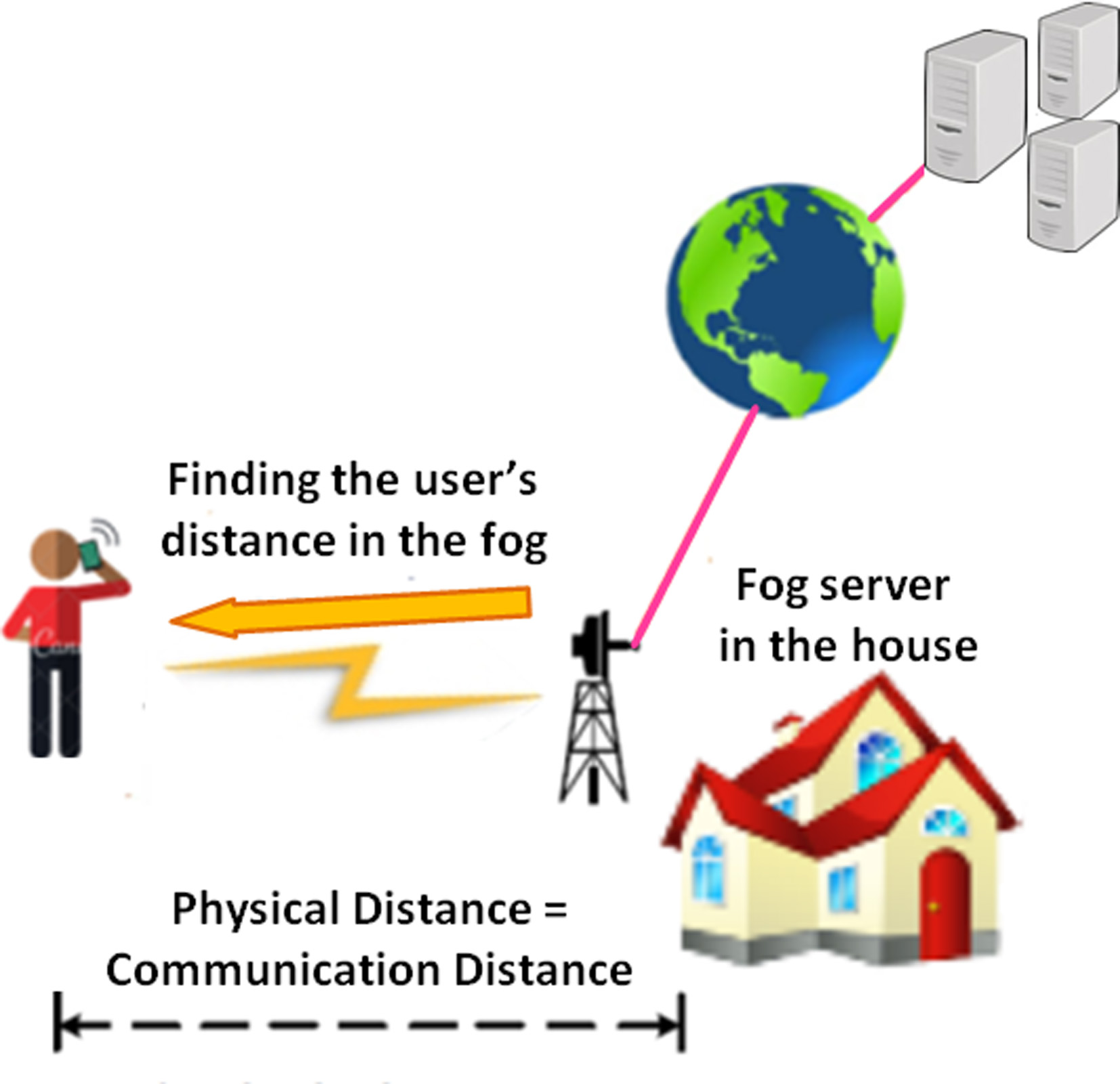
As shown in Fig. 7, with the Fog server located in the house, it will be easy and fast to find the distance between the user and the house (or the office) just with a simple communication with the user. The physical distance will be the distance of this communication. GPS location, one of the services provided by our Fog server can indicate the communication distance [25]. Now, to ensure that the user is in or out of the house, one must monitor the movement of his mobile if he will exceed a well-defined threshold.
We suggested a workflow diagram for the user’s location and the automatic adjustment of the energy saving policy that we explained earlier. This is shown in Fig. 8. It shows step by step how our work is completed from beginning to end. It is divided into two parts: user location and the resulting energy saving policies adjustment. The work starts after an appropriate authentication to an energy saving policy adjustment application, and ends after the user wishes to exit this application, that is, as soon as the user opens the application, the automatic adjustment starts to work and once the application is closed, automatic adjustment stops working; but the user will not be able to leave the application if each of the two buildings does not save energy.
In addition, we assume that the user occupies the house or the office for a period not exceeding 8 hours (08 hours in the house to sleep, 08 hours in the office to work and 08 hours outside the house and same office). As a result, the automatic adjustment of energy consumption policies will stop the operation of some electrical appliances for 16 hours in buildings, both home and office.
Daily home energy consumption estimation
Daily home energy consumption estimation
Daily office energy consumption estimation
First, we estimate the measurements of the power of basic electrical appliances [2] associated with the user in both buildings, at home and in the office; we divide the energy consumption of users into three potential modes: “plenty mode”, “ordinary mode” and “economic mode” and for each mode, we estimate the amount of energy consumed daily. Then we track and record the user’s location in a 24-hour period and apply dynamic control and policy changes at home and at the office. The estimation results for home and office are shown in Tables 2 and 3 respectively, which also explain the three modes.
Daily intelligent energy consumption of the Home
Daily intelligent energy consumption of the Home
Daily intelligent energy consumption of the office
Workflow of the user location-based energy saving.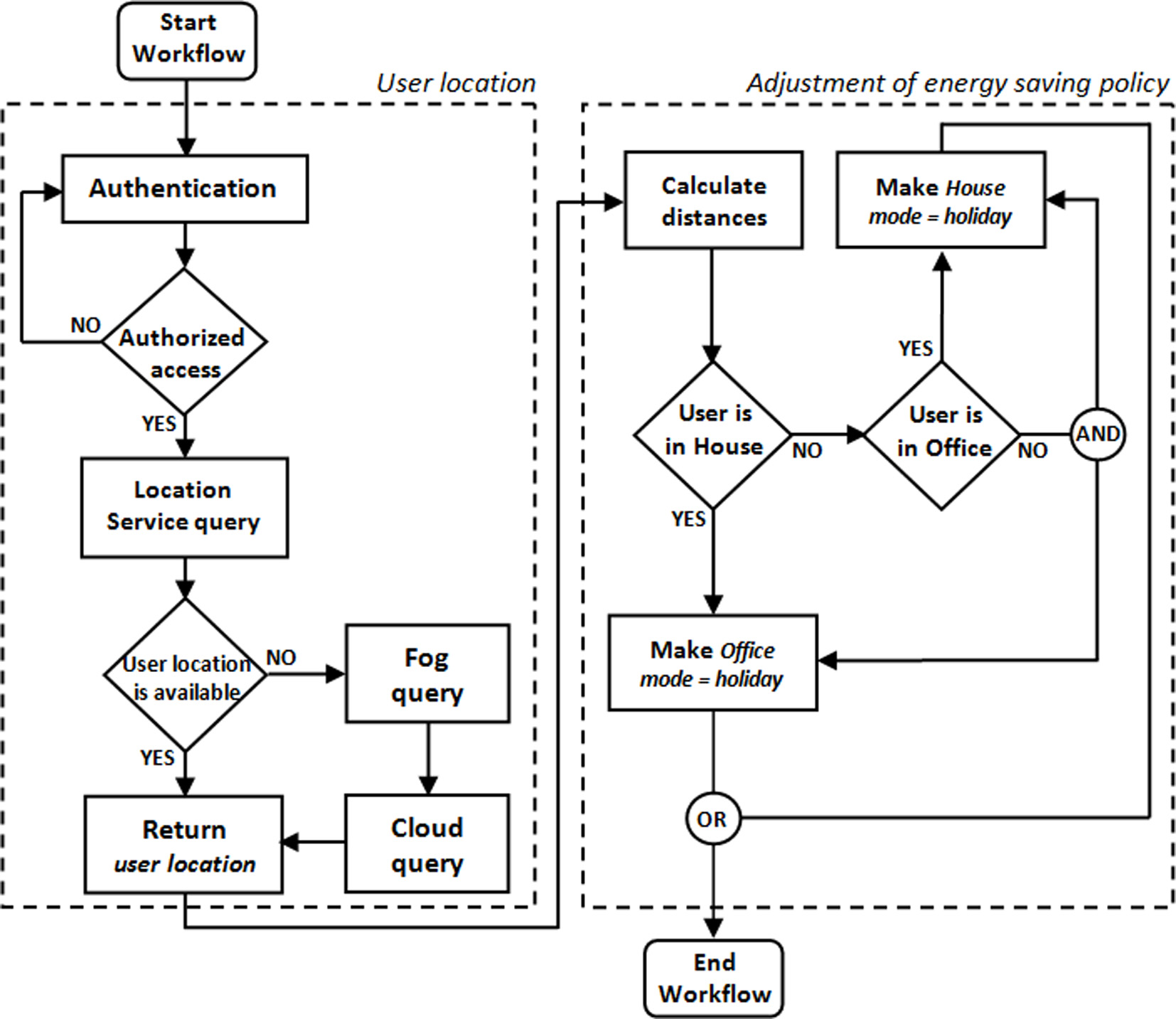
Comparison of the real energy consumption of the home (a) and of office (b) after applying our idea with the three modes’ energy estimation.
Based on the plenty mode measurements, we calculate the energy consumption obtained after applying the energy consumption policy adjustment in buildings, both home and office. We name the resulting life-mode as “intelligent mode”. Some equipment consumes only one third of the energy consumed in plenty mode (only 08 hours of occupation for each building, house or office, and therefore the automatic adjustment will stop the operation of some equipment for 16 hours in both buildings). The results of this calculation are presented in Tables 4 and 5. Thus, for comparison, we put the real recorded energy consumption data after applying our ideas (intelligent mode) together with the energy consumption estimation results of the three modes, to demonstrate how much energy can be saved. The results are shown in Fig. 9.
We note that the actual energy consumption of the system after the application of our location-based framework is very close to the economic mode energy consumption for both buildings, home and office. It means that with our new idea, general users will enjoy luxurious lifestyle without special care or changes and they will pay what economic mode users pay.
In this paper, we have proposed some new contributions besides of literature previous works regarding the IoT framework for smart energy in buildings. The work includes: (1) WSN as Building Automation System, (2) fog computing platform, (3) Service Oriented Middleware for WSN, and (4) GPS location of user to improve the energy efficiency in buildings. We put them into a complete four-step research and added significant new contributions proving the ideas and concepts we proposed.
As for the WSN-BAS, we have explored the topological hierarchy of our BAS network where we explained the zonal distributions in the buildings and network equipment corresponding to these application zones. As for the fog computing platform, we explained what must exist as services and we have detailed the infrastructure of this platform. The services presented in this proposal are those that the platform must perform for managing energy in smart buildings. The components presented in the platform’s infrastructure are system monitoring, network management, VM planning, and Smartphone control of home appliances. As for the SOM for WSN, a layered architecture has been proposed to ensure the transformation of collected data into application services, necessary for the intelligent management of energy in the building. The UML sequence diagram described above in Fig. 6 explains this transformation of data into services from beginning to end (see Section 3.3).
Finally, for the GPS location of the user, we have described a virtual scenario of decentralized smart building control with GPS location of user, including all the entities mentioned above, illustrating the complete phenomenon of the application of our proposed framework on two buildings (house and office) and a user. In a workflow diagram, we formulated the problem. Afterwards, we compared the actual energy consumption data recorded after applying our ideas with estimated energy consumption results. We found that the actual energy consumption of the system after the application of our location-based framework was very close to the energy consumption of an economical mode for buildings, both home and office. By building this IoT framework in smart buildings, homes or offices, we aim to enable not only smart energy management, but also create an intelligent building space which is an important part of the future smart world.
We present in Table 6 a summarized and well-detailed comparative study of the most related works in order to emerge our position relative to the recent work closest to our problematic. The analytical criteria presented in this table have been merged and applied to the technologies discussed in our paper. Complexity of proposals, computing power, abstraction level, security and privacy are the key requirements for the researchers to be targeted to facilitate the adoption of automatic control of smart buildings.
Qualitative comparison table
Qualitative comparison table
The gathering of the four contributions already submitted in one single work ensures a simplicity serving the facility to implement our holistic framework, and this pushed us to put in this table the option lower for the criterion complexity of the proposal in the line relating to our proposal. As well, the smart location policy of our framework, based on the fog computing paradigm, ensures higher computing power to quickly calculate the user’s location relative to the home or office. We also consider that our service-oriented middleware provides a higher level of abstraction of data sources. In terms of security and privacy, we proposed a policy of an authenticated access to our platform, which pushed us to put medium for this criterion. The last line of Table 6 shows the summary of the criteria characterizing our work and for each technology, the desirable characteristics are highlighted. We emphasize that our work covers almost all these technological requirements.
In this work, we propose a whole new holistic framework allowing to optimize energy management in smart buildings. It carries many new technologies to meet the needs of today’s world. The overall goal is to integrate smart buildings into new IoT technologies. WSN is the pivotal technology that has enabled the development of IoT applications that we have proposed in previous contributions presented in our smart building energy management framework.
We also used the location information of user in designing dynamic control policies that can turn on/off energy consuming devices at home or office depending upon the location and movement direction of the user. Fog computing approach is presented in this framework for improving the energy saving inside the IoT network by reducing the number of transmissions between the IoT devices. This framework has been tested in an application scenario of a user of two buildings home and office, having in feedback good results in terms of reducing energy consumption of buildings while ensuring satisfactory comfort for users.
Our future works includes the implementation of the various modules of the proposed framework adding a security module and the development of the required data model that supports different types of buildings. We also want to test the overall functioning of this new framework by applying it on a larger environment including all the characteristics of the real world. It’s important to mention that our current approach builds the basis for future developments that could use additionally intrusion detection systems and resilient techniques to protect buildings that apply this approach.
Footnotes
UML: Unified Modeling Language.
GPS: Global Positioning System.
Available at:
SDN: Software-Defined Networking.
NFV: Network Function Virtualization,
Authors’ Bios