



Abstract
Campus security issues have always been a hot topic of concern from all walks of life. To analyze the changes in network public opinion of college students’ campus security incidents, this study proposes to classify campus security incidents and track related topics. The classification algorithm and topic tracking algorithm for campus security incidents based on Internet technology are studied, and a prototype system of campus security incidents based on Internet is designed for analysis. The research results show that the Internet-based campus security incident prototype system can classify campus security incidents more accurately, and can also track security incidents on related topics, which provide support for student security management to a certain extent. This technology will be applied to the tracking and classification of college safety accidents, and provide certain reference for ensuring college students’ campus safety.
Keywords
Introduction
Every time a safety accident occurs, it will attract the attention of all sectors of the society, especially the safety accidents that occur on campus or on students [1, 2, 3]. Parents, teachers, social media and many other parties express their own comments and opinions on events thatrelated to their own interests. These views and articles spread all over the world along with the Internet, and eventually forms a complex, influential and uncontrollable social public opinion. However, the network public opinion without specific classification and fixed theme cannot judge the authenticity [4, 5, 6]. To reduce public opinion on campus safety and strengthen the management of student safety work, this research proposes the classification of security incidents based on Internet technology and tracks the subjects of security incidents. The research innovatively combines the text classification topic extraction and topic tracking technology to construct the algorithm design, and uses the prototype system to search and classify the extracted topic words for campus security events. It is expected that this study can provide some reference for the public opinion management of campus security incidents.
Literature review
College students’ campus safety is the premise and foundation for the smooth development of various tasks in colleges and universities. Network security in the information age is a huge challenge to campus security. Cohen et al. [7] studied the spread of the new type of coronavirus on university campuses. The results showed that without external intervention, college students would choose to relax in bars or clubs on the basis of their own protection. Daigle et al. [8] investigated the factors of campus crime in the United States and Canada. The results showed that Canadian college students generally believed that their safety was higher than that of American college students, although they faced higher risk of victimization. In addition, the crime factors between the United States and Canada also showed some similarities. Jouriles et al. [9] studied the relationship between the use of party security strategies and the frequency of freshman girls attending parties and being sexually assaulted. The results showed that the frequency of partying was positively correlated with sexual abuse. This relationship was appropriately adjusted through the use of security policies. Murray et al. [10] conducted a study on the prevalence of food insecurity in Australian university campuses and their satisfaction with food choices on campus. The result showed that nearly half of the students were not satisfied with the school’s food supply. The insecurity and scarcity of food environment in university campus were very common.
Chen [11] studied the prevention mechanism of campus security incidents represented by campus bullying incidents from a judicial perspective, aiming at how to reduce the occurrence of campus security incidents. The survey results showed that the construction of the multiple governance system of campus bullying must follow the principles of timely prevention and comprehensive governance. Only by taking measures to deal with the root cause of the incident can effectively avoid the occurrence of relevant safety incidents. Li et al. [12] designed a new sustainable personalized growth system model to manage students’ campus security. The system was based on AI, big data analysis and intelligent graphic element technology to realize intelligent supervision of campus security. The results showed that the method had obvious advantages in accuracy, safety and sustainability. Gong et al. [13] used the feature optimized robot to mine the safety performance of the campus workplace. The results showed that the development of this process feature had significantly improved the safe text mining in the campus workplace and provided support for the campus safety maintenance. Tan et al. [14] used the theory of planned behavior (TPB) to investigate the response of Malaysian college students to potential security threats and prevent major events. The results showed that the TPB method had a good analysis effect and provided a reference for improving students’ ability to deal with unexpected safety events.
Tracking algorithms are popular in engineering, machinery and information classification and extraction because they can achieve accurate positioning of target objects. Khan and Habib [15] used the tracking algorithm to locate the speaker. The results proved that the location tracking algorithm proposed in study can successfully locate the speaker under multiple speakers, and the algorithm had better stability and robustness. Ali et al. [16] used the tracking algorithm to simulate the DC-DC buck converter controlled by dual-loop PI. The results showed that the tracking algorithm had better applicability and more accurate test results when testing the battery charging controller. Srivastava et al. [17] proposed a thunderstorm tracking method based on full flash data and adjacent algorithm to forecast lightning activity in the area of concern. The results showed that the tracking algorithm predicts the area of thunderstorm in advance, with the tracking accuracy of 63%, 80% and 91% respectively for 30 minutes, 15 minutes and 5 minutes. Melzer et al. [18] proposed a recognition tracking algorithm for measuring sea level. The scale vortex tracking algorithm could better explain the embedding environment of the circulation. The results showed that the algorithm could better represent the changes of the upper ocean structure. Liu et al. [19] proposed a hierarchical topic detection and tracking method based on the event itself to solve the problems that were easy to be ignored in the topic detection process and the semantic drift problem, and effectively improved the accuracy of topic detection and tracking.
From the above analysis, the research content on university campus security and target tracking algorithms is rich, but campus security itself contains many potential dangers. The relevant research has not specifically classified and tracked various security events. Therefore, the research combined the topic tracking algorithm classifies campus security incidents and tracks them based on classified subject words, hoping to improve the management mode of campus security incidents and build a better campus environment.
Classification of university security events and research on topic tracking algorithms
Text classification based on thesaurus
The text information classification of campus security incident can be realized by studying the text classification algorithm of subject words. The cosine theorem is used to calculate the similarity of the event texts to be classified in the subject terms of campus security incidents in order to realize the subject vocabulary text classification of campus security incidents. The core of the text classification algorithm based on subject words is to construct the subject words of campus security incidents, establish a vector space model of security events, and then calculate the similarity of the event texts to be classified in the subject terms of campus security incidents. The following describes how thesaurus classification was done for this investigation.
Workflow chart of text classification based on thesaurus.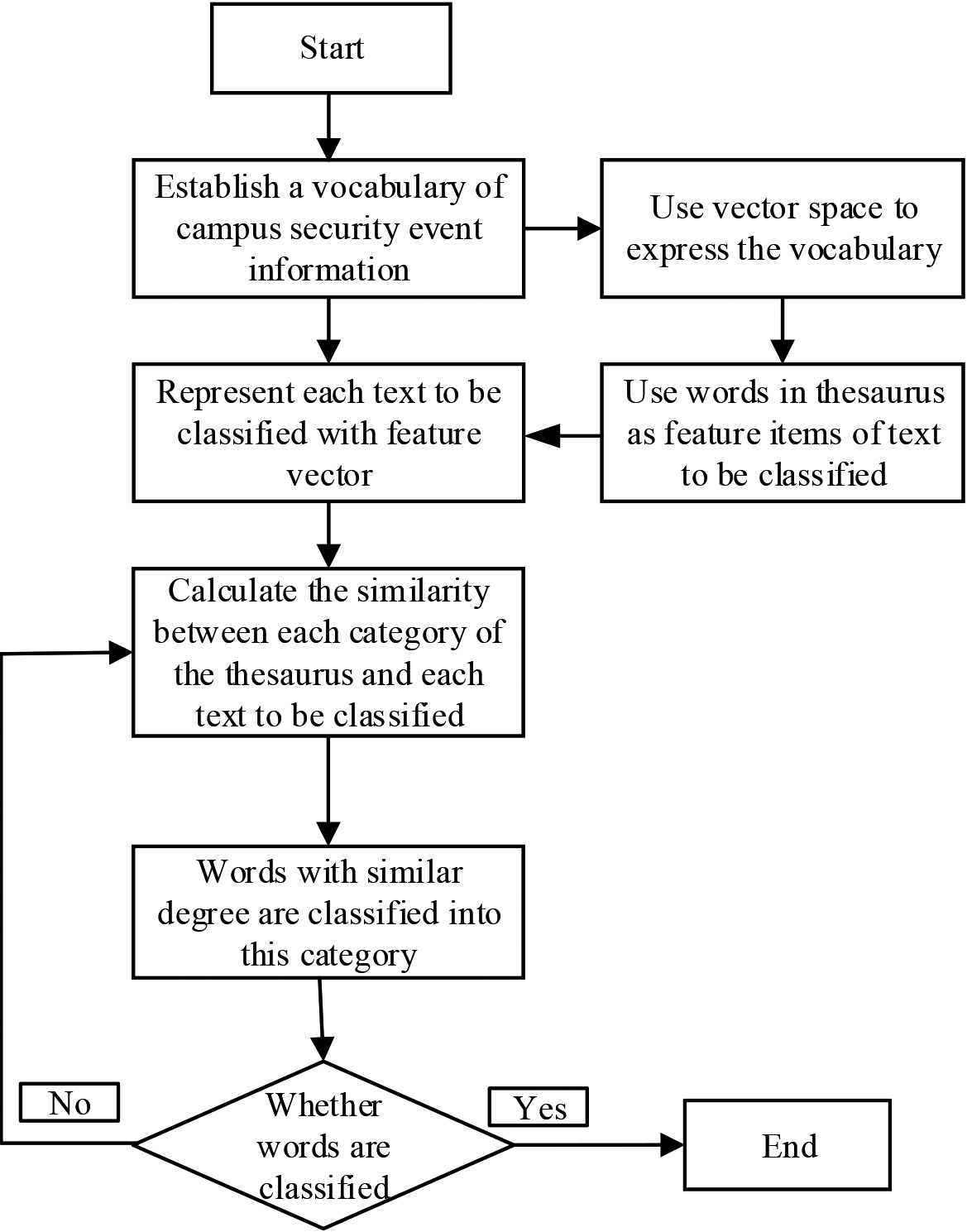
Figure 1 is the workflow diagram of text classification of subject words in this research. In practice, it is vital to realize the classification and tracking of campus security incidents because the information about security incidents involving college students is broad and unevenly distributed [20]. First of all, it is necessary to establish a vocabulary related to campus security incident information. In this study, campus security incidents are divided into 12 categories. These categories are education and teaching activities safety, traffic safety, fire safety, food hygiene safety, experimental class safety, school assembly safety, campus violence, gate guard safety, natural disasters, boarding student safety, campus surrounding safety and drowning accidents. Take education and teaching activities as an example. This category includes words such as slapping, corporal punishment and fracture. The traffic safety category includes school bus, rollover and accident.The number of words contained in each category is shown in Table 1. Through the information in Table 1, a more intuitive data reference can be provided for public opinion analysis and processing, providing a reference for establishing a more complete campus security event information text vocabulary. To improve the accuracy of word tagging, the manual tagging method is used for tagging operation, which sacrifices certain time efficiency. Specific information is shown in Table 1.
The categories and numbers of campus security incidents
Table 1 shows the classification of campus security incidents in this study and the number of words contained in each category. Table 1 illustrates that there are 876 words in the 12 safety incidents, and the words contained in each type of safety incident are different. The most words are used in road safety, while the fewest words are used in drowning occurrences. After completing the establishment of the vocabulary related to campus security incident information, the classification of campus security incidents can begin. The cosine theorem and vector space are the foundations of the categorization technique for incidents involving campus security.
In Eq. (1),
In Eq. (2), the denominator represents the vector product of the feature item set in this study and the vector membrane of each type of topic word, and the numerator represents the membrane product of the feature set and the vector membrane of a certain type of topic word. When Eq. (2) is infinitely close to 1, it means that the subject is closer to the category in the thesaurus.
Topic extraction refers to selecting several words in an article to form the main body of the article, so that the main content of the article can be understood through the number of themes in the words [21, 22]. The subject extraction process may be broken down into two primary parts after the aforementioned subject word classification is finished, namely, implementing subject extraction using the LDA model and extracting text events after the subject extraction is finished. When using the LDA model to describe the topic extraction algorithm, D represents all collections of campus security incidents, T represents the collection of security incident topics, and VOC represents the collection of all text in security incidents. In topic extraction, d represents the extracted text,
In Eq. (3),
In Eq. (4),
When conducting topic tracking, this study uses an improved topic tracking algorithm, which can perform weight calculations based on the characteristics of articles in each category. Match according to the campus security incident vocabulary, and then calculate the security incident words weight in a certain time. After the weights are calculated, the data is sorted by size, and the
In Eq. (5),
Prototype system design of Internet-based network security
To realize the classification and topic tracking of college students’ campus security incidents, this research has designed a prototype system of campus incidents. The system is primarily made up of three modules: a module for thesaurus-based text classification, a module for topic extraction, and a module for topic tracking [24]. In the process of text classification based on thesaurus, there may be two situations. The first is that there is a lack of vocabulary alignment between the subject words and the news, which prevents classification from succeeding, and the second is that there is very little vocabulary alignment between the subject words and the news, which lowers the accuracy of the classification results [25]. To control the classification accuracy, the study uses the following relational expression to express the classification accuracy.
The second module is the topic extraction module. The work of this module is mainly divided into topic event element extraction and topic extraction based on the LDA model. The keywords corresponding to each topic can be extracted through topic extraction based on the LDA model. Taking the traffic safety incident in this research as an example, the number of topics is set to 3. The following table shows the keywords in the traffic safety incident and the number of documents corresponding to each topic.
Keywords of traffic safety incidents and the number of corresponding documents
Table 2 shows the keywords of the three topics in traffic safety incidents and the number of documents corresponding to each topic. Through the LDA model algorithm, it is observable that the number of keywords isset first set, the word vector is calculated using TF, and then the keywords can be located. The feature extraction is to divide each topic into multiple subtopics, and finally form a complete event composed of named entities and verbs.
When using the prototype system to analyze network security events, first test the performance of the prototype system used in the study. From Fig. 2, when the threshold value is reduced from 100 mV to 50 mV, the data volume continues to increase until the saturation state. Therefore, the system can complete a data readout at about 6.1 MB/s.
Performance analysis of prototype system.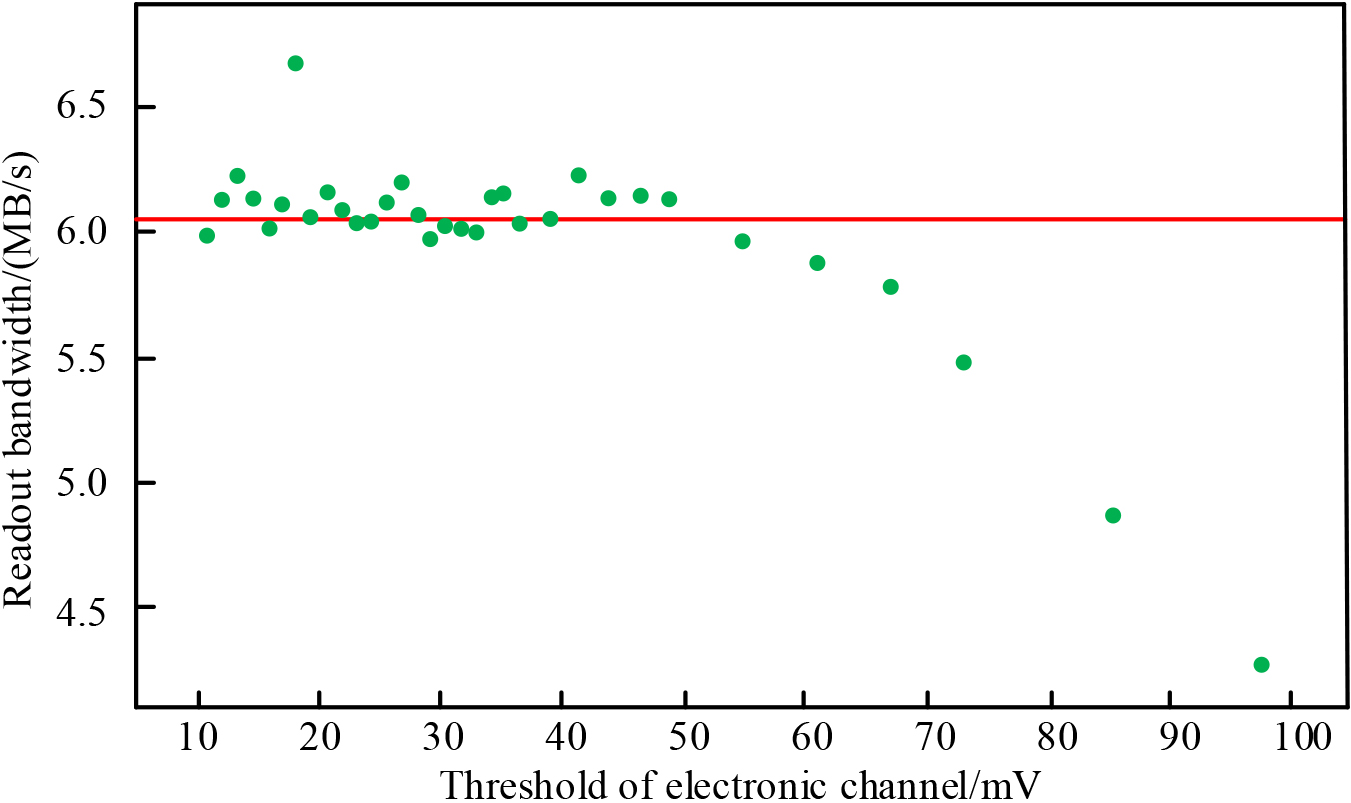
Web page distribution query results.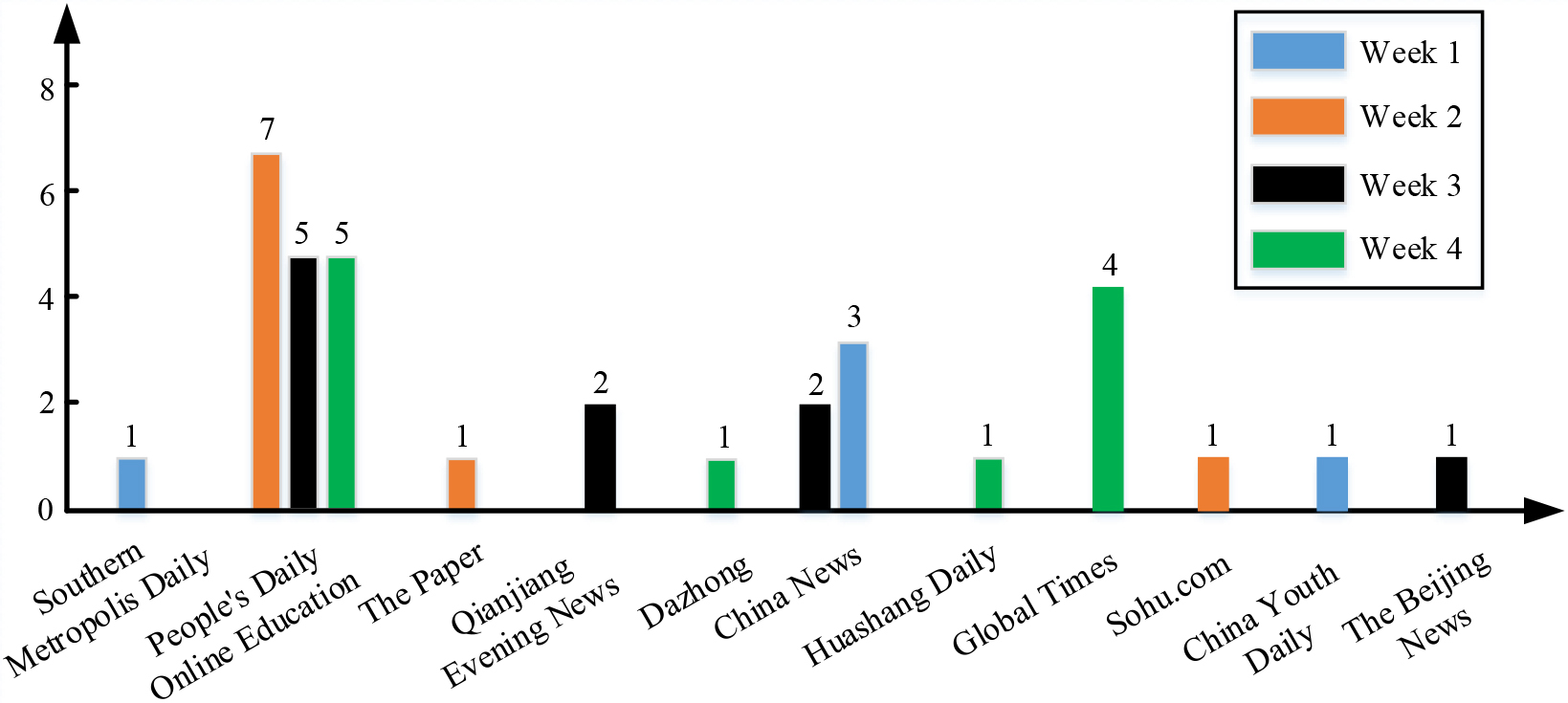
This research used a prototype system to inquire about college students’ campus security incidents in the online media from May 11 to June 15. The query content includes the media distribution, the proportion of each keyword and the total number of security incidents.
Figure 3 shows the query results and the web page distribution. The statistic shows that the articles about college students’ campus safety events are primarily published in the People’s Daily Online-Education section and were available on this website for a total of 11 days. Compared with this, the articles about university campus safety accidents only appeared for one day on other websites such as Southern Metropolis Daily, The Paper, Dazhong, China News and Huashang Daily. In addition, the study also inquired about the distribution of the number of articles. The results are as follows.
Distribution of various articles.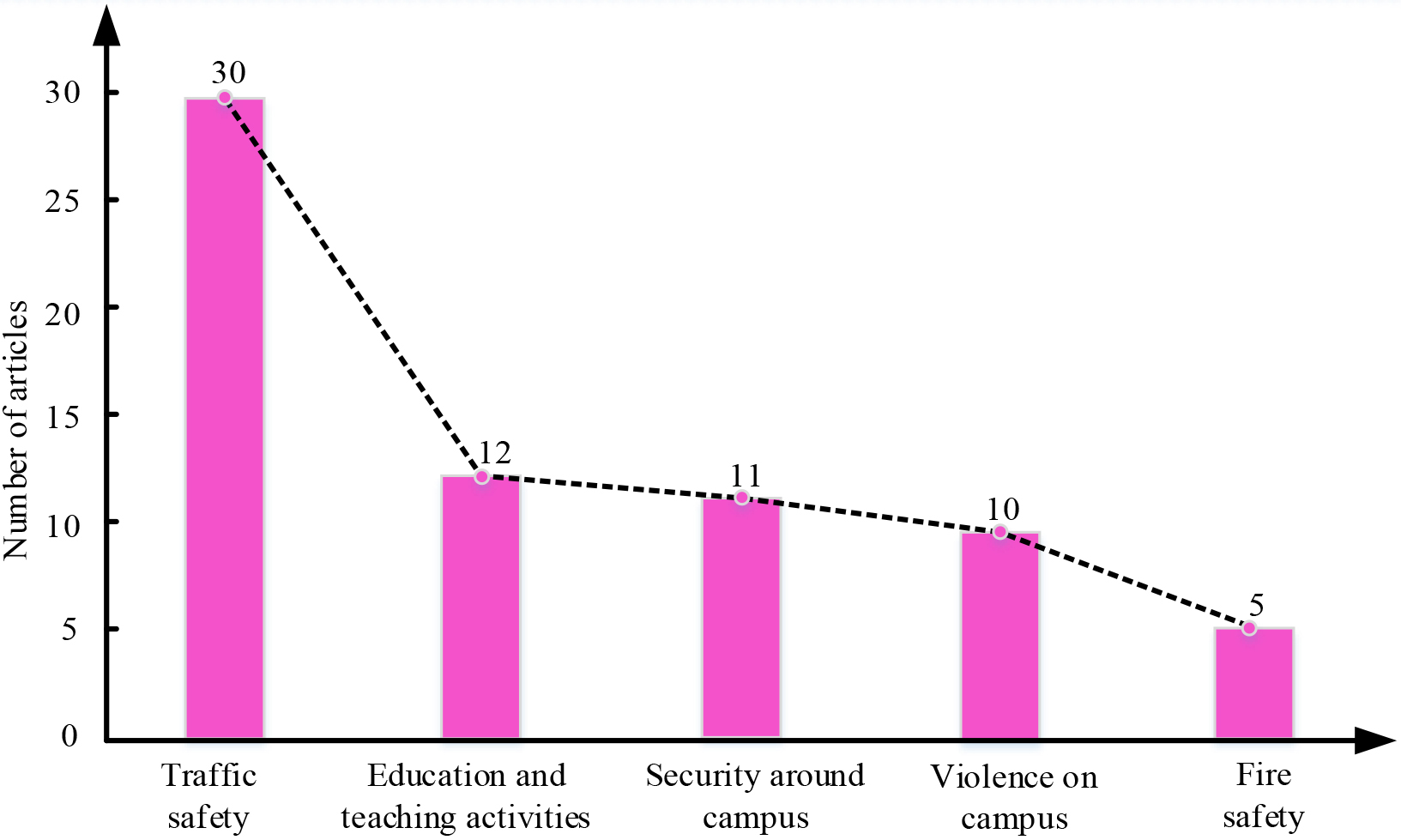
Figure 4 shows the distribution of the number of various articles from May 11 to June 15. The figure shows that there are 30 articles on traffic safety accidents, which are the most among all article types. And there are only 5 articles about school violence security incidents. The frequency of the other three types of articles in the figure is relatively close. Through the calculation of the classification accuracy rate, the accuracy rate of the classification results in this study is as high as 80%. In conclusion, the Internet-based network security prototype system suggested in this study may precisely search and categorize campus security incidents involving college students online.
Tracking results of various types of topic articles.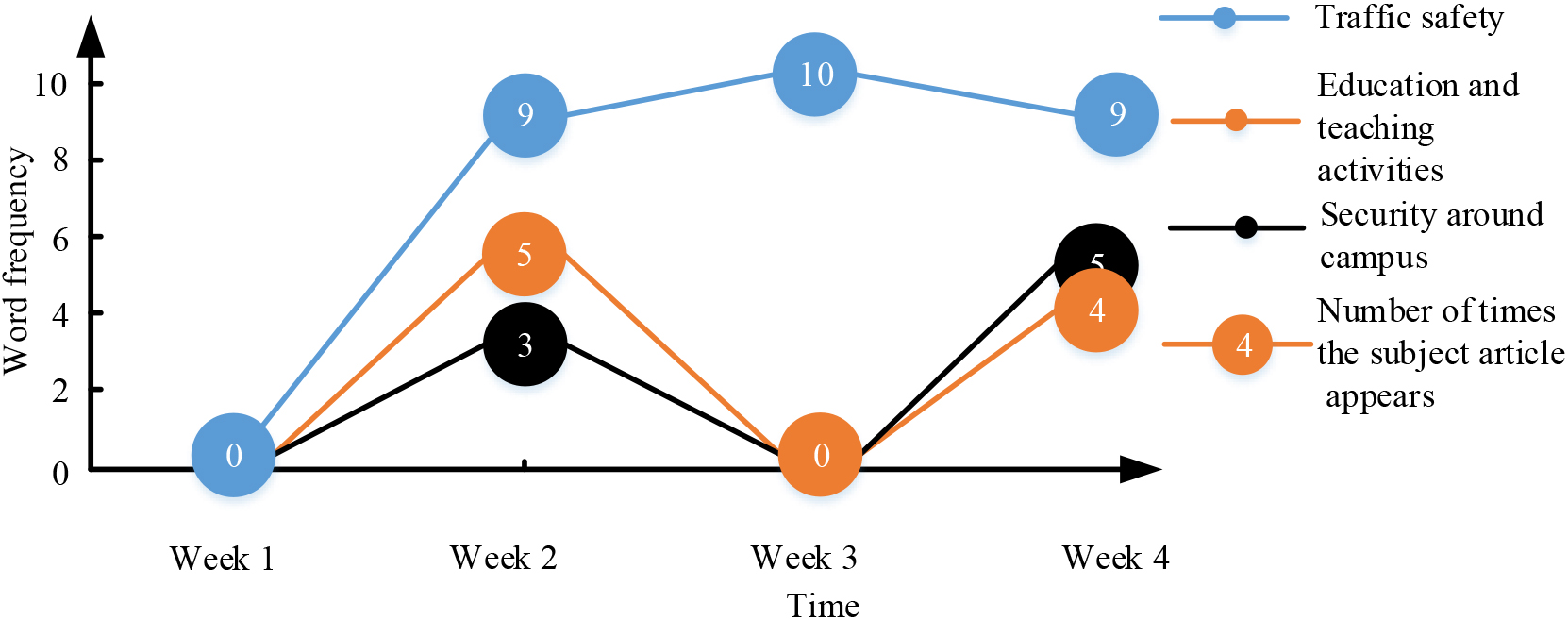
Figure 5 above shows the tracking results of the top 3 types of thematic articles on security incidents. From the above figure, it can be seen that the top 3 themes of the articles that appeared during the period from May 11 to June 15 are traffic safety, education and teaching activities and security around campus. Among them, Among them, 9 articles on traffic safety appeared in the second week, 10 in the third week, and 9 in the fourth week. On the other hand, there were four educational and teaching theme events in the third week, five in the second week and four in the fourth week. There were two security incidents around campus in the first week and five in the second week.The most articles are related to road safety, and their overall number is the highest. In addition, this study tracked the keywords in the topic articles of traffic safety accidents, and the word frequency search results of the keywords in the prototype system are as follows.
The occurrence frequency of subject words.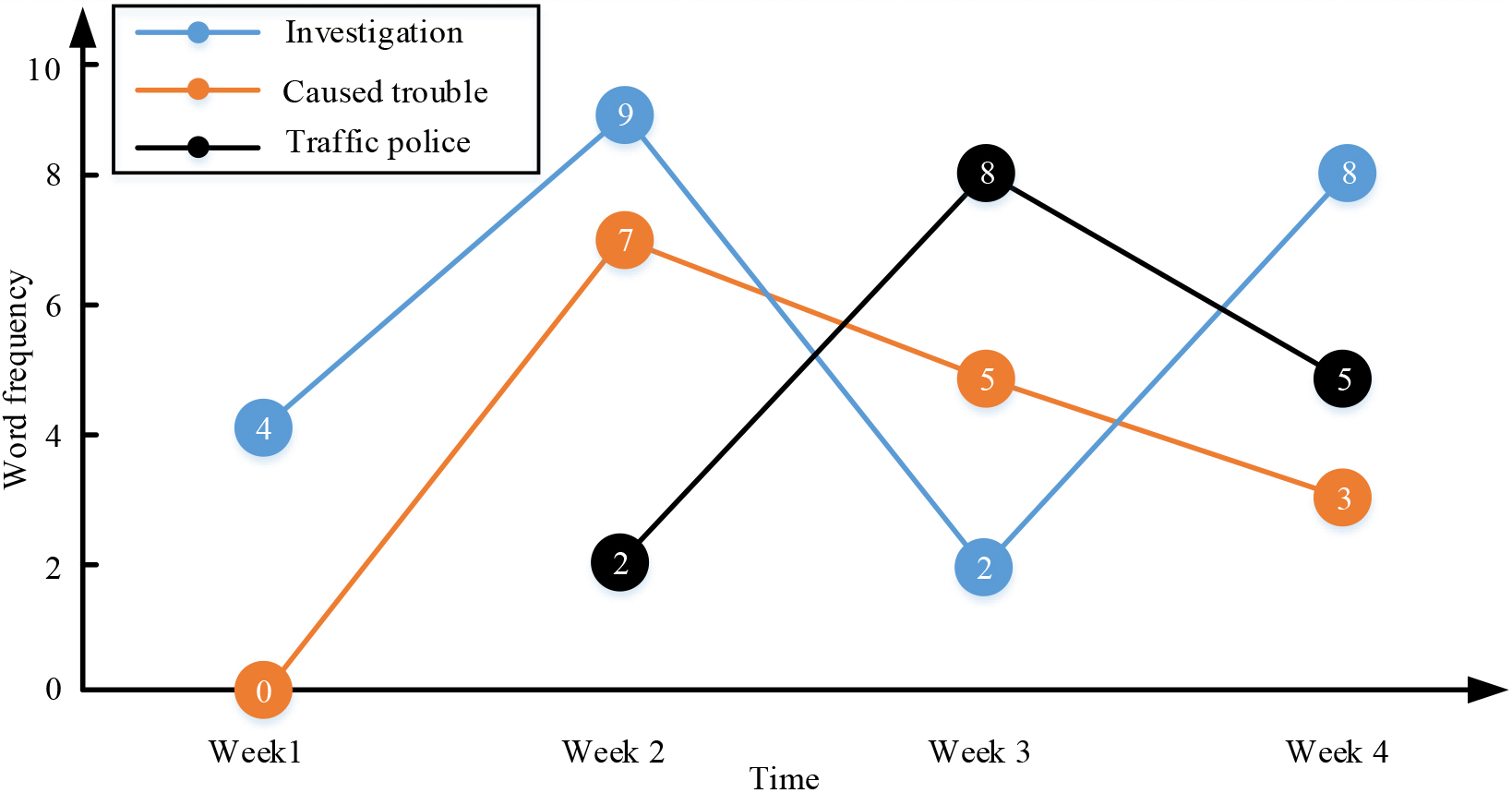
Figure 6 shows the frequency of keywords in the prototype system. Among them, the three keywords “investigation”, “caused accident” and “traffic police” appear most frequently in articles on the topic of traffic safety accidents. The word “survey” appeared continuously during this period, and reached the peak frequency of 9 times in the second week. In four consecutive weeks, the total number of occurrences reached 23. The theme word “accident” appears for three consecutive weeks from the second to the fourth week, of which the number of occurrences of the second week is at most 7, and the total number of occurrences in three weeks is 15. The key word “traffic police” is the same as the word “accident”. It also appeared for three consecutive weeks from the second week to the fourth week, and reached the peak frequency of 8 times in the third week. In the three weeks, it appeared for a total of 15 times.
The analysis results of the four query methods showed that the prototype system designed in this research can accurately classify college students’ campus security incidents and obtain the number of related articles in each category. In addition, the prototype system can also realize the tracking of the subject. After obtaining the relevant subject terms, statistics can be made on these subject terms in various aspects, so that articles related to the target subject can be displayed clearly and intuitively. In short, the LDA model proposed in the study can extract the keywords corresponding to each topic based on the realization of topic extraction. The text event is extracted when the subject extraction is finished, and then a finished event made up of named entities and verbs is created. Finally, the prototype system is used to classify and track topics. The accuracy of the classification results of the prototype system reaches 80%. Therefore, the subject words extracted based on the LDA model can accurately realize the classification and search of college students’ campus security events in the prototype system to meet the needs of campus security management.
With the increasing frequency of campus security incidents,all sectors of society pay more attention to student security incidents. A campus security event prototype system based on Internet technology will be developed as part of the research to realize the classification of security events and the tracking of relevant issues in order to better understand how public perception of campus security events develops over time. The feasibility of the system is verified by experiments. The research results showed that the classification accuracy of campus security event prototype system for security events is as high as 80%. In addition, on the basis of ensuring the classification and search of the subject words related to campus security events, the system realizes the tracking of the number and category of security events articles on related topics. This showed that the research and design of campus security event prototype system is feasible in security event classification and subject article tracking, and can provide certain support for the current campus security management of college students. The prototype system can obtain the change trend of college students’ campus security events relatively accurately, provide data support for campus administrators, and is beneficial to the development of campus security education. However, there are still some deficiencies in this study. The subject words used in the study are all collected manually, so it is inevitable to have a certain degree of subjectivity.In the future research, more safety events need to be involved in the collection of safety event keywords to improve the rigor of the research. In addition, when using the prototype system to track the subject words, more subject words need to be added to improve the scope of security events covered by the system.
Footnotes
Funding
This study was funded by the National Social Science Foundation of China (Title: Study on Theoretical Logic and Practical Path of Cultural Mission of Ideological and Political Education in New Era. Grant No. 20XKS022).