



Abstract
This study aims to explore the application status of Internet of Things and multimedia technology in English online teaching and its optimization measures. The Internet of Things is a technology that connects objects together and realizes information exchange through the network, while multimedia technology refers to the integration and processing of different forms of information including text, images, sound, video and so on. Firstly, the development status of Internet of Things and multimedia technology at home and abroad, as well as the development trend and demand of online English teaching, are analyzed. Secondly, through a questionnaire survey, data on the teaching methods, content, student feedback, and teachers’ teaching methods and effects in English online teaching were collected. Through in-depth data analysis and empirical research, this paper discusses how to integrate the Internet of Things and multimedia technology to build a more efficient online English teaching model. On this basis, the problems existing in the Internet of Things and multimedia technology in English online teaching are summarized, such as uneven application of technology, lack of targeted teaching design, and insufficient interactivity. In response to these problems, a series of optimization measures are proposed, including balancing the application of technology, personalized teaching design, improving interactivity, cultivating independent learning ability and solving technical problems. Finally, the future development of English online teaching in the application of Internet of Things and multimedia technology is prospected, focusing on technological innovation and application, personalized and intelligent teaching, teaching mode and method innovation, teacher role change and evaluation system construction.
Introduction
In the past few years, as the Internet of Things (IoT) and multimedia technology (MMT) have advanced rapidly, the utilization scopes of China’s IoT technology and MMT have been progressively broadening. The Internet of Things, or IoT, is a technology that connects various things through a network to achieve information sharing and data exchange. Multimedia technology, referred to as MMT, is a technology that integrates sound, image, text, video and other media to provide a richer and more vivid way of information transmission. In terms of IoT technology, domestic related enterprises such as Huawei, Alibaba, Tencent, etc., have continuously increased their investment in the research and advancement of IoT technology and achieved a series of innovative results [1]. Simultaneously, prominent domestic universities are actively engaged in the exploration of IoT technology research, offering substantial backing to the progress of this domain. In terms of MMT, China’s online video, online games, online music and other industries have risen rapidly, and online education has also become a hot field for MMT applications. Many well-known online education platforms such as NetEase Cloud Classroom, Good Future, Learning and Thinking, etc., have adopted MMT to deliver students a more engaging and dynamic educational experience [2]. Furthermore, domestic educational institutions have also undertaken numerous endeavors and investigations regarding the implementation of MMT in the field of education.
In foreign countries, the utilization domains of IoT technology and MMT are also expanding. With regards to IoT technology, advanced nations including Europe, America, and Japan have conducted extensive research and practical implementation in areas such as smart homes and smart cities, yielding notable outcomes. In addition, major universities and enterprises have also carried out a lot of innovative explorations in IoT technology. In terms of MMT, foreign online education platforms are also developing continuously. For example, online education platforms such as Coursera, edX, and Udacity use MMT to provide students with more vivid and flexible learning methods [3]. Moreover, overseas colleges and universities extensively employ MMT in their instructional practices, incorporating techniques such as online videos, multimedia course materials, and other teaching methodologies to enhance the quality and efficacy of education. The impact of the Internet of Things (IoT) and multimedia technologies (MMT) in global applications is also reflected in relevant international standards and specifications. These standards unify technical specifications, ensure technical interoperability, and promote global development. In the field of IoT, the International Telecommunication Union (ITU), the European Telecommunications Standards Institute (ETSI), and the International Electrotechnical Commission (IEC) develop global IoT technical standards, including communication protocols, data formats, security, interoperability, and so on. In terms of MMT, the ISO/IEC JTC 1/SC 29 committee jointly established by the International Organization for Standardization (ISO) and IEC is responsible for developing multimedia related standards, covering audio coding, video coding, image coding, multimedia information description, multimedia security, etc. The famous MPEG series of standards has a profound impact on global audio and video technology. When applying these technologies, countries need to follow these standards to achieve global compatibility and interoperability. These standards also influence technological development and policy making in countries.
As the Internet becomes more accessible and technology advances, online instruction has emerged as a significant trend within the education sector. Online instruction offers students a greater degree of flexibility and freedom in their learning approaches, while also equipping educators with a wider array of teaching resources and tools. Especially during the epidemic, online teaching has become an indispensable teaching method [4]. Social and economic factors have a profound impact on the development of online teaching, and this is also driving the use of Internet of Things and multimedia technology in online teaching. First, social factors such as the pandemic have turned online teaching from an alternative to a necessity. This has forced educational institutions, teachers and students to adapt to this new teaching model and learn to use the Internet of Things and multimedia technology for distance learning. In addition, society’s demand for technical skills is also increasing, which makes educational institutions and teachers must use the Internet of Things and multimedia technology to improve teaching results and help students improve technical skills. Secondly, economic factors are also driving the development of online teaching. In the context of a globalized economy, the demand for language proficiency continues to grow, and English, as an international language, is in particular in great demand. The online teaching model makes learning English more convenient and fast, which is a great benefit for students who cannot study in English-speaking countries. In addition, the development of the Internet of Things and multimedia technology has also provided more educational institutions and teachers with more teaching resources and tools, so that they can provide better teaching services at a lower cost.
Overall, social and economic factors have made online teaching a new teaching trend, and the Internet of Things and multimedia technology have played a key role in this process. They can not only improve teaching results, but also provide students with a better learning experience. Furthermore, online instruction must prioritize students’ learning outcomes and learning experiences, necessitating the implementation of more flexible and diverse teaching approaches [5, 6].
The content of this study is shown in Fig. 1.
Study flow chart.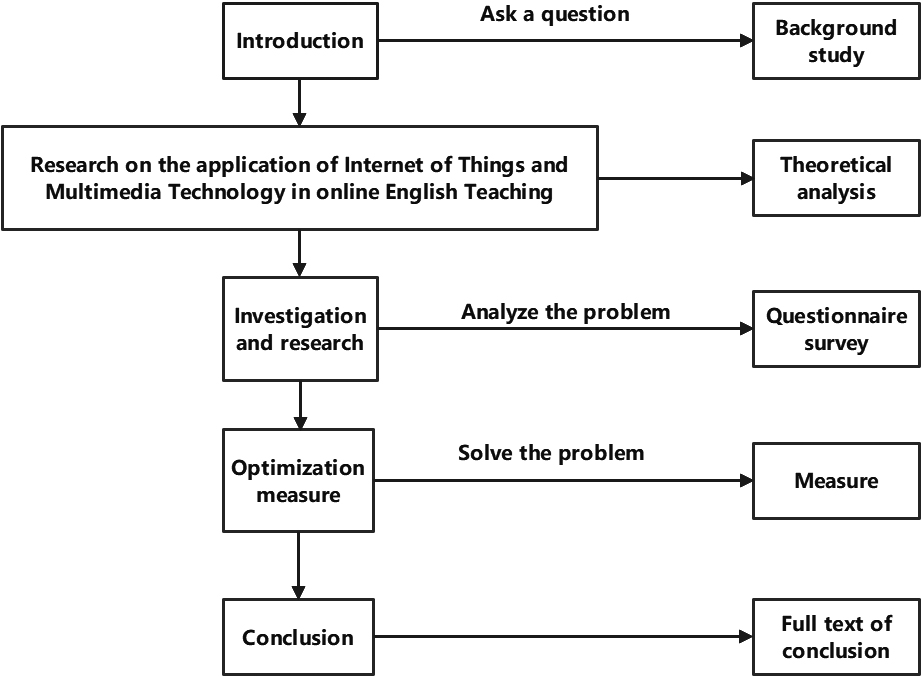
Application methods and advantages of Internet of Things and multimedia technology in English online teaching
Application principles and principles of Internet of Things and multimedia technology in English online teaching advantage
In English online teaching, the IoT and MMT can be applied to many aspects, such as courseware production, integration of learning resources, monitoring and management of teaching process, etc. The utilization of IoT and MMT can make teaching more vivid, diverse and interactive, thereby improving students’ learning effect and interest.
IoT technology enables the monitoring and administration of the instructional process by establishing device connections and facilitating data transmission [7]. For example, the Smart Classroom program has been implemented in more than 100 schools around the world. In this project, through the students’ smart devices, teachers can understand the students’ learning and progress in real time, and provide timely help and guidance. Teachers can collect student learning data, including learning time, task completion speed and accuracy. These data can help teachers carry out personalized teaching and solve students’ learning problems more targeted. At the same time, IoT technology can also achieve a more convenient and efficient teaching method by connecting teaching equipment and student equipment.
MMT has the capability to enhance the visual impact of the course material through the utilization of images, audio, videos, and other multimedia formats, enabling students to comprehend and retain knowledge points more easily [8]. Take “Khan Academy” as an example, it is a well-known online education platform that uses a large number of multimedia teaching resources, including video lectures, interactive tests and virtual experiments. These resources enrich students’ learning experience and enable them to acquire knowledge in a more engaging and interesting way. Furthermore, MMT can integrate teaching resources, facilitating easier access for students to the learning resources they require.
Under the influence of the Internet of Things and multimedia technologies, the role of the teacher is undergoing a profound transformation. They transform from traditional knowledge disseminators to learning instructors and learning data analysts for students. Iot technology can collect student learning data, giving teachers the ability to better understand students’ learning behaviors and habits, and then customize personalized teaching programs based on this information. The role of the teacher is more like an educational designer, using multimedia technology to design rich and engaging teaching content based on the needs and interests of the students. This shift helps to improve teaching efficiency and make education more personalized, while also motivating students to actively engage in learning. The application of the Internet of Things and multimedia technology is driving education to become more student-centered, which is an important direction of the current education reform.
Application scenarios of Internet of Things and multimedia technology in English online teaching
The IoT and MMT have many application scenarios in online English teaching. For example, video conferencing system can be used for remote teaching to provide students with better classroom experience. Online learning platforms such as Zoom and Google Classroom use IoT to enable remote learning, enabling teachers and students to learn and communicate effectively even if they are physically separated. This not only increases the flexibility of teaching, but also allows students to learn in a comfortable environment. Multimedia teaching AIDS such as teaching videos, interactive games, etc., can make interesting courseware and stimulate students’ interest in learning. A study at the University of California showed that classes using multimedia AIDS increased student engagement by more than 20 percent. These teaching AIDS present teaching content in a more engaging form, making it easier for students to understand and retain knowledge. In addition, online resources can be used to build a comprehensive learning platform, such as Coursera and edX, to provide students with a more diversified learning experience. Through these platforms, students can access rich English learning resources, such as audio recordings, texts, videos, etc., anytime and anywhere, enabling them to learn English in a more personalized way. In short, the widespread implementation of IoT and MMT in online English instruction can yield numerous practical advantages for both students and educators. IoT and MMT can improve educational outcomes by providing a more personalized, interactive learning environment that enhances the quality of instruction and enhances the learning experience for students.
Indeed, the adoption of the Internet of Things (IoT) and multimedia technology (MMT) varies significantly across the globe, driven by factors such as technological infrastructure, educational resources, and educational policies. In terms of technical infrastructure, developed countries such as the United States and European countries have higher network coverage and more advanced communication technology, so there are more possibilities in the application of IoT and MMT. For example, they can use 5G networks to provide high-quality real-time video for distance learning. Conversely, some developing countries may face difficulties in implementing these technologies due to network coverage and bandwidth limitations. In terms of educational resources, developed countries usually have rich online teaching resources and mature learning platforms, such as Coursera and edX, providing high-quality online courses. However, some developing countries may need more efforts to build and improve these resources. In terms of education policy, countries also have different attitudes and strategies for the application of IoT and MMT in education. For example, the Singapore government is actively promoting digital education and encouraging the use of these technologies. Conversely, some countries may be wary of the application of these technologies due to privacy and security concerns. In general, the application of IoT and multimedia technologies is still evolving, and countries need to adjust and optimize the implementation of these technologies according to their own actual conditions and needs.
The depicted in Fig. 2 are the usage contexts of IoT and MMT in online English instruction.
The integration of IoT and MMT in online English instruction.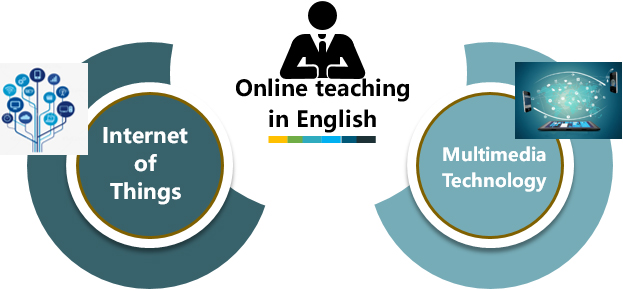
While IoT and MMT have gained significant traction in online English instruction, numerous issues and challenges persist. Some of these include:
Lack of adequate interactive and personalized learning experiences: While IoT and MMT provide certain avenues for student interaction, such as online discussions and study groups, these interactions often fall short in terms of depth and engagement compared to traditional face-to-face teaching. In addition, students may lose interest and be easily distracted due to the lack of personalized learning experience. Technical glitches and network delays: The IoT and multimedia technologies require a reliable network connection, otherwise students may suffer from technical glitches and network delays, which can affect their learning progress. Students have different levels of technical competence and digital literacy: Online learning requires students to have a certain level of technical competence and digital literacy, however, not all students are able to adapt to this learning style. Some students may need additional support and guidance to take full advantage of the IoT and MMT [9, 10]. Lack of effective evaluation mechanism: The online learning platforms utilizing IoT and MMT may lack an effective evaluation mechanism, potentially impacting students’ learning outcomes and teachers’ instructional quality. Current educational evaluation systems rely too heavily on traditional exams and tests and may not accurately reflect learning outcomes in online learning environments. Recommendations for improvement include: implementing comprehensive evaluations to examine students’ skills, emphasizing process evaluations, building timely feedback mechanisms, encouraging student self-evaluation and peer evaluation, and developing new evaluation tools and methods for online learning environments. Such an evaluation system will more effectively promote students’ all-round development and independent learning.
Application strategies of internet of things and multimedia technology in online English teaching
In the realm of online English instruction, the utilization strategies of IoT and MMT encompass the following aspects:
Innovation of teaching content. Through the integration of IoT and MMT, teaching content can be rendered more vibrant, visually appealing, and comprehensible, thereby augmenting students’ interest and enthusiasm towards learning [11]. For example, using technologies such as virtual LABS and virtual scenes, students can learn English in a simulated environment and experience language application in context. For example, in a virtual restaurant scene, students can simulate the actual English situation of ordering food and talking. Further, artificial intelligence (AI) can be introduced for personalized recommendation and adaptive learning, such as recommending appropriate learning resources and courses based on students’ learning situation and progress. Revolutionizing instructional approaches. The utilization of the IoT and MMT can also change the traditional teaching methods. For example, using live webcasts or video conferencing for online teaching, students can participate in real-time classroom discussions from any location, enhancing interactivity. Another example is the use of smart bracelets, smart glasses and other devices for personalized learning, students can obtain course information at any time, adjust the learning progress, which has a great role in promoting independent learning. Integration of learning resources. The Internet of Things and multimedia technology can integrate various learning resources, such as online dictionaries, exercise question banks, listening materials, etc. Students can freely choose according to their needs, which makes learning more flexible and personalized. But it also places a demand on students’ technical competence, for which more technical support and training will need to be provided, as well as the creation of more user-friendly platforms and applications. Innovation of evaluation and feedback. The IoT and MMT can facilitate the development of more precise and scientifically grounded assessment and feedback mechanisms. For example, intelligent teaching platforms can be used to evaluate learning outcomes, and online questionnaires can be used to collect feedback from students. Further, new assessment tools and methods can be developed, for example, using data analytics and artificial intelligence for personalized and continuous assessment, which can help to more accurately understand the state of learning of students, leading to more effective teaching.
Online English listening teaching cases integrating IoT technology In traditional English listening teaching, students usually learn by listening to the teacher or listening to tapes. The problem with this approach is that it is often difficult for students to truly engage in the listening environment and for teachers to provide real-time feedback and personalized guidance [12, 13]. By integrating the IoT technology, more interactive and personalized English listening teaching can be achieved. For example, an English listening teaching program that integrates IoT technology is connected to the real English listening environment through intelligent devices and IoT technology. Students can use smart headphones or other devices to listen to English conversations in real situations, such as shopping in the mall or picking up tickets at the airport [14]. Simultaneously, instructors can utilize the system to monitor students’ listening conditions and offer timely feedback and guidance. Within this program, students can gain a more profound comprehension of the English listening environment and engage in learning and training tailored to their individual levels and requirements. Simultaneously, teachers can better monitor students’ listening progress and effect, and provide personalized guidance and help. This program can not only improve students’ listening level, but also enhance their practical English application ability [15]. Online oral English teaching cases based on MMT Oral English teaching has always been a headache for students. Traditional oral English teaching is often too mechanized, lack of enough interaction and creativity. By using MMT, oral English teaching can be more vivid, rich and personalized. A MMT based oral English teaching program is to use video production and broadcast technology, so that students can watch English sitcom or animation, and imitate the accent and intonation of the characters for practice. In this way, students can not only improve their oral ability, but also improve their understanding of English pronunciation and culture. Furthermore, the utilization of MMT allows for the attainment of instantaneous interaction between instructors and students. Through video technology, educators can directly communicate with students, delivering personalized guidance and assistance. Students can also communicate with teachers directly through video technology for targeted questions and learning.
Questionnaire survey
Questionnaire design
To gain a comprehensive understanding of the practical application outcomes, existing issues, and challenges pertaining to the utilization of IoT and MMT in online English instruction, this study devised a questionnaire-based survey. The survey questionnaire content aims to collect data from related teaching methods and contents, students’ feedback, teachers’ teaching methods and effects, etc., to provide empirical evidence for the discussion of optimization measures in Chapter 4 and the proposal of conclusions and prospects in Chapter 5.
The questionnaire mainly includes the following parts (Table 1).
Questionnaire survey design
Questionnaire survey design
Through the design of the above six parts, this research questionnaire aims to comprehensively collect the practical application situation, advantages, challenges and problems of IoT and MMT in online English teaching, so as to better analyze the practical application effect of these technologies in online English teaching. These data will help to formulate optimization measures for the problems of IoT and MMT in online English teaching in Chapter 4, and forecast the future development trend of IoT and MMT in online English teaching in Chapter 5.
In order to fully understand the utilization of IoT and MMT in online English teaching, the survey objects of this study cover the main participants of online English teaching: students, teachers and relevant leaders of online education platforms. The survey covers students and teachers of different ages, genders, regions and educational backgrounds, as well as online education platforms of different sizes and types in China.
More specifically, the participants and survey scope are presented in Table 2.
Survey object and scope
Survey object and scope
Through a comprehensive analysis of the above three categories of survey objects, this study will comprehensively understand the utilization status of IoT and MMT in online English teaching, and provide empirical evidence for subsequent chapters.
To comprehensively comprehend the practical implementation, benefits, challenges, and issues related to IoT and MMT in online English instruction, the research encompasses the following aspects:
Demographic information: Gather the demographic details of the survey participants, including gender, age, location, educational background, etc., to gain insights into the attributes of the surveyed sample. Choice of instructional platform: Acquire information regarding the e-learning platform employed by the respondents and assess the utilization of IoT and MMT across diverse platforms. Instructional approaches and content: Explore the instructional methods (including IoT, multimedia, etc.) employed by both students and teachers in online English instruction, along with the encompassed teaching content. This will enable a comprehensive understanding of the application scenarios of IoT and MMT in online English teaching. Student satisfaction: Gather data on students’ contentment with online English programs or students’ level of satisfaction with online English learning experiences, encompassing their evaluation of teaching methods, teaching content, and instructional outcomes, with the aim of evaluate the practical application effect of IoT and MMT in online English teaching. Teaching methodologies and impact on teachers: Explore the instructional approaches and outcomes of teachers when using IoT and MMT for online English teaching, so as to understand how teachers use these technologies for teaching innovation in the teaching process. Advantages and challenges of IoT and MMT: To investigate the opinions of students and teachers on the advantages and challenges of IoT and MMT in online English teaching, so as to understand the advantages and disadvantages of these technologies in the practical application process. Issues encountered and proposed improvements: To understand the problems encountered by students, teachers and leaders of online education platforms when using IoT and MMT for online English teaching and their suggestions for improvement, so as to provide reference for subsequent optimization measures.
By collecting the above survey contents, this study will have a comprehensive understanding of the utilization status of IoT and MMT in online English teaching, and provide empirical evidence for the following chapters.
Basic information
Based on the findings from the survey conducted through questionnaires, a considerable number of valid responses have been collected. Table 3 presents the statistical analysis of the respondents’ demographic information:
Statistical results of basic information of respondents
Statistical results of basic information of respondents
Through the statistics of basic information, we can see that the survey samples cover students and teachers of different genders, age groups, regions and educational backgrounds, as well as leaders of online education platforms in different regions of China. This will help us to have a more comprehensive understanding of the practical utilization of IoT and MMT in online English teaching.
Based on the findings derived from the survey conducted through questionnaires, data regarding the instructional methods and content in online English instruction have been collected. The outcomes are depicted in Figs 3 and 4.
Statistical analysis of instructional approaches and technology implementation.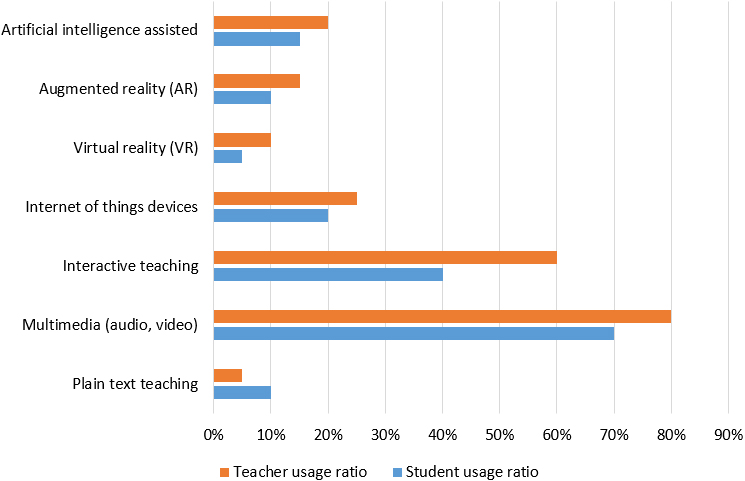
Through the statistics of teaching methods and contents, we can see that multimedia (audio and video) and interactive teaching have a high proportion of applications in online English teaching, while IoT devices, virtual reality (VR), augmented reality (AR) and applications assisted by artificial intelligence exhibit a relatively minor representation. From the perspective of the attention of teaching contents, traditional English teaching contents such as basic grammar, listening practice, speaking practice, reading comprehension and vocabulary memory still receive great attention, while cultural background knowledge receives relatively little attention. This helps us to understand the practical utilization of IoT and MMT in online English teaching, as well as the focus of teaching content.
Based on the findings from the survey conducted via questionnaires, we have collected students’ feedback on online English teaching. The statistics reported by students are shown in Fig. 5.
Statistical results of teachers’ teaching methods and effects
Statistical results of teachers’ teaching methods and effects
Statistical analysis of attention given to instructional content.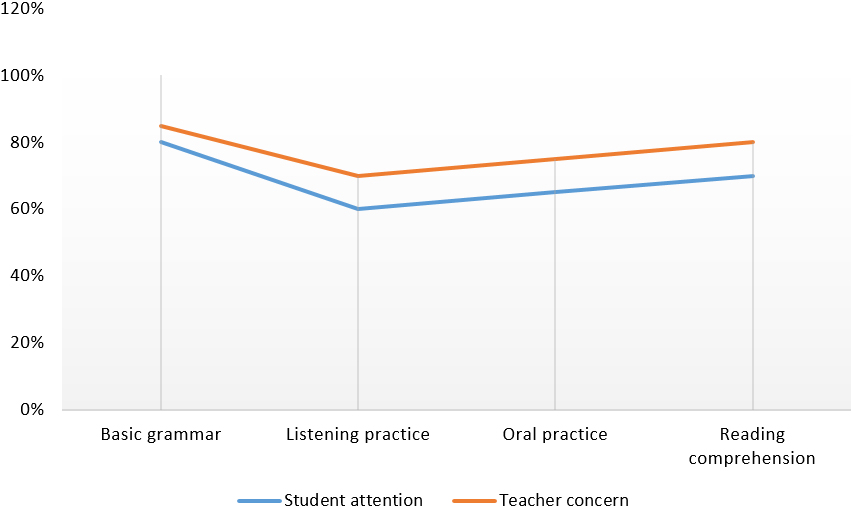
Statistical results of students’ feedback.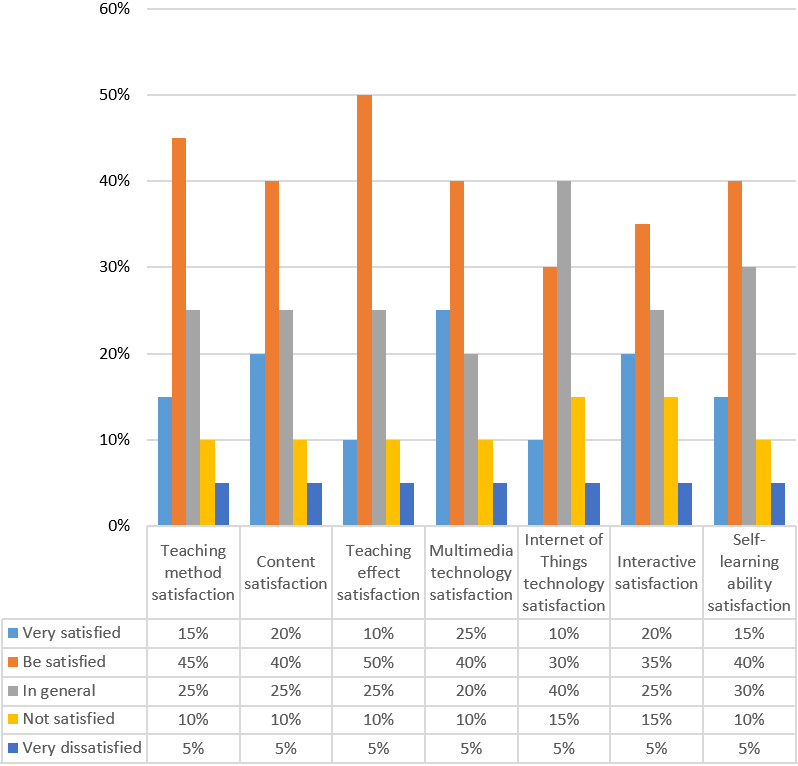
According to the data feedbacks from students, most students are satisfied with the teaching methods, content and effects of online English teaching. MMT gets high satisfaction from students’ feedback, while IoT technology gets relatively low satisfaction. At the same time, students’ satisfaction with interactive and autonomous learning ability also needs to be improved. These feedbacks help us to understand the practical effects of IoT and MMT in online English teaching, as well as the direction of further optimization of teaching methods and content.
According to the results of the questionnaire survey, we have collected the teaching methods adopted by teachers in online English teaching and the teaching effects they think. The statistics of teachers’ teaching style and effectiveness are shown in Table 4.
From the data of teachers’ teaching methods and effects, multimedia (audio and video) and interactive teaching scored high in the effectiveness of teachers’ opinion, while the efficacy of IoT devices, virtual reality (VR), augmented reality (AR), and artificial intelligence assistance exhibited a relatively modest level. These data reflect teachers’ cognition and evaluation of different teaching methods and technology applications in actual teaching, which helps us to further understand the practical effects of IoT and MMT in online English teaching.
Problems of Internet of Things and multimedia technology in online English teaching
Based on the findings from the survey conducted through questionnaires and the analysis of instructional methods, content, and outcomes, it is evident that IoT and MMT encounter the following challenges in online English instruction:
Uneven application of technology. While MMT has gained significant popularity in online English instruction, the utilization of IoT devices, virtual reality (VR), augmented reality (AR), and artificial intelligence-assisted applications remains relatively limited. This discrepancy could be attributed to factors such as the adoption of new technology by teachers and students, the cost of technology, and the prevalence of equipment. Lack of targeted teaching design. In some online English teaching, teachers may rely too much on technology and ignore personalized teaching design according to students’ needs and characteristics. This may lead to students’ lack of interest and motivation in the learning process, affecting the teaching effect. Lack of interactivity. Although interactive teaching occupies a certain proportion in online English teaching, there is still room for improvement. Real-time interaction and communication between teachers and students may be limited by technology, resulting in a lack of student participation and achievement while engaging in learning. Insufficient self-directed learning skills. The online learning environment necessitates students to possess strong independent learning capabilities, yet the cultivation of such skills in online English instruction remains inadequate. Teachers must prioritize leveraging IoT and multimedia technologies to aid students in enhancing their self-directed learning abilities. Technical difficulties. The utilization of IoT and MMT in online English teaching still faces some technical problems, such as network delay, data security and privacy protection. These challenges necessitate resolution in future research endeavors and practical implementations.
To sum up, although the IoT and MMT have made some achievements in online English teaching, there are still some problems and challenges. To enhance the efficacy of English instruction by effectively leveraging these technologies, it is imperative to undertake comprehensive research on these issues and explore corresponding remedies.
In view of the problems of IoT and MMT in online English teaching, we propose the following optimization measures:
Balanced technology application: Enhance the adoption of IoT devices, virtual reality (VR), augmented reality (AR), and artificial intelligence assistance in online English instruction. Educational policies should support and encourage research and application of emerging technologies, for example, by providing financial support for research and development, organizing relevant teacher training, and encouraging educational institutions and teachers to use these emerging technologies. Personalized teaching design: When using the IoT and MMT for teaching, teachers should prioritize addressing the requirements and attributes of students, teach students according to their aptitude, and design targeted teaching content and activities to foster students’ enthusiasm and drive for learning. To this end, the education sector should develop standards and guidelines for instructional design to help teachers more effectively utilize IoT and MMT for instructional design. Improve the interaction: Interactivity plays an important role in online teaching. The interactivity in online teaching can not only improve students’ learning interest and enthusiasm, but also enhance students’ understanding and memory of the learning content. In addition, through interactive communication, teachers can learn about students’ learning progress and problems in time, and further provide personalized teaching guidance. Interaction between students can also stimulate students’ thinking and develop their teamwork and communication skills. Interactive tools and platforms in online English teaching include video conferencing tools, online whiteboards, discussion forums and social media. They enhance student interactivity, facilitating real-time communication, teamwork and knowledge sharing. Benefits include ease of use, collaboration across time zones and a variety of ways to interact. However, network stability, technical equipment requirements and privacy security are limitations. It is recommended that education departments provide high-quality platforms and regulate their use to provide a better interactive learning experience. Enhance the online instructional platform, improve the quality of audio and video communication, and strengthen real-time interaction and communication functions to foster better communication and engagement between teachers and students. To this end, the education sector should provide high-quality online teaching platforms and formulate relevant policies and regulations to encourage and regulate their use. Cultivate self-learning ability: develop additional self-directed learning assignments and motivate students to utilize IoT and multimedia resources for self-learning and exploration. Additionally, teachers can provide ongoing guidance and assessment of students’ independent learning to aid in the enhancement of their self-directed learning capabilities. Teachers can support and promote students’ self-directed learning in an online environment by making specific recommendations for: providing clear learning objectives and guidance and encouraging students to set self-directed learning plans; Share diverse learning resources and tools to guide students to explore independently; Encourage students to participate in discussions and collaborative projects to develop teamwork and problem solving skills; Provide timely feedback and assessment to help students recognise their progress and room for improvement; Work closely with parents to support students’ self-directed learning and provide positive feedback and encouragement. Solve technical problems: prioritize the advancement and development of IoT and MMT in English online teaching, and solve technical problems such as network delay, data confidentiality and privacy safeguarding. To this end, the education sector and related policies should emphasize cybersecurity and data protection, and develop corresponding regulations to regulate the use of these technologies.
By implementing these optimization measures, we are anticipated to leverage the strengths of IoT and MMT to their fullest potential in online English instruction, improve teaching quality and effectiveness, and provide students with a more efficient, convenient and personalized learning experience.
Conclusion
Through an in-depth analysis of the utilization of IoT and MMT in online English teaching, this study summarizes the existing problems in online English teaching, and suggests the appropriate optimization strategies. The conclusion is as follows:
IoT and MMT hold immense potential and benefits for online English instruction, such as improving teaching quality, enriching teaching means, enhancing interaction and so on. However, certain issues persist in the implementation process, such as unbalanced technology application, lack of targeted teaching design, lack of interactivity, lack of independent learning ability training and technical difficulties. To harness the full potential of IoT and MMT in online English instruction, we put forward some optimization measures, such as balancing technology application, personalized teaching design, improving interactivity, cultivating self-learning ability and solving technical problems. The adoption of these measures will contribute to enhancing the quality and efficacy of online English instruction, while offering students a more efficient, convenient, and personalized learning experience.
Outlook
Looking ahead, as the IoT and MMT continue to evolve and advance, online English teaching will face more opportunities and challenges. Our attention should be directed towards the following aspects:
Technological advancements and implementation: As new technologies continue to emerge, it is crucial to explore their integration into online English instruction and enhance their impact on teaching outcomes. Future research can continue to focus on the utilization and development of IoT, virtual reality (VR), augmented reality (AR), artificial intelligence and other technologies in online English teaching. Individuation and intelligentization: The pursuit of personalized and intelligent online English teaching based on students’ needs and characteristics represents the future direction. Subsequent research endeavors may delve into leveraging big data, machine learning, and other technologies to facilitate personalized and intelligent English instruction. Innovation of teaching models and methods: As the IoT and MMT continue to advance, the models and methods of online English teaching also need to be constantly innovated. Future research could focus on innovative models that combine new technology with traditional teaching to adapt to the changing educational environment. Teacher role change: In the context of widespread adoption of the IoT and MMT in online English teaching, the role of teachers will undergo important changes. From the traditional imparts of knowledge to the guide, organizer and evaluator of students’ learning. Future research endeavors may focus on assisting teachers in adapting to this role transition and enhancing their teaching competence within the evolving educational landscape. Evaluation system construction: As online English teaching continues to advance, the traditional evaluation system may no longer be suitable. Therefore, future research should prioritize the development of a robust and valid online English teaching evaluation system that can holistically and objectively assess students’ learning outcomes and teachers’ instructional quality.
In a word, the IoT and MMT have great development potential in online English teaching. By constantly optimizing teaching methods and paying attention to technological innovation and development trends, we are confident that we can achieve more efficient, convenient and personalized online English teaching and provide students with better learning experience. This study makes an important contribution to both academic and practical fields, not only providing a new perspective and thinking for current online English teaching, but also providing direction and reference for future research and practice.
In the future application of Internet of Things and multimedia technology in English online teaching, one possible innovation point is to combine VR and AR to create mixed reality teaching environments, allowing students to experience learning situations in an immersive way. In addition, AI can develop intelligent teaching assistants to provide personalized learning programs for each student. Assessment systems based on the Internet of Things and big data can comprehensively evaluate learning outcomes and teaching effectiveness in real time. The application of blockchain technology ensures the fairness and transparency of online teaching. Finally, in the face of changes in the future working environment, the teaching objectives should also be changed, such as paying more attention to the cultivation of cross-cultural communication skills and problem-solving skills. These innovations have the potential to bring about innovative teaching models and learning experiences.