



Abstract
The heat source tower heat pump system is widely used in large and medium-sized air conditioning systems due to its good energy-saving advantages. However, there is no relatively reasonable evaluation system for the applicability of heat source tower heat pumps due to significant regional climate differences. Therefore, in order to better comprehensively evaluate the applicability of the heat source tower heat pump system, a comprehensive evaluation index system for the applicability of the heat source tower heat pump system was first constructed. On the basis of this evaluation index, an applicability evaluation model based on backpropagation neural network is constructed. In response to the slow convergence speed and susceptibility to local values in the application process of this evaluation model, particle swarm optimization algorithm is used to improve it. A comprehensive evaluation model for the applicability of heat source tower heat pumps based on improved backpropagation neural networks has been constructed. For the evaluation model constructed in the study, experimental data from four different regions were selected for validation. The experimental results show that in the training set, the F-Measure value of the evaluation model reaches 0.949, and in the test set, the F-Measure value of the model reaches 0.973. The comprehensive evaluation data from four regions indicate that the heat source tower heat pump system can achieve different heating and cooling effects in different regions. This indicates that the proposed comprehensive evaluation model for the applicability of heat source tower heat pumps based on this improved method has good evaluation results. It can conduct a good analysis of the applicability of the heat source tower heat pump system, providing effective support for developing reasonable and energy-saving refrigeration and heating methods in different regions.
Keywords
Introduction
The water source heat pump device is a product, which uses air as the heat source and achieves various functions such as refrigeration, ice storage, heating, and providing sanitary hot water through the way the heat source tower exchanges heat and how the heat pump works [1, 2]. The contradiction between increasing building energy consumption and limited resources urgently needs to be resolved. The percentage of air conditioning in total building energy consumption is more than one-third [3, 4]. Therefore, for buildings to be energy efficient, decreasing the use of heating, cooling, and air conditioning systems is crucial. In recent years, more and more engineering projects have started to use HSTHPSs to provide cooling and heating for buildings. There is no frost problem in winter and it is not constrained by geographic or geological factors [5]. However, there is currently no relatively reasonable evaluation method for the assessment of HSTHPS’ performance, which to some extent restricts the development and promotion of Heat Source Tower Heat Pumps(HSTHP). Therefore, to better evaluate the Applicability of the Heat Source Tower Heat Pump System(AHSTHPS), a corresponding evaluation index system for the applicability of the heat source tower heat pump is constructed. Then the particle swarm optimization (PSO) algorithm is used to improve the Back Propagation Neural Network (BPNN) model. The PSO-BPNN HSTHP applicability evaluation model is constructed. It is expected that the intelligent evaluation model constructed through research can provide a reasonable and objective evaluation for the applicability of the heat source tower heat pump system, providing data reference for expanding the application scope and better achieving building energy efficiency.
There are four sections to the study. The first section discusses and summarizes The Heat Source Tower Heat Pump System (HSTHPS) and related intelligent algorithms. The second component primarily builds a thorough index system for evaluating the application of HSTHPs, and constructs an intelligent evaluation model for applicability based on this index. The third part mainly conducts experimental research on the intelligent evaluation model. The final part is a summary and discussion of the entire article.
The contributions of the research are as follows. Firstly, based on comprehensive consideration of various influencing factors, a relatively comprehensive evaluation index system for the applicability of heat source tower heat pump systems was constructed. Secondly, based on the evaluation index system, an improved BPNN suitability evaluation model for the heat source tower heat pump system was studied and constructed, providing an evaluation method for the adaptability evaluation of the system in different regions.
The research significance is as follows. Based on this research, the applicability evaluation system of the heat source tower heat pump system has been further supplemented and improved. The evaluation model constructed through research can effectively analyze the applicability and performance of heat source tower heat pump systems in different regions. This method can provide guidance for developing reasonable heating and cooling methods in different regions, effectively promoting energy conservation and recycling in the region.
Related work
HSTHPS can combine both cooling and heating functions and is less affected by external disturbing conditions, so it has received more attention. The majority of academics have been enhancing HSTHPS performance to continuously improve the range of use and energy efficiency. Zhang et al. [6] established a heat pump with a solar-air combination heat source. The prototype could achieve heating and cooling. The SA-CHSHP system can successfully use air source heat pumps and solar energy for stable operation under various operating conditions. Li et al. [7] designed a HSTHP unit using air injection enthalpy technology according to the climate and building load characteristics. The system was tested under cooling, heating, heating high temperature and heating low temperature conditions. The overall performance coefficient of the unit was 4.21 throughout the year, and the cooling energy efficiency ratio was 2.80 in the cooling condition (condensing temperature of 54.8
PSO, which obtain optimal solutions by continuously updating individual and population extremes, have been widely used and improved in industrial production and mechanical engineering, etc. Wang et al. [11] proposed a new multi-objective optimization method to design a wing fin PCHE by using an enhanced PSO to optimize a printed circuit heat exchanger (PCHE). High heat transfer performance and minimal flow resistance may be achieved using a printed circuit heat exchanger with wing fins. El Rassy et al. [12] proposed a particle swarm algorithm based rope-driven humanoid robotic arm trajectory control method for the problem of poor accuracy of robotic arm bar trajectory control method. The optimal control trajectory is achieved by optimizing the configuration of the robot arm sensor parameters and combining the algorithm search. The proposed algorithm controls the trajectory of the humanoid robotic arm with a small value of trajectory tracking error and has more desirable control accuracy. To solve the reliability redundancy allocation, Ouyang et al. [13] proposed an improved particle swarm optimization algorithm with random perturbation properties to solve the resulting optimization problems. The results demonstrate that the proposed method has good effectiveness. Zhang et al. [14] proposed an enhanced PSO to solve the premature and convergence problems of the standard PSO, and enhance the global and local search capabilities of the algorithm. Apply this method to simulate and analyze the operation of a typical Japanese island microgrid. This technique successfully lowers the overall target cost and produces positive optimization outcomes.
In summary, most of the research focuses on the optimization and efficiency improvement of this system, and there is no relatively reasonable judgment and research on the AHSTHPS. Therefore, the study firstly constructs the evaluation index system of the AHSTHPS, based on this evaluation index, the study combines the PSO to improve the BPNN, and constructs the comprehensive evaluation model of the AHSTHPS based on PSO-BPNN, expecting to make a reasonable evaluation of the applicability of the existing HSTHPS through this evaluation model, and provide the applicability range and efficiency.
HSTHP applicability comprehensive evaluation method construction
For the problem of evaluating the AHSTHPS, the study constructs a corresponding applicability evaluation index system based on the construction of a HSTHP model. By determining the index weights, the applicability evaluation model based on particle swarm algorithm optimized BPNN model is designed.
Construction of HSTHP applicability evaluation index based on regional climate difference
There are substantial climate variations across the enormous nation of China. Therefore, HSTHPS as a heating and cooling system is affected by the climate difference between different places. Currently, HSTHPS are widely used, however, there are some differences in details of HSTHPS in different regions, and it is difficult to find a universal model that can be used for the applicability evaluation of all HSTHPS [15]. The overall HSTHP evaluation system has some problems in the process of establishing and using, such as the evaluation index is not comprehensive enough, the reasonableness of the proportion of evaluation index, and the evaluation method is influenced by subjective factors, etc. The existence of these problems has a great impact on the specific use of HSTHPS [16]. Therefore, on the basis of the establishment of the current HSTHP evaluation system, following the basic principles of comprehensiveness and direction, different evaluation indicators, or different weights for evaluation, the use of artificial intelligence and other evaluation methods capable of dealing with non-linear problems more considerable. The evaluation type of HSTHPS is single and the weight of evaluation index is unreasonable to improve. In Table 1, by summarizing the existing studies, field research and consulting relevant experts, the study constructed a comprehensive evaluation index for the AHSTHPS [17].
Comprehensive Evaluation Index System for Applicability of HSTHP
Comprehensive Evaluation Index System for Applicability of HSTHP
Economy refers to the economic costs of the system at all stages of operation and maintenance. Weather suitability refers to the cooling and heating effects of the system under different temperature and seasonal conditions, as well as the heating effects of domestic hot water under different weather conditions. Among the above evaluation indicators, the comfort of the heat source tower heat pump system mainly includes its defrosting process and the stability of indoor temperature. Energy saving performance refers to the equipment power consumption and energy consumption of the heat source tower heat pump system while meeting the requirements of refrigeration and heating. Constructability refers to the difficulty and safety of the construction of the heat source tower heat pump system in different locations [18]. Comfort refers to the overall user experience and convenience level during the use of the system. The system is not prone to frost during operation, with a small amount of frost and a longer defrosting interval, which will improve its comfort. The stability of indoor temperature directly affects the user experience. According to AHSTHPS evaluation index system constructed above, the corresponding scoring questionnaire is designed. Then, the fuzzy comprehensive evaluation method (FCEM) is used to calculate the weight values of each secondary indicator and determine the rationality of the indicator. FCEM is based on fuzzy mathematics, and through the synthesis of fuzzy relationships, factors that cannot be quantitatively measured or have unclear boundaries are quantitatively represented [19]. The results obtained by this evaluation method have strong systematicity and clarity. It plays a significant role in solving various uncertain problems. The specific calculation steps for indicator weights are as follows. The set of weight values is denoted as
After determining the weight set
In Eq. (2),
The weight results of each indicator are used to verify the consistency of the indicators. Once the results meet the consistency inspection requirements, the intelligent evaluation model of the heat source tower heat pump can be constructed.
After normalizing the above indicators, the indicators are used as input variables to complete the subsequent applicability evaluation. Based on the constructed suitability evaluation index system for the special source tower heat pump system, the corresponding suitability evaluation model is designed. With the development of technology, artificial neural networks are popular in many aspects of economy, transportation, and daily production life, etc. BPNN is a vast nonlinear network that simulates the physiological reflection process of humans. This structure converts input and output information into signals, which can process multiple signal information in parallel, thereby improving the calculation and response speed of the entire system and reducing the running time of the system. The basic idea of BPNN is to estimate the error of the previous layer based on the output error, in order to obtain the error estimates of all layers. Based on this error estimation, the connection weights of each layer are adjusted. The adjusted connection weights are used to recalculate the output error until it reaches the preset value, thus achieving its evaluation goal. As one of the stable and efficient network models, BPNN is widely used in various evaluation tasks. BPNN have the characteristics of self-organization, self-learning, and strong generalization ability. The basic structure is shown in Fig. 1.
Basic structure of BPNN.
On the basis of the above heat source other heat pump model construction and suitability evaluation index construction, the study constructs the suitability evaluation model of heat source other heat pump based on BPNN model. although BP neural network has better generalization ability, its own limitations also exist all the time. The BPNN’s sluggish rate of convergence makes it simple to settle on local values. In addition, the strong dependence of BPNN on samples reduces the applicability of the model. Therefore, the study proposes to optimize it using PSO. PSO is a global optimization algorithm. This intelligent algorithm originates from the predatory behavior of birds and searches the optimal solution by discovering the pattern from the behavior of biological populations. Each solution to be solved is a particle, and each particle corresponds to a fitness function value [20]. The PSO-BPNN is implemented in the following steps. First, the BPNN model is initialized and the size of the particle population is set according to the actual index parameters of the suitability of the heat source he heat pump. In general,
In Eq. (4),
The
The individual extremum is
In Eq. (7),
Based on the above calculation results, the fitness function values of the particles are then recalculated and the individual extremes and population extremes of the particles are updated. If the desired error has been reached, the iteration is ended, otherwise the new fitness value continues to be calculated [22]. The obtained optimal values are the BPNN’s initial weights and thresholds. The implementation process of the PSO-BPNN based heat source he heat pump suitability comprehensive evaluation model is shown in Fig. 2.
Comprehensive evaluation model for the applicability of heat source heat pump based on PSO-BPNN.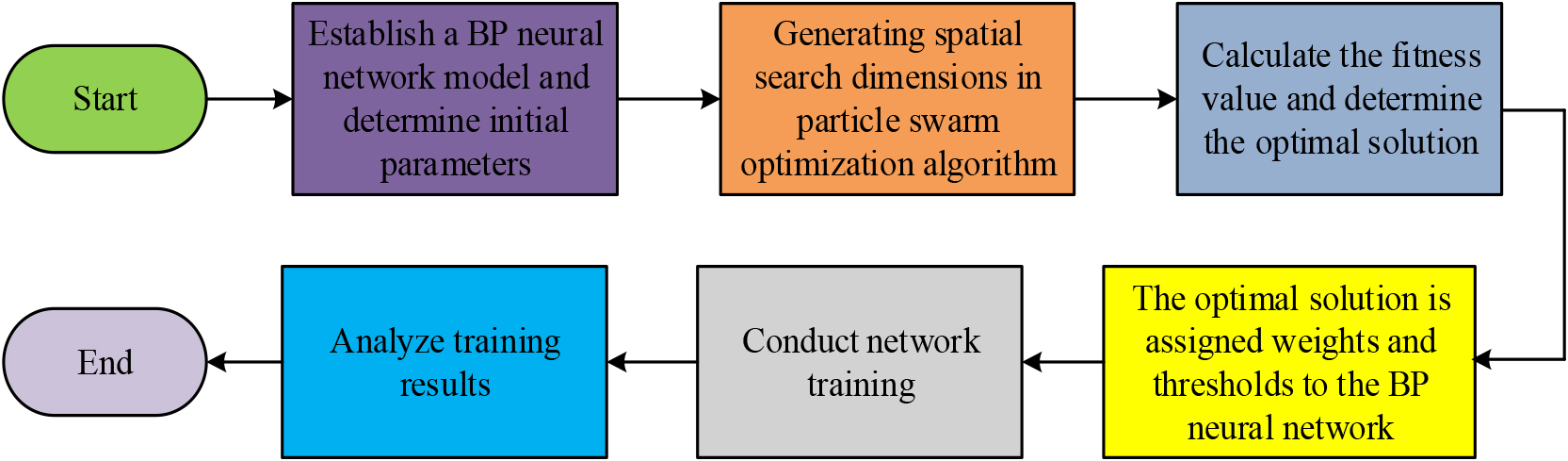
In Fig. 2, the BP neural network is first established and the search dimension is generated in the corresponding particle space. Then, the fitness value and optimal solution of the particle swarm algorithm are calculated. The calculation result is used as the threshold for neural network training. The final corresponding training results are obtained, ending the process. The BP neural network with optimized weights and thresholds based on the PSO is trained to build a PSO-BPNN neural network-based heat source special heat pump evaluation model. After the construction of the intelligent evaluation model is completed. The model can be trained. The sample dataset of evaluation indicators is used as the input eigenvector of the model, and the applicability evaluation result of the heat source tower heat pump obtained is the output value [23]. The specific implementation process is shown in Fig. 3.
In this chapter, the weight values of the constructed HSTHP suitability evaluation index are first analyzed. Then based on this index, the performance of the constructed PSO-BPNN intelligent evaluation model is analyzed. And based on this applicability evaluation index, the applicability performance of a HSTHPS at a site is evaluated experimentally.
Analysis of AHSTHPS index based on regional climate differences
The applicability evaluation index system for HSTHPs constructed includes 5 first level indicators and 19 second level indicators. Corresponding survey questionnaires are developed and relevant professionals are invited to rate them. Collect and process the completed questionnaire to obtain corresponding experimental data. The weights associated with each indication were calculated using the fuzzy comprehensive evaluation method. Table 2 shows the weights of the applicability evaluation indicators for the HSTHP obtained. The weight value of operating costs is the highest, at 0.18. From this, it can be seen that the operating costs will be affected by different regional and environmental conditions, which is a key factor affecting the applicability of HSTHPs. In addition, the operating period reaches 0.11, which has a significant impact on the AHSTHPS. Therefore, to improve the AHSTHPS, it is necessary to reduce the investment in its operation and maintenance, reduce energy consumption and construction difficulty, to effectively enhance the applicability of the HSTHP.
Weights of the suitability evaluation index system for HSTHPs
Weights of the suitability evaluation index system for HSTHPs
Process for evaluating the applicability of heat source tower heat pumps.
To verify the PSO-BPNN HSTHP suitability assessment model’s performance, the study designed the corresponding experiments for comparative analysis. The relevant data of the heat source tower heat pump required in the experiment are monitored in four different provincial capital cities A, B, C, and D from January to February 2022 and from July to August 2022. Among them, City A is located in the northeast region, City B is located in the north China region, City C is located in the northwest region, and City D is located in the southwest region. After analyzing and selecting the obtained data, the remaining 100 sets of data are used for experimental analysis. In this experimental data, 25 sets of data were obtained for each city. Among them, 15 sets of data are experimental data under winter conditions, and 10 sets of data are experimental data under summer conditions. 30% is used as the test set, and the remaining 70% is used as the training set. The commonly used optimization methods of the BPNN algorithm were used for comparison and validation of the PSO-BPNN improvement method proposed in the study. The Genetic Algorithm (GA) algorithm, the Neighborhood Algorithm (K-Nearest Neighbor, KNN), and the Whale Optimization Algorithm (WOA) are used to optimize the BPNN, respectively, as shown in Fig. 4 [24]. The convergence of the GA, KNN and WOA algorithms is shown in Fig. 4a, and it can be seen that the number of iterations of both the GA and KNN algorithms is higher, reaching 450, probably because these two algorithms fall into local search in the late iteration. In Fig. 4b, the training errors of the BPNN model after the optimization process of the four algorithms are shown. PSO-BPNN converges the fastest and owns the highest accuracy. The optimization of the BPNN using the PSO yields the best results.
Optimization performance analysis of several algorithms.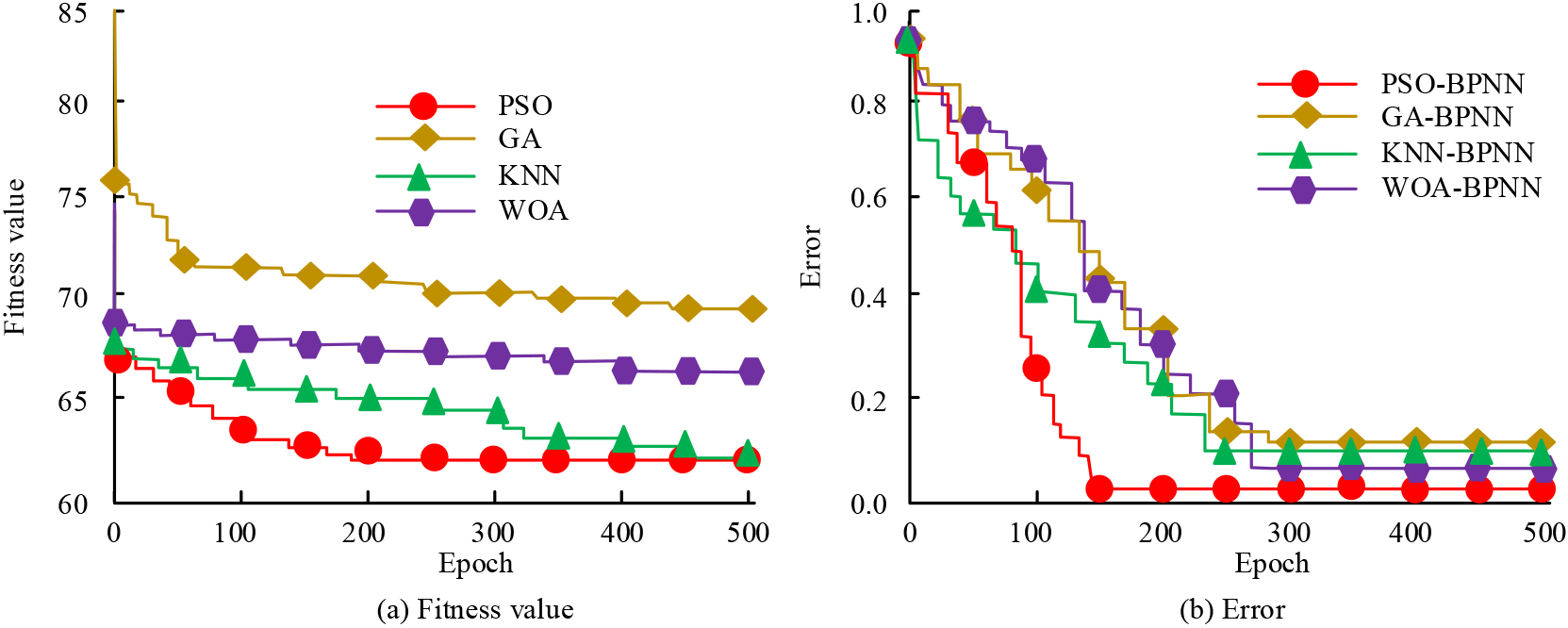
For the intelligent evaluation of the data, the commonly used genetic algorithm optimization-based BPNN model (GA-BPNN), support vector machine model (SVM) and PSO-BPNN model are compared. The F1 values of the three models on the training and test sets are shown in Fig. 5. In Fig. 5a, on the training set, the F1 value of the PSO-BPNN reaches 0.949, which is 0.046 and 0.087 higher than GA-BPNN and the SVM model, respectively. in Fig. 5b, on the test set, the F1 value of the PSO-BPNN reaches 0.973, which is 0.021 and 0.034.
F1 value of three models.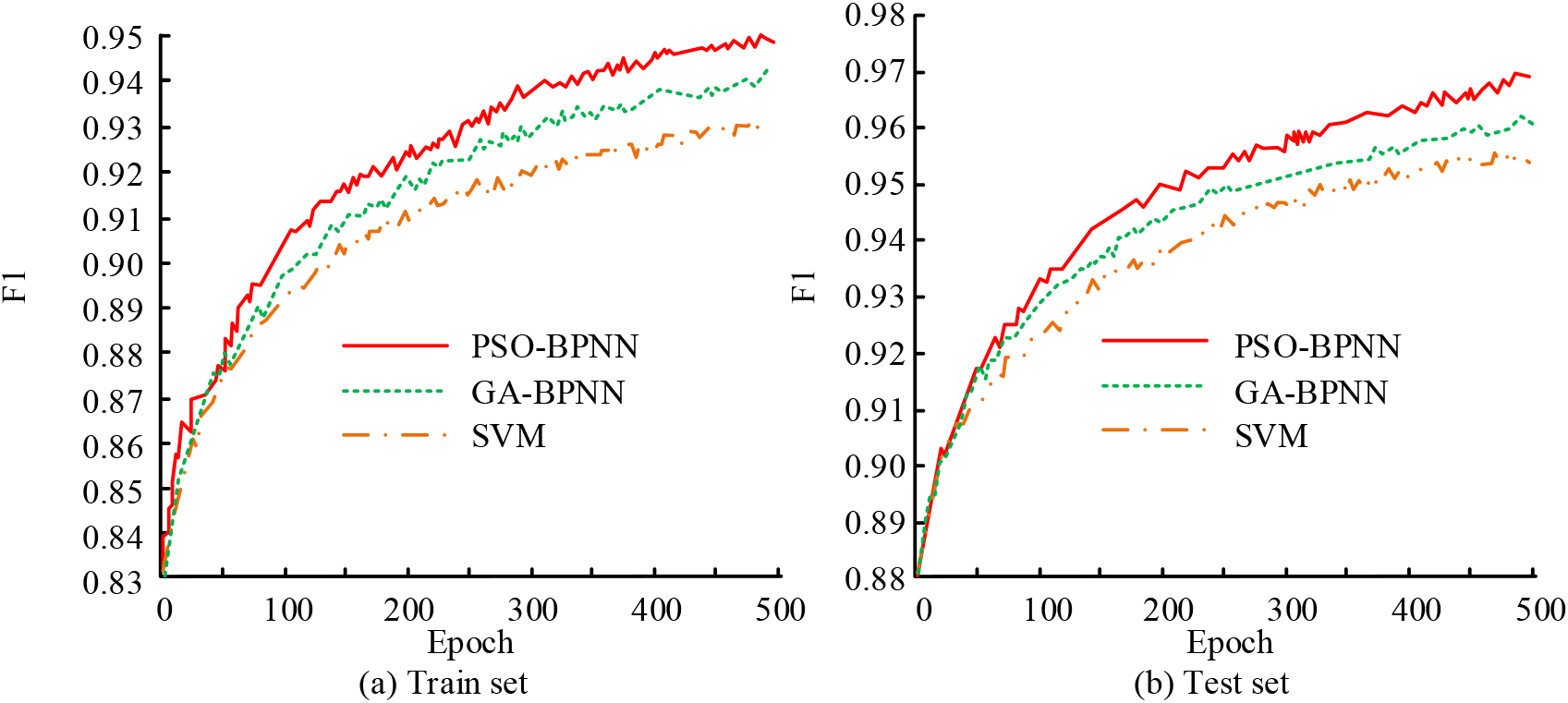
The fitness of the above models is compared. In Fig. 6, the fit of PSO-BPNN model reaches 0.942, the fit of GA-BPNN is 0.908, and the fit of SVM model is 0.879. it can be seen that the fit of PSO-BPNN is 0.034 and 0.063 higher than GA-BPNN model and SVM model, respectively. in summary, the PSO -BPNN evaluation model constructed by the study -BPNN evaluation model has high evaluation accuracy and can achieve relatively accurate comprehensive intelligent evaluation of the AHSTHPS, which provides data support for the wide application of HSTHPs.
Fit of several models.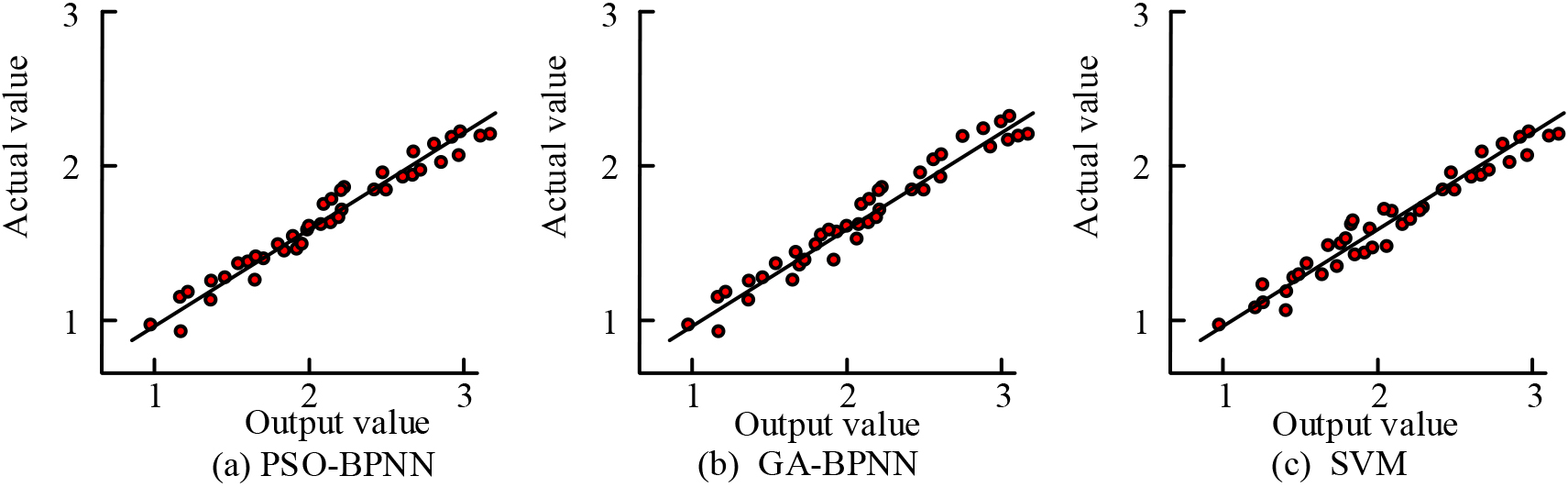
The performance of heat source tower heat pump systems in four regions was analyzed, and the performance of heat source tower heat pump systems in A, B, C, and D is shown in Fig. 7. COP and EER (Energy Efficiency Ratio, EER) are the measurement coefficients of the heat source tower heat pump system in terms of heating and cooling, respectively [25, 26]. In Fig. 7(a), as the outdoor temperature gradually increases, the COP of City A increases from 2.8 to 4.13, and the EER increases from 2.37 to 3.24. Figure 7(b) shows the Coefficient of performance of heat source tower heat pump in City B. In the comprehensive implementation process of heat source tower heat pump, the COP of the heat source tower heat pump system fluctuates from 4.58 to 4.13 with the increase of outdoor temperature, and the EER gradually increases from 3.85 to 4.07. In summer, due to the high outdoor ambient temperature, the heat transfer range of the heat source tower heat pump is wide, and energy-saving effects can be achieved by changing the air volume and cooling water. Fig. 7(c) shows the Coefficient of performance of heat source tower heat pump in city C. In the comprehensive implementation process of heat source tower heat pump, the COP of the heat source tower heat pump system fluctuates continuously between 3.20 and 4.00, and the EER varies between 2.4 and 3.2. Figure 7(d) shows the Coefficient of performance of heat source tower heat pump in City D. The COP of the heat source tower heat pump system gradually increased from 4.05 to 4.56, and the EER gradually increased from 3.80 to 4.20. In summary, there are relatively significant differences in the heating and intelligent effects of heat source tower heat pump systems under different climatic conditions in different regions, which are greatly affected by climatic conditions. The overall temperature in the northeast region where City A is located is relatively low, and the energy consumption and performance of the heat source tower heat pump system are higher, while the overall performance in other regions is higher.
Performance of heat source tower heat pump system in different cities.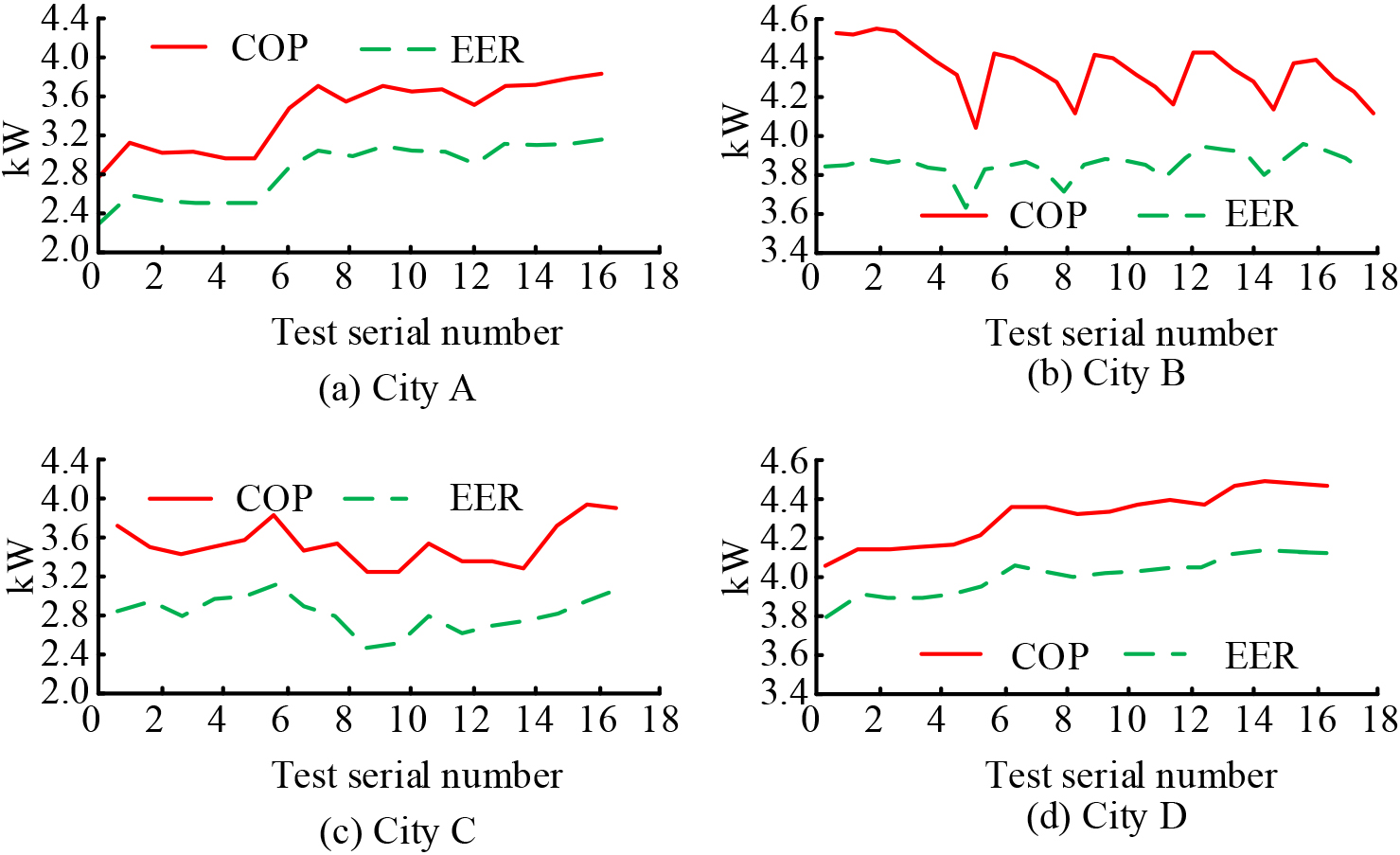
Energy consumption in four places.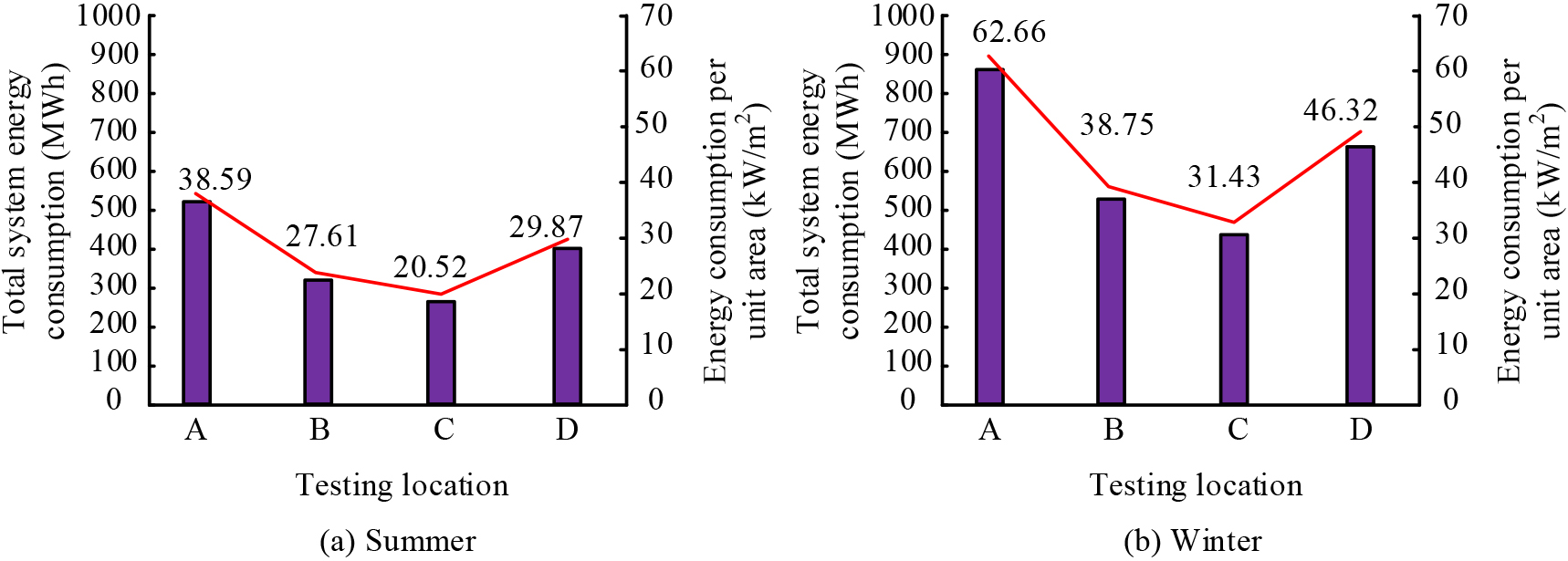
The energy consumption of four urban heat source tower heat pump systems in summer and winter is shown in Fig. 8. The energy consumption of the four places is shown in Fig. 8. As shown in Fig. 8, the total energy consumption of City A in summer and winter is 523 MWh and 864 MWh, respectively. The energy consumption per unit area is 38.59 kW/m2 and 62.66 kW/m2, respectively. The total energy consumption of B city in summer and winter is 356 MWh and 547 MWh, respectively. The energy consumption per unit area is 27.61 kW/m2 and 38.75 kW/m2, respectively. The total energy consumption of City C in summer and winter is 287 MWh and 462 MWh, respectively. The energy consumption per unit area is 20.52 kW/m2 and 31.43 kW/m2, respectively. The total energy consumption of D city in summer and winter is 435 MWh and 649 MWh, respectively. The energy consumption per unit area is 29.87 kW/m2 and 46.32 kW/m2, respectively. The above data shows that due to the influence of climate conditions, the overall temperature in the northeast region where City A is located is relatively low, so its energy consumption is significantly higher than that of other regions. The energy consumption of North China, where City B is located, is the third among the four cities, because there is sufficient photogrammetry in this area, but there is also more precipitation in summer, and the temperature changes greatly, resulting in relatively high energy consumption. The northwest region where City C is located has the most abundant sunlight and relatively low energy consumption. The southwest region where D city is located has lower winter temperatures and higher energy consumption.
The economic costs of heat source tower heat pump systems in four cities were analyzed, and the investment comparison of heat source tower heat pump systems in the four places is shown in Table 3. From Table 3, it can be seen that the investment differences of the heat source tower heat pump system in four different regions are significant. Specifically, the initial investment cost of City A is 19.75 million yuan, and the annual operating cost is 2.5 million yuan. The initial investment cost for City B is 16.5 million yuan, and the annual operating cost is 1.5 million yuan. The initial investment cost of City C is 17.85 million yuan, and the annual operating cost is 1.8 million yuan. The initial investment cost of D city is 19.5 million yuan, and the annual operating cost is 1.9 million yuan. Overall, the investment and operating costs in Region B are the lowest. This is because City B is located in North China, where the economy is relatively developed. The overall infrastructure level is high and the cost is relatively low. Therefore, the heat source tower heat pump system is the most economical, cost-effective, and adaptable in the region.
Investment comparison of heat source tower heat pump systems
The heat source tower heat pump system can achieve temperature cooling and heating based on seasonal climate differences. The applicability is not affected by regional conditions. Based on the regional differences in the use of heat source tower heat pump systems, an evaluation index system for the applicability of heat source tower heat pumps is constructed. Based on this indicator system, an applicability evaluation model based on PSO-BPNN is constructed. According to the experimental results, the following conclusions can be drawn. Firstly, under different climatic conditions in different regions, there are relatively significant differences in the heating and cooling energy efficiency of heat source tower heat pump systems, which are greatly affected by climatic conditions. Secondly, from the energy consumption of the heat source tower heat pump system in different regions, it can be seen that the overall temperature in the northeast region where City A is located is relatively low, so its energy consumption is significantly higher than that of other regions. The energy consumption of North China, where City B is located, is the third among the four cities, because there is sufficient photogrammetry in this area, but there is also more precipitation in summer, and the temperature changes greatly, resulting in relatively high energy consumption. The northwest region where City C is located has the most abundant sunlight and relatively low energy consumption. The southwest region where D city is located has lower winter temperatures and higher energy consumption. Finally, from the perspective of operating costs of the system, Region B has the highest economic level, the lowest investment and operating costs, the lowest cost, and the highest applicability. This indicates that the performance of the heat source tower heat pump system varies greatly under different temperature conditions. At the same time, the level of regional economic development will also have a significant impact on its applicability. However, there are still shortcomings in the study. The performance of the heat mass transfer directly influences the performance of the HSTHP, and thus the applicability of the system. Therefore, the effect of this condition on the AHSTHPS should be investigated in depth in subsequent studies.
Footnotes
Funding
The work was financially supported by Science and Technology Projects from State Grid Corporation of China, (Research and application of heat source tower heat pump operation control and interaction optimization technology that adapts to low-carbon buildings, No.: 5400-202320224A-1-1-ZN).