



Abstract
Intelligent interconnection and big data will be the core content of the future competition, and a unified digital platform construction of the automobile manufacturing industry will inevitably become an important support for the future development from large to strong. Using literature research and expert consultation, 14 influencing factors of digital platform construction in the automobile manufacturing industry were sorted out. this study uses ISM (Interpretative structural modelling) model to stratify the influencing factors of digital platform construction of the automobile manufacturing industry, draw a multi-layer hierarchical structure diagram of influencing factors, and uses the MICMAC (Matrix impacts cross-reference multiplication applied to a classification) method to analyze the dependence and driving force of the main influencing factors. The results show that 14 factors are more scientific and reasonable as influencing factors of digital platform construction in the automobile manufacturing industry. A1, A3, B1, B3, C3, D2, D3 are the top-level influencing factors. C1 and C2 are the bottom influencing factors, highlighting that technical factors are still the fundamental factors affecting the digital platform of the automobile manufacturing industry. C1, D1 and C2 are autonomous factors with a high driving force and play an important role in promoting digital platform construction in the automobile manufacturing industry. The research results have important reference value for accelerating the digital transformation of the automobile manufacturing industry, enhancing the core competitiveness of automobile industry enterprises, and improving the monitoring degree of operation status of the automobile industry market.
Introduction
The upstream and downstream industrial chain of the automobile manufacturing industry is long. It involves many fields, and its related products play a huge role in stimulating consumption. With the rapid development of Internet and communication technology and the national big data strategy, integrating the Internet and traditional industries has accelerated. Management and operation models of traditional automobile manufacturing enterprises are constantly being overturned, and intelligent interconnection and big data will be the core factors for future competition. The unification of data standards and specifications for the automobile manufacturing industry to build a big data platform for the automobile industry is bound to become an important support for the future transformation of China’s automobile industry. The acceleration of the modernization process has caused Chinese enterprises to develop rapidly. Especially China has begun to develop the new energy industry vigorously. The technological innovation of new energy and China’s emphasis on non-fossil energy has significantly impacted automobile manufacturing enterprises. China’s automobile industry has invested more resources in researching and developing new energy vehicles. The automobile manufacturing industry needs to strengthen the research and development and innovation of core technologies to enhance the competitiveness of independent brands. By increasing investment in key technology areas, automobile manufacturers’ core independent innovation capability can be enhanced. Dependence on critical technologies of foreign automobile leading enterprises can be reduced to improve automobile products’ quality and technical content.
The digital platform of the automobile manufacturing industry can carry out data interaction services for the entire automobile industry, also known as the industry data centre or data interaction platform, providing the channel and solution for data interaction and sharing between automobile enterprises. As for influencing factors of the digitalization of the automobile manufacturing industry, or the impact of digital technology on the automobile industry, Zheng and Ming [1] believed that with changes in the global economic pattern and development of manufacturing technology, the framework of intelligent manufacturing workshop was proposed, and the realization method and potential of the framework were detailed by taking the manufacturing of automobile body in white as an example. Zhang et al. [2] constructed a collaborative manufacturing system model from four perspectives: network perspective, collaborative manufacturing perspective, platform perspective and industrial ecosystem perspective. Aalbers and Whelan [3] conducted a longitudinal case study of the first open innovation network in the German automotive industry, and the results showed that enterprises implementing digital collaborative thinking needed to establish additional mechanisms based on stronger offline interactions. Lee et al. [4] believed that constructing automotive digital platforms such as digital twins, additive manufacturing, AI-based monitoring and detection, human-machine collaboration, advanced supply chain, and logistics would significantly impact. Llopis-Albert et al. [5] believed that digital technology was changing the automotive industry and applied fuzzy set qualitative comparative analysis (fsQCA) to analyze the future impact of digital transformation on enterprise performance models and different participants’ satisfaction. Paolucci et al. [6] conducted a multi-respondent survey of 101 Italian automotive suppliers. They found that digital technology shaped the governance of buyer-supplier relationships in different modes. In contrast, the adoption of physical-digital interface technology and its enhanced virtualization and traceability characteristics further enhanced the impact of relationship governance on supplier efficiency improvement.
Digital technology topics were distributed across the four ideal-typical technology categories of transformation: enhancement, spanning, transformation, and disruption. Bolton et al. [7] analyzed the impact of emerging Unified Communications and Collaboration (UC&C) technologies on General Motors, a leader in the global automotive industry. Felser [8] studied the potential impact of digitalization on IT outsourcing in the German automotive industry and proposed an initial model for analyzing changes in IT procurement strategies. The model was developed through more in-depth interviews to provide operational guidance for IT managers and strategists in the German automotive industry. A multi-case study of four existing automobile manufacturers by Bosler [9] proposed changes in how automobile manufacturer companies deployed and allocated resources through digital services. Luka et al. [10] considered it necessary to apply modern teaching and experimental methods that accompanied the development of new technologies to the education of the automotive industry. It can be seen from the existing research literature that in the context of the application and development of big data technology, big data is collected through the link of “interconnection” to promote the rapid development of the automobile industry and digital platform construction of automobile manufacturing industry will also be one of the driving forces for the rapid development of automobile industry.
All countries in the world, especially the United States, Germany and Japan, as major automobile manufacturing countries, have matured the construction of digital platforms. To improve data management efficiency in the automobile manufacturing industry, mining the value of big data, mining big data platforms, and integrating multi-level and multi-link massive multivariate and heterogeneous data play a pivotal role. Therefore, this study uses ISM-MICMAC to explore further influencing factors of digital platforms construction of the automobile manufacturing industry, aiming to provide references for the comprehensive application of big data, to provide more new development opportunities for the traditional automobile industry through digital technology, and to help automobile manufacturing enterprises realize transformation and upgrading.
Modeling and data source
Modeling
Interpretative structural modeling (ISM), first proposed by Warfield [11], is a complex system hierarchical analysis method of combing. This method combines the theoretical knowledge of researchers and computer equipment to deal with the relationship between many factors. It decomposes the complex system into several subsystems and finally constructs a multi-level hierarchical interpretation structure model. ISM can deeply explore fundamental and surface factors influencing complex systems and clearly express the messy relationship between complex factors in graph theory. In this study, the digital platform construction of the automobile manufacturing industry is affected by many factors, and the relationship among these factors is disordered, which accords with the applicable conditions of the ISM model. Therefore, the ISM model is used to analyze the relationship between the factors of digital platform construction in the automobile manufacturing industry. Generally, the ISM model can be implemented in the following ways.
The first step is to construct a list of system elements. It should collect and process elements of the system under study and establish a system element list
The adjacency matrix
In Eq. (2), if
In Eq. (3),
Then, the system elements are divided into three different regions, namely, reachability set, antecedent set and common set. Reachable set
Then the level is divided. Elements of the system are divided into levels, and the level of each element is determined. Firstly, the layer 1 element of the set is found. When
Matrix impacts cross-reference multiplication applied to a classification (MICMAC) is used to analyze the position of influencing factors in the system and the degree of their mutual influence and to help find influencing variables for key intervention and management. This method calculates the driving force and dependence of various factors based on a reachable matrix of ISM analysis. It divides influencing factors into four quadrants by taking the dependence as the horizontal coordinate and the driving force as the vertical coordinate. Using the MICMAC method to draw the quadrantal diagram can more intuitively clarify the position and function of each element in the system. The specific calculation method is as follows. According to reachability matrix
In Eqs (6) and (7),
This study uses literature review and field research methods to collect and identify influencing factors of digital platform construction of automobile manufacturing industry. By searching keywords such as “automobile manufacturing industry”, “digital platform” and “digital platform of automobile manufacturing industry” in web of knowledge and other databases, 28 policies, papers and journals related to the research on influencing factors of digital platform construction of automobile manufacturing industry are selected. Influencing factors are extracted through the research of these policies, papers and journals. Then, all influencing factors are integrated with field research methods. Repetitive and small influencing factors are deleted, and un-extracted factors are added. Finally, a list of influencing factors is obtained, including 26 factors. The 26 influencing factors in the list are scored by questionnaires issued in paper and electronic versions, mainly by 16 industry experts engaged in information management in automobile manufacturing. Finally, 14 factors are identified as influencing factors of digital platform construction in the automobile manufacturing industry, as shown in Table 1.
Index system of influencing factors of digital platform construction of automobile manufacturing industry
Index system of influencing factors of digital platform construction of automobile manufacturing industry
(1) Constructing adjacency matrix
Firstly, the adjacency matrix is constructed. Influencing factors of digital platform construction of automobile manufacturing industry interact with each other. Through analysis and discussion and consultation with relevant experts, adjacency matrix
Adjacency matrix
Adjacency matrix
(2) Calculating reachable matrix
After completing construction of adjacency matrix, it represents direct relationship between the two factors in the system, while reachable matrix represents relationship between the factors after introducing the transitivity concept. On the basis of obtaining adjacency matrix, matrix transformation is carried out to calculate reachable matrix. The transformation form of the matrix is to perform Boolean algebra power operation after adding the connection matrix and identity matrix. MATLAB2017 b programming is used to compute a reachable matrix, as shown in Table 3.
Reachable matrix
(3) Decomposition of reachable matrix
According to Eq. (5), the reachable set and preceding set and their intersection tables are obtained, as shown in Table 4.
Reachable set, antecedent set and their intersection table
Note: The numbers in reachable set R, antecedent set Q, and intersection A represent factor numbers corresponding to influencing factors.
(4) Drawing hierarchical structure diagram
It continues to draw hierarchical structure diagram, as shown in Fig. 1.
Hierarchical structure diagram.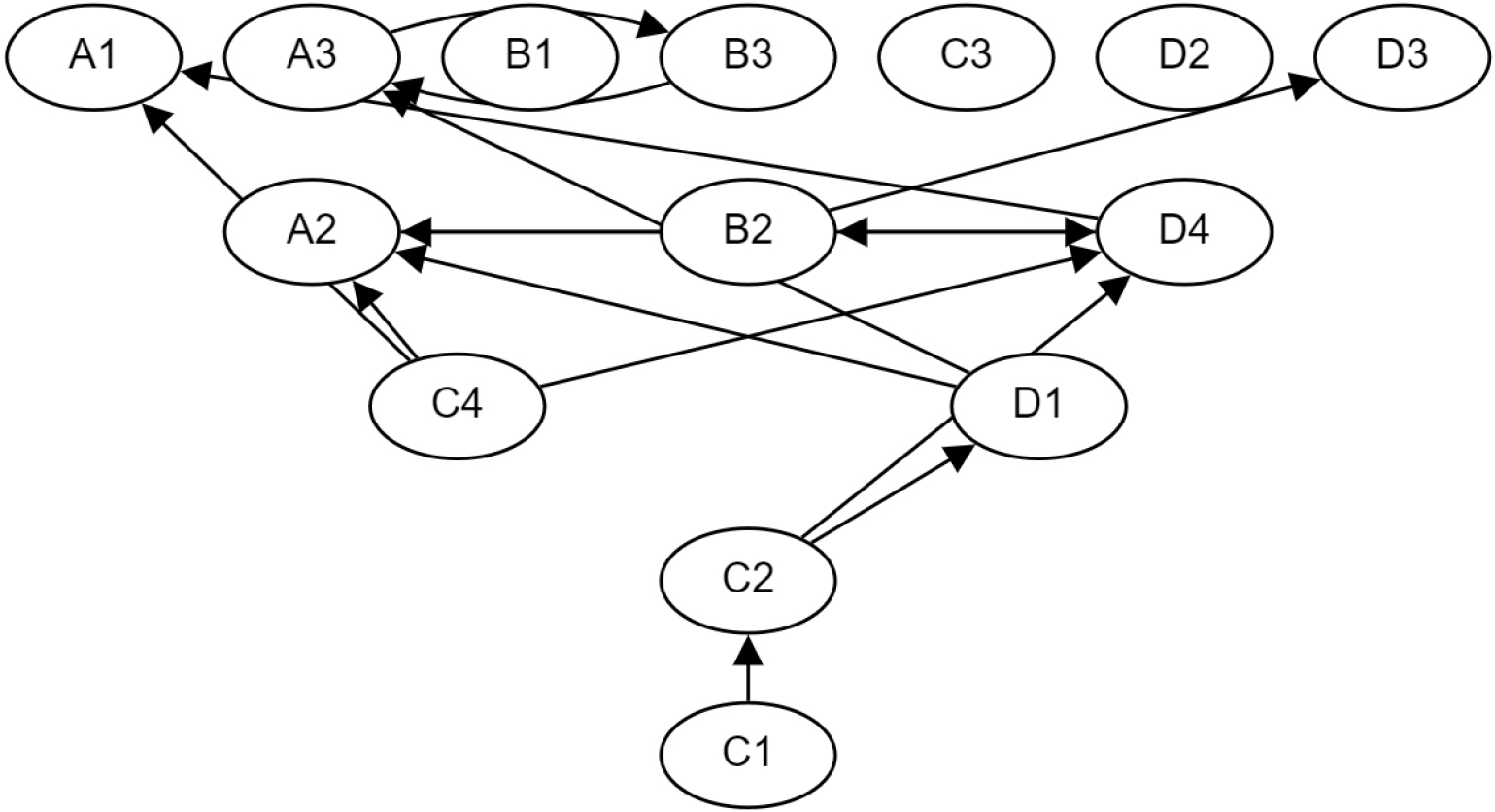
It can be seen from Fig. 1 that A1, A3, B1, B3, C3, D2 and D3 are the top-level influencing factors. The integrity of supply chain information resources (A1) and resource allocation efficiency (A3) of the automobile manufacturing industry fully demonstrate that resources are the basis for information resource-sharing platforms to provide services. Information resource-sharing activities and service items focus on resource co-construction and sharing. To realize resource sharing in the digital platform of the automobile manufacturing industry and ensure the processing quality of information resources and effectiveness of query services, it is necessary to formulate a unified standard for the data of the digital platform of the automobile manufacturing industry. The data is accurate and complete to ensure information and data processing consistency. Standards are standardized to maximize resource sharing. It should be ensured that information resources of the digital platform of the automobile manufacturing industry are continuously constructed. Based on the principles of integrity, continuity and availability of database information collection content, scientific and technological information with complete data content, stable access channels and frequent updates should be selected for collection. In the automobile manufacturing industry, the active participation intention of downstream users (B1) and the existing platform interface of midstream users (B3) in automobile manufacturing industry fully indicate that users’ participation in the digital platform system of the automobile manufacturing industry is fundamental and guaranteed for realizing sustainable development of the platform. The growth of users is the key to implementing the overall strategic objectives of the digital platform of the automobile manufacturing industry. Only by actively participating in the construction and sharing of the digital platform of the automobile manufacturing industry, concentrating superior resources, optimizing resources and distribution, and ensuring equal benefits and benefits of users to the digital platform of the automobile manufacturing industry can the normal operation of the digital platform of the automobile manufacturing industry be maintained. Only by building an information resource sharing system with users as its tentacles and observing and giving feedback on needs and changes of various terminals and market services can the digital platform of the automobile manufacturing industry make timely adjustments to resources, services, products and technologies. The network organization form of the digital platform of the automobile manufacturing industry (C3) explains that platform network organization form is the key technology in digital platform construction of the automobile manufacturing industry. Standard specification platform is the realization of the unification of repetitive events and concepts in the organization process of the digital platform of the automobile manufacturing industry through the formulation, release and execution of standards so as to obtain the best order and efficiency. The willingness to share services (D2) of service providers of the digital platform of the automobile manufacturing industry and technology maturity of distributed services of the digital platform of the automobile manufacturing industry (D3) indicates that the ability of service providers has a direct and brief guiding and influencing effect on the thinking concepts and behaviors of platform users. It also directly determines the level and grade of platform construction. Continuing to provide necessary services to its members and end users is the key to the continued development of the digital platform of the automobile manufacturing industry and to increase its competitive advantage. Sharing services based on the digital platforms of the automobile manufacturing industry is not only the main way to carry out information resource-sharing activities of members but also an important means for users to intervene in the operation of social networks with the help of the digital platforms of the automobile manufacturing industry. C1 and C2 as the bottom influencing factors indicate that technical factors are still the basic influencing factors. Because the key technologies of digital platform construction in the automobile manufacturing industry determine platform management mode and network organization form, management platform framework and mode hurt technology platform construction ideas and operation mechanism. Promulgations and implementation of standard specification platforms constrain and standardize the construction of technology and management platforms. At the same time, the organization of the platform’s technical means and management and operation mechanism also affect the selection and formulation of standards and specifications.
After determining the hierarchical structure of each influencing factor through the ISM model, the MICMAC method is used to further determine the position and role to put forward more targeted countermeasures and suggestions. The main purpose of MICMAC analysis is to calculate the dependence and driving force of the main influencing factors, as shown in Table 5.
Driving force and dependency values of influencing factors
Driving force and dependency values of influencing factors
The dependence and driving force of each influencing factor can be known from Table 5, and the average value of the two is calculated accordingly. The average value is taken as the quadrant dividing line. All influencing factors are divided into each quadrant, and the MICMAC analysis quadrant diagram of influencing factors of the development of new energy vehicles is drawn, as shown in Fig. 2.
Dependency-driving force classification of influencing factors.
As it can be seen from Fig. 2:
The first quadrant is the autonomous factor. In this quadrant, influencing factors have weak dependence, large driving force, and no important system. It mainly comprises C1, D1 and C2, and these three factors constitute the lowest factor in the ISM decomposition result. Because they have a higher driving force and a lower dependence, they are less affected by other factors and have a greater impact on the upper factors. The factors (C1, D1, and C2) play a linking role; once there is a problem, it will have a greater impact on the upper factors. The third quadrant is the linkage factor. In this quadrant, influencing factors have strong dependence and strong driving forces, which connect the system and transfer the influence of the lower factors to the upper level. It mainly comprises A1, A2, A3, B2, B3 and D4, which are the middle layer of ISM decomposition results and are important in connecting other factors. A2 and B2 are very close to the linkage area, indicating that the effects of the above factors on the system are transferred to the upper layer through the above factors, which conforms to the ISM model. The fourth quadrant is an independent factor, in which influencing factors have little dependence and a large driving force. All the top-level factors of the ISM model are in this quadrant. Other factors do not easily influence them and strongly boost the digital platform of the automobile manufacturing industry. Even small changes in these factors can lead to a long and large ripple effect on the digital platform of the automobile manufacturing industry. High-quality development of the automobile manufacturing industry is inseparable from the top-level design, core technology research and infrastructure improvement.
With the development of automobile products to intelligence and networking, automobiles gradually move from transportation tools to mobile intelligent terminals. Digital platform construction in the automobile manufacturing industry can clean, integrate, and manage massive amounts of data. It provides more new development opportunities for the traditional automobile industry and helps enterprises to achieve transformation and upgrading. In this study, the ISM model is used to stratify influencing factors of digital platform construction of the automobile manufacturing industry, and the MICMAC method is used to analyze the dependence and driving force of the main influencing factors. The following three conclusions are obtained. (1) 14 factors are more scientific and reasonable as influencing factors of digital platform construction of the automobile manufacturing industry. (2) Technical factors are still the fundamental factors affecting the digital platform of the automobile manufacturing industry. (3) C1, D1 and C2 are autonomous factors with a high driving force and are important in promoting digital platform construction in the automobile manufacturing industry. It is suggested that further research should be carried out in automobile manufacturing data visualization technology, real-time warning platforms of the whole operation of the automobile industry, and the sharing mechanism of the data industry chain.
Footnotes
Acknowledgments
This study was supported by the China Postdoctoral Science Foundation (No. 2022M712660).
Declarations of interest
None.