



Abstract
Low-carbon building is an unavoidable development trend in the construction industry, especially in the critical moment of global warming, it is necessary to make a comprehensive evaluation of low-carbon buildings. At this stage, low carbon building has become an important direction in the construction field, and whether the low carbon building reaches the corresponding standards and the advantages played by the low carbon field need to be assessed with perfect evaluation indexes. Based on this, this paper constructs a low-carbon building evaluation system from the whole life cycle of the building using the hierarchical analysis method (AHP) and BP neural network method. Firstly, the definition and influencing factors of low-carbon buildings are analyzed, secondly, the evaluation index system of low-carbon buildings is constructed, and then the evaluation index system of low-carbon buildings is verified by using the hierarchical analysis method, and the results show that the evaluation results based on the hierarchical analysis and the BP neural network method are more accurate than those of the traditional hierarchical analysis method. The results show that the evaluation results based on hierarchical analysis and BP neural network are more accurate than the traditional hierarchical analysis method. It shows that the BP neural network method can effectively reduce the influence of subjective factors in the hierarchical analysis method and improve the objectivity of the evaluation results. On this basis, this paper proposes countermeasures to promote the development of low-carbon buildings, in order to provide a certain reference for the long-term development of low-carbon buildings.
Introduction
Low carbon building refers to the reduction of fossil energy use, improvement of energy efficiency and reduction of carbon dioxide emission during the whole life cycle of building materials and equipment manufacturing, construction and building use. At present, low-carbon buildings have gradually become the mainstream trend in the international architectural community [1]. Previously, the China Real Estate Research Association and the Construction Industry Development and Technology Committee have jointly released the “Low Carbon Housing Technology System Framework”, but this is only a technical consideration. There are many factors affecting the development of low-carbon buildings, such as social, economic, technical, market, management, etc. It is difficult to provide objective and effective guidance for the development of low-carbon buildings by considering the influencing factors only at the technical level. Therefore, the innovation of this paper is that it will start from a normative and comprehensive point of view, clearly define the factors constraining the development of low-carbon buildings, synthesize the social, economic, technological, management and other factors, construct a hierarchical structural model of the influencing factors of low-carbon buildings, and then apply the hierarchical analysis method to analyze and deal with the influencing factors in the hierarchical structural model, in an attempt to find out the key factors constraining the development of low-carbon buildings. It provides fundamental information for the research of low carbon building development. Through the research of this paper, it has two aspects of significance. First, at the theoretical level, it helps to improve the research related to the evaluation index system of low-carbon buildings and provides certain reference for the theoretical improvement. Secondly, at the practical level, through the construction of low carbon building evaluation index system based on hierarchical analysis method, it can provide certain basic information for the efficient evaluation of low-carbon buildings and the long-term development of low-carbon buildings to ensure the long-term development of low-carbon buildings.
Definition and connotation of low carbon building
Definition of low carbon building
Low-carbon refers to the reduction of greenhouse gas (mainly carbon dioxide) emissions [2]. The concept of low carbon building has just been put forward in recent years, and at present there is no unified understanding of low carbon building at home and abroad. In the field of construction, a clearer definition of low carbon building is: a building that reduces the use of fossil energy, improves energy efficiency and reduces carbon dioxide emissions in the entire life cycle of building materials and equipment manufacturing, construction and building use (building planning, design, construction, operation and maintenance, and demolition and reuse processes), on the premise that it meets the requirements of human beings for living comfort. The term “building” is more clearly defined as a building that, on the premise of meeting human living comfort requirements, reduces the use of fossil energy, improves energy efficiency, and reduces carbon dioxide emissions throughout the entire life cycle of material production, building planning, design, construction, operation and maintenance, and demolition and reuse.
Low-carbon buildings-Kloboucká lesní headquarters.
Clichy-Batignolles ecoregion.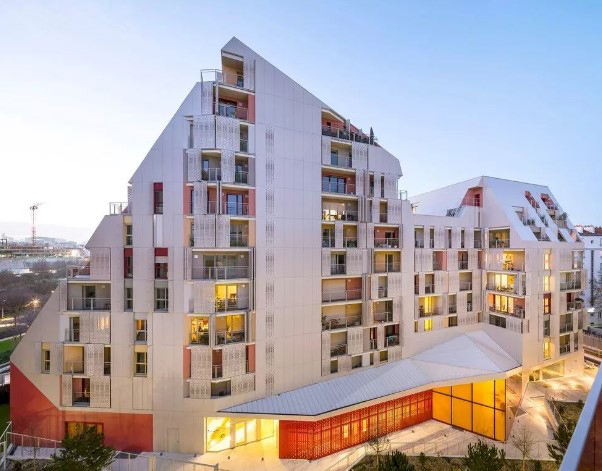
The evaluation systems of green buildings in foreign countries are more perfect, and the evaluation is also carried out in the overall process of the building, and the better evaluation systems include the LEED system (Leadership in Energy and Environmental Design) in the United States, CASBEE (Comprehensive Assessment System for Building Environmental Efficiency) in Japan, and DGNB (Deutsche Gesellschaft für Nachhaltiges Bauen) in Germany. Assessment System for Building Environmental Efficiency) in the United States, CASBEE (Comprehensive Assessment System for Building Environmental Efficiency) in Japan, and DGNB (Deutsche Gesellschaft für Nachhaltiges Bauen) in Germany, etc. However, the carbon emission of buildings is not highlighted in these systems, and the assessment system for green buildings attaches importance to the carbon emission index of buildings. The green building assessment system pays less attention to the carbon emission index of buildings. There is no widely recognized evaluation standard for low-carbon buildings in China. In his article “Research on Green and Low-Carbon Rural Development in China: A Scientometric Analysis Using CiteSpace (1979-2021)”, Liu suggested that by 2020, China will have a “dual-carbon” goal, i.e. to achieve carbon peak by 2030 and carbon neutrality by 2060 [3]. According to Jia, in a low-carbon economy, the sun is similar to a kind of LED lighting, which can be used as a linear light source. Therefore, the discussion related to indoor solar lighting can seek experience in the study of indoor LED arrangement [4]. Xu pointed out in his study that based on the development context of low-carbon construction, it is necessary to reduce the carbon dioxide emissions of urban construction land, and this approach is a key way to effectively mitigate global warming problems [5].
Throughout the domestic and international research on the evaluation system of low-carbon buildings, the evaluation system of low-carbon buildings has not been well established, and the requirements of low-carbon buildings caused by the imperfect system have not been strictly complied with, and their construction mainly relies on the conscientiousness of the decision-makers of enterprises. There are many factors affecting low-carbon buildings, such as society, economy, market, construction, environment and so on. Considering the influencing factors only from the technical level, it is difficult to provide objective and effective guidance for the development of low-carbon buildings. Therefore, this paper synthesizes the literature on the basis of research, will be aimed at restricting the development of low-carbon building influencing factors to carry out a comprehensive and comprehensive research. This paper innovatively divides the influencing factors of low carbon building development into four parts: social influencing factors, economic influencing factors, technical influencing factors and management influencing factors. This provides corresponding support for the construction of low-carbon building index evaluation system. The details are shown in the figure:
Fractors influencing the development of low-carbon buildings.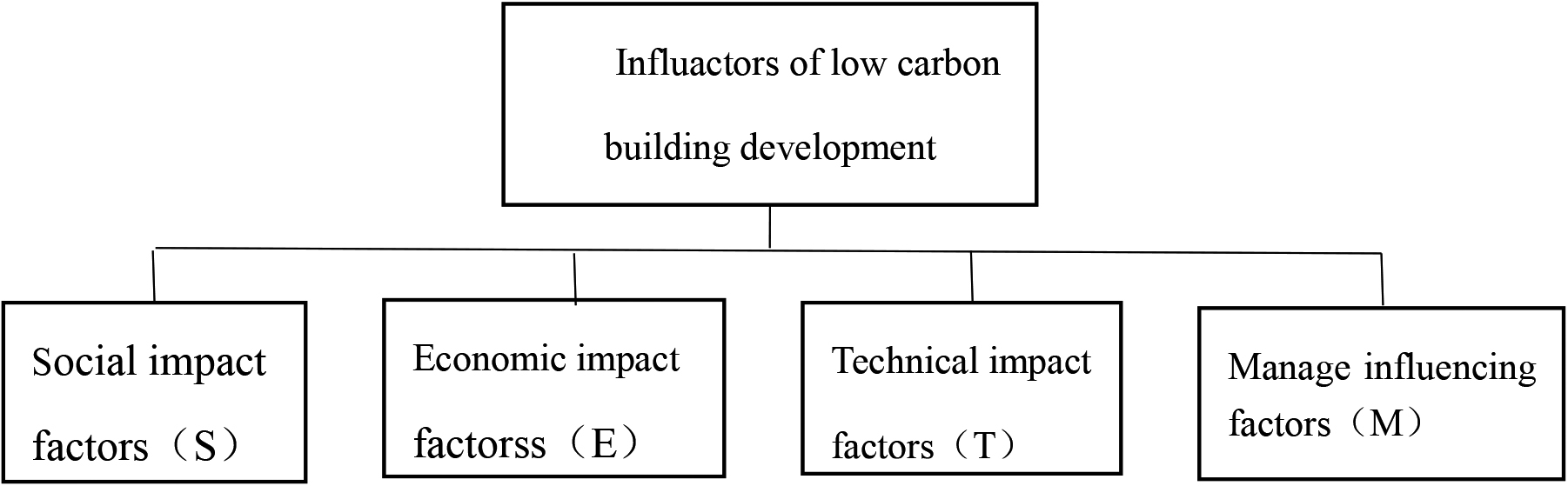
The social factors of the building system mainly refer to the sum of factors at all levels of society, such as policies and regulations, social values, social consciousness, value orientation, etc., which influence the development of buildings, specifically embodied in the public’s sense of social responsibility, the public’s awareness of energy conservation and environmental protection [6]. The development of low-carbon buildings must be based on modern living standards, aesthetic requirements and moral and ethical values. The framework system of social influence factors mainly includes seven parts: (1) the construction of low-carbon buildings policies and regulations; (2) the degree of low-carbon buildings demonstration and promotion; (3) the system of low-carbon buildings evaluation methods; (4) the public’s awareness of low-carbon; (5) the degree of satisfaction of stakeholders; (6) the consumer demand for consumption; (7) the degree of perfection of low-carbon market mechanisms.
Economic influence factor framework
Economic factors are the first and foremost guaranteed conditions for realizing low-carbon buildings and improving the low-carbon efficiency of buildings in China. The environmental and social benefits of low-carbon buildings are undoubtedly conducive to the sustainable development of society, but because their initial investment is often high, they are usually not favored by investors. The framework system of economic influencing factors mainly includes four aspects: (1) Government subsidies and incentives for low-carbon construction enterprises; (2) financing level of low-carbon construction enterprises; (3) low-carbon buildings costs; (4) short-term economic benefits of low-carbon construction investors.
Framework of technical influencing factors
Technical factors, which are factors that directly affect the effect of low-carbon building implementation. The degree of research and development of low-carbon technology largely determines the development of low-carbon buildings, such as the development and application of green materials and green construction technology. The framework system of technical influencing factors for low-carbon building development mainly includes seven aspects: (1) development of low-carbon materials and technologies; (2) low-carbon energy use; (3) low-carbon design; (4) low-carbon construction; (5) low-carbon construction; (6) low-carbon recycling and emission; (7) greening and carbon sinks.
Management influencing factor framework
Management refers to the process of combining human, material, financial and information resources by means of planning, organizing, leading, controlling and innovating in order to achieve organizational goals efficiently. The improvement and enhancement of low carbon management level is an important guarantee to promote the low carbon of China’s construction and improve the low-carbon efficiency of China’s urban construction. As the direct organizer and leader of the development of the construction industry, the construction management department has a pivotal role in promoting the process of low-carbon buildings, therefore, it is important to fully identify the main factors affecting the development and management of low-carbon buildings, learn from advanced management experience at home and abroad, and adopt practical methods and countermeasures to promote the healthy and orderly development of the management of low-carbon buildings and to promote the sustainable development of the entire construction industry as well as the whole society. It is of great significance. The framework system of influencing factors of low carbon building development and management mainly includes seven aspects: (1) government supervision and management mechanism; (2) professional training; (3) low-carbon buildings development and management mode; (4) low-carbon design management; (5) low carbon construction management; (6) low-carbon operation management; (7) low-carbon end-of-life management.
Construction of low carbon building evaluation index system
The goal of low-carbon buildings is to reduce the use of fossil energy, improve energy efficiency and reduce carbon dioxide emissions throughout the life cycle of buildings. The construction of low-carbon building evaluation index system should start from the whole life cycle, that is, to reflect the energy saving and emission reduction of low-carbon buildings comprehensively and objectively, and at the same time, the selection of indexes should follow the principles of global, comparability and sustainability [7]. By consulting with several experienced experts and referring to a large number of relevant research materials, a more systematic and reasonable low-carbon building evaluation index system is integrated and established, as shown in Fig. 1.
Low-carbon building evaluation index system
Low-carbon building evaluation index system
Ask several experts to score each index of the actual construction (I-VIII), and each index score is scored as (0–5). Make the qualitative evaluation index factors set quantitative, establish the specific evaluation index value, and then sort out.
Principle of hierarchical analysis method and application steps
The basic idea of the hierarchical analysis method is: first decompose and then synthesize. Firstly, the problem to be analyzed is hierarchized to form a multi-layer analysis structure model, which finally boils down to the question of the weight or relative order of merit of the relative importance of the bottom level (programs, measures, indicators, etc.) in relation to the top level (the overall goal). Its main steps in the evaluation process are as follows.
(1) Establish a multi-layer analysis structure model: target layer A
(2) Construct pairwise comparison matrix. Let there be n factors in a layer, i.e.
Note: A total of 6 judgment matrices are constituted, which are the judgment matrix of the criterion layer to the target layer (1) and the judgment matrix of the indicator layer to the criterion layer (5).
(3) Hierarchical single ranking and consistency test. Determine the ranking of the importance of each factor in this layer to a factor in the previous layer, which becomes the hierarchical single ranking. The maximum eigenvalue
In order to strive to ensure the validity of the requested weight vector
Where
If CR
Level single sorting and consistency test table
Level single sorting and consistency test table
(3) Hierarchical total ranking and consistency test.
Determine the ranking of the importance of the factors in this layer for the total target, which becomes the hierarchical total ranking. Then the weight of indicator layer C to target layer A
Based on the scores of each index given by the experts in Table 1, the final scores of the actual buildings are weighted using the weight values determined by the hierarchical analysis method. The final scores of the actual buildings (I-VIII) are: 2.8068, 1.9214, 3.2136, 2.0547, 2.2787, 3.1699, 3.8517, 2.8116.
Factors hindering the development of low-carbon buildings and countermeasures
Inadequate system of policies in social management
At this stage, the reason why the development of low-carbon buildings is slow being mainly due to the policy aspect: one of them is that there is no technical standard for low-carbon buildings [8]. At this stage, China has not introduced technical guidelines and standards for low-carbon buildings. Because of the lack of unified standards, various low-carbon buildings in the market mainly emphasize the application of technology, but lack a comprehensive assessment of the effect of energy saving and emission reduction in the construction process, so the problem of low carbon on the surface, but the actual carbon emissions are also high, so that the public and the market are misled. Second, there are fewer policies to support low-carbon buildings. Since the cost expenditure of low-carbon buildings is higher, it leads to its development in a lagging state. As we all know, the process of low-carbon building construction is not only using a single low-carbon material, but the overall large scope and space of low-carbon construction, including design projects, construction, decoration, equipment, maintenance, greening and many other elements, all involving low carbon. Therefore, low-carbon projects are a complete innovation of traditional projects and require the use of the most advanced technology and equipment, which will then inevitably increase the cost expenditure. In terms of using building materials, the use of more innovative and modern materials can control carbon emissions, but because of the high cost, many developers cannot afford it, and the general audience will be discouraged by the price of low-carbon buildings. In view of this, low-carbon buildings are not yet widely popular, and their poor recognition and high prices make it difficult for them to develop rapidly. Thirdly, there is not yet a relatively sound monitoring system for low-carbon buildings. A very special situation is that although the concept of energy saving is incorporated into the building layout in the process of construction work, the overall design is unreasonable or the technical means are not in place, resulting in a situation where the planning of energy saving in buildings does not live up to its name. There is also no standard for the use of buildings. In addition, there are no strict standards for the review and acceptance of low-carbon buildings, which has a negative impact on the promotion of low-carbon buildings. In terms of the setting of energy efficiency standards, the lack of clarity in acceptance criteria and the lack of clarity in the formulation of the corresponding details make it difficult to truly achieve the desired results. Moreover, the acceptance standards are not standardized, and the existing regulations cannot reasonably control them, making it difficult to maximize the energy-saving effect of energy-efficient buildings. Fourth, there is no reasonable public opinion propaganda response to low-carbon buildings. At the Copenhagen Climate Conference, the serious climate problems we are currently facing were revealed. This has led to the need to take a more serious approach to global warming. But on a practical level, although there is currently a high level of acceptance of low-carbon living, there is even the view that low-carbon must be achieved at the cost of lower living standards. The government has a very important role to play in guiding public opinion. Only by prompting the government to give full play to the low-carbon effect and realize the publicity and guidance of low-carbon living and low-carbon buildings from the government level can the people be effectively mobilized to realize low-carbon living and have a deeper understanding of low-carbon buildings and low-carbon living.
Insufficient financial security at the economic level
Due to the large proportion of building energy consumption in the end energy consumption of the society, which has a large energy-saving and low-carbon potential, all countries have taken positive actions on building energy saving and low-carbon [9]; at the same time, due to the external economics of building low-carbon leads to the partial failure of the market mechanism in this field, through the adoption of different incentives and subsidies, especially in the economic aspect, to actively guide the social investment main body to put more funds into the construction of low-carbon, so as to realize the building Low-carbon goals. At present, China’s low-carbon buildings are still in their infancy, whether it is the introduction of low-carbon technologies from abroad, or independent research and development by our government, enterprises or relevant scientific research institutions, the use of low-carbon materials, the use of low-carbon technologies, etc. will increase the cost of construction. The high cost largely affects the promotion of low-carbon buildings. Undoubtedly, the environmental and social benefits of low-carbon buildings are favorable to the sustainable development of society. Therefore, for the country, the long-term economic benefits of developing low-carbon buildings must be objective, but for investors, benefit maximization is the aim. Benefit maximization includes investor payback period and return on investment, so it pays more attention to the short-term economic benefits and hopes to recover the investment as early as possible, so the short-term economic benefits are an important factor influencing investors to invest in low-carbon buildings.
Insufficient technological innovation and application at the design level
At present, the system of low carbon design in China needs to be further improved. In terms of the construction of low-carbon buildings, from the initial design, to the process of construction and then to the final house should always adhere to the concept of low-carbon, environmentally friendly operation, but also to ensure the comfort of housing, and promote the harmonious coexistence between the building and ecological development. For this reason, in the development of architectural plans, we must be guided by the concept of sustainable development, in the lighting, heating, ventilation and the application of building materials and other levels of housing construction should be integrated into the low-carbon concept. In addition, the current low-carbon building development lacks excellent design talents [10]. China’s real estate industry is in the stage of rapid development, so for the layout of housing buildings, designers are required to complete the most outstanding design drawings set in the shortest possible time. The architects, under the pressure of fierce market competition, are difficult to make low carbon trade-offs as a whole to ensure design timeliness, and are unable to make optimal low carbon building solutions based on the advantages of different regions.
Insufficient promotion of low-carbon buildings at the management level
Although the low-carbon voice in China has been high in recent years, people’s understanding of low-carbon is still insufficient. The first manifestation is the low public awareness of low carbon. At present, in the process of development of China’s hey building industry, the operational concept of low carbon, energy saving and emission reduction is very much emphasized. Around this requirement, the state has also adopted a series of means to adjust the economic structure. Therefore, our people are required to further enhance their low-carbon awareness so that they can participate in low-carbon actions with a higher awareness. At the 2015 APEC Leaders’ Meeting, General Secretary Xi Jinping reiterated the concept and requirements of energy conservation and emission reduction in China, and pointed out that he hoped to achieve an increase in low-carbon awareness among the whole population by means of publicity and education, and to actively engage in the practice of low-carbon concepts. Secondly, there is insufficient incentive for China to carry out low-carbon building consumption. Although the state has made a series of efforts to promote low-carbon buildings, in order to truly promote low-carbon buildings in place, real estate developers play a very important role, and there must also be a large audience willing to pay for low-carbon buildings. If both developers and consumers make concessions, the market for low-carbon buildings will gradually move into a normal development path. However, the higher cost of low-carbon buildings means that consumers have to pay more for their homes, which is obviously difficult to get the majority of consumers to agree [11]. From the national level, the state does not have many preferential policies for consumers to purchase low-carbon buildings, so it also leads to low enthusiasm of consumers for low-carbon buildings. Therefore, it is also necessary for the state to introduce corresponding incentives to stimulate the enthusiasm of low-carbon building consumption. It is also necessary to strengthen the guidance on the value of low-carbon buildings in terms of publicity. Considering that consumers are more concerned about the purchase price, so if real estate developers raise the sales price of real estate products on the grounds of low carbon, it will certainly lead to the loss of many potential consumers. This is because from a consumer perspective, many consumers believe that purchasing a low carbon building will cost more and it is difficult for consumers to see where the benefits of low carbon housing lie in the early stages. Therefore, for consumers, buying low-carbon buildings is essentially altruistic, ignoring the long-term benefits that low carbon housing can bring to consumers. Secondly, from the market level, there is a serious lack of marketing about low-carbon buildings, and consumers do not know enough about low-carbon buildings, so there are still many concerns about whether to buy low-carbon buildings. However, if we can make consumers understand more about low-carbon buildings and look at the long-term benefits of low-carbon buildings from a rational perspective, they will realize that purchasing low-carbon buildings can achieve both self and altruistic goals.
Countermeasures for the development of low-carbon buildings
Establish and improve the relevant policy mechanism
According to the national energy-saving and emission reduction strategic plan, the core purpose of promoting the development of low-carbon buildings is to promote the development of Chinese real estate gradually into a green, low-carbon healthy development track. Therefore, in order to promote the further development of low-carbon buildings in China, the state must carry out the formulation and introduction of corresponding policies. At the same time in this process also need to be combined with the current practice of China’s energy saving and emission reduction work, while the development of China’s real estate industry to develop its development of energy saving and emission reduction policy planning. In addition, for the development of China’s construction industry, it is also necessary to carry out further improvement of the corresponding legal norms. To promote China’s real estate construction development process, from real estate layout planning, construction and acceptance of real estate products, and even product sales to late residential maintenance and other levels can form a relatively perfect legal regulation, and actively promote the establishment of a third-party low-carbon building assessment system with China’s current development status.
Introduce more economic incentive policies to enhance developers’ motivation to save energy
From the perspective of policy formulation, the government should combine the development needs of low-carbon buildings and give priority to the allocation of land resources required for low-carbon buildings in terms of land use. At the same time, the government should set lower-than-average tax rates for low-carbon buildings, so that real estate companies can effectively reduce the costs of low-carbon building development. At the same time, the state can also provide the necessary financial subsidies for low-carbon building development by means of financial subsidies to boost the enthusiasm of real estate enterprises to develop low-carbon buildings [12]. At the same time, it can improve the applicability of existing financial policies to low-carbon building development and give more preferential conditions to low-carbon building development enterprises. The government should provide economic support to individuals, research institutions and enterprises in developing new materials and technologies for low-carbon buildings, and increase the fostering and promotion of new materials and technologies. At the same time, the promotion of low-carbon building technology is inseparable from the training of relevant talents, so the government should increase the training of university construction-related talents, and actively carry out low-carbon architectural design, planning competitions, and from the source of low-carbon construction to the construction of low-carbon awareness of building practitioners. While advocating the development of new materials and technologies, the government should also formulate a system to eliminate backward products and technologies or prohibit their use.
Optimize low-carbon and energy-saving building design
Energy saving is the core element on low carbon building design and development. In order to reach the energy-saving goal, it is necessary to integrate the site of the housing building, greenery and the layout of the indoor and outdoor environment to fully realize the low-carbon and energy-saving design considerations. The first is to have an overall layout and planning of the building. In other words, the development of low-carbon buildings should be based on the local situation, making full use of the local advantageous geographical and climatic conditions to reasonably select low-carbon buildings and building layout. Specifically, the overall architecture of the building, the building spacing and the building density should be weighed comprehensively to achieve the best design solution to promote the layout of low-carbon buildings to achieve maximum energy efficiency. First, the layout of the use of natural lighting and ventilation should be reasonable, so as to reduce the energy consumption of the building in heating and lighting. The second is to reasonably design the house insulation and choose new building materials. To fully meet the house insulation needs, but also to enable the house to achieve better light transmission and heat insulation effect. At the same time, based on the use of new technology to promote the use of housing construction materials can occur corresponding physical changes, always ensure that the interior of the house to maintain the appropriate temperature, in order to further reduce the energy consumption of life [13]. At present, some high insulation materials, as well as some polymer moisture absorption materials have good application benefits. Finally, the green layout. Combined with green design to promote housing away from the urban “heat island effect”, not only to make housing more comfortable, but also to effectively reduce energy consumption, to implement the national requirements of the concept of energy saving and emission reduction.
Guide the public to low-carbon consumption
The government’s mandatory measures for the promotion of low-carbon buildings mainly include the formulation of laws and regulations, the standardization of industry standards and tax restrictions, etc. Under the government’s restrictive measures for the promotion of low-carbon buildings as well as supervision and management, the government has prompted enterprises to not only pursue profit maximization in the production process, but also to take into account the comprehensive interests of resources and the environment, to set up a low-carbon awareness of the enterprise to increase technological inputs, and to improve the level of their low-carbon technology. At the same time, the research results of scientific research institutions on low-carbon buildings can provide strategic support for the government to promote low-carbon buildings, such as the formulation of laws and regulations, industry standards, supervision and management tools. The most preferential policies should be given to the consumption of low-carbon buildings as much as possible, whether it is for residential or commercial use, and the corresponding preferential conditions should be given to the purchase of housing. Since the development cost of low-carbon buildings is higher, this will also inevitably lead to a corresponding increase in their market sales prices. Therefore, the public should be guided to consume low-carbon buildings, and the media and public opinion should be integrated to guide the public’s awareness of the energy-saving benefits of low-carbon buildings, and digital cost comparisons can be adopted to show the advantages of low-carbon buildings to the public. In addition, a variety of activities, such as forums and competitions, can be used to attract more public attention to low-carbon buildings.
Conclusion
Through the study of the evaluation index system of low-carbon buildings, this paper illustrates the proportion of each index in carbon emissions with specific figures. In this way, it helps construction enterprises to understand the current situation of their own carbon emissions, and then improve the links and activities that have a greater impact on carbon emissions, so as to provide a basis for the study of the development of low-carbon buildings and the corresponding low-carbon optimization measures. However, due to the defects and limitations of the AHP hierarchical analysis method itself, the selected indicators are only typical indicators in low-carbon buildings to be analyzed, so they are not comprehensive, so in the future research, the scope of the indicators will be expanded to derive more accurate data, which will provide a certain reference for the construction of the evaluation index system of low-carbon buildings.