



Abstract
With the continuous improvement of the social and economic level, the investment in fixed assets in the whole society is increasing steadily, while the phenomenon of uncontrollable investment is becoming more and more serious. Therefore, it is very important to increase the investment estimate in the early stage of the project construction. Based on this, in this paper, by studying the BP neural network, a mathematical model of the prediction of engineering cost based on the improved BP neural network model was proposed; then, taking a 15-storey tall building in a residential district as a prediction object, by collecting and sorting out engineering cost data similar to the predicted object, the improved BP neural network model was estimated and trained; finally, the prediction of the engineering cost data for the project was carried out, and the actual results were compared with the estimation results of the traditional prediction model; thus, the speediness and accuracy of the proposed improved BP neural network model in the field of the prediction of engineering cost were verified.
Introduction
Project cost forecasting is an important part of the project investment decision-making to the preliminary design stage. It is not only an important part of the project proposal and feasibility study report, but also one of the important basic work. Project decisions have a controlling effect on the total cost of the project [1]. For construction projects, the time and capital investment of the project should be directly proportional to each other, and only if both are normal, the project can be successfully completed. Therefore, it is particularly important for governments and investors to predict and control project costs during construction [2]. Through correct forecasting and control, investors can reduce investment risk and control project costs in the early stages of the project and during construction [3]. For contractors and construction units, the risk of project cost can be fully considered during bidding, and the construction cost of the building can be actively controlled during construction, thereby reducing business risks and improving business profits [4]. Therefore, accurately predicting the project cost is of great significance to the smooth development of the project. Due to its good cognitive and computational capabilities, neural networks can select the most appropriate weighting coefficients from the data stored in the system to obtain relatively accurate predictions. Therefore, this paper discusses the engineering cost forecast based on the improved BP neural network algorithm.
Based on the analysis of the prediction results of engineering cost prediction model and standard BP prediction model, this paper constructs a BP neural network engineering cost prediction model. The conjugate gradient algorithm accelerates the convergence speed of network training by transforming the gradient, which can improve the convergence speed and convergence performance. In this paper, the conjugate gradient algorithm is used to optimize the BP neural network. The improved BP neural network can reflect the objective reality of engineering cost growth and development, and the fitting accuracy is also high. Finally, the 15-storey building in the residential area is used as the prediction object to verify the effectiveness of the improved BP neural network model.
The engineering cost prediction model constructed in this paper has certain advantages. Firstly, the improved BP neural network can reflect the objective reality of engineering cost growth and development, and the fitting accuracy is also high. Secondly, the model has shorter operation time, human error factors are greatly reduced, and engineering cost estimation efficiency is greatly improved.
This paper studies the engineering cost forecasting model by improving the basic BP neural network model, expounds the forecasting effect of the engineering cost forecasting model and the standard BP forecasting model, and proposes a BP neural network based engineering cost forecasting model, which is based on the 15-story building in the residential community. The predictive object verifies the validity of the model. Through the results of project engineering cost forecasting, it can be seen that the improved BP neural network model is feasible and can improve the efficiency and accuracy of engineering cost prediction. This research provides a certain guiding significance for the establishment of civil construction project cost prediction model.
The establishment of the prediction model of engineering cost based on BP neural network algorithm
The basic theory of engineering cost and its prediction model
Engineering cost has two definitions based on the scope it involves. The generalized engineering cost refers to all the fixed assets investment costs for building a project, including construction and installation engineering costs, equipment and equipment purchase costs, construction costs and preparatory fees [15]. However, in a narrow sense, engineering cost is also known as engineering price, which includes the cost of land and necessary equipment for engineering construction, and the cost of obtaining technology and labor in the process of construction. These costs constitute the price of the construction project and the total price of the project [16]. From the point of view of the participating units, engineering cost is the cost of engineering investment for the investor or the project legal person [17]. And for the contracting parties, engineering cost is the contract price of the project [18]. From the scope of coverage, the extension of the cost of engineering investment is multi-angle and multi-directional, including all the costs in the process of construction. Figure 1 shows the significance of the prediction of engineering cost in engineering projects.

The importance of cost estimation in construction engineering projects.
In general, a variety of factors should be taken into consideration in the construction project cost, which brings great difficulties to the researchers. However, at present, there are some new methods in the field of cost research, and engineering cost estimation models are built up, such as neural network computing, optimization calculation, stability calculation, convergence calculation, complexity calculation, error correction calculation, robustness calculation, etc. Through the above methods, the network computation is simulated to study the effectiveness and operability of artificial neural network in science, technology, economy and other fields [19, 20]. In a word, compared with other traditional computing methods, the rapid development of neural network information technology will be greatly promoted.
BP neural network technology is a parallel information processing system developed based on the principle of biological neural system, which has high nonlinear fitting ability and can get the relationship between complex variables in the system. The standard three-level BP neural network is usually composed of input layer, hidden layer and output layer, where the signal is input to the input layer first, then passes through the hidden layer, and finally reaches the output layer. The signal propagation path of the neural network is shown in Fig. 2.
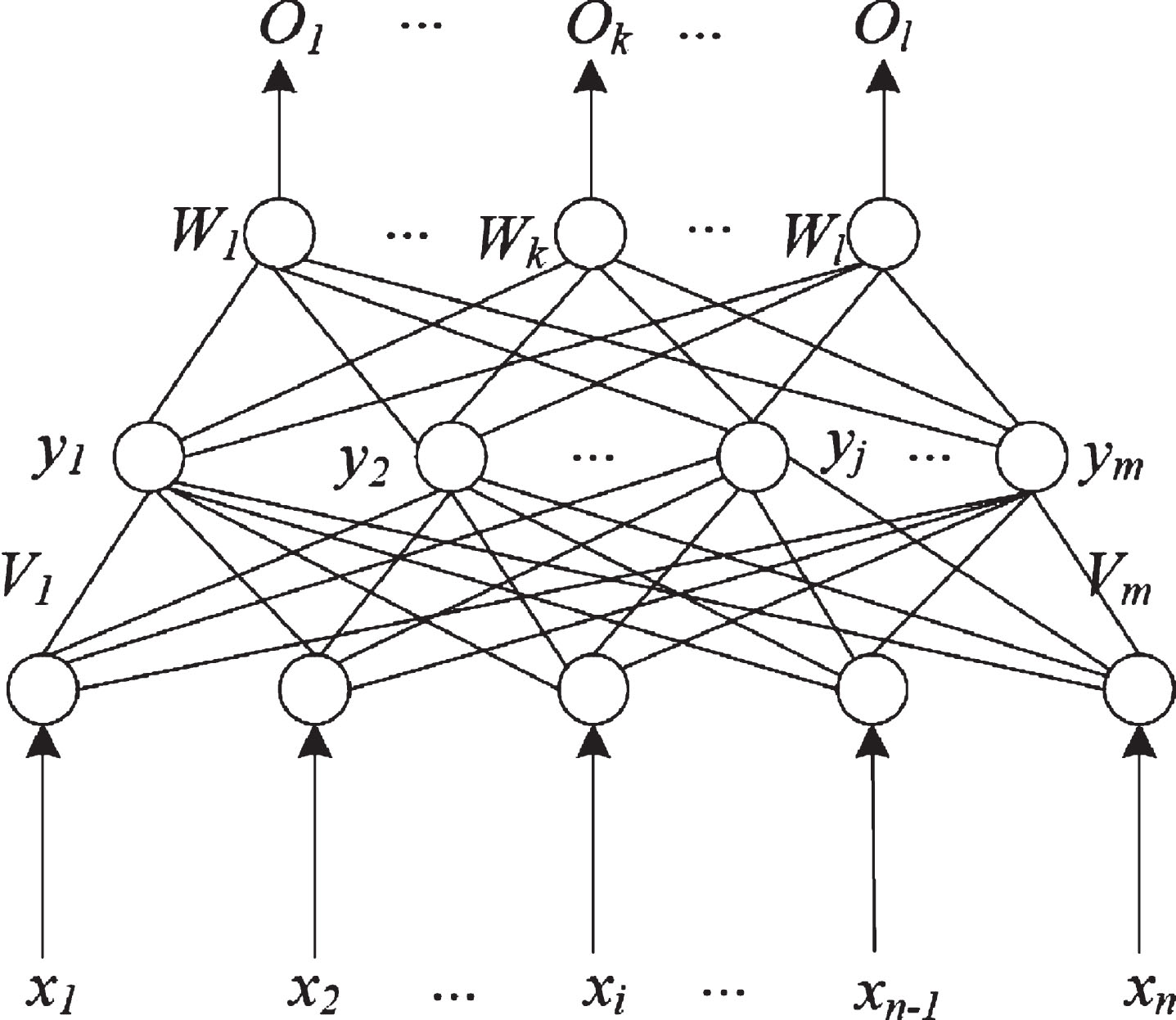
Diagram of BP neural network learning path.
In the standard BP neural network algorithm, the k is the number of iterations, and the correction press of each layer of weights and thresholds is carriedout.
In the form: x (k) is the connection weight vector or the threshold vector between the levels of the k iteration.
For an example of a two layer BP network, there is only one input sample, there are:
In which:
From the point of view of the whole model, the number of nodes in the network layer, input layer and output layer is determined according to the actual demand of the prediction of engineering cost, and can’t be changed. However, the number of nodes, transfer functions, learning functions, and other parameters in the hidden layer are the best choices based on multiple network training. Therefore, the problem may appear on the learning algorithm of BP neural network, and there are some defects in the standard BP network algorithm, mainly as follows: (1) BP algorithm converges according to the gradient descent direction of mean square error, but there are many local and global minimum points in the gradient curve of mean square error, which makes the neural network easily fall into local minimum; (2) the convergence rate of BP learning algorithm is slow, and it may waste a lot of time; (3) there is a lack of unified and complete theoretical guidance for the selection of the number of hidden nodes in the network; (4) the generalization ability of the well learning network is poor.
From the above analysis, it is known that the standard BP neural network algorithm has the disadvantage of slow convergence speed and local minimum of the objective function. The prediction model of engineering cost based on BP neural network can improve the accuracy of the prediction, so it is necessary to improve the learning algorithm of the BP neural network.
The conjugate gradient algorithm accelerates the convergence speed of the network training through the transformation gradient, and can improve the convergence speed and convergence performance. The improved conjugate gradient algorithm can improve the convergence speed without increasing the complexity of the algorithm, and can achieve the global optimum in the conjugate direction, that is, the global extreme point. The improved conjugate gradient algorithm requires linear search in the process of algorithm and Fletcher-Reeves linear search method to ensure the convergence speed of the algorithm.
The subspace formed by the gradient vector g(x) and the direction vector d (0) , d (1) , …, d (k - 1) is orthogonal. Once iteration, the dimension of the subspace is added to 1. The learning rate α (k) changes along the search direction d(k)every iteration, and its size depends on the result of the Fletcher-Reeves linear search.
If the conjugate gradient method increases the value of the target function at the learning rate α (k) at the k+1 time, that is, when the search direction of a step becomes a non-descending direction due to the accumulation of errors; according to the global convergence theorem, the objective function must be continuously decreasing in the whole iteration process. Therefore, the learning rate α (k) of k+1 times is set to 0, and the gradient is (k - 1) = g (k), and the direction vector is d (k - 1) = d (k), the conjugate gradient method begins again. At this time, it is equivalent to the implementation of a fast descent step for the conjugate gradient method. After the iteration, the results converge to the global minimum point.
The modified conjugate gradient method is applied to the BP neural network algorithm. The steps are as follows: The initial point w(0) and the initial search direction d (0) = - g (0) are selected; For k = 0, 1, 2,…, n-1, the weight correction formula for BP networks is:
In the formula, α (k) is the learning rate; d(k) is the conjugate direction of the k iteration. The new gradient vector g(k+1) is calculated. If k = n-1, w(n) is used to replace w(0), and then return to the step (1); otherwise, it is necessary to return to the step (5); The conjugate direction d(k+1) of the k+1 iteration is calculated.
The Fletcher-Reeves formula is:
If d T (k + 1) g (k + 1) >0, w(n) is used to replace w(0), and then return to the step (1); otherwise, it is necessary to return to the step (2).
Based on the improved BP neural network model, the prediction model of engineering cost isestablished. According to the characteristics of the development of engineering cost, the final cost data of 5 similar projects will be used to predict the cost of the current project. Therefore, the number of neurons selected in the input layer is 5, and the number of neurons in the output layer is 1. The hidden layer nodes are determined to be 9 according to the trial and error method. The improved BP neural network can reflect the objective reality of the growth and development of engineering cost, and the fitting accuracy is also high. BP neural network modeling is improved according to the following parameters: (1) the number of nodes in the input layer is 5; (2) the number of nodes in the hidden layer is 10; (3) the number of nodes of the output layer is 1; (4) the number of training times is 4000; (5) and the error of network training is 0.0001. The initial weight, learning rate and threshold of the network are automatically selected by the network.
Empirical analysis
Summary and data processing of engineering projects to be estimated
The case selected in this study is a residential district in a city. The project is invested and developed by a real estate development limited liability company in the city, where the building area is about 169000 square meters, including 30 non decorated houses and commercial buildings with 5–20 storey high, with a total investment of about 160 million. The 2#building was selected as a case for empirical analysis. The specific engineering information is shown in Table 1.
Project overview of research case
Project overview of research case
To ensure the accuracy of the engineering cost data estimation of the proposed project, it is necessary to collect engineering data similar to the selected project cases as training samples. In this chapter, the case was the housing project in Xuzhou area. In the process of collecting data, considering the different price levels of labor and materials in different areas and the difference between the construction process and the technical scheme, the residential projects in the city and its surrounding cities were selected. Through a variety of channels, such as the engineering cost information network in the city’s province, 20 groups of high-rise residential data in the past five years were collected, the samples collected were all residential engineering of 10–15 layers, and the site was located in the city and its surrounding cities, thus ensuring the uniformity of the sample area and the consistency of the categories. Then through 19 engineering features and 4 engineering cost data of the preliminary statistical training samples, the engineering feature vectors of the training samples were obtained. And in order to facilitate the processing and calculation of sample data for the model, it was necessary to quantify and normalize the obtained preliminary statistical data. The quantized input vector is shown in Table 2.
Quantized table of input vectors
Quantized table of input vectors
The quantified training samples were still difficult for the identification and processing of the model. In order to reduce the complexity of model calculation and simplify the calculation program, the linear normalization method introduced was used to normalize the quantized data of training samples, so that the quantized values of all input vectors were distributed within the range of [0, 1]. In order to increase the accuracy of the model, for all normalized data, the way to keep the four bits after the decimal point was taken. The input vector and the expected output vector obtained after the maximum and minimum linear normalization are shown in Tables 3 and 4, respectively.
The state diagram of the three-state process
The state diagram of the three-state process
Before the quantification, the input vectors of the selected research cases were as follows: X_test = [8860.00, shear wall structure, 12 layer raft foundation, 34.89m, fine stone concrete floor, paint exterior wall, latex paint inner wall, sintered porous brick, plywood door, plastic steel window drainage power]T, the desired output vector was: D_test = [974.9272, 42239.7891, 380.1051, 3451.47, 689.13]T. After being quantified, X_test = [8860.00, 5, 12, 4 33.99, 2, 3, 4, 2, 6, 104.18,1]T, and after normalization, the final input vector was as follows: X_test = [0.3247, 1.0000, 0.3333,0.7600,0.6232, 0.6267, 0.5200, 0.8000, 0.0100, 0.2367, 0.6017, 0.0000]T, and the desired output vector was as follows: D_test = [0.0002,0.4239, 0.1532, 0.1862, 0.8641]T.
In order to make the results true, first of all, the quality of the survey data was preliminarily evaluated to ensure the accuracy and reliability of the data obtained. The accuracy and reliability of the data were tested in two steps: the first step was to analyze the deviation of the respondents, to ensure that the respondents filled out the questionnaire carefully and responsible, and the data provided was authentic and credible; the second step was to analyze the difference in the method of investigation, so as to confirm that there was no obvious difference in the distribution of the data.
After collecting and sorting out the data of the training samples and the selected cases, the optimized BP neural network model was called, and the training samples were used to train the model. The statement was load filename gabpnnt, and at this time, the training sample input vector was: XX = (X1, X2, X3, X4, X5, X6, X7, X8, X9)T, and the desired output vector was DD = (D1, D2, D3, D4) T. After training, the mean error curve is shown in Fig. 3.
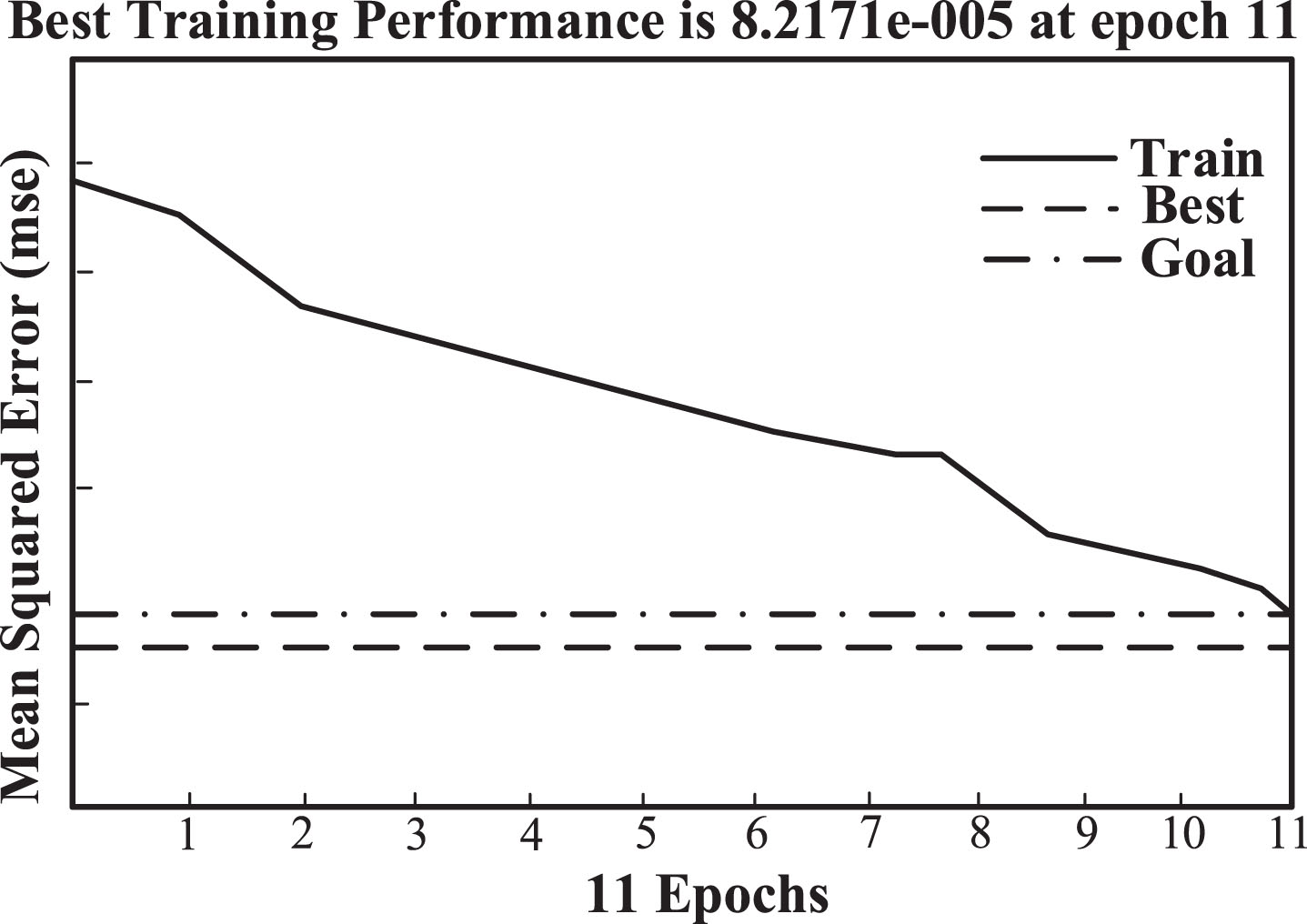
Figure of error curve.
As can be seen from the diagram, the speed of the error decline was at a high level during the training process. When the neural network was circulated to the eleventh step, the error was 0.000082171, reaching a set of 0.0001 error targets. At this time, the model stopped training, the training time was 1s, and the minimum performance gradient was 0.000862.
The main materials of the estimate included steel, wood, and cement and were different from the selected output vector steel, concrete and cement, and as a result, only the same items were compared. The actual data of the project was compared with the predicted values obtained from the improved BP neural network model and the value of the traditional engineering cost estimate. The comparison results are shown in Table 5.
Contrast table of output results
Contrast table of output results
According to the comparison between the calculation results of the estimated index and actual value, it is not difficult to find that the single cost and cement consumption calculated by the traditional estimation index are higher than the actual data, while the artificial day consumption is relatively low relative to the actual value. A layer of basement is included in the estimation conditions of the estimated index of civil engineering, while is not included in the selected case works. Then, taking into account the number of the upper floors, the basement needs waterproofing and foundation treatment, and the material requirements are higher than the common practices, thus resulting in a higher cost of underground space than that of the aboveground parts. And the corresponding artificial consumption will also decrease with the increase of mechanical construction. Therefore, the cost and material consumption of the selected index will be much higher than that of the same type housing project without basement, while the consumption of manpower will be reduced.
As can be seen from Table 5, the accuracy of the calculation results with the traditional estimation index is poor, while the accuracy of the estimated value obtained by the improved BP neural network algorithm has been significantly improved. From the estimation speed, when each engineering cost investment estimate is calculated, the traditional estimation methods need to collect the relevant information of the project, and the process is complicated and the calculation is cumbersome. However, for the improved BP neural network estimation model, as long as the coverage of the sample library is wide and constantly updated, in estimating new projects, only a small amount of data is needed, and more accurate results can be obtained through training and learning of the model. In addition, the operation time is shorter and the factors of human error are greatly reduced, and the efficiency of engineering cost estimation is greatly improved.
In recent years, the basic national policy of our country tends to strengthen the basic construction, and the value of the investment estimation of the construction project is also greatly improved. In the construction project, the cost control of the basic construction and the investment and estimation of the status are increasing day by day. The investment estimation of construction projects is that the project should make a judgment on its own investment based on the current data, which is the basis of the project feasibility study, but also an important basis for the bid. Generally speaking, the cost estimation of construction project is based on the bill of quantities, where there are many specific pricing rules, complex calculation and very heavy workload, thus being difficult to meet the rapid changes in the social market today. In order to scientifically and rationally determine the investment estimation and simplify the work of the investment estimation, in this paper, through the improvement of the basic BP neural network model, a mathematical model of the prediction of engineering cost based on improved BP neural network model was proposed; then, taking a 15-storey building in a residential district as the prediction object, by collecting and sorting out engineering cost data similar to the predicted object, the improved BP neural network model was estimated and trained. Through the results of the prediction of engineering cost of the project, it can be seen that the improved BP neural network model is feasible, and can be used to estimate the cost of the project and improve the efficiency and accuracy of the cost estimation. Thus, the research provides a certain guiding significance for the establishment of the prediction model of engineering cost for civil buildings.