



Abstract
Due to the influence of various factors such as design, construction and use, concrete structures are prone to various damages and defects, so it is necessary to strengthen and repair, and the strengthening technology of carbon fiber external bonding plate is one of the important methods. Therefore, a study on the strengthening performance of prestressed unbonded carbon fiber reinforcement of continuous beams under artificial intelligence technology is proposed. Concrete beams were tested, including the flexural properties of damaged concrete beams strengthened with carbon fiber reinforced polymer, the flexural properties of damaged concrete beams strengthened with prestressed CFRP, and the shear properties of damaged concrete beams strengthened with CFRP. On the basis of experimental research, the calculation methods of flexural capacity, stiffness, crack width and shear capacity of reinforced beams are studied theoretically. The shear strengthening tests of fiber grating and ECC composites are carried out. Through the comparison with ordinary reinforced concrete and carbon fiber reinforced concrete specimens, the crack development, ultimate deflection, ultimate bearing capacity and failure mode of different specimens are studied. The experiments show that the research method provides a new idea for the application of new materials such as carbon fiber grating in structural strengthening engineering.
Keywords
Introduction
Carbon fiber is a high performance continuous fiber, such as carbon fiber, glass fiber or aramid fiber, impregnated in corrosion resistant resin to form a grid like whole, with two-dimensional and three-dimensional shapes. Carbon fiber has the advantages of light weight, high strength, bidirectional force, easy construction, and can be used in harsh environments. When used together with polymer mortar, it has the advantages of good fire resistance, good peeling resistance, strong durability and obvious reinforcement effect [1]. Carbon fiber has been widely used in tunnel engineering, slope reinforcement, runway and other fields. In addition, because carbon fiber is a non-magnetic material, it is also suitable for hospitals, laboratories, observation stations and other structures with high environmental magnetic requirements. In coastal areas, carbon fiber can also be used instead of rebar to solve the problem of steel corrosion. Increasing the cross-sectional area of concrete to improve the bearing capacity of the structure is a traditional method with wide application, strong reliability and greatly increased resistance and stiffness. However, there is a large amount of wet work on site, obvious secondary stress of the structure and long curing time, which will have a certain impact on production [2]. Prestressed steel braces or steel tie bars are applied to the components to change the distribution of internal forces of the structure, so as to improve the bearing capacity of the components. The prestress can slow down or eliminate the stress hysteresis of the post-added members, so that the post-added members can work effectively. This method is suitable for the reinforcement of long span structures and high stress and strain state, but the disadvantage is the addition of prestressing equipment and process. The above methods can effectively improve the strength and stiffness of the structure, and improve the seismic performance to a certain extent [3]. However, due to its own professional limitations, complex construction, poor corrosion resistance and other shortcomings, has been unable to meet the needs of modern development. In recent years, with the continuous emergence of new materials, fiber reinforced materials to strengthen concrete structures are favored by experts and scholars at home and abroad [4]. Therefore, this paper puts forward the research on the reinforcement performance of prestressed unbonded carbon fiber reinforced plastic bars of continuous beams under artificial intelligence technology. Its innovation and contribution is to put forward the application of artificial intelligence technology in the reinforcement performance of materials required for continuous beams. Among them, artificial intelligence technology is a new technical science that studies the technology and application system used to simulate, extend and expand human intelligence, which can simulate the information process of human consciousness and thinking. The main goal of artificial intelligence research is to enable the machine to be competent for some complex work of continuous beam prestressed unbonded carbon fiber reinforcement that usually requires human intelligence. Carbon fiber reinforced composites have been widely used in the field of reinforcement because of their light weight, corrosion resistance, high strength, convenient construction and other advantages.
Strengthening performance of prestressed unbonded carbon fiber reinforced plastic bars in continuous beams
Performance of prestressed unbonded carbon fiber materials for continuous beams
Combined with the characteristics of carbon fiber sheet, the application research of carbon fiber sheet in other aspects is gradually deepened, and more research results have been obtained. So far, there are nearly 10 scientific research institutes and more than 10 universities in China have studied the application of carbon fiber reinforcement technology in different aspects, and achieved a lot of scientific research results [5]. According to the performance of CFRP (Carbon Fiber Reinforced Polymer), the existing researches mainly focus on the flexural and shear performance of concrete beams strengthened with CFRP, the compressive performance of concrete columns wrapped with CFRP, the flexural performance of concrete beams strengthened with prestressed CFRP, and the durability of concrete members strengthened with CFRP. Carbon fiber sheet has excellent physical and mechanical properties, high strength and elastic modulus, which can be used to improve the bearing capacity of concrete structure, and plays an important role in reinforcement and repair [6]. Carbon fiber sheet reinforcement and repair technology can be widely applied to a variety of structural types, and the shape and appearance of the structure remain unchanged, which is not possessed by other reinforcement methods, especially for some large concrete structures, the advantage of carbon fiber sheet reinforcement and repair technology is more prominent. Carbon fiber composites have good corrosion resistance and durability, and can resist the corrosion of acid and alkali salts. After reinforcement, it can protect the internal concrete structure and play the role of double reinforcement and repair [7]. The flexibility of carbon fiber material determines that even if the surface of the reinforced structure is not flat, it can basically guarantee a nearly 100% qualified rate. If there are bubbles after pasting, the resin can be injected into the bubbles with a resin syringe to eliminate the bubbles. The weight of carbon fiber material is less than 1.0 kg per square meter, and the thickness of one layer is about 1.0 mm. As the fiber sheet is often exposed to the air, the durability plays a key role in its tensile strength.
Durability of carbon fiber sheet
Durability of carbon fiber sheet
It is one of the earliest forms of using carbon fiber sheet to reinforce concrete beams by pasting carbon fiber sheet on the surface of concrete tensile zone. The mechanical performance of beams strengthened by secondary loading, the bonding failure mechanism of strengthened beams, the mechanical performance of beams strengthened by pre cracking, and the calculation method of flexural stiffness of strengthened beams are studied in different degrees [8]. According to the high strength of carbon fiber, but the elastic modulus is relatively low, and the utilization rate of early strength is low in ordinary reinforcement, the strengthening method of prestressed carbon fiber sheet is also studied [9]. However, it should be noted that the research on flexural stiffness, crack width and prestressed reinforcement method of strengthened beams is not in-depth and systematic, and there is no consensus on some problems, so it is necessary to carry out more in-depth research on these problems [10]. This paper makes a qualitative analysis of various performances of concrete structures strengthened with materials, and the performance comparison is shown in Table 2.
Strengthening performance of carbon fiber sheet
Carbon fiber not only has high tensile strength, but also has high elastic modulus and excellent high temperature resistance. Its specific gravity is less than a quarter of steel, its tensile strength is generally higher than 3500 MPa, far greater than the tensile strength of steel, and its elastic modulus is 23 000–43 000 Mpa. Microcrystalline graphite can be obtained by carbonization of organic fiber materials, which is called carbon fiber [11]. Its microstructure looks like artificial graphite, and its structure type is disordered graphite structure. At present, polyacrylonitrile carbon fiber and pitch carbon fiber are widely used. Carbon fibers can be processed into fabrics, mats, paper and other materials. In general, carbon fiber is often used as thermal insulation materials, carbon fiber can also be added to resin, concrete and other materials to play the role of reinforcing materials. According to the knowledge of structural mechanics, in the cast-in-place reinforced concrete continuous beam, the maximum shear occurs at the negative moment of the support end, which is an important part of shear reinforcement [12]. Because the beams and slabs of the cast-in-place structure work together, the beam section of the specimen is designed as T-shape, and the flange is downward when loading, so that the flange plate is located in the shear tension zone, which is opposite to the bending shear situation of the simply supported T-beam, but it is consistent with the actual stress situation of the continuous beam support. According to the different connection modes between reinforcement and concrete, the artificial intelligence model of reinforced concrete is often divided into three types, which are integral model, separate model and combined model [13]. The integral model is also called dispersive model or distributed model, which means that the reinforcement is scattered in the whole element, and at the same time, it is assumed that there is a good bond between the reinforcement element and the concrete element, and the element is regarded as a continuous and uniform material. The stiffness matrix is composed of the stiffness matrix of reinforcement and the stiffness matrix of concrete.
In the formula,
Among them:
Then:
The transverse shear stiffness can be ignored when the reinforcement element is analyzed by artificial intelligence, and the reinforcement can be regarded as a linear element. According to the bond performance between the reinforcement unit and the concrete unit, we can judge whether to choose the bond unit. If the bonding performance between elements is good, there will be no bond slip between elements [14]. In this case, the connection between elements can be regarded as rigid connection, so the bonding element is not needed. If the bond performance between the elements is poor, the bond slip phenomenon will appear. At this time, the bond element can be used to simulate and analyze the bond slip between the reinforcement element and the concrete element. Usually, there are cracks on the bonding surfaces of steel and concrete [15, 16]. After the reinforced concrete structure is stressed, the deformation of steel and concrete will appear as an uncoordinated phenomenon, which determines that the separate model is widely used in artificial intelligence analysis. Compared with ordinary steel, the tensile strength of carbon fiber sheet is 8–18 times of that of steel, but the elastic modulus of carbon fiber is close to that of steel, so the high strength characteristics of carbon fiber can not be brought into play in the normal use stage. In addition, in the actual structure, the initial stress and deformation often exist in the reinforced members, which leads to the stress lag problem of carbon fiber material [17]. It is in this case that the flexural behavior of concrete beams strengthened with CFRP sheets under pre tensile stress is studied experimentally. Adding prestress to CFRP can not only partially eliminate the strain lag effect of CFRP in the secondary stress, but also further improve the reinforcement effect on the basis of CFRP direct reinforcement.
Based on the experimental study of flexural concrete beams strengthened with CFRP sheets, it is found that the plane section assumption is still approximately true in flexural concrete beams strengthened with CFRP sheets. The experimental research and theoretical analysis show that the failure mode of concrete first crushing can be avoided by appropriate design method, and the failure of carbon fiber and concrete peeling can be avoided by adopting anchoring measures. Therefore, in the design and calculation of the normal section bearing capacity of reinforced beams and slabs, the normal section strength theory of reinforced concrete flexural members can be used according to the plane section assumption and the first two failure modes. In the calculation of flexural capacity of beams strengthened with prestressed CFRP sheets, the same assumptions as those of beams strengthened with ordinary CFRP sheets are still adopted, such as plane section assumption, no bond failure assumption and so on [18, 19]. However, due to the existence of carbon fiber pre tension stress, the strain of carbon fiber and bonding position (such as beam bottom) is different, that is, the strain of carbon fiber cloth is “ahead”. Therefore, in the calculation of bearing capacity, the advance strain of carbon fiber cloth should be calculated according to the application method of pre tension. Based on the basic bending theory of reinforced concrete, the calculation method of flexural capacity of beams strengthened with prestressed CFRP sheets (including beams without unloading) is analyzed [20, 21]. Because the stress-strain relationship of concrete is more complex, the calculation process is more cumbersome, and the calculation process needs to be further simplified. The strain of steel bar, concrete and carbon fiber on the section of CFRP strengthened concrete beam always accords with the assumption of plane section before and after the stress [22, 23]. After the concrete cracks in the tensile zone, the tensile action of the concrete is ignored, and the tensile force is assumed to be borne by the tensile reinforcement and carbon fiber. The algorithm of concrete constitutive relation is as follows.
In the formula,
Stress strain relationship of concrete.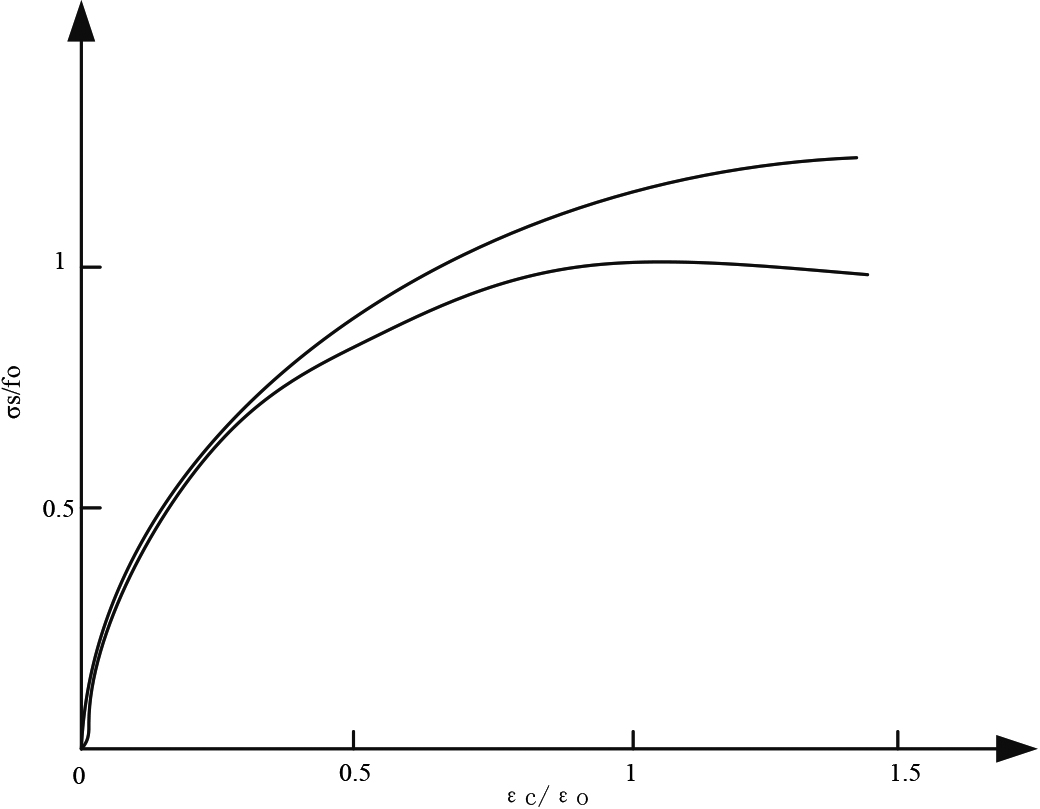
Stress strain relationship of reinforcement.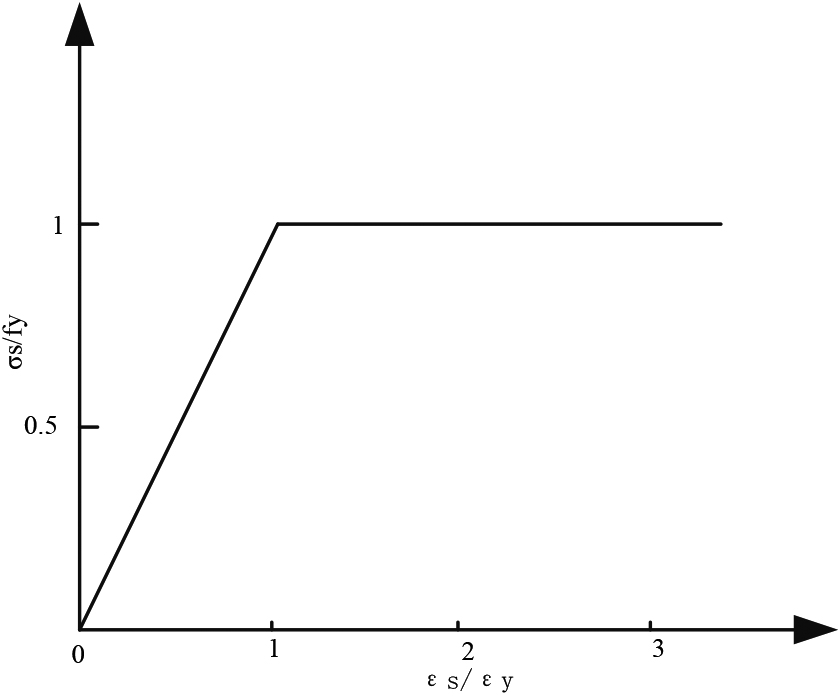
The constitutive relation of reinforcement is as follows:
The stress-strain relationship of reinforcement is shown in Fig. 2.
There is no slippage between CFRP, longitudinal reinforcement and concrete, which ensures the continuity of stress and strain of CFRP strengthened concrete beams [24, 25]. The failure modes of CFRP strengthened concrete beams are mainly divided into three types: The first is that the concrete in the compression zone is crushed before the strain on the CFRP reaches the ultimate strain; The second is that the strain on the CFRP reaches the ultimate compressive strain before the concrete is crushed, so it is pulled off; The third is the peeling failure between the CFRP and the concrete beam. Let the stress value of the equivalent rectangular stress diagram be a1fc, where the value of A1 is shown in Table 3.
Equivalent rectangular stress diagram of concrete compression zone
According to the balance of the force in the horizontal direction:
The moment of the force on the cross section to the center of the carbon fiber is obtained as follows:
According to the balance of the force in the horizontal direction:
The moment of the force on the section to the center of the concrete compression zone is obtained as follows:
According to the bending moment formula at the most unfavorable section, the value of ultimate load
In the formula:
According to the simple interface shear test of lap joint, the bond strength model is obtained.
According to the existing research results, the ultimate bearing capacity of high-strength concrete beams strengthened with Carbon Fiber Reinforced Polymer (CFRP) under different failure modes is calculated. The Newton-Raphson equilibrium iteration method is usually used in artificial intelligence analysis and calculation with ANSYS software. In order to make the calculation results easy to converge, the displacement load should be applied and the displacement control should be carried out. The first step is to apply the gravity load without dividing the load sub steps. The second step is to apply the displacement load on the cushion block. In order to prevent the stress concentration caused by too large load from causing the result not to converge, the load step should be divided into a series of load sub steps.
In order to accelerate the convergence of the calculation results, the arc length method is usually used. In the artificial intelligence analysis of reinforced concrete, there are usually two models to simulate cracks: one is dispersion crack model, and the other is separation crack model. The dispersive crack model uses “continuous” distributed cracks to replace “discontinuous” unit cracks. That is to say, after cracks appear in concrete structure, concrete materials should still be regarded as “continuous” distributed medium. Therefore, the mechanical principle of continuum can still be used to analyze the cracking of concrete. In this model, when the stress in a unit exceeds the tensile strength of concrete material, the unit is considered to have cracked, and the cracks formed in the unit are parallel to each other, not a single crack. The cracks will cover the whole unit or the area near the full stress point. At this time, the crack width is small and “continuous”, so the cracked concrete material can be regarded as an orthotropic continuum. The split crack model uses the element boundary when simulating the actual crack, and uses the crack interface element model and defines the relationship between the stress and slip on the crack surface. Through this model, we can see the direction of crack development and the deformation near the crack section. The dispersive crack model assumes that the concrete material is continuous after cracking, and the cracks are all over the whole unit. The crack development is simulated by reducing the values of stress and modulus. Therefore, the fixed mode can be used in the grid division in the process of artificial intelligence calculation, which greatly simplifies the work of artificial intelligence analysis and has a wider range of applications. In order to track discontinuities, the mesh topology needs to be modified many times, which greatly reduces the efficiency of program operation. However, if the crack path can be predicted in advance, the virtual crack interface element can be used before the structural analysis, which can greatly simplify the analysis and calculation steps.
Four reinforced concrete beams are tested, among which L1 is ordinary reinforced concrete beam, L2 is reinforced concrete beam strengthened with carbon fiber sheet, L3 is reinforced concrete beam strengthened with fiber grid and polymer mortar, and L4 is reinforced concrete beam strengthened with fiber grid and ECC. The shear reinforcement effect of different reinforcement methods is compared through comparative test. The simulation experiment environment is shown in Fig. 3.
The strength grade of concrete used in the test is C40, the stirrup is 6, and the longitudinal reinforcement is 22. The fiber grid is made of carbon fiber grid named nefmac made in Japan, the model is c6-50
Characteristics of experimental materials
Characteristics of experimental materials
The size of the ordinary reinforced concrete beam is 180 mm
Concrete performance index
Simulation experiment environment.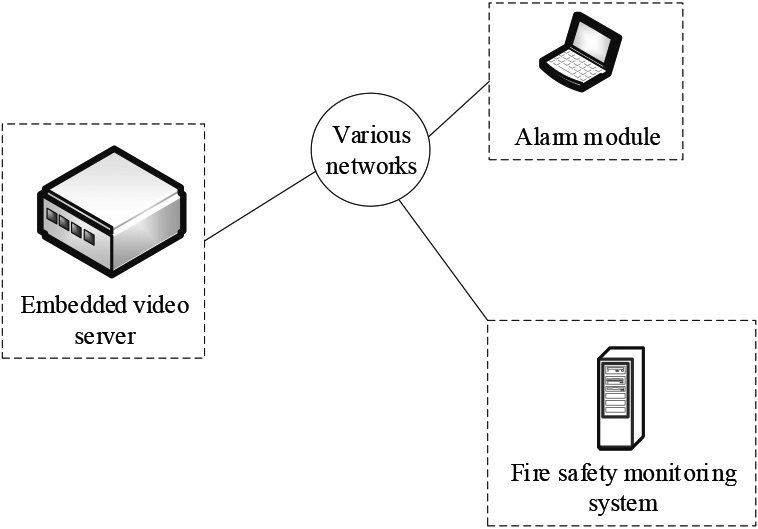
According to the balance of the force in the horizontal direction:
Mechanical property index of reinforcement
The performance index of carbon fiber is shown in Table 7.
Performance index of carbon fiber
According to the site conditions, the actual loading conditions after adjustment are as follows: for non externally prestressed reinforced beams, the loading capacity of each stage is 5.0 kn, when the total load is added to 80%–120% of the calculated cracking load, the loading capacity of each stage is 10.0 kn; For externally prestressed beams, the loading capacity of each stage is 10.0 kn, when the total load is added to 0%–120% of the calculated cracking load, the loading capacity of each stage is 20.0 kn; The loading amount is controlled by the oil pressure of the jack, excluding the loading weight of the distribution beam and jack. The ultimate load comparison between artificial intelligence calculation and test is shown in Table 8.
Comparison of ultimate load between finite element calculation and test
According to the Table 8, the limit load calculated by artificial intelligence is close to the limit load of test, and the maximum error is about 5%. The limit load increases obviously after reinforcement, but it does not increase linearly with the increase of fiber sheet dosage. Due to the influence of service efficiency, the improvement range decreases correspondingly. Compared with the test results, the limit load calculated by artificial intelligence is lower, which may be due to the following reasons: The reinforcement adopts the complete elastic-plastic double linear model, without considering its stress strengthening, and the stress of reinforcement does not increase after yielding; The artificial intelligence calculation adopts the separate model, without considering the bond slip between reinforcement and concrete, so the degree of restraint is higher; The connection between CFRP sheet and concrete beam adopts the way of common node, which may cause peeling due to the weak connection; The artificial intelligence calculation does not consider the discreteness of concrete and the bonding quality of CFRP sheet, which is highly idealized. The load displacement curve is drawn by taking the sum of the bearing reaction forces of the nodes on the cushion block as the ordinate and the displacement value of a point at the top of the symmetrical section as the abscissa, and compared with the test curve, as shown in Figs 4 and 5.
Comparison results of load displacement of continuous beam under this method.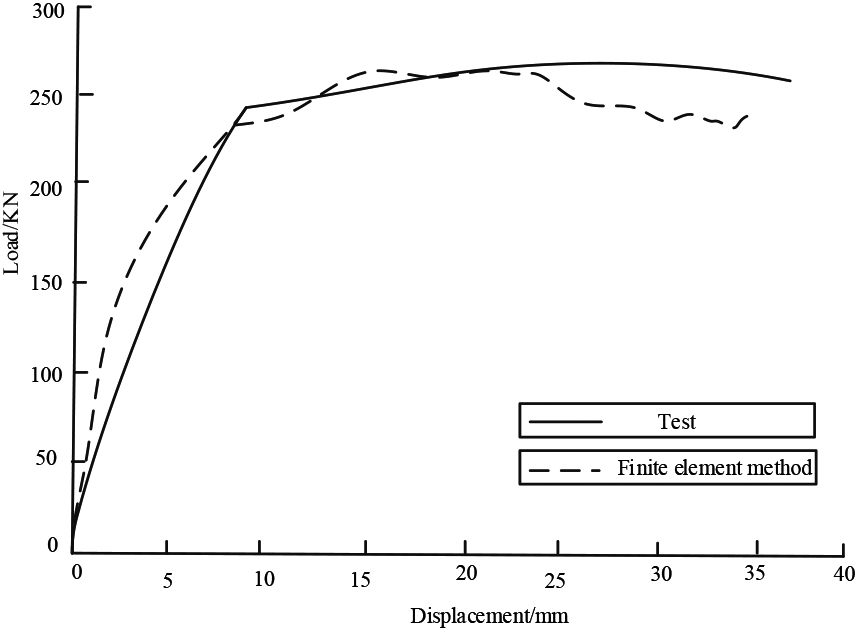
Comparison results of load displacement of continuous beam under traditional method.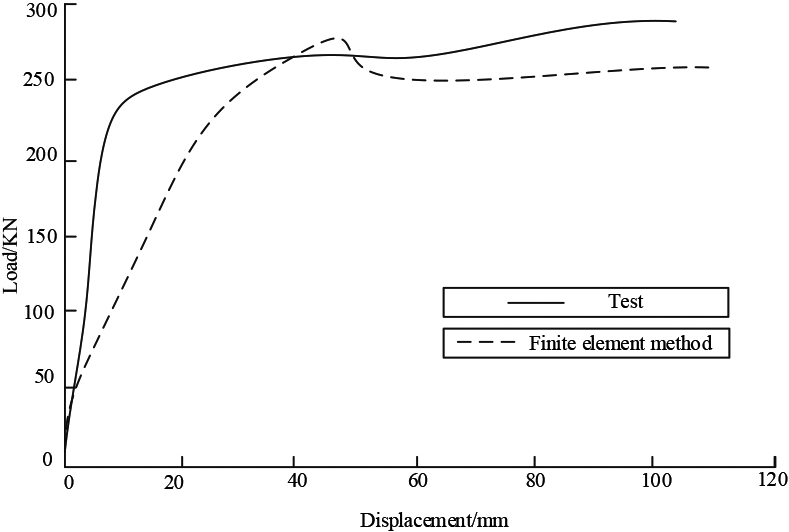
From the comparison of the load displacement curves, it can be seen that the overall trend of the curves of the artificial intelligence calculation results and the test results is basically the same, and the artificial intelligence calculation curves of the test beams all have a downward section. After strengthening, the bearing capacity and stiffness of concrete beams are improved, but the ductility decreases in varying degrees. The deflection of the reinforced concrete beam is much larger than that of the unreinforced concrete beam, and increases with the increase of the amount of reinforcement. Before concrete cracking, the member is in the elastic stage, and the load displacement curve is a straight line. After the concrete cracks, the concrete in the tension zone is out of work. For the carbon fiber continuous beam, the stress is transferred to the steel bar. For other test beams, the stress is transferred to the steel bar and carbon fiber, and the load displacement curve is nonlinear. In the elastic stage, compared with the test curve, the slope of the artificial intelligence calculation curve of the continuous beam is larger, because the artificial intelligence calculation adopts the separate model, which ignores the bond slip between the steel bar and the concrete, and increases the stiffness of the component. The reason for the small slope of the artificial intelligence calculation curve of other test beams is that compared with the better bond between the carbon fiber sheet and the concrete in the test, the artificial intelligence calculation adopts the joint mode of the two, the bond strength is not high, so the stiffness is reduced. Through the comparison between mw1-8 beam and other test beams, it can be known that the artificial intelligence calculation results will decline because the connection mode between carbon fiber and carbon fiber is a common node, the bond strength is low, the bond strength is easy to fail under large load, and even the peeling phenomenon will appear between carbon fiber, which can be seen from the crack development graph, so it has an impact on the mechanical properties. The role of carbon fiber sheet. Therefore, for the concrete beam strengthened with only one layer of carbon fiber, the common node method can be used for calculation, but if two or more layers of carbon fiber are used for reinforcement, in order to avoid the falling section, the spring element can be used for simulation, so as to improve the accuracy of calculation. The load strain curve is drawn by taking the sum of the bearing reaction force of the node on the cushion block as the ordinate and the strain value at the top of the symmetrical section as the abscissa, and compared with the test curve, as shown in Figs 6 and 7.
Strain curve of continuous beam structure under load by traditional method.
Strain curve of continuous beam under load.
From the comparison of load-strain curves, it can be seen that the overall trend of the curves calculated by artificial intelligence is basically the same as that of the experimental results, but there is also the problem of falling section. For m-beam, because the bond slip between reinforcement and concrete is ignored, the stiffness of the component is increased, so the slope of the artificial intelligence calculation curve is larger in the elastic stage. However, for other test beams, the method of joint sharing is adopted in the artificial intelligence calculation, so the bond strength is not high and the stiffness of the component is reduced, so the slope of the artificial intelligence calculation curve in the elastic stage is small. Before the cracking of concrete beam, the strain of concrete keeps a linear growth. After the cracking of concrete beam, the concrete in tension zone quits working, the stress on the concrete in tension zone turns to be borne by the steel bar or steel bar and carbon fiber, the vertical crack develops rapidly, the position of neutral axis rises continuously, and the strain of concrete in compression zone increases rapidly. The load growth of concrete beam is slow before reaching the ultimate load. After reaching the ultimate load, the reinforcement enters the strengthening stage, and the load growth becomes faster. Due to the low bond strength in the artificial intelligence calculation, each test beam has different degrees of decline, and the reinforcement stress strengthening has not been fully utilized. The experimental results show that the cracking load and bending stiffness of the strengthened members can be significantly improved after prestressed concrete beams are strengthened with CFRP sheets. The high strength performance of CFRP sheets can be fully utilized under the condition of small deformation. And the occurrence of bond failure can be delayed. However, due to the difficulty of prestressed construction technology, there are only a few experimental data, and the calculation method of flexural capacity is only studied on the basis of experimental research. The calculation of flexural stiffness and cracks of beams strengthened with prestressed CFRP is not in-depth.
The comparison and analysis of artificial intelligence calculation results and test results show that the artificial intelligence model established in this paper can better simulate the mechanical properties of CFRP reinforced high-strength concrete beam, and the artificial intelligence analysis can be used as an effective means to analyze the flexural reinforcement performance of high-strength concrete beams. The ultimate bearing capacity of CFRP reinforced high-strength concrete beam can be improved significantly, but it does not increase linearly with the increase of fiber content. After reinforcement, the stiffness of the high strength concrete beam can be increased, but the ductility will be reduced in different degrees. The deflection and strain of reinforced high-strength concrete beam are much larger than those of unreinforced high-strength concrete beam, and increase with the increase of reinforcement amount. In the elastic stage, the artificial intelligence calculation adopts the separation model, ignores the bond slip between reinforcement and concrete, and increases the stiffness of the component, so the slope of the artificial intelligence calculation curve of the contrast beam is larger. Because joints are used in the artificial intelligence calculation, the bond strength is not high and the stiffness of the components is reduced, so the slope of the artificial intelligence calculation curve of the test beam is small. CFRP reinforced high-strength concrete beam can inhibit crack development and crack propagation. Therefore, the number of cracks in reinforced high-strength concrete beams is significantly increased, and the crack spacing is small. In the final failure stage, the cracking of the beam is further aggravated, the cracks cover the whole height of the beam, and the shear inclined cracks at the support extend to the top.