We put forth the notion of publicly evaluable pseudorandom functions (PEPRFs), which can be viewed as a counterpart of standard pseudorandom functions (PRFs) in the public-key setting. Briefly, PEPRFs are defined over domain X containing a language L associated with a hard relation , and each secret key is associated with a public key . For any , in addition to evaluate using as standard PRFs, one is also able to evaluate with , x and a witness w for . We consider two security notions for PEPRFs. The basic one is weak pseudorandomness which stipulates a PEPRF cannot be distinguished from a real random function on uniformly random chosen inputs. The strengthened one is adaptive weak pseudorandomness which requires a PEPRF remains weak pseudorandom even when an adversary is given adaptive access to an evaluation oracle. We conduct a formal study of PEPRFs, focusing on applications, constructions, and extensions.
∙ We show how to construct chosen-plaintext secure (CPA) and chosen-ciphertext secure (CCA) public-key encryption (PKE) schemes from (adaptive) PEPRFs. The construction is simple, black-box, and admits a direct proof of security. We provide evidence that (adaptive) PEPRFs exist by showing constructions from injective trapdoor functions, hash proof systems, extractable hash proof systems, as well as a construction from puncturable PRFs with program obfuscation.
∙ We introduce the notion of publicly sampleable PRFs (PSPRFs), which is a relaxation of PEPRFs, but nonetheless imply PKE. We show (adaptive) PSPRFs are implied by (adaptive) trapdoor relations. This helps us to unify and clarify many PKE schemes from seemingly unrelated general assumptions and paradigms under the notion of PSPRFs.
∙ We explore similar extension on recently emerging constrained PRFs, and introduce the notion of publicly evaluable constrained PRFs, which, as an immediate application, implies attribute-based encryption.
∙ We propose a twist on PEPRFs, which we call publicly evaluable and verifiable functions (PEVFs). Compared to PEPRFs, PEVFs have an additional promising property named public verifiability while the best possible security degrades to unpredictability. We justify the applicability of PEVFs by presenting a simple construction of “hash-and-sign” signatures, both in the random oracle model and the standard model.
A preliminary version of this paper appears in SCN 2014 (9th Conference on Security and Cryptography for Networks).
Introduction
Pseudorandom functions (PRFs) [37] are a fundamental concept in modern cryptography. Loosely speaking, PRFs are a family of keyed functions such that: (1) it is easy to sample the functions and compute their values, i.e., given a secret key , one can efficiently evaluate at all points ; (2) given only black-box access to the function, no probabilistic polynomial-time (PPT) algorithm can distinguish for a randomly chosen from a real random function, or equivalently, without no PPT algorithm can distinguish from random at all points .
In this work, we extend the standard PRFs to what we call publicly evaluable PRFs, which partially fill the gap between the evaluation power with and without secret keys. In a publicly evaluable PRF, there exists a language with a hard relation , and each secret key is associated with a public key . In addition, for any , except via a private evaluation algorithm with , one can also efficiently compute the value of via a public evaluation algorithm with the corresponding public key and a witness w for . Regarding the security requirement for PEPRFs, we require weak pseudorandomness which ensures that no PPT adversary can distinguish from a real random function on uniformly distributed challenge points in L (this differs from the standard pseudorandomness for PRFs in which challenge points are arbitrarily chosen by an adversary).
While PEPRFs are a conceptually simple extension of standard PRFs, they have surprisingly powerful applications beyond what is possible with standard PRFs. Most notably, as we will see shortly, they admit a simple and black-box construction of PKE.
Motivation
PRFs have a wide range of applications in cryptography. Perhaps the most simple application is an elegant construction of private-key encryption as follows: the secret key of PRFs serves as the private key; to encrypt a message m, a sender first chooses a random , and then outputs a ciphertext . It is tempting to think whether PRFs also yield PKE in the same way. However, the above construction fails in the public-key setting when is a standard PRF. This is because without no PPT algorithm can evaluate (otherwise this violates the pseudorandomness of PRFs) and thus it is impossible to encrypt publicly. Moreover, since PRFs and one-way functions (OWFs) imply each other [37,41], the implications of PRFs are inherently confined in .1
According to [47], refers to the world where one-way functions exist, but public-key cryptography does not; while refers to the world where public-key cryptography is possible.
This result rules out the possibilities of constructing PKE from PRFs in a black-box manner.
Meanwhile, most existing PKE schemes based on various concrete hardness assumptions can be casted into several paradigms or general assumptions in the literature. In details, hash proof systems [27] encompass the PKE schemes [26,28,51,53], extractable hash proof systems [66] encompass the PKE schemes [14,16,40,44,49], one-way trapdoor permutations/functions encompass the PKE schemes [60–63].2
The references [61,62] actually refer to the padded version of RSA encryption and Rabin encryption.
However, the celebrated Goldwasser–Micali PKE [38] and ElGamal PKE [32] do not fit into any known paradigms or general assumptions.
Recently, indistinguishability obfuscation () together with puncturable PRFs (PPRFs) have proven to be an extremely powerful combination and have been used to construct a variety of cryptographic primitives, such as PKE, short signature, non-interactive zero knowledge proof, oblivious transfer [65], multiparty key exchange and traitor tracing [13], etc. On one hand, while these results are exciting, existing instantiations of candidate obfuscators [2,3,34,58] have several drawbacks in terms of efficiency [67] and inherently rely on multilinear maps. On the other hand, we observe that in the constructions of PKE and multiparty key exchange is in fact compiling PPRFs into some kind of “publicly computable” PRFs as an intermediate primitive, which are in turn sufficient for the applications. However, no such “publicly computable” PRFs is known to date.
Motivated by the above discussion, we ask the following intriguing questions:
Can we adapt the concept of PRFs to the public-key setting? If so: Can it enable the above PRF-based private-key encryption to work the public-key setting? Can it be instantiated from standard assumptions? Can it be used to explain unclassified PKE schemes?
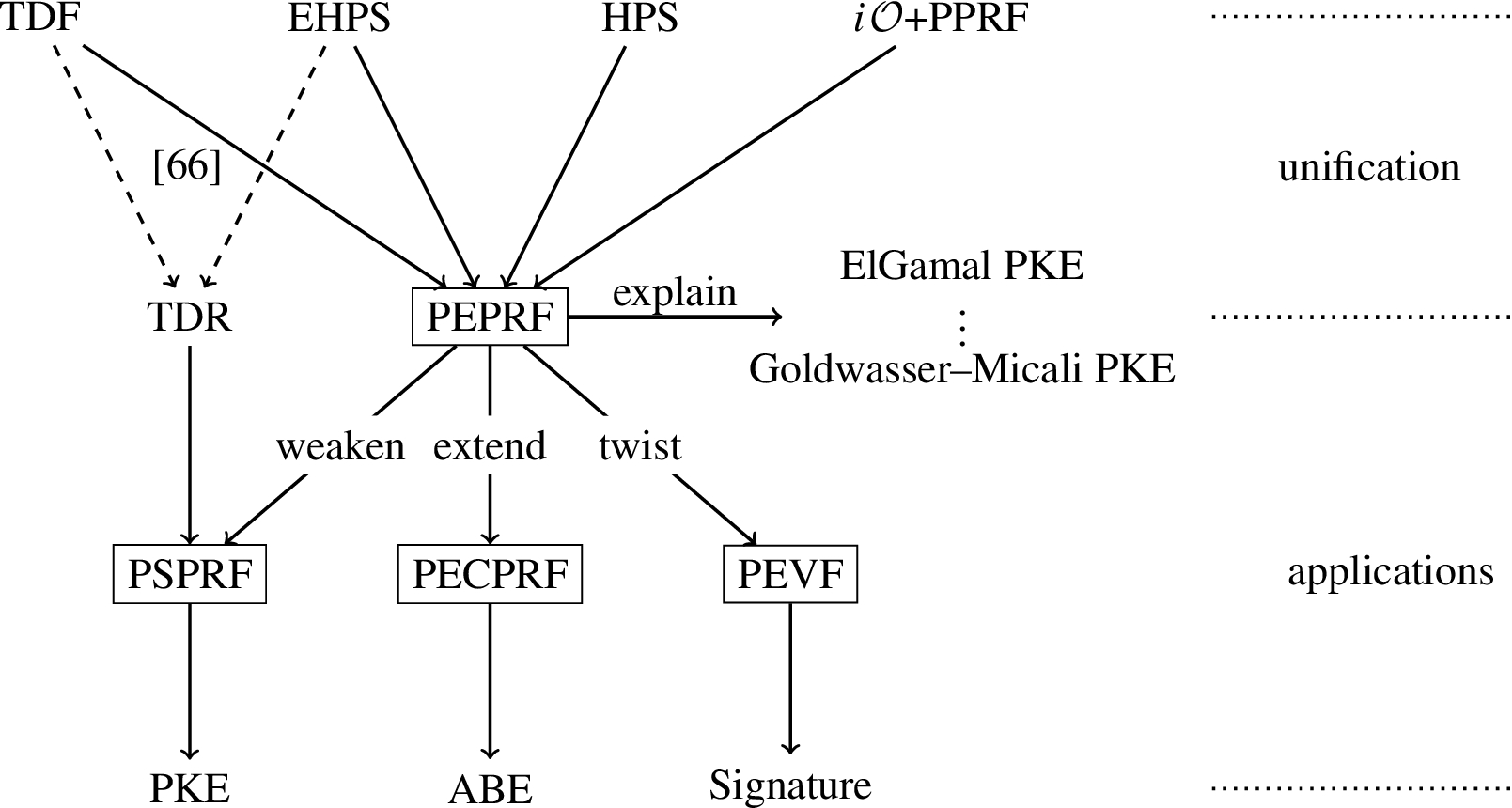
Summary of main results in this work. The bold lines and rectangles denote our contributions and our new concepts, while the dashed lines denote those from existing works.
Our contributions
We give positive answers to the above questions. Our main results (summarized in Fig. 1) are as follows:
In Section 3, we introduce the notion of publicly evaluable PRFs (PEPRFs), which is a counterpart of standard PRFs in the public-key setting. In a PEPRF, there is a language defined by a hard relation , and each secret key is associated with a public key . For any , except via a private evaluation algorithm with , one can efficiently evaluate using and a witness w for . We also formalize security notions for PEPRFs, namely weak pseudorandomness and adaptive weak pseudorandomness.
In Section 4, we demonstrate the power of PEPRFs by showing that they enable the PRF-based private-key encryption to work in the public-key setting, following the KEM-DEM methodology. In sketch, the public/secret key for PEPRF serves as the public/secret key for PKE. To encrypt a message m, a sender first samples a random with witness w, then publicly evaluates from , x and w, and outputs a ciphertext . To decrypt, a receiver simply uses to compute privately, then recovers m. Such construction is simple, black-box, and admits a direct proof of security.3
For simplicity, we treat PKE schemes as key encapsulation mechanisms (KEM) in this work. It is well known that one can generically obtain a fully fledged CCA-secure PKE by combining a CCA-secure KEM (the requirement on KEM could be weaker [43]) and a data encapsulation mechanism (DEM) with appropriate security properties [28,52,53].
In particular, in Section 3.1 we show that the celebrated Goldwasser–Micali PKE and ElGamal PKE can be explained neatly by weak pseudorandom PEPRFs based on the quadratic residuosity assumption and the decisional Diffie–Hellman assumption, respectively.
In Section 5, Section 6 and Section 7, we show how to construct PEPRFs from trapdoor functions (TDFs), hash proof systems (HPSs), and extractable hash proof systems (EHPSs), respectively. This indicates that previous works on TDFs, HPSs and EHPSs implicitly constructed PEPRFs. Therefore, PEPRFs are abstraction of the common aspect of HPSs and EHPSs which are not formalized before. Moreover, existing constructions of TDFs, HPS and EHPS imply that PEPRFs can be instantiated from a variety of number-theoretic assumptions. In Section 8, we show that recent work [65] essentially suggests a way to compile puncturable PRFs to adaptive weak pseudorandom PEPRFs via indistinguishability obfuscator. This result reinforces the intuition that in several obfuscation-based constructions the indistinguishability obfuscator is in fact compiling puncturable PRFs into some kind of publicly computable PRFs as an intermediate object.
In Section 9, we introduce the notion of publicly sampleable PRFs (PSPRFs), which is a relaxation of PEPRFs, but nonetheless implies PKE. Of independent interest, we redefine the notion of trapdoor relations (TDRs). We show that injective TDFs imply “one-to-one” TDRs, while the latter further imply PSPRFs. This implication helps us to unify and clarify more PKE schemes based on different paradigms and general assumptions from a conceptual standpoint, and also suggests adaptive PSPRFs as a candidate of the weakest general assumption for CCA-secure PKE.
In Section 10, we introduce an extension of PEPRFs named publicly evaluable constrained PRFs (PECPRFs). An immediate application of PECPRFs is attribute-based encryption. We also present an instantiation of PECPRFs based on an attribute-based encryption scheme from multilinear maps [35].
In Section 11, we propose a twist on PEPRFs named publicly evaluable and verifiable functions (PEVFs), which enjoy an additional property named public verifiability and only require unpredictability rather than weak pseudorandomness. We demonstrate the utility of PEVFs by presenting a simple construction of “hash-and-sign” signatures, both in the random oracle model and the standard model.
Related work
CCA-secure PKE from general assumptions or paradigms. Except the effort on constructing CCA-secure PKE from specific assumptions [39,55] or from encryption schemes satisfying some weak security notions [10,25,29,31,45,54,57], it is of great theoretical interest to build CCA-secure PKE from general assumptions and paradigms. Cramer and Shoup [27] generalized their CCA-secure PKE construction [26] to the notion of hash proof systems (HPSs) and used it as a paradigm to construct CCA-secure PKE from various decisional assumptions. Kurosawa and Desmedt [53] and Kiltz et al. [51] later improved upon the original HPS paradigm. Peikert and Waters [60] proposed lossy trapdoor functions (LTDFs) and showed a black-box construction of CCA-secure PKE from them. Rosen and Segev [63] introduced correlated-product secure trapdoor functions (CP-TDFs) and also showed a construction of CCA-secure PKE from them. Moreover, they showed that CP-TDFs are strictly weaker than LTDFs by giving a black-box separation between them. Kiltz et al. [50] introduced (injective) adaptive trapdoor functions (ATDFs) which are strictly weaker than both LTDFs and CP-TDFs but suffice to imply CCA-secure PKE. Wee [66] introduced the notion of extractable hash proof systems (EHPSs) and used it as a paradigm to construct CCA-secure PKE from various search assumptions. Wee also showed that both EHPS and ATDFs imply (injective) adaptive trapdoor relations (ATDRs), which are sufficient to imply CCA-secure PKE. To the best of our knowledge, the notion of ATDRs is the weakest general assumption that implies CCA-secure PKE.
Constrained PRFs. Very recently, constrained PRFs are studied in three concurrent and independent works, by Kiayias et al. [48] under the name of delegatable PRFs, by Boneh and Waters [12] under the name of constrained PRFs, and by Boyle, Goldwasser, and Ivan [15] under the name of functional PRFs. In constrained PRFs, the secret key admits a delegation for a family of circuits, and the delegated key for circuit f enable one to compute the PRF value at any point x such that . This natural extension turns out to be useful since it has powerful applications outside the scope of standard PRFs, such as identity-based key exchange, and optimal private broadcast encryption.
Witness PRFs. Independently and concurrently of our work, Zhandry [67] introduces the notion of witness PRFs (WPRFs), which is similar in concept to PEPRFs. In a nutshell, both WPRFs and PEPRFs are defined with respect to a language and extend standard PRFs with the same extra functionality, i.e., one can publicly evaluate for with its witness. The main differences between WPRFs and PEPRFs are as follows:
In WPRFs the associated relation of the language is required to be polynomially bounded, while in PEPRFs the associated relation of the language is required to be hard.
WPRFs require that is pseudorandom for any adversarially chosen , while PEPRFs only require that is pseudorandom for randomly chosen .
WPRFs are introduced as a weaker primitive to replace indistinguishability obfuscation for several obfuscation-based applications. By utilizing the reduction from any language to the subset-sum problem, WPRFs can handle arbitrary languages. However, for applications of WPRFs whose functionalities rely on for , such as public-key encryption, non-interactive key exchange, and hardcore functions for any one-way function, the underlying languages have to be at least hard-on-average (i.e., the associated relation is hard). This is because these applications usually need the indistinguishability between and to argue is computationally pseudorandom for .
Preliminaries
Basic notations
We review the basic terminology used throughout the paper. For a distribution or a set S, we write to denote the operation of sampling s according to S or uniformly at random from S, and use to denote its size. For a set S, we let denote the uniform distribution over S.
We let denote the positive integers. The natural security parameter throughout the paper is λ, and all other quantities as well as all algorithms (including the adversary) are implicitly functions of λ. We write to denote an arbitrary polynomial function in λ. We write to denote an arbitrary negligible function in λ, which vanishes faster than the inverse of any polynomial. We say a probability is overwhelming if it is , and said to be noticeable if it is . A probabilistic polynomial-time (PPT) algorithm is a randomized algorithm that runs in time . If is a randomized algorithm, we write to indicate that outputs z on inputs and randomness r. We will omit r and write . In addition, we assume an algorithm always outputs ⊥ when its input is ⊥.
The statistical distance between two random variables X and Y having a common domain S is . We write as shorthand for computationally indistinguishable.
Languages and relations
Cryptographic hard problems are usually given by a set of instances, which we denote by X. We call a subset L of X as a language, in which all its elements meet some property. Typically, a language L can be associated with a binary relation , i.e., s.t. . The only restriction is that if , then . We call a witness for the membership of . We recall some properties of relations as below.
Easy to sample a tuple: There exists a PPT algorithm that on input a public description for and fresh random coins r, outputs a random tuple . We can further decompose to and . The former on input and r outputs , while the latter on input and r outputs .4
When the context is clear, we usually omit from the input of .
Hereafter, let R be the random coins space of , , and . We require that for any , it holds that .
Hard to find a witness: Given x where , no PPT algorithm can compute such that with non-negligible probability.
Easy to verify a tuple: is polynomially-verifiable (i.e., ).
We say a relation is hard or one-way if it satisfies the first two properties. We say a relation is polynomially bounded if it satisfies the third property. Polynomially bounded relations define the usual language.
(Subset membership problem).
Let be a language, and both L and allow efficiently uniform sampling (let and be the sampling algorithms respectively5
Without loss of generality, we assume and induce identical distribution over L.
). We say subset membership problem w.r.t. is hard if:
Pseudorandom functions
We first recap the definition of PRFs in order to compare them with PEPRFs more clearly.
A family of PRFs consists of three polynomial-time algorithms as follows:
: on input , output public parameters (the sets , X, and Y may be parameterized by λ), where can be viewed as a keyed function indexed by , namely .
: on input , output a secret key .
: on input and , output .
For any , any , any and any , we have .
The standard security requirement for PRFs is pseudorandomness. Let be an adversary against PRFs and define its advantage as:
where , (here is chosen uniformly at random from all the functions from X to Y6
To efficiently simulate access to a uniformly random function from X to Y, one may think of a process in which the adversary’s queries to are “lazily” answered with independently and randomly chosen elements in Y, while keeping track of the answers so that queries made repeatedly are answered consistently.
). Note that can adaptively access the oracle polynomial many times. We say that PRFs are pseudorandom if for any PPT adversary its advantage function is negligible in λ. We refer to such security as full PRF security.
Sometimes the full PRF security is not needed and it is sufficient if the function cannot be distinguished from a uniform random one when challenged on random inputs. The formalization of such relaxed requirement is weak pseudorandomness (weak PRF security), which is defined the same way as the full PRF security except that the inputs of oracle are uniformly chosen from X by the challenger instead of adversarially chosen by . PRFs that satisfy weak pseudorandomness are referred to as weak PRFs.
Publicly evaluable PRFs
Here we define PEPRFs. We begin with the syntax and then define the security.
(Publicly evaluable PRFs).
A family of PEPRFs consists of four polynomial-time algorithms as below:
: on input , output public parameters which includes , where could be viewed as a keyed function indexed by , is a language defined by some hard relation , and W is the set of associated witnesses. We assume is efficiently sampleable, that is, there exists a PPT algorithm which on input random coins r, output a random tuple .
: on input , output a secret key and an associated public key .7
In a standard PRF, it is also harmless to explicitly introduce a public key, which includes the information related to secret key that can be made public. For example, in the Naor–Reingold PRF [56] based on the DDH assumption: , where is the secret key, for can be safely published as the public key. If no information can be made public, one can always assume .
: on input and , output .
: on input and together with a witness , output .
For any , any and any , we have:
Let be an adversary against PEPRFs and define its advantage as:
where is any polynomial, , , , and is not allowed to query with any . We say that PEPRFs are adaptive weak pseudorandom if for any PPT adversary its advantage function is negligible in λ.8
The readers should not be confused with adaptive PRFs [9], where “adaptive” means that instead of deciding the queries in advance, an adversary can adaptively make queries to based on previous queries.
The adaptive weak pseudorandomness captures the security against active adversaries, who are given adaptive access to the oracle . We also consider weak pseudorandomness which captures the security against static adversaries, who is not given access to oracle .
On the basis of previous works [4,5,42], one can also define more advanced security notions such as security against related-key attacks and security against key-leakage attacks for PEPRFs.
Different from standard PRFs, PEPRFs require the existence of a language as well as a public evaluation algorithm. Due to this strengthening on functionality, we cannot hope to achieve full PRF security, and hence settling for weak PRF security is a natural choice.9
In the full PRF security experiment the inputs of are chosen by an adversary, thus it may know the corresponding random coins and then evaluate publicly.
Note that the weak PRF security implicitly requires that the associated relation is hard.
In some scenarios, it is more convenient to work with a definition that slightly restricts an adversary’s power, but is equivalent to Definition 3.1. That is, the query times by an adversary is fixed to 1. Due to the existence of oracle , a standard hybrid argument can show that PEPRFs secure under this restricted definition are also secure under Definition 3.1. In the remainder of this paper, we will work with this restricted definition.
A possible relaxation. To be completely precise, it is not necessary to require the distribution of x induced by conditioned on is identical or statistically close to uniform. Instead, it could be some other prescribed distribution χ. In this case, weak pseudorandomness extends naturally to χ-weak pseudorandomness.
A useful generalization. In some scenarios, it is more convenient to work with a more generalized notion in which we consider a collection of languages indexed by the public key rather than a fixed language L. Correspondingly, the sampling algorithm takes as an extra input to sample a random tuple . We refer to such generalized notion as PEPRFs for public-key dependent languages, and we will work with it when constructing adaptive PEPRFs from hash proof systems.
Two simple PEPRFs from number-theoretic assumptions
In what follows, we present two illustrative constructions of PEPRFs from the quadratic residuosity (QR) assumption (cf. Appendix A.6) and the decisional Diffie–Hellman (DDH) assumption (cf. Appendix A.7), respectively.
(PEPRFs based on the QR assumption).
We build PEPRFs from the QR assumption as follows:
: run , set , , , , , will be defined later; L be the set of elements in having Jacobi symbol +1. Let z be an element in , we can define , the corresponding sampling algorithm on input , public key , and random coins r, picks , computes either or , then outputs .
: pick , output and .
: output 1 if and 0 otherwise. This algorithm defines .
: output 1 if and 0 if .
It is easy to verify that the above PEPRFs are weak pseudorandom based on the QR assumption. Looking ahead, applying the construction shown in Section 4 to the PEPRFs yields the Goldwasser–Micali PKE [38].
(PEPRFs based on the DDH assumption).
We build PEPRFs from the DDH assumption as follows:
: run , set , , is defined as ; we can define ; the corresponding sampling algorithm on input λ and random coins r, picks , computes , then outputs .
: pick , compute , output .
: output .
: output .
It is easy to verify that the above PEPRFs are weak pseudorandom based on the DDH assumption. Looking ahead, applying the construction shown in Section 4 to the PEPRFs yields exactly the plain ElGamal PKE [32].
KEM from publicly evaluable PRFs
In this section, we present a simple and black-box construction of KEM from PEPRFs. For compactness, we refer the reader to Appendix A.1 for the definition and security notion of KEM.
(KEM from PEPRFs).
We show how to construct KEM from PEPRFs in a black-box manner as follows:
: run to generate as public parameters.
: run to generate .
: run to generate a random tuple , set x as the ciphertext c and compute as the DEM key k, output .
: output .
Correctness of the above KEM construction follows immediately from correctness of PEPRFs. The security of the above construction is assessed in the following theorem. The proof is straightforward, which transforms an adversary against IND-CPA security (resp. IND-CCA security) of the KEM construction to a distinguisher against weak pseudorandomness (resp. adaptive weak pseudorandomness) of PEPRFs, and thus contradicts the assumed security of the underlying PEPRFs. We refer the reader to [17] for the full proof.
The KEM is CPA-secure (resp. CCA-secure) if the underlying PEPRFs are weak pseudorandom (resp. adaptive weak pseudorandom).
Connection to trapdoor functions
Trapdoor functions (TDFs) are a fundamental primitive introduced by Diffie and Hellman [30]. In the following, we recall the syntax and security notions of TDFs and then show how to construct PEPRFs from them.
(Trapdoor functions).
A family of trapdoor functions is given by four polynomial-time algorithms as below.
: on input , output public parameters , where can be viewed as a keyed function indexed by . We assume the domain S is efficiently sampleable, that is, there exists a PPT algorithm , which on input random coins , output a random element .
: on input , output a public key (serve as a key for evaluation) and a corresponding secret key (serve as a trapdoor for inversion).
: on input and , output .
: on input and , output or a distinguished symbol ⊥ indicating u does not have pre-image.
For any , any , any and any , we have .
Let be an inverter against TDFs and define its advantage as:
where , and is not allowed to query for the challenge . We say that TDFs are adaptive one-way (or simply adaptive) [50] if for any PPT inverter its advantage is negligible in λ. The standard one-wayness can be defined similarly as above except that the adversary is not given access to the inversion oracle.
(Hardcore functions).
A polynomial-time algorithm is said to be a hardcore function of a family of efficiently computable functions if for any PPT algorithm , the following two distributions are computationally indistinguishable:
where , , , .
Letbe a family of efficiently computable injective functions.is one-way if and only ifhas a hardcore function.
(Construction from TDFs).
We show how to construct PEPRFs from a family of (adaptive) injective TDFs as follows:
: on input , run to generate for TDFs, and let be a corresponding hardcore function; then create public parameters for PEPRFs as follows: set and the same as that of TDFs, set Y the same as that of the hardcore function, set , , will be defined latter. The algorithm induces a collection of languages over X where each . The sampling algorithm on input r, runs , computes , and then outputs and . We assume the public parameters of TDFs and PEPRFs contain essentially the same information.
: on input , output .
: on input and , output . This algorithm defines .
: on input and together with a witness w, output .
Correctness of the above construction follows from correctness and injectivity of TDFs. The security of the above construction is assessed in the following theorem. The proof is straightforward, which transforms an adversary against weak pseudorandomness (resp. adaptive weak pseudorandomness) of PEPRFs to an adversary against pseudorandomness (resp. adaptive pseudorandomness) of , and thus contradicts to the assumed one-wayness (resp. adaptive one-wayness) of the underlying TDFs. We refer the reader to [17] for the full proof.
PEPRFs are weak pseudorandom (resp. adaptive weak pseudorandom) if the underlying TDFs are one-way (resp. adaptive one-way).
Connection to hash proof systems
Hash proof systems are introduced by Cramer and Shoup [27] as a paradigm of constructing PKE from a category of decisional problems, named subset membership problems. As a warm up, we first recall the notion of HPS and then show how to construct PEPRFs from them.
(Hash proof system).
An HPS consists of the following algorithms:
: on input , output public parameters which includes an HPS instance , where can be viewed as a keyed function indexed by , L is a language defined over X, W is the associated witness set, and α is a projection from to .
: on input , pick , compute , output .
: on input and x, output .
: on input and together with a witness w, output .
Following [27,51] we introduce the following notions and properties for Λ on .
The collision probability of Λ is defined as:
Λ is ϵ-universal1 if for all ,
where and .
[27] introduced a relaxation of universal1 property, named smoothness, which only requires the universal1 property holds in the average case.
Λ is ϵ-smooth if for ,
where and .
[27] also introduced a strengthening of universal1 property, named universal2 property.
Λ is ϵ-universal2 if for all with ,
where and .
Kiltz, Pietrzak, Stam, and Yung [51] (henceforth KPSY) provides a generic transform from universal1 to universal2 HPS. Given a with hash regarding projection and a family of functions , we can define its hashed variant with hash regarding where , , and . Note that X and L are the same for and .
Assume Λ is-universal1with collision probabilityand(where) is a family of 4-wise independent hash functions, thenis-universal2for:
In what follows, we show how to build PEPRFs from different kinds of HPSs.
(Construction from smooth HPS).
We show how to construct weak pseudorandom PEPRFs from a smooth HPS w.r.t. as follows:
: on input , run to generate a smooth HPS instance , then create for PEPRFs as follows: set , , X, L, and W the same as that of HPS, set , . We assume the public parameters of HPS and PEPRFs contain essentially the same information.
: on input , output .
: on input and , output .
: on input and together with a witness for x, output .
(Construction from smooth and universal2 HPSs).
We show how to construct adaptive weak pseudorandom PEPRFs from a smooth and an universal2 w.r.t. same language as follows:
: on input , run to generate a smooth HPS instance , run to generate an universal2 HPS instance , then build public parameters for PEPRFs from and as follows, sets , , , , , will be defined later. The algorithm induces a collection of languages over , where each . The corresponding sampling algorithm on input and random coins r, runs , computes , sets , , outputs . We assume the two HPSs share a common sampling algorithm and .
: on input , run and to get and respectively, output , .
: on input and , output if and ⊥ otherwise. This algorithm defines .
: on input and an element together with a witness w, output .
The security of the above two constructions is assessed in the following theorem. Its proof is similar to the one in [27]. We refer the reader to [17] for the full proof.
If the underlying subset membership problem is hard, then the PEPRFs from the smooth HPSs (resp. plus the universal2HPSs) are weak pseudorandom (resp. adaptive weak pseudorandom).
To ensure the adaptive weak pseudorandomness of the above construction, we can weaken universal2 property to weak universal2 property, which requires the former property holds when . This is because adaptive weak pseudorandomness only stipulates pseudorandomness holds on the average case.
(Construction from universal1 HPS).
We show how to construct adaptive weak pseudorandom PEPRFs from an universal1 HPS w.r.t. as follows:
: on input , run to generate for an universal1 HPS instance (Λ, , , , , , Π, α), then apply the KPSY-transform [51] to obtain an universal2, where is a family of 4-wise independent hash functions from Π to ; then build public parameters for PEPRFs from and as follows, where , , , , , will be defined later. The algorithm defines a collection of languages over where each . It is easy to see that a witness for is also a witness for . The corresponding sampling algorithm on input and random coins r, samples , computes , sets and , outputs .
: on input , run twice independently to get and , pick , set , , output .
: on input and , output if and ⊥ otherwise. This algorithm defines .
: on input and an element together with a witness w, output .
In the above construction, we implicitly build , which is universal2 according to Theorem 6.1. The security of the above construction is assessed in the following theorem. Its proof is similar as the one of Theorem 6.2. We refer the reader to [17] for the full proof.
If the underlying subset membership problem is hard, then the PEPRFs from the universal1HPSs are adaptive weak pseudorandom.
While Construction 6.1 is straightforward, Construction 6.2 and Construction 6.3 are more technically involved. The basic idea underlying the latter two constructions are similar as the CCA-secure PKE from smooth plus universal2 HPSs [27]. That is, using a “weak” HPS to generate a random DEM key, while using a “strong” HPS to eliminate “dangerous” decapsulation queries. As we analyzed above, the minimum requirement for the weak HPS is smoothness, while the minimum requirement for the strong HPS is being universal2. The advantage of Construction 6.2 is that both HPSs exactly satisfy the respective minimum requirements, while the disadvantage is that we have to assume that there exists a strong HPS sharing the same X and L as that of the weak HPS. On the contrary, the advantage of Construction 6.3 is that we can start from a single weak HPS and then build a strong HPS from it, while the disadvantage is that the weak HPS has to be universal1, which is strictly stronger than smooth. It seems to us that the KPSY transform cannot convert a smooth HPS into an universal2 one.
Connection to extractable hash proof systems
Extractable hash proof systems (EHPS) were introduced by Wee [66] as a paradigm of constructing PKE from search problems associated with hard relations. In the following, we recall the notion of EHPS and then show how to construct PEPRF from them.
(Extractable hash proof system).
An EHPS consists of a tuple of algorithms (, , , , , ) as below:
: on input , output public parameters which include an EHPS instance , where can be viewed as a keyed function indexed by . Let be a corresponding hard relation for L, and be a hardcore function for .
: on input public parameters , output a key pair .
: on input public parameters , output a key pair .
: on input , x and r, output where .
: on input and , output .
: on input , , and , output such that if and if not.
In an EHPS, and work in the hashing mode, which are only used to establish security. An EHPS satisfies the following property:
The first outputs (namely ) of and are statistically indistinguishable.
(All-but-one extractable hash proof system).
An all-but-one (ABO) EHPS is a richer abstraction of EHPS, besides algorithms (, , , , , ), it has an additional algorithm .
: on input public parameters and an arbitrary , output a key pair .
: on input and , output .
: on input , such that , and , output such that if and otherwise.
In ABO EHPS, , , and work in the ABO hashing mode, which are only used to establish security. All-but-one EHPS satisfies the following property:
For any , the first output (namely ) of and are statistically indistinguishable.
(Construction from (ABO) EHPS).
We show how to construct PEPRFs from an (ABO) EHPS as follows:
: run to generate an EHPS instance , and let be a hardcore function for ; build public parameters for PEPRFs as follows: sets , , , and will be defined later. The algorithm induces a collection of languages over where each . The corresponding sampling algorithm on input r, computes and , outputs and . We assume the public parameters of PEPRF and EHPS essentially contains the same information.
: on input , output .
: on input and x, parse x as , compute , output . This algorithm defines as .
: on input and together with a witness for x, compute , output .
The security of the above construction is assessed in the following theorem. Its proof is similar as the ones in [66]. We refer the reader to [17] for the full proof.
If the underlying binary relationis one-way, then the PEPRFs from the EHPSs (resp. ABO EHPSs) are weak pseudorandom (adaptive weak pseudorandom).
Connection to puncturable PRFs
Puncturable PRFs (PPRFs) are a special type of constrained PRFs, where the constrained key is associated with a single point . Such constrained key allows evaluation at all points . As noted by [12,15,48], the GGM tree-based construction of PRFs from one-way functions (OWFs) [37] can be modified to construct PPRFs.
Sahai and Waters [65] showed how to construct PKE/KEM from indistinguishability obfuscator (), pseudorandom generator (PRG), and PPRFs. We refer to [65] for the definitions of and PPRFs. We observe that a slight modification of their construction essentially gives us a way to compile PPRFs to PEPRFs via .
(Construction from PPRFs and ).
We show how to construct PEPRFs from PPRFs and as follows:
: on input , generate an for circuit class , a length-doubling pseudorandom generator , and a puncturable PRF ; then build public parameters for PEPRFs, where , , , , , and . The corresponding sampling algorithm on input , outputs and .
: on input , pick a puncturable PRF key as the secret key , create an obfuscation of the program of Fig. 2 (the size of the program is padded to be the maximum of itself and of Fig. 3) as the public key .
: on input and x, output .
: on input , an element together with its witness w, output .
Program public evaluation.
Program public evaluation*.
The security of the above construction is assessed in the following theorem. Its proof is similar as the one in [65]. We refer the reader to [17] for the full proof.
If theis indistinguishably secure,is a secure pseudorandom generator, andis selective pseudorandom, then the PEPRFs are adaptive weak pseudorandom.
Publicly sampleable PRFs
In this section, we consider a relaxation of the functionality for PEPRFs, that is, instead of requiring is publicly evaluable on L, we only require that the distribution is efficiently sampleable over . More precisely, we require there exist a PPT algorithm that on input fresh random coins r, outputs such that . We refer to this relaxed notion as publicly sampleable PRFs (PSPRFs). Clearly, PEPRFs imply PSPRFs. The (adaptive) weak pseudorandomness for PSPRFs can be defined analogously. It is easy to verify that PSPRFs and KEM imply each other by viewing (resp. ) as (resp. ).10
Without loss of generality, we assume is deterministic. We note that there do exist randomized decapsulation algorithms, e.g. those that implement “implicit rejection” strategy [52]. In that case, we can view as randomized PSPRFs.
In light of this observation, we view PSPRF as a high level interpretation of KEM, which allows significantly simpler and modular proof of security. In what follows, we revisit the notion of trapdoor one-way relations, and explore its relation to PSPRFs.
Trapdoor relations
Wee [66] introduced the notion of trapdoor relations (TDRs) as a functionality relaxation of injective TDFs, in which the “easy to compute” property is weakened to “easy to sample”. Wee also showed how to construct such TDRs from EHPSs.
(Trapdoor relations).
A family of trapdoor relations consists of four polynomial-time algorithms as below.
: on input , output public parameters (these sets are parameterized by λ), and a collection of binary relations indexed by . We say is one-to-one if for any , we have: (1) for any there exists one and only one such that ; (2) for any there exists at most one such that .
: on input , output a public key (serve as a key to sample a relation) and a secrey key (serve as a trapdoor to find a match).
: on input and , output or a distinguished symbol ⊥ indicating u does not have a match under .
: on input and random coins r, output a tuple .
For any , any , any , and any , we have .
Let be an inverter against TDRs and define its advantage as:
where , and is not allowed to query for the challenge . We say TDRs are adaptive one-way (or simply adaptive) if for any PPT inverter its advantage is negligible in λ. The standard one-wayness can be defined similarly as above except that the adversary is not given access to the inversion oracle.
(PSPRFs from TDRs).
We show how construct PSPRFs from one-to-one TDRs as follows:
: run to generate , and let be a hardcore function for ; build public parameters for PSPRFs as follows: set and the same as that of TDRs, set , , , and will be defined later. induces a collection of languages over where each . The corresponding sampling algorithm is the same as that of TDRs. We assume the public parameters of TDRs and PEPRFs essentially contains same information.
: on input , output .
: on input and x, output . This algorithm defines .
: on input and random coins r, compute , output .
The correctness of the above construction is easy to verify. The security of the above construction is assessed by the following theorem.
The resulting PSPRFs are (adaptive) weak pseudorandom if the underlying TDRs are (adaptive) one-way.
We omit the proof for its straightforwardness. The above result indicates that adaptive PSPRFs are implied by adaptive TDFs. By the separation result due to Gertner, Malkin, and Reingold [36] that it is impossible of basing TDFs on trapdoor predicates, as well as the equivalence among trapdoor predicates, CPA-secure PKEs and PSPRFs, we conclude that PSPRFs are strictly weaker than TDFs in a black-box sense. We conjecture a similar separation result also exists between adaptive PSPRFs and ATDFs. Besides, whether adaptive PSPRFs are strictly weaker than general ATDRs is also unclear to us. We left this as an open problem.
Publicly evaluable constrained PRFs
In this section, we introduce the notion of publicly evaluable constrained PRFs (PECPRFs), which is an extension of recent constrained PRFs [12,15,48] analogous to PEPRFs of PRFs. We begin with a formal definition, and then proceed to explore possible applications.
(Publicly evaluable constrained PRFs).
Publicly evaluable constrained PRFs consists of six polynomial-time algorithms as follows:
: on input , output public parameters which include finite sets , , I, X, Y, a class of circuits , a collection of languages defined over X, a witness set W, as well as a PRF family . Unlike the syntax of CPRFs [12,15,48], here we explicitly define the domain as a Cartesian product of I and X. We also assume that for any one can efficiently find a circuit satisfying .
: on input , output master public key and master secret key .
: on input and a circuit , output a secret key .
: on input and fresh random coins r, output a random tuple .
: on input and together with a witness for x, output .
: on input secret key and , output .
For any , any , any , any , and any , it holds that:
Let be an adversary against publicly evaluable constrained PRFs and defines its advantage as:
where , . The adversary is restricted from querying with f such that , and the is restricted from querying with . PECPRFs are said to be adaptive weak pseudorandom if for any PPT adversary its advantage function is negligible in λ.
We can define a weaker security notion by considering adversaries who only adaptively query oracle but never query oracle . We refer to the corresponding security notion as semi-adaptive weak pseudorandomness.
It is furthermore possible and straightforward to give an analogous relaxation of publicly evaluable constrained PRFs, namely requiring that is publicly sampleable instead of publicly evaluable.
Attribute-based KEM from publicly evaluable constrained PRFs
Sahai and Waters [64] introduced the notion of attribute-based encryption (ABE), which admits one to implement fine-grained yet flexible access control over sensitive data. As in the public-key setting and identity-based setting, there are numerous practical reasons to prefer an attribute-based key encapsulation mechanism (AB-KEM) over an ABE. Combining a data encapsulation mechanism (DEM) with appropriate security properties with an AB-KEM yields a fully functional ABE. For IBE this was formally proven in [8]. The proof can easily be adapted to the ABE setting. We refer the readers to Appendix A.2 for the formal definition of AB-KEM.
The construction of AB-KEM from PECPRFs is almost immediate, by simply using the PRF value as a DEM key. In particular, given a PECPRF with range Y, we can construct an AB-KEM with the same index set I and the DEM key set . The algorithms and are the same as that of the PECPRF, and the algorithm is the same as the algorithm of PECPRF. The algorithms and are defined by:
: on input and , run with fresh random coins r to sample a random with a witness w for x, compute , set , and output .
: on input and c, output .
Correctness of this construction follows directly from that of PECPRF. The security of the above construction is assessed in the following theorem. We omit the proof here its triviality.
The AB-KEM is CPA-secure (resp. CCA-secure) if the underlying PECPRFs are semi-adaptive weak pseudorandom (adaptive weak pseudorandom).
Considering PECPRFs that supports a special class of circuits (point circuits) where each f is indexed by I and is defined as iff . It is easy to see that such PECPRFs immediately implies an identity-based key encapsulation mechanism (IB-KEM), while itself can be generically constructed from either an identity-based hash proof system (IB-HPS) [1,18] or an identity-based extractable hash proof system (IB-EHPS) [19].
Instantiations of PECPRFs
Next we provide an instantiation of PECPRFs for general circuits from multilinear maps based on the attribute-based encryption scheme [35]. We use the same notation for circuits as in [35], which is included in Appendix A.3 for completeness. We refer the readers to Appendix A.4 for the definition of multilinear maps and the related hardness assumption.
: on input and the maximum depth ℓ of a circuit, run to generate multilinear groups with canonical generators as public parameters .
: on input public parameters , choose and , output and . We let , . For any , let be the set of subscript indices i such that . We define a collection of languages indexed by I, where serves as the witness.
: on input and a circuit f, choose (where random coins is associated with wire w), first produce a “header” component , then produce key components for every wire w. The structure of the key components depends upon if w is an input wire, an AND gate, or an OR gate. We describe each case as below:
Input wire. By our convention if then it corresponds to the wth input. Pick , and create key component , where
OR gate. Suppose that wire and . In addition, let be the depth of wire w. Pick , and create key component , where
AND gate. Suppose that wire and that . In addition, let be the depth of wire w. Pick , and create key component , where
: on input and random coins , set , for , and output and witness .
: on input , , and a witness , output .
: on input a secret key for a circuit and x (the associated can be simply recovered from x), first compute , then evaluate the circuit from the bottom up: consider wire w at depth j, if then computes , else nothing needs to be computed for this wire. The evaluation proceeds iteratively starting from to finally , with the purpose of the computation on a depth wire (that evaluates to 1) will be defined before computing for a depth j wire. We show how to compute for all w where , again according to whether the wire is an input, AND or OR gate.
Input wire. By our convention if then it corresponds to the wth input. Suppose that . The algorithm computes:
OR gate. Suppose that wire and that . In addition, let be the depth of wire w. Suppose that . If (the first input evaluated to 1), then we compute:
Alternatively, if , but , then we compute:
AND gate. Suppose that wire and that . In addition, let be the depth of wire w. Suppose that . Then and we compute:
Finally, output . The correctness is easy to verify by observing that if , then and the final output is .
The security of the above construction is based on the MDDH assumption, which follows immediately from the analysis of attribute-based encryption [35]. Applying the generic construction presented in Section 10.1 to the above PECPRF, we recover exactly the ABE scheme [35].
Publicly evaluable and verifiable functions
In this section, we introduce a twist on PEPRFs, which we call publicly evaluable and verifiable functions (PEVFs). Compared to PEPRFs, PEVFs have an additional property named public verifiability, while the best possible security degrades from weak pseudorandomness to unpredictability. In addition, in PEVFs while in PEPRFs .
(Publicly evaluable and verifiable functions).
A family of PEVFs consist of the following polynomial-time algorithms:
: on input , output public parameters , where can be viewed as a keyed function indexed by .
: on input , output a secret key and an associated public key .
: on input and , output .
: on input and together with a witness for x, output .
: on input , x and y, output true if and false if not.
Let be an adversary against PEVFs and define its advantage as:
We say that PEVFs are unpredictable if for any PPT adversary its advantage function is negligible in λ.
Analogous to the generalization on PEPRFs, we can also generalize PEVFs by considering public-key dependent languages rather than a fixed language L. Correspondingly, the sampling algorithm takes as an extra input to sample a random tuple . The instantiation based on the RSA assumption presented in Section 11.2 exemplifies the usefulness of such generalization.
Application of PEVFs
(Signature from PEVFs).
Now we show a simple and intuitive construction of “hash-and-sign” signature from PEVFs.
: on input , run to generate public parameters . Let M be the message space, be a hash function.
: run to generate , output as the verification key and as the signing key.
: on input the signing key and a message m, compute signature via .
: on input , m and σ, output .
Note that the algorithm is not used in the above construction, but will prove useful in security argument.
The above signature is strongly unforgeable under adaptive chosen-message attack in the random oracle model if the underlying PEVFs are hard to compute on average. Supposeis a random oracle, for any adversarybreaking the signature with advantagethat makes at mostrandom oracle queries to, there is an algorithmthat breaks the security of PEVFs with advantage at least.
We prove this theorem by showing how to transform an adversary against the signature into an algorithm breaking the security of the underlying PEVFs. Without loss of generality, we assume : (1) always queries the random oracle with distinct messages; (2) first queries before querying the signing oracle with a message m; (3) first queries before outputting a forgery . Given and the challenged point , interacts with as follows, with the aim to compute .
Setup: sends to . randomly picks .
Random oracle queries: To process random oracle queries, maintains a list H which is initially empty. Each entry in H is of the form , where , and . When ith random query on message comes, responds as follows:
If , picks , runs to obtain , adds the entry to the H list, returns to .
If , adds the entry to the H list, returns to .
Signing queries: Upon receiving the singing query on message , responds as follows:
If , responds with .
If , aborts.
Forgery: Finally, outputs a forgery . If , forwards to its own challenger. Else, aborts.
It is not difficult to verify that, unless aborts, the simulation provided for is perfect and correctly computes the PEVF value at point if outputs a valid signature for . It is easy to show the probability that does not abort is . The theorem immediately follows. □
Looking ahead, when applying the above generic construction to PEVFs based on the RSA assumption and the CDH assumption in bilinear groups presented in Section 11.2, yields precisely the Bellare–Rogaway signature [6] and the Boneh–Lynn–Shacham (BLS) signature [11]. We also note that the “full domain hash” (FDH) framework cannot encompass the BLS signature accurately, because there is no corresponding efficiently computable trapdoor function/permutation.
Replacing random oracle. Hohenberger, Sahai, and Waters [46] utilized to give a way to instantiate the random oracle with a concrete hash function in FDH applications. We extend their techniques to replace the random oracle in the above construction. In what follows, we sketch how to instantiate and establish the security. Let be a puncturable PRF. To build a concrete hash function for , the user first picks a master key k for , then sets the hash function as an obfuscation of the program described in Fig. 4.
Hash .
The security proof will proceed via a sequence of games. Let Game 0 be the standard selective security game with hash function instantiated as described above. In Game 1, we replace the original program with an obfuscation of a “puncturable program” as described in Fig. 5, where is the message that commits to attack before seeing the , and .
Hash .
Since the input/output behaviors of the two programs are identical, Game 0 and Game 1 are computationally indistinguishable by the security of . In Game 2, we replace with a random element chosen from L in the program of . Due to the selective pseudorandomness of , Game 1 and Game 2 are computationally indistinguishable. At this moment, we can build an algorithm that breaks the security of PEVFs by invoking in Game 2. After receiving PEVF challenge and ’s target message , creates , then uses it together with the information of and to build the program , then sends to . During Game 2, is able handle signing queries for any without knowing as follows: (1) compute ; (2) compute ; (3) output . Finally, simply forwards the signature on as the solution of . We note that one could use the usual complexity leveraging arguments to claim adaptive security.
We remark that our security proofs are both in the random oracle model and the standard model share some of the spirit of the general RO security proof for FDH signatures, where the reduction programs the challenge at one point and it is able to produce valid signatures at all others points. A distinguished aspect is that the reduction creates the signature σ for message m via different methods. In the general RO security proof for FDH signatures, the reduction first picks σ randomly from domain, then programs to its trapdoor permutation . In contrast, in our security proofs for PEVF signatures, the reductions first programs to a random element x with extra information – its witness w, then computes its signature σ as using the publicly evaluable property.
Randomized PEVFs. We can further generalize the notion of PEVFs to randomized publicly evaluable and verifiable functions (RPEVFs). Briefly, RPEVFs are PEVFs whose evaluation is randomized, and the random coins is added to the image. We believe RPEVFs are suitable for admitting more applications, such as probabilistic “hash-and-sign” signatures.
Instantiations of PEVFs
Here we construct PEVFs based on the RSA assumption (cf. definition in Appendix A.5) and the CDH assumption in bilinear groups, respectively.
(PEVFs based on the RSA assumption).
Next, we show how to instantiate PEVFs from the RSA assumption.
: run , set , set , set , where . The corresponding sampling algorithm on input and random coins r, picks and computes , then outputs .
: pick , compute .
: on input and x, output . This algorithm defines .
: on input , x and w, output w.
: on input , x and y, output true if and false if not.
(PEVFs based on the CDH assumption).
Next, we show how to instantiate PEVFs from the CDH assumption in bilinear groups.
: run bilinear group generator to generate , set , set , set . The corresponding sampling algorithm on input random coins r, picks and computes , then outputs .
: pick , compute .
: on input and x, output .
: on input , x and w, output .
: on input , x and y, output true if and false if not.
Footnotes
Acknowledgments
We are grateful to Yi Deng, Qiong Huang, and Dennis Hofheinz for insightful discussions and advice. We thank the reviewers of Journal of Computer Security for many helpful comments.
Yu Chen is supported by the National Natural Science Foundation of China (Grant No. 61303257, No. 61379141), the IIE’s Cryptography Research Project (Grant No. Y4Z0061B02), the Strategic Priority Research Program of CAS (Grant No. XDA06010701), and the State Key Laboratory of Cryptology’s Open Project (Grant No. MMKFKT201511). Zongyang Zhang is an International Research Fellow of JSPS and supported by the National Natural Science Foundation of China (Grant No. 61303201).
Review of standard definitions and assumptions
References
1.
J.Alwen, Y.Dodis, M.Naor, G.Segev, S.Walfish and D.Wichs, Public-key encryption in the bounded-retrieval model, in: Advances in Cryptology – EUROCRYPT 2010, LNCS, Vol. 6110, Springer, 2010, pp. 113–134.
2.
P.V.Ananth, D.Gupta, Y.Ishai and A.Sahai, Optimizing obfuscation: Avoiding Barrington’s theorem, in: Proceedings of the 2014 ACM SIGSAC Conference on Computer and Communications Security, 2014, pp. 646–658.
3.
B.Barak, S.Garg, Y.T.Kalai, O.Paneth and A.Sahai, Protecting obfuscation against algebraic attacks, in: Advances in Cryptology – EUROCRYPT 2014, LNCS, Vol. 8441, Springer, 2014, pp. 221–238.
4.
M.Bellare and D.Cash, Pseudorandom functions and permutations provably secure against related-key attacks, in: Advances in Cryptology – CRYPTO 2010, LNCS, Vol. 6223, Springer, 2010, pp. 666–684.
5.
M.Bellare and T.Kohno, A theoretical treatment of related-key attacks: Rka-prps, rka-prfs, and applications, in: Advances in Cryptology – EUROCRYPT 2003, LNCS, Vol. 2656, Springer, 2003, pp. 491–506.
6.
M.Bellare and P.Rogaway, The exact security of digital signatures – How to sign with rsa and rabin, in: Advances in Cryptology – EUROCRYPT 1996, LNCS, Vol. 1070, 1996, pp. 399–416.
7.
M.Bellare, V.Tung Hoang and P.Rogaway, Foundations of garbled circuits, in: ACM Conference on Computer and Communications Security, CCS 2012, ACM, 2012, pp. 784–796.
8.
K.Bentahar, P.Farshim, J.Malone-Lee and N.P.Smart, Generic constructions of identity-based and certificateless kems, Journal of Cryptology21(2) (2008), 178–199.
9.
I.Berman and I.Haitner, From non-adaptive to adaptive pseudorandom functions, in: Theory of Cryptography – 9th Theory of Cryptography Conference, TCC 2012, LNCS, Vol. 7194, Springer, 2012, pp. 357–368.
10.
D.Boneh, R.Canetti, S.Halevi and J.Katz, Chosen-ciphertext security from identity-based encryption, SIAM Journal on Computation36(5) (2007), 1301–1328.
11.
D.Boneh, B.Lynn and H.Shacham, Short signatures from the Weil pairing, in: Advances in Cryptology – ASIACRYPT 2001, LNCS, Vol. 2248, 2001, pp. 514–532.
12.
D.Boneh and B.Waters, Constrained pseudorandom functions and their applications, in: Advances in Cryptology – ASIACRYPT 2013, LNCS, Vol. 8270, Springer, 2013, pp. 280–300.
13.
D.Boneh and M.Zhandry, Multiparty key exchange, efficient traitor tracing, and more from indistinguishability obfuscation, in: Advances in Cryptology – CRYPTO 2014, LNCS, Vol. 8616, Springer, 2014, pp. 480–499.
14.
X.Boyen, Q.Mei and B.Waters, Direct chosen ciphertext security from identity-based techniques, in: CCS 2005, ACM, 2005, pp. 320–329.
15.
E.Boyle, S.Goldwasser and I.Ivan, Functional signatures and pseudorandom functions, in: 17th International Conference on Practice and Theory in Public-Key Cryptography, PKC 2014, LNCS, Vol. 8383, Springer, 2014, pp. 501–519.
16.
D.Cash, E.Kiltz and V.Shoup, The twin Diffie–Hellman problem and applications, J. Cryptology22(4) (2009), 470–504.
17.
Y.Chen and Z.Zhang, Publicly evaluable pseudorandom functions and their applications, Cryptology ePrint Archive, Report 2014/306, 2014, available at: http://eprint.iacr.org/2014/306.
18.
Y.Chen, Z.Zhang, D.Lin and Z.Cao, Anonymous identity-based hash proof system and its applications, in: Provable Security – 6th International Conference, ProvSec 2012, LNCS, Vol. 7496, Springer, 2012, pp. 143–160.
19.
Y.Chen, Z.Zhang, D.Lin and Z.Cao, Identity-based extractable hash proofs and their applications, in: International Conference on Applied Cryptography and Network Security – ACNS 2012, LNCS, Vol. 7341, Springer, 2012, pp. 153–170.
20.
J.H.Cheon, K.Han, C.Lee, H.Ryu and D.Stehlé, Cryptanalysis of the multilinear map over the integers, in: Advances in Cryptology – EUROCRYPT 2015, LNCS, Vol. 9056, Springer, 2015, pp. 3–12.
21.
J.H.Cheon, C.Lee and H.Ryu, Cryptanalysis of the new CLT multilinear maps, IACR Cryptology ePrint Archive2015 (2015), 934.
22.
J.-S.Coron, C.Gentry, S.Halevi, T.Lepoint, H.K.Maji, E.Miles, M.Raykova, A.Sahai and M.Tibouchi, Zeroizing without low-level zeroes: New MMAP attacks and their limitations, in: Advances in Cryptology – CRYPTO 2015, LNCS, Vol. 9215, Springer, 2015, pp. 247–266.
23.
J.-S.Coron, T.Lepoint and M.Tibouchi, Practical multilinear maps over the integers, in: Advances in Cryptology – CRYPTO 2013, LNCS, Vol. 8042, Springer, 2013, pp. 476–493.
24.
J.-S.Coron, T.Lepoint and M.Tibouchi, New multilinear maps over the integers, in: Advances in Cryptology – CRYPTO 2015, LNCS, Vol. 9215, Springer, 2015, pp. 267–286.
25.
R.Cramer, D.Hofheinz and E.Kiltz, A twist on the Naor-Yung paradigm and its application to efficient cca-secure encryption from hard search problems, in: Theory of Cryptography, 7th Theory of Cryptography Conference, TCC 2010, LNCS, Vol. 5978, Springer, 2010, pp. 146–164.
26.
R.Cramer and V.Shoup, A practical public key cryptosystem provably secure against adaptive chosen ciphertext attack, in: Advances in Cryptology – CRYPTO 1998, LNCS, Vol. 1462, Springer, 1998, pp. 13–25.
27.
R.Cramer and V.Shoup, Universal hash proofs and a paradigm for adaptive chosen ciphertext secure public-key encryption, in: Advances in Cryptology – EUROCRYPT 2002, LNCS, Vol. 2332, Springer, 2002, pp. 45–64.
28.
R.Cramer and V.Shoup, Design and analysis of practical public-key encryption schemes secure against adaptive chosen ciphertext attack, SIAM Journal on Computing33 (2003), 167–226.
29.
D.Dachman-Soled, A black-box construction of a cca2 encryption scheme from a plaintext aware encryption scheme, IACR Cryptology ePrint Archive2013 (2013), 680.
30.
W.Diffie and M.E.Hellman, New directions in cryptograpgy, IEEE Transactions on Infomation Theory22(6) (1976), 644–654.
31.
D.Dolev, C.Dwork and M.Naor, Nonmalleable cryptography, SIAM J. Comput.30(2) (2000), 391–437.
32.
T.ElGamal, A public key cryptosystem and a signature scheme based on discrete logarithms, IEEE Transactions on Information Theory31 (1985), 469–472.
33.
S.Garg, C.Gentry and S.Halevi, Candidate multilinear maps from ideal lattices, in: Advances in Cryptology – EUROCRYPT 2013, LNCS, Vol. 7881, Springer, 2013, pp. 1–17.
34.
S.Garg, C.Gentry, S.Halevi, M.Raykova, A.Sahai and B.Waters, Candidate indistinguishability obfuscation and functional encryption for all circuits, in: 54th Annual IEEE Symposium on Foundations of Computer Science, FOCS 2013, IEEE Computer Society, 2013, pp. 40–49.
35.
S.Garg, C.Gentry, S.Halevi, A.Sahai and B.Waters, Attribute-based encryption for circuits from multilinear maps, in: Advances in Cryptology – CRYPTO 2013, LNCS, Vol. 8043, Springer, 2013, pp. 479–499.
36.
Y.Gertner, T.Malkin and O.Reingold, On the impossibility of basing trapdoor functions on trapdoor predicates, in: 42nd Annual Symposium on Foundations of Computer Science, FOCS 2001, IEEE Computer Society, 2001, pp. 126–135.
37.
O.Goldreich, S.Goldwasser and S.Micali, How to construct random functions, J. ACM33(4) (1986), 792–807.
38.
S.Goldwasser and S.Micali, Probabilistic encryption, J. Comput. Syst. Sci.28(2) (1984), 270–299.
39.
G.Hanaoka and K.Kurosawa, Efficient chosen ciphertext secure public key encryption under the computational Diffie–Hellman assumption, in: Advances in Cryptology – ASIACRYPT 2008, LNCS, Vol. 5350, Springer, 2008, pp. 308–325.
40.
K.Haralambiev, T.Jager, E.Kiltz and V.Shoup, Simple and efficient public-key encryption from computational Diffie–Hellman in the standard model, in: Public Key Cryptography – PKC 2010, LNCS, Vol. 6056, Springer, 2010, pp. 1–18.
41.
J.Håstad, R.Impagliazzo, L.A.Levin and M.Luby, A pseudorandom generator from any one-way function, SIAM J. Comput.28(4) (1999), 1364–1396.
42.
C.Hazay, A.López-Alt, H.Wee and D.Wichs, Leakage-resilient cryptography from minimal assumptions, in: Advances in Cryptology – EUROCRYPT 2013, LNCS, Vol. 7881, Springer, 2013, pp. 160–176.
43.
D.Hofheinz and E.Kiltz, Secure hybrid encryption from weakened key encapsulation, in: Advances in Cryptology – CRYPTO 2007, LNCS, Vol. 4622, Springer, 2007, pp. 553–571.
44.
D.Hofheinz and E.Kiltz, Practical chosen ciphertext secure encryption from factoring, in: Advances in Cryptology – EUROCRYPT 2009, LNCS, Vol. 5479, Springer, 2009, pp. 313–332.
45.
S.Hohenberger, A.B.Lewko and B.Waters, Detecting dangerous queries: A new approach for chosen ciphertext security, in: Advances in Cryptology – EUROCRYPT 2012, LNCS, Vol. 7237, Springer, 2012, pp. 663–681.
46.
S.Hohenberger, A.Sahai and B.Waters, Replacing a random oracle: Full domain hash from indistinguishability obfuscation, in: Advances in Cryptology – EUROCRYPT 2014, LNCS, Vol. 8441, Springer, 2014, pp. 201–220.
47.
R.Impagliazzo, A personal view of average-case complexity, in: Proceedings of the Tenth Annual Structure in Complexity Theory Conference, STOC 1995, IEEE Computer Society, 1995, pp. 134–147.
48.
A.Kiayias, S.Papadopoulos, N.Triandopoulos and T.Zacharias, Delegatable pseudorandom functions and applications, in: 2013 ACM SIGSAC Conference on Computer and Communications Security, CCS 2013, ACM, 2013, pp. 669–684.
49.
E.Kiltz, On the limitations of the spread of an ibe-to-pke transformation, in: Public Key Cryptography – PKC 2006, LNCS, Vol. 3958, Springer, 2006, pp. 274–289.
50.
E.Kiltz, P.Mohassel and A.O’Neill, Adaptive trapdoor functions and chosen-ciphertext security, in: Advances in Cryptology – EUROCRYPT 2010, LNCS, Vol. 6110, Springer, 2010, pp. 673–692.
51.
E.Kiltz, K.Pietrzak, M.Stam and M.Yung, A new randomness extraction paradigm for hybrid encryption, in: Advances in Cryptology – EUROCRYPT 2009, LNCS, Vol. 5479, Springer, 2009, pp. 590–609.
52.
E.Kiltz and Y.Vahlis, Cca2 secure ibe: Standard model efficiency through authenticated symmetric encryption, in: CT-RSA, LNCS, Vol. 4964, Springer, 2008, pp. 221–238.
53.
K.Kurosawa and Y.Desmedt, A new paradigm of hybrid encryption scheme, in: Advances in Cryptology – CRYPTO 2004, LNCS, Vol. 3152, Springer, 2004, pp. 426–442.
54.
H.Lin and S.Tessaro, Amplification of chosen-ciphertext security, in: Advances in Cryptology – EUROCRYPT 2013, LNCS, Vol. 7881, Springer, 2013, pp. 503–519.
55.
T.Matsuda and G.Hanaoka, Chosen ciphertext security via point obfuscation, in: TCC 2014, LNCS, Vol. 8349, Springer, 2014, pp. 95–120.
56.
M.Naor and O.Reingold, Number-theoretic constructions of efficient pseudo-random functions, J. ACM51(2) (2004), 231–262.
57.
M.Naor and M.Yung, Public-key cryptosystems provably secure against chosen ciphertext attacks, in: Proceedings of the 22th Annual ACM Symposium on Theory of Computing, STOC 1990, ACM, 1990, pp. 427–437.
58.
R.Pass, K.Seth and S.Telang, Indistinguishability obfuscation from semantically-secure multilinear encodings, in: Advances in Cryptology – CRYPTO 2014, LNCS, Vol. 8616, Springer, 2014, pp. 500–517.
59.
C.Peikert, Lattice cryptography for the Internet, in: Post-Quantum Cryptography – 6th International Workshop, PQCrypto 2014, LNCS, Vol. 8772, Springer, 2014, pp. 197–219.
60.
C.Peikert and B.Waters, Lossy trapdoor functions and their applications, in: Proceedings of the 40th Annual ACM Symposium on Theory of Computing, STOC 2008, ACM, 2008, pp. 187–196.
61.
M.Rabin, Probabilistic algorithms in finite fields, SIAM Journal on Computation9 (1981), 273–280.
62.
R.Rivest, A.Shamir and L.Adleman, A method for obtaining digital signatures and public key cryptosystems, Communications of the ACM21(2) (1978), 120–126.
63.
A.Rosen and G.Segev, Chosen-ciphertext security via correlated products, SIAM J. Comput.39(7) (2010), 3058–3088.
64.
A.Sahai and B.Waters, Fuzzy identity based encryption, in: Advances in Cryptology – EUROCRYPT 2005, LNCS, Vol. 3494, Springer, 2005, pp. 457–473.
65.
A.Sahai and B.Waters, How to use indistinguishability obfuscation: Deniable encryption, and more, in: Symposium on Theory of Computing, STOC 2014, ACM, 2014, pp. 475–484.
66.
H.Wee, Efficient chosen-ciphertext security via extractable hash proofs, in: Advances in Cryptology – CRYPTO 2010, LNCS, Vol. 6223, Springer, 2010, pp. 314–332.
67.
M.Zhandry, How to avoid obfuscation using witness prfs, in: Theory of Cryptography – 13th International Conference, TCC 2016-A, LNCS, Vol. 9563, Springer, 2016, pp. 421–448.