



Abstract
Precision agriculture (PA) involves collecting, processing, and analyzing datasets in agriculture for an informed decision. Due to the high data storage and application maintenance costs, farmers usually outsource their agricultural data obtained from PA to cloud service providers to leverage cloud services. Nonetheless, serious security concerns arise from using cloud services for farmers. For instance, an attacker can intercept agricultural data and run comprehensive statistical analyses to adjudicate farmers’ financial status, extort money, commit identity theft, etc. As a result, compelling data security schemes have become crucial for secure precision farming, where only legitimate users are required to access the agricultural data outsourced to the cloud. This article presents a certificateless signcryption scheme with proxy re-encryption (CLS-PRE) for secure access control in PA. An in-depth security analysis proves that the CLS-PRE scheme is secure in the Random Oracle Model. Detailed performance evaluation also shows that the scheme can reduce the time required to signcrypt and unsigncrypt messages and lower communication overhead.
Introduction
Precision agriculture (PA) is a cutting-edge farming practice that leverages advanced technology and data analytics to optimize crop production and minimize costs, environmental degradation, and waste [8]. This approach involves collecting and analyzing multisource data with a high spatial and temporal resolution to ensure that crops and soil receive exactly what they require for optimal health and productivity. The core of PA is agricultural data, which is gathered through sensors such as GPS receivers, yield monitors, soil sensors, and weather stations. The agriculture data is used to create detailed field maps and customized plans for each field or plot, allowing farmers to make informed decisions about how best to cultivate their crops [8].
Using collaborative cloud-based platforms for exchanging agricultural data can unleash the full potential of valuable farming resources to optimize efficiency in the agricultural industry. The cloud-based platforms can facilitate the sharing of collective knowledge and improve decision-making by enabling farmers to communicate with other farmers and pertinent stakeholders about the best farming techniques, such as site-specific crop management, conservation tillage, yield mapping, and variable rate planting and fertilization. However, the platform users ought to prioritize the security of agricultural data since a cyber-attack could compromise the data’s confidentiality and integrity, which would have severe repercussions like the loss of sensitive data, financial losses, and identity theft [17]. It is paramount to safeguard the accuracy of the information in agricultural data and the privacy of farmers by maintaining the confidentiality and integrity of farming data.
One savvy solution that can help to protect the confidentiality and integrity of agricultural data in collaborative data-sharing platforms is the use of certificateless signcryption [1,3,4]. This cryptographic primitive allows a sender to sign and encrypt a message in a single logical step, providing both authenticity and confidentiality at a lower cost than the traditional separate encryption and signature schemes. Certificateless signcryption also reduces the reliance on a single trusted authority, making it more resistant to attacks and tampering [4]. For instance, a certificate authority (CA) is responsible for issuing and managing certificates in traditional public key encryption schemes, which can be a potential point of vulnerability. However, in certificateless signcryption, the KGC (Key Generation Center) and users work together to generate a shared key for secure communication. The KGC computes one portion of the key while each user independently generates the other half. This shared key is then used to signcrypt (encrypt-then-sign) and unsigncrypt (decrypt-then-verify) messages, eliminating the need for a central authority to manage certificate distribution and authenticate users. As depicted in Fig. 1, unmanned aerial vehicles (UAVs), sensors, and network modules generate real-time data on a farm and transmit it to a trusted edge server. To guarantee data security, the garnered data on the edge server is signcrypted (encrypted-then-signed) under the public key of an AI data analyzer before the resultant ciphertext is outsourced to the cloud service provider (CSP) for model training and analysis. The problem is as follows: How can the data owner (DO) securely share the outsourced ciphertext with a researcher concerned with maximizing agricultural productivity while minimizing environmental degradation?
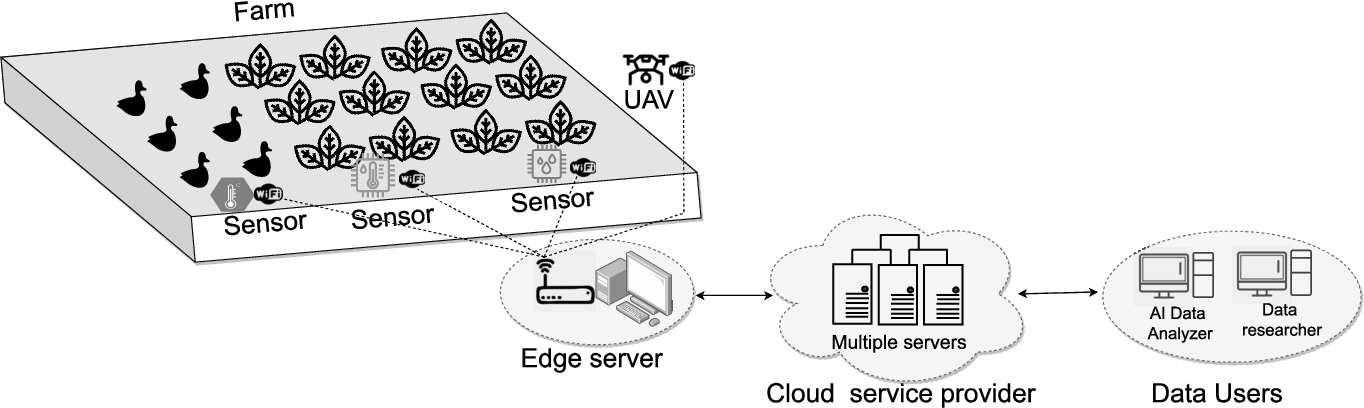
Data sharing scenario in precision agriculture.
Certificateless-based signcryption primitives can solve the key escrow problem, in which the private key generator uses archive keys to decrypt ciphertext without authorization. However, a traditional certificateless-based scheme is unsuitable as the delegator has to download the data from the cloud server before it can be unsigncrypted and re-encrypted with the new user’s public key to grant the user access to the data. This process can result in high computation and communication overhead, negating the benefits of cloud-based data sharing [1,3]. One effective solution is using proxy re-encryption [10], in which a “proxy” party acts as an intermediary between the sender and receiver of the encrypted data. The proxy server performs the re-encryption process on behalf of the sender without being able to read or access the data itself. Proxy re-encryption is helpful in situations where data access needs to be granted to new users, as it allows prior signcrypted data to be transformed into a new ciphertext that can be accessed with a different set of private keys. The advantage of the proxy encryption scheme is that an authorized user, the data owner (DO), can generate a valid proxy re-encryption key to grant users access to ciphertexts without needing multiple signcryptions for each set of users.

Data sharing scenario with proxy re-encryption.
As shown in Fig. 2, suppose Alice is a farmer who has recently adopted precision agriculture techniques. She uses sensors and drones to collect data on soil properties, crop production, water use efficiency, and analytical data to make informed decisions about her farming practices. Alice also participates in a collaborative data-sharing platform, where she shares her data with other farmers and relevant stakeholders to improve the group’s collective knowledge and decision-making.
One day, a researcher named Bob approaches Alice and requests access to her data to study the effects of different farming practices on crop yields and environmental degradation. Alice is willing to share her data, but she wants to ensure the confidentiality and integrity of her data. She does not want anyone to be able to access it without her permission.
To protect the confidentiality and integrity of an outsourced data, Alice decides to use a certificateless identity-based signcryption with proxy encryption to securely share her data with Bob. In this scheme, Alice first signcrypts her data using her own public key (identity), which provides both authenticity (verification to prove the originality of the data source) and confidentiality (protection of the data from unauthorized access). The signcrypted data is then stored in the cloud and can be re-encrypted using a proxy encryption scheme.
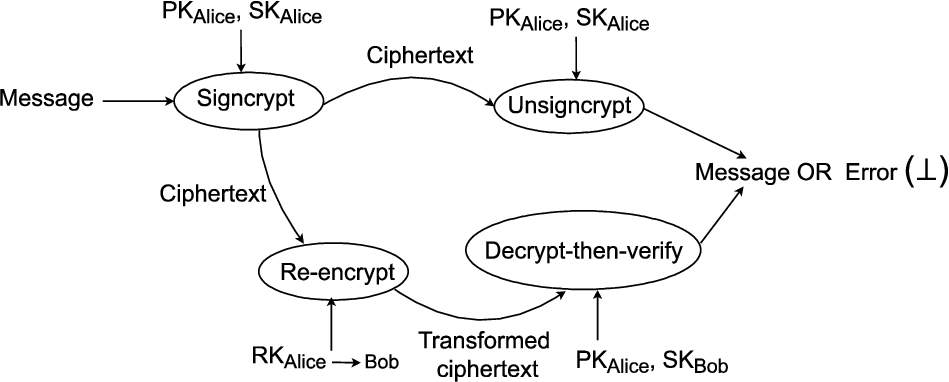
Proxy re-encryption data sharing scenario between DO and Alice.
To grant Bob access to the data, Alice generates a proxy re-encryption key using Bob’s public key (identity) and sends it to the cloud server. The cloud server can then transform the original ciphertext (signcrypted data) into a form that Bob can decrypt with his private key. As Alice’s public key is used in computing the first level of ciphertext, she can implement fine-grained access control with proxy re-encryption for each user or group she wants to grant access to the data. When a user wants to access the data, she can use her private key to generate a proxy re-encryption key which the cloud server can use to transform the ciphertext into a form that the user can decrypt. Figure 3 illustrates the proxy re-encryption approach facilitating secure data sharing between Alice and Bob. This approach allows Alice to selectively grant access to her data to specific users or groups of users while still retaining control over who can access the data. Note that the cloud server cannot perform data transformation to grant data access to entities without legitimate authorization from Alice, as the cloud server is unaware of the private key required to generate valid proxy re-encryption keys.
The existing certificateless signcryption with proxy re-encryption (CLS-PRE) methods [1–3] have several limitations that make them unsuitable for our proposed application of agricultural data sharing. In particular, they require the presence of a ciphertext to generate a proxy re-encryption key, which can lead to performance bottlenecks. This means that the data owners (DOs) cannot pre-generate proxy re-encryption keys for a set of users that they want to grant access to a ciphertext. Additionally, each proxy re-encryption key is bound to a specific ciphertext, so it is impossible to generate a single key that can transform multiple ciphertexts. This can be cumbersome and inefficient when many ciphertexts need to be transformed. To address these limitations, we propose a new scheme that allows for the generation of proxy re-encryption keys before or after ciphertexts have been created. Our scheme is based on the standard notion of proxy re-encryption, as introduced by Blaze et al. [10] and has been tailored specifically for use in a cloud-based collaborative data-sharing context. The absence of bilinear pairing in the scheme makes it lightweight and cost-effective for PA applications.
We summarize our contributions as follows:
We propose a certificateless identity-based signcryption with a proxy re-encryption (CLS-PRE) scheme and provide the security proof in the Random Oracle Model (ROM).
The proposed scheme is not based on bilinear pairing, a highly computation-intensive operation in cryptographic constructions. This makes the scheme lightweight for resource constraints environments such as PA. The proposed scheme’s novelty is the pairing-free operation without key escrow issues and a proxy re-encryption key without any ciphertext component. None of the existing CLS-PRE schemes has achieved these properties.
We provide system architecture for PA and demonstrate the communication process required in the system to achieve data security.
Our security analysis indicates that the proposed CLS-PRE scheme maintains authentication, integrity, non-repudiation, and confidentiality while eliminating the key escrow vulnerability.
We conduct comprehensive performance evaluations to show that the proposed CLS-PRE scheme achieves relatively fewer communication and computation costs when compared to other CLS-PRE schemes applicable to PA.
The rest of the paper is organized as follows. Related works are shown in the Section 2. The important theories and hard mathematical problems applied in the work are briefly reviewed in Section 3. Section 4 shows the system overview and the detailed implementation of the proposed scheme. Security analysis for the system is presented in Section 6. Performance evaluation of the proposed scheme is done in Section 7. Finally, we give a brief conclusion in Section 8.
Related works
Data access control schemes
As cloud-based data-sharing continues to evolve, various cryptographic schemes have been proposed to provide secure access control. Two cryptographic primitives that have received significant attention in this context are “signcryption” and “proxy re-encryption” (PRE).
Signcryption combines digital signature and public-key encryption, providing non-repudiation, authentication, confidentiality, and integrity at a lower cost than traditional methods such as sign-then-encrypt or encrypt-then-sign [32]. In 2002, Malone-Lee [25] constructed an identity-based signcryption (IBSC) scheme that applies to resource-constrained devices due to low computation cost. However, the IBSC scheme depends on a private key generator (PKG) to generate private keys for all the system users. As such, the scheme suffers from a key escrow inherent, as the PKG can access the private keys of all system users, decrypt every ciphertext, and forge signatures for any system user. To address the key escrow issue in the IBSC of [22,25,37], Barbosa et al. [7] introduced the concept of “certificateless signcryption” (CLSC). The certificateless technique improves the efficiency and security of signcryption cryptographic schemes by eliminating the need for certificate maintenance and verification. It simplifies system design and improves scalability while reducing the risk of security breaches associated with a rogue certificate authority. However, the certificateless signcryption schemes in [14,41,42] do not appear relevant to our application scenario as they do not support proxy re-encryption functionality.
The benefit of PRE (Proxy Re-Encryption) is that it enables secure data sharing with multiple users by re-encrypting the data with their public keys, without the need to download it from the cloud server, thereby reducing data transfer costs. Due to the cost-effectiveness of PRE, it has been used in identity-based cryptography to construct identity-based proxy re-encryption (IB-PRE) schemes [7,45]. The IB-PRE schemes are a variant of traditional proxy re-encryption (PRE) schemes that use an identity string instead of a public key to determine who is authorized to decrypt the ciphertext. Hence, they do not have certificate management issues. However, the key escrow issue is a potential drawback, as they require absolute trust in the private key generator (PKG) to safeguard all the private keys. Therefore, a malicious PKG can sell or leak the escrowed private keys to unauthorized parties, allowing them to decrypt messages meant for only the legitimate private key owner. The IB-PRE schemes such as [13,21,37] and [34] are vulnerable to key escrow attacks. Also, the scheme in [18] is mathematically incorrect, while [37] and [13] are vulnerable to adaptive chosen ciphertext attacks. The authors of [22] developed a secure identity-based signcryption (IBSC) and demonstrated that the scheme is applicable for access control in cloud computing. Likewise, [20,24,36] showed that PRE techniques can be employed in cloud computing to gain access control. However, these schemes are also vulnerable to key escrow attacks.
In addressing the key escrow vulnerability in signcryption and PRE cryptographic primitives, Ahene et al. [1–3] proposed identity-based signcryption with proxy re-encryption (CLS-PRE) for cloud-based data sharing using certificateless cryptography. Certificateless cryptography eliminates the need for certificate management by dividing the responsibility of key creation between the user and a semi-trusted entity called the Key Generation Center (KGC). This approach allows the authenticity of the keys to be verified without the use of certificates and also solves key escrow issues present in Identity based Encryption (IBE) methods by not allowing the KGC to access the user’s secret keys. However, the CLS-PRE schemes in [1–3] do not follow the standard definition of proxy re-encryption scheme introduced in [10] as elements of the ciphertext are required to generate proxy re-encryption keys. Therefore, a re-encryption key has to be generated for every ciphertext that a designator wants a delegatee to decrypt. The number of re-encryption keys created in the scheme will grow linearly with the number of ciphertexts the delegatee can access.
Furthermore, the bilinear pairing-free scheme proposed in [1] is not secure against forgery attacks, as the ciphertext component
Similarly, data access control can be accomplished through either the Attribute-based encryption(ABE) method or a combination of ABE and PRE techniques. Yu et al. [44] introduced data access control with ABE and PRE technologies. Their framework achieves adequate fine-grained access control in cloud systems. Also, the authors in [19,23,27,44] used ABE techniques to control access to data, which may be appropriate for PA as in [16,28,29], but ABE schemes have two shortcomings.
They have key escrow flaws and do not perform authentication or non-repudiation. They are entangled with the complexity of changing access policies (i.e. revoking or adding attributes to an access structure).
Authors in [19,27] have made tremendous efforts to build ABE schemes to surmount these shortcomings. However, the resultant schemes are extremely complex and associated with high communication and computation costs due to the expressiveness of the ABE access structure.
Consequently, no existing known CCA21
CCA2 (Adaptive Chosen Ciphertext Attack) is the strongest security definition for cryptographic schemes that allows the adversary to adaptively query a decryption oracle with ciphertexts of their choice.
EUF-CMA (Existential Unforgeability under Chosen Message Attack) is a security definition for digital signature schemes that ensures that an adversary cannot forge a signature on a message that they did not create.
In PA, the use of IoT devices such as sensors and drones to collect data about crops, weather, and soil conditions is prevalent. However, these devices are typically power-constrained and have limited computing capabilities, making it challenging to handle the computational load of cryptographic algorithms required to protect the sensitive agricultural data being collected. To ensure security, we offload the cryptographic operation to the edge server and provide a lightweight CLS-PRE scheme to secure the data. The proposed scheme does not rely on bilinear pairing but instead uses modular point multiplication on an elliptic curve, which is less computationally expensive. As a result, it allows the edge server to efficiently encrypt the agricultural data from these devices while reducing power consumption, ensuring faster and more efficient data processing, and preventing transmission delays and backlogs in the system.
In [17,35,43], the authors identified security threats, vulnerabilities, and threat scenarios in precision agriculture. In contrast, their work presented limitations to abstracted cybersecurity solutions with no concrete construction.
Barreto and Amaral [8] presented empirical methodology to highlight security issues and challenges in smart farming. The work deliberates security challenges, including agro-terrorism, social engineering, ransomware attacks, denial of service attacks, and cyber espionage. However, they did not present concrete implementation with results. Moreover, there was no demonstration of orchestrated attacks through use cases.
Chae and Cho [12] proposed an enhanced secure device authentication algorithm in the peer-to-peer (P2P) based smart farm system. They devised a lightweight encryption and decryption method to facilitate a robust authentication solution in smart farming P2P communication. However, the certificate authority (CA) used in the scheme introduces certificate management problems into the precision agriculture architecture. The CA’s issuance, revocation, and distribution of certificates are opaque and vulnerable to attack. Like the DigiNotar attack, there have been times when a rogue CA has made fake certificates for targeted people.
West [40] provided a methodology for predicting cyber-attacks on precision agriculture to create a standard vulnerability scoring system (CVSS score) that relies on smart farming technology. Although the CVSS score has become the industry standard for determining the severity of vulnerabilities and prioritizing patches, it has some flaws. Smart farming encompasses a wide range of devices and systems linked together. The CVSS score only looks at individual weaknesses and does not consider its effect on the general system.
Ametepe et al. [5] proposed a hybrid technique for secure data transmission in an intelligent network for crop monitoring in agriculture fields by integrating asymmetric and symmetric cryptographic schemes. They designed a secure, scalable, robust, and reliable wireless sensor network to overcome the inherited limitations of storage capacity, processing power, and communication range of IoT devices. However, the scheme relies heavily on public key infrastructure and is subjected to certificate management problems. Also, the scheme does not provide the ability to perform proxy re-encryption of ciphertext. Furthermore, no concrete scheme addresses the security challenges in precision (smart) agriculture by ensuring PA’s data integrity, non-repudiation, and confidentiality while eliminating key escrow threats. Hence, we propose the use of CLS-PRE in PA to achieve the desired security properties.
Preliminaries
Security assumptions
Let P be a generator with prime order q. Let G be a set of points on an elliptic curve over a finite field
Elliptic curve discrete logarithm (ECDL) problem is to find the value a given
Computational Diffie–Hellman (CDH) problem in G is to find
Given a random instance
The gap Diffie–Hellman (GDH) problem is to compute
Descriptions of symbols and notations
Descriptions of symbols and notations
The important symbols used in the CLS-PRE scheme are presented in Table 1. The general syntax of CLS-PRE comprises the following ten algorithms.
Setup: The KGC executes this algorithm with the input of a security parameter π to generate master secret key s and public parameters
SVS: This algorithm is executed by the user by taking its identity
PPKE: The KGC performs this algorithm. It obtains an identity
PKS: The user initiates this algorithm by using the tuple
PKG: The user performs this algorithm by taking its secret value
SC: This algorithm is used to signcrypt messages. A sender (Alice) creates a ciphertext
PKGen: This algorithm is designed to generate proxy re-encryption keys. Bob defines the proxy re-encryption key
Re-Enc: This algorithm is used to proxy re-encrypt the first level of a ciphertext
USC: This algorithm simultaneously decrypts and verifies the authenticity of a ciphertext. It is a deterministic algorithm which outputs the message m with a given inputs
Dec: This algorithm is used for deciphering a ciphertext. It takes the input of
In general, the CLS-PRE scheme must be consistent. It must comply with the following: If
Security notion
First, confidentiality must be maintained in the CLS-PRE scheme against indistinguishability adaptive chosen ciphertext attack IND-CCA2. Secondly, it should retain unforgeability against adaptive chosen message attacks (EUF-CMA). We, therefore, adopt the techniques proposed in [22] and [31] for the IND-CCA2 and the EUF-CMA security analysis. We use two types of adversaries
Moreover, a type II adversary is an honest but curious internal user like the KGC who has access to the MSK but cannot change any user’s public key. We now define the security models for the CLS-PRE scheme using a sequence of games. Finally, a challenger
Confidentiality model
To achieve IND-CCA2, we define
Setup
Phase 1
Partial Private Key Queries: Private Key Queries: Public Key Queries: Public Key Substitution Queries: Proxy Key Generation Queries: Signcryption Queries: Re-Encryption Queries: In this phase, Unsigncryption Queries: Decryption Queries:
Challenge
Phase 2
Identical to Phase 1 regarding queries execution,
Guess
Setup
Phase 1
The execution queries between
Challenge
Phase 2
Identical to Phase 1 in terms of the execution of queries.
Guess
The CLS-PRE scheme is IND-CCA2 secure if there are no polynomially bounded adversaries
In this stage, two interactive games are played between
Setup
Inputting π,
Attack
Forgery
The advantage of
Setup
Inputting π,
Attack
Forgery
The CLS-PRE scheme is assumed to be EUF-CMA secure if there is no probabilistic polynomial time (PPT) adversaries
The advantage of
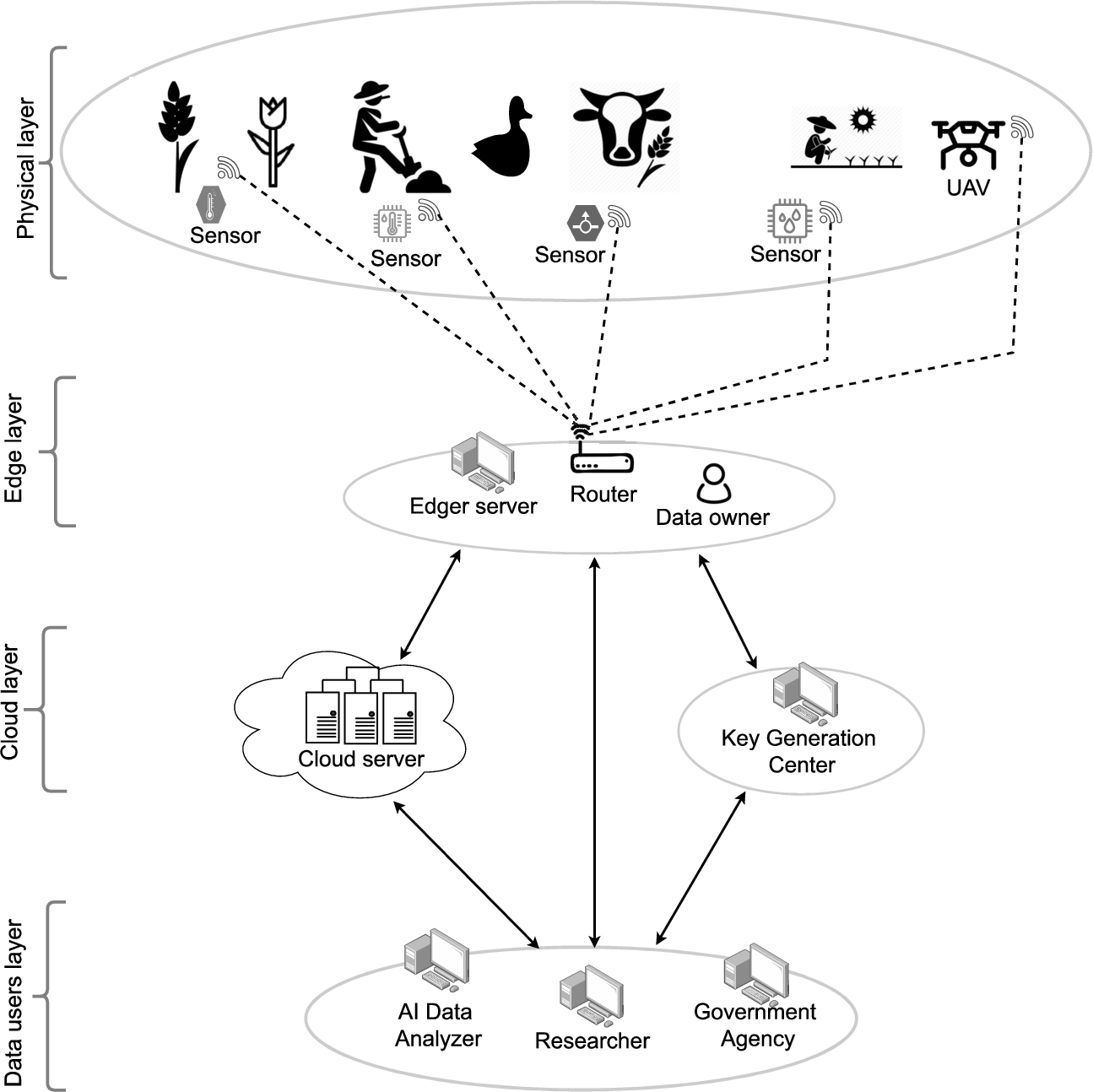
System model.
Figure 4 describes the system model for the proposed scheme. The system has four layers: the physical layer, the edger layer, the cloud layer, and the data user layer.
The physical layer comprises unmanned aerial vehicles (UAVs), sensors, and network modules that can gather real-time data from the farm and transmit it to the edge layer. The sensors usually support short-range communications. Mostly, they prefer to exchange data with nearby sensor nodes that relay information to the gateway node.
The Edge layer comprises an edge server and router to receive data from the physical layer and relay it to the cloud server. The edge server encrypts the agricultural data locally before sending it to the cloud.
The cloud layer comprises the cloud server and a key generation center (KGC). The KGC is for registering and generating a partial private key for the system users, such as DOs and data users. The DO is the front end of the sensor nodes (edger server). The cloud server (CS) provides cloud-based data storage, virtualization, and proxy re-encryption (PRE). Succinctly, the CS acts as a proxy for re-encryption and maintains the outsourced encrypted data. We assume the KGC is trustworthy and can never be compromised, whereas the CS is honest but curious. First, a data consumer sends a query message to the DO if he/she wants to obtain data from the CS. Afterward, the DO sends a re-encryption command to the CS. Finally, the CS re-encrypts the ciphertext and forwards it to the data for decryption.
Data user layer comprises researchers and government agencies. For the users to access the agricultural data resources, they need to send a request to the DO, which then generates a proxy re-encryption key for the CS, so that the CS can transform the ciphertext that can be decrypted with their private key.
The system model must have the following properties: confidentiality, authentication, integrity, and non-repudiation. It is said to be confidential when data is kept private from all entities except approved entities such as DOs and users. This means CS is not aware of the data contents. When outsourced data is protected against unauthorized modification, data integrity is established. Authentication is gained when only the authorized DO outsources information. Finally, non-repudiation is realized when the DO cannot reverse his previous acts, such as outsourcing encrypted data to a CS.
Our proposed scheme
Construction
We introduce a novel CLS-PRE scheme and then evaluate its security and performance. For simplicity, we suppose that Alice (DO) identified with
Setup
This algorithm is run by the key generation center (KGC). With the input of the security parameter π, the KGC proceeds as follows.
Chooses random Selects these hash functions:
where κ represents the size of the message. Publishes the public parameters
SVS
The user selects random
PPKE
To get a partial private key, a user sends Selects Computes
The KGC securely sends
PKG
This algorithm is executed by a user U with the input of
PKS
This algorithm is executed by a user U with the input of
SC
Given Alice’s identifier Selects random Computes Sets Computes Computes Outputs the first level ciphertext as
PKGen
This algorithm generates a proxy re-encryption key. It accepts the input of Eve’s public key Selects random Computes Computes Selects Outputs
Re-Enc
This algorithm accepts the input of Computes Outputs a second level ciphertext
USC
With a given ciphertext Computes Computes Computes Checks if
Dec
With a given ciphertext Computes Computes Computes Computes Computes Checks if
Correctness for signature verification
We give the correctness of the verification of the scheme as follows:
Furthermore, we provide the correctness of proxy decryption and unsigncryption for the users Eve and Bob, respectively. Bob can retrieve the plaintext
Security analysis
The CLS-PRE scheme uses Theorems 1 and 2 to achieve confidentiality and unforgeability, respectively.
Confidentiality
Our CLS-PRE scheme is IND-CCA2 secure in the random oracle model (ROM) against the adversaries
Assuming that there exists
The challenge algorithm
Phase 1
Let i represents a counter with the default value set to 1. It checks whether the DDH oracle outputs TRUE when queried on When Partial Private Key Queries: If If Public Key Queries: If If Public Key Substitution Queries: Private Key Queries: Proxy key generation Queries: Signcryption Queries: The sender’s identity is represented as If Now, if Re-Encryption Queries. If Now, if
Unsigncryption queries
If Now, if At this point,
Decryption queries
If Now, if
Challenge
Phase 2
Guess
Hence, it is evident that
The probability of selecting T randomly from the record
Assuming that there exists
Phase 1
It checks whether the DDH oracle outputs TRUE when queried on When Public Key Queries: If If Private Key Queries: Proxy key generation Queries: Signcryption Queries: The sender’s identity is represented as If Now, if Re-Encryption Queries. If Now, if
Unsigncryption queries
If Now, if At this point,
Decryption queries
If Now, if
Challenge
Phase 2
Guess
Hence, it is evident that
Authenticity
The proposed CLS-PRE scheme is EUF-CMA secure in the ROM.
The proof for Theorem 2 is done using Lemma 3 and Lemma 4. □
Assuming that there exist
Analogous to [14] and [1], we prove Lemma 3 using forking lemma [33]. □
Firstly, we describe how our scheme fits in with the signature scheme proposed in [33]. With the forking lemma, a simulation can be done without the sender’s private key [32]. We assert that during the signcryption process, the tuple generated as
Attack
Every hash query is identical to that of Lemma 1. Here, we set the identical challenge
Forgery
Analysis
Here, we provide an analysis of the probability of this event happening.
Assuming that there exist
Suppose
Hence, it is evident that
Public Key Queries: If If
Forgery
Analysis
Here, we analyze the probability of this event happening.
Hence, it is evident that
System security analysis
This section analyzes the security requirements outlined in Section 4.1.
Confidentiality: An illegitimate user or attacker can decrypt the ciphertext only if it can solve the underlying mathematical hard problems: GDH and ECDL, or successfully execute unsigncryption algorithms without the knowledge of the actual private key. This Attack, however, is impossible for a polynomially bound adversary, according to the Theorem 1. Integrity: Integrity is achieved if an authorized user can use the unsigncryption algorithm in the proposed model to verify the authenticity of the data m. Thusly, Authentication: Authentication is ensured through the SC algorithm since it is computationally hard to forge a legitimate ciphertext Non-repudiation: If the customer denies sending Absence of Key Escrow: The generation of the user’s private and public keys is not left solely dependent on the KGC. The KGC instead produces partial private keys to enable users to derive their private keys. Hence, the developed algorithm alleviates escrow problems. No ciphertext components in proxy re-encryption key: Our proposed scheme does not require ciphertext components to generate a proxy re-encryption key. Therefore, the number of proxy re-encryption keys developed in the scheme is linearly independent of the number of ciphertexts the delegatee can access.
Performance evaluation
The efficacy of the proposed CLS-PRE is demonstrated by utilizing performance benchmarks (criteria) in terms of scheme functionality, computational cost, and communication overhead.
Scheme functionality
The functionality requirements outlined in Table 2 pertain to the various security properties considered essential for a secure proxy re-encryption scheme. These properties include confidentiality, integrity, authentication, non-repudiation, key escrow-free, and the presence of ciphertext components in the computation of proxy re-encryption keys. From observation, it is evident that all the schemes meet the confidentiality requirement, which is a fundamental security property in any cryptographic scheme. All schemes meet the integrity requirement except for the method proposed in [1]. Furthermore, the scheme [1] lacks several other crucial security properties, such as authentication and non-repudiation. Additionally, it does include ciphertext components in the computation of the proxy re-encryption key, which is a significant drawback. In comparison, the scheme proposed in [3] has been improved to include all the security properties outlined in the table but still needs to include ciphertext components in the computation of proxy re-encryption keys. On the other hand, the schemes proposed in [22,37] satisfy all the security requirements outlined in the table but still suffer from the inherent effects of key escrow, which could compromise the system’s security. Lastly, the scheme proposed in [34] fulfills all the security requirements outlined in the table; however, it still needs to meet the non-repudiation requirement.
Comparison of computational costs
Comparison of computational costs
✓-scheme satisfies functionality; ✗-schemes lacks functionality
The proposed CLS-PRE scheme not only fulfills all the necessary functions listed in Table 2, but it also surpasses other schemes by not incorporating ciphertext components in the computation of the re-encryption keys. This allows for generating the re-encryption key before computing the ciphertext.
A simulation is conducted on a 16 GB RAM computer with a 2.9 GHz Intel Core i7 processor to achieve quantitative results for our analysis. The Multiprecision Integer and Rational Arithmetic Cryptographic Library (MIRACL) [26] was adopted for the simulation. In the pairing-based scheme, a bilinear pairing
With the evaluation of the cryptographic schemes [1,3,22,34,37] and ours CLS-PRE, we take into account the computational cost of specific mathematical operations such as bilinear pairing
Analysis of computation and communication cost
Analysis of computation and communication cost
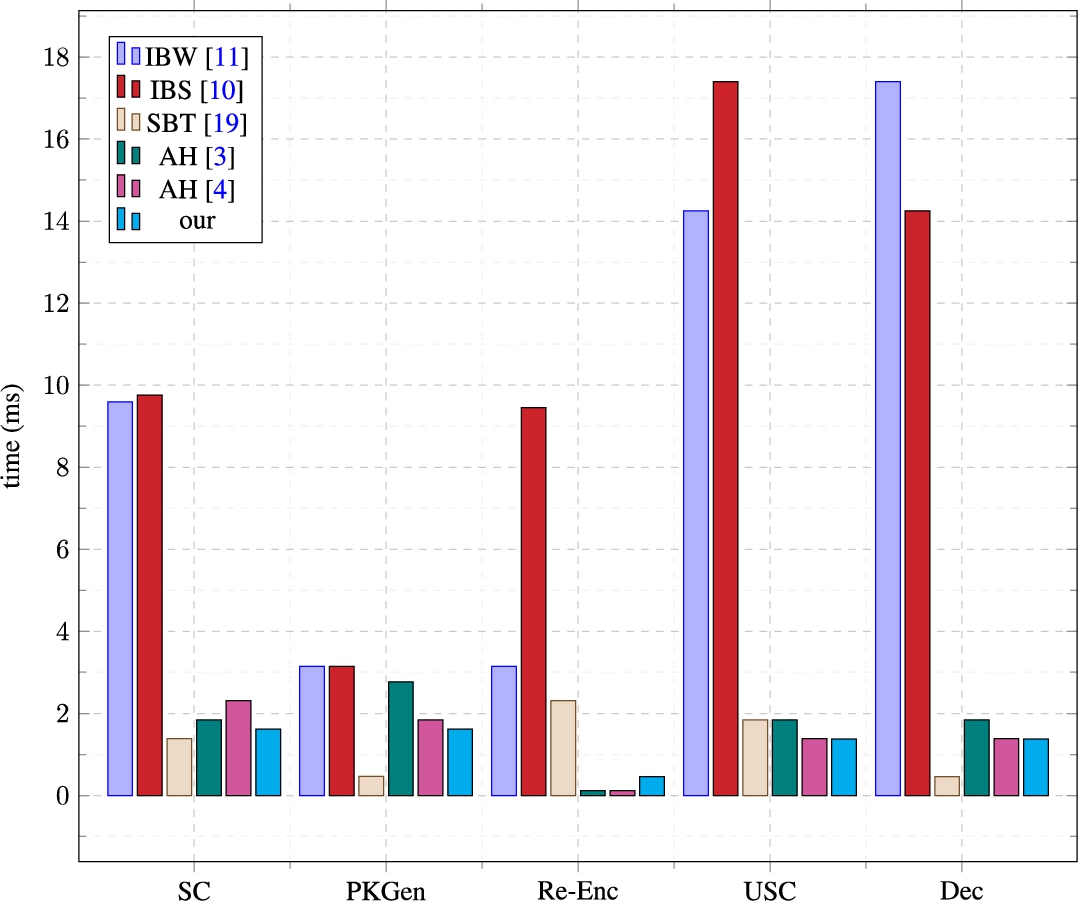
Computation time comparison.
The results from Table 3 and Fig. 5 show that our proposed ECC-based CLS-PRE scheme has the lowest computation cost of
The efficiency of the proposed CLS-PRE scheme compared to other schemes can be calculated using the standard equation:
The communication overhead of a scheme is the cost incurred when transmitting a message from a sender to a receiver. In our analysis, we assume that the message length, denoted by
The efficiency of our CLS-PRE scheme can be calculated using the following equation:
This means that our CLS-PRE scheme has the smallest communication overhead among all the schemes, thus reducing the communication cost when ciphertext is outsourced to a cloud server. The benchmark of the results is shown in Fig. 6.
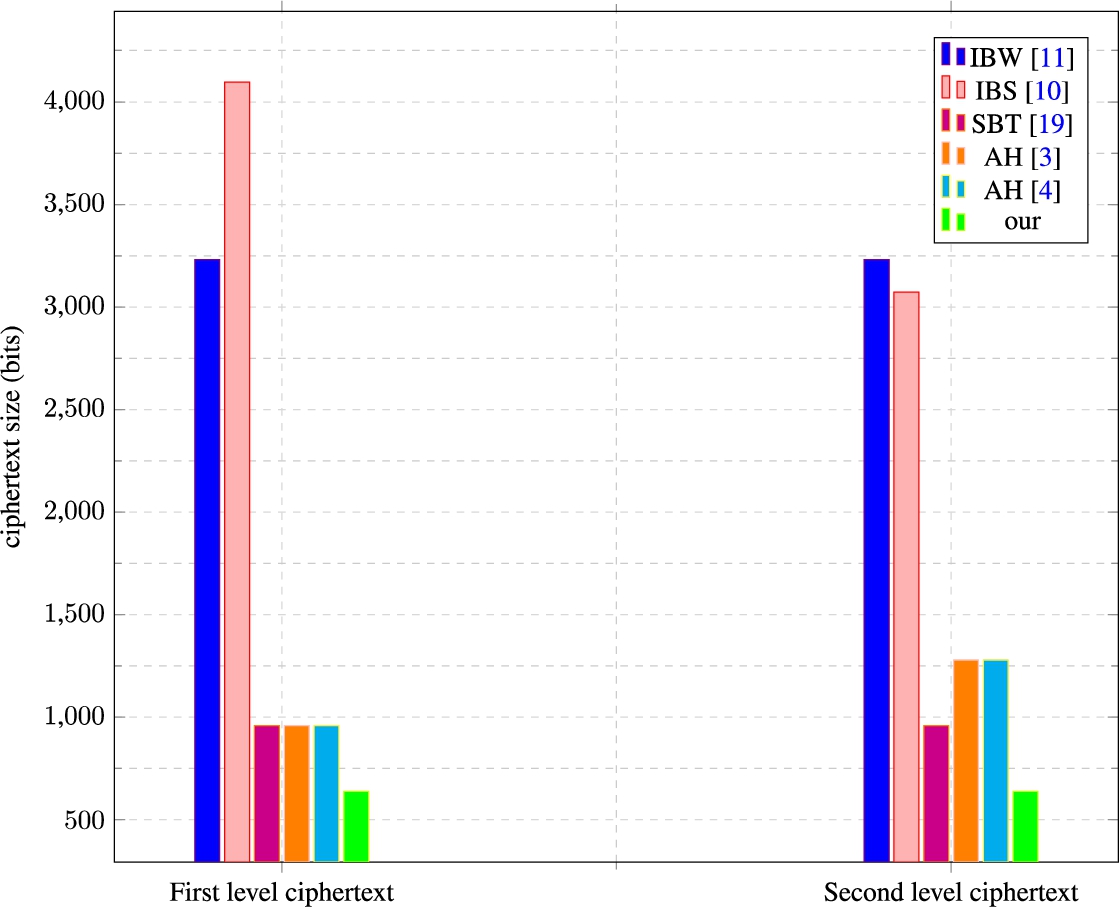
The signcryption and unsigncryption cost.
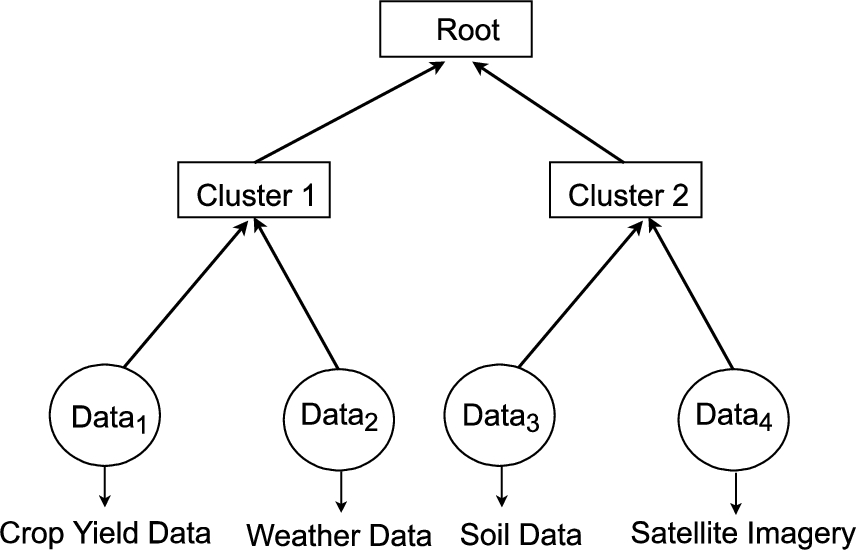
Example of data partition tree.
Our CLS-PRE scheme offers a cost-effective advantage for secure data distribution in a cloud-based PA system. Inferring from Fig. 7, the data owner (DO) partitions their data according to the sensitivity level and user roles. The agricultural data is divided into four categories: crop yield, weather data, soil data, and satellite imagery. Each type of data has a specific use case and is considered sensitive. For example, crop yield data includes information on crop types, field locations, and yields per hectare which is used to predict crop yields and make decisions about planting and harvesting. Weather data includes information on temperature, precipitation, and wind speed and is used to predict weather conditions and make decisions about planting and harvesting. Similarly, soil data provides information on pH levels, nutrient levels, and soil types which is also used to predict soil conditions and make decisions about planting and harvesting. Satellite imagery contains images of the earth’s surface taken by satellites and is used to monitor crop growth, predict crop yields, and identify suitable areas for farming.
The DO then creates a hierarchical access tree for the partitioned data, as shown in Fig. 8, by generating identities and public and private key pairs for each data point at the leaf nodes. The DO aggregates the information in each leaf-node pair to the immediate non-leaf node until it reaches the root node. The primary purpose of the hierarchical access tree is to assign a different access level to users based on their role and the sensitivity level of the datasets.
The DO further derives a ciphertext for each data point in the chosen tree by using a secure method called MAC (Message Authentication Code), denoted as
The MAC value protects both the integrity and authenticity of a message generated by the symmetric encryption scheme. Also, the symmetric encryption scheme encrypts the actual data whiles the SC algorithm is used to signcrypt the session key and MAC value due to the efficiency of the symmetric encryption over the Public key encryption schemes. With the following inputs: DO’s identity, public and secret keys (i.e., Select a session key Compute Compute
where
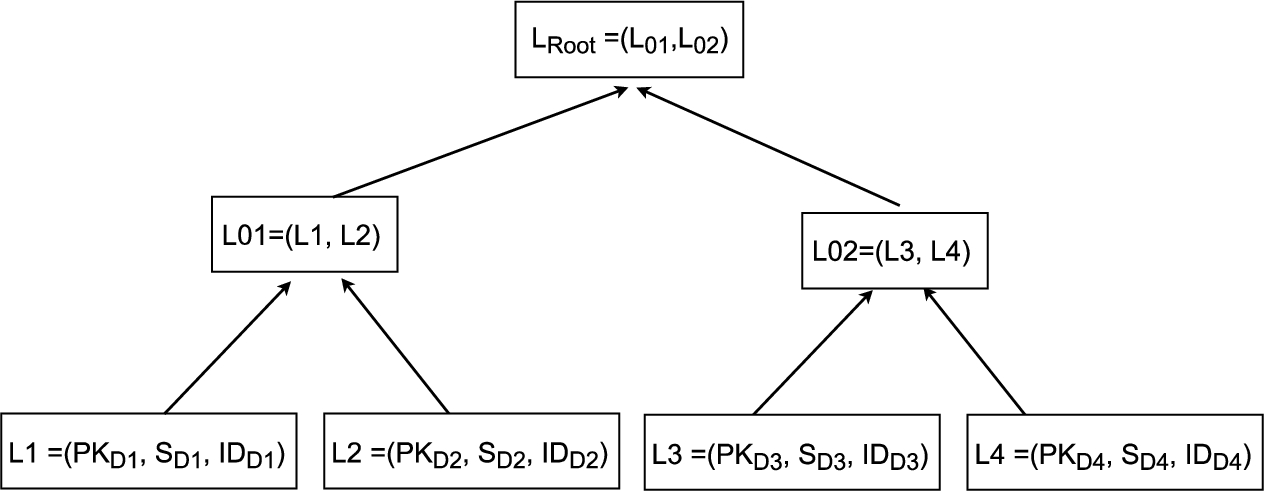
Example of hierarchical access tree.

Data sharing in cloud-based precision agriculture.
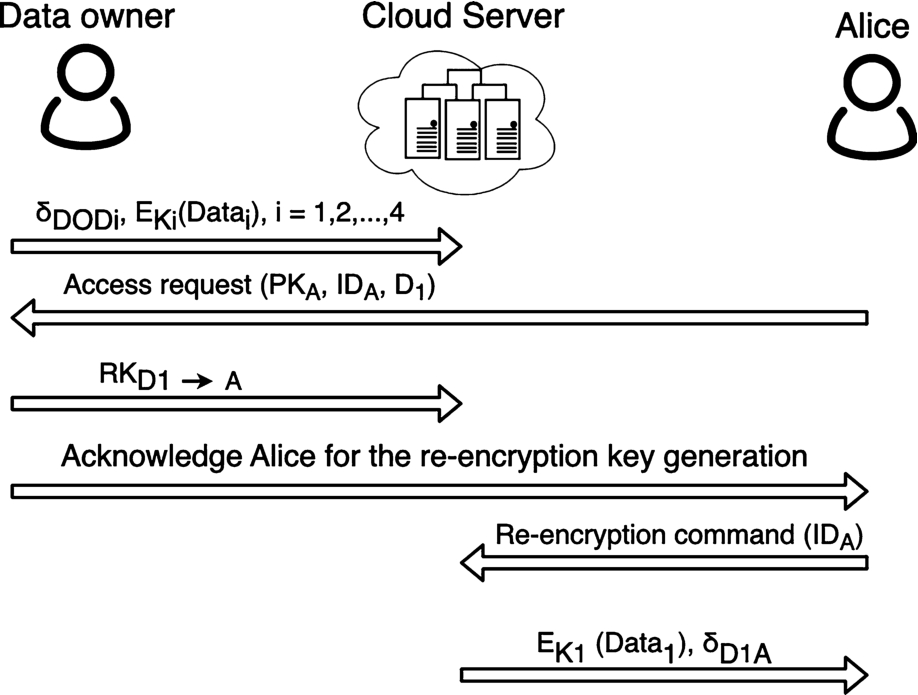
The communication in cloud-based precision agriculture data sharing.
Assuming a user requests access to agricultural data, the DO must determine the level of the hierarchical access tree at which the user will be given the appropriate access privileges. The DO generates one or more proxy re-encryption keys based on the matching level of permissions in the access tree with the user’s public key. These re-encryption keys are then disseminated to the cloud server, where the data users can authorize the server to perform re-encryption on their behalf, enabling them to access the ciphertext utilizing their private key. Figure 9 and Fig. 10 describe the process in which the ciphertext and proxy re-encryption keys are stored on the cloud server to authorize data access for system users. For instance, when a user named Alice requests permission to access Compute Verify if Compute the symmetric decryption algorithm
Notably, the CS does not know
We utilized the 128-bit AES-CBC method for symmetric encryption in MIRACL [26] in addition to the elliptic curve E and the associated values of p and q as specified in the communication Section 10 to evaluate the performance of our proposed CLS-PRE scheme.
To provide clarity, we have divided the process into three distinct steps. The first step, data creation, is handled by the data owner and involves data encryption. The second step, delegation, consists of the first-level ciphertext re-encryption. The final step, data opening, involves the decryption of the provided ciphertexts. The overall process is depicted in Fig. 11 for ease of understanding.
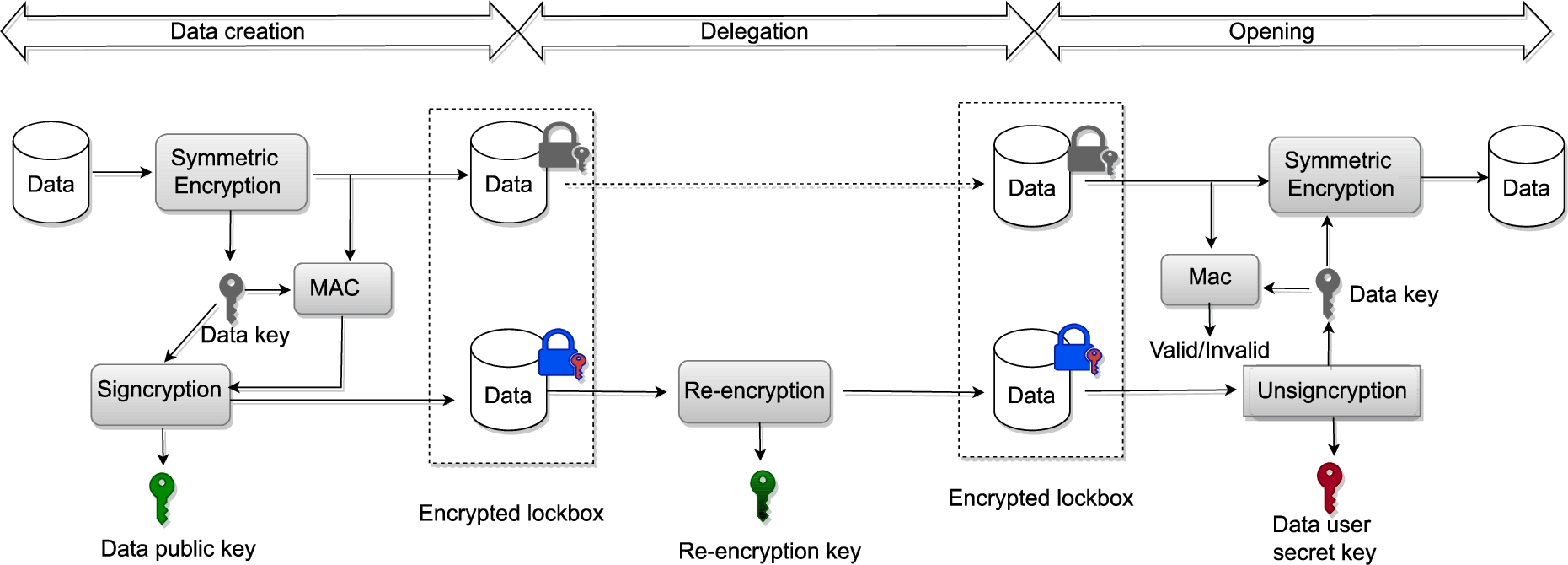
Steps in sharing data with CLS-PRE scheme.

Data owner computation time.

Data user computation time.
The benchmark results from the CLS-PRE scheme operations are presented in Fig. 12 and Fig. 13. From the results, we conclude that the CLS-PRE operations are suitable for use in an access control solution for cloud-based collaborative data sharing. For example, the data owner operations of data creation (AES encryption, MAC, and signcryption) for 200 megabytes (MB) of data have a computational cost of 0.06487 ms. On the client side, the data opening (AES decryption, MAC, and unsigncryption) for 200 megabytes (MB) of data has a computational cost of 0.064451 ms. The costs are minimal, making the proposed approach viable for real-world implementation.
We also observe that the time cost for signcryption is constant regardless of the increase in data size. This is because the CLS-PRE scheme encrypts only the symmetric key (data key), which is the same size for each item, not the original data. However, the AES encryption/decryption and MAC operations increase concerning the file size. For larger file sizes, performing symmetric (AES) encryption and decryption requires an extended computational period.
We evaluated the performance of our access control server when faced with heavy workloads. As shown in Fig. 14, our proxy re-encryption server can handle up to 2457600 pending requests without showing any signs of strain. To simulate this, we replayed a trace of proxy re-encryption Remote Procedure Calls (RPCs) on the server. This process required no computation on the part of the data user and caused the server to perform proxy re-encryption. We made one request at a time, waiting for the response before sending another. To simulate multiple clients, we gradually increased the number of outstanding RPCs. Our server could sustain 200 re-encryptions per 0.03 seconds until reaching 2457600 outstanding requests. These results show that the server can handle a large number of requests in a short period and has good scalability under heavy loads.
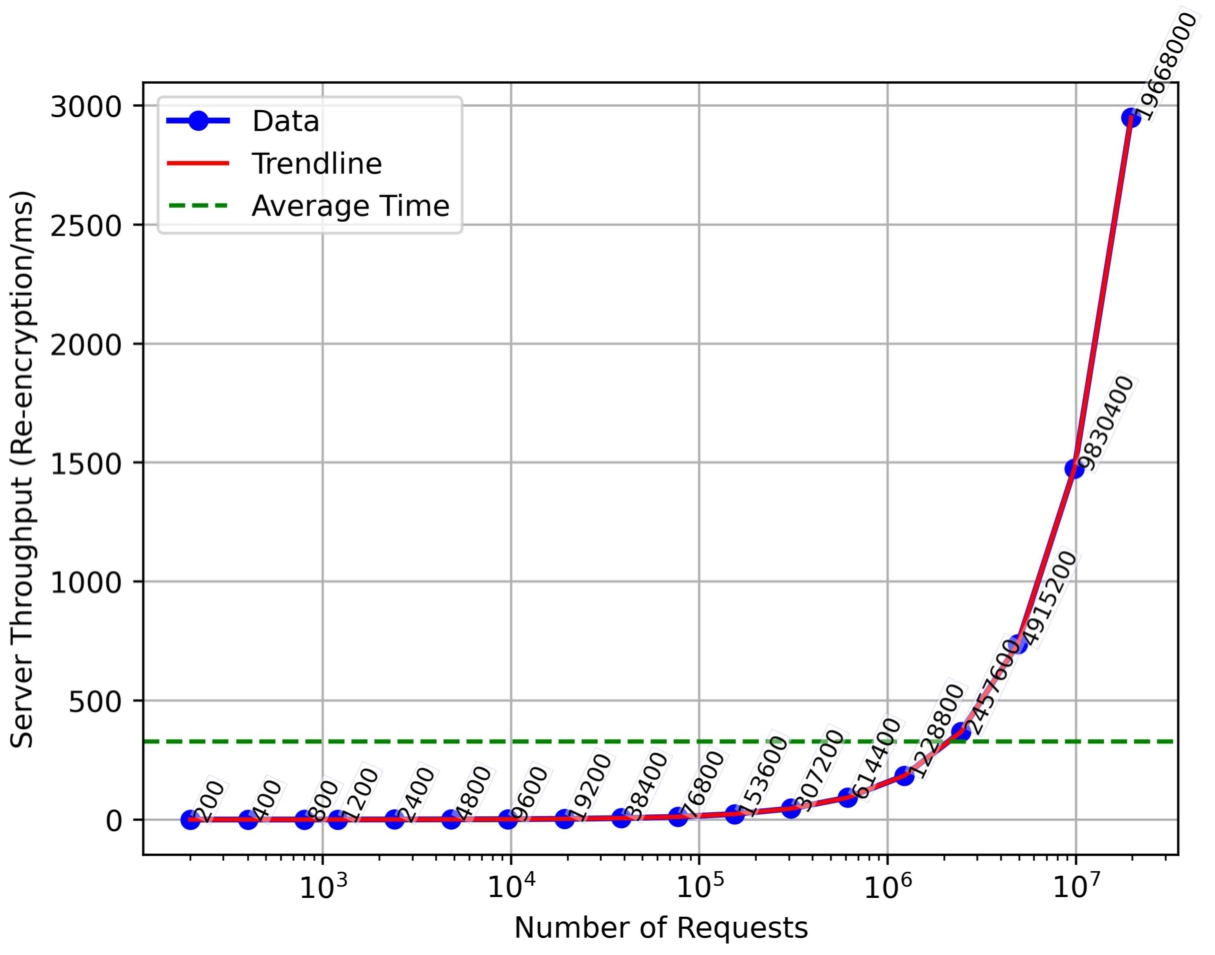
Aggregate access control server throughput.
The application instance of the CLS-PRE scheme has several advantages over existing methods. It allows the DO to change and define the granular level of data access based on the dataset’s public information rather than the users. It also makes it easy for the DO to quickly revoke access rights by removing the proxy re-encryption keys associated with a user or dataset. Furthermore, the scheme allows the DO to add new data to the system quickly and securely, as the new data can be partitioned based on the existing partition tree and signcrypted based on the hierarchical access tree. The cloud server can re-encrypt the ciphertext using the existing proxy re-encryption keys so that the authorized user can use their secret key to access the data. Note that this functionality is not present in existing CLS-PRE schemes, as the proxy re-encryption key is typically bound to a particular ciphertext, as the component of the ciphertext is used in the proxy re-encryption key generation.
Cloud-enabled user revocation
Attribute-based encryption (ABE) is a promising solution for fine-grained encryption of cloud data. However, one major challenge with ABE is revoking access for individual users. Traditional ABE schemes, such as those in [9,29,39], use an “expiry time” attribute in the attribute set, but this method does not allow for immediate revocation of access. Other variants of ABE, such as predicate encryption and functional encryption, are also limited in their revocation capabilities. In a situation where a single user in ABE is identified as malicious, ABE does not provide any alternative to remove such a user. Revoking the attribute related to the malicious user automatically removes other legitimate users who shared the same or some attributes with the malicious user, which is not a desirable outcome. Stateful user revocation mechanisms such as [6,38,44] have limitations as they require regenerating cloud data and redistributing new keys, which puts a significant burden on the cloud and are not an ideal solution for data users. General, user revocation remains a considerable challenge that needs to be addressed for ABE to be an effective solution for fine-grained encryption of cloud data. The proposed cloud-enabled user revocation approach, based on the CLS-PRE scheme, addresses the challenges associated with traditional ABE schemes and other variants by allowing the cloud to hold the re-encryption keys of all authorized users. This allows the cloud to transform encrypted data records into ciphertexts under a user’s public key if the user is authorized and has a re-encryption key held by the cloud. To revoke a user, the cloud erases the user’s re-encryption key, preventing the cloud from transforming encrypted data for that user. However, there are a few essential points to note regarding this approach.
The cloud is assumed to be semi-trusted, meaning that it is considered an adversary mainly to the secrecy of cloud data but honest in managing cloud data, processing user access requests, and other administrative activities. When a user requests data from the cloud, he needs to include his identity with the request, facilitating the cloud’s determination of the corresponding re-encryption key to use from the Re-encryption Key database. However, the cloud is not required to check the authenticity of the request, meaning the cloud does not concern itself with one user impersonating another. This is because each user’s unique re-encryption key only pairs up with his private key. The novelty of our proposal is that it utilizes CLS-PRE for user revocation, and the CLS-PRE scheme proposed attains “fine-grainedness” comparable to ABE. However, it should be noted that a user who has successfully obtained ω from the decrypt algorithm can authorize another user to decrypt the data with the assistance of ω. The scheme only requires that a user i without a valid secret key
The application of CLS-PRE for implementing cloud-enabled user revocation has challenges. It requires the cloud to perform a Re-Enc operation upon every data access request, which is expensive. However, the actual deployment of the CLS-PRE scheme can amortize this overhead by encrypting the payload data with a random key under symmetric encryption and encapsulating the encryption key with the CLS-PRE scheme. This allows for a Re-Enc operation by the cloud to allow a user to access many data records rather than one per request. The proposed approach also provides for user revocation by using a new key for a specific level of the hierarchical access tree when encrypting new data records. However, the online computation required by this approach is a tradeoff for the unique feature of user-side efficiency and the non-requirement of pairing support on the user side.
Conclusion
Precision agriculture is a field that has received minimal attention from cryptographic researchers. In this era of outsourced cloud data sharing, farmers can make use of cloud computing and storage for collaborative data sharing to improve farming methodology and practices. However, cyber threats affect data stored in cloud servers. The authors propose an efficient access control scheme for precision agriculture that utilizes a novel CLS-PRE method to mitigate these threats. The cloud server acts as a proxy, performing re-encryption of ciphertext for third-party data consumers. The proposed CLS-PRE scheme is IND-CCA2, and EUF-CMA secures in the Random Oracle Model under the assumptions of GDH and ECDL. The proposed scheme also outperforms comparative schemes while achieving authentication, confidentiality, non-repudiation, and integrity, resolving the key escrow problem.
Footnotes
Acknowledgments
This work was partially supported by Sichuan Science and Technology Program (2018HH0102, 2019YFH0014, 2020YFH0030, 2020YFSY0061).