



Abstract
Timed data release refers to protecting sensitive data that can be accessed only after a pre-determined amount of time has passed. While blockchain-based solutions for timed data release provide a promising approach for decentralizing the process, designing an attack-resilient timed-release service that is resilient to malicious adversaries in a blockchain network is inherently challenging. A timed-release service on a blockchain network is inevitably exposed to the risk of post-facto attacks where adversaries may launch attacks after the data is released in the blockchain network. Existing incentive-based solutions for timed data release in Ethereum blockchains guarantee protection under the assumption of a fully rational adversarial environment in which every peer acts rationally. However, these schemes fail invariably when even a single participating peer node in the protocol starts acting maliciously and deviates from the rational behavior.
In this paper, we propose a systematic solution for attack-resilient and practical blockchain-based timed data release in a mixed adversarial environment, where both malicious adversaries and rational adversaries exist. We first propose an effective uncertainty-aware reputation measure to capture the behaviors of the peer involved in timed data release activities in the network. In light of such a measure, we present the design of a basic protocol that consists of two critical ingredients, namely reputation-aware peer recruitment and verifiable enforcement protocols. The former, prior to the start of the enforcement protocols, performs peer recruitment based on the reputation measure to make the design probabilistically attack-resilient to the post-facto attacks. The latter is responsible for contractually guarding the recruited peers at runtime by transparently reporting observed adversarial behaviors. However, the basic recruitment design is only aware of the reputation of the peers and it does not consider the working time schedule of the participating peers and as a result, it results in lower attack-resilience. To enhance the attack resilience further without impacting the verifiable enforcement protocols, we propose a temporal graph-based reputation-aware peer recruitment algorithm that carefully determines the peer recruitment plan to make the service more attack-resilient. In our proposed approach, we formally capture the timed data release service as a temporal graph and we develop a novel maximal attack-resilient path-finding algorithm on the temporal graph for the participating peers.
We implement a prototype of the proposed approach using Smart Contracts and deploy it on the Ethereum official test network, Rinkeby. For extensively evaluating the proposed techniques, we perform simulation experiments to validate the effectiveness of the reputation-aware timed data release protocols as well as our proposed temporal-graph-based improvements. The results demonstrate the effectiveness and strong attack resilience of the proposed mechanisms and our approach incurs only a modest gas cost.
Introduction
Timed data release refers to protecting sensitive data that can be accessed only after a pre-determined amount of time has passed. Examples of applications using timed data release include secure auction systems where important bidding information needs protection until all bids arrive and secure voting mechanisms where votes are not permitted to be accessed until the close of the polling process. Concretely, in such applications, timed data release can serve as a service that takes charge of protecting sensitive information (bidding and voting) before the release time and releasing such information to the public after hitting the release time. Since the early research on timed information release [29], there has been several efforts focusing on providing effective protection of timed release of data. In the past few decades, a number of rigorous cryptographic constructions [4,5,17,18,34] have enriched the theoretic foundation of the timed-release paradigm to provide provable security guarantees. Even though the theoretic constructions in cryptography provide strong foundations for the development of the timed data release, designing a scalable and attack resilient infrastructure support for timed release of data is a practical necessity to support emerging real-world applications, especially in decentralized applications that require timed data release. Recently, a category of decentralized data systems, namely self-emerging data infrastructures [3], have been proposed to provide a practical infrastructure support for supporting the timed data release paradigm. Such a self-emerging data infrastructure aims at protecting the data until a prescribed release time and automatically releasing it to the recipient. In such data infrastructures, participating entities of a decentralized peer-to-peer network (e.g., an Ethereum Blockchain network) take charge of protecting and transferring the data. This approach provides an alternate decentralized management of the timed release in contrast to traditional solutions (e.g., cloud storage platforms) that may provide a centralized view to support timed data release. A centralized construction completely relies on a single point of trust that becomes a key barrier to security and privacy, especially in emerging decentralized applications.
Decentralized design of self-emerging data infrastructures [23] has been gaining attention recently with the proliferation of blockchains and blockchain-based decentralized applications. A blockchain provides a public decentralized ledger system operated by a large number of participants connected through a peer-to-peer network. Powerful consensus protocols such as Proof-of-Work guarantee the correctness of operations in a blockchain. Such attractive features of blockchains provide a flexible and reliable design platform for developing decentralized self-emerging infrastructures. While blockchains enable a promising platform for building decentralized infrastructures, blockchain-based solutions for timed data release include several inherent risks. In this paper, we particularly focus on two major risks of blockchain-based infrastructures for timed data release: First, the open and public environment in blockchains, where a large number of mutually distrusted participants jointly engage in some services, is full of uncertainty. Such an environment may consist of peers with heterogeneous unpredictable behaviors. One can imagine a scenario where some misbehaving participants always seek opportunities to sabotage a decentralized service while some other peers may perform actions for seeking maximum profit. Second, the blockchain-based infrastructure is inevitably under the threats of post-facto attacks, where adversaries may launch potential attacks after the data is released in the blockchain network and control some of the participating peer nodes. In this paper, we materialize such a type of attack with two representative examples, namely drop attack and release-ahead attack. In a drop attack, an adversary may successfully launch the attack by destroying the data at any time before the prescribed release time, which results in the failure of the release of the data. For instance, in a secure biding system, such an attack may destruct the protected biding information before the arrival of all bids. A release-ahead attack may be launched by an adversary who covertly interacts with some participating nodes to intercept the data and perform premature release of such data before the prescribed release time. For example, adversaries may maliciously disclose the protected biding information before the prescribed release time. With such concerns in mind, designing a reliable and attack-resilient timed release service is significantly challenging. Existing blockchain-based protection for timed data release focus on two aspects. First, grounded on the game theory, incentive-based solutions [22–24] protect the timed data release from peers with a fully rational context in the Ethereum network. Second, cryptography-based solutions [31] are proposed to handle the malicious adversaries who launch incentive-based attacks. However, existing solutions either disregard the heterogeneous marketplace in blockchains or ignore the damage of post-facto attacks, which makes blockchain-based timed-release service less practical and secure.
In this paper, we carefully consider a mixed adversarial environment in blockchains where both rational peers and malicious peers exist. Specifically, a rational peer only performs attacks when s/he receives higher profit. A malicious peer always deviates from the timed-release protocol without being concerned of any monetary loss. Designing a strong timed-release protocol that survives in such contexts consisting of heterogeneous unpredictable behaviors involves multiple challenges. First, the incentive-only mechanism in blockchain-based timed release is not sufficient for evaluating peers with malicious behaviors and it is important to design a metric that is able to effectively capture the behaviors of each peer. Second, it is crucial to measure and quantify attack resilience and designing an attack-resilient timed-release scheme to mitigate the impact of mixed adversarial environment is inherently challenging. Finally, evaluating peers’ dynamic behaviors in a decentralized environment is essential to identifying and rewarding honest peer behavior in the system. For addressing these challenges, we first propose an uncertainty-aware reputation measure to evaluate the behavior of each peer. Such a measure captures how likely a peer may perform honest actions or malicious actions in an incoming timed-release request. Based on the uncertainty-based reputation model, we propose a basic suite of reputation-aware timed-release protocols consisting of two key ingredients: First, a reputation-aware peer recruitment policy is designed to achieve better drop attack resilience and release-ahead attack resilience while the selected peers’ working time windows cover the entire life cycle of the timed-release service. Briefly, such recruitment first retrieves peers who are available at a given time point, followed by picking a qualified peer based on his/her reputation. This procedure is operated recursively until the entire life cycle of the timed data release service is covered. Second, a suite of decentralized on-chain protocols, namely verifiable enforcement protocols, are proposed to guarantee the normal operations of the timed-release protocol. Concretely, during service runtime, such protocols take responsibility for making any adversarial behaviors publicly verifiable and updating reputation transparently. However, the initial reputation-aware peer recruitment explores available peers in a local search fashion while disregarding the big picture that captures the entire time availability of the peers over the life cycle.
To address this limitation, we adopt the notion of Temporal Graph [13] to formally capture the peer service availability in the blockchain-based timed data release design. Specifically, we first construct a temporal graph from public information shown in the smart contract, consisting of each peer’s available working windows as well as the peer’s reputation. We then show the equivalence of our maximal attack-resilient peer recruitment problem with the minimum temporal path finding [42,43] problem. However, directly adopting existing techniques for the optimal solution does not serve the purpose as existing solutions only focus on temporal-related metrics (e.g., latency or duration) rather than the attack-resilience properties that is of great importance in our scenario. To this end, we propose a novel efficient path finding algorithm in temporal graph, namely maximal attack-resilient path finding, to tailor to the needs of our timed release service requests that maximizes the attack resilience. Concretely, grounded on our resilience metrics, we demonstrate that our problem shows an optimal substructure property [6]. We then propose an efficient algorithm to offer an optimal recruitment that maximizes drop attack resilience or release-ahead attack resilience.
For extensively evaluating our proposed timed-release protocol, we first perform simulation studies using a synthetic dataset to evaluate the effectiveness of the reputation-aware peer recruitment as well as the temporal graph-based recruitment technique. To demonstrate the gas-efficiency of our proposed verifiable enforcement protocols, we implement a proof-of-concept prototype using real-world smart contracts developed using the Solidity programming language and we deploy the smart contracts on the Ethereum official test net, Rinkeby. The results demonstrate that, compared with the existing solutions, the proposed techniques achieve significantly higher attack resilience while incurring only a modest on-chain gas cost. In summary, our key contributions of this paper are as follows:
We carefully design an effective uncertainty-aware reputation measure for supporting the needs of blockchain-based timed-release services.
We propose a suite of novel reputation-aware timed-release protocols to construct an attack-resilient timed-release scheme.
In order to maximize attack resilience, we propose an enhanced recruitment scheme using the notion of Temporal Graph.
We perform extensive evaluation of our proposed protocol through simulation studies as well as proof-of-concept prototype implementation on official Ethereum test network Rinkeby.
The rest of this paper is organized as follows. In Section 2, we provide key preliminaries adopted in this work. In Section 3, we provide an overview of the framework as well as the adversary model. Then, we highlight the limitations in the existing works with motivating examples. In Section 4, we formally introduce our proposed reputation model. Then, using the proposed reputation model, the full view of the construction of our reputation-aware timed-release protocol is unfolded in Section 5. In Section 6, we formally introduce our temporal graph-based design. In Section 7, we discuss the results of our simulation studies and present the on-chain gas evaluations using our prototype implementation. In Section 8, we discuss the related work and in Section 9, we conclude the paper.
Preliminaries
The Ethereum blockchain
As a pioneering blockchain that embraces the design of smart contracts [38], Ethereum has been gaining popularity. In Ethereum, a smart contract consists of a piece of computer code executed and stored on Ethereum. Such a salient feature provides an effective mechanism for decentralized application (DApp) developers to design decentralized applications.
There are two types of accounts active in Ethereum. One is Externally Owned Account (EOA). An EOA is controlled by a real-world user who is in possession with a unique public-private key pair as well as a balance of Ether, the cryptocurrency associated with Ethereum. The other is Contract Account (CA). A CA, without a private key, takes charge of storing the smart contract code and hold a balance of Ether. Information flow between EOAs and CAs on the Ethereum blockchain is realized in terms of issuing transactions. Specifically, an EOA can transfer some amount of Ether to another by privately signing a transaction with his/her owned private key. Also, a transaction can also allow an EOA to invoke a function coded in a smart contract owned by a
To support the submission and execution of transactions in a decentralized fashion, at a lower level, Ethereum constructs and maintains a peer-to-peer network that is composed of a set of Ethereum workers (miner nodes). Such nodes jointly confirm transactions by following the Proof-of-Work (PoW) consensus protocol supported by Ethereum. Ethereum incentivizes the flow of transactions by introducing the Gas mechanism [10]. The Gas is measured by Ether. For instance, to submit a new transaction, an EOA needs to pay some gas for Ethereum workers as reward to execute the transaction.
In this paper, we use the account network consisting of both EOAs and CAs to provide a decentralized environment to implement the timed data release.
Cryptographic primitives
In this work, we adopt the following cryptographic primitives:
Cryptographic Hash Function: To support data integrity check, we adopt the cryptographic hash function, Keccak256 [10], supported by Ethereum. For simplicity, in the remaining of this paper, we assume that
Cryptographic Digital Signature: We adopt the cryptographic digital signature, ECDSA, supported by Ethereum to enable public verification. In this paper, we denote
Whisper Key Protocol: In contrast to the interactions through issuing transactions that are public, we also allow two EOAs to interact privately. To this end, we follow the Whisper Key Protocol mentioned in [23] to build private channels. Such a scheme supports a symmetrical whisper key share, in which the first EOA encrypts his/her whisper key with the public key of the second one. This design ensures that only the second one can get the whisper key.
Onion Routing: To provide protection to the data, we follow the design in [12] to encrypt the data in multiple layers.
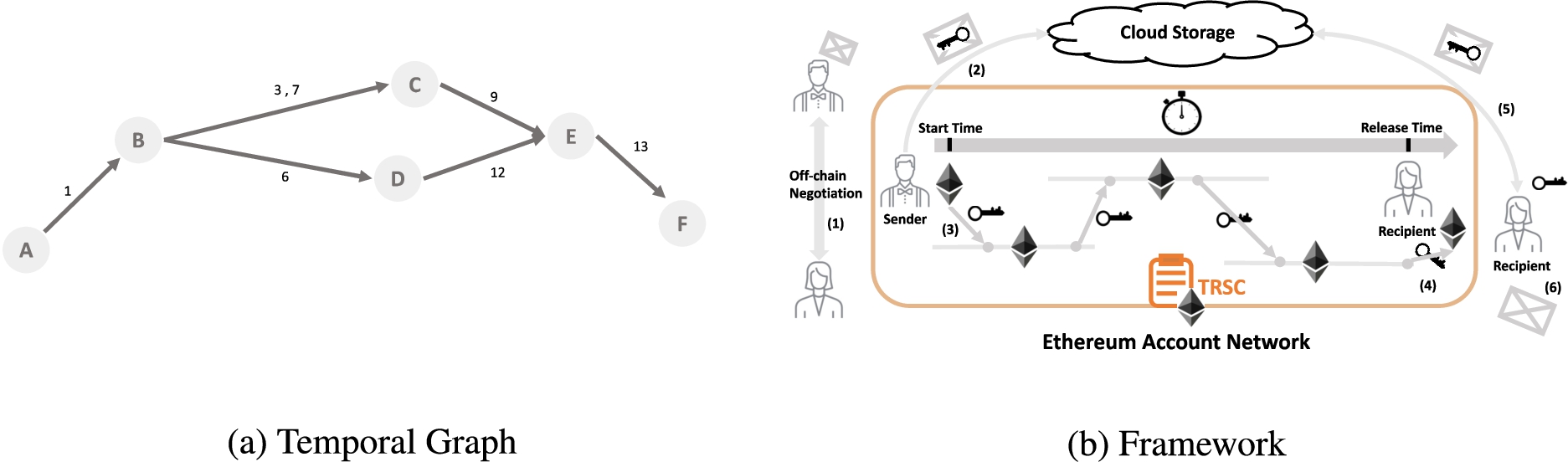
The framework of timed data release.
In this section, we introduce the fundamentals of temporal graph [13]. We formally capture our timed data release work by adopting such a graph. In particular, we consider directed temporal graphs. Let
In our work, we carefully adopt the path related properties in temporal graphs to investigate our framework. Several key notions are described as follows: In a temporal graph G, we define a temporal path
Background & motivation
In this section, we first introduce blockchain-based self-emerging data infrastructures. We then present the adversary models and discuss the limitations of existing solutions.
Timed-release of self-emerging data using Ethereum blockchain
There are four key components for supporting a timed-release service, namely Data Sender, Data Recipient, Cloud Storage, and Blockchain Infrastructure respectively. Without loss of generality, we denote multiple timed-release service requests as
Adversary model
Mixed adversarial environment
We consider three different types of peer accounts,2
In this paper, we use the terms peer and peer account interchangeably. We also note that a peer may represent an individual holding Ethereum account and not a miner node.
Every rational peer acts with economic rationality. Such a type of peer is driven by self-interest and only chooses to violate timed-release service protocol when doing so allows to earn a higher profit. Every malicious peer always maliciously launches attacks and deviates arbitrarily from the prescribed timed-release service in an attempt to violate security.
To concretely capture such a mixed adversarial environment, we assume that there always exists a malicious adversary M holding an EOA as well as a global view of our protocol to aggressively break normal operations of our timed-release service. Such an adversary may adopt two potential approaches to corrupt heterogeneous peers. One is bribery [23], where the rational peers are the chief victims. The other one is malicious peer injection, where M intentionally creates a set of peer accounts acting as the malicious peers and controls them to register themselves with the timed-release smart contract,

Post-facto attack examples.
We consider two concrete post-facto attacks in our framework. One is drop attack, which aims at destroying the data before the prescribed release time and results in a failing data release at the prescribed release time. Such an attack may be launched by M who controls one or more injected malicious peers engaging in the timed-release service. For example, in Case 1 of Fig. 2a, M controls the injected malicious peer
We generalize D as any data transmitted over the Ethereum account network. Here, D specifically refers to the secret key generated by the sender.
The other form of attack is the release-ahead attack. A successful release-ahead attack results in a premature release of the data D. It can be launched by M by corrupting a fraction of peers engaging in the timed-release service to get the data before the prescribed release time and disclose it. For example, in Fig. 2b Case 1, M may control
We present an example to illustrate the fully rational environment [23], described in Case 3 in Fig. 2a and Fig. 2b, in which the global-view adversary M also acts rationally. The incentive-only solution [23] can regulate each rational peer’s behavior based on the existence of Nash Equilibrium [30], and D will be normally released at
Uncertainty-aware reputation measure in timed data release
In this section, we introduce our proposed uncertainty-aware reputation measure. In our framework,
Inspired by the binary assessments of behaviors as well as the engagement within multiple requests, we borrow the ideas from Beta distribution [16] to measure the reputation of each engaged peer from an uncertainty perspective. Here, leveraging Beta distribution is natural. In the literature [16], when measuring reputation in cases involving binary assessment, Beta distribution has typically been adopted to represent probability distributions of binary events. Based on the Beta distribution, we propose a novel reputation measure for our framework next.
We start with the sketch of the Beta distribution, which is a two-parameter family of functions represented by α and β, defined as
Next, we detail the establishment of our reputation measure. We first define a behavior evaluator to reflect the resultant evaluations.
(Behavior Evaluator).
Let
The detailed criterion, such as what behaviors are treated as
(Counter Function).
For every If If If
Such definitions aim at quantifying the evaluation results for further usage. As an example, if
Honest Observer: We define an honest observer as the following function Malicious Observer: We define a malicious observer as the following function
In our design, as a special case where
Then, based on the definition of the observers, we focus on a specific peer
For a given peer
As an example, for the peer
(Uncertainty-aware Reputation Measure).
For all
With our proposed reputation measure (Equation (8)) in hand, we next uncover our basic reputation-aware timed data release design.
Attack-resilient timed data release design: A basic protocol
In this section, we demystify the detail of our reputation-aware timed-release service protocol. Specifically, on top of our uncertainty-aware reputation mechanism built in Section 4, we carefully design four tightly coupled subprotocols, namely
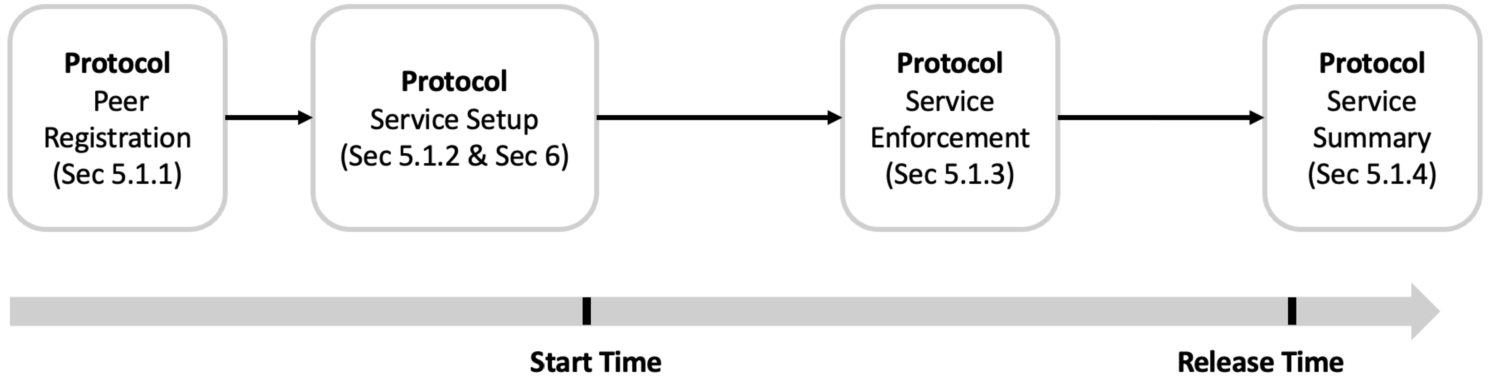
Life cycle of reputation-aware timed data release protocol.
We now describe the detailed design of our reputation-aware timed-release protocol.
Peer registration
Our basic protocols start peer registration protocol that aims at making any peer in the network get an opportunity to engage in our timed data release service. We detail our design as follows:
At any time, any voluntary peer After confirming the registration request from Followed by step 2, the information regarding
Service setup
Before initializing a new timed-release service, the sender
We formally quantify such likelihood with two distinct attack resilience metrics, namely drop attack resilience and release-ahead attack resilience respectively. With the help of our uncertainty-aware reputation measure
(Drop Attack Resilience).
The drop attack resilience of E, denoted as
Such a definition reflects that, to successfully launch the drop attack, the malicious adversary M must control at least one peer involved in the scheme E. Then, for the release-ahead attack resilience, we have
(Release-ahead Attack Resilience).
The release-ahead attack resilience of E, denoted as
In the above definition, by directly following the adversarial setting of [20,21,23], we only consider that the adversary M intends to pre-release the data at the start time. Since the scheme E is protected with the Onion Routing [32] scheme, an adversary must control all peers to prematurely release the data at the start time. We discuss this later in the Service Enforcement protocol.
Our peer recruitment for the timed-release service consists of multiple rounds. In each round of selection, the sender will take a time point as the input. By retrieving all the available registered peers whose working window covers the input time point in terms of

Peer recruitment example.
We illustrate our design approach using an example in Fig. 4a. In the example, there are totally 8 peers
For the reputation-unaware recruitment in Fig. 4b, in each round of selection, only the peer who has the longest working time is selected. The peers
After completing Service Setup, a timed-release service moves into execution. Service Enforcement takes charge of monitoring the correctness and timeliness of the executions after the data is released into the blockchain network. Moreover, with the help of the Service Enforcement protocol,
We denote
We stress that the above procedures work under the assumption that malicious peers only launch the drop attack or the release-ahead attack. In fact, there may be other scenarios that impact the evaluation results, such as bad reputation evaluations on
Service summary
There are two scenarios that trigger Service Summary:(1) A timed-release service is successfully finished. Under this scenario,
Taking into consideration the entire protocol, we would like to underscore the underlying philosophy of our design. In contrast to aiming to achieve immunity to any misbehavior, our focus lies in safeguarding the service by offering satisfactory service quality in terms of attack resilience. While the reputation measure, a key pillar in our design, cannot completely prevent misbehavior, it works in conjunction with peer recruitment to provide senders with valuable guidance regarding the service’s attack resilience. For example, if a sender anticipates a 95% drop attack resilience for their service, but the recruitment policy can only guarantee 75%, the sender may opt to decline the service and thereby reduce the risk of data loss during its execution. Conversely, without the support of the reputation measure, in an environment plagued by malicious adversaries, senders are compelled to adhere to the recruitment scheme, which may involve these adversaries. Unfortunately, this significantly increases the likelihood of failures in timed data release services.
Limitations of the basic reputation-aware peer recruitment
In comparison with the baseline peer recruitment policy, our proposed straightforward peer recruitment approach does offer a scheme providing a better attack-resilient metrics. Such a design, however, inevitably suffers from a limitation that it cannot fully make use of the peers’ working window distribution. Specifically, given a predetermined hand-off duration
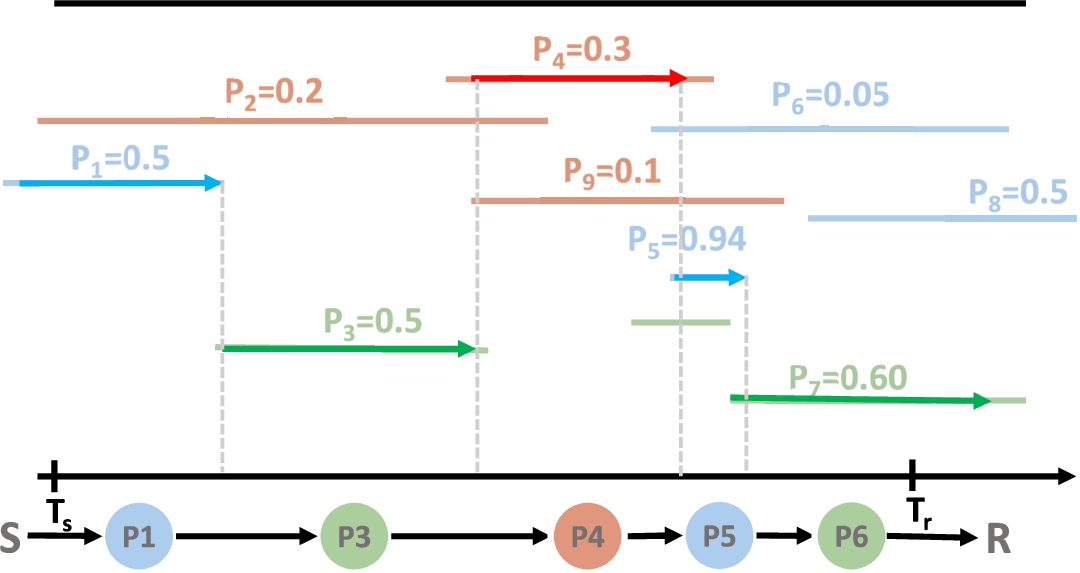
A higher release-ahead attack-resilient path.
In this section, we discuss the design of our blockchain-based timed data release by adopting the notion of temporal graphs. We emphasize that approaches proposed in this section serve as an alternative, showing higher attack resilience, to the reputation-aware peer recruitment in the service setup protocol.
Framework descriptions
We begin by first formally capturing our blockchain-based timed data release based on the discussion of temporal graphs in Section 2.3. Before an incoming timed data release service, S first constructs a temporal graph based on the information published on the smart contract
Given the notion of the temporal edge, together with the temporal path definition in Section 2, we next define the notion of Timed Data Release Service Path that seamlessly fits in our service requirement.
(Timed Data Release Service Path).
Given a constructed temporal graph Maximal Drop Attack-resilient Path: Maximal Release-ahead Attack-resilient Path:
Keeping such a definition in mind, to build an attack-resilient timed data release service, our peer recruitment procedure aims at exploring a service path consisting of a set of peers in
The minimal weight temporal path with the consideration of
Assume that there exists a temporal path
The maximal weight temporal path with the consideration of
Assume that there exists a path
We next formally investigate our timed data release service path finding problem.
Problem statement & analysis
Our timed data release service path finding problem is described as follows: Given a timed data release temporal graph
We address this problem by showing the existence of an optimal substructure described as follows:
Assume that
Since a timed data release service path may be maximal in drop attack resilience or release-ahead attack resilience, we only show the proof of the drop attack case here and the other is trivial.
We prove by contradicting. Now,
With such a property in hand, we propose a greedy algorithm for determining the service path.
We design an efficient one-pass algorithm to derive the timed data release service path. We follow the convention in [42] to represent
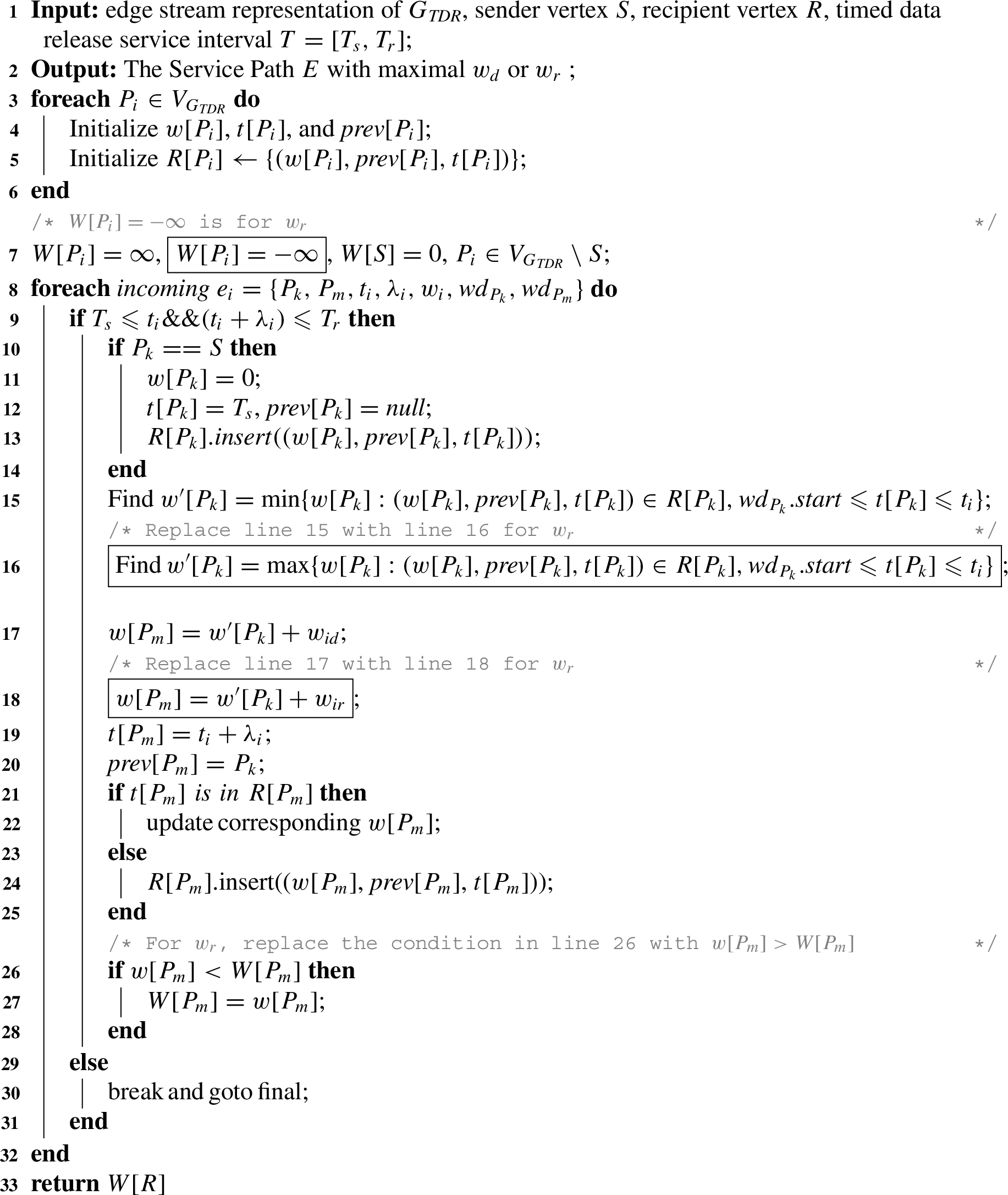
Timed data release service path finding
We take
Note that this proposed approach will be adopted by the sender before the start time of a service, which means that the entire procedure does not incur any on-chain operations that are expensive computationally.
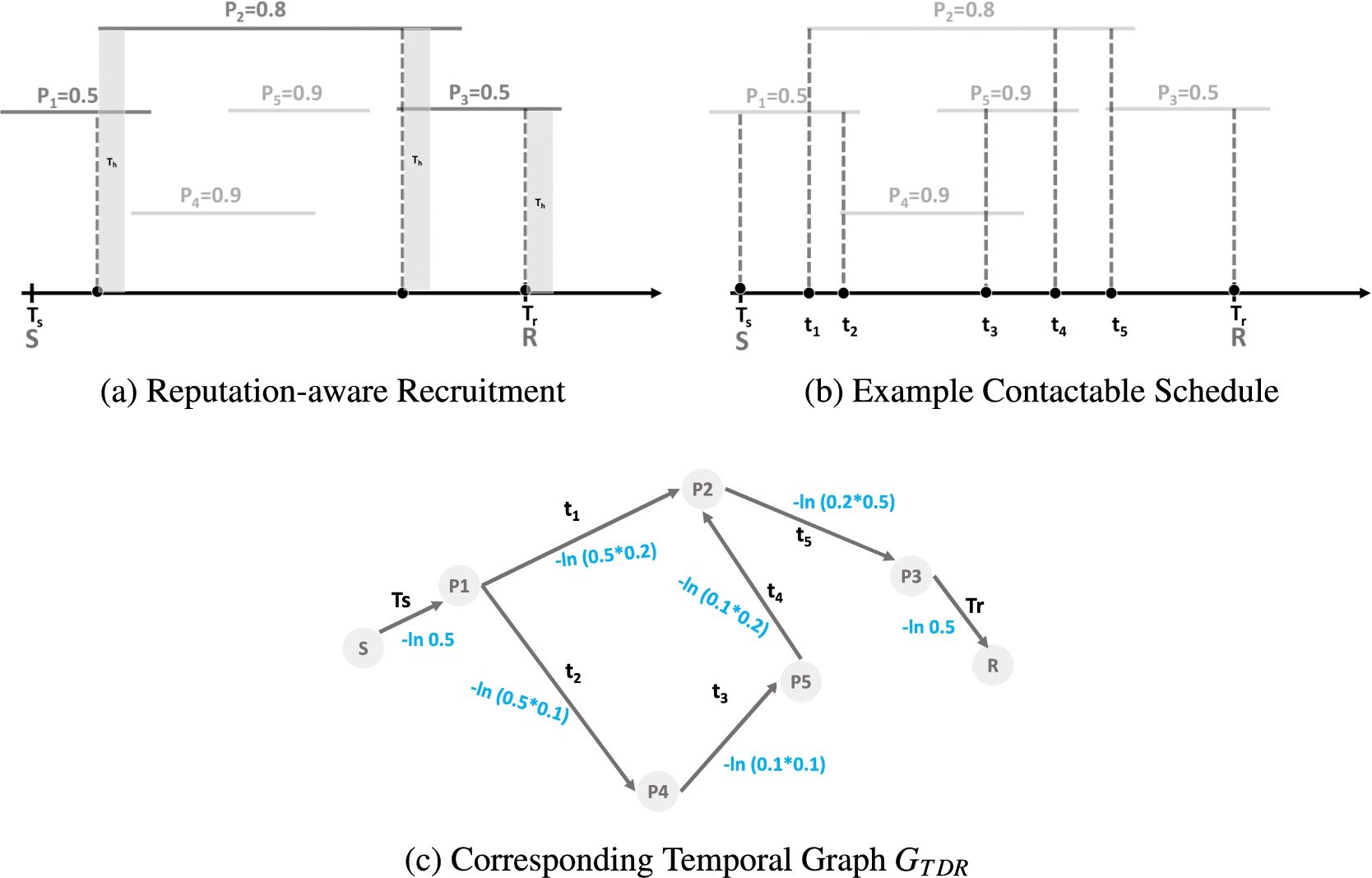
An working example of temporal graph-based design.
Then, for our temporal graph-based recruitment, in Fig. 6b, based on Algorithm 1, we can retrieve a timed data release service path from
In this section, we evaluate our proposed framework using our simulation environment as well on the real-world Ethereum test network. Specifically, in Section 7.1, we perform simulation studies to demonstrate the effectiveness and efficacy of our proposed basic protocol and the temporal graph-based peer recruitment algorithm. In Section 7.2, we provide a proof-of-concept implementation to demonstrate the practical applicability of our framework.
Simulation evaluations
The objective of our simulation evaluations are two-fold: first, with the help of our proposed reputation measure, we would like to show the benefits regarding the attack-resilient metrics in our proposed framework; second, in comparison with our basic protocols, we aim at showing and validating the optimal attack resilience from our temporal graph-based design.
Synthetic dataset
To the best of our knowledge, there is no existing public data set that reflects our application settings completely. We thus decide to synthesize a data set by closely following the settings of [23]. Detailed description on our synthetic data is elaborated as follows:
Experimental settings
Non Reputation-aware Peer Recruitment (
Basic Reputation-aware Peer Recruitment (
Temporal graph-based Peer Recruitment (
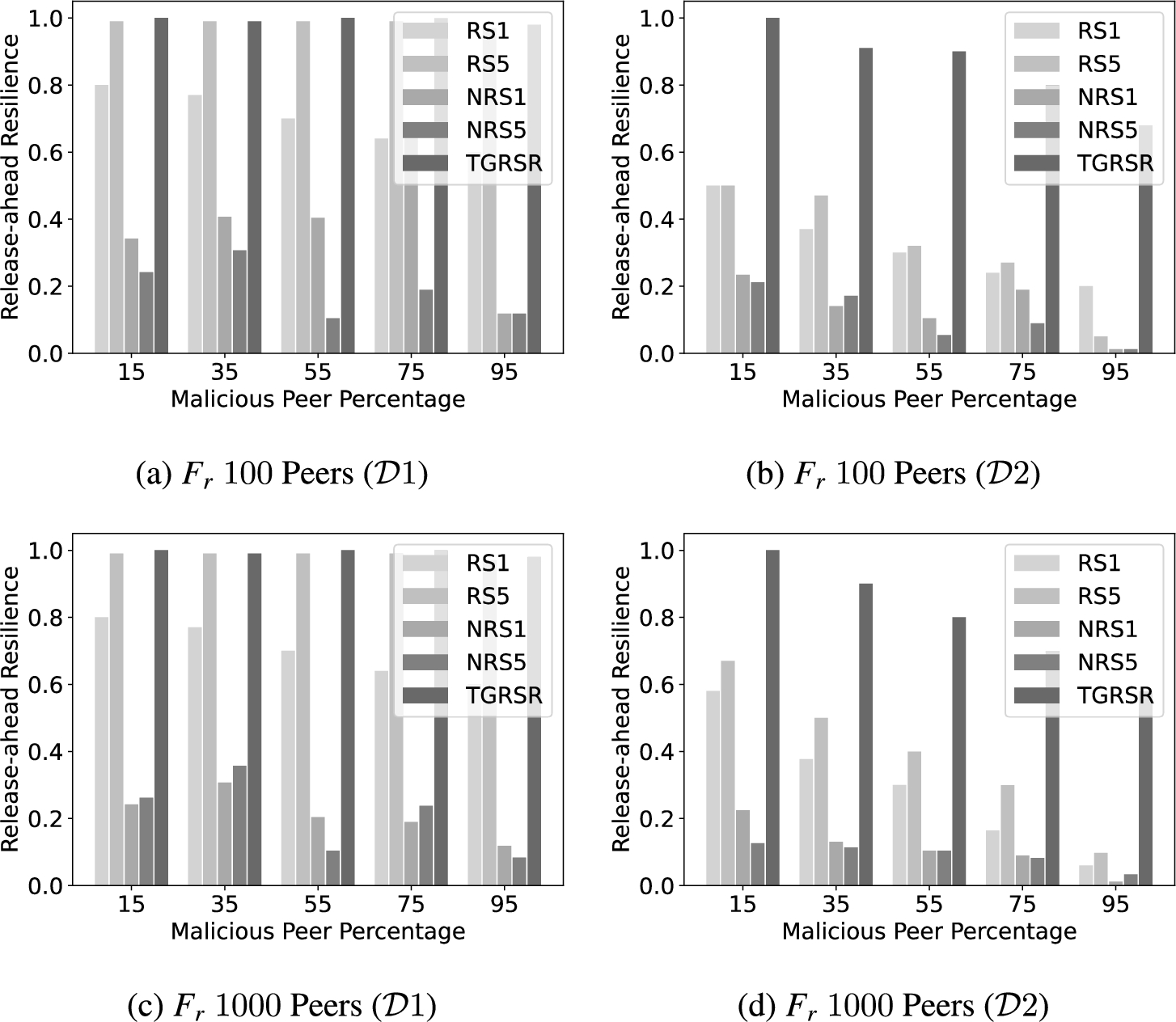
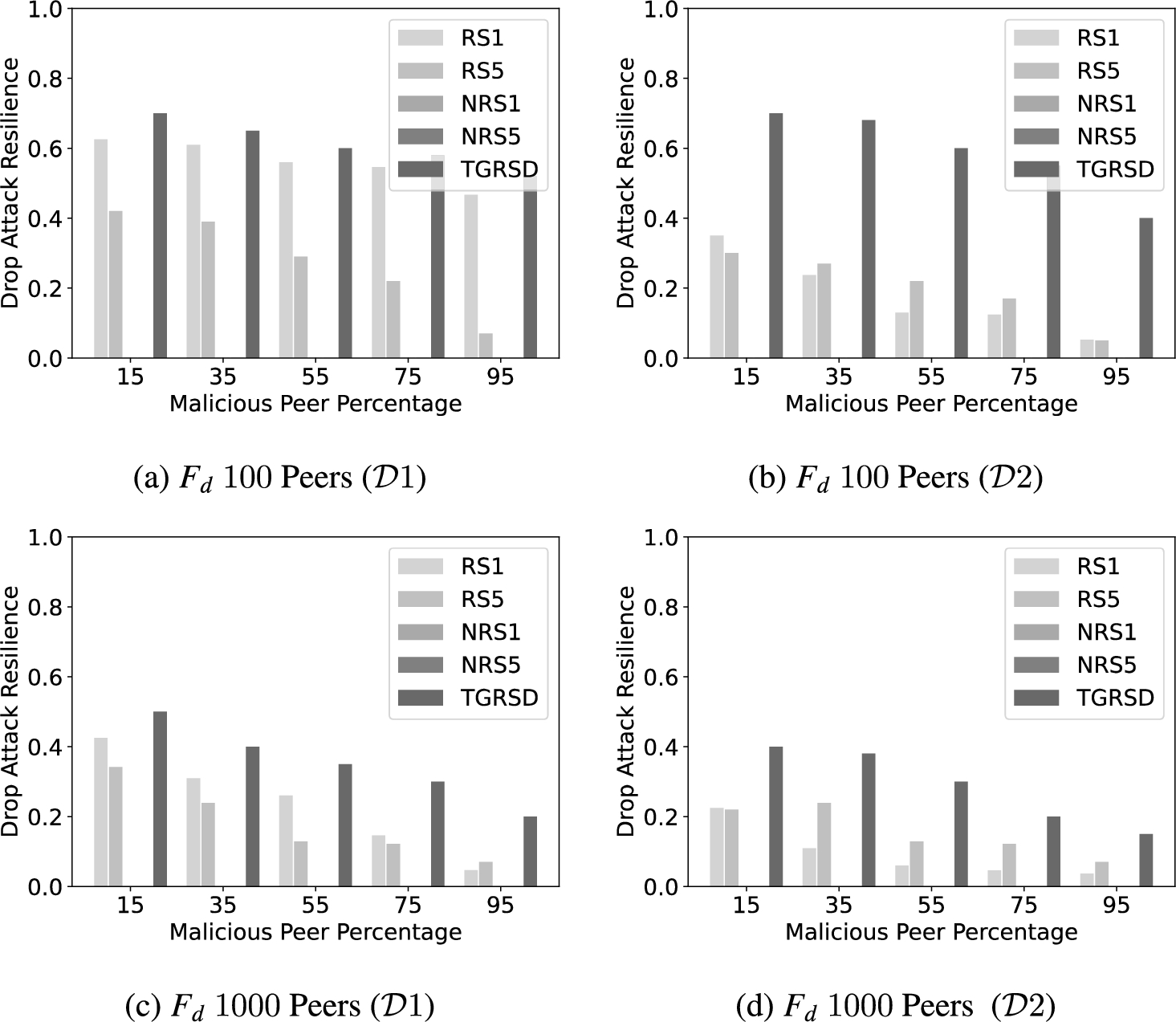
This suite of experiments demonstrates effectiveness of our proposed reputation-aware peer recruitment policy (RS1 and RS5) as well as the optimum of our proposed temporal graph-based ones (TGRSR/TGRSD) under various percentage of malicious peers. To offer a fine-grained analysis, we split our experiments into two sub-groups to observe resultant
In the second sub-group, we investigate
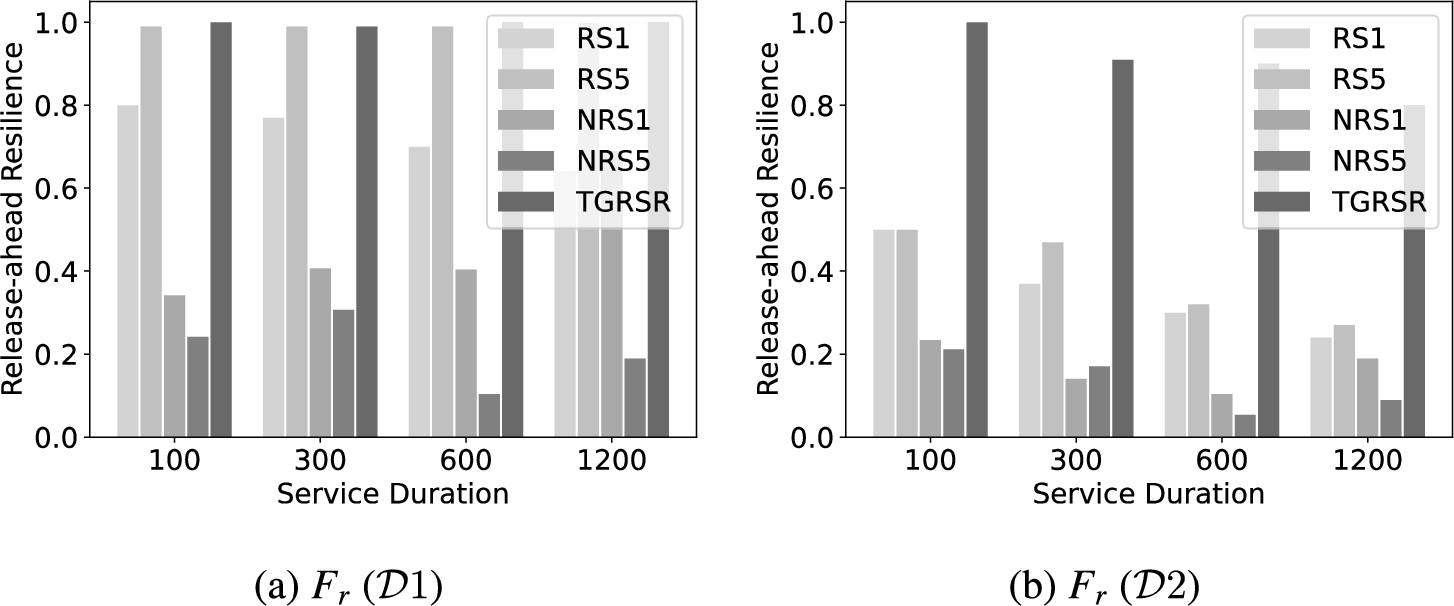
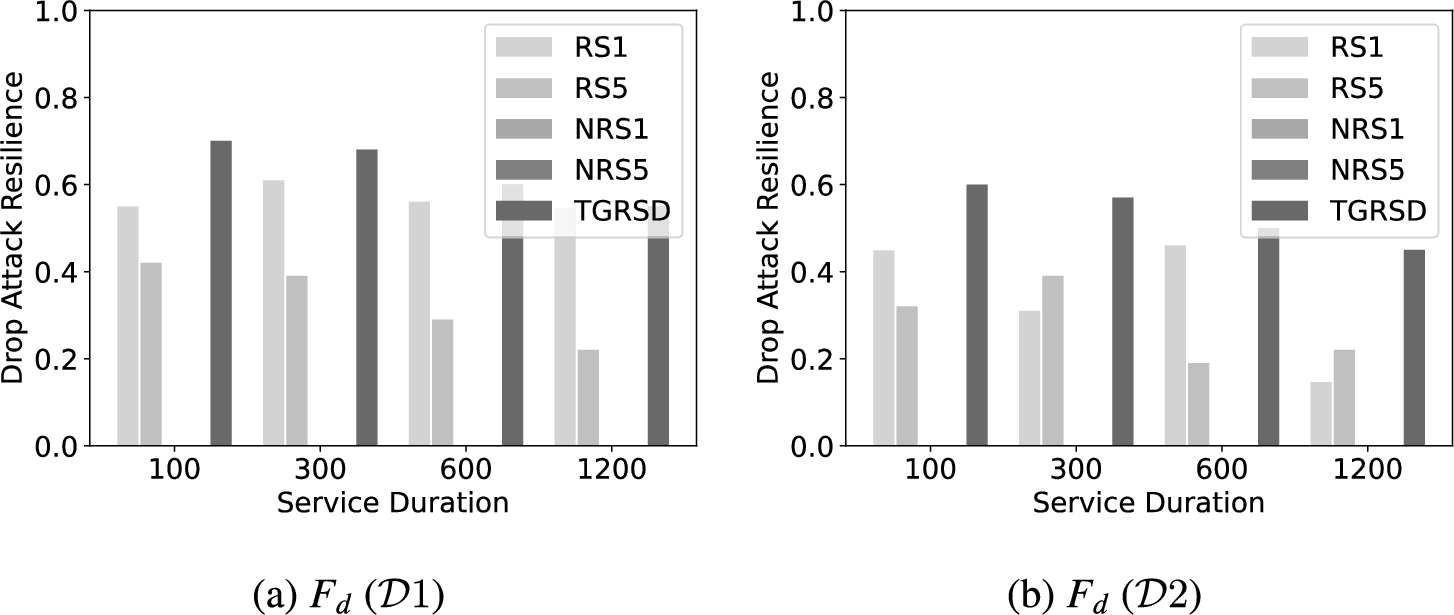
In Figs 9a, 9b, in the evaluation of
Smart contract implementation
In this section, we present our prototype implementation. We implement our smart contract in the official programming language Solidity [36]. We deploy our smart contract on Ethereum official test network Rinkeby [33] through the interface, Infura [14]. We use the data from our simulation studies as the input for on-chain validations. We have 7 selected peers in total that take charge of 1200 hour service. The results from Table 1 show the details of our implementations. The implementation of our reputation-aware timed-release protocol consist of five different modules.
Gas cost
Gas cost
From Table 1, we have two significant observations regarding the cost: first, there are four functions incurring relatively higher cost namely peerRegister(229669), senderSign(355534), setup(122682), and peerEvaluation(139363). Specifically, peerRegister is invoked by any peers, senderSign and setup are both invoked by a sender. peerRegister is invoked by the last peer in the routing scheme. We note that those four functions are only invoked once per request and therefore it is an one-time cost. Second, our proposed on-chain reputation mechanisms only incurs a modest gas cost from the summary module where peerEvaluation incurs 139363 and reputationUpdate incurs 48620.
Related work
Blockchain-based timed data release
With recent advancements in decentralized cryptocurrency solutions, adopting blockchains to develop decentralized timed data release has been gaining attention. There has been two major lines of work on this topic. The first line of work strives to provide effective cryptographic constructions. Specifically, Liu et al. [26–28] proposed to construct a variant of timed-lock encryption [34] by incorporating the notion of computational reference clocks, derived from Bitcoin with Witness Encryption [11]. Later, Ning et al. [31] constructed a provably-secure scheme using secret sharing [35] and Ethereum smart contracts [10]. Recent solution, named i-TiRE [2], offers a gas-efficient timed-encryption construction on Ethereum. Though the above-mentioned theoretical constructions provide provably-secure guarantee, their scalability is often limited and therefore, it is hard to directly adopt such schemes for practical blockchain-based timed data release. The second line of work on this topic has focused on developing practical alternative solutions for timed data release. Conretely, CTDRB [41] provides a controllable blockchain-based timed data release solution by carefully considering the tradeoff between data privacy and data control. By characterizing adversaries as economically rational, Li et al. [23] designed protocols in smart contracts as an extensive-form game with imperfect information [19]. Bacis et al. [1] developed an alternate construction with the help of Secure Multiparty Computation [7]. However, in a real-world decentralized network, there may be also malicious adversaries in addition to rational adversaries. To mitigate such an adversarial environment, our earlier work [39,40] has introduced the preliminary concepts and techniques related to uncertainty-aware reputation mechanisms for peer recruitment for tackling the mixed adversarial environment comprising of both rational as well as malicious adversaries.
Reputation measure in blockchains
The transparent nature of blockchains provides a suitable context to build reputation systems. There are several representative blockchain-based reputation mechanisms in the literature. Based on social norm, Li,et al. [25] build a reputation model on Ethereum-based crowdsourcing framework to regulate the worker’s behaviors. Zhou, et al [45] leverage a simple reputation measure to block the witnesses with misbehaviors in a blockchain-based witness model. RTChain [37] integrates a reputation system into the blockchains that focus on e-commerce to achieve transaction incentives and distributed consensus. RepuCoin [44] proposed proof-of-reputation in a permissionless blockchain to achieve a strong deterministic consensus which is robust to attacks. Unlike the reputation scheme developed in this work, these existing schemes primarily focus on blocking the participants with misbehaviors and are not designed to directly provide quantitative analysis to aid peer selection in mixed adversarial settings.
Temporal graph and applications
The notion of Temporal Graph [13] provides an effective approach for modeling real-world network activities such as social contact networks. Temporal Rechability, as a critical temporal-related property, measures whether two given vertices are reachable within a given time interval. There has been a group of work aiming at exploring minimum temporal path in a given temporal graph. One can treat such a path as a counterpart of shortest path in static graph but with more fine-grained awareness of temporal measure. Our proposed temporal graph-based timed data release construction is closely related to these problems. Xuan et al. [43] suggest three important types of temporal path, namely earliest-arrival time, foremost path, as well as shortest traversal path. They also propose efficient algorithms to derive such paths. Such algorithms, however, inevitably incur computational complexity because of their complicated graph representation. By observing such a limitation, the work, proposed by [42], addresses this by representing a temporal graph in an edge-stream manner. With their proposed streaming algorithms, the computational efficiency of the three types of paths is improved. However, directly adopting their designs for our optimal attack-resilient path is not feasible as the greedy techniques in [42] are based on temporal metrics and are not aware of our edge resilience metrics. In summary, prior techniques strive to boost computational efficiency within a constraint scope focusing on the three types of paths and as a result, they are not suitable as effective solutions in our timed data release design.
Conclusion
In this paper, we develop techniques to protect blockchain-based timed data release in mixed adversarial environments where both malicious adversaries and rational adversaries exist. An uncertainty-aware reputation measure is developed to quantitatively capture the behavior of peers engaging in timed release service. Based on the reputation measure, a novel reputation-aware timed-release protocol is designed to handle such mixed adversarial settings. First, an off-chain reputation-aware peer recruitment is performed by carefully considering the impact on attack resilience. Then, a suite of on-chain mechanisms are proposed to take charge of monitoring the states of the protocol and evaluate the behavior of each engaged peer. Our extensive simulations demonstrate the effectiveness of our proposed protocol. Compared with the existing solutions, the approach achieves significantly higher attack resilience. We develop a prototype of the proposed protocol using smart contracts and we deploy it on the Ethereum official test net, Rinkeby. The on-chain evaluations show that our protocol incurs only a moderate amount of gas cost and demonstrates its cost-effectiveness.
Footnotes
Acknowledgment
This material is based upon work supported by the National Science Foundation under Grant #2020071. Any opinions, findings, and conclusions or recommendations expressed in this material are those of the author(s) and do not necessarily reflect the views of the National Science Foundation.