



Abstract
The increased adoption of the Internet Protocol (IP) in ICSs has made these systems vulnerable to the same security risks that are present in traditional IT environments. The legacy nature of ICSs and their unique operational requirements make them vulnerable to security threats that are different from those in IT environments. In this paper, we describe a protocol, named ArpON, which is able to wipe out in quasi real time any ARP cache poisoning attempt, thus making it ineffective. Contrarily to solutions presented in the literature for contrasting ARP cache poisoning, ArpON incurs in low operational costs, is backward compatible, transparent to the ARP protocol and does not use any HW feature nor cryptography functionality. We also model and validate ArpON in the OMNET
Introduction
Industrial Control Systems (ICSs) form the critical infrastructure backbone, ensuring the seamless operation of essential facilities, ranging from power plants to water treatment facilities. These systems serve as the industrial counterpart to Information and Communication Technologies (ICTs), playing a pivotal role in monitoring and controlling diverse processes through Supervisory Control and Data Acquisition (SCADA) systems. Historically, ICS components were interlinked using distinct serial fieldbus protocols like Controller Area Network (CAN-bus), Modbus, PROFIBUS, and CC-Link. Originally conceived for localized tasks devoid of external connectivity, these protocols operated in isolation. However, as the Internet matured and corporate operations expanded geographically, a pressing need emerged for ICS devices to communicate with external systems. This integration offered cost efficiencies and enhanced convenience, enabling remote control and monitoring from multiple locations. Nevertheless, this convergence came at a price: the isolation that once shielded ICSs from external threats was eroded, necessitating a profound reassessment of system security. The watershed moment came with the discovery of the Stuxnet worm [34], catapulting the security of ICSs to the forefront of research institutions, government agencies, security industries, and media organizations.
The increasing integration of the Internet Protocol (IP) into ICSs has exposed these systems to a range of security risks akin to those encountered in conventional IT environments. This paradigm shift underscores the imperative for ICSs to fortify their security measures to ward off potential cyber threats capable of causing significant disruptions to the critical processes they oversee. Regrettably, the prevalence of legacy ICSs, coupled with their distinct operational requirements, renders them susceptible to security challenges that are unique to their industrial setting. Consequently, it becomes paramount to confront these security intricacies to uphold the dependable and secure operation of ICSs.
Within the scope of this research, our primary focus centers on addressing the security challenges inherent in the deployment of the Ethernet protocol in communication components of ICSs. Ethernet, a foundational element of the TCP/IP stack, serves as the linchpin for device connectivity within localized networks. However, the original iteration of Ethernet falls short of meeting the stringent real-time demands typical of ICS environments. This limitation has spurred the evolution of various adapted versions collectively referred to as “Industrial Ethernet” [4,17,22,27,63]. Furthermore, industrial networks may involve heterogeneous technologies and they are often hybrid networks involving both wired and wireless links. The latter ones are more convenient for ICSs as they avoid a clutter of cables crowding industrial plants, but they are also more prone to security issues due to their intrinsic unshielded nature. A number of protocols for wireless industrial networks are either compatible or based on Ethernet too, such as Siemens IWLAN [54]. Widely used wireless protocols such as WiFi are typically used in conjunction with the IEEE 802.2 standard as the Logical Link Control protocol, so as to interwork seamlessly with Ethernet and to be able to carry IP traffic in hybrid networks. Notably, despite these adaptations, certain fundamental elements of the Ethernet protocol, such as the Address Resolution Protocol (ARP), remain unchanged. While ARP excels in terms of efficiency, it harbors a widely acknowledged vulnerability known as “ARP poisoning”. This vulnerability opens the door for potential attackers to execute Man-in-the-Middle (MITM) attacks, a concern substantiated by a body of recent research studies detailing successful MITM exploits targeting ICS and SCADA systems [6,23,28,36]. As a consequence, attacks conducted exploiting the ARP poisoning vulnerability represent a menace worth of discussion for wireless networks (included industrial ones) as well [56–58].
Our study delves into the performance evaluation of our defensive solution known as ArpON within the context of a specific ICS network. While our protocol has gained widespread acceptance across industry devices and is now effectively the norm, this marks the first time it has been thoroughly analyzed in a scientific research paper. ArpON is purpose-built to thwart ARP poisoning attacks by swiftly detecting and mitigating such attacks in near real-time. It accomplishes this task without imposing substantial resource overhead and operates without necessitating specialized hardware or cryptographic support. One key advantage of ArpON lies in its full compliance with all iterations of the ARP protocol as stipulated in the relevant Request for Comments (RFCs) [14,15,45], thereby ensuring its seamless integration into Local Area Network (LAN) environments. This adaptability makes it a valuable addition to modern SCADA systems and extends its applicability to some Programmable Logic Controllers (PLCs), particularly those based on platforms like OpenPLC [42].
To ascertain the practicality of integrating ArpON into ICS environments, we constructed a model of it within the OMNET
This paper presents the following contributions:
Background
Distinctive challenges in industrial networks
Industrial networks diverge significantly from the classical Internet across several dimensions, profoundly influencing the prerequisites for the protocols in use. The array of connected devices can be numerous, necessitating robust scalability and minimal overhead in the adopted solutions. Additionally, a considerable portion of these devices may possess scarce resources, encompassing processing power, memory, and communication capabilities, which, once again, accentuates the preference for lightweight solutions. The devices themselves are highly specialized in executing specific tasks, making them inherently resistant to customizations beyond these tasks. Furthermore, the spectrum of devices extends beyond transmission technologies, as explored in Section 1, to encompass heterogeneous components, ranging from cloud-based servers to SCADA systems overseen by employees, as well as Remote Terminal Units (RTUs) and/or PLCs, responsible for managing actuators and monitoring sensors. Given this heterogeneity, solutions must be broadly applicable across all network technologies and system components, while also adhering to established standards. The intricacy inherent in ICS platforms mandates the adoption of autonomic solutions [51], equipped with the ability to self-heal in response to misbehavior, devoid of human intervention. Furthermore, when misbehavior is induced by security threats, the countermeasures must activate within a remarkably short time frame to safeguard the ICS platform. This challenge is exacerbated by devices that may lack the necessary resources or proficiency in swiftly executing complex tasks, including data encryption and machine learning.
Scheme in network communication
The Internet is a complex network comprising numerous LANs, each governed by its own set of protocols. These protocols, responsible for regulating the behavior of devices within a LAN, are situated within the Data Link Layer of the OSI model. In contrast, inter-network protocols like TCP/UDP and IP operate at the Network and Transport layers, as outlined in [5].
In this intricate ecosystem, two distinct addressing schemes come into play. Within the confines of a LAN, devices are uniquely identified by their 48-bit MAC (hardware) address. This MAC address, a permanent and manufacturer-assigned identifier, is embedded in the network interface card of each device. On the other hand, for communication across different LANs, a 32-bit IPv4 (network) address is employed. The allocation of IPv4 addresses can take one of two forms: either a network administrator manually assigns a static IP address, or a dynamic IP address is automatically assigned by a DHCP server, contingent on the specific network to which the device connects. Furthermore, devices also have the option to autonomously select a dynamic IPv4 address from the 169.254.0.0/16 range, as described in [15].
This intricate addressing system means that every device h connected to the Internet is uniquely identified by a paired set, denoted as
Address resolution protocol
The Address Resolution Protocol (ARP) is a data link layer protocol running on all devices of a LAN as well as on its routing elements. ARP main task is to learn the host’s MAC address associated to a certain IPv4 address. In order to perform such a task, every running instance of ARP maintains in the device’s memory a table containing the known mappings
Roughly speaking, ARP cache entries are either built through a static or a dynamic method. Static entries are manually added to the cache and never automatically removed, while dynamic entries are constructed as follows: consider two devices h and k on the same LAN. h needs to send a packet to k, but it only knows k’s IP address. To reach k in the local network, h must know k’s MAC address. First, h searches its own ARP cache for an entry
ARP also provides the option for a device to announce its IPv4 and MAC addresses upon boot or changes. This is useful, for example, when a device joins a LAN. Such an announcement, known as a gratuitous ARP message, is usually broadcast as an ARP request or an ARP reply. A gratuitous ARP sent as an ARP request is not intended to solicit a reply, but rather updates any cached entries for the sending device in the ARP tables of the packet receivers. This update is performed because of the implicit ARP assumption that all devices in a LAN are trustworthy.
ARP poisoning MITM attacks
The ARP protocol can be easily subverted by performing Man-in-the-Middle (MITM) attacks (see e.g. [10]), using a technique known as ARP poisoning or ARP spoofing, described in the following.
Let us consider three devices in a LAN x, w, z and their corresponding MAC and IP addresses
The goal of MITM attacks is to take over a communication session between two devices in order to intercept and view the information being exchanged between them. ARP poisoning is not difficult to obtain by leveraging some of the features of the ARP protocol. Here there are some methods adopted to perform a MITM attack:
A malicious user h can craft a gratuitous ARP message by inserting in the packet header the pair
A malicious user h can craft an ARP request by inserting in the packet header the pair
A malicious user h can craft an unsolicited ARP reply by inserting in the packet header the pair
In all cases, the ARP caches of the devices receiving the forged packets – and either being the packet destination or already having a cache entry for
Threat model
A Man-in-the-Middle (MITM) ARP poisoning attack represents a serious security threat within ICS networks. This threat model outlines the key elements of this attack and its potential impact on ICS environments. The adversary in this threat model is an individual or entity with malicious intent. They may possess varying degrees of technical expertise, ranging from basic networking knowledge to advanced hacking skills. In particular, in our context the attacker operates at the network level and they can perform the following operations:
The motivation behind the MITM ARP poisoning attack could include data interception, network disruption, or unauthorized control over ICS components. More technical details about the attack scenario are reported in Background Section 2.4.
ArpON protocol
This section introduces ArpON, the innovative protocol designed to detect and mitigate MITM attacks through ARP poisoning in near real-time.
Overview
ArpON is a solution designed to work in parallel with the standard ARP protocol. It utilizes the same message formats and does not require cryptography, making it compatible with legacy ARP implementations. In a LAN environment, devices that use either the traditional ARP or the “ARP + ArpON” solution can coexist. The latter devices will have their ARP caches protected from man-in-the-middle ARP poisoning attacks.
The core idea behind ArpON is to supervise ARP cache management to detect and recover from ARP poisoning attacks. This is achieved by relying on its own cache, which is separate from the ARP cache. ArpON works in user space and cooperates with the ARP protocol in the kernel to manage Ethernet interfaces. An instance of the ArpON daemon exists for each Ethernet interface. The overall architecture is depicted in Fig. 1.
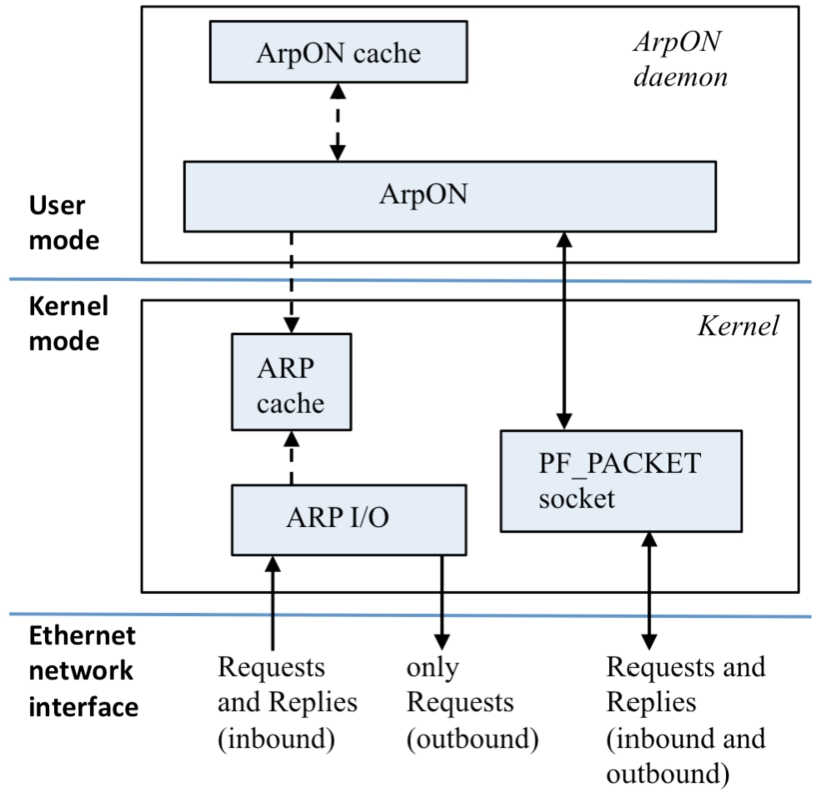
ArpON general architecture.
ArpON has the responsibility of overwriting the ARP cache based on its policies upon the reception of ARP messages. It tracks the outbound messages generated by the device in its cache, and classifies inbound messages that do not match previous outbound messages as “unsolicited.” This allows ArpON to detect ARP cache poisoning attacks such as ARP requests, unsolicited replies, or gratuitous messages.
At start-up, the ARP cache and ArpON cache are emptied, and the generation of ARP replies and creation of new ARP cache entries are disabled in the operating system (
By contrast, messages concerning either unknown static addresses or dynamic addresses are managed with the support of state information maintained in the ArpON cache (DARPI mode). Specifically, the information carried by potentially dangerous messages (see Section 2.4) is checked using the following verification procedure:  The value of
The verification procedure is used as follows: 
If a host x has to resolve the IPv4 address of the destination of a locally generated UDP message, similarly to the operations above, it records an entry for that IP in the ArpON cache.
These procedures aim at preventing ARP cache poisoning of devices. Consider a device k which receives an ARP message (request, gratuitous, or unsolicited reply) from h: in order to verify the information contained in the message, k broadcasts an ARP request for
Note, however, that the above protocol has a transient flaw which happens when a malicious device m anticipates h’s ARP reply, with a packet containing the
In our previous work, outlined in [11], we conducted a comprehensive analysis of both the ARP poisoning problem and the ArpON algorithm. In this subsection, we provide a concise summary of the key findings from [11]. Regarding the ARP poisoning problem, [11] furnishes a formal proof utilizing logical and algebraic formalisms, establishing the inherent challenge of preventing ARP cache poisoning within a network with one or more malicious attackers, especially in the absence of cryptography. In essence, the proof demonstrates that the only address resolution algorithm capable of thwarting ARP cache poisoning is a simplistic one, whereby, for each IP address, it maintains an undefined MAC address in the cache. While this algorithm ensures safety by never associating an incorrect MAC address, it renders network communication effectively impossible. The crux of this proof hinges on the absence of a reliable authenticator, which could verify the source of a message.
Regarding the ArpON algorithm, when implemented across hosts within a LAN, it can be formally represented as an infinite-state reactive parameterized system. In [11], we employed model checking, utilizing the MCMT tool [24], to model both the actions performed by a process employing the algorithm and potential malicious behaviors exhibited by attackers. The safety property, verified by MCMT for any number of hosts within the LAN, guarantees that in the event of cache poisoning (as indicated by the aforementioned impossibility result), ArpON consistently and successfully eradicates it. This property aligns with the concept of ‘self-healing’ seen in industrial networks, as discussed in Section 2. Furthermore, the performance evaluation discussed in Section 5 reveals that the elimination of poisonings occurs in less than a millisecond, ensuring the requisite “promptness”, another crucial requirement in the context of industrial networks, as elaborated in Section 2.
Implementation aspects
The ARP protocol, as defined in the network kernel subsystem, consists of two main components: (1) ARP cache management and (2) I/O ARP functions (Fig. 1). The first component updates the ARP cache based on ARP network traffic observations, while the second component manages ARP packet transmission operations for each network interface present in the host machine.
For ArpON to function properly, it needs to handle the ARP requests/replies associated with a specific network interface and apply its own policies rules. To achieve this, ArpON modifies the
By setting
For each network interface, the system spawns an ArpON instance (e.g., a user space application) that is responsible for sending and receiving ARP packets. Specifically, ArpON exclusively handles the sending of ARP reply packets when a request ARP packet has been received. The ARP cache is handled by both ArpON and the network kernel subsystem, based on the detection rules previously described.
It is important to note that ArpON only modifies some network function calls related to interception and leaves all other operations to the kernel subsystem. This design allows for easy deployment of ArpON on a vast majority of operating systems and permits coexistence with other detection systems without requiring complex authentication among network devices.
Experimental evaluation
To assess the applicability of ArpON within ICSs, we conduct a comprehensive evaluation, scrutinizing both its effectiveness and efficiency when compared to the original ARP protocol. Our evaluation specifically emphasizes the unique characteristics and requisites of industrial networks, as detailed in Section 2.1. There are two potential approaches for conducting this evaluation:
We commence by delineating the network topologies considered and the protocol stack employed in our models. Subsequently, we delve into the examination of various attack scenarios. We introduce a set of performance metrics, aligning with the specific attributes of industrial networks outlined in Section 2.1. Finally, we provide a comprehensive analysis of the simulation results.
Network and protocols configuration
The network under consideration consists of N identical hosts connected in a network. Looking at the documentation of industrial network equipment producers [19,20,66,67], three topologies are usually adopted: star, ring, or linear. The star topology (that may also represent wireless networks with thin devices communicating via an access point) has the central point usually settled in the PLC; it supplies greater reliability, resilience, real time timeliness and lower probability of bottlenecks than the other two schemes. The linear topology, for cabled networks, is less expensive than the star but less performant under the other aspects. The ring topology is intermediate between the other two.
In most of the presented simulations, a star topology was considered with a central switch; but we also considered a linear topology in some experiments. Each host implements a protocol stack consisting of UDP, IP, ARP, and Fast Ethernet (100 Mbps) at the MAC layer. Each host runs two applications as it may act as both a source and destination for UDP messages.
The simulations run for 3600 seconds of simulated time with varying number of hosts N, ranging from 10 to 150. As a source, a host generates a new message with an exponential distribution with a parameter of 15 s, and selects a random destination according to a uniform distribution. If an ARP cache entry for the message destination does not exist, then either ARP or ArpON is run to find out the correspondence. During the initialization phase, each node uploads the correct correspondence between IP and MAC addresses of all nodes from a file. This information is used throughout the simulation for measurement purposes only, so as to detect the start and end of poisonings (if a correct information overwrites a poisoned one). In this phase, one of the nodes is randomly selected to act as the attacker for the entire simulation. All updates to the ARP caches are performed either according to ARP (modeled as per RFC 826 [45]) or ArpON. Each ARP cache entry has a lifetime of 120 seconds before it expires.
Table 1 summarises the configuration parameters used in the simulations.
Configuration parameters used in the simulations
Configuration parameters used in the simulations
As explained in Section 2.4, there are two ways to perform ARP cache poisoning:
poisoning a single cache, by crafting either an ARP request or reply containing a mistaken correspondence poisoning the caches of all hosts already owning a correspondence for
The latter way can trivially achieve a much more disruptive effect than the former, increasing with time and the consequent population of the ARP tables.
Both ways were modeled in the simulated networks, for both ARP and ArpON. In each simulation, just one strategy of attack is considered in order not to mix up their effects and ease the interpretation of the results. In case (a), a full MITM attack is perpetrated via unsolicited replies: the two selected hosts are simultaneously victims and targets, and the attacker generates an unsolicited reply to both of them; renewals are as well sent to both nodes at the same time. In case (b), a half MITM attack is perpetrated via gratuitous announces.
When an attack is started, the attacker randomly extracts – with uniform distribution – and records the identity of both a target node and a victim, and repeats the attack every 110 s so as to avoid the removal of the poisoned information from the ARP cache of the target(s); this is repeated three times, thus achieving an attempted attack duration of around 6–7 minutes. When an attack finishes, the attacker schedules the time to start the next attack according to an exponential distribution with variable parameter τ. For both kinds of attacks, the aggressiveness of the attacker was determined by changing the value of τ in between 60 s and 900 s. The value
It is worth to notice that the identity of node y is not relevant, be it either the attacker itself or a further node different from both victims and targets. In the simulation, y is the attacker itself. Though, there is no loss of generality with this setting, as ArpON is – unavoidably – blind to the identities of the involved nodes; it simply reacts to the insertion of a non-requested correspondence into the cache. In the experiments, we were just interested in observing whether and how long a poisoning occurs.
Performance indexes
The performance evaluation centers around the unique characteristics of industrial networks detailed in Section 2.1. Specifically, we scrutinize three critical aspects:
As far as
As far as
As far as
As far as the
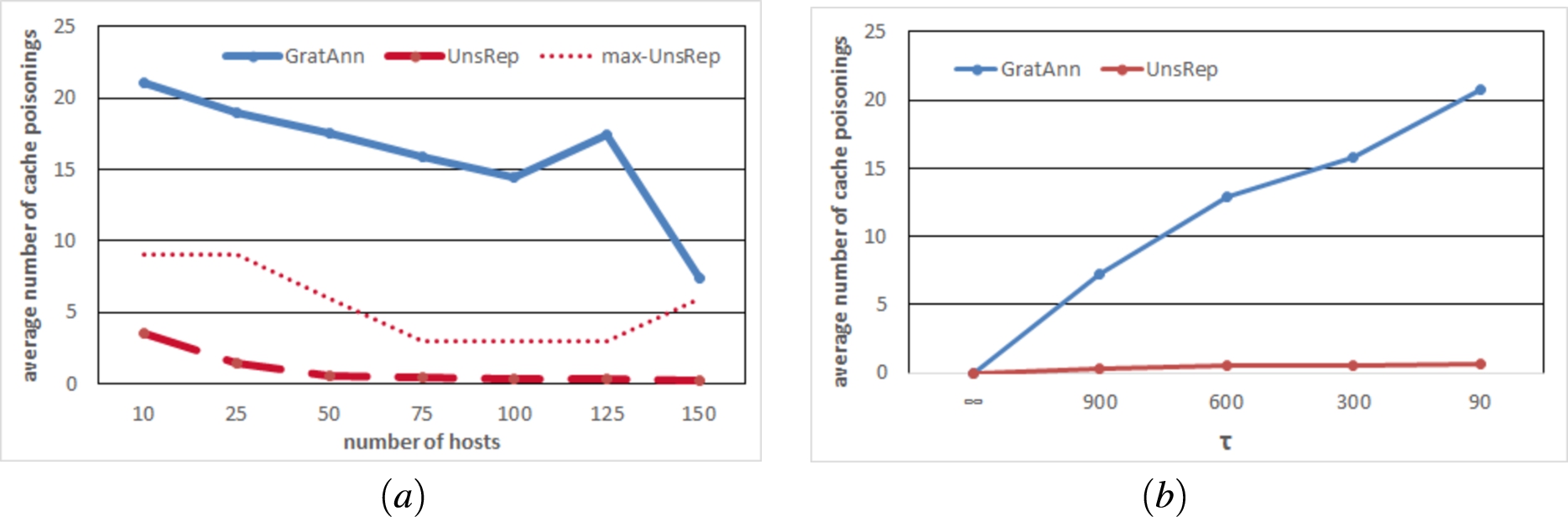
ARP: average number of cache poisoning suffered by a host (a) with variable number of hosts and
As far as ArpON is concerned, in the performed simulations
Three renewals of the same attack are counted as 3 poisonings, of roughly 2 minutes each.
In Fig. 3(a), the percentage of targets poisoned by a gratuitous announce is shown in a sample case (125 hosts and
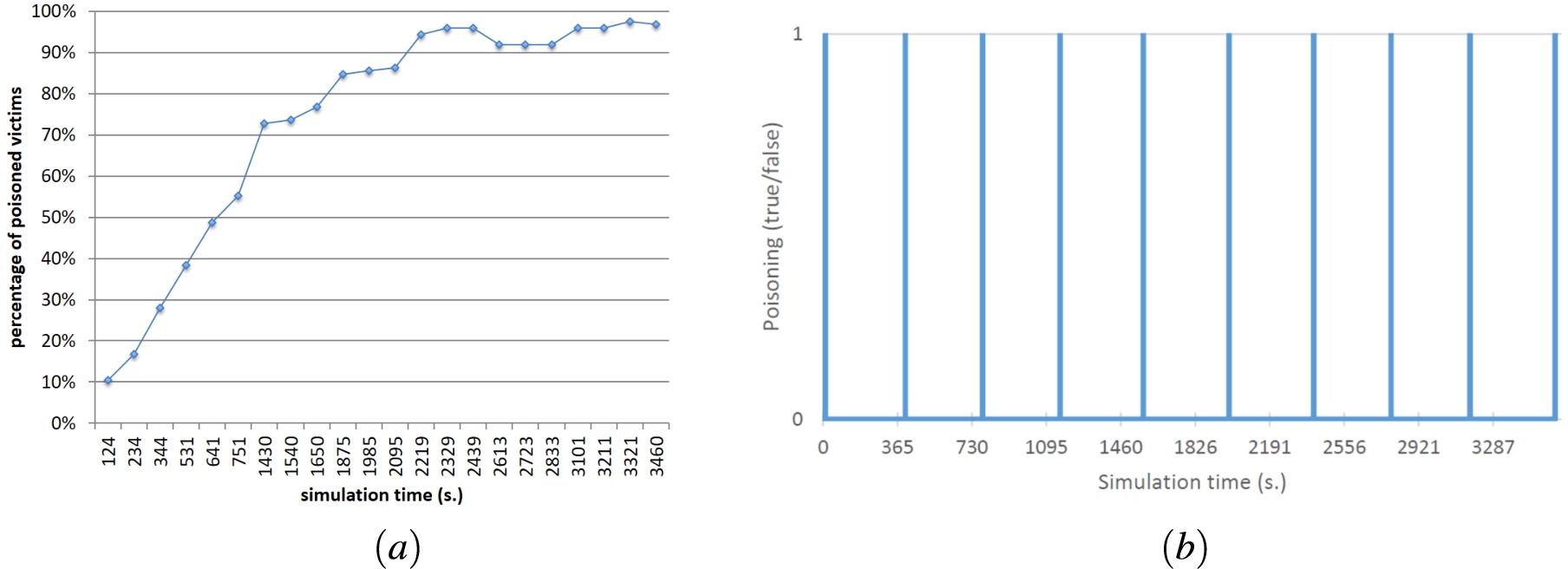
(a) ARP: percentage of hosts poisoned via gratuitous announces, in case of 125 hosts in the LAN and
In the case of attacks carried out with unsolicited replies, the lowest average for fixed τ and
In Section 4, the possibility of a transient flaw of ArpON has been explained. In order to be able to evaluate the impact of this event, an ad-hoc setting was reproduced, emulating a

(a) Zoom of a single poisoning event with ArpON in the emulated linear topology. (b) Cumulative distribution of the duration of ARP cache poisoning in case of unsolicited replies, with variable τ and 75 hosts.
As anticipated in Section 4.2 and formally proved in [11], ArpON is able to remove cache poisonings and self-heal. In Fig. 4(a), a zoom of a particular attack affecting ArpON hosts in the emulated linear topology shows that the observed cache poisonings last 0.10548 ms, which account for the difference in transmission times of a packet of around 50 bytes along links with the considered heterogeneous bit rates. Since ARP cache poisoning is removed in less than milliseconds, the capability of an attacker of stealing sensitive information in the meantime is limited to a very large extent.
By contrast, standard ARP is not able to remove poisonings, thus paving the way to attacks that can last a long time and therefore potentially cause severe damage to the infrastructure. In case of full MITM attacks perpetrated using unsolicited replies, Fig. 4(b) shows the cumulative distribution of the duration of the poisonings that affected ARP caches, in case of 75 hosts in the LAN and variable τ. The graph shows that 60–80% of the poisonings are resolved before the expiration of the cache entry, due to the reception of an ARP message from the victim of the poisoning, which generates a UDP message and broadcasts a request trying to resolve the IP address of the message destination. In average, these poisonings last 38.99 s (five orders of magnitude more than with ArpON); all the UDP traffic addressed to the victim and generated by the target in the meanwhile is actually intercepted by the attacker. Moreover, 20–40% of the attacks last more than or equal to 120 s; they correspond to either attacks successfully renewed by the attacker, or to entries removed only when the target generates a UDP message for the victim after the cache entry expiration, invalidates the entry, and generates a new request to refresh the entry. The average duration of those poisonings equals 224.1 s.
Figure 5(a) reports a similar behaviour in case of unsolicited replies,
A similar behavior is observed with attacks perpetrated via gratuitous announces (Fig. 5(b)). In this case, all measures are averaged over a greater number of affected nodes, which as a consequence (i) lowers the result for short poisonings removed by several nodes at a time when the victim of the attack generates a UDP message, and its request to resolve the message destination IP address arrives to the (multiple) poisoned hosts; while (ii) increases the result in case of poisonings not removed by multiple nodes. In fact, the difference between the two values is magnified with respect to the previous cases: short poisonings last 36.9 s in average, while long poisonings last 232.2 s.
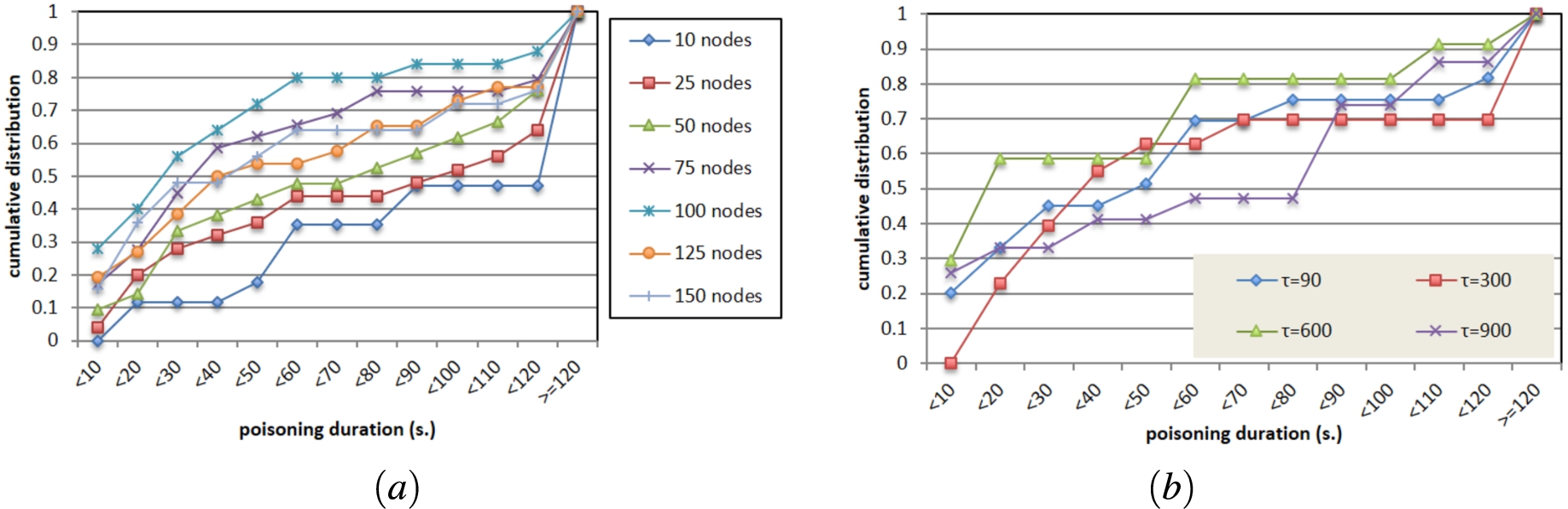
(a) Cumulative distribution of the duration of ARP cache poisoning in case of full MITM attack via unsolicited replies with
Number of sent ARP replies for both protocols, with
Communication overhead. Since the choice of both UDP message sources and destinations is uniform, the need of resolving IP addresses is evenly distributed across nodes, and for each host the number of sent ARP requests and replies is always almost equal.
In case of full MITM perpetrated through unsolicited replies, load balancing is also observed among the nodes with both protocols. Table 2 shows – for both protocols and for both attacked and non-attacked hosts – the average number of replies sent by a node throughout the simulation, the standard deviation σ, the max and min values, the range (difference between max and min), and the interquartile range (IQR). These indexes prove the scarce variability among hosts. In all cases, 6 pairs of nodes were involved in the attacks. Yet, ArpON generates more traffic since every potentially dangerous message – be it actually poisoned or not – raises a verification. The indexes do not differ too much when considering the number of sent requests, nor – for what we just said – when changing τ.
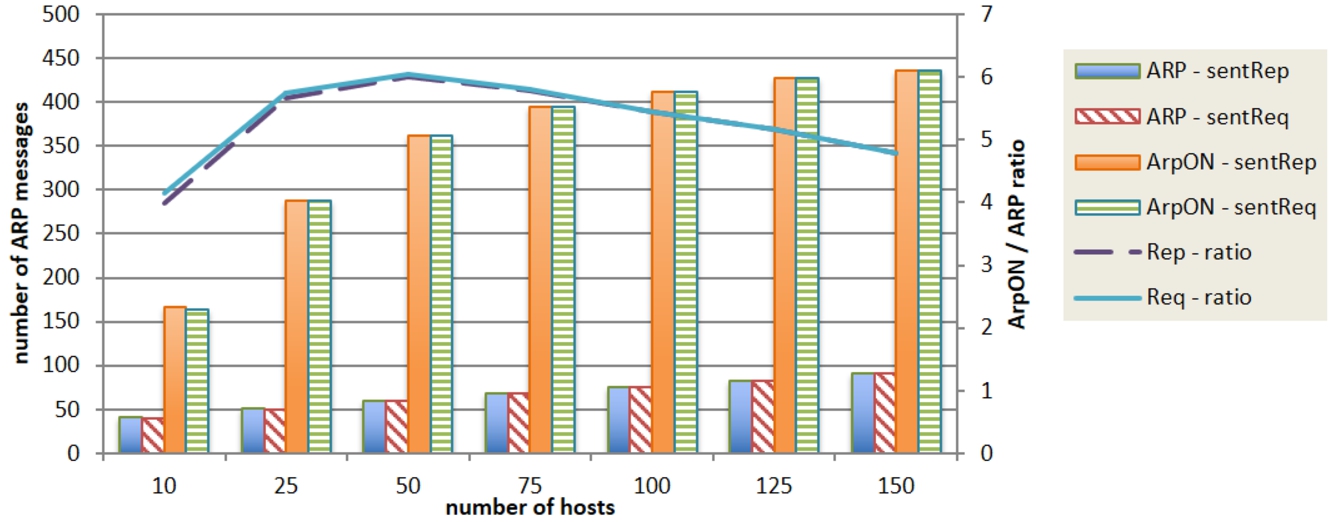
Average number of both sent replies and requests for both ARP and ArpON, with variable number of nodes and full MITM attack via unsolicited replies and
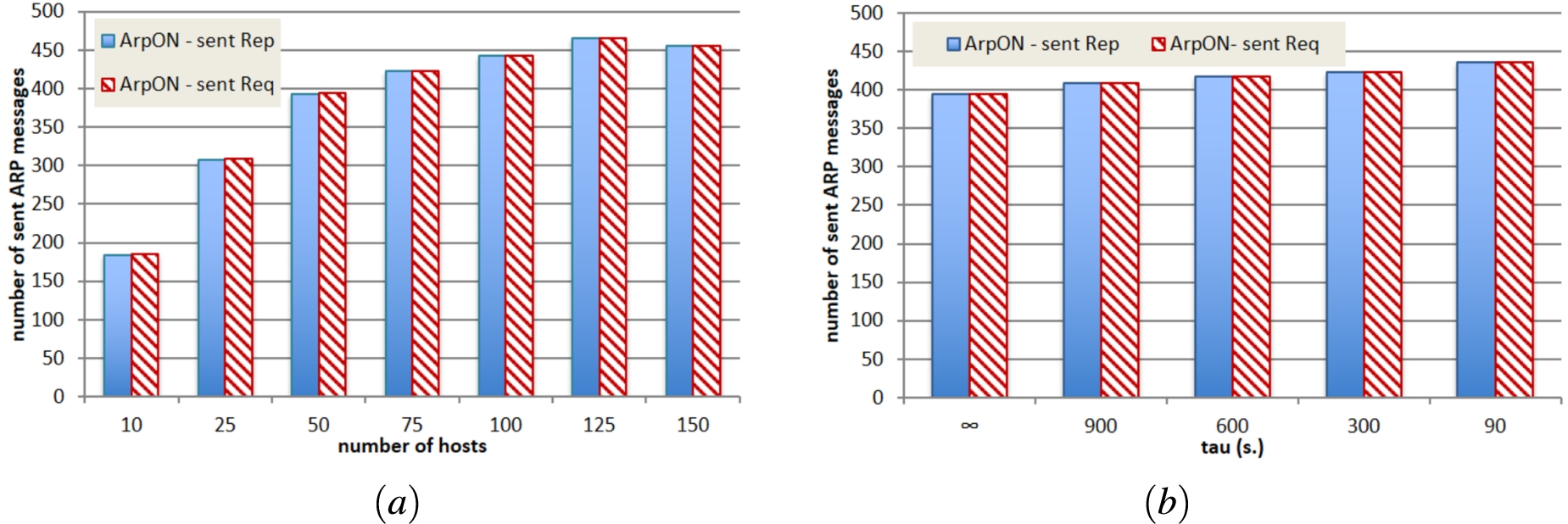
Number of both sent requests and replies for ArpON, in case of attacks perpetrated using gratuitous announces, (a) with variable number of hosts and
By contrast, the performance is affected by the variable number of hosts, as each host can generate UDP messages that may raise an address resolution. In Fig. 6, the number of both sent requests and sent replies is shown for both protocols, in case of full MITM attacks via unsolicited replies and
Things change when malicious gratuitous announces are sent. While the behavior of ARP obviously stays comparable, the fact that gratuitous announces simultaneously try to poison the ARP cache of several hosts, and all of them broadcast verification requests to avoid this event, make ArpON performance depend on both the number of hosts (Fig. 7(a)) and the arrival of messages, which is more frequent for more frequent attacks (lower τ, Fig. 7(b)). The generated traffic for the highest frequency of attack is 10.6% greater than without any attack. Moreover, the generation of ARP messages is unfairly distributed on nodes, differently from the previous case, as shown in Table 3: the hosts chosen as victims (6 in our simulations) generate
Number of sent ARP replies for both protocols, with
Memory and computation overhead in the switch / PLC. As a consequence of the higher traffic generated by ArpON, the central switch of the star topology – which often is also the PLC of the industrial network – might become a bottleneck. Moreover, as every message in ArpON is broadcast, the switch replicates it to all its interfaces. In Fig. 8, the length of the queue associated to a switch interface is shown along simulation time, in case of attacks via gratuitous announces with
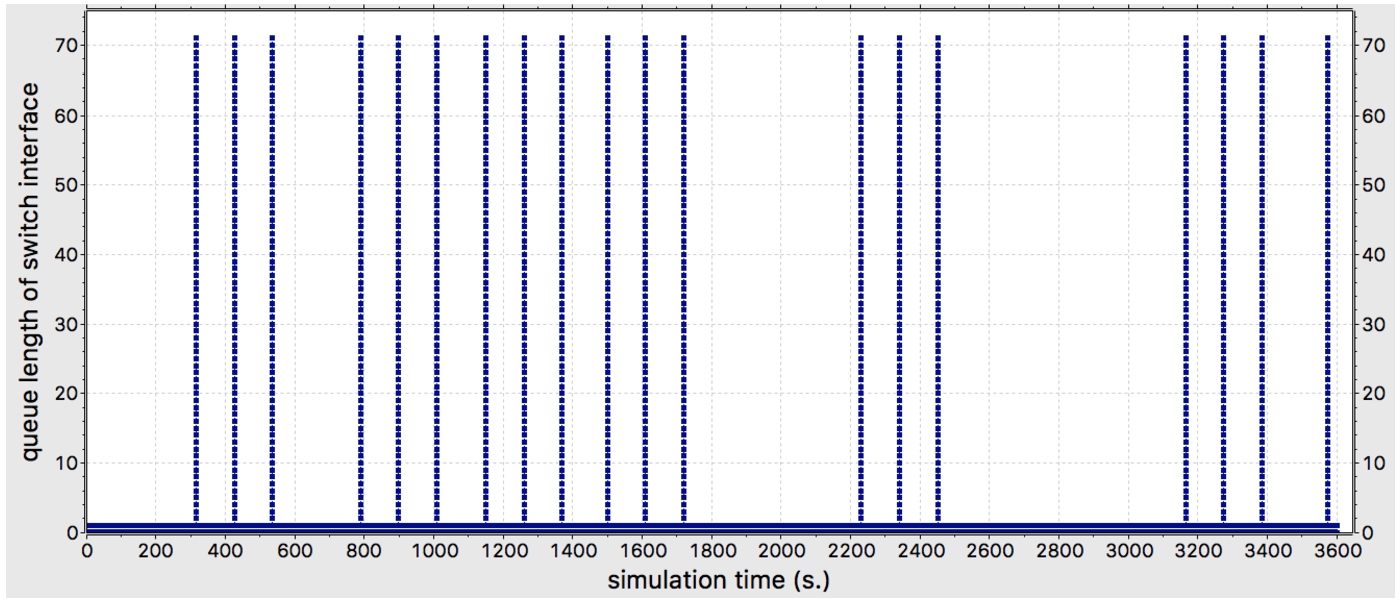
Length of the queue associated to a switch interface, along time.
Actually, in the considered schemes the switch never experiences overload. In Fig. 9(a), the amount of traffic either received or sent by the switch, averaged on all its interfaces, is shown in case of attacks perpetrated via gratuitous announces,
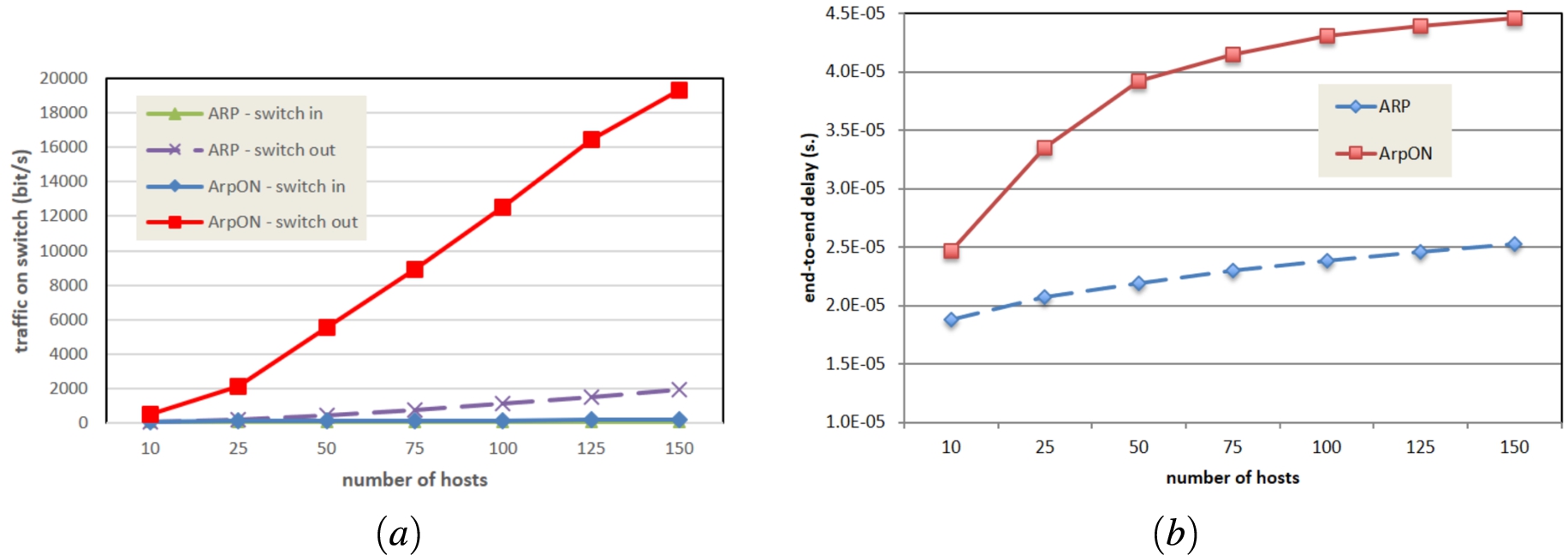
(a) Amount of traffic in the switch for both ARP and ArpON; (b) End-to-end delay for both ARP and ArpON, with variable number of nodes,
Switch performance with ArpON, in case of 75 hosts, and gratuitous announces attack with variable τ
The queue length and the amount of traffic is almost constant with ARP when varying τ for fixed number of nodes, for both unsolicited replies and gratuitous announces: the average length of the switch queues is always slightly lower than 0.5 with ARP. With the analyzed values of τ, this also holds with ArpON when unsolicited replies are generated, indicating that queues are emptied before the next attack occurs. In case of gratuitous announces, the queues grow but not dramatically, as shown in Table 4 where all results are averaged over all the switch interfaces.
Despite the higher amount of traffic generated by ArpON compared to ARP, message latency is not affected and therefore neither is the timeliness of the industrial network communications. Figure 9(b) shows the end-to-end latency, measured as time elapsed from the generation of a UDP message requiring an address resolution till its transmission when the resolution as been accomplished; results refer to a variable number of hosts in the LAN,
Related work
Numerous defensive mechanisms have been put forth in the literature to counter cache poisoning attacks, primarily falling into two categories: (1) static and (2) dynamic.
Static approaches, as exemplified in works such as [1] and [31], prove to be effective by relying on predetermined, unalterable entries in the ARP cache. These entries, immune to updates via ARP replies, can solely be modified through manual intervention by the system administrator. Nonetheless, this method faces scalability challenges, particularly in networks with a substantial number of hosts, such as those found in industrial environments. In such cases, the manual insertion of entries on each host or device becomes impractical.
Another well-established static defense method is known as “Port Security” [50]. This technique leverages features present in many modern network devices, allowing them to recognize and authorize only a single MAC address on a specific physical port. While this protection can prove effective against certain attack vectors, it may fall short in countering specific variants of ARP poisoning attacks where the attacker abstains from spoofing their own MAC address, opting instead to poison the ARP caches of two targets. Consequently, such defensive mechanisms may exhibit inefficacy in these scenarios. However, ArpON addresses this limitation by implementing cache entry validation through a stateful prevention protocol, thereby enhancing its capability to thwart these types of attacks.
Additional defenses that deviate from relying solely on ARP behavior are integrated into Intrusion Detection Systems (IDSs) [25,40] and personal firewalls [48]. These protective mechanisms operate by continuously monitoring network traffic and typically notify the user when an ARP cache entry undergoes alteration. Although such systems can offer value in specific scenarios, they often place the ultimate decision-making responsibility on the user, who may lack awareness of intricate network security issues, resulting in suboptimal responses to potential threats.
In the realm of dynamic defenses, proactive mechanisms aim to identify irregularities gleaned from protocol observations. Solutions like Arpwatch [35] and ARPalert [7] are examples of such tools designed to mitigate ARP poisoning attacks. However, a notable limitation of these approaches is their inability to preemptively prevent attacks. This becomes particularly critical in expansive networks, where an abundance of false positives can overwhelm network administrators, necessitating the arduous task of sifting through numerous messages to distinguish genuine threats from false alarms [43]. In stark contrast, ArpON sets itself apart by operating without the need for pre-configurations or manual intervention, effectively thwarting ARP spoofing attacks. This unique feature renders it highly suitable for large-scale networks, including those housing devices with minimal or no user interaction, such as sensors within industrial infrastructures.
Alternative solutions harness kernel patches and network traffic monitoring to bolster their defenses. For instance, Anticap [9] adopts a strategy that refrains from updating the ARP cache when an ARP reply carries a MAC address diverging from the one already stored for a given IP. It further triggers a kernel alert to notify of potential ARP cache poisoning attempts. Notably, this approach contrasts with ARP specifications, as it discards legitimate gratuitous ARP messages. In contrast, Antidote [60] offers a more intricate defense mechanism. Upon receiving a new ARP reply indicating a change in a <IP, MAC> pair, it endeavors to ascertain whether the previous MAC address remains active. If the prior MAC address responds to the query, the update is rejected, and the new MAC address is blacklisted. However, it is worth noting that Antidote’s susceptibility to MAC address spoofing could allow a host to coerce another host into blacklisting a target. Finally, in [64], a solution featuring two distinct queues – one for requested addresses and the other for received replies – is proposed. This system discards ARP replies if the corresponding request was never dispatched (absent from the queue). Additionally, in the received queue, replies with IP addresses already associated with different MAC addresses are also rejected, enhancing security through rigorous address validation.
All these solutions share a common limitation, as anticipated in Section 4.1: if a malicious ARP reply arrives before the legitimate one, as can happen in a real request scenario, the target’s cache may inadvertently store the incorrect reply, allowing the attack to succeed. This situation essentially creates a race condition, with the attacker and victim vying to influence the cache contents. When the initial ARP request is broadcast, both the victim and the attacker receive the message. The party that responds first gains control until the cache entry expires. Moreover, the attacker can employ a tactic involving the spoofing of an ICMP echo request message, swiftly followed by a counterfeit ARP reply. When the target, denoted as t, receives the ICMP echo request, it triggers an ARP request. However, the spurious ARP reply is already present in its received packet queue, causing t to accept it as a valid response. Cisco switches introduced a security feature called Dynamic ARP Inspection [16], utilizing a local pairing table established through DHCP snooping to identify and block invalid
XArp [68] stands as a robust defense mechanism offering highly adaptable ARP spoofing detection capabilities. It incorporates both active and passive techniques to identify potential hackers within the network. However, a drawback of this method lies in its reliance on continuous traffic monitoring, leading to a substantial computational overhead. In contrast, ArpON operates more efficiently, as it merely intercepts ARP update packets rather than continuously scrutinizing the entirety of network traffic, making it a less resource-intensive and more streamlined solution
S-ARP [12] and TARP [37] adopt asymmetric cryptography and an Authoritative Key Distributor to establish the authenticity of ARP messages. TARP [37] introduces a signed attestation, attaching addresses to a public key or ticket, and digitally signs messages at the sender’s end, thereby thwarting attempts to inject spoofed information. Nevertheless, implementing key management at the data link layer can be intricate, and S-ARP’s incompatibility with legacy code due to a divergent packet format from the ARP-Packet format defined in [45] adds to its challenges. Conversely, Arpsec [61] relies on Trusted Platform Module (TPM) attestation to ensure trust in remote hosts. However, this system necessitates both TPM hardware features on each host and robust key management support, features that may be absent in ICSs and embedded systems characterized by limited computational resources. As highlighted earlier, ArpON operates independently of these features, rendering it a suitable choice for safeguarding platforms where such capabilities may be lacking.
Nam et al. introduced an advanced ARP detection mechanism known as MR-ARP [39], which offers protection against ARP poisoning Man-in-the-Middle (MITM) attacks through a voting-based approach. When ARP request or reply messages contain a MAC address mismatched with the one recorded in the ARP cache for a specific IP address, MR-ARP solicits neighboring nodes to cast votes in favor of the new IP address, facilitating the determination of the corresponding MAC address. However, the effectiveness of this voting mechanism relies on the condition that the voting traffic rates among the responsive nodes are nearly identical. This requirement may not hold true in wireless networks due to traffic rate adaptations influenced by signal-to-noise ratio (SNR), specifically auto rate fallback (ARF). In contrast, our proposed approach operates independently of the underlying data-transmitting medium, making it a versatile solution applicable across various network configurations.
Recent studies have explored the potential of harnessing machine learning (ML) techniques for the detection of ARP poisoning attacks, as evidenced in works like [8,30,33]. This approach can yield commendable accuracy performance contingent upon the selected ML algorithm. However, its practical implementation on real devices may entail significant computational overhead, as observed with CPU utilization reaching 97% in [3]. Furthermore, the detection latency in such ML-based solutions can extend to the order of tens of milliseconds, as demonstrated by detection times within 63 ms in [3]. Consequently, these solutions may not be viable for resource-constrained industrial devices and may fall short in meeting the stringent latency requirements of Industry 4.0 communications. In contrast, our proposed solution excels in swiftly addressing ARP poisoning, with removal occurring in less than a millisecond when prevention measures are not in place.
Classical attacks, including ARP spoofing, are emerging as growing concerns with the deployment of novel infrastructures that embrace IoT and Industry 4.0 paradigms [13,29,47]. While the literature has seen several works dedicated to addressing the vulnerabilities of SCADA systems [18,21,49], traditional remedies such as cryptography [13,59,62] and IDSs [32,44,46] have been proposed. For instance, in [41], an IDS was implemented on an edge node (sensor) within an ICS infrastructure, successfully detecting ARP poisonings but not preventing them. However, this approach incurred a significant increase in latency, tripling the latency while reducing throughput to less than one-sixth with the IDS. In contrast, the solution presented in this work imposes minimal overhead and performance degradation on the communication network. Moreover, it effectively prevents and rectifies ARP cache poisonings, all without the need for human intervention.
This recent paper [38] shows a comprehensive exploration of ARP spoofing attacks and related research is undertaken. The article introduces an effective method based on the ICMP protocol to identify malicious hosts involved in ARP spoofing attacks. This technique involves the collection and analysis of ARP packets, followed by the injection of ICMP echo request packets to detect malicious hosts based on their response packets. Importantly, this method operates without disrupting the normal network operations of other hosts and can even identify the true address mappings during an attack. However, the associated increase in bandwidth costs renders this approach impractical for ICS networks.
Within the realm of SDN, various innovative solutions have emerged. For example in [26], a novel ARP enhancement is introduced to thwart MITM attacks, even in both wired and wireless LAN environments. The study employs computer simulations to showcase the exceptional performance of this proposed method. This research emphasizes the potential for enhancing overall network security through the incorporation of SDN, highlighting the importance of considering an SDN-based security strategy and conducting a thorough analysis of security factors.
Additionally, the paper [52] evaluates the existing security landscape and outlines strategies for enhancing it using SDN technology. Furthermore, [53] conducts a performance analysis of SDN using the Mininet emulator, where the centralized controller makes routing decisions while switches handle packet forwarding. The benefits of SDN, particularly in addressing ARP spoofing and ARP cache poisoning attacks commonly found in LAN networks, are emphasized in [2], underlining how SDN can mitigate these issues without requiring extensive modifications to the network. Despite such interesting results, the suitability of SDN for ICS depends on factors such as network size, criticality of operations, and specific security and performance requirements that cannot be always satisfied.
Security analysis

HARPI-mode dynamic defense against a MITM attack.
To assess the effectiveness of our approach, we utilize the widely recognized penetration test suite [55], referred to as
Figure 10 visually illustrates the response of ArpON in the HARPI mode when subjected to an attack. The network configuration comprises two hosts: machine A (IP: 10.0.1.1, MAC: 58:ac:78:88:1a:bb) and machine B (IP: 10.0.10.1, MAC: 90:94:e4:7e:f4:59), an attacker-host C (IP: 10.0.0.10, MAC: d4:be:d9:fe:8b:45), and a default gateway D (IP: 10.0.10.254, MAC: c8:f7:33:dd:8b:c9) serving as the gateway to the Internet. Machines A and B are equipped with ArpON configured in HARPI mode. Specifically, machine A has statically inserted the address of machine D into its ARP cache, treating the address of machine B as dynamic. Subsequently, it initiates the execution of ArpON, as evidenced by the following log:

The same operations are performed by machine B that runs ArpON in HARPI mode.

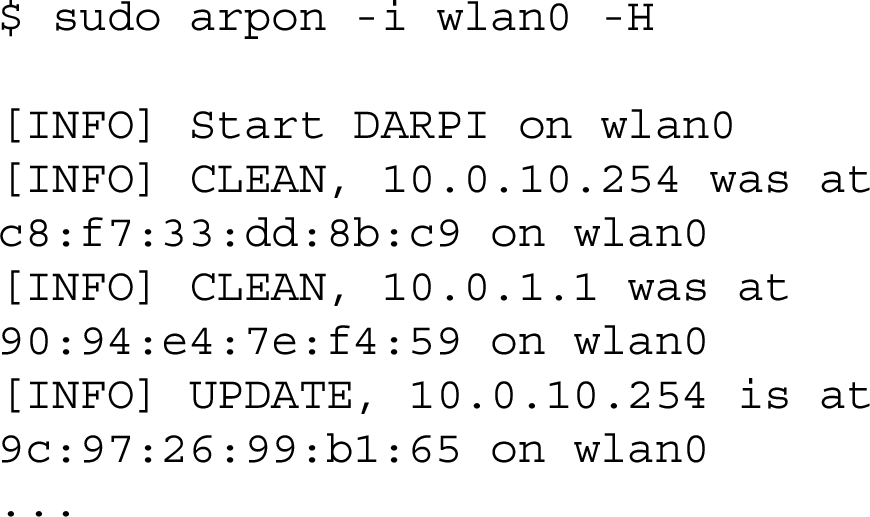
Subsequently, the attacker host (machine C) initiates a full-duplex MITM attack to intercept both communication channels: A-C-B and B-C-A.2
Various publicly available tools can be employed for this attack; in our case, we utilize
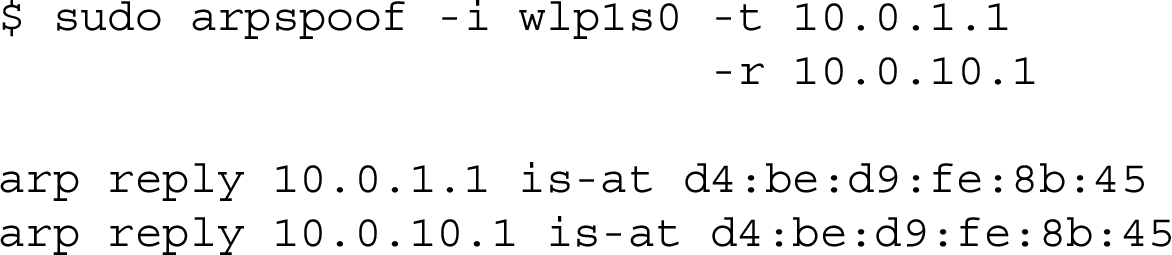
The attack initiates the generation of two ARP reply packets directed towards 10.0.1.1 and 10.0.10.1, intended to update the ARP cache of the victim hosts, as depicted in Fig. 10. Upon receiving the ARP reply packet from machine A, ArpON takes control and follows the protocol outlined in Section 4.
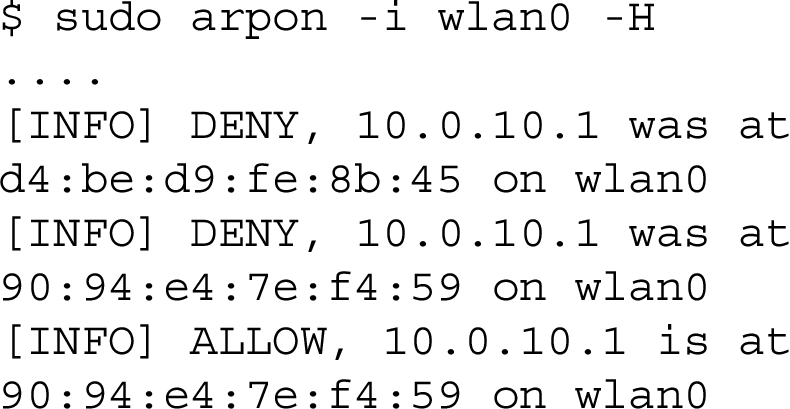
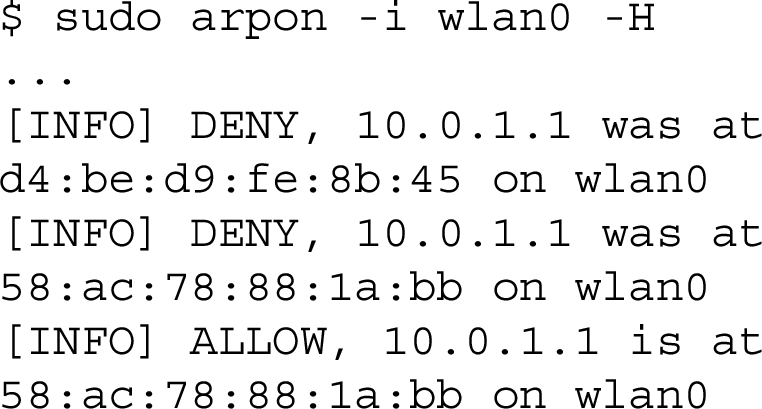
To elaborate further, if the ArpON cache is found to be empty (as is the case here), host A dispatches an ARP request to 10.0.10.1. It then removes the corresponding entry from the ARP cache (utilizing the
Finally, both machines receive ARP reply packets. At this juncture, with the ArpON cache containing an entry associated with the sender’s address, ArpON removes the entry from the ArpON cache and records the new association between MAC address and IP address in the ARP cache (utilizing the
In our research, we confront the persistent challenge of ARP cache poisoning attacks within Industry 4.0 Ethernet networks, a longstanding threat that persists due to the gradual transition to all-IPv6 networks and the expanding adoption of Industry 4.0 applications employing variations of the Ethernet protocol. To address this issue, we introduce ArpON, an innovative suite of protocols designed to seamlessly integrate with traditional ARP implementations while circumventing the need for costly or impractical cryptographic techniques. We rigorously assess ArpON’s performance through extensive simulations conducted across diverse scenarios. Our findings reveal that ArpON effectively mitigates ARP poisoning attacks with a high degree of success. In the rare instances where attacks manage to breach the defenses, ArpON swiftly rectifies ARP cache poisoning in less than a millisecond. This achievement comes with a reasonable uptick in host and network device loads, all without compromising network latency – a pivotal factor in the context of industrial networks. As part of our future endeavors, we aim to implement a prototype of ArpON tailored for PLCs and delve deeper into exploring potential security challenges that may impact industrial Ethernet protocols.
Footnotes
Acknowledgment
This work was supported in part by Spoke 08 – Risk Management & Governance and Spoke 10 – Data Governance and Protection of Project “SEcurity and RIghts in the CyberSpace – SERICS” (PE00000014) under the National Recovery and Resilience Plan MUR Program funded by the European Union – NextGenerationEU.