



Abstract
This paper proposes a criterion with which to differentiate classes of service on the basis of an available bandwidth metric. As the service classes are differentiated in terms of their available bandwidth values, the difference between neighboring classes must be proportional to the square of the available bandwidth of the current class. This statement is equivalent to saying that the difference in packet delay between neighboring service classes is constant. The ratios connecting minimum delay, network jitter and packet proportion are derived for different classes. Experiments carried out using an NS-2 network simulator illustrate the efficiency of the proposed criterion.
Introduction
The importance of Quality of Service (QoS) [12] in modern computer networks is increasing year by year, with the throughputs of telecommunication channels and the quota of interactive traffic that is dramatically sensible to the parameters of a data transfer environment both constantly growing. Modern Internet technology offers services that provide different priorities to transmitted traffic, as well as transportation for a wide range of applications. For the maintenance of such multiservice traffic, ISPs must carefully manage the backup and distribution of network resources in order to provide a guaranteed level of service. For end-users, the cost of this service depends on the QoS level provided. Therefore, facilitating the achievement of the required QoS is a viable and significant field of investigation in network technology science.
In order to meet the required QoS, various different service models have been developed. For example, the differentiated services (DiffServ) model is based on the division of outgoing data flow into classes of service sub-flows. In contrast, the integrated services model implies the reservation of resources required for network connection in some client applications.
Unfortunately, the question of differentiating service levels into different classes is not yet resolved at the theoretical level. Indeed, the main regularities of traffic management on the basis of which a criterion for differentiating IP traffic network service classes could be formulated are not defined. In this paper we search for such regularities based on a method for estimating available bandwidth and the delay distribution function.
In solving this problem, requirements will be formed with which to distinguish between different classes of service, expressed in terms of constraints on the delay of packet delivery. Such a criterion can be found by estimating the available channel bandwidth, with the difference in packet delay for traffic belonging to two neighboring classes always remaining constant.
The earliest available bandwidth estimation techniques [8,14] have a number of disadvantages. In particular, they suggest the utilization of bilateral measurements for which a special utility must be installed at both ends of the network route. It should be noted that most utilities implemented on the basis of these techniques are characterized by low stability.
No method for estimating available bandwidth based on delay measurement has yet been proposed [5] for packets of different sizes [19]. The latter model is used in the current paper in order to find a criterion for the differentiation of service classes in TCP/IP networks.
The second starting point is the distribution function for packet delay in IP networks [11]. Based on this function, class boundaries can be calculated that define traffic priority.
Finding a solution to this problem would allow the verification of theoretically calculated class boundaries defining the priority of traffic to actually provided services. As a result of computer simulation using the theoretically calculated data regarding class differentiation, the main provisions of the presented model can be confirmed.
The paper contains the following parts. Section 2 comprises a survey of previous papers examining different service models of QoS. Section 3 contains the derivation of the criterion, which differentiates service classes by estimating the available bandwidth and the distribution function for packet delay. Section 4 describes the planning and conducting of experiments in the NS-2 Network Simulator, including the introduction of a traffic priority control. Section 5 describes the experimental verification of the service class differentiation criterion in the NS-2 simulator.
Survey of previous work examining QoS provision
Guaranteed QoS provision currently relies on two processes [16]. The first of these involves determining the level of QoS for single traffic flow or for groups of flows with unified QoS requirements, while the second proposes the differentiation of classes based on relative or absolute parameters.
The integrated services (IntServ) model [4] uses absolute parameters for single flows. However, because of scalability problems and long delays in the data transfers that take place as a result of applying this approach, a second approach based on the utilization of relative parameters is more widely practiced in global Internet networks. Such an approach is employed in the differentiated services (DiffServ) model [2].
QoS provision with relative parameters, as discussed in the context of DiffServ, defines the qualitative differentiation of services without guaranteed quantity differentiation. The only exception to this rule is the service of expedited forwarding [13], including its current versions [1,6]. This service proposes that high-priority packets (belonging to higher-level classes) are transferred with fewer delays and a lower rate of packet loss. Recently, attempts have been made to improve QoS provision via the use of relative parameters [3,17]. The most well-known of these attempts is the proportional differentiation model [7,9], according to which the relations for delays and packet loss for subsequent service classes should be constant. For example, based on this method it is possible to specify that delays for a high-priority class should be twice as few as those for a low-priority class; the upper delay limit is not specified.
One of the four key parameters employed in determining the provided level of QoS is available bandwidth. In order to provide stability to services such as VoIP (Voice over IP) and VoD (Video on Demand), the relevant application should have information regarding the available bandwidth of the network path. Papers [8,18] and [10] discuss the different technologies used in available bandwidth estimation. It should be noted that due to the disadvantages of these earlier technologies, a new measurement model not subject to these limitations has been developed [19]. In the present paper the proposed service class differentiation criterion based on available bandwidth builds on this earlier model.
Search for a criterion delineating service classes
In paper [19] it was shown that the available bandwidth for end-to-end paths can be found as
The advantage of the proposed model is that it does not require the use of bilateral measurements to calculate the available bandwidth, as under actual conditions equipment on the receiver side cannot always be accessed. Thus, one can calculate one metric of service quality, the available bandwidth, using the ping and traceroute utilities on the basis of the ICMP protocol.
In order to find the area of model applicability, the measurement error for available bandwidth must be found. The upper bound
At this stage of the investigation it is necessary to find out how to determine the difference in available bandwidth between service classes. The resulting criterion should answer the question as to whether it is possible to allocate significant differences between neighboring classes.
Equation (3) enables a solution to be found regarding the question of service class differentiation. It should be noted that the accuracy of packet delay
Service classes should therefore be differentiated in terms of the available bandwidth in such way that the difference between neighboring classes is proportional to the square of the available bandwidth of the current class.
This criterion is not very convenient for practical use, since configuration of real QoS systems assumes constraints applied to the delay D. In order to determine the difference
The product
Thus the difference in delay values for packets belonging to neighboring service classes is constant.
In other words, the condition for the differentiation of traffic in terms of class of service from Eq. (4) is related to the available bandwidth. This condition is equivalent to stating that there is a limit to the delay for each class. The difference in packet delay between neighboring classes is constant.
In order to find the value of f we here use the distribution function for packet delay proposed in paper [11]:
If we suppose that the provider wants to guarantee QoS, where the proportion of packet Θ is accorded the highest priority, then the delivery time for packets which correspond to first-class service will not exceed:
Let us assume that the provider wishes the share of packets
For the nth service class the maximum delay can be found as
Therefore, for through connection with the parameters
This section contains a description of the experiment introducing classes of QoS in the NS-2 network simulator, based on a joint buffer management and scheduling (JoBS) algorithm [15]. JoBS provides the opportunity to define a wide range of relative and absolute parameters of service classes for delays and packet losses. However, it does not support certain access management and traffic management policies.
The JoBS algorithm provides two unique features:
Distribution of path load and buffer management are performed simultaneously during the same step;
JoBS supports both relative and absolute service class parameters.
The JoBS algorithm works as follows: Each time a packet arrives, the delay forecast for the remaining packets is carried out, with the distribution of available bandwidth for each class then executed in order to achieve the assigned value of delay. As the algorithm provides the distributions of delays and packet losses for each node independently, the delay from source to destination node depends on each transmitting node and the number of nodes in the path.
The JoBS algorithm was here implemented as part of a simulation scenario carried out in an NS-2 network simulator.
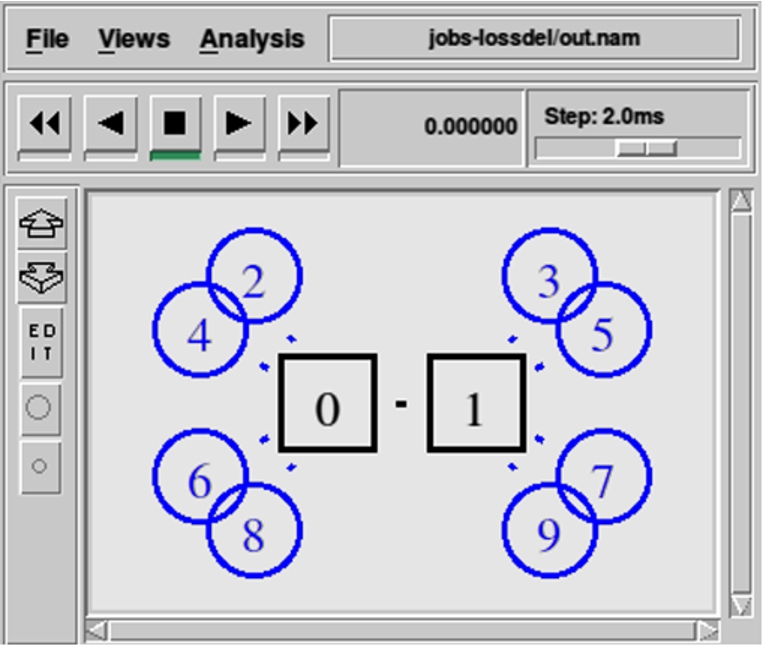
Schema of the experimental Network Animator program. (Colors are visible in the online version of the article; https://dx-doi-org.web.bisu.edu.cn/10.3233/JHS-150510.)
The schema of the experiment, as visualized in the Network Animator program, is presented in Fig. 1. The sources of data are nodes 2, 4, 6 and 8, and the data receivers are nodes 3, 5, 7 and 9. Nodes 0 and 1 are intermediate. Each channel has an available bandwidth of 10 Mbps and a minimal delay time of 1 ms. The overall simulation time is 11 s. Two experiments were conducted with packets of different sizes, at 210 and 50 bytes, respectively.
The JoBS algorithm assumes use of the following QoS parameters:
relative delay constraints (RDC) define the proportional delay distribution between different service classes. Delays for two adjacent classes are related and can be calculated via the following expression:
absolute delay constraints (ADC) represent the delay of the defined class that should satisfy the following condition:
relative loss constraints (RLC) are packet losses for two adjacent traffic classes, which should satisfy the condition:
absolute loss constraints (ALC) define the value of packet loss for each class that should not be exceeded. Therefore the delay of the ith class should satisfy the following condition:
In the conducted experiment the following service class parameter values were specified:
class 1:
class 2: without ADC requirement, without ALC requirement,
class 3: without ADC requirement, without ALC requirement,
class 4: without ADC requirement, without ALC requirement,
Based on the simulation results, delays for transmitted packets were calculated. The chart presented in Fig. 2 shows the packet delays obtained in the experiment involving packets of 210 bytes. According to this chart it is possible to identify groups of packets corresponding to each of the four service classes.
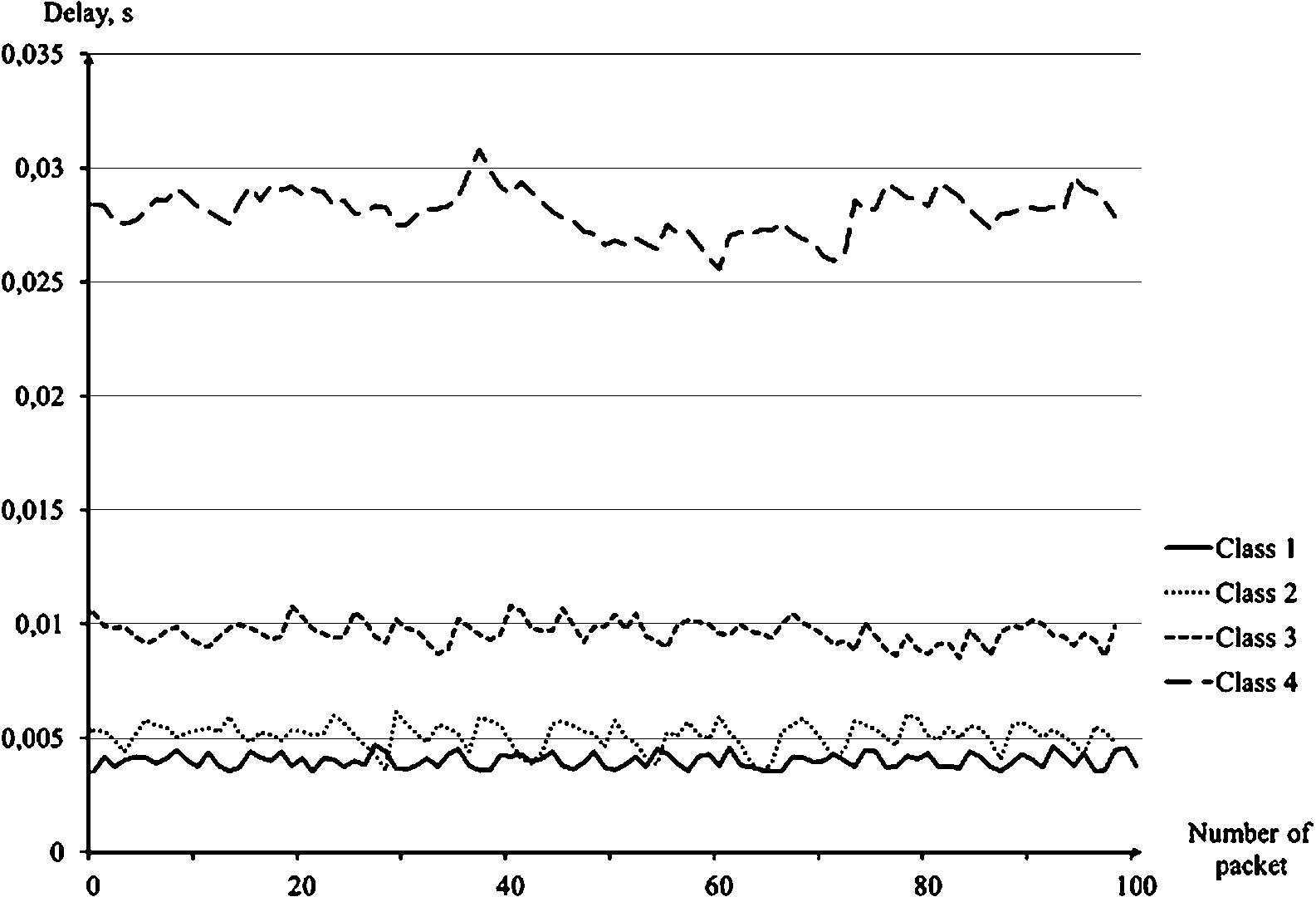
Delays in 210-byte packet transmission.
Calculations of available bandwidth for packets of 210 bytes
The results of the calculations corroborated the assumption that due to the introduction of different service classes, the available bandwidth values for these classes would be sufficiently distinct. This variation is a consequence of the introduction of packet prioritization, with packets processed in correspondence with the rules introduced aimed at achieving the required parameter values for the highest priority classes. Therefore, the time spent waiting in a queue varies for packets in different classes. Since the available bandwidth depends on the queue delay, available bandwidth values for packets corresponding to different service classes can also differ.
Figure 3 presents a chart of the delays obtained with packets of 50 bytes. According to this chart the different service classes are less noticeable than in Fig. 2. This discrepancy reflects the fact that the packet size in the later experiment is more than four times smaller than that in the previous one; QoS requirements remained the same as in the experiment with packets of 210 bytes. Therefore, on the one hand, meeting these requirements for smaller packets is simpler due to the dependence of delay on packet size. On the other hand, the number of packets in the queue increases and as a result the time spent waiting in the queue also increases.
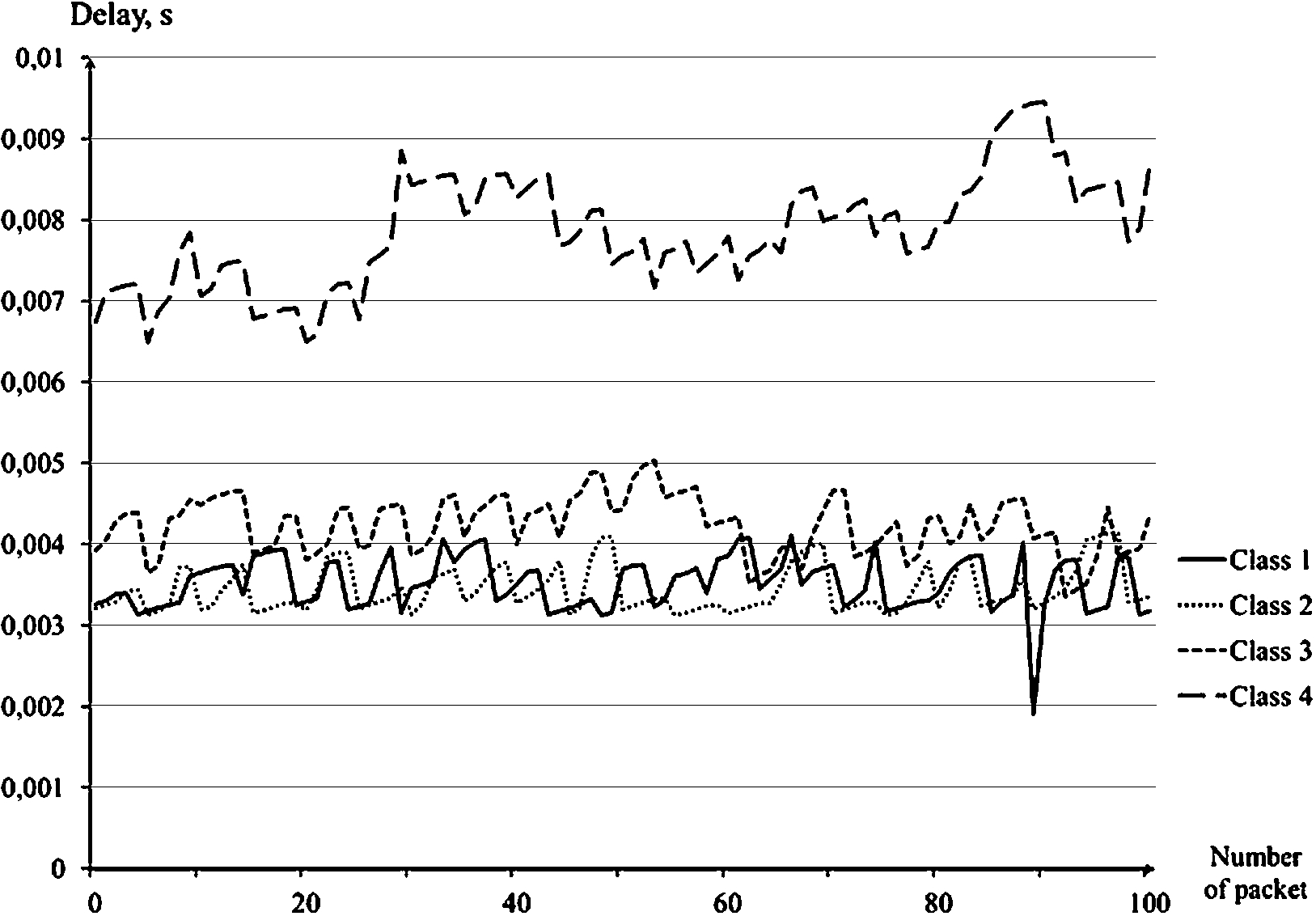
Delays in 50-byte packet transmission.
Calculations of available bandwidth for packets of 50 bytes
The above experimental results demonstrate that the introduction of service classes has a considerable influence on available bandwidth measurement. It should be noted that in real-life situations, providers are required to guarantee the values of QoS parameters (such as available bandwidth) according to the SLA (service level agreement). The criterion proposed in the present work enables the achievement of the desired available bandwidth differentiation for the defined service classes.
Service class parameters in the NS-2 simulator
Service class parameters in the NS-2 simulator
Calculations for determining available bandwidth bounds between classes of service
According to the results presented in Table 4, it is obvious that by increasing packet delay in the NS-2 simulator, the available bandwidth value decreases with each subsequent class. It should be noted that the experimental available bandwidth difference values (
The investigations outlined in the present paper demonstrate that the introduction of service classes affects available bandwidth measurement results. A criterion for available bandwidth differentiation between classes of service in modern IP-networks was found. It has been shown that service classes should be differentiated in terms of their available bandwidth in such a way that the difference between neighboring classes’ available bandwidth is proportional to the square of that of the current class, with the difference between neighboring classes’ delay being a constant. A formula for calculating the value of this constant based on jitter values and the percentage of the highest-priority class packets in whole packet flow has been provided, together with a further formula for calculating the maximum delay value for any service class. The experiments using the NS-2 network simulator demonstrate the efficiency of the proposed criterion.
The presented results of the investigation into packet delay differentiation of service classes in order to meet QoS requirements have high theoretical and practical importance due to the actuality of the problem.
Footnotes
Acknowledgements
This work was supported by grant of the Russian Foundation for Basic Research (RFBR) 13-07-00381a. This work was supported by Ministry of education and science of Russian Federation in the framework of the implementation of the program of increasing the competitiveness of SSAU among the world’s leading scientific and educational centers in 2013–2020 years.