



Abstract
The quadratic assignment problem (QAP) is a well-known challenging combinational optimization problem that has received many researchers’ attention with varied real-world and industrial applications areas. Using the framework of basic artificial bee colony algorithm, frequently used crossover and mutation operators, and combined with an effective local search method, this paper proposes a simple but effective discrete artificial bee colony (DABC) algorithm for solving quadratic assignment problems (QAPs). Typical QAP benchmark instances are selected from QAPLIB in order to conduct the simulation experiment where common performance metrics are used to evaluate the algorithm. The paper also investigates the influence factors of the algorithm’s performance. The results show that the proposed algorithm is a quite effective and practical new approach for handling QAP problems.
Keywords
Introduction
Quadratic Assignment Problem is a typical combinational optimization problem [1]. The mathematical description of Quadratic
Assignment Problem is [2]: presetting
n facilities and n locations, define two n × n matrices
QAP is well known because of its widespread application background. At the same time, it is recognized as one of intricate problems. At present, the QAP has been researched deeply. The research and design of heuristic algorithm for solving QAP become one research hot spot in the academia because QAP is an NP-hard problem [3]. Misevicius and Verene [12] presented a hybrid genetic-hierarchical algorithm for the solution of the quadratic assignment problem. The genetic algorithm is combined with the so-called hierarchical (self-similar) iterated tabu search algorithm, which serves as a powerful local optimizer (local improvement algorithm) of the offspring solutions produced by the crossover operator of the genetic algorithm. The results of the conducted computational experiments demonstrate the promising performance and competitiveness of the proposed algorithm. Ahuja et al. [1] proposed a solving QAP greedy genetic algorithm. In the design of the algorithm, the author integrated the multiple greedy strategy, such as using heuristic algorithm, to produce the initial population of random structure and design of a crossover operator based on greedy thought. In QAPLIB’s 103 test cases, greedy genetic algorithm has been found the best solution to problems of the known. Pardalos et al. [14] gave a suitable greedy randomized adaptive search procedure (GRASP) for QAP. The method had achieved a satisfactory solution on some QAPLIB test cases. Misevicius [10] put forward an improved simulated annealing algorithm to solve the problem of QAP effectively. The algorithm mixes with tabu search in order to improve the quality of the solution. The experimental results showed that the performance of the algorithm is better than the earlier version of the simulated annealing algorithm in QAPLIB test case. Misevicius [11] proposed a new version of the tabu search algorithm for QAP. One of the most important features of his tabu search implementation is an efficient use of mutations applied to the best solutions. He tested this approach on a number of instances from the library of the QAP instances–QAPLIB. The results obtained from the experiments show that the proposed algorithm belongs to the efficient heuristics for QAP. The researchers designed other heuristic algorithms specifically for solving QAP, such as ant colony algorithm [19], particle swarm optimization algorithm [22], flood algorithm [18], differential evolution algorithm [16] and bacterial foraging algorithm [15].
Artificial Bee Colony (ABC) is a simulation of the process of bees intelligent optimization algorithm and is put forward by Karaboga and Basturk [6]. In the ABC algorithm, there are three different types of bees such as employed bees, onlooker bees and scout bees. Different bee species have different work tasks. ABC algorithm considers a feasible solution to the problem as a food source, and give it a fitness. In the process of algorithm implementation, firstly, each employed bee produces a new food source and greedy strategy is used to choose between the old and the new food source. Secondly, each onlooker bee chooses a food source by way of roulette according to the information of the food source providing by the employed bees (i.e. fitness), uses the mechanism which is similar to the employed bees to try to improve the food source. Finally, if a food source in the consecutive iterations of “limit” did not improve, it corresponds to the employed bees changing to scout bees. Scout bees can produce a viable random solution according to the search space [20,21]. Repeat the process until the termination conditions are met.
Artificial bee colony algorithm has achieved great success in solving a single objective continuous optimization problems. In recent years, the study of discrete artificial bee colony algorithm has also aroused the attention of many scholars at home and abroad. In the existing literature, there are a number of examples that use artificial colony algorithm to solve the Lot-streaming Flow Shop Scheduling Problems [17], Permutation Flow Shop Scheduling Problem [9], Job-shop schedule problem [5] and Traveling Salesman Problem [7,13], amongst others. However, there is almost no literature using ABC algorithm to solve the problem of QAP. The research emphasis of this paper is the design and implementation of the discrete artificial colony algorithm which is suitable for QAP’s problem. Using the basic framework of artificial bee colony algorithm, applying common crossover operator and mutation operator and combining with effective local search strategy is the design of a simple and effective discrete artificial bee colony (DABC) algorithm. We choose the famous QAPLIB test instance to conduct a simulation experiment and compare the experimental results with the optimal results that have been reported. Finally, the paper discusses and analyzes the influence of local search strategy, mutation operator and different control parameters on the performance of the algorithm.
Discrete artificial bee colony algorithm of solving QAP
Solving the quadratic assignment problem which is put forward by this paper of the main process of discrete artificial bee colony (DABC) algorithm is shown in Fig. 1. As can be seen, DABC algorithm includes five main parts, initializing controls parameter, initializing colony (food source) and the phase of the employed bees, onlooker bees and scout bees.
Initializing control parameters
There are two control parameters in DABC algorithm, the colony’s size of
Coding scheme
Code maps the feasible solution to the problem into a “string” with a suitable algorithm.
The choice of the ways of encoding will have great influence on the performance of the
algorithm. In terms of QAP, a common way of coding is encoding the feasible solution into
Permutations ϕ, a collection,

Main flowchart of DABC.
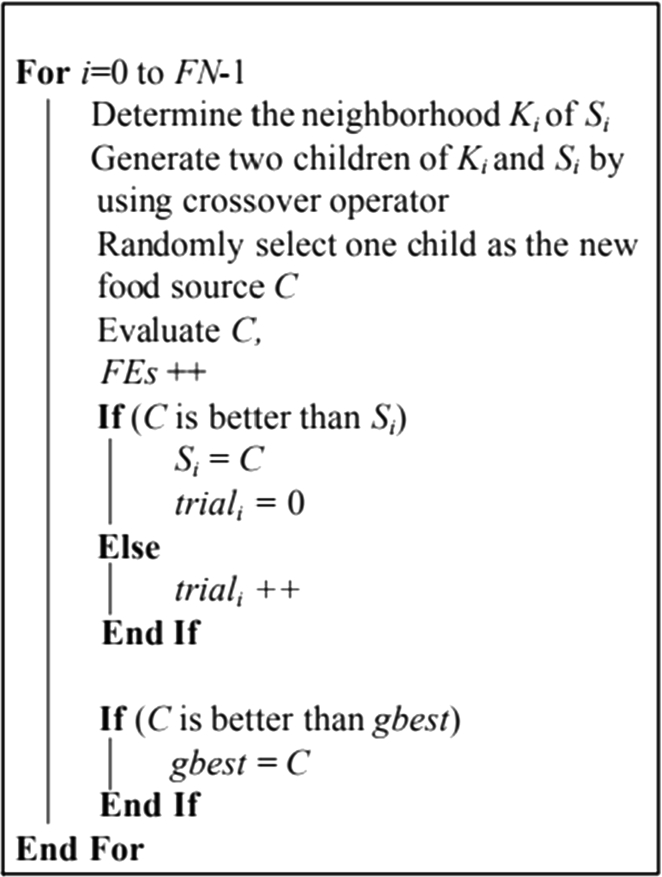
Employed bee phase.
According to the encoding rule, the number of feasible solution is up to
Employed bees’ phase
The process of the Employed bees phase is shown in Fig. 2.
For each food source
Onlooker bees’ phase
The process of the Employed bees phase is shown in Fig. 3.
At this stage, the onlooker bee will select individuals to improve adapting the way of
roulette according to the food source information provided by employed bee. The
probability of the ith food source which is selected is
Use the formula (1) to calculate the objective function
of ith food source
Find out the minimum value of all
Calculate
Calculate
If the sum is greater than zero, then
If the sum is equal to 0, then
In a specific colony, the minimum min of all food source’s objective function is fixed.
If the sum is greater than 0 (namely the objective functions of each food source are not
equal), the formula (2) is used to calculate

Onlooker bee phase.
The number of the onlooker bee in DABC algorithm is
For n facilities and n locations of the QAP, the number of the “neighbors” of the food
source ϕ is

2- Exchange local search’s specific algorithm
Scout bees phase of the process is shown in Fig. 4. As mentioned earlier, when the trial value of certain food source is more than limit value, the food source will be discarded, and the corresponding employed bees will be converted to scout bees. First, find a maximum value from a swarm of bees in the trials of food source, and then determine whether the trial value is greater than the limit. If so, generated a new food source Sol randomly, then carry on the mutation and local search. Finally, evaluate the new result and use it to replace the original source of food. In the DABC algorithm, only one scout bee is allowed at each iteration.

Scout bee phase.
The experimental results and analysis
In order to test the performance of DABC algorithm, this paper chooses 75 simulation
benchmark examples of QAPLIB [3]. The size of
these benchmark examples ranges from
Performance gap [1] is used to measure the
quality of the solution. For a specific problem, suppose algorithm finding the optimal
value of
The running time of the algorithm is the time required for the last update
The control parameters of DABC algorithm are set to:
As can be seen from Table 1, in terms of the minimum value
of gap, the DABC algorithm can solve 55 benchmark instances successfully (73% of the
total). For the average, the percentage of successful solution to the benchmark instance
is
Experimental results of DABC on selected benchmarks from QAPLIB
In order to analyze the influence of different control parameter values on the
performance of DABC algorithm, 8 typical examples in QAPLIB (bur26a, chr12a, esc32h,
sko64, sko100a, tai40a, tai80a, wil50) were selected for the experiment. First,
To analyze local search and exchange variation effect on the properties of DABC
algorithm, in

Effect of parameter CS on the performance of the algorithm.

Effect of parameter limit on the performance of the algorithm.
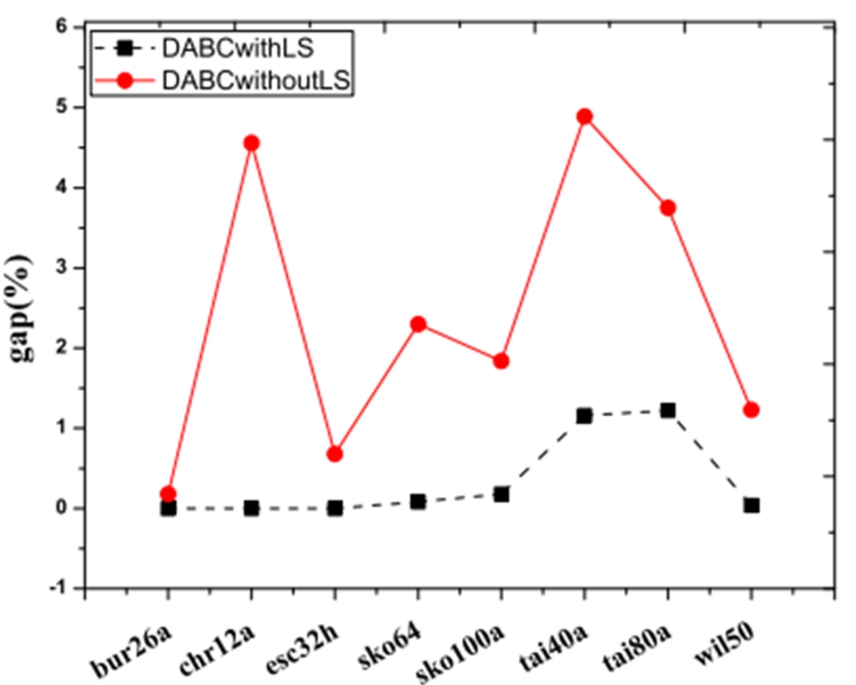
The effect of local search on the performance of the algorithm.

The effect of exchange variation on the performance of the algorithm.
Based on the basic framework of artificial bee colony algorithm, used common crossover and mutation operator, combined with effective 2 – exchange local search algorithm, we proposed an effective discrete artificial bee colony algorithm of solving QAP in this paper. Simulation experiments on 75 benchmark examples in QAPLIB illustrate the effectiveness and efficiency of this algorithm. The influencing factors of the performance of the algorithm are analyzed and discussed: 1) Local search can improve the performance of the algorithm greatly; 2) The new algorithm is insensitive to the control parameters. Therefore, the algorithm proposed in this paper has certain application prospect and future research direction mainly includes: 1) The new algorithm is used to solve practical problems; 2) The algorithm is extended to deal with multi-objective optimization problems, amongst others.
Conflict of interest
None to report.