



Abstract
Internet of Vehicles (IoV) presents a new generation of vehicular communications with limited computation offloading, energy and memory resources with 5G/6G technologies that have grown enormously and are being used in wide variety of Intelligent Transportation Systems (ITS). Due to the limited battery power in smart vehicles, the concept of energy consumption is one of the main and critical challenges of the IoV environments. Optimizing resource management strategies for improving the energy consumption using AI-based methods is one of important solutions in the IoV environments. There are various machine learning algorithms for selecting optimal solutions for energy-efficient resource management strategies. This paper presents the existing energy-aware resource management strategies for the IoV case studies, and performs a comparative analysis among their applied AI-based methods and machine learning algorithms. This analysis presents a technical and deeper understanding of the technical aspects of existing machine learning and AI-based algorithms that will be helpful in design of new hybrid AI approaches for optimizing resource management strategies with reducing their energy consumption.
Keywords
Introduction
Today, Intelligent Transportation Systems (ITS) have more developed to gain the internet connectivity between smart transportation and safe establishments of vehicles by using the concept of Internet of Vehicles (IoV) [25]. The IoV is an interconnection of vehicles, smart devices such as sensors, camera, smartphones, and cloud-edge appliances using 5G / 6G technologies. In the IoV environments, resource management strategies such as computation offloading, scheduling and service composition are main important optimization goals. Due to limited power saving and energy efficiency issues, there are some critical problems in the energy-aware resource management strategies in the IoV that must be solved. For example, authors in this paper [10] have discussed on resource management approaches for cloud-edge computing in the Internet of Things (IoT) environments. Also, some other review studies [15,18] have investigated energy consumption strategies in industrial IoT with respect to some resource management methods such as service routing, service placement, service discovery and service allocation methods.
On the other hand, Artificial Intelligence (AI) techniques such as machine learning, Deep learning, meta-heuristic algorithms and evolutionary computation have been applied to optimize NP-hard resource management problems in the IoV and ITS environments [14]. Existence of Quality of Service (QoS) factors with different cloud-edge resources in IoV generate different types of resource management strategies by various energy-efficiency perspectives. Applying AI-based optimization methods can help to select optimal solutions for reducing energy consumption and maximizing performance of resource management process. To date, some comprehensive and technical discussions have presented existing AI-based optimization methods in the Internet of Things (IoT) [3], Software Defined Vehicles (SDV) [22] and ITS environments. The IoT environments, AI-based optimization algorithm, sensors and smart devices have undergone significant developments in the IoV processing, which is why the ITS is comprehensively involved in various areas such as Underwater transportation systems, Unmanned Aerial Vehicle (UAV) [6], and smart road systems.
To the best of our knowledge, many review or survey papers have presented AI-based mechanisms and machine learning methodologies on the IoT and the ITS environments and showed a detailed discussion on all technical aspects of applied algorithms. However, energy-aware resource management mechanisms in the IoV are not well addressed. The main contributions behind presenting this paper is shown as follows:
Providing a technical taxonomy on the energy-aware resource management strategies based on machine learning and AI-based classifications in the IoV environments. This taxonomy helps to understand the specific division of existing AI-based methods and machine learning algorithms in an IoV environment.
Elaborating applied algorithms, evaluated factors and main effective problem statement on energy efficiency and reducing power consumption in the IoV environments.
Discussing on different open issues, hot research gaps and new challenges of energy efficient resource management strategies with existing solutions. Also, the open research problems have also been discovered.
The main organization of this paper is shown as follows: Section 2 describes the IoV architecture and the related critical points as existing problem statement. Also, Section 3 shows a detailed technical taxonomy and related AI-based approaches and machine learning algorithms in the resource management strategies. Section 4 provides the performance metrics and categorizes QoS factors into existing evaluation results based on applied algorithms. Section 5 shows the potential research directions, new challenges and open issues as well. Section 6 presents conclusion of this content with the related limitations and future works.
Resource management in the IoV architecture
In this section, resource management strategies in the IoV are illustrated. Also, a brief description of the IoV platform is shown. Then, the main technical aspects of IoV communication methods are presented based on energy efficiency factor and power consumption.
Resource management strategies
Resource management strategy is a popular and interesting portion of cloud-edge computing in IoT environments [28]. There are enormous contributions from researchers towards resource management strategies. There are two main categorizations for resource management strategies in the IoV including application-based resource management and hardware-based resource management. Application-based resource management strategies consist of resource allocation, task scheduling, resource selection and composition, resource provisioning, resource discovery and computation offloading. In IoV environment, all the cloud-edge computing resources as well as the intelligent Road Unit Systems (RUS) [11] and smart applications can be obtained from the cloud-edge providers without huge investment by the user in a vehicular communication. The intelligent RUS environment has three main layers for navigating data as transmission layer, management of services as applications layer and finally improvement of services as gradient layer. It is a critical point for interconnection of vehicles, which need low computing power and energy consumption thus keep away from purchasing costly servers. According to Fig. 1, the resource management platform includes cloud data centers, fog nodes, base stations and sensors as IoT devices, smart vehicles and user applications. Communication between fog nodes, cloud data centers and smart applications is considered as application-based resource management strategies. On the other hand, collaboration between smart devices, vehicles and the RUS is considered as hardware-based resource management strategies. In this content, device assignment and inter-connected vehicles are important methods for managing hardware-based resource management strategies.

Resource management platform for the IoV environment [24].
Vehicular communication case studies should be categorized to different types of technical communication strategies according to main road subsides scenarios. The main communication strategies in the IoV environment is categorized into five classes as follows: Vehicle to Vehicle (V2V), Vehicle to Cloud (V2C), Vehicle to Application (V2A), Vehicle to Road unit (V2R) and Vehicle to Infrastructure (V2I) strategy. For example, in a smart city with multiple IoT devices, vehicles, user applications, and RUS stations create a smart IoV platform form a 2-dimensional V2V, V2A and V2I communication methods that navigates a smart vehicular connection between existing attributes. As shown in Fig. 2, existing communication methods is shown based on each vehicular connectivity with cloud-edge servers, user applications and RUS stations. Designing a comfortable communication method for the IoV platform is based on vehicle density, number of RUS stations, type of roadway and multiline highway mode.
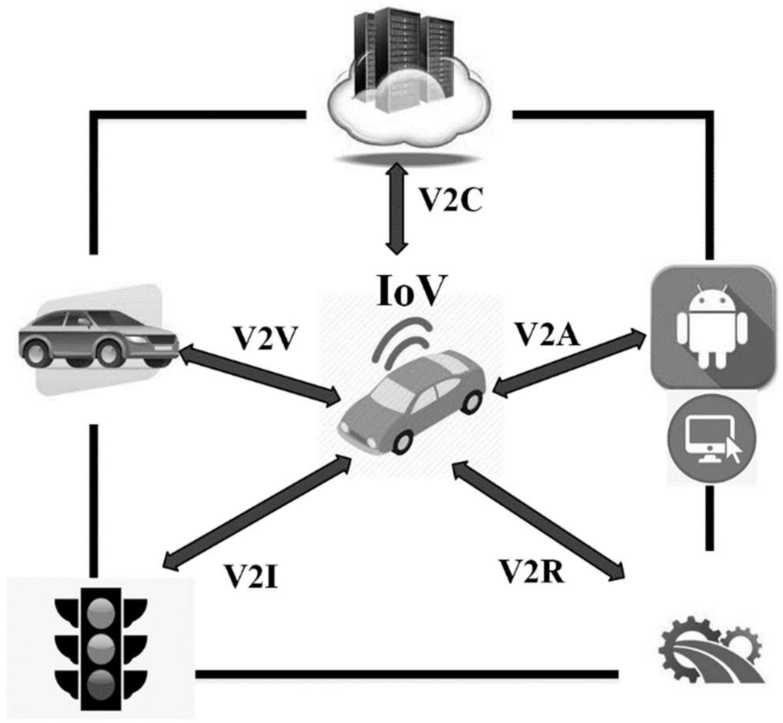
IoV communication types [9].

Categorization of AI-based algorithms for energy-aware resource management strategies in IoV.
This section shows a technical taxonomy for existing energy-aware resource management strategies in the IoV environments. The general interest of the IoV environment is related to find a suitable and optimized energy efficient solution for application-based and hardware-based resource management strategies. So, we can consider that the energy-aware transportation systems must grow in an optimized solution and safe strategy using AI-based methodologies. Also, road units have extremely dynamic conditions with respect to specific periods of the crowded places, various speeds of vehicles and traffic road map. In this section, existing energy-aware resource management strategies are presented that each of them represents an optimal solution to decrease the energy usage in IoV technology by using machine learning and AI-based algorithms. Figure 3 illustrates a technical taxonomy to categorize existing research studies based on two main concepts including resource management type and AI-based methods and machine learning algorithms. In the resource management type, there are four main classifications that present applied AI-based algorithms to optimize energy efficiency for IoV resources including resource allocation, resource scheduling, resource offloading, and power-based resource selection approaches. First, resource selection is applied for cloud edge service to check minimum energy consumption in the IoV. Then, resource allocation and scheduling are applied on the existing energy-aware services. Finally, resource offloading is considered for existing energy-aware services for applying machine learning methods on the IoV environments. Each subcategory consists of different AI-based algorithms such as deep learning, supervised and unsupervised mechanisms, heuristic algorithms, natural-inspired algorithms, and fuzzy methods. On the other hand, Fig. 4 illustrates a new categorization on existing resource management strategies based on IoV communication types. Each communication type of the IoV is categorized to V2V, V2A V2C, V2R and V2I communication methods.

Categorization of IoV communication types for energy-aware resource management strategies.
After, organizing existing technical taxonomies, following sections present a brief description of each sub-category of the resource management strategies in the IoV. Some advantages and weaknesses of each case study is explain as well.
In this section, applied machine learning and deep learning algorithms are described to optimize energy-aware resource allocation approaches in the IoV.
Wang et al. [30] presented a new resource allocation approach that describes to IoV enable inter connect vehicles method Used to support existing services as well as increase the quality and experience of users. The computational tasks generated by these applications on vehicles limit the load on resources, allowing edge-to-board tasks (EI) to be loaded onto other servers. Excessive workload can lead to fierce competition for computational resources between vehicles and ultimately increase energy and delay in processing, consumption and system costs to solve this problem by managing the knowledgeable uplink resource for transfer, we have used it as a Markov decision-making process with variable formulation time. Total latency, energy consumption, and cost of quantum-inspired reinforcement learning (QRL) represent an evolving intelligence-driven edge evacuation strategy the simulation result, presents above algorithm can significantly reduce the transmission delay and computational delay and purpose of this joint optimization method is to maintain a balance between the two items.
Zhao et al. [36] proposed a new to vehicle fog computing (VFC) approach and demonstrates a new incentive resource allocation mechanism that combines resource segments and resource benefits. Authors presented distribute profound to use reinforcement learning is used to allocate resources and reduce system torsion. Task offloading approach based on the queue model; several vehicles are presented to avoid the collision of the decision to unload tasks. The simulation result, show the numerical experiment approach illustrates to propose scheme had achieved a significant resource allocation performance betterment in task offloading.
He et al. [13] proposed a new Demonstrates a multi-layered resource management optimization algorithm to improve the Quality of Experience (QoE) in IoV. In this paper, the communication downlink transmission system is designed for input and output rate factors in a random queue model. The proposed optimization algorithm transfers a the exchange problem between queue stability and QoE can be decomposed through Lyapunov optimization algorithm and a series of online modes that include joint optimization of rate control, power allocation and mobile relay selection. They solved this problem by Lagrangian method independently. The simulation results, show of the allocation method increase the optimization power and the optimization factors of mobile relay selection to achieve low complexity.
Muhammad et al. [23] proposed a new resource allocation efficient method to increasing communication of vehicles in IoV. One of the new goals in vehicle technology is the rapid jump in the green energy revolution in electric vehicles. Other reason is reduced carbon footprints and use the high energy IoE to reduction energy consumption. Authors applied simulation provide, an efficient and active resource organization for IoV services by cloud-edge infrastructure using machine learning for resource management and virtual network function in the primary resource.
Liu et al. [20] proposed a new resource allocation approach in IoV. This method increases the energy efficiency of the system according to the fog computing vehicular (FCV) network and non-orthogonal multiple access (NOMA). By considering resource management approach, the energy consumption is solved by the power allocation, Reel encrypted Chemical reaction optimization Algorithm (RCCRO) is the Chemical Reaction Optimization algorithm (CRO). In simulation results, the fog computing technology is applied to Improves local storage computing capabilities in IoV.
Lee et al. [17] presented a new road side unit (RSU) method for a trust-aware resource allocation in the fog-based IoV. The RSU suggests the fog services for vehicles. In this paper, services allocation uses a Vickery-Clarke-Groves (VCG) auction mechanism. Also, RSU has offered a bid as a seller that sells computing resources for buyers’ computing resources services.
To secure transactions, the China Blockchain system is distributed and implemented among RSUs based on the Fabric Hyperlieger Framework for transaction verification. The simulation result, shows that the presented system provides service stability while providing trustworthy service.
LiWang et al. [21] presented a new for vehicular clouds computing framework to match resource allocation in the IoV. This framework presents two stages for allocated scheme that splits template searching from power energy. The framework uses tree-based random subgraph isomorphism mechanism to increase yield. The result simulation The method of power allocation based on achieving an exchange between completion time and energy consumption has been presented in this research.
Cesarano et al. [4] offered an energy aware prototype for IoV systems, where roadside units require to be continually allocated and re-allocated to the operational vehicles. The advantage of this study is offering a quick heuristic-based method. Moreover, the suggested algorithm can effectively operate in real-time the roadside units, determining at each term those to be started and those to be changed off. Experimental results confirmed an appreciable growth in general cost with a reasonable delay in discovering the explanation.
Resource scheduling approach
This subsection shows existing AI-based resource scheduling approaches for optimizing energy consumption in the IoV environments.
Xin et al. [31] presented a new AI-based resource scheduling method to revolutionize the IoV environment for wireless and portable devices that became essential for various consumer activities to transfer multimedia materials. The proposed method presents two new algorithms called EQOA and QQOA as an alternative approach to the proposed problems, to provide a system for multimedia communication as well as multimedia IoV transmission via mobile devices, which provides the QoE optimization method the maximum amount of QoE increases the maximum quality, has increased the enjoyment of users of smartphones. Finally, the proposed algorithms for implementing IoV are generated from the baseline, and transitions are considered as promising competitors during multimedia transitions.
Ejaz et al. [8] presented a new IoV framework that Includes the deployment of scheduling methods for mobile charging infrastructure. This framework formulates an optimization obstacle to decreases the final cost of mobile charging substructure placement as long as consider constraints on the number of electric vehicles. The above IoV-based scheduling framework proposes to minimize the charging distance of electric vehicles (EVs). An important strength of this article is the disregard for traffic sensors in the proposed IoV scheduling method to enable EV users. The experimental results, show that the Impact of fixed charging optimization on charging infrastructure and schedule have efficient performance for EVs.
Finally, Yaghoob et al. [33] provided energy-efficient scheduling dissemination (E2SD) as a fog-based method in terms of decreasing the density of the messages in the queue. This method is for IoV which is modernized of VANET. They benefit E2SD to notify traffic status and if an emergency occurred, it will integrate the whole system for help to gather a rescue team and provide the required securities. Compared with resembling schemes; E2SD is capable of reducing delivery expenses, bandwidth consumption, and lagging time in addition to the model’s main purpose which is preventing message congestion and accelerating message delivery. The future goal is to study the effect on the diversity of queue extent interface in emergency and message aggregating situations.
Shen et al. [27] offered an energy-aware reasonable edge scheduling method for energy optimization of the IoV in smart cities for vehicle movement discharging with the calculated quantity of time with smaller energy usage. Moreover, an optimized energy-aware scheduling method is developed to decrease the entire communication delay and decrease the energy usage during discharge. The experimental results showed that the proposed method improved the performance rate with less communication delay, smaller energy usage for vehicle movement systems in smart cities.
Resource offloading approach
In this subsection, we have categorized resource offloading approaches for energy-aware resource management strategies in the IoV.
Lin et al. [19] presented a new Peer-to-Peer (P2P) computing resource offloading system approach to balance the dynamic spatial and temporal needs of IoV computing resources in smart city. From one side, guarantee transaction security and privacy-preserving in the system. On the one side, ensuring transaction security and privacy in the system is important they have used the China Consortium blockchain approach and demonstrated the process of trading secure computing resources without regard to trusted third parties to encourage unique smart vehicles to participate in the system. They co-build a two-stage Stackelberg game, extracting buyer and seller optimization tools, as well as computational pricing strategies and optimal trading volume in the proposed game. At the end simulations result, Security analysis shows that system security efficiently and numerically indicates the encouragement of strategic cooperation between the buyer and smart vehicles.
Sharma et al. [26] presented a new mechanism method for Manage vehicles by following the principles of the Chinese blockchain to connect to each other causes need for serious issues to update the total number of transactions that may lead to energy consumption for vehicles. Solve and provide an effective way to optimally control the number of transactions through distributed clustering can manage the Internet energy needs of Chinese blockchain vehicles. The simulation results, show that the approach presented in this paper is better than blockchain in terms of the number of transactions required and energy saving to share the total amount of blockchain data.
Bahreini et al. [2] presented a new energy-based resource management model in Vehicular Edge Computing systems. This model includes an energy manager algorithm to handle vehicular resources and resource selector algorithm for managing participating vehicles in Vehicular Edge Computing systems. The simulation results show that the proposed model minimizes energy consumption of vehicles’ computational resources and execution time with respect to Workload Types Data Size. The main weakness of this research is ignoring data transmission size for computational energy consumption of vehicles.
Zhai et al. [34] proposed a new resource offloading method Examines the discharge problem in SDN and IoV systems based on fog calculations. They tried to be aware on energy dynamic offloading scheme and it has been suggested that IoV runtime may increase battery life to increase performance in applications. The existing battery power cost implementation model is explained with the aim of improving the dynamic weight optimization and the relationship between them is considered in the cost model. Problems to be solved by heuristic optimization algorithm so that the simulation result, the discharge plan can manage more applications with available battery power under application dependency constraints.
Zhang et al. [35] presented a new of changes the fast growing of vehicle applications model and a IoV will be a practical architecture for dealing with big data and an important link for smart cities in the future. Fault control is cited as the main data: cloud and cloud computing, which is responsible for computing to local fog servers (LFSs). By consider some agents likes: mobility, latency, localization and scalability. The above paper introduces the concept of using services for regional cooperative architecture (CFC-IoV) to deal with large IoV data in the smart city. The simulation result, the model is hierarchical in fog and also focuses on optimizing the energy efficiency and loss rate of LFSs in CFC-IoV.
Hameed et al. [12] proposed a new load-balancing approach is based on the capacity to process the IoT environment to perform distributed fog calculations with energy awareness and high vehicle performance. This approach suggests position, speed, and communication of exciting clusters which allows node position prediction to manage dynamic networks. The simulation result show that the proposed approach decreases network delay and increases network utilization balanced network with respect to energy consumption. The main weakness of this research is Includes simultaneous improvement of energy consumption and management of network resource performance.
Moreover, Sulistyo et al. [29] presented a power offloading control for the challenges that were found during the implementation of VANET, similar to SINR of vehicles, in addition to its safety and intelligence. The authors provided power control by using a fuzzy system with the usage of the FPC algorithm, which could adjust transmitter power based on the vehicle’s SINR differences. They evaluated the method by a program using C++ language and simulated the environment on a road 5 kilometers long and with 3 lanes, withstanding between 200 and 500 vehicles. The results of this experiment show the performance of FPC, not only in the population of vehicles but also in the system throughput. As could be observed, it can increase the system throughput and the SINR of vehicles in the vehicular network.
Collotta et al. [7] proposed a useful fuzzy-based offloading management method to handle power usage and grade of services of IoV applications. The advantage of this study is presenting two fuzzy switches to improve the battery life while maintaining an adequate throughput to workload ratio founded on the theoretical example of battery usage. The simulation results indicated that this method is able to reach lower power usage, resulting in the most extended battery lifetime.
Power-based resource selection approach
In this subsection, there are just four research studies to evaluate power-based resource selection approach in the IoV using machine learning methodologies.
Yang et al. [32] presented a new method to policy jointly communication selection on transfer resource block and power control D2D that enabled V2V based in IoV connection network. The other side low delay communication for V2V Links That Include the Total Capacity of Large V2I Links. Due to unfamiliar environments, a decentralized reinforcement learning model with a new reward function is used for political communication with the environment. The main goal is (ETAC) approach to improve the learning convergence speed support reliable and delay-sensitive vehicular services in IoV networks. The simulation result, demonstrates that the ETAC approach can effectively reduce interference in IoV networks and ensures the need for delay and reliability of the V2V link to achieve fast convergence speeds and high stabilization, compared to other available methods.
Also, Bahreini et al. [1] proposed a new connection management algorithms to reduce the energy consumption of computational nodes in electric vehicles. This method can Achieving energy minimization in electric vehicles is connected to energy saving for electric vehicles for different levels by taking advantage of computing power settings. The evaluation of the above algorithm shows that the computing energy consumption of vehicles is significantly reduced with advanced baselines. Finally, this simulation results, algorithm average energy savings compared to baselines that run locally are more energy efficient than baselines that run only with RSUs.
In the other work, Khan et al. [16] offered an energy-aware resource selection design to save energy for the IoV Networks. Moreover, this study assumed a real 6G vehicular design where numerous Road-Side Units transmit with their associated IoV via a downlink protocol. Simulation outcomes indicated that the proposed optimization design with ambient backscatter transmissions is better than the other methods. Finally, Chaudhary et al. [5] presented a collaborative power-saving and resource selection method in IoV. This procedure has an effective energy usage algorithm using concurrent wireless data and power transition to amplify energy performance. Besides, to decrease different security attacks, a lightweight security organization protocol is developed that simply trusted vehicles can intercommunicate with each other and with the closest base stations. The experimental results demonstrated that the suggested procedure achieved more useful energy efficiency and more increased throughput.
Discussion
IoV systems are very attractive according to their complex inter-connected and intra-connected communications. The main critical issue of energy consumption in sending, processing, and receiving information and data transmission procedure is the most important challenge in the IoV, which comes along with other main challenges such as safety, reliability and security. Different AI-based algorithms such as deep learning, machine learning, and meta-heuristic algorithms have been applied to enhance energy consumption and increase performance of IoV communications. In this section, a point-to-point discussion is presented for technical aspects and main features of existing resource management strategies. Moreover, the existing evaluation metrics as QoS and QoE factors are categorized and discussed on them using AI-based algorithms. To this end, following question can be defined to answer the key points of this discussion:
1. Which machine learning and AI-based methods are used to enhance prediction of resource management strategies?

Percentage of the AI-based methods for optimizing resource management strategies in IoV.
According to Fig. 5, deep learning and unsupervised algorithms have maximum usage for evaluating energy-aware resource management strategies in IoV environments. Moreover, supervised methods and heuristic algorithms have 5 and 4 evaluation strategies in IoV environments. The fuzzy method is applied to a synchronized resource offloading with respect to the main conceptual aspects of cloud-edge service offloading in the available resources that supports feature selection with various simple strategies. Also, the natural-inspired algorithms are applied to a heterogeneous V2V and V2A connection type by considering various number of vehicles and user applications.
2. Which vehicular communication strategy to be used in the IoV?
According to Fig. 6, existing IoV communication types are categorized into five classes with respect to main case studies and environments in the resource management strategies. We can see that V2V and V2C communication types have highest research directions on this field based on IoV ecosystem.
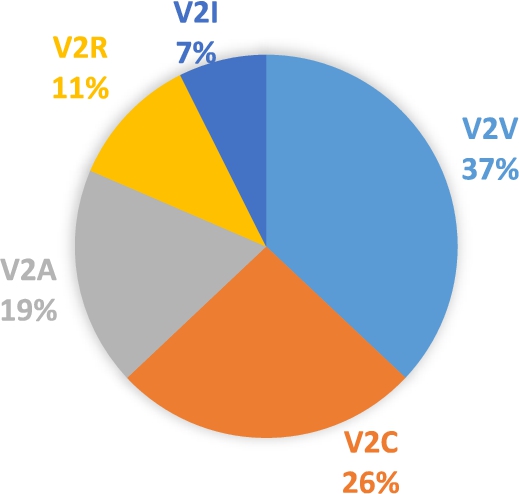
Comparison of IoV communication types in energy-aware resource management strategies.
3. What kind of the energy-aware resource management strategies are applied to solve the problem statement of the IoV?
According to Fig. 7, there are four sub-categories for energy-aware resource management strategies including resource allocation, resource scheduling, resource offloading, and power-based resource selection approaches. Each subcategory consists of different AI-based algorithms such as deep learning, supervised and unsupervised mechanisms, heuristic algorithms, natural-inspired algorithms, and fuzzy methods. We observed that resource allocation strategy has highest research analysis for enhancing energy efficiency and power consumption in V2V, V2C, V2A, V2I and V2R communications types.
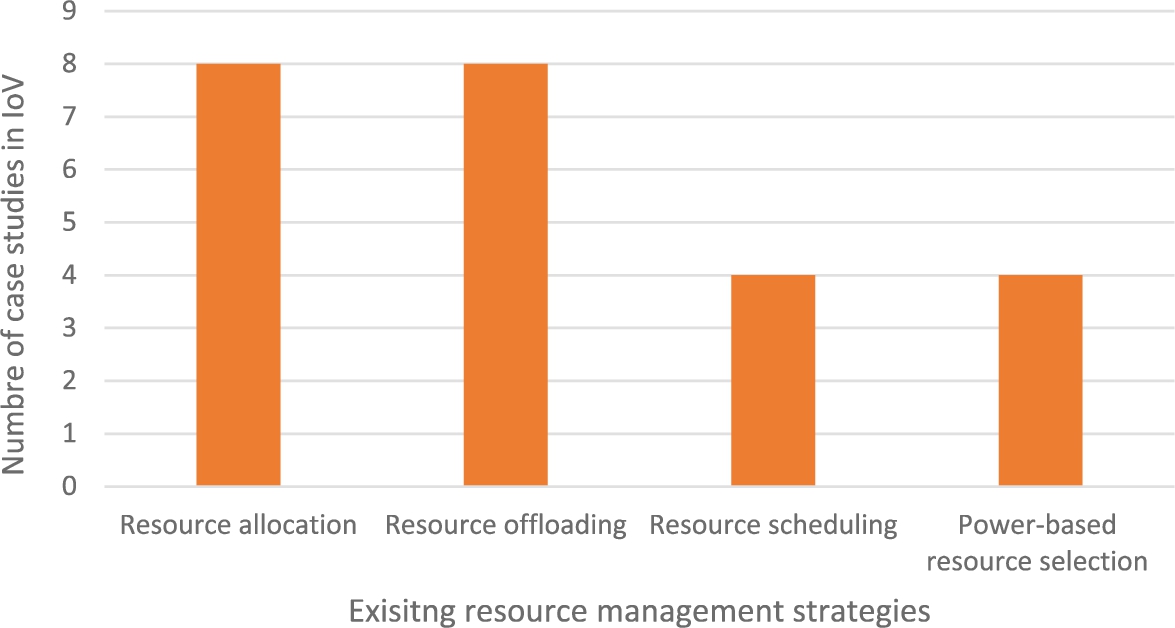
Variety of energy-aware resource management strategies in IoV environments.
4. Which evaluation metrics are measured for resource management strategies in the IoV?
Figure 8 shows a technical analysis on the QoS factors that have been examined using AI-based method for energy-aware resource management strategies in IoV environments. Eventually, we can see that the accuracy, cluster head number, and execution time factors are the most important predictive metrics to assess vehicular communication methods in IoV environments. Also, energy consumption is applied with highest usage than the other QoS factors. Finally, we conclude that other important QoS factors such as reliability, security and privacy can be evaluated for resource management strategies in IoV.
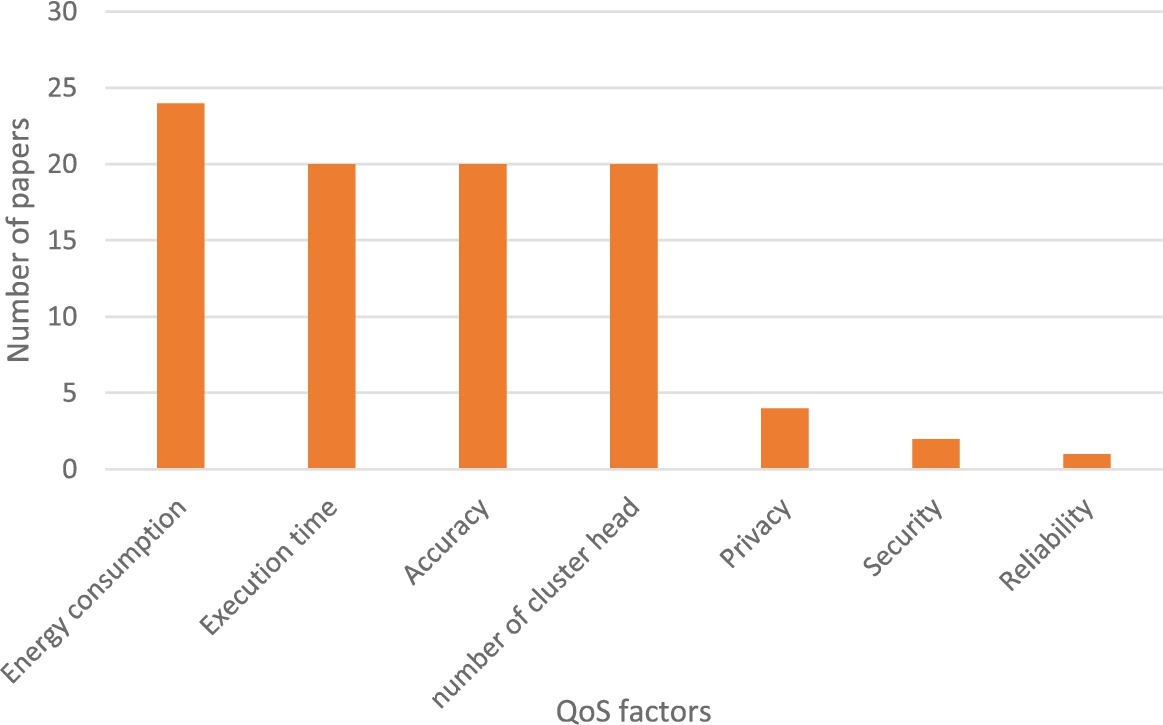
Evaluation of QoS factors using AI-based techniques in resource management strategies.
Resource management in the IoV is one of the most and critical affecting for performance evaluation. Existing methodologies related to energy-aware resource management are used to provide minimized energy consumption with enhanced QoS factors, which is important for each IoV environments. Following concepts are useful and important challenges for new open issues and research directions:
Reliability factor is an important metric to evaluate probability of system failure and flexible fault tolerant method for a specified periodic time in the IoV systems. The reliability of vehicles and data transmission links can enhance energy consumption for a long term data transmission in the IoV environments. Increasing accuracy and minimizing computation time overhead: Each AI-based solution is proposed to increase maximum accuracy factor and have minimum computation time. This helps in developing heterogeneous solutions for the variety of IoV connectivity. However, it is not easy to offer a high accuracy solution with a complex algorithms without involving relevant computation time. Cost of maintaining energy-efficient devices and price of developing smart IoV environment is one of important and critical issues as main challenges in the resource management strategies. Data migration is one of important open issues for increasing transmission speed and minimizing energy consumption for vehicle nodes in the IoV. A set of resources should be migrated to near safe vehicles when a node has failure condition. Then, fault tolerant can decrease energy consumption and delay for data transmission method. Applying meta-heuristic algorithms, deep learning and federated learning methods can be promised to improve the energy efficiency of resource management in the IoV systems. Traffic density: In resource management, optimizing traffic density in roads is n critical and main topic in the IoV. In a V2V strategy, vehicles are not able to move independently, and check traffic status for an optimal and low-density way. In this manner, optimizing V2V connectivity analysis can be more efficient to assess energy efficiency and QoS factors.
Conclusion
In this paper, a comprehensive analysis and technical comparison has provided for existing energy-aware resource management strategies in the IoV. Also, existing optimized algorithms, IoV communication types and recent open issues and new challenges have been elaborated and discussed. This technical analysis has been shown the different aspects of machine learning methodologies to enhance prediction of energy efficiency of IoV. First, existing energy-aware resource management strategies have been presented. Then a technical categorization was provided to illustrate main challenges of this issue with respect to machine learning algorithms. So, a detailed discussion and evaluation on the optimized prediction methodologies have been illustrated. The analytical results show that V2V communications method has highest research analysis using AI-based algorithms in the IoV. In future work, other new studies can be applied to enhance energy consumption of resource management methods in the IoV environments using federated learning.
Conflict of interest
None to report.