




Abstract
IoT networks can be defined as groups of physically connected things and devices that can connect to the Internet and exchange data with one another. Since enabling an increasing number of internets of things devices to connect with their networks, organizations have become more vulnerable to safety issues and attacks. A major drawback of previous research is that it can find out prior seen types only, also any new device types are considered anomalous. In this manuscript, IoT device type detection utilizing Training deep quantum neural networks optimized with a Chimp optimization algorithm for enhancing IOT security (IOT-DTI-TDQNN-COA-ES) is proposed. The proposed method entails three phases namely data collection, feature extraction and detection. For Data collection phase, real network traffic dataset from different IoT device types are collected. For feature mining phase, the internet traffic features are extracted through automated building extraction (ABE) method. IoT device type identification phase, Training deep quantum neural networks (TDQNN) optimized with Chimp optimization algorithm (COA) is utilized to detect the category of IoT devices as known and unknown device. IoT network is implemented in Python. Then the simulation performance of the proposed IOT-DTI-TDQNN-COA-ES method attains higher accuracy as26.82% and 23.48% respectively, when compared with the existing methods.
Keywords
Introduction
In the twenty-first century a critical need for IOT device safety. IOT connects everyone and everything, but it also opens up a lot of potential for different attack types to succeed [10]. Even though the term “Internet of Things” is brief in its circumstances, it encompasses the whole world with its sophisticated technology and imaginable services. Internet of things is employed to establish a connection amongst human and virtual world under several smart devices and its services via various communication protocols. Through an open network, IoT devices are used for a number of purposes, improving the users’ access to the devices [11]. Although IoT advances technology and makes life easier and more convenient, it also puts consumers’ privacy at danger from various attacks. The safety of IOT devices has become a major concern because anyone can access some IOT devices from anywhere without the user’s permission. To safeguard, numerous security measures have been implemented. But, the physical design limitations their processing, also limits their ability to apply sophisticated security protocols [12]. A threat/attack occurs when an unauthorized user gains access to a system as well as discloses private data without associated user’s consent. Typical computer security system can be separated as 2 types: network and host. Both systems have diverse incorporated security modules, like firewalls, intrusion detection schemes, antivirus software, which observe the system as well as alert while spiteful actions happens [5]. Amongst them, intrusion detection scheme contributes a significant part on information safety technology. This is an essential safety approach to handle network attacks, also detect spiteful actions. Due to the tremendous number of malware produced every day, including worms, viruses, Trojan horses, botnets, ransomware, many attackers still hold a disproportionate amount of power, despite the fact that many companies on the market create embedded safety modules. Additionally, a lot of small- and medium-sized networks are incapable of timely updating virus data bases along patches, or linked devices lack any protection capabilities. These networks have highly susceptible to attackers. Therefore, this is required to design automatic systems to identify with categorize malware. IoT networks are collections of physical items and equipment that may connect to the Internet and exchange data with one another. They are embedding with sensor, actuator, computing, storage, communication mechanisms [18].
The training Deep Quantum Neural Networks to realize the IOT devices linked with network. This is probable to identify distinct configurations that can differentiate device types. The proposed technique can protect the IOT networks’ process effectually against diverse attacks by verifying and examining IOT devices’ process.
The Chimp optimization Algorithm (COA) is employed to enhance the parameter structure of TDQNN and determine the proper hyper parameters to avert the higher labor price of manually tuning the parameters that determine the identification task fit to the network attack category. Chimp Optimization Algorithm optimizes the DQNN’s parameters, making it more robust to variations and noise in the input data. This robustness can help mitigate the challenges posed by the heterogeneity and dynamic nature of IoT environments. The optimized DQNN can better handle variations in device behavior, environmental conditions, and data quality.
The major drawback is that it can only recognize device types that have been seen before and that it needs labeled data for training. Device types that are added later on will be regarded as unknown types. Since there are hundreds of millions of new IoT devices created annually in the real world, a system that relies exclusively on supervised learning would be unworkable.
The main contribution of this manuscript is summarized as below,
Combining the deep learning with IoT is proposed to perform known as well as unknown device type categorization,
Anomaly identification is enabled to protect internet of things networks from unauthorized device entry.
To reduce the dimensionality of datasets, the proposed method uses an automatic building extraction approach, which achieves equilibrium among overhead and classification accuracy.
Remaining manuscript is designed as. Literature review is presented in Section 2, Proposed Methodology is illustrated in Section 3, the results and the discussions are presented in Section 4 and Finally, Section 5 concluding this manuscript.
Literature review
Several works were already suggested in the literature related to IoT device type identification; a few works are divulged here,
Yousefnezhad et al., [17] have suggested Device type identification (DTI) with the use of full packet information utilizing real-time network traffic. That was the consolidation of sensor measurement and statistical feature sets. The suggested method was assessed through normal and under-attack conditions through the collection of IoT devices real-time data. It provided lower detection accuracy and higher accuracy Yue et al., [19] have presented Device type Identification using security behaviour analysis dependent on deep learning in IoT. LGBM algorithm produced excellent detection results, and handled situations for devices, that provided high accuracy and low computational time Kumar et al., [8] have presented IoT device detection through network traffic analysis. Where, network statistics and machine learning was employed for the recognition of IOT devices. Then, a differentiation between traffic produced by IOT devices and non-IOT devices using supervised training also included. It provided high accuracy and low computational time. Li et al., [9] have presented Deep learning in IOT security. It covers how IOT recognize and response to cyber assaults, to search the prospect of deep learning for enhancing the IOT security structure. It discussed about security research in application areas, like industrial IOT, the internet of vehicles, smart grid, smart homes, smart medical. Afterwards, a summary of the areas that were developed in future technological development was given, like computing power sharing via the edge network processing unit central device, integrating environmental simulation models with real world, malicious code detection, intrusion detection, production safety, vulnerability detection, fault diagnosis, and blockchain technology. It provides higher accuracy and low AUC.
Saba et al., [13] have presented Anomaly-base intrusion identification scheme for IOT utilizing deep learning. CNN-based method was presented for anomaly-based IDS that take benefit of IOT’s power to proficiently scrutinize entire traffic across the IOT. The method was trained with tested under NID, BoT-IoT data sets and reached 99.51%, 92.85%, accuracy. It provides higher AUC and high computation time.
Karthika and Vidhya Saraswathi, [6] have presented IoT under machine learning safety improvement in video steganography allocation for Raspberry Pi. The AI Security System for Raspberry Pi IoT setup uses a progression mechanism that is driven by representations. The AI Security System for Raspberry Pi IoT setup uses a progression mechanism that is driven by representations. A lower control, commercially sensible, typical IOT-dependent safety AI supports nearness ID, unmistaken 98% proof, and pariahs confirmation. The process employs USB Webcam as image capture tool and electric door strike as actuator; such devices offer application programming interfaces for gathering game plans were suited with IOT fundamental development for Raspberry Pi video steganography dissemination. It provides low computation and low accuracy.
Azumah et al., [1] have presented a deep lstm based method for intrusion identification IOT devices network in smart home to predict cyber-attacks on smart home IOT network devices. The presented method was based upon long-term memory, which accomplishes a substantial accuracy. It provides high accuracy and high computation time.
Proposed methodology
IoT device type identification using Training deep quantum neural networks optimized with a Chimp optimization algorithm for enhancing IOT security (IOT-DTI-TDQNN-COA-ES) is proposed here. [3]
The proposed method consists of three phases: data collection, feature extraction and detection [15]. For the collection of data, real internet traffic dataset from different IoT device types are collected. For feature extraction phase, the internet traffic features, are extracted by automated building extraction (ABE) method. IoT device type detection phase, Training deep quantum neural networks (TDQNN) [4] optimized with Chimp optimization algorithm (COA [7]. Figure 1 shows that the Block Diagram proposed IOT-DTI-AGNN-WMA approach.
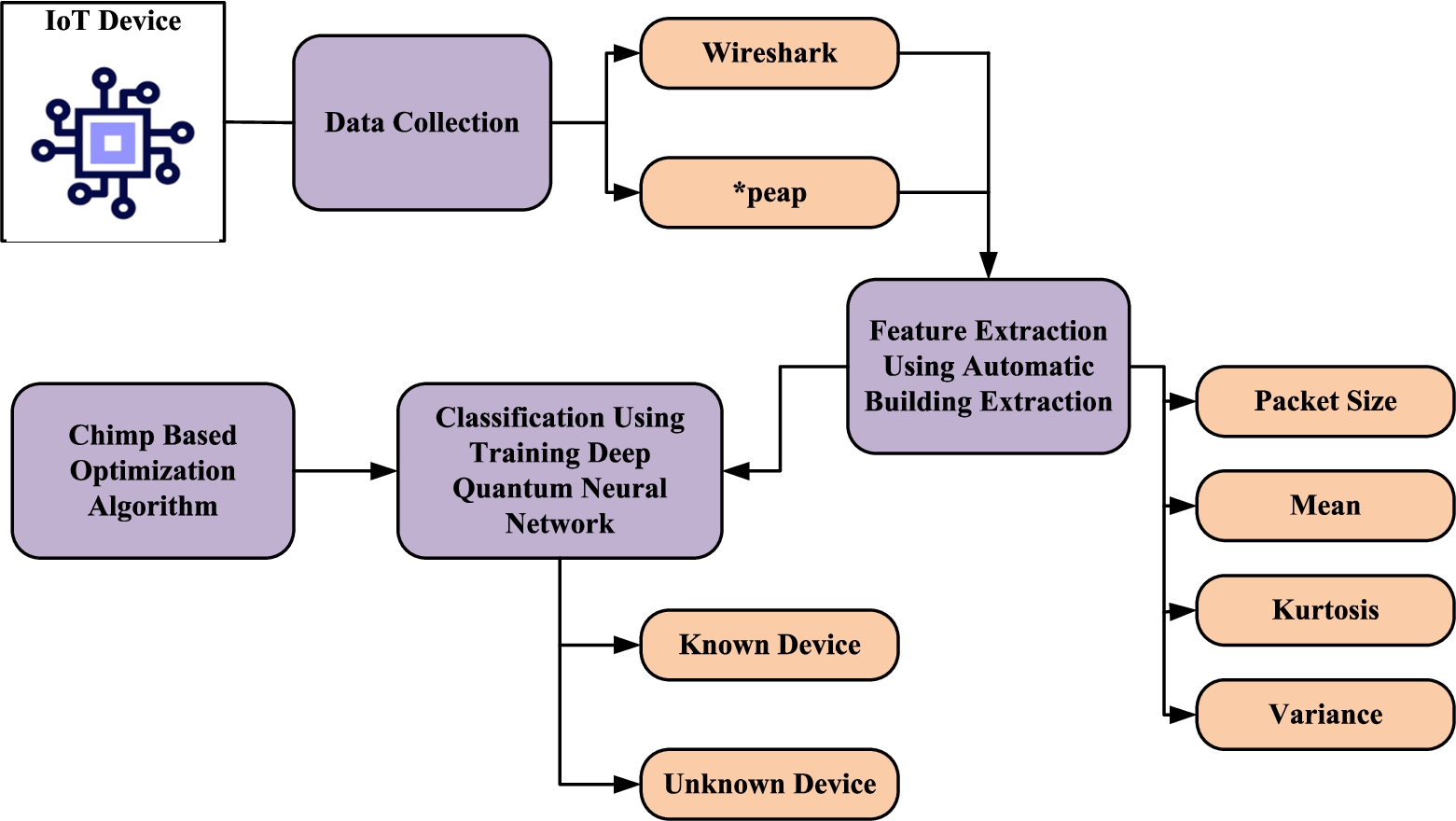
Block diagram proposed IOT-DTI-AGNN-WMA approach.
In Data collection phase, the file has collected the data of network traffic. Its setup is typically “*.pcap” and stage is commonly executed by Wire shark. In this phase, real network traffic dataset collected from different IoT device types are included. IoT device types are provided in Table 1.
IoT device categories
IoT device categories
Automatic building extraction from data plays a critical role in development in urban places and making digital city construction applications. So extraction by using automated building is extremely a challenging. The features from the internet traffic dataset are extracted using automatic building extraction. Here, the network traffic feature vector is extracted through feature extraction. The features that were used in the IoT device identification contain packet sizes; mean, variance and kurtosis are extracted using ABE method. Where
Where
IoT device type recognition using training deep quantum neural networks
In this section, IoT device identification is done using Training Deep Quantum Neural Networks (TDQNN).The extracted feature data’s are given to the IoT device type identification for the identification of known and unknown device categories. In quantum computing principles into the neural network architecture, the proposed approach has the potential to strength quantum advantages. Quantum computing offers the possibility of exponential speedup for certain computations, which could provide significant performance gains in processing and analyzing IoT device data. TDQNN combine the power of deep learning and quantum computing, allowing for more sophisticated and nuanced analysis of IoT device data. This can result in more precise classification and identification of device types. The training Deep Quantum Neural Networks to recognize the internet of things devices plugged into the network. At this way, this is feasible to find distinct configurations that can differentiate between different device kinds. The proposed technique can protect the IoT networks’ process against various attacks effectually by analysing IoT devices’ operations.
The network architecture makes it possible to use fewer coherent qubits to hold the intermediate states necessary for CNN evaluation. Thus, the number of qubits we need to hold only scales with the network width. Quantum computers use two basis quantum states denoted as
Matric K is selected, so the cost function is raised instantly: the change in C is given in equation (5)
From Equation (4), a formula is derived for parameter matrices where,
Optimized TDQNN for IoT device type identification using Chimp Optimization Algorithm (COA)
COA is used for optimizing the parameters of the TDQNN model to receive the optimum parameters. These parameters are optimized to compute the optimal parameters to ensure exact categorization. The Chimp Optimization Algorithm improves the security of the proposed approach by optimizing the TDQNN for accurate device type identification. This enables tailored security measures based on device types, enhancing protection against unauthorized access. The algorithm enhances anomaly detection capabilities, aiding in the identification of security breaches and compromised devices. It facilitates rapid response to threats through fast convergence and training, mitigating potential risks. The Chimp algorithm enables fine-grained security policies by capitalizing the optimized TDQNN, addressing specific vulnerabilities of different device types for enhanced overall IoT security.
COA is developed to solve these two issues: slow convergence speed and trapping in local optimization. The weight parameters of the TDQNN
A fitness function is a specific type of objective function, used to summarise a given design solution to attain the goals. Here
Chimp optimization algorithm is used to optimize weight parameter and of TDQNN classifier which accurately detects the IOT device type. At the end, TDQNN classifier accurately detects the IOT device type using COA. The Chimp Optimization Algorithm optimizes the DQNN’s parameters, making it more robust to variations and noise in the input data. This robustness can help mitigate the challenges posed by the heterogeneity and dynamic nature of IoT environments. The optimized DQNN can better handle variations in device behavior, environmental conditions, and data quality. The COA enhances the agility of the TDQNN by enabling faster convergence and training. This adaptability allows the system to respond more efficiently to emerging security threats and changes in the IoT landscape. It can quickly adapt to new device types, patterns, or attack vectors, improving the system’s ability to detect and counter potential security risks. Accurate device type identification enables more effective security measures. The proposed approach can enforce tailored security policies based on identified device types. This enables finer-grained access control, anomaly detection, and security protocols, enhancing overall IoT security.
Results and discussion
This segment describes the IoT device type identification using Training Deep Quantum Neural Networks with Chimp Optimization Algorithm for Enhancing IoT Security (IoT-DTI-TDQNN-COA-ES). The simulations are done in Python, Mac-OS Catalina operating system. The performance metrics is evaluated, like ROC, computational time and accuracy and the proposed method is comparing to existing IoT-DTI-STI-ES and IoT-DTI-DNN-ES models.
The real network traffic datasets gathered from ten different kinds of Internet of Things (IoT) devices, including baby monitors, lights, motion detectors, security cameras, smoke detectors, sockets, thermostats, TVs, watches, and water sensors.. Some kinds are made by various vendors, or by the same sellers but with various models. In a pcap file, traffic data passing via a switch connecting all of the devices is first recorded using Wireshark, and recording data has transformed as 297-feature vectors. A count of destination port, size of packet, TCP segments count out of order, are some examples of such features. TCP segment represents an effectual connection that begins with 3-way-handshake and discontinues when times out. The training data set contains 1400 feature vectors collected via 7 internet of things devices and labelled its device-type. The testing data set has 1005 feature vectors gathered via 10 device categories along 3 (out of 10) are presented devoid of label, so this is deemed as ‘anomaly’. That means 3 of 10 device types are deemed as newly/unknown/unseen, 7 are deemed as known/seen. Table 2 shows that the Output of IoT Device.
Output of IoT Device
Output of IoT Device
Experimental setup. The proposed technique is activated in Python3 on MacOS Catalina OS. To conduct min-max scaling of data, built-in MinMaxScaler for Python Sklearn package is utilized because distinct features have different value ranges in the raw data set, causing all feature values to fall in
Analysis of performance metrics such as accuracy, computational time and ROC are done.
Accuracy
The ratio of exact predictions to the total number of proceedings is determined in equation (13),
ROC
Roc gives insight and its clearance rate from the body is expressed in equation (14)
Computation time
Computation time is an operating time, where the duration of time needed to act a computational process is called as computation time. It is shown in equation (15).
Simulation result
Figures 2–4 shows the simulation results of the IoT device type identification using Training Deep Quantum Neural Networks with Chimp Optimization Algorithm for Enhancing IoT Security (IoT-DTI-TDQNN-COA-ES). The performance metrics like accuracy, ROC and time calculation are analysed and compared with the existing IoT-DTI-STI-ES and IoT-DTI-DNN-ES methods.

Comparative analysis of accuracy with various methods.
Figure 2 shows Accuracy analysis. Here, the proposed method provides 5.88% and 15.38% higher accuracy for known IoT devices; 21.78% and 8.22% higher accuracy for unknown IoT devices compared with existing methods like IoT-DTI-STI-ES and IoT-DTI-DNN-ES respectively.
Figure 3 represents ROC analysis. The proposed method attains 35.66% and 28.89% with existing IoT-DTI-STI-ES and IoT-DTI-DNN-ES methods.
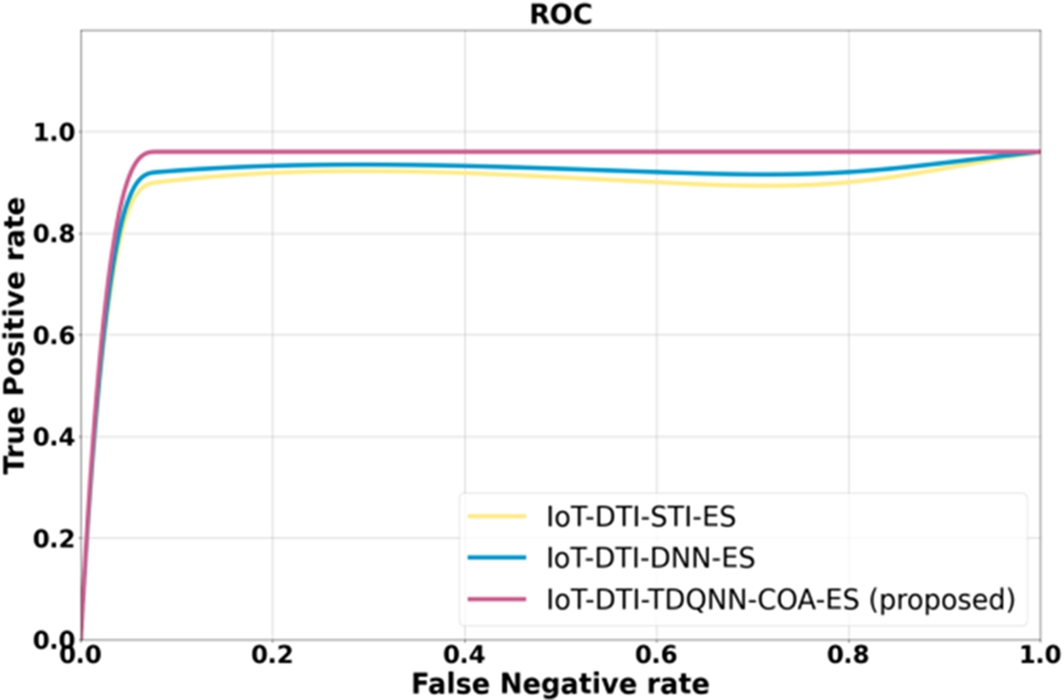
Comparative analysis of ROC with various methods.
Figure 4 depicts the analysis of computational time. Here, the proposed method attains 28% and 31% Low computational time compared with existing methods.
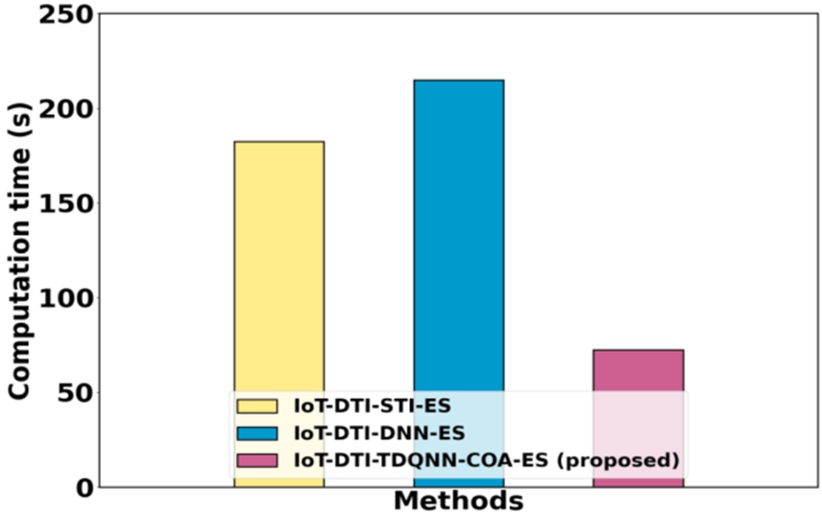
Comparative analysis of computational time.
Discussion.
Bench mark table using literature support
In this manuscript, training Deep Quantum Neural Networks Optimized with Chimp Optimization Algorithm is an interesting approach to enhance Iot security and IoT Device Type Identification. It is clear to see that the COA-TDQNN algorithm has advantages over TDQNN in every way. First off, the COA-TDQNN algorithm’s cross-entropy loss value is much lower than that of the TDQNN method throughout every training cycle on training set, but the accurateness is greater. This shows that the COA-TDQNN has a greater training impact, demonstrating its effectiveness in model training. Additionally, the pattern of discount is evident from the perspective of the validation set. With greater precision, the model’s total detection rate increases. As a result, the effectiveness of the model’s prediction is confirmed by the proposed algorithm. According to the practical significance, a method with an entire higher identification rate of network attacks is essential because the small value of cross-entropy loss function determines the high accuracy. The research demonstrates the successful application of TDQNN for identifying the types of IoT devices with respect to their data patterns, contributing to enhancing IoT security. Address the privacy and ethical considerations associated with IoT device type identification. Investigate techniques such as machine learning or differential privacy to protect sensitive data and preserve user privacy. By optimizing the TDQNN using the Chimp optimization algorithm, the accuracy of device type identification is improved, leading to more reliable and robust security measures. Simulation results illustrate from Table 3 shows that the Proposed IOT-DTI-TDQNN-COA-ES model provide 4.52%, 13.82%, 9.45%, 11.45%, 12.45%, 15.34% and 11.94% higher accuracy compared with existing methods like, Yousefnezhad et al., [17], Kumar et al., [8], Saba et al., [13], Karthika and Vidhya Saraswathi, [6], Balakrishnan et al., [2], Yin et al., [16] and Sharma et al., [14] respectively. The Proposed IOT-DTI-TDQNN-COA-ES model provide 22.33%, 28.70%, 14.56%, 11.22%, 22.22%, and 15.21% higher ROC compared with existing methods like Yousefnezhad et al., [17], Yue et al., [19], Li et al., [9], Saba et al., [13], Azumah et al., [1] and Sharma et al., [14] respectively. The Proposed MLBF-ArOA-SRCE model provide 10.22%, 24.67%, 15.7%, 32.22%, and 18.11% lower computation time compared with existing methods likes, Yousefnezhad et al., [17], Kumar et al., [8], Karthika and Vidhya Saraswathi, [6] Azumah et al., [1] and Yin et al., [16] respectively.
In this manuscript, IoT device type identification using Training Deep Quantum Neural Networks with Chimp Optimization Algorithm for Enhancing IoT Security (IoT-DTI-TDQNN-COA-ES) is verified. Here, the assessment metrics like accuracy, computational time and ROC are analyzed. Then the proposed IoT-DTI-TDQNN-COA-ES technique shows lower computational time at 28.21% and 28.99%compared with the existing IoT-DTI-STI-ES and IoT-DTI-DNN-ES methods.
The research demonstrated the effectiveness of TDQNN for recognizing the types of IoT devices based upon their data patterns, contributing to enhancing IoT security. By optimizing the TDQNN using the Chimp optimization algorithm, the accuracy of device type identification was improved, resulting in more reliable and robust security measures. The combination of TDQNN and the Chimp optimization algorithm showcased the potential for advanced machine learning techniques and optimization algorithms to strengthen IoT security measures. The research focused on device type identification, and further exploration of other security aspects, such as anomaly detection, intrusion prevention, and authentication, would enrich the overall IoT security framework. Future work will focus on expanding the variety and quantity of internet of things devices and collecting real-time network data for long period. Extend the research to include additional security aspects beyond device type identification, such as anomaly detection, real-time threat response, and secure communication protocols. Collaborate with IoT industry stakeholders and security experts to validate and deploy the proposed approach in real-world IoT ecosystems, considering practical challenges and implementation considerations. Also decide to include behavioral features for device recognition.
Conflict of interest
The authors have no conflict of interest to report.