



Abstract
The Internet of Things (IoT) necessitates secure communication and high availability among objects at the network edge to ensure reliable object-to-object transactions. In the IoT networks, despite resource limitations, especially at the edge of the network, the potential for error is high. Therefore, a mechanism to increase the reliability, lifetime, and stability of the network is necessary. In this paper, we introduce a trust evaluation framework based on a reliability-based friendly relationship method in IoT networks. We present a conceptual trust model that captures the overall performance of the IoT social network based on parameters such as nodes’ communication history experiences. Trust in the IoT network is built upon a harmonious communication environment that aligns with the trustworthiness of each object and its ability to maintain continuous interactions. We propose an empirical Trust Indicator (TI) that captures individual agents’ experiences in IoT groups, considering the results of system executions, current experience values, and timestamps of interactions. Mathematical models are developed to analyze the dynamics of trust, including trust increase through increased reliability and collaborative interactions and trust decay due to non-cooperative interactions and lack of communication. The model parameters in IoT groups through simulation show that in this system based on the level of reliability and its increase or decrease, its direct effect can be evaluated by quantitative measurement of mean time to failure (MTTF), which is a measure of devices trust and the network itself.
Introduction
With the development of the Internet of Things (IoT), a lot of data is generated that requires privacy analysis. Therefore, the cloud resources of the Internet of Things, while delaying the connection of these devices, have high bandwidth and perform calculations close to IoT devices. Distributing data processing between several edge devices allows for low latency, reduced network traffic, and fast local processing on heterogeneous devices at the edge of this network.
Considering these features while accessing the elements and data of the devices, privacy should also be improved. As will be seen in the next sections; To maintain privacy and data availability in local areas and S-IoT devices, we need secure computing to enable greater communication and device availability when sharing data [12]. Social Internet of Things (SIoT) is a new concept in the Internet of Things paradigm that integrates the Internet of Things with the concept of a social network [12]. This integration is based on object discovery and suitable friend selection according to the services required by objects and trust management among network objects. The number of friends in each group and the complexity of relationships between objects affect the navigability of communication between objects, especially at the edge of the network. According to Fig. 1, we can see an overview of the distributed learning method in the groupings of a SIoT network.
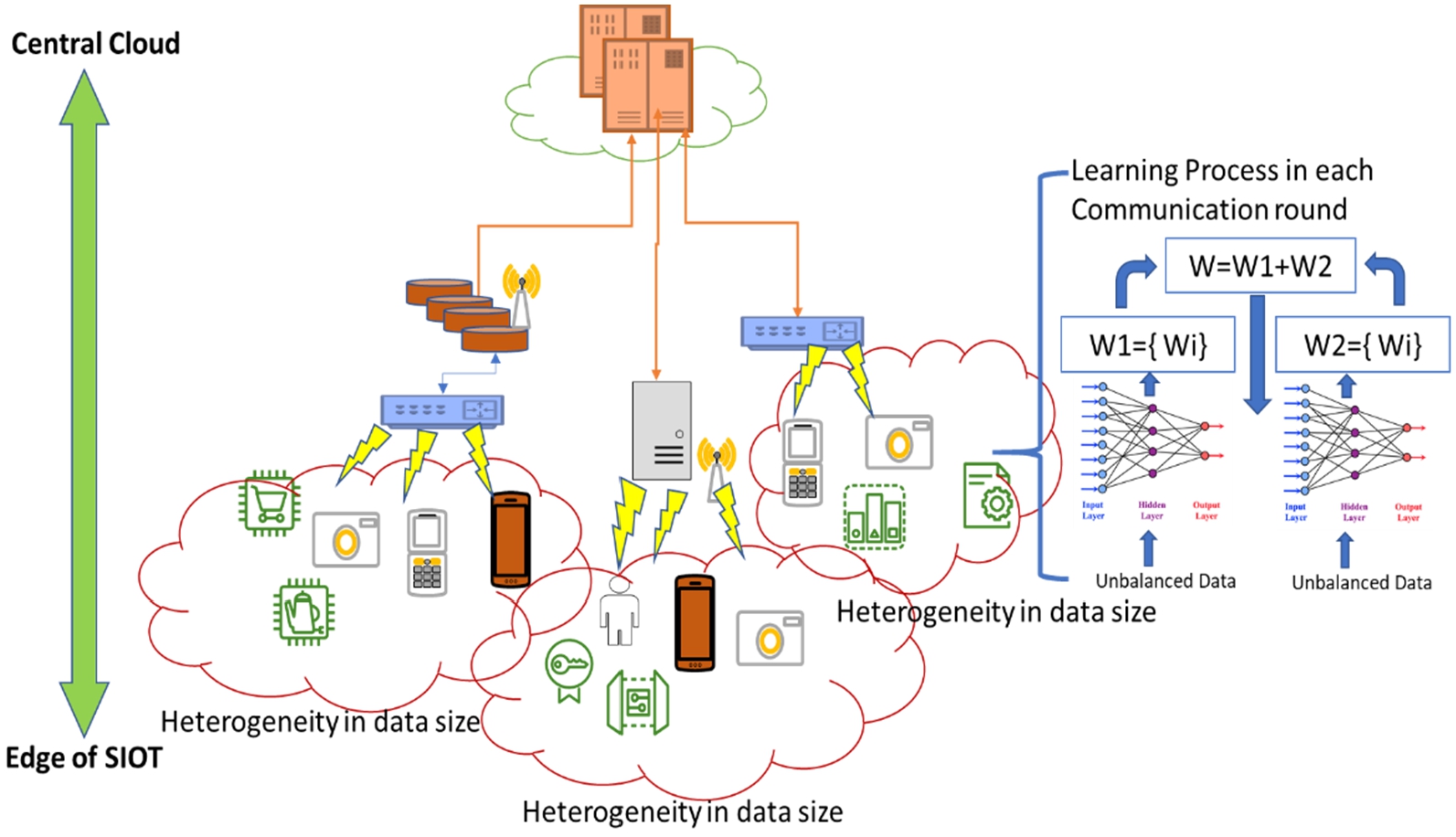
An overview of the process of distributed learning method in the groupings of a SIoT network.
With ever-increasing development of the Internet of Things and the current smartening of societies and cities, it is necessary to analyze and protect privacy to facilitate people’s lives at any time and place. Therefore, in the new SIoT technology, cloud resources are distributed to the edge of the network to carry out the practical duties of service requesters. However, these resources, have high latency and requires high bandwidth in the certain periods of time. In such conditions, especially in real-time systems and resource-sensitive objects, the safety and reliability of systems are important issues, and in computing near the edge of IoT devices, trust in workgroups is important. Accordingly, the scheduling and distribution of processing tasks among groups of SIoT devices [2], even heterogeneous ones, reduces edge-to-cloud traffic, network latency, and processing limitations.
Ensuring object-to-object transactions in the SIoT requires secure communication and high availability between objects at the edge of the network. This intelligent scenario adopts peer-to-peer object trust and object intrusion detection to solve the interference problem of faulty and invalid elements at the edge of the network [25]. In SIoT networks, despite the limited resources, especially at the edge of the network, the probability of error is high. Therefore, a mechanism is necessary to increase the reliability as well as the lifetime and stability of the network [15]. One of the main concepts that improve communication efficiency at the edge of the SIoT network is the concept of trust and its effective modeling in network performance and interactive groups of objects that are affected by failures and errors in the communication of network elements.
In general, trust is a measure of trusting an object in the network of objects despite not having sufficient ability to monitor and access it in the environment in which it is operating, although trust in this discussion is divided into two general categories: trust in the “applicant” and trust It is divided at the “system” level [3]. The concept of trust in both categorized forms is an abstract concept and varies depending on the network elements, the type of activity, the extent of the SIoT network and the expected scenarios. Also, various quantitative and qualitative factors can be effective in it. Here, according to the concept of trust in human society, the use of certificates and previous experience of the trustee is the task of creating trust. According to the opinion of objects participating in the SIoT group, reputation is the result of the previous interactions of objects at the edge of the network with the trusted element, and therefore trust is formed around the axis of “assurance”. It is the assurance that people, objects, data, institutions, operational processes and information are related in expected ways. Of course, in these interactions, access to group objects has the highest value coefficient. In this research, the awareness of access is the main factor in the formation of communication and interaction of the objects of a group [13]. Taking a deeper look at the issue, trust can come from privacy parameters. In the IoT environment, trust is formed according to the integrity of the network of things and the ability of network elements to maintain stable communication, which is one of the results of accessibility required for communication. Analyzing the data collected from the environment and making effective decisions with the information obtained from it creates knowledge based on trust in computing at the edge of the network and defines the parameters of the model.
Given that trust for a SIoT system includes the reliability, privacy and data security [20]. Therefore, it can practically indicate the ability of the system to provide quality services in terms of features such as safety, availability, confidentiality, integrity and reliability[27]. According to Grandison and Sloman, this definition of trust is called “infrastructural trust” [9].
Reliability in the IoT systems is formed by recording the social interactions of objects with each other or humans and devices in the form of a social capital (Fig. 2). This social capital in the SIoT network can include different aspects of social networks and objects and persons. To close the concept of trust in the Internet of Things network, a trustor (object/person) in relation to the whole group of SIoT elements is considered [22,26].
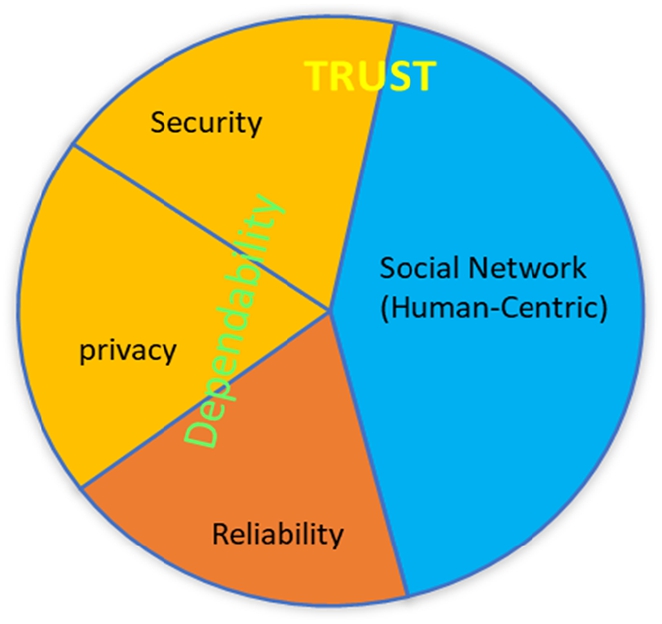
Reliability in IoT systems by recording the social interactions of things with each other or humans and devices with together.
Investigating the reliability of social IoT, fog network infrastructures and the dynamics of the environment and fault tolerance are of particular importance with considering reliability criteria. According to the studies, fault tolerance and reliability in the SIoT environment have not yet been considered in the purposes of trust and access privacy of objects. Therefore, in this paper, while examining a SIoT system resistant to errors and breakdowns, tolerance and trust approaches in SIoT have also been examined. Modeling has been done based on three operating modes, permanent failure and temporary failure. Simultaneity, reliability, availability, mean time to failure (MTTF) and density function were considered. The goal of this paper is to address the status of edge-based IoT devices according to the type of error and the threshold set for its correction, and the level of system confidence in maintaining the connection of standby devices in each group and preventing the network from collapsing.
Therefore, the main contributions of the research includes the following:
Proposing a new trust-aware task scheduling model to in social Internet of Things (IoT) devices. Mathematical modeling of service reliability and trust, and planning of possible errors regardless of the hardware conditions of heterogeneous systems and trust management of active network nodes during its development, considering the possible activity of faulty nodes in the network and their impact. Technical analysis of the proposed trust-aware task scheduling model using quality evaluation of failure detection, accuracy of fault prediction, convergence accuracy and communication overhead factors.
The main organization of this paper is shown as follows: in Section 2, related works is presented in this field. In Section 3, a SIoT trust-based clustering model for fault detection and recovery is presented, where the faults of each detected communication at the edge of the communication network are modeled in the friendly and cooperative social group. In Section 4, SIoT network performance criteria based on lifetime, node communication history, and object availability at the edge of the network, i.e. average failure time, and their mathematical equations on the communication model have been examined. Then, the results of the research through operational analysis of SIoT in a model environment, simulation results are shown in Section 4. In Section 5, we present conclusion and future work.
Due to the multiplicity of error handling mechanisms in the IoT network and the network delay and additional bandwidth costs required, edge and fog infrastructures have emerged in this cloud network to enable response in edge groups by transferring work processing to the edge of the network. The IoT network reliability will increase and the Internet traffic will decrease.
In the following, while examining fault tolerance in these networks, we will also examine its relationship with reliability. Considering that failure tolerance is important in SIoT networks and is considered as a main measure of trust, therefore workload scheduling plans should also be reviewed and presented.
Considering that the communication links between the end devices at the edge of the SIoT network to the cloud center are mostly wireless, and several rounds of repeated communication between the central cloud servers and the end devices at the edge of the network, and also the connection of the devices of each group is needed to aggregate the parameters of the learning model. By reducing the data size of parameters loaded in each connection and reducing the number of iterations in the entire learning process, the communication cost can be reduced [24]. The compression of loaded model parameters in each communication round is the solution which used in [10] and an algorithm called Fed-PAQ is used and its convergency is checked. It is shown in [6] that the convergency of federated learning is improved by intelligent selection of the terminal device. The partial participation of each local device in each iteration of communication in the group of Internet of Things devices in updating the learning model is proposed as a strategy, in where there is no need to upload the model parameters of local devices that have approached the local optimal state [5].
It is shown in [28] that the use of reinforcement learning in selecting the subset of final devices of a group has the best operational efficiency. In [21], by using the FOLB algorithm in choosing the optimal device, the casualty of the devices have been reduced to the lowest amount. In [16], the conditions for selecting the best number of network edge devices in each round of communication have been used according to the reinforcement learning method and the network edge conditions have been investigated. In the method presented in [18], heterogeneity problems are divided into two categories: statistical heterogeneity of data and heterogeneous systems. Of course, the heterogeneity of the system and end devices leads to the possibility of different computing capacities in communication conditions, also, different heterogeneous devices have different power, which causes synchronization problems and losses of devices in each group of objects. In general, three system solutions can be stated to solve synchronization problems; asynchronous parallel systems [1], massively synchronous parallel systems [32] and old synchronous parallel [11].
There has been extensive research on trust in social sciences, computer sciences and computer networks. However, in [8] the authors state that an element of society is considered trustworthy if its action is beneficial or non-harmful to the observing agent. This belief quantitatively indicates the probability of an agent trusting other agents in a given period of time in any group [9]. The concepts of competence and reputation in the digital world also include trust management mechanisms in security issues such as identity management in the network [31] and access control in distributed systems [14]. In these references, the authors have developed the concept of trust in network environments such as P2P networks, wireless sensor networks, social networks, mobile ad-hoc networks, and the Internet of Things. However, little work has been done on trust assessment in IoT environments.
In [19], the authors have proposed a distributed processing system for edge computing near the edge devices that, while having trust between components, also disrupts latency. In this research, the authors have grouped the edge objects in such a way that they are processed when the task arrives, its processing begins so that it can respond to the needs at the appointed time. The goal is reducing the congestion of network by processing large tasks at the edge of the network. What is certain in this work is, the importance of fault tolerance, especially in mobile devices at the edge of the network. Therefore, the authors have presented a decentralized error processing method by focusing on the heterogeneity of devices while maintaining the reliability of the edge network. It can be seen that the complexity of IoT conflicts with the strategy of fault tolerance and trust, and this issue should be considered as a dominant assumption in conducting research in this field.
The authors in [33] presented certain models in trust evaluation. They calculated direct trust, which is a part of reliability, and explained that in some scenarios of trust evaluation in mobile networks, due to the high mobility of network elements, some elements are sometimes unavailable and maintaining the system for managing information is difficult. Therefore, the importance of awareness of availability is evident in this work and it requires the possibility of research in limited environments in future works. The weakness of the method which presented above is that, the authors have not provided a mechanism for extract knowledge and combine information from trust evaluation, which in the current work of the federated learning-based method can help to provide such a trust mechanism.
In [4], a data-driven approach for rational evaluation of single critical error and reliability of a safety system is presented. Logical error injection has been used during system performance, to check trust and reliability. An unsupervised machine learning method was used for the error occurrence, propagation, detection and correction in the system execution cycle. The interaction between the system components causes logic errors and timing errors. The authors have used the Trellis diagram to graphical description of error convergence. Also, one of the other results of this research is familiarity with the content and knowing when the error occurred. There is also a logical argument in this article that shows; Estimating system reliability and trust without achieving a degree of reliability improvement has no operational value, so the primary goal of knowing the error and the level of reliability and availability of a system is to increase, its resistance to error and failure and failure holes.
According to the above-mentioned related case studies, recent research papers didn’t investigated trust factor for approving friendly relationship for social nodes in the SIoT with respect to direct evaluation of reliability factor. So, this research suggests a new conceptual trust model based on Trust Indicator method to manage reliability for task scheduling in the SIoT.
Trust evaluation based on reliability in SIoT systems
This section proposes the role of friendly relationship for social nodes in the IoT. First, a brief illustration of trust model in the SIoT is presented. Second, the concept of empirical Trust Indicator (TI) is presented. Measuring the value of trust in the network and between its elements can be absolute or relative. It can also include trusted trustee information and specific network requirements for a given purpose. For example, the goal of reducing the risk of accidents of smart and self-driving cars.
Third, analysis of mathematical model is illustrated based on some important formulas. Finally, the final model is extracted and simulations are performed based on it.
Definition of trust and presented a conceptual trust model in the SIoT
Trust is a trustor’s belief in a trusting element that performs the tasks required by the system in the field of trust to meet the trustor’s expectations in the network infrastructure. Therefore, in the trust evaluation process, network components are analyzed to measure the resulting risk. These components can be combined with parameters of human interactions in any society consisting of objects or humans and objects. Trustees in this type of network are different and can include; The custodians of communication in the community are elements and different areas of trust, such as priorities of threats, opinions, experience/history of elements and entities, and have different risks. Also, in the SIoT network, trustees and trusted elements can be final devices, systems, humans, servers, services and applicants (programs).
Here, it is important to explain that the trust does not include the preferences of the trustee and the assets of the trustee, such as trustworthiness and reputation. Therefore, according to this conceptual model, trust in the SIoT network includes the understanding of each trusted element about the trustworthiness of the trusted element in the SIoT environment and in a certain period of time. Trust is created by creating a harmony between the desires of elements to communicate and maintaining the continuity of communication and environmental conditions, which are the main shapers of the requirements of access and time and the ability to interact between elements and devices. One of the important features of trust is that its functional context can change in each period of system implementation and sample execution because it is related to the history of communication of elements and objects.
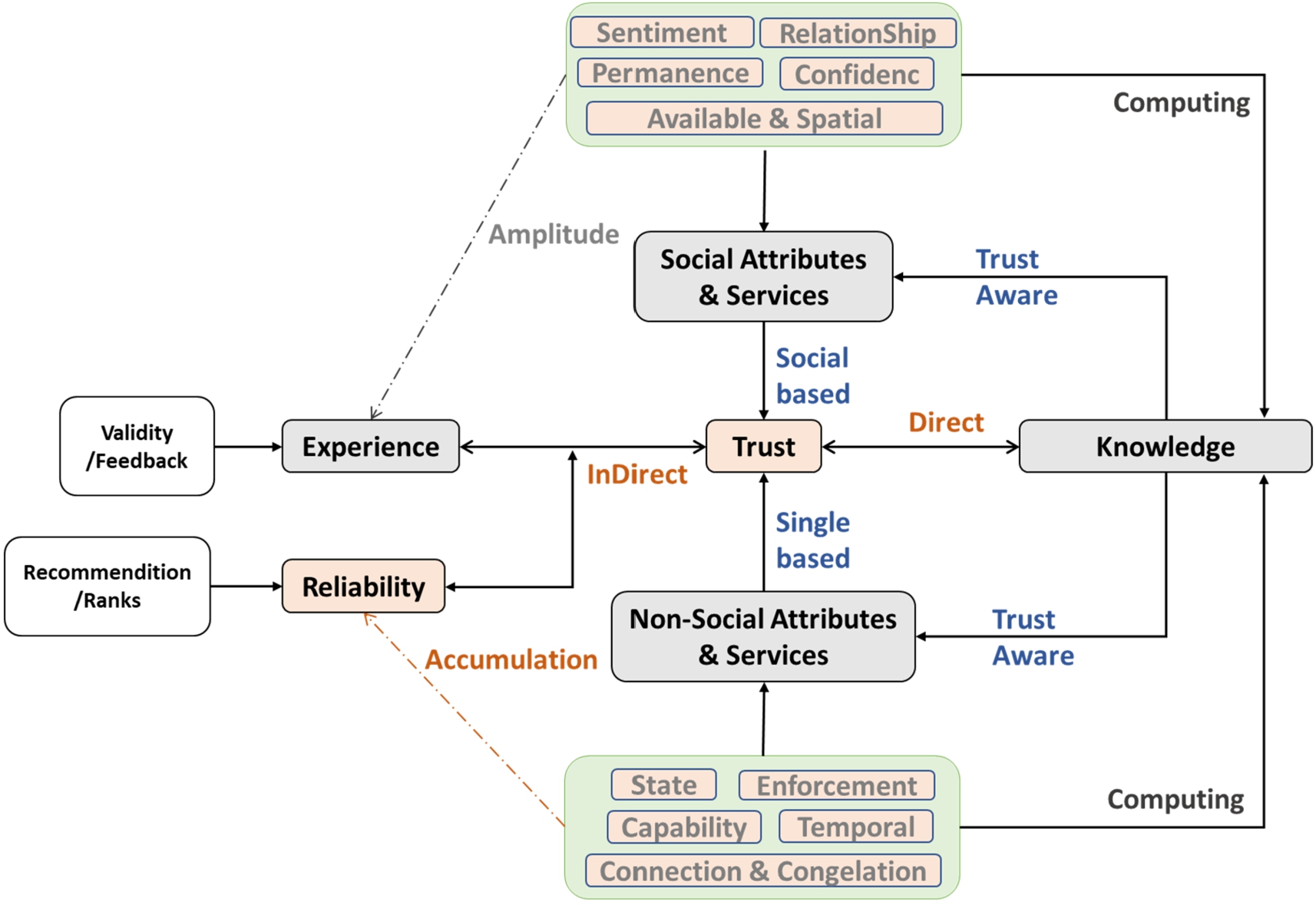
The conceptual model of trust and the requirements of its provider in the environment.
In fact, trust can include a trustor and a trustee with the above-mentioned conceptual model, who must have the same work background. Although the operating environment of the elements is different. According to the conceptual model of trust and the requirements of its providers in each environment shown in Fig. 3, trust can be obtained directly or indirectly, as well as socially from objects or from each object alone. Of course, depending on the type and requirements of the supplier, it can have different grade. According to the above explanations and the ones which shown in Fig. 3, we can say; The purpose of each trust model in the SIoT network and its groups has two aspects: (1) TA evaluation in each time period of the trustworthiness of an element, taking into account the environmental conditions and the objects present in the group; (2) calculating the sum of the perceived trustworthiness in the combination of TAs as a quantitative value of trust. In this SIoT model, the most suitable distribution for friendship values between network elements is used as a cumulative distribution with one or more related probability density relationships. This distribution is similar to a power law for each X_Friend and guarantees the communication direction of systems in the SIoT network. In addition, the root mean square error has been used to calculate the distance between elements in the IoT. Friendship relationships between elements in our model are static and dynamic friendships. Static friendship is defined based on data profile characteristics and distances between static elements that are constant over time, and dynamic friendship is defined based on interaction history that varies over time. Therefore, a trust evaluation model is formed based on a combination of interaction history and distance and device profile. This means that each device interacts with other SIoT network elements and evaluates and updates its trust based on mutual interest in others in communication and interactive behavior. So, in this model, it is said that trust is dependent on static distance and trust is dependent on dynamic interaction. Conditional distribution expresses its relationship and reliability with Bayes conditional probability method (Eq. (1)).
Presenting a conceptual model for experience Trust Indicator (TI) can be according to trustee and trustor, which calculates the experiences of individual objects in SIoT groups based on the following three main concepts: the results of each execution period / test of the informative system, the current value of experience in each iteration in the group of objects, network edge, and timestamps of individual interactions between network edge elements. For example, after each interaction between objects, the implicit and explicit feedbacks can be obtained from the system and cause the devices confirmation, reputation or isolation based on reliability or failure in the group which remove even an inaccessible device, and in the final result estimate their success or failure by tracking the interaction between the devices, in each connection.
The model of SIoT systems
Another important component in this research is the possibility of creating an aggregation model at the network level to calculate Experience TI (Trust Implementation) in each implementation period. An important assumption using the relationship between humans in society, which is also used in SIoT, is that; In cooperative interactions, the sum of experimental calculations is important, and non-cooperative interactions reduce this parameter [7]. Based on the conceptual model of trust in interactive systems such as SIoT, these non-cooperative interactions usually have a basis based on the reliability and failure of devices and communications in the group, which is as follows.
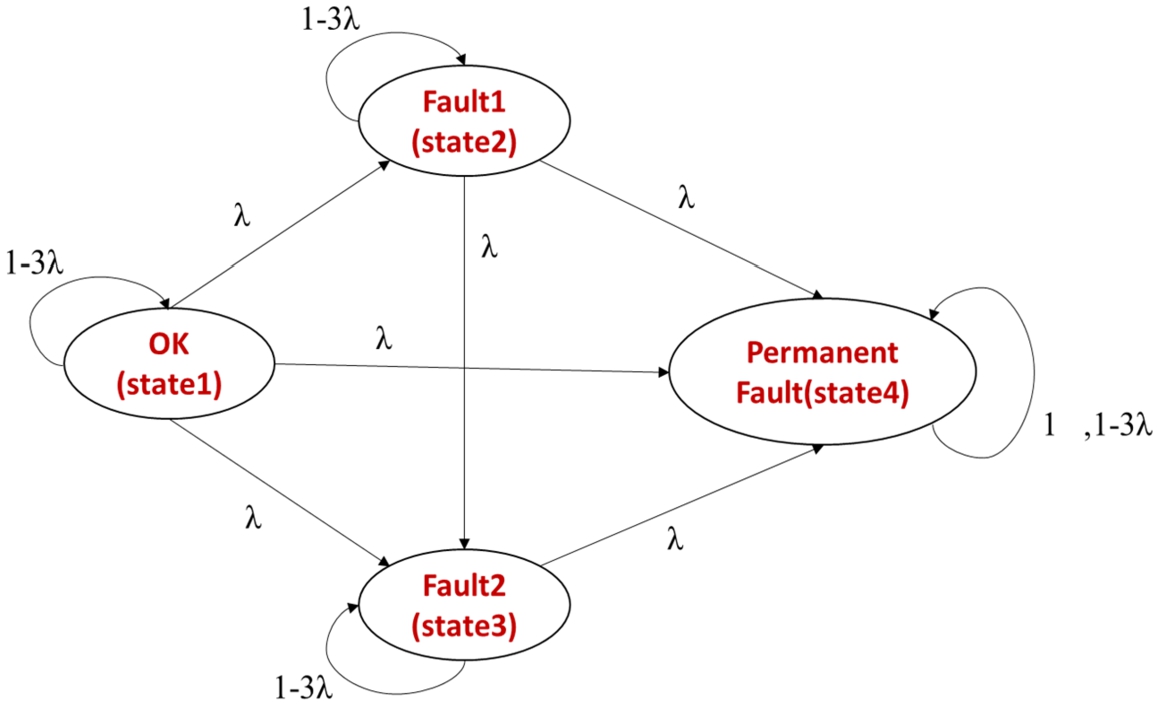
Hidden Markov chains based on conceptual model for reliability in proposed trust-SIoT.
To exploit the reliability/failure output of any system model with heterogeneous data in the system structure to evaluate the trust in communication between the components of a group, the best tool is, the hidden Markov chain which shown in Fig. 4 for the failure reliability of each faulty object which is mapped in the proposed Trust-SIoT (TSIoT). In this diagram, Ok mode indicates the health of the object, mode 2 and 3 respectively indicate a temporary failure in the object due to software and hardware problems, and mode 4 indicates the permanent stop of the object and its failure in connection with the components of the object group, Assuming λ as the failure rate, which depends on the physical and communication of the object, with the threshold
In relation (6), ϑ is the interaction score is in the range
Decrease and reduction due to non-cooperative interactions between things and requesters
A non-cooperative interaction occurs when the interaction experience quality score
Communication decay due to lack of communication in consecutive periods
If the participants of a group of objects do not interact with each other, the relationships between them deteriorate over time [23]. Similarly, it can be said; If after some time there is no interaction or the interactions are just neutral repetitions (i.e.
Communication’s trust in edge of SIoT
Functional requirements resulting from trust-based communication include; The data size of the transmitted model is the number of end devices that are selected at the edge of the network for each SIoT group and they depend on the IoT device model, and the number of repetitions of communication rounds. In fact, the rate of convergence is derived from the repetitions of communication rounds in each group. Therefore, in terms of local iteration in each network edge group, the following two factors can be effective [29];
Communication frequency, which is the number of rounds of each network edge group before aggregating the trust parameter in the central server and is denoted by τ. Convergence rate, which as mentioned includes the total number of local iterations in each group of SIoT objects transactions and is denoted by T. Therefore, the total number of communication rounds is C, which is calculated as
According to the concept of SIoT and the definition of clustering according to Algorithm 1, it can be approximated by the computational complexity of time and space in real implementation. According to Algorithm 1, if the number of clusters K and the dimensions d are assumed to be fixed, it is shown that the grouping of SIoT objects has a time complexity of

Clustering of SIoT devices
With the modeling that described in the clustering of objects in SIoT, and the grouping performed to determine trust-based friendships, the size of live nodes in each group and cluster and node links were evaluated by simulating the average failure time. The number of live nodes at any moment represents, the number of current operating nodes and ready-to-work nodes in SIoT. The accuracy of observation error also shows the ratio of faulty nodes to the total inactive or broken nodes in SIoT. The number of active links in the network is also dependent on the number of processing tasks or requests of applicants that are answered in time by the network. With the random clustering technique which described in Algorithm 1 and in the presence of 100 nodes of SIoT groups, data that can be fixed or moving in simulation model, with
As shown in the conceptual model of Fig. 3, reliability is one of the fundamental requirements of trust in SIoT systems. The number of healthy and active nodes in each network decreases with the passage of time. By reducing the number of safe and healthy nodes, the trust of the whole system is lowered and there is a possibility of disintegration. In the proposed model, the number of live nodes can be increased with the possibility of replacing deleted nodes with standby nodes. On the other hand, there is a direct relationship between trust, the number of active links and the number of live nodes. Establishing a balance between fault tolerance and node battery power increases the reliability and longevity of more active nodes in SIoT [30].
Considering the effect of mean time to failure (MTTF) in reliability assessment as an effective method and according to the conceptual model of trust in Fig. 3, it can be said; There is a direct relationship between reliability and trust. Therefore, calculate the MTTF with using the arithmetic mean R (t) can be used as a measure of the reliability of the network. Also, this measure relates the quantitative values and the relationships of the number of nodes during the network activity and the failure rate in the calculation of trust.
This result is derived from the mechanism of continuous performance and formulation of the reliability and its explained role in network trust. Of course, errors and short-term stops of the network caused by calculations, are ignored, because short-lived errors are tolerable in the SIoT implementation process.
As seen in Fig. 5; The effective failure mechanism is phased in the trust of local nodes at the edge of the network and then in each cluster and the entire SIoT network. The most important work done in this model is local checking or sending a request from the local node to the SIoT server in the cloud so that the group related to the faulty node can be identified. To increase trust at the SIoT edge, the server delegates network responsibilities to the edge processor of each group. In this step, by localizing the friend detection process, grouping is done at the edge of the network. In the model used here, the results of each processing round are sent back to the cloud, then the requester’s fog response is also sent by making a decision at the network level. The assumption used in the modeling of this SIoT network is that in order to replace a faulty node or turn it into a standby mode, the initial request is sent to the cloud server to select the most suitable spare node among the edge nodes. In this way, the transfer of request and fault correction from the edge to the center of the cloud can increase trust. Then, in the reconfiguration, the cloud server redistributes the responsibilities and specifies the responsibility of the spare node at the local edge. However, any changes of network nodes and effective changes in their trust are stored in the local cloud server and transferred to the central cloud server for use when needed. This process continues until the system is active and all SIoT communications are down.
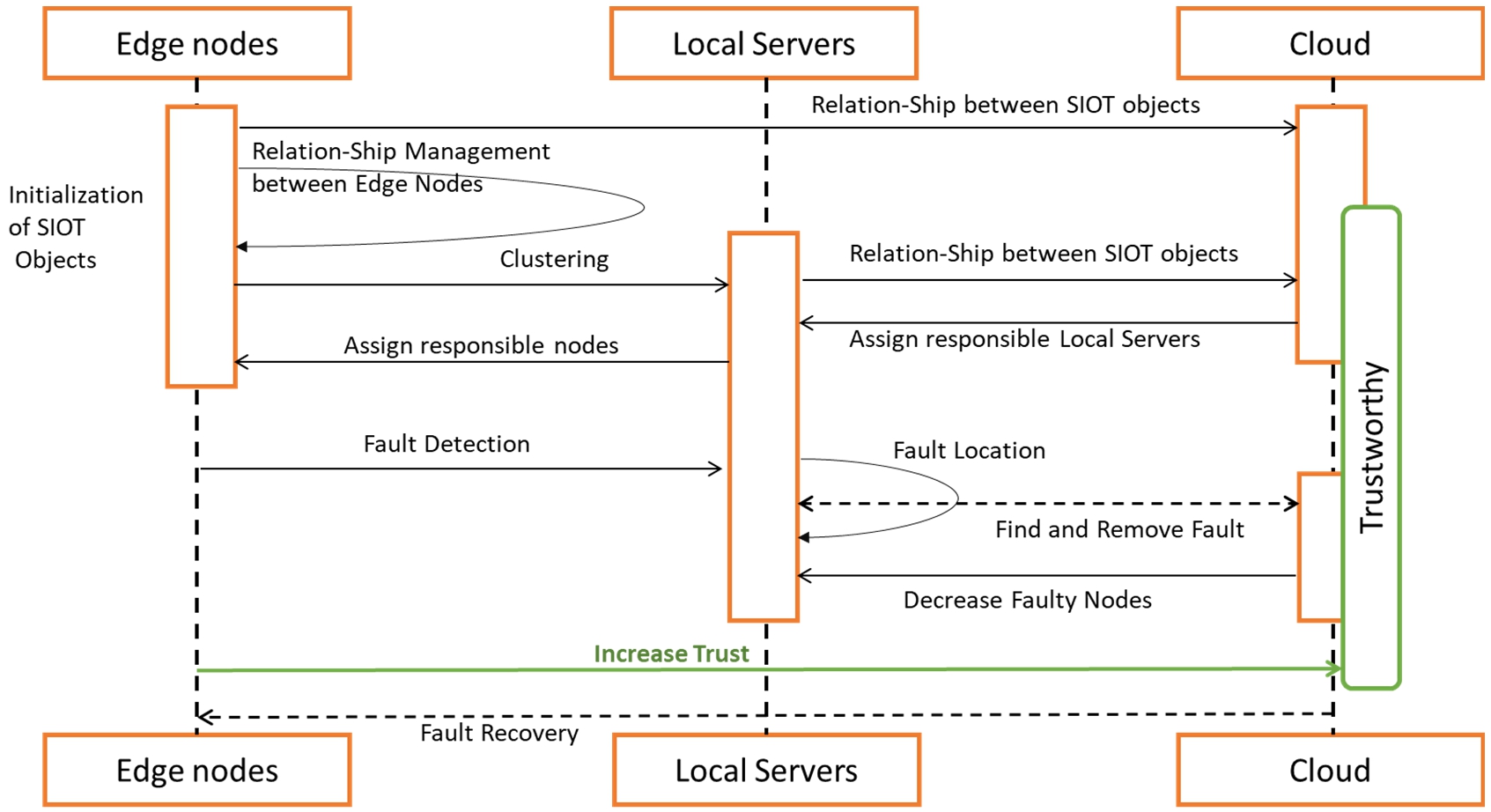
The fault detection and recovery mechanism to increase trust at the SIoT.
Therefore, by considering the interactions resulting from the cooperation of Trust SIoT nodes and reliable data sharing, malicious nodes can be removed or their errors corrected, thereby increasing the trust of the entire network. It can also be concluded from the direct relationship between trust and reliability in TSIoT that the increase of one of them causes the increase of the other.
In this section, while simulating the SIoT model based on trust and failure of network and communication nodes, the availability of devices in each group is checked. The current simulation was carried out during 500 seconds and with the number of 300 nodes in both fixed and incremental node modes in the SIoT model and the following results were obtained. Improvement in communication and increase in trust as well as improvement in communication overhead in the case of creating SIoT network based on cumulative distribution model, compared with Weibull distribution which is a solution for using two parameters of interaction history and distance parameter. As seen in diagram Fig. 6, which is the result of a simulation period; In using Weibull distribution, the level of trust in SIoT increases with the increase of the number of nodes.
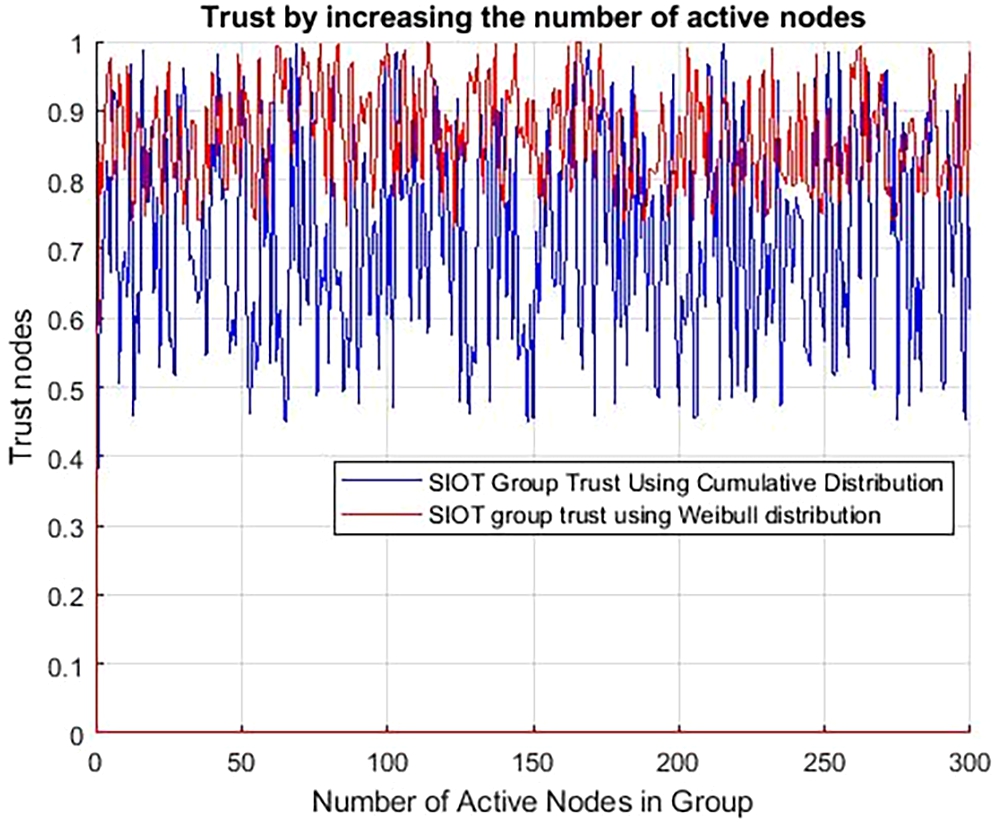
Comparison of SIoT trust level based on cumulative distribution with one parameter and Weibull distribution with two parameters, distance and communication history of nodes and increasing the number of active nodes.
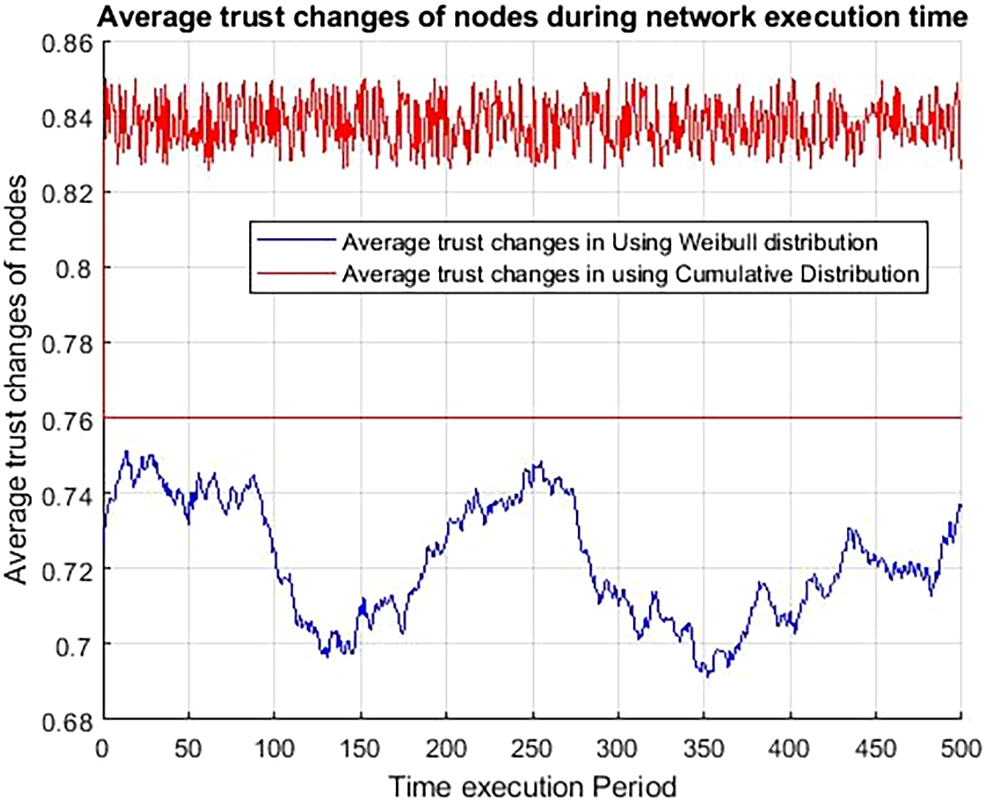
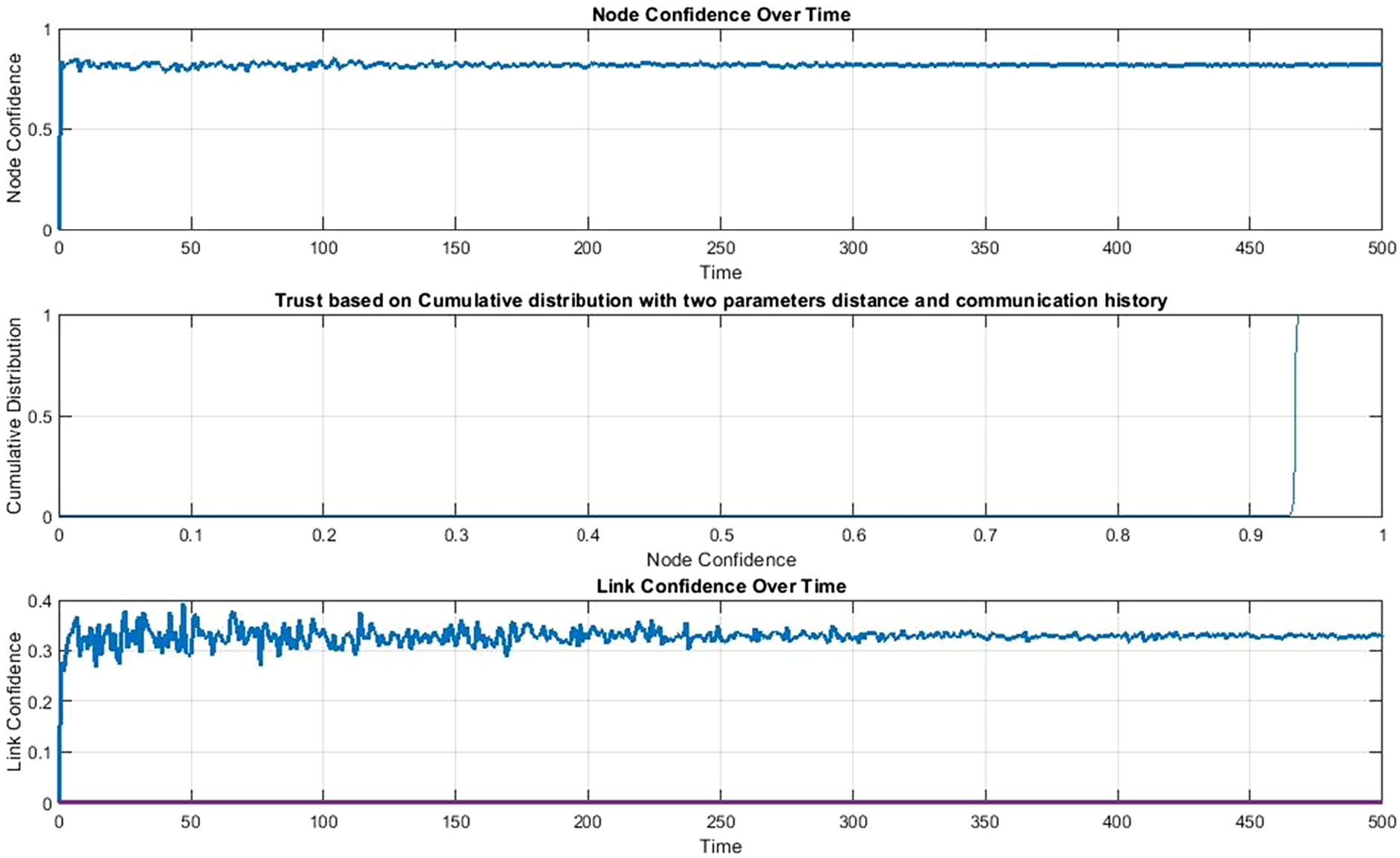
But in the fixed number of nodes during the simulation period and without changes in the number of active nodes, the SIoT communication model based on cumulative probability distribution and node error parameter has higher reliability. In a way that shows significant changes compared to the state of the effective parameters of network error and node error. Of course, the characteristics of the node itself are also effective in these changes, which are omitted here (Fig. 7). In this simulation, the loss function of training repetitions is also calculated based on nonlinear transformations and cross entropy [27].
Node and link trust in using cumulative distribution for SIoT organization.
The simulation of the reliable communication model was done based on the modeled data set, in a multi-layered manner with an input layer, an output layer and a hidden layer and densely connected and interconnected. Grouping is an essential part of the initial work steps and always helps to separate and clarify communication. This grouping of a set of objects is done based on the measurement of distance and similarity and the history of interactions. Regarding the similarity, the profile of the object is used, which is assumed to be a known and fixed value in the simulator. The connection between the edge network and the cloud is established after grouping. The proposed reliable and fault-tolerant architecture uses an edge grouping algorithm. Fault tolerance consists of four stages: detecting the fault, identifying its location, restraining and correcting it, and restoring the node’s active state or replacement, and finally, by reconfiguring the network while ensuring the established trust value, the network can also reach the end of the trust state. It will work and then it will end. Assuming the failure at the IoT edge and the cloud equal to zero, the trust model is expressed as follows: relationships between network nodes are established in the setup phase, a trust according to [32] is modeled in each SIoT group will be upon receiving a friend request, the profile details of the applicant are checked by the local server at the edge of the network. Assuming that the applicant is not assigned in the current group, the task of evaluating the status of the applicant is performed through the central cloud and sent to the IoT edge server. In each step, the status of the active node and the number of failures associated with each node should be recorded in order to detect temporary errors. In this method, one unit is added to the reliability coefficient and one unit is added to its value for each observation. If the failure rate threshold is lower than the specified value, this node is temporarily removed and a standby node can replace it. We assume that after three failures of the node, it should be removed from the SIoT network. As seen in the graphs of Fig. 8 and Fig. 9. Cumulative and Weibull distributions have close effects on the confidence level. What is certain is that the effect of failure and the average time to failure has a significant effect on the total trust level, and its changes cause confusion in the level of trust, which can be seen as an example in Fig. 10.
Link and node trust changes in the presence of cumulative distribution.

Node trust and link interactions in using Weibull distribution for SIoT organization.
Cumulative and Weibull distributions have close effects on the confidence level. What is certain is that the effect of failure and the average time of failure has a significant impact on the overall level of trust, and its changes cause confusion in the level of trust, of course, with the reduction of the failure rate at the level of network components, the total failure rate has also decreased in both nodes and connections. And this increases the failure rate, the change trend of the failure rate during the simulation run can be seen in Fig. 10.
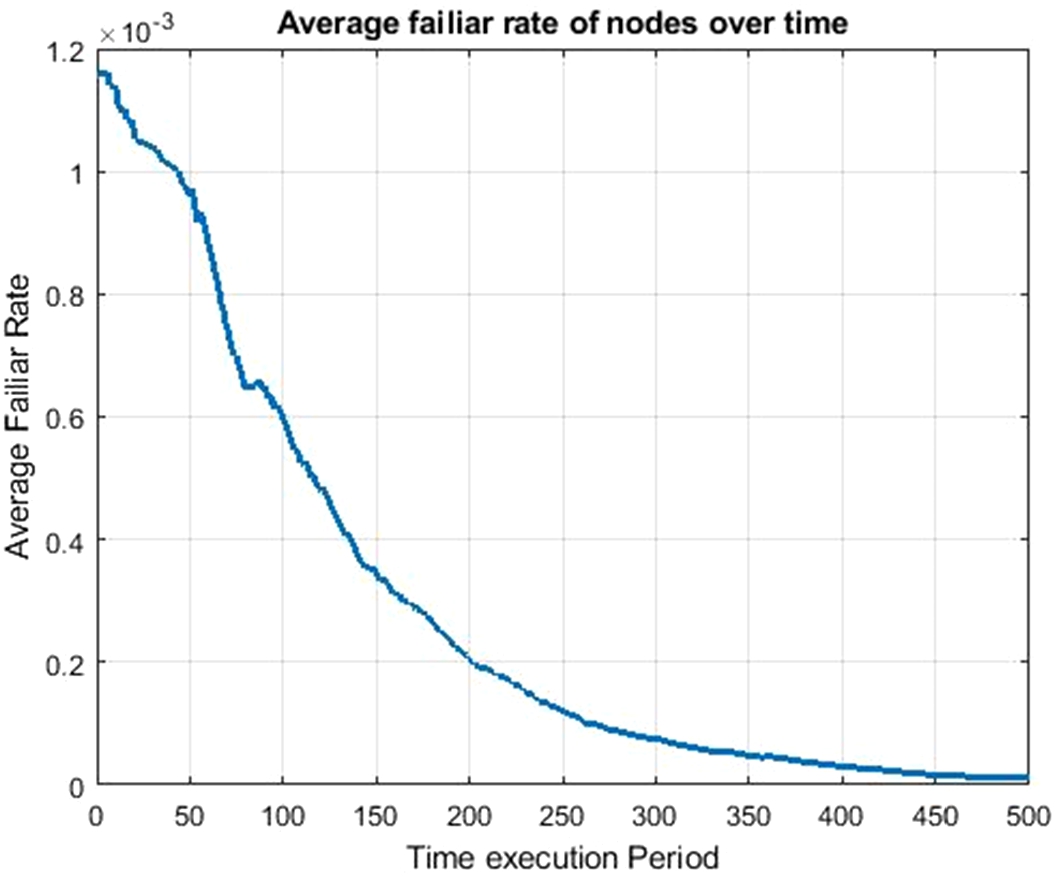
Decreasing changes in the failure rate during the simulation execution period.
By considering the trust parameters in the SIoT model and strengthening the transmission rate, higher access can be obtained [5] and also by increasing or decreasing the connection strength in SIoT, there is a direct and relative relationship with the level of applicants. But if the uploading of local model parameters in the central servers is to be divided into several parts, this issue can increase the communication overhead and weaken the communication. On the other hand, since SIoT edge end devices usually have limited processing resources, therefore, there must be a balance between the level of privacy protection, access, convergence performance and error detection and accuracy [10], which can reduce communication costs to improve.
To implement the problem of trust assessment in SIoT, first by using the grouping of objects based on distance and communication history and the characteristics of nodes, a fault-tolerant based trust model implemented based on network edge schemes has been prepared. In this research, we designed a decentralized technique based on error and failure assessment for processes with diverse time requirements and heterogeneous system type to moderate the disadvantages caused by requirements such as delay in the IoT and the availability of failure-prone nodes by reducing it. First, with a grouping method, the SIoT grouping in the network was done and the edge nodes of the IoT that are responsible for providing services were identified. Nodes are grouped by distance and desired connectivity, and relationships are established as new live nodes join the network and reliability. The reliability is evaluated every moment and its information is provided to the SIoT manufacturer. By successfully clustering, network traffic is reduced. In other words, it can be said that using the method of trust and error management during it at the edge of the network also reduces the energy consumption of Internet of Things devices, so the lifespan of the system increases and error detection in the applicants is also improved. The simulation results show that the changes in device failure and communication failure are directly related to trust, and increasing the effective parameter in the social networking of objects in SIoT does not have a significant effect on the process of trust changes in the entire network.
In the future, it is suggested to work on trust management in SIoT by considering other requirements in the presented conceptual model. Also, the FL-SIoT algorithm should be investigated by focusing on direct and indirect methods and considering optimal access policies. To reach the desired answers, different machine learning methods can be tested in real problems and the degree of deterioration or improvement of their effect can be calculated. Due to the limitation of the number of devices used in this research, it is suggested that scalability is also considered as an effective requirement in grouping and its effect in SIoT, as well as the use of FL in SIoT.
Footnotes
Acknowledgements
This paper has received support by the funding project: China Southern Power Grid Co., Ltd. Technology Project (GDKJXM20230711). All authors would like to express their gratitude to Zhongshan Power Supply Bureau of Guangdong Power Grid Co., Ltd. for providing data support and application cases.
Conflict of interest
The authors have no conflict of interest to report.