



Abstract
A directed hypergraph is powerful tool to solve the problems that arise in different fields, including computer networks, social networks and collaboration networks. In this research paper, we apply the concept of single-valued neutrosophic sets to directed hypergraphs. We introduce certain new concepts, including single-valued neutrosophic directed hypergraphs, single-valued neutrosophic line directed graphs and dual single-valued neutrosophic directed hypergraphs. We describe applications of single-valued neutrosophic directed hypergraphs in manufacturing and production networks, collaboration networks and social networks. We develop and implement algorithm for our certain networks models based on single-valued neutrosophic directed hypergraphs.
Keywords
Introduction
Fuzzy set theory generalizes the concept of the classical set theory. In classical set theory, we may only conclude either the statement is true or false. However, many statements have variable answers which can be handled more accurately using fuzzy set theory. Zadeh gave the concept of fuzzy sets in 1965 to solve problems with uncertainties [34]. Fuzzy sets and fuzzy logic are playing a vital role in controlling and modeling uncertain systems in various fields, including society and nature, clustering, linguistics and decision-making. In 1986, Atanassov [8] illustrated the extended form of fuzzy set by adding a new component, called, intuitionistic fuzzy set (IFS). The notion of intuitionistic fuzzy set (IFS) is more meaningful as well as inventive due to the presence of degree of membership, degree of non-membership and the hesitation margin. In 1998, Smarandache [28] submitted the idea of neutrosophic set (NS). A NS has three constituents: truth-membership, indeterminacy-membership and falsity-membership, in which each membership value is a real standard or non-standard subset of the unit interval ] 0-, 1+ [. In real-life problems, NSs can be applied more appropriately by using the single-valued neutrosophic sets (SVNSs) defined by Smarandache [28] and Wang et al. [30]. A SVNS generalizes the concept of IFS. In SVNS, three components are not dependent and their values are contained in the unit interval [0, 1]. Majumdar and Samanta [20] studied similarity and entropy of SVNSs. Ye [31] proposed correlation coefficients of SVNSs to solve single-valued neutrosophic decision-making problems. To simplify neutrosophic sets, he also [33] proposed a method of multicriteria decision-making using aggregation operators.
Graph theory has become a powerful conceptual framework for modeling and solution of combinatorial problems that arise in various areas, including Mathematics, Computer Science and Engineering. Hypergraphs [11], a generalization of graphs, have many properties which are the basis of different techniques that are used in modern Mathematics. The applicability of graph theory has widened by the generalization of undirected graphs, called undirected hypergraphs, which have been proved to be more useful as mathematical modeling tools. In real World applications, hypergraph techniques appear very useful in many places, including declustering problems which are important to increase the performance of parallel databases. Hypergraphs can be demonstrated as a useful engine (or tool) to model concepts and systems in different fields of discrete mathematics. There are many complex phenomena and concepts in many areas, including rewriting systems, problem solving, databases and logic programming which can be represented using hypergraphs. Directed hypergraphs are used to solve and model certain problems arising in deductive databases and in model checking.
Fuzzy graphs were narrated by Rosenfeld [26] in 1975. After that in 1987, some remarks on fuzzy graphs were represented by Bhattacharya [12]. He showed that all the concepts of crisp graph theory do not have similarities in fuzzy graph theory. Several concepts on fuzzy graphs and fuzzy hypergraphs were discussed by Mordeson and Nair [21]. Parvathi et al. described some operations on intuitionistic fuzzy graphs in [22]. Kaufmann [16] gave the idea of fuzzy hypergraphs and Chen [14] defined the interval-valued fuzzy hypergraphs. Generalization and redefinition of fuzzy hypergraphs were discussed by Lee-Kwang and Keon-Myung [18]. Parvathi et al. [23] established the notion of IF hypergraph. Later, Akram and Dudek extended this idea and studied its various properties in [7]. They also represented various applications of intuitionistic fuzzy hypergraphs such as radio coverage network and clustering problem. Parvathi et al. [24] established the notion of IF directed hypergraphs. The minimum spanning of SVN tree and its clustering method were studied by Ye [32]. Akram and Shahzadi [2] introduced the notion of neutrosophic soft graphs with applications. Akram [3] introduced the notion of single-valued neutrosophic planar graphs. Akram et al. [1] also introduced the single-valued neutrosophic hypergraphs. Representation of graphs using intuitionistic neutrosophic soft sets was discussed in [6]. Akram and Shahzadi [5] highlighted some flaws in the definitions of Broumi et al. [10] and Shah-Hussain [27].
This paper is classified as follows: In Section 2, concepts of SVN directed hypergraphs are described. The concepts of simple, elementary, support simple and sectionally elementary SVN directed hypergraphs are introduced. Section 3 deals with concepts of SVN line directed graphs, 2-section of a SVN directed hypergraphs and dual SVN directed hypergraphs. We describe the construction of dual SVN directed hypergraphs. In Section 4, we discuss how the concept of SVN directed hypergraphs and SVN line directed graphs can be helpful to understand and analyse the production and manufacturing networks, social networks and collaboration networks. In the last section, we conclude our results. Throughout the paper, following notations and terminologies are used:
Single-valued neutrosophic directed hypergraphs
In real life applications, it is complicated to use neutrosophic set in scientific and engineering problems having the values from real standard or non-standard subset of ] 0-, 1+ [. To apply neutrosophic sets in real life problems more conveniently, we use single-valued neutrosophic sets.
We now define a single-valued neutrosophic directed hypergraph.
α
H
(E
i
) = α
H
({v1, v2, v3, …, v
r
})≤ min {α
A
i
(v1), α
A
i
(v2), α
A
i
(v3), …, α
A
i
(v
r
)}, β
H
(E
i
) = β
H
({v1, v2, v3, …, v
r
}) ≤ min {β
A
i
(v1), β
A
i
(v2), β
A
i
(v3), …, β
A
i
(v
r
)}, γ
H
(E
i
) = γ
H
({v1, v2, v3, …, v
r
}) ≤ max {γ
A
i
(v1), γ
A
i
(v2), γ
A
i
(v3), …, γ
A
i
(v
r
)}, for all v1, v2, v3, …, v
r
∈ X. X = ⋃
k
supp (A
k
), for all A
k
∈ V.
Here {E1, E2, E3, …, E r } is the family of directed hyperedges.
In SVNDHG D = (V, H), any two vertices s and t are adjacent vertices if they both belong to the same directed hyperedge. A source vertex s is defined as a vertex in D if h (x) ≠ s, for each x ∈ H. A destination vertex d is defined as a vertex if t (x) ≠ d, for every x ∈ H.
We illustrate the concept of a single-valued neutrosophic directed hypergraph with an example.
Incidence matrix of SVNDHG
Incidence matrix of SVNDHG
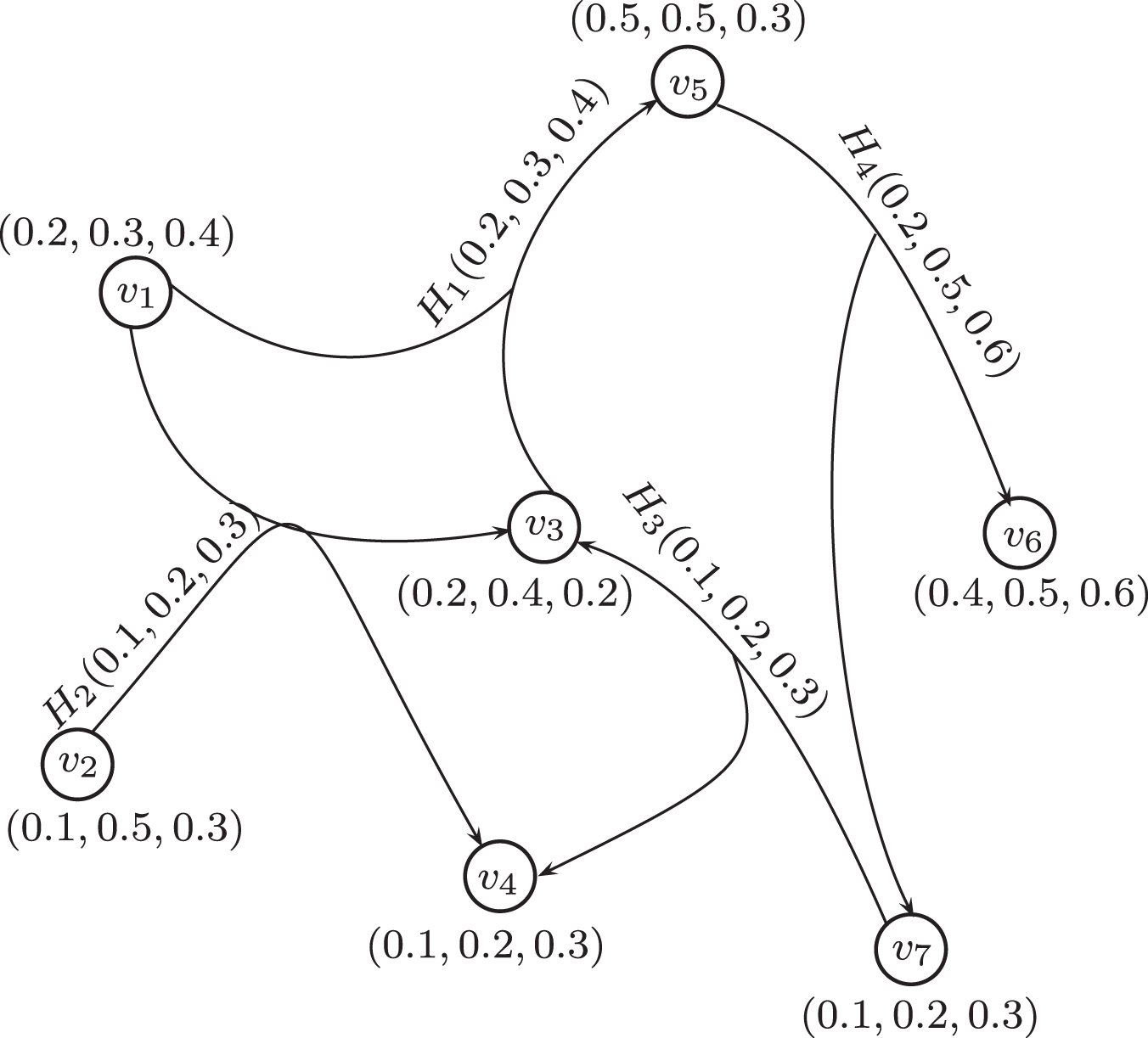
SVNDHG.
A SVNDHG D = (V, H) is an elementary SVNDHG if its all directed hyperedges are elementary.
The strength of directed hyperedge describes that the objects having the participation degree at least η (H i ) are grouped in the directed hyperedge H i .
A SVNDHG D = (V, H) is called support simple if A j , A k ∈ H, supp (A j ) = supp (A k ) and A j ≤ A k , then A j = A k .
A SVNDHG D = (V, H) is called strongly support simple if A j , A k ∈ H and supp (A j ) = supp (A k ) imply that A j = A k .
Then every set containing single element has height (1, 1, 1), height of every set containing two elements is (0.5, 0.5, 0.5) and so on. Hence D is elementary, simple and |H|=2 n - 1. □
Let D(u
i
,v
i
,w
i
) = (V(u
i
,v
i
,w
i
), H(u
i
,v
i
,w
i
)) be the (u
i
, v
i
, w
i
)-level hypergraphs of D. The sequence of real numbers (u1, v1, w1), (u2, v2, w2) , . . ., (u
n
, v
n
, w
n
), 0 < u
n
< un+1 < , …, < u1 = u, 0 < v
n
< vn+1 < , …, < v1 = v, and w
n
> wn+1 > , . . . , > w1 = w > 0, which satisfies the properties: if ui+1 < u′ < u
i
, vi+1 < v′ < v
i
, wi+1 > w′ > w
i
(w
i
< w′ < wi+1), then H(u′,v′,w′) = H(u
i
,v
i
,w
i
), H(u
i
,v
i
,w
i
) ⊑ H(ui+1,vi+1,wi+1),
is fundamental sequence of SVNDHG D, denoted by FS (D). The set of (u
i
, v
i
, w
i
)-level hypergraphs {D(u1,v1,w1), D(u2,v2,w2), . . . , D(u
n
,v
n
,w
n
)} is known as core hypergraphs of SVNDHG D and is denoted by c (D).
The corresponding sequence of (u i , v i , w i )-level directed hypergraphs {D(u1,v1,w1) ⊆ D(u2,v2,w2) ⊆ . . . ⊆ D(u n ,v n ,w n )} is called the Dinduced fundamental sequence.
Incidence matrix of D
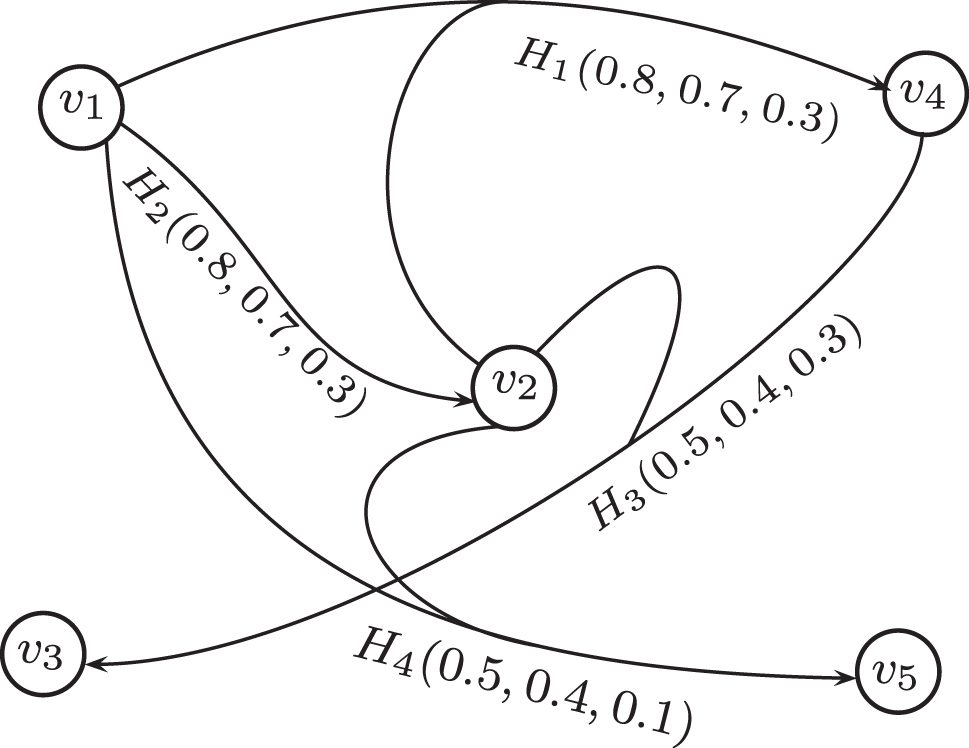
SVNDHG.
By routine calculations, we have h (D) = (0.9, 0.8, 0.1), H(0.9,0.8,0.1) = {{v1, v2}}, H(0.8,0.7,0.1) = {{v1, v2}} and H(0.5,0.4,0.3) = {{v1, v2}, {v1, v2, v5}, {v1, v2, v4}, {v2, v4}}. Therefore, the FS (D) is {(0.9, 0.8, 0.1), (0.5, 0.4, 0.3)}. The set of core hypergraphs is c (D) = {D(0.9,0.8,0.1) = (V1, H1), D(0.5,0.4,0.3) = (V2, H2)}. Note that H(0.9,0.8,0.1) ⊆H(0.5,0.4,0.3) and H(0.9,0.8,0.1) ≠H(0.5,0.4,0.3), H i ⊈ H j for all H i , H j ∈ H, hence D is simple. Further, it can be seen that supp (H i ) = supp (H j ) for all H i , H j ∈ H implies H i = H j . Thus, D is strongly support simple and support simple. The induced fundamental sequence of D is given in Fig. 3.
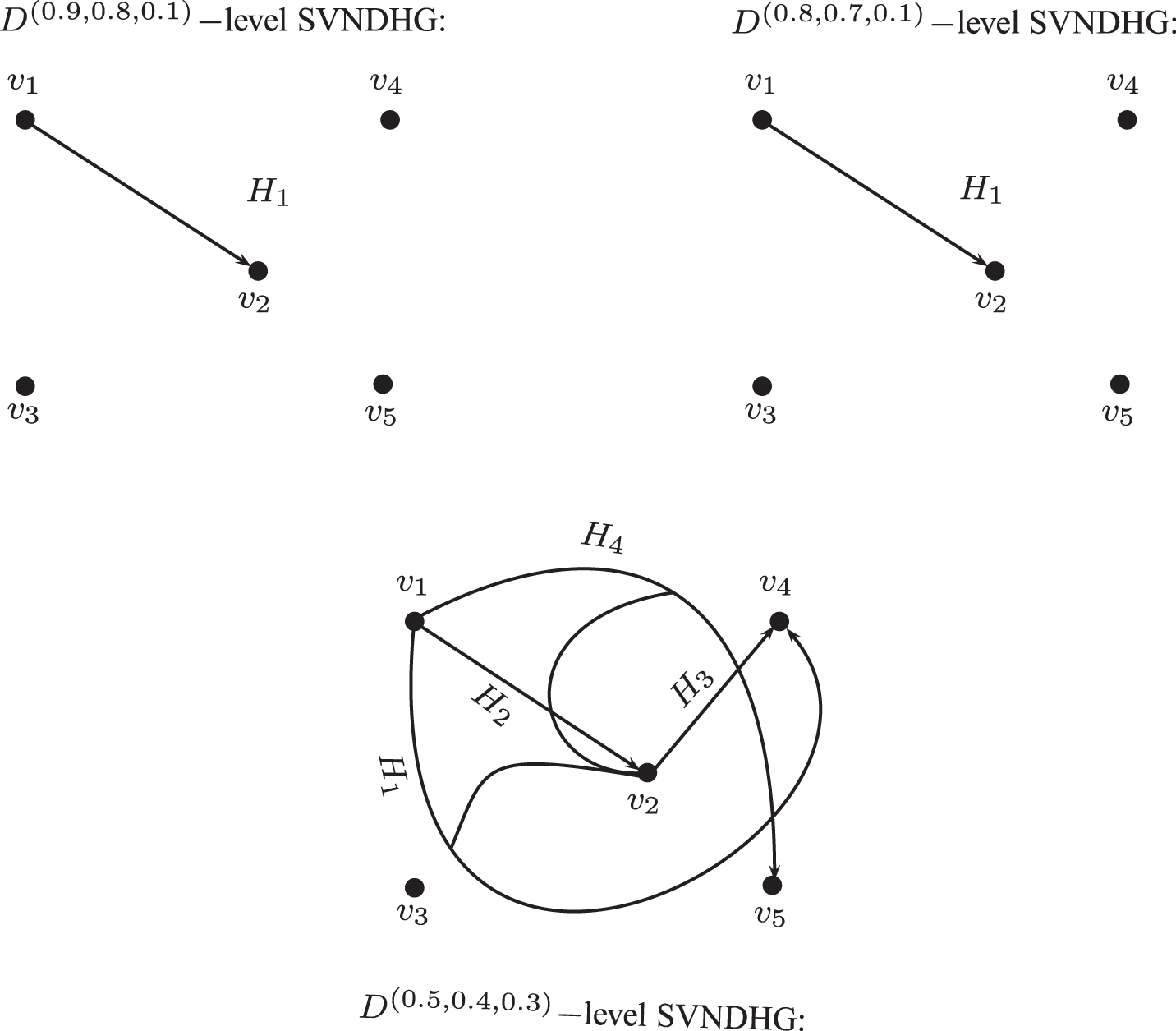
Induced fundamental sequence of D.
It can be noted that D is sectionally elementary if and only if α H i (x) , β H i (x) , γ H i (x) ∈ FS (D) for all H i ∈ H and for every x ∈ V.
The sequence is called simply ordered if it is ordered and if whenever
The corresponding SVNDHG is shown in Fig. 4.
Incidence matrix of D

Sectionally elementary SVNDHG.
α
H
(H
i
) >0, β
H
(H
i
) >0 and γ
H
(H
i
) >0, v
i
, vi+1 ∈ H
i
, i = 1, 2, 3, …, k .
A SVN directed hyperpath is called a SVN directed hypercycle if v1 = vk+1.
The strength of connectedness between s and t is defined as,
Conversely, suppose that χ∞ (s, t) >0
supp (H
i
) ⊆ supp (H
j
) implies i = j, |supp (H
i
) ⋂ supp (H
j
) |≤1.
We now define the dual SVN directed hypergraphs.
V* = H is single-valued neutrosophic set of vertices of D*. If |V| = n, then H* is the SVNS on the set of directed hyperedges {V1, V2, V3, …, V
n
} such that V
i
= {H
j
|v
i
∈ H
j
, H
j
is the directed hyperedge in D}. This means that V
i
is the set of those directed hyperedges which contain the vertex v
i
as a common vertex.
The truth-membership, indeterminacy and falsity-membership values of V
i
are defined as,
We describe the method of construction of dual single-valued neutrosophic directed hypergraph D* of a SVNDHG D as a simple procedure given below. We also describe an example.
Make the single-valued neutrosophic set of vertices of D* as V* = H. Define a one to one function f : V → H from the set of vertices to the set of directed hyperedges of D in the way that if the directed hyperedges H
s
, Hs+1, Hs+2, …, H
j
contain the vertex v
i
, then v
i
is mapped onto H
s
, Hs+1, Hs+2, …, H
j
as shown in Fig. 5. Draw the directed hyperedges {V1, V2, …, V
n
} of D* such that V
i
= {H
j
|f (v
i
) = H
j
}. Make the directed hyperedges as the vertex H
j
of D* belongs to h (V
i
) if and only if v
i
∈ t (H
j
) in D and similarly H
j
is in t (V
i
) if and only if v
i
∈ h (H
j
). Calculate the truth-membership, indeterminacy and falsity-membership values of directed hyperedges in D* as α
H
*
(V
i
) = inf {α
H
(H
j
) : v
i
∈ H
j
}, β
H
*
(V
i
) = inf {β
H
(H
j
) : v
i
∈ H
j
}, γ
H
*
(V
i
) = sup {γ
H
(H
j
) : v
i
∈ H
j
}. SVNDHG and its dual directed hypergraph D*.
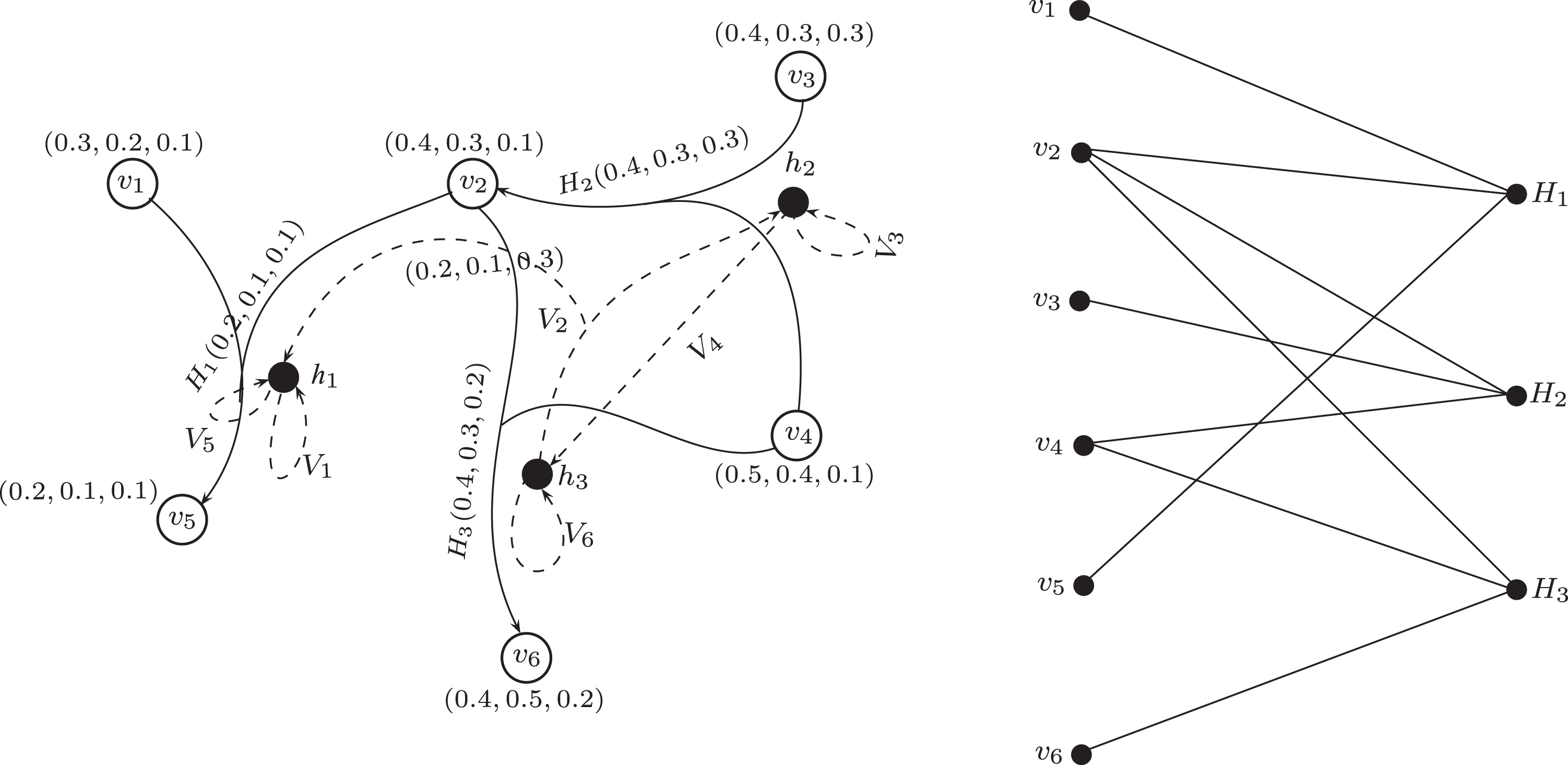
Incidence matrix of dual single-valued neutrosophic directed hypergraph
V
L
= H, {A
i
, A
j
} ∈ H
L
if and only if |supp (A
i
)⋂ supp (A
j
) | ≠ ∅ for i ≠ j.
The truth-membership, indeterminacy and falsity-membership values of vertices and hyperedges of L (D) are defined as, V
L
(A
i
) = H (A
i
), α
H
L
{A
i
, A
j
} = min {α
H
(A
i
), α
H
(A
j
) |A
i
, A
j
∈ H}, β
H
L
{A
i
,A
j
} = min {β
H
(A
i
), β
H
(A
j
) |A
i
, A
j
∈ H} and γ
H
L
{A
i
, A
j
} = max {γ
H
(A
i
), γ
H
(A
j
) |A
i
, A
j
∈ H},
respectively.

SVNDHG and its line directed graph L (D).
Take the set of edges of G as the vertices of D. Let W = {w1, w2, w3, …, w
n
} be the directed edges of G and Z
D
be the set of vertices of D, then Z
D
= W. Let V = {ρ1, ρ2, ρ3, …, ρ
r
} be the collection of non-trivial SVNSs on Z, such that ρ
k
(w
i
) =1, i = 1, 2, 3, …, n . Let Z = {z1, z2, z3, …, z
m
}, then the set of directed hyperedges of D is H
D
= {H1, H2, H3, …, H
n
}, where H
j
are those edges of G in which z
i
is the incidence vertex, that is, H
i
= {w
j
|z
i
∈ w
j
, j = 1, 2, 3, …, n .}. Further, H (H
i
) = U (z
i
), i = 1, 2, 3, …, n .
We claim that D is a linear SVNDHG. Consider the directed hyperedge H j = {w1, w2, w3, …, w k }. From the definition of SVNDG, we have αH(H i ) = inf {∧ j α ρ j (w1) , ∧ j α ρ j (w2) , … , ∧ j α ρ j (w k )} = α U (z i ) ≤1, βH(H i ) = inf {∧ j β ρ j (w1) , ∧ j β ρ j (w2) , …, ∧ j β ρ j (w k )} = β U (z i ) ≤1 and γH(H i ) = sup {∨ j γ ρ j (w1) , ∨ j γ ρ j (w2) , …, ∨ j γ ρ j (w k )} = γ U (z i ) ≤1, 1 ≤ i ≤ n, and ⋃ r (ρ r ) = Z D , for all ρ r ∈ V.
Thus D is SVNDHG. We now prove that D is linear. Since the truth-membership, indeterminacy and falsity-membership values of all the vertices of D are same. Therefore, supp (ρ
i
) ⊆ supp (ρ
j
) implies i = j, for each 1 ≤ i, j ≤ r . On contrary, suppose that supp (ρ
i
) ⋂ supp (ρ
j
) = {w
l
, w
m
}, that is, the both edges w
l
, w
m
have two incident vertices in G, which is a contradiction to the statement that G is simple. Hence |supp (ρ
i
) ⋂ supp (ρ
j
) |≤1, 1 ≤ i, j ≤ r . □
Since H i and H j were chosen arbitrarily. Hence L (D) is connected. The converse part of the theorem can be proved on the same lines. □
V = V, i.e., [D] 2 has the same set of vertices as D. E = {h = v
i
v
j
|v
i
≠ v
j
, v
i
v
j
∈ H
k
, k = 1, 2, 3, ⋯}, i.e., two vertices v
i
and v
j
are adjacent in [D] 2 if they belong to the same directed hyperedge H
k
in D and α
E
(v
i
v
j
) = inf {∧
k
α
H
k
(v
i
), ∧
k
α
H
k
(v
j
)}, β
E
(v
i
v
j
) = inf {∧
k
β
H
k
(v
i
), ∧
k
β
H
k
(v
j
)}, γ
E
(v
i
v
j
) = sup {∨
k
γ
H
k
(v
i
), ∨
k
γ
H
k
(v
j
)}.

A SVNDHG and its 2-section.
Graphs and hypergraphs can be used to describe the complex network systems. The complex network systems, including social networks, World Wide Web, neural networks are investigated by means of simple graphs and digraphs. The graphs take the nodes as a set of objects or people and the edges define the relations between them. In many cases, it is not possible to give full description of real World systems using the simple graphs or digraphs. For example, if a collaboration network is represented through a simple graph. We only know that whether the two researchers are working together or not. We can not know if three or more researchers, which are connected in the network, are coauthors of the same article or not. Further, in various situations, the given data contains the information of existence, indeterminacy and non-existence.
To overcome such type of difficulties in complex networks, we use single-valued neutrosophic directed hypergraphs to describe the relationships between three or more elements and the networks are then called the hyper-networks.
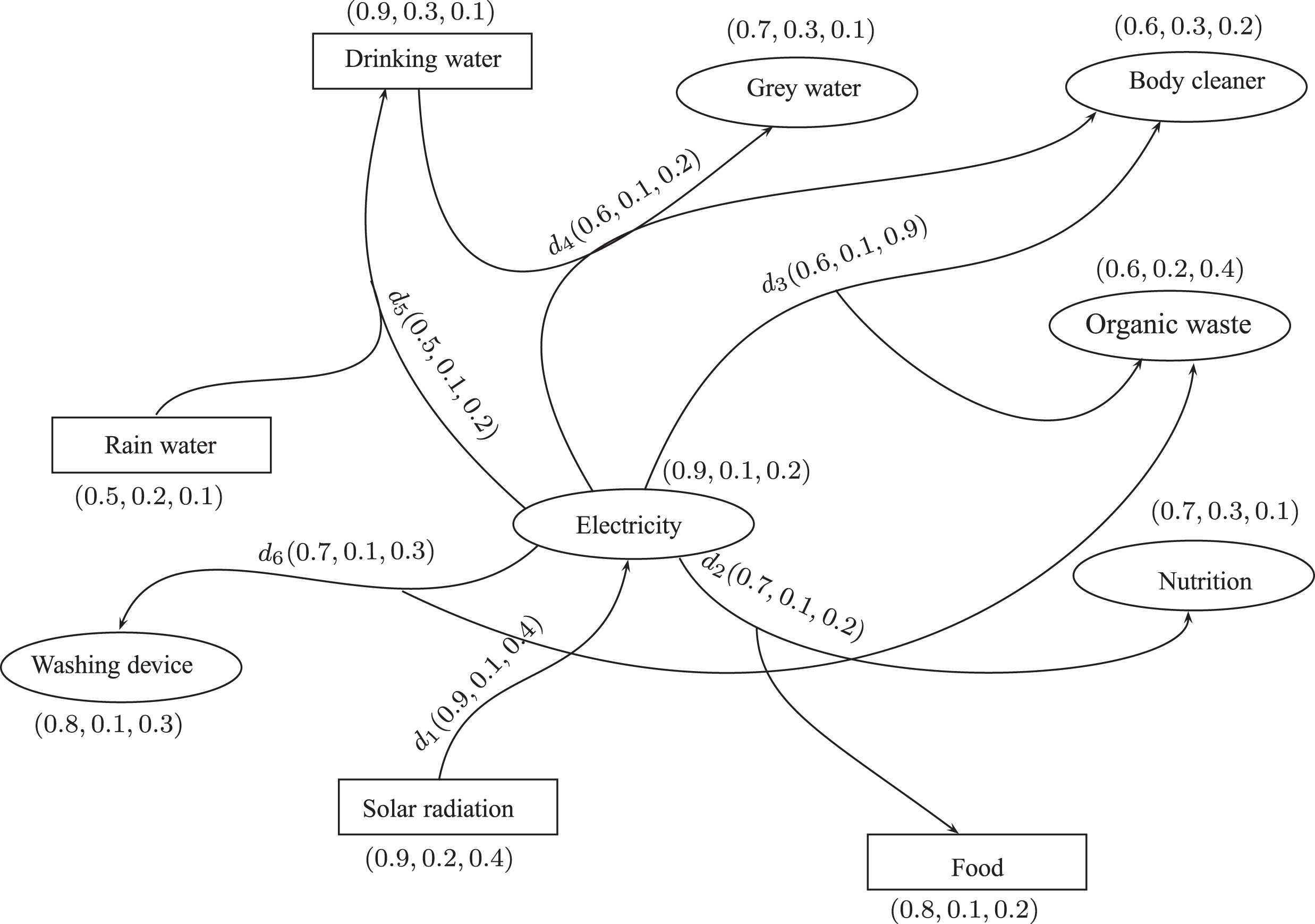
Production system using a SVNDHG.
SVNDHG representing the collaboration network.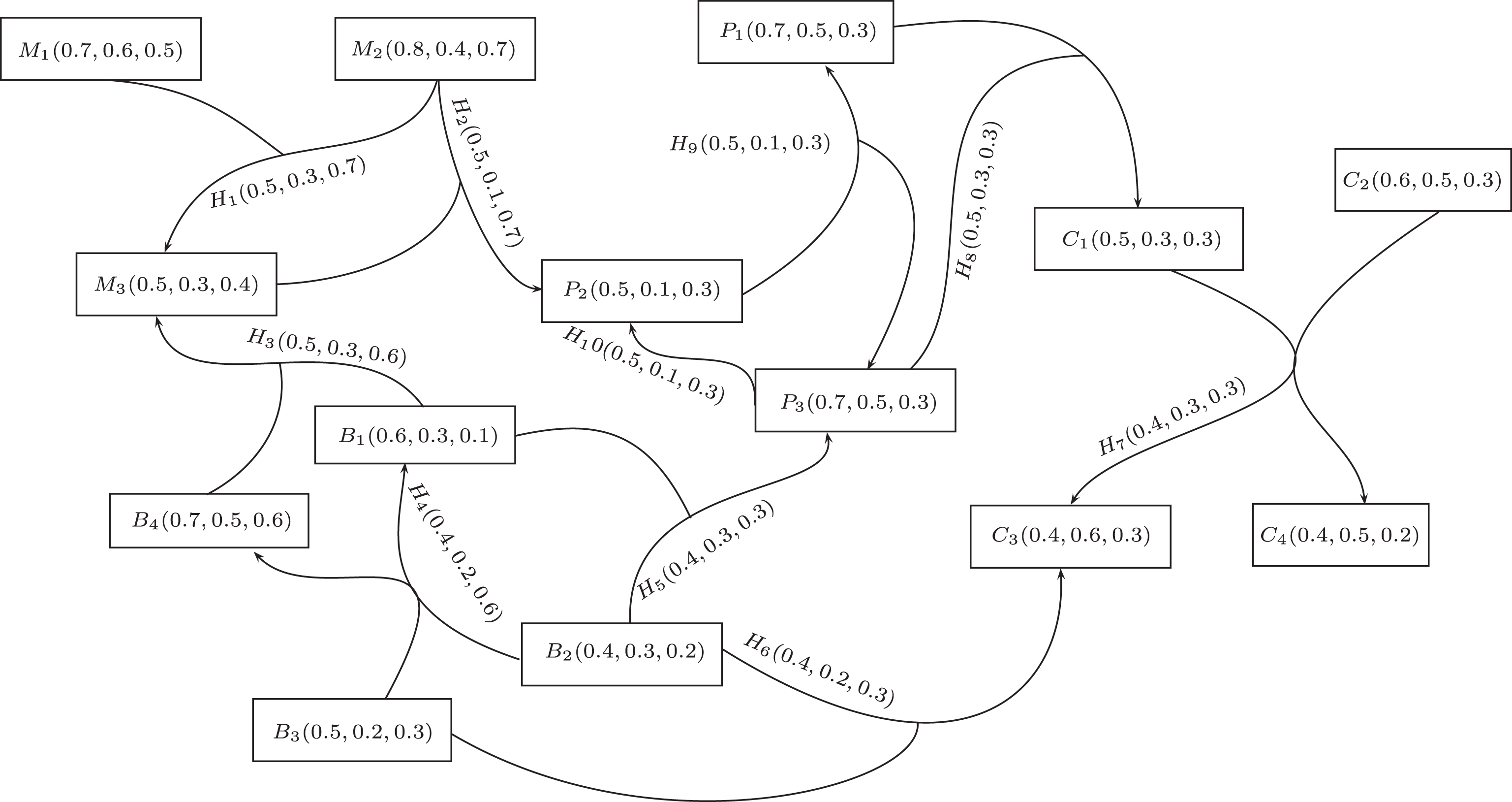
Thus, we have H8 is the strongest edge among the all. So we conclude that the researchers P1, P3 from the field of Physics and C1 from the field of Chemistry have done more joint work as compared to others, i.e., they have 50% publications, 30% of their research work is submitted and 30% papers are rejected. The method adopted in our example can be explained by a simple algorithm given in Table 5.
Algorithm for collaboration network
Representation of a social network using SVNDHG.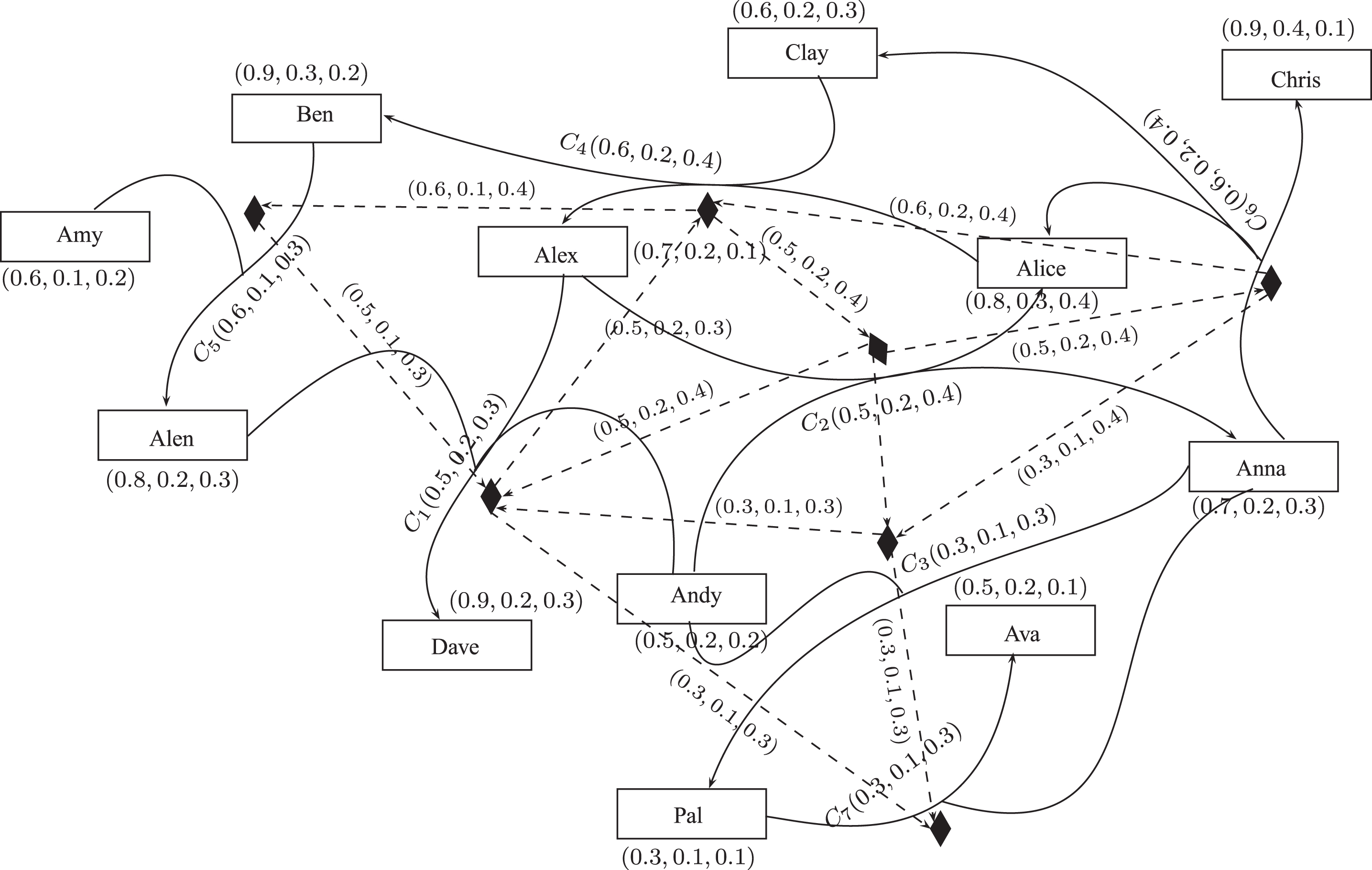
The line directed graph of social network SVNDHG is given in Figure 10 with dashed lines. Each common edge between two social clubs describes the common characteristics of members of different clubs. For example, the edge C1C2 shows that the members of C1 and C2 have 50% common characteristics, 40% different to each other and 20% they have unpredictable behavior. The procedure followed in our example can be explained by means of simple algorithm given as follows.
Input the number of directed hyperedges m of SVNDHG D = (V, H). Input the degree of membership of all directed hyperedges C1, C2, …, C
m
. Construct the SVN line directed graph L (D) = (V
L
, H
L
) by taking {C1, C2, C3, …, C
m
} as set of vertices such that V
L
(C
i
) = D (C
i
), 1 ≤ i ≤ m. Draw an edge between C
i
and C
j
if |C
i
∩ C
j
| ≠ ∅ and H
L
(C
i
C
j
) = (min {α
H
(C
i
), α
H
(C
j
)}, min {β
H
(C
i
), β
H
(C
j
)}, max {γ
H
(C
i
), γ
H
(C
j
)}). The edge CiCj describes the common characteristics of members of various clubs.
A single-valued neutrosophic set is an extension of fuzzy set as well as intuitionistic fuzzy set. The models based on single-valued neutrosophic sets are more precise, compatible and flexible in comparison to other traditional models. In this research paper, we have applied the notion of SVNS to the theory of directed hypergraphs. We have described the novel concepts, including single-valued neutrosophic directed hypergraphs, line directed graphs, dual directed hypergraphs and 2-section graphs. We have described some applications of single-valued neutrosophic directed hypergraphs in production system, social networking and collaboration networking to explain the flexibility of the model when the given data contains the part of indeterminacy. We are extending our research to (1) Bipolar fuzzy soft neutrosophic hypergraphs, (2) Interval valued neutrosophic hypergraphs, (3) Fuzzy rough neutrosophic hypergraphs and (4) Bipolar fuzzy rough directed hypergraphs.
Competing interests
The authors declare that they have no competing interests.
Footnotes
Acknowledgements
The authors are highly thankful to an Associate Editor and the referees for their invaluable comments and suggestions.