This paper considers networks as wireless sensor (hyper)networks and social (hyper)networks by single–valued neutrosophic (directed)(hyper)graphs.The notion of single–valued neutrosophic hypergraphs are extended to single–valuedneutrosophic directed hypergraphs and conversely. We derived single–valued neutrosophic digraphs from single–valued neutrosophic directed hypergraphs via a positive equivalence relation. It tries to use single–valued neutrosophic directed hypergraphs and positive equivalence relation to create the sensor clusters and to access to cluster heads in wireless sensor (hyper)networks. Finally, the concept of α-derivable single–valued neutrosophic digraph is considered as the energy-efficient protocol of wireless sensor networks and is applied this concept as a tool in wireless sensor (hyper)networks.
As a generalization of the classical set theory, fuzzy set theory was introduced by Zadeh [33] to deal with uncertainties. Fuzzy set theory is playing an important role in modeling and controlling unsure systems in nature, society and industry. Fuzzy set theory also plays a vital role in phenomena which is not easily characterized by classical set theory. Smarandache proposed the idea of neutrosophic sets and mingled thee component logic, non-standard analysis, and philosophy, in 1998 [26, 27]. Smarandache [26] and Wang et al. presented the notion of single-valued neutrosophic sets in real life problems more conveniently [32]. A single-valued neutrosophic set has three components: truth membership degree, indeterminacy membership degree and falsity membership degree. These three components of a single-valued neutrosophic set are not dependent and their values are contained in the standard unit interval [0, 1]. Single-valued neutrosophic sets have been a new hot research topic and many researchers have addressed this issue. Majumdar and Samanta studied similarity and entropy of single-valued neutrosophic sets [16]. Smarandache [28, 29] have defined four main categories of neutrosophic graphs, two based on literal indeterminacy (I), whose name were; I–edge neutrosophic graph and I–vertex neutrosophic graph, these concepts have been deeply studied and have gained popularity among the researchers due to their applications in real world problems [10, 30]. Akram et al. defined the concepts of single-valued neutrosophic hypergraph, line graph of single-valued neutrosophic hypergraph, dual single-valued neutrosophic hypergraph, transversal single-valued neutrosophic hypergraph [1, 3]. A directed hypergraph is a powerful tool to solve the problems that arise in different fields, including computer networks, social networks and collaboration networks. Akram et al. applied the concept of single–valued neutrosophic sets to directed hypergraphs and introduced certain new concepts, including single-valued neutrosophic directed hypergraphs, single-valued neutrosophic line directed graphs and dual single-valued neutrosophic directed hypergraphs. They described applications of single-valued neutrosophic directed hypergraphs in manufacturing and production networks, collaboration networks and social networks [2, 4]. Further materials regarding graph and hypergraph are available in the literature too [3, 17–25]. Wireless sensor networks (WSNs) have gained world wide attention in recent years, particularly with the proliferation of micro–electro–mechanical systems technology, which has facilitated the development of smart sensors. WSNs are used in numerous applications, such as environmental monitoring, habitat monitoring, prediction and detection of natural calamities, medical monitoring, and structural health monitoring. WSNs consist of tiny sensing devices that are spread over a large geographic area and can be used to collect and process environmental data such as temperature, humidity, light conditions, seismic activities, images of the environment, and so on.
Regarding these points, this paper aims to generalize the notion of single-valued neutrosophic directed graphs by considering the notion of a positive equivalence relation and trying to define a concept of derivable single-valued neutrosophic directed graphs. The relationships between derivable single–valued neutrosophic directed graphs and single-valued neutrosophic directed hypergraphs are considered as a natural question. The quotient of single-valued neutrosophic directed hypergraphs via equivalence relations is one of our motivations of this research. Moreover, by using a positive equivalence relation, we define a well–defined operation on single-valued neutrosophic directed hypergraphs that the quotient of any single–valued neutrosophic directed hypergraphs via this relation is a single–valued neutrosophic directed graph. We use single–valued neutrosophic directed hypergraphs to represent wireless sensor hypernetworks and social hypernetworks. By considering the concept of the wireless sensor networks, the use of wireless sensor hypernetworks appears to be a necessity for exploring these systems and representation their relationships. We have introduced several valuable measures as truth–membership, indeterminacy and falsity–membership values for studying wireless sensor hypernetworks, such as node and hypergraph centralities as well as clustering coefficients for both hypernetworks and networks. Clustering is one of the basic approaches for designing energy–efficient, robust and highly scalable distributed sensor networks. A sensor network reduces the communication overhead by clustering, and decreases the energy consumption and the interference among the sensor nodes, so we via the concept of single-valued neutrosophic (hyper)graphs and equivalence relations considered the wireless sensor hypernetworks. A single–valued neutrosophic directed hypergraphs in a similar way, can also be used to study and understand the social networks, using people as nodes (or vertices) and relationships between two or more than two peoples as single valued neutrosophic directed hyperedges. The main our motivation in this study is a simulation and modeling of social network and sensor network to single-valued neutrosophic hypergraphs to solve a considered applied issue. Indeed single-valued neutrosophic directed hypergraphs connected some sets of nodes such that single-valued neutrosophic directed graphs could not connect them. For solving this problem, we modelify any (hyper)network to a single-valued neutrosophic directed hypergraph and by using a positive equivalence relation, convert the single-valued neutrosophic directed hypergraph to a single-valued neutrosophic directed graph. So we extract a single-valued neutrosophic directed graph from a (hyper)network by some algorithms in single-valued neutrosophic directed hypergraphs.
Preliminaries
In this section, we recall some definitions and results, which we need in what follows.
Let X be an arbitrary set. Then we denote P* (X) = P (X)\ ∅, where P (X) is the power set of X.
Definition 2.1. [9] A hypergraph on a finite set G is a pair such that for all 1 ≤ i ≤ m, we have, Ei ∈ P* (G) and .
The elements of G are called vertices, and the sets E1, E2, …, Em are said the hyperedges of the hypergraph H. For any 1 ≤ k ≤ m, if |Ek|≥2, then Ek is represented by a solid line surrounding its vertices, if |Ek|=1 by a cycle on the element (loop). If for all 1 ≤ k ≤ m, |Ek|=2, the hypergraph becomes an ordinary (undirected) graph.
Theorem 2.2. [12] Let H = (G, {Ex} x∈G) be a hypergraph, and η = η*. Then for every there exists a relation “*i” on G/η such that H/η = (G/η, * i) is a graph.
Definition 2.3. [31] Let X be a set. A single valued neutrosophic set A in X (SVN–S A) is a function A : X ⟶ [0, 1] × [0, 1] × [0, 1] with the form A = {(x, αA (x) , βA (x) , γA (x)) | x ∈ X} , where the functions αA, βA, γA define respectively a truth–membership function, an indeterminacy–membership function and a falsity–membership function of the element x ∈ X to the set A such that 0 ≤ αA (x) + βA (x) + γA (x) ≤3.
Moreover, Supp (A) = {x | αA (x) ≠0, βA (x) ≠0, γA (x) ≠0} is a crisp set.
A single valued neutrosophic hypergraph (SVN–HG) is defined to be a pair , that H = {v1, …, vn} is a finite set of vertices and is a finite family of non–trivial neutrosophic subsets of the vertex H, such that . Also is called the family of single valued neutrosophic hyperedges of and H is the crisp vertex set of .
Let 1 ≤ ∈1, ∈2, ∈3 ≤ 1, then A(∈1,∈2,∈3) = {x ∈ X | αA (x) ≥ ∈1, βA (x) ≥ ∈2, γA (x) ≤ ∈3} is called an (∈1, ∈2, ∈3)–level subset of A.
Definition 2.5. [11] Let G be a set and F ⊆ P* (G) × P (G) . Then F = (T (F) , H (F)) is called a directed hyperedge or hyperarc, if T (F)∩ H (F) = ∅, where T (F) is called the tail of F and H (V) is called its head. A hypergraph is called a directed hypergraph (dihypergraph), if for every 1 ≤ i ≤ n, Fi is a directed hyperedge.
Definition 2.6. [13] Let be a dihypergraph. Then define, α1 = {(x, x) | x ∈ G} and for every integer n ≥ 2, αn is defined as follows:
xαny ⇔ ∃1 ≤ k ≤ n such that {x, y} ⊆ T (Fk) ∪ H (Fk), where for any 1 ≤ i ≠ k ≤ n, x, y ∉ T (Fi) ∪ H (Fi) and n = |T (Fk) | = |H (Fk) |. Obviously the relation α = di ⋃ n≥1αn is an equivalence relation on . We denote the set of all equivalence classes of α by . Hence .
Theorem 2.7. [13] Let be a dihypergraph. Then there exists a relation “*” on such that is a digraph.
Definition 2.8. [1] A single-valued neutrosophic directed hypergraph (SVN–DHG) on a non-empty set X is defined as an ordered pair , where for all 1 ≤ j ≤ n, is a family of non-trivial single-valued neutrosophic subsets on X and Fj (T (Gj) , H (Gj)) = (αFj, βFj, γFj) in such a way that
In this section, we apply the concept of single–valued neutrosophic hypergraphs, construct the single–valued neutrosophic directed hypergraphs and present an associated algorithm. The quotient single–valued neutrosophic hypergraph, is constructed via the equivalence relations and the notation of single–valued neutrosophic graphs is reintroduced.
Theorem 3.1From every SVN–HG, (where for all 1 ≤ i ≤ m, |Ei|≥2), can construct at least an SVN–DHG such that
G = H,
m = n,
for any 1 ≤ i ≤ m, there exists 1 ≤ j ≤ n, such that T (Gj) ∪ H (Gj) = Ei.
Proof. Let be an SVN–HG. Then H = {v1, v2, …, vn} is a finite set of vertices and is a finite family of non–trivial neutrosophic subsets of the vertex H such that . For every 1 ≤ i ≤ m and 1 ≤ j ≤ n, define an equivalence relation Ri on Ei and consider in such a way that . Now, for every 1 ≤ i ≤ m, we set
and Fj (T (Gj) , H (Gj)) = (αFj, βFj, γFj), where and . Some modifications and computations show that , is a single-valued neutrosophic directed hypergraph (SVN–DHG), where for all 1 ≤ j ≤ m, Gj = Ej = {(vj, αEj (vj) , βEj (vj) , γEj (vj)))}. Clearly for any 1 ≤ i ≤ m, T (Ei) ∪ H (Ei) = Ei and implies that . □
Corollary 3.2.From all SVN–HG, , can construct at least an SVN–DHG, such that
G = H,
n = m,
for any 1 ≤ i ≤ m, there exists 1 ≤ j ≤ n, such that T (Gj) ∪ H (Gj) = Ei.
Let be an SVN–HG. We will call the SVN–DHG which satisfied in Corollary 3, by a derived single-valued neutrosophic directed hypergraph (derived SVN–DHG) from SVN–HG, and will show by .
The method for the construction of an SVN–DHG from an SVN–HG is explained in Algorithm 1 in Table 1.
Algoritm 1
1. Input the SVN–HG and equivalence relation R on H.
2. If |H/R| = k, then for all 1 ≤ i ≤ k and 1 ≤ s, t ≤ n set ,
Definition 3.4. Let be an SVN–DHG. We call is a derivable SVN–DHG, if there exists an SVN–HG as such that is derived from .
Theorem 3.5.Every SVN–DHG is a derivable SVN–DHG.
Proof. Let be an SVN–DHG. Then consider H = G and for every . Since , we get and so is an SVN–HG. Now, if consider αFi = dis ⋀ x∈EiαEi (x) , βFi = dis ⋀ x∈EiβEi (x) and γFi = dis ⋀ x∈EiγEi (x) , then is derived from and so it is a derivable SVN–DHG. □
Definition 3.8 (i) A single valued neutrosophic digraph(SVN–DG) is a pair D = (V, A), where is a family of non-trivial single-valued neutrosophic subsets on V, A = {(vi, vj) , (vj, vi) | vi, vj ∈ V}, such that (1) , αA (vi, vj) ≤ min {αV (vi) , αV (vj)}, (2) , βA (vi, vj) ≥ max {βV (vi) , βV (vj)}, (3) , γA (vi, vj) ≥ max {γV (vi) , γV (vj)} and for every ,
(ii) an SVN–DG is called a weak single–valued neutrosophic graph(WSVN–DG), if supp (A) = V;
(iii) an SVN–DG is called a regular single–valued neutrosophic graph(RSVN–DG), if it is a WSVN–DG and for any vi, vj ∈ V have αB (vi, vj) = min {αA (vi) , αA (vj)} , βB (vi, vj) = max {βA (vi) , βA (vj)} and γB (vi, vj) = max {γA (vi) , γA (vj)}.
Proposition 3.9.LetV = {a1, a2, …, an}. Consider the complete graph Kn and define .
If , then D = (V, A) is a WSVN–DG.
If , then D = (V, A) is an RSVN–DG.
Example 3.10. Let V = {a, b, c}. Then D = (V, A) is an SVN–DG in Figure 5.
SVN–DG K3
Corollary 3.11.Any finite set can be an RSVN–DG and a WSVN–DG.
Proof. Let G be a finite set and R be an equivalence relation on G. Then consider, H = (G, {R (x) × R (y)} x,y∈G), whence it is a complete graph. Applying Proposition 3, the proof is obtained. □
Lemma 3.12.LetX be a finite set and A = {(x, αA (x) , βA (x) , γA (x)) | x ∈ X} be an SVN–S in X. If R is an equivalence relation on X, then A/R = {(R (x) , TR(A) (R (x)) , IR(A) (R (x)) , FR(A) (R (x)) | x ∈ X} is an SVN–S, where αR(A) (R (x)) = di ⋁ tRxαA (t) , βR(A) (R (x)) = di ⋁ tRxβA (t) and γR(A) (R (x)) = di ⋁ tRxγA (t) .
Proof. Let X = {x1, x2, …, xn} and be a partition of X, where k ≤ n. Since for any xi ∈ X, αA (xi) ≤1, βA (xi) ≤1 and γA (xi) ≤1, we get that di ⋁ tRxiαA (t) ≤1, di ⋁ tRxiβA (t) ≤1 and di ⋁ tRxiγA (t) ≤1. Hence for any 1 ≤ i ≤ k, 0 ≤ di ⋁ tRxiαA (t) + di ⋁ tRxiβA (t) + di ⋁ tRxiγA (t) ≤3 and so is a single–valued neutrosophic set in X/R. □
Theorem 3.13LetV = {v1, v2, …, vn} and be an SVN–DHG. If R is an equivalence relation on H, then is an SVN–DHG, where n′ ≤ n.
Proof. By Lemma 3, is a finite family of single–valued neutrosophic subsets of V/R. Since , we get that . Now, for all 1 ≤ i ≤ n′, define Fi/R (T (Fi/R) , H (Fi/R)) = (αFi/R, βFi/R, γFi/R) as follows; if R (x) ∈ T (Gi/R) and R (y) ∈ H (Gi/R), then for all a ∈ R (x) , b ∈ R (y) there exist 1 ≤ j ≤ n, a′ ∈ T (Gj) , b′ ∈ H (Gj) such that (a, a′) ∈ R, (b, b′) ∈ R, αFi/R = dis ⋀ αFj, βFi/R = dis ⋀ βFj and γFi/R = dis ⋀ γFj. It follows that is an SVN–DHG.□
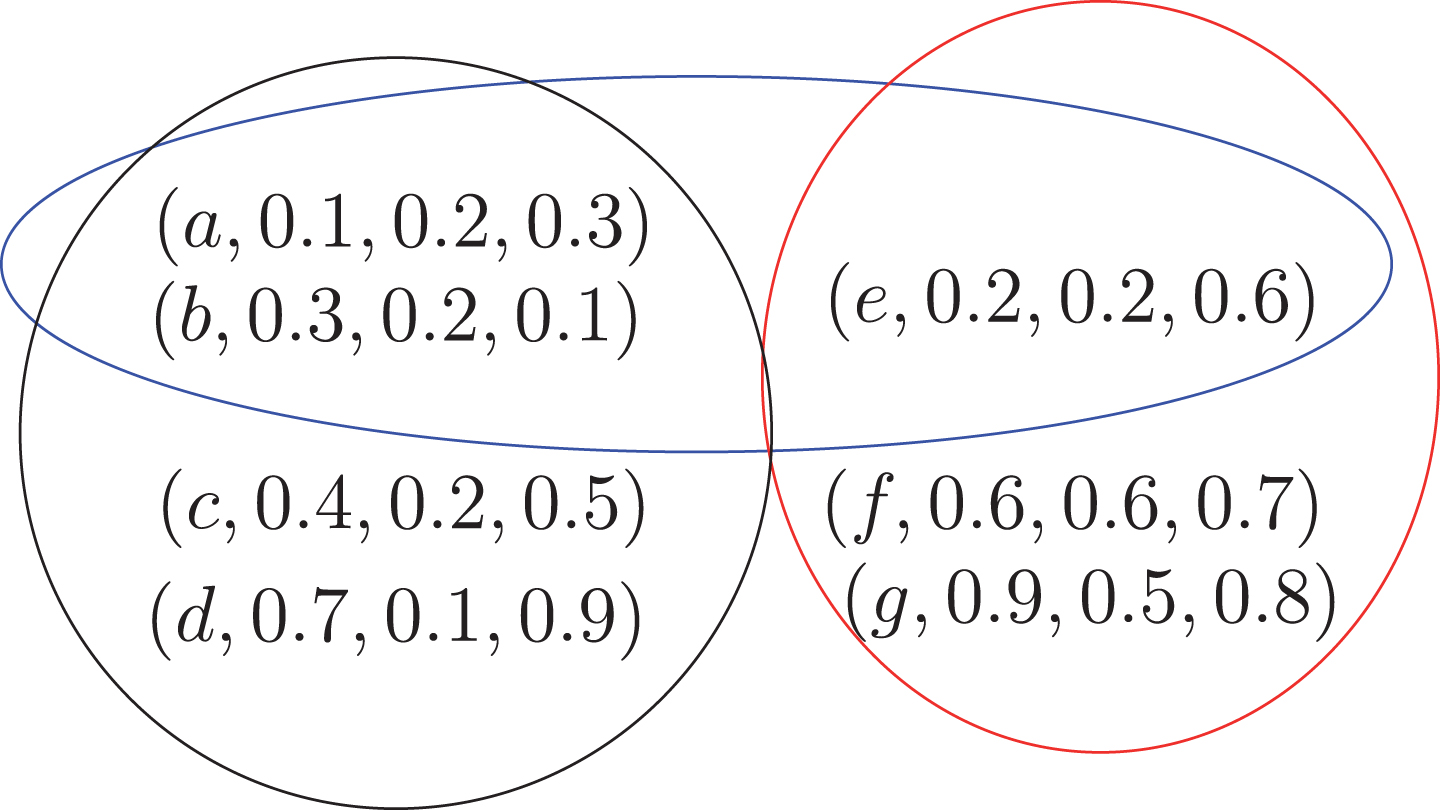
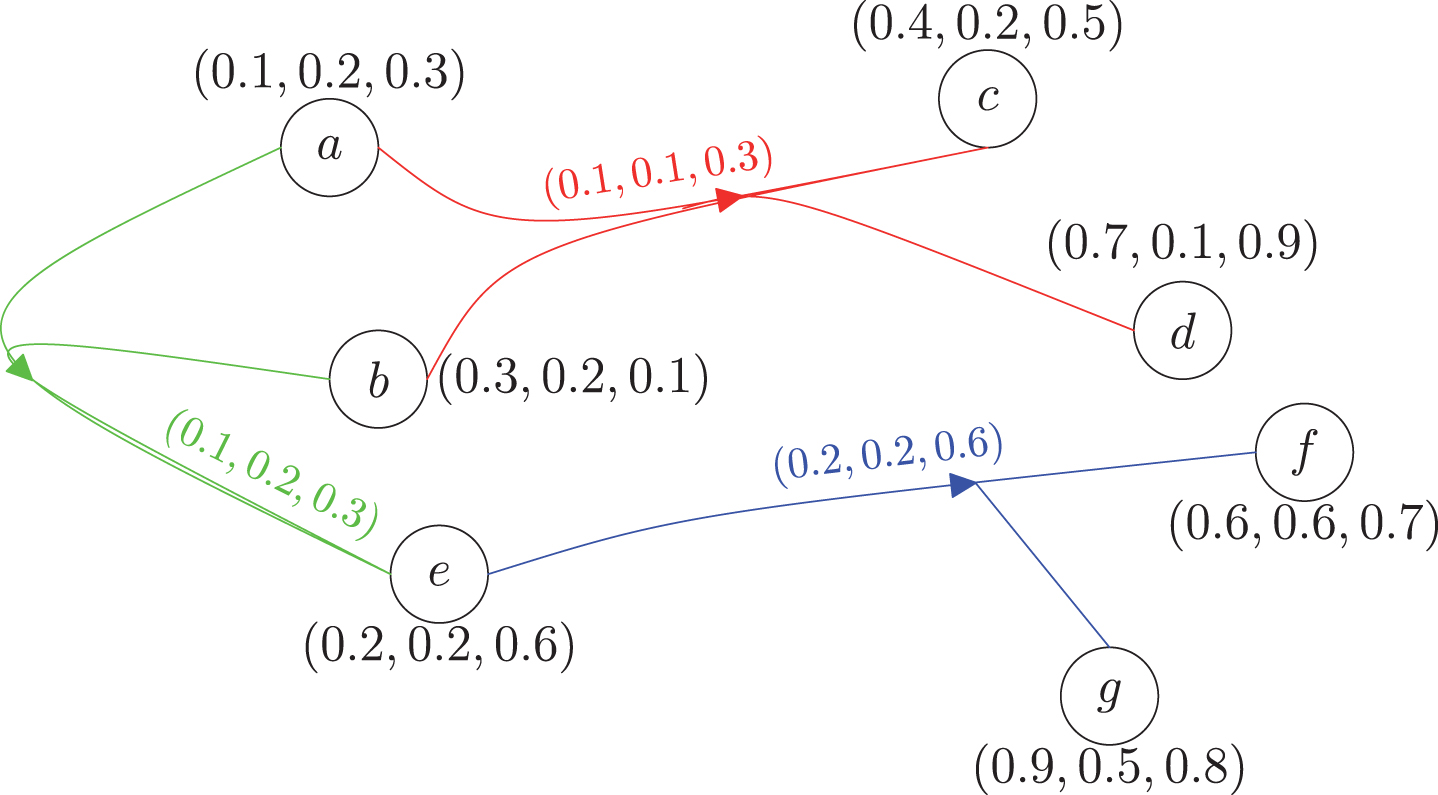
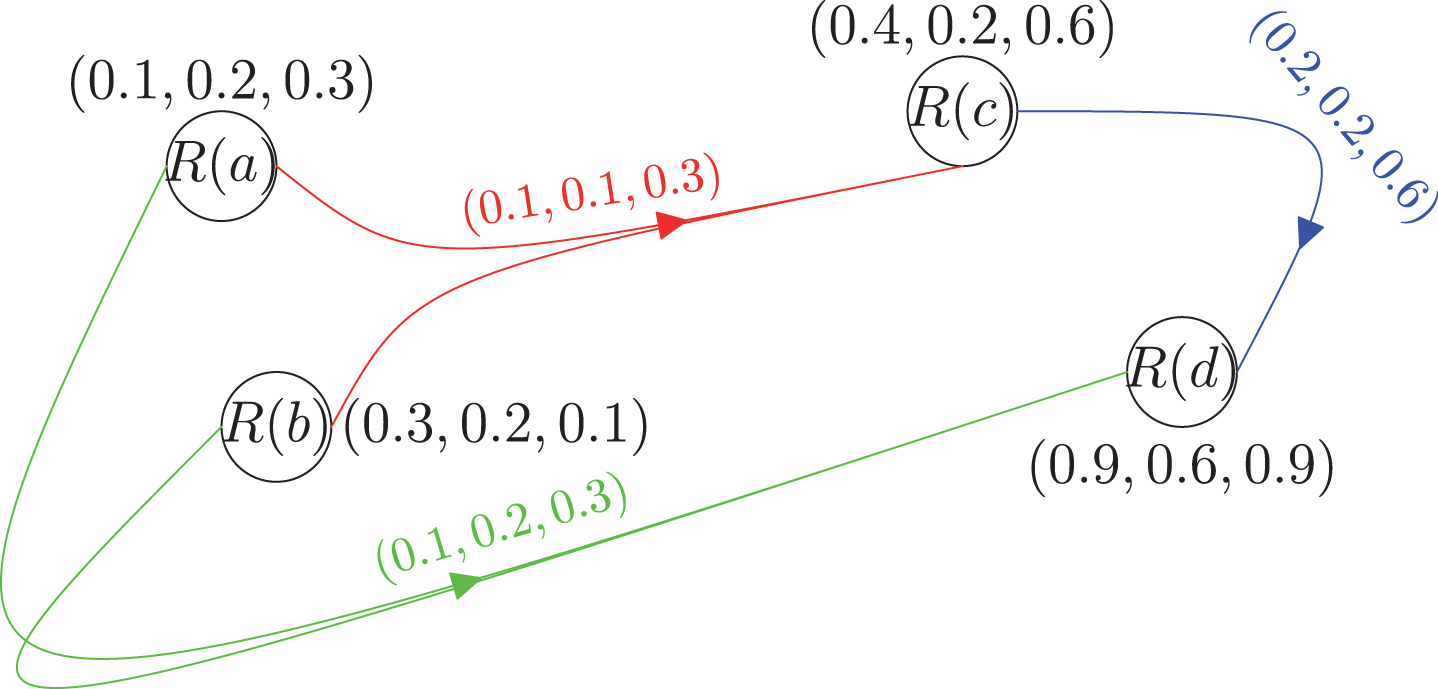
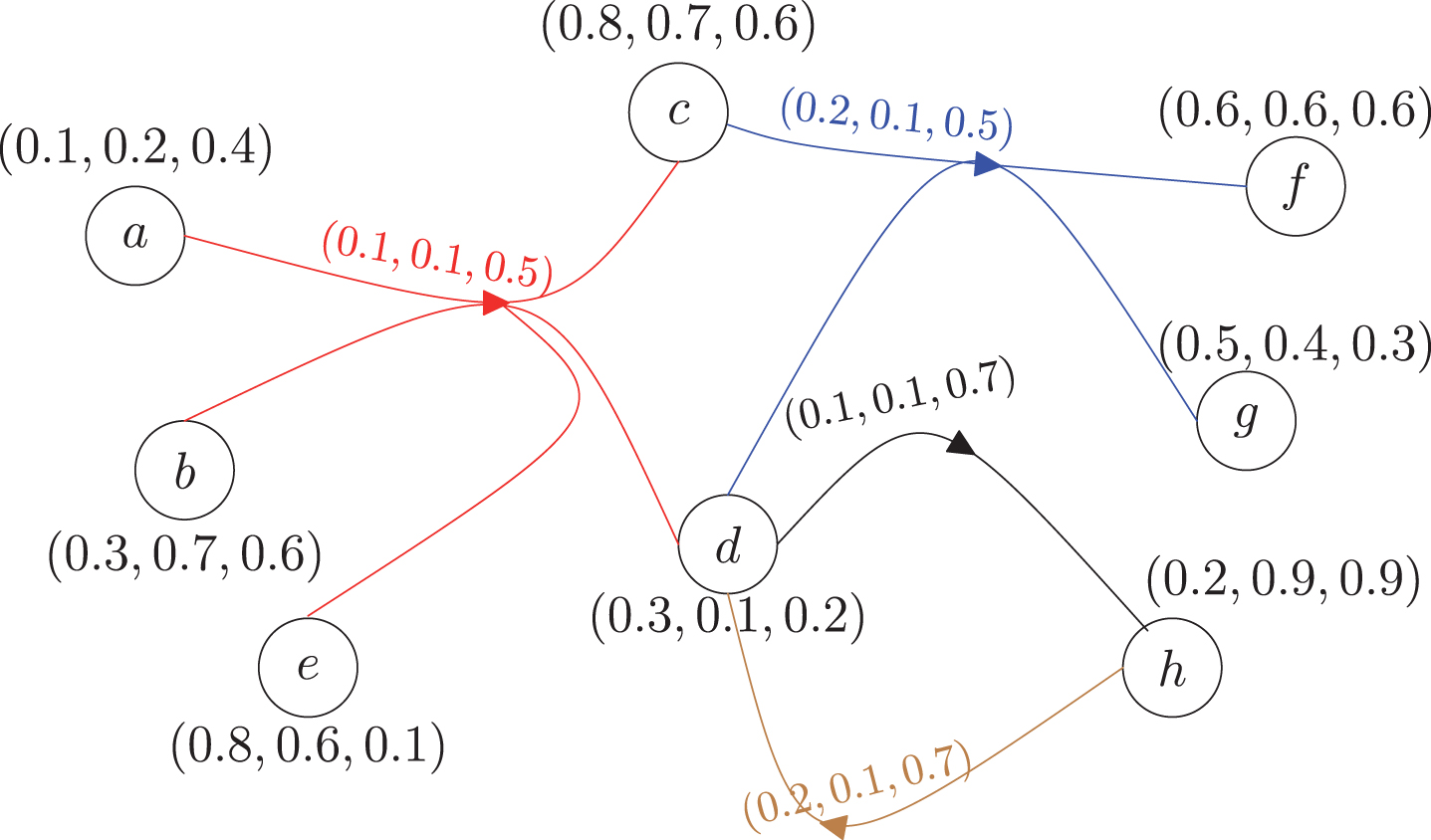
Example 3.14. Consider the SVN–DHG , in Figure 2. If R is an equivalence relation on G such that R (a) = {a} , R (b) = {b} , R (c) = {e, c} and R (d) = {d, g, f}. Since G1 = {{(a, 0.1, 0.2, 0.3) , (b, 0.3, 0.2, 0.1)} , {(e, 0.2, 0.2, 0.6)}} and R (c) = R (e) , we get that R (G2) = {{(R (a) , 0.1, 0.2, 0.3) , (R (b) , 0.3, 0.2, 0.1)} , {(R (c) , 0.4, 0.2, 0.6)}} . In a similar a way, G2 = {{(a, 0.1, 0.2, 0.3) , (b, 0.3, 0.2, 0.1)} , {(c, 0.4, 0.2, 0.5) , (d, 0.7, 0.1, 0.9)}} and R (d) = R (g) = R (f) imply that R (G1) = {{(R (a) , 0.1, 0.2, 0.3) , (R (b) , 0.3, 0.2, 0.1)} , {(R (d) , 0.9, 0.6, 0.9)}} . Because G3 = {{(e, 0.2, 0.2, 0.6)} , {(f, 0.6, 0.6, 0.7) , (g, 0.9, 0.5, 0.8)}}, R (c) = R (e) and R (d) = R (g) = R (f), we have R (G3) = {{(R (c) , 0.4, 0.2, 0.6)} , {(R (d) , 0.9, 0.6, 0.9)}}. Thus by Theorem 3, we obtain the SVN–DHG , in Figure 6, where (αF1, βF1, γF1) = (0.1, 0.1, 0.3) , (αF1/R, βF1/R, γF1/R) = (0.1, 0.2, 0.3) and (αF1/R, βF1/R, γF1/R) = (0.2, 0.2, 0.6) .
SVN–DHG from Figure 2
α–Derivable SVN–DG
In this section, we introduce the concept of α–derivable single–valued neutrosophic digraphs via the equivalence relation α on single–valued neutrosophic directed hypergraphs. It is shown that any single–valued neutrosophic digraph is not necessarily an α–derivable single–valued neutrosophic digraph and it is proved under some conditions. Furthermore, it can show that directed path graphs, directed cyclic graphs, directed star graphs, directed complete graphs can be single–valued neutrosophic directed graphs and can be α–derivable single–valued neutrosophic directed graphs. Also we define the concept of α–(semi)self derivable single–valued neutrosophic digraphs and prove that some class of directed graphs are not α–self derivable single–valued neutrosophic digraphs, while are α–semiself derivable single–valued neutrosophic digraphs.
Theorem 4.1.Let be an SVN–DHG. Then there exists a relation “*” on such that is an SVN–DG.
Proof. By Theorem 3, is an SVN–DHG, where αα(Gj) (α (x)) = di ⋁ xαt∈GαGj (t) , βα(Gj) (α (x)) = di ⋁ xαt∈GβGj (t) and γα(Gj) (α (x)) = di ⋁ xαt∈GγGj (t) . Let α (x) = α ((x, αGj (x) , βGj (x) , γGj (x))) and . Then define an operation “*” on by
where T : ∃1 ≤ k ≤ n, α (x) ∩ T (Gk) ≠ ∅ and α (y) ∩ H (Gk) ≠ ∅ and for any x, y ∈ H, (α (x) , α (y)) is represented as an ordinary directed edge from vertex α (x) to vertex α (y) and ∅ = (α (x) , α (x)) means that there is no edge. We show that * is a well-defined relation. Let α (x) = α (x′) and α (y) = α (y′). Then there exists uniquely 1 ≤ k, s ≤ n such that {x, x′} ⊆ T (Gk) ∪ H (Gk) , and {y, y′} ⊆ T (Gs) ∪ H (Gs) . If α (x) * α (y) = (α (x) , α (y)), then there exists 1 ≤ m ≤ n such that α (x) ∩ T (Gm) ≠ ∅ and α (y) ∩ H (Gm) ≠ ∅ . It follows that T (Gk)∩ T (Gm) ≠ ∅ and so α (x′)∩ T (Gm) ≠ ∅. In a similar way α (y′)∩ H (Gm) ≠ ∅ and so α (x′) * α (y′) = (α (x′) , α (y′)) = (α (x) , α (y)). If α (x)* α (y) = ∅, then for any 1≤ m ≤ n, α (x) ∩ T (Gm) = ∅ or α (y)∩ H (Gm) = ∅. It follows that T (Gk)∩ T (Gm) = ∅ and so α (x′)∩ T (Gm) = ∅. In a similar way, α (y′)∩ H (Gm) = ∅ and so α (x′) * α (y′) = (α (x′) , α (y′)) = (α (x) , α (y)). It is easy to see that is a simple graph. Consider as a directed edge from vertex α (x) to vertex α (y) and define an operation “*′” on by
where and Now, define αα(Gi), βα(Gi), γα(Gi) : α (G) × α (G) ⟶ [0, 1] by αα(Gi) (α (x) , α (y)) = di ⋀ aαx, bαy (αα(Gi) (a) ∧ αα(Gi) (b)) , βα(Gi) (α (x) , α (y)) = di ⋁ aαx, bαy (βα(Gi) (a) ∨ βα(Gi) (b)) and γα(Gi) (α (x) , α (y)) = di ⋁ aαx, bαy (γα(Gi) (a) ∨ γα(Gi) (b)) . It is easy to see that
and
Hence is an SVN–DG.□
The method for the construction of an SVN–DG from an SVN–DHG is explained in Algorithm 2 in Table 2.
Algorithm 2
1. Input the SVN–HG , where .
2. Input the . If ∃ ! 1 ≤ i ≤ k such that x, y ∈ Gi, then y ∈ α (x) , |α (x) |≥2 and if ∃1 ≤ i ≠ i′ ≤ k such that x, y∈
Gi ∩ Gi′, then α (x) = {x}.
3. Input the . If for a fixed 1 ≤ i ≤ k, we have α (x)∩ T (Gi) ≠ ∅ and α (y)∩ H (Gi) ≠ ∅, then α (x) * α (y) =
(α (x) , α (y)) and in else case α (x)* α (y) = ∅(no edge).
4. Input the . If , then as a directed edge from
vertex α (x) to vertex α (y), and in else case , where .
Since
we get that
Hence we obtain . Since
we get that
Since So we obtain the SVN–DG, in Figure 8.
SVN–DG
Definition 4.3. An SVN–DG G = (V, A) is said to be:
(i) an α-subderivable SVN–DG if there exists a nontrivial SVN–DHG such that G = (V, A) is isomorphic to a subgraph of and . An α-subderivable SVN–DG G = (V, A) is called an α-derivable SVN–DG, if , also is called an associated SVN–DHG with SVN–DG G;
(ii) an α-semiself derivable SVN–DG, if it is an α-subderivable SVN–DG by itself;
(iii) an α-self derivable SVN–DG, if it is an α-derivable SVN–DG by itself.
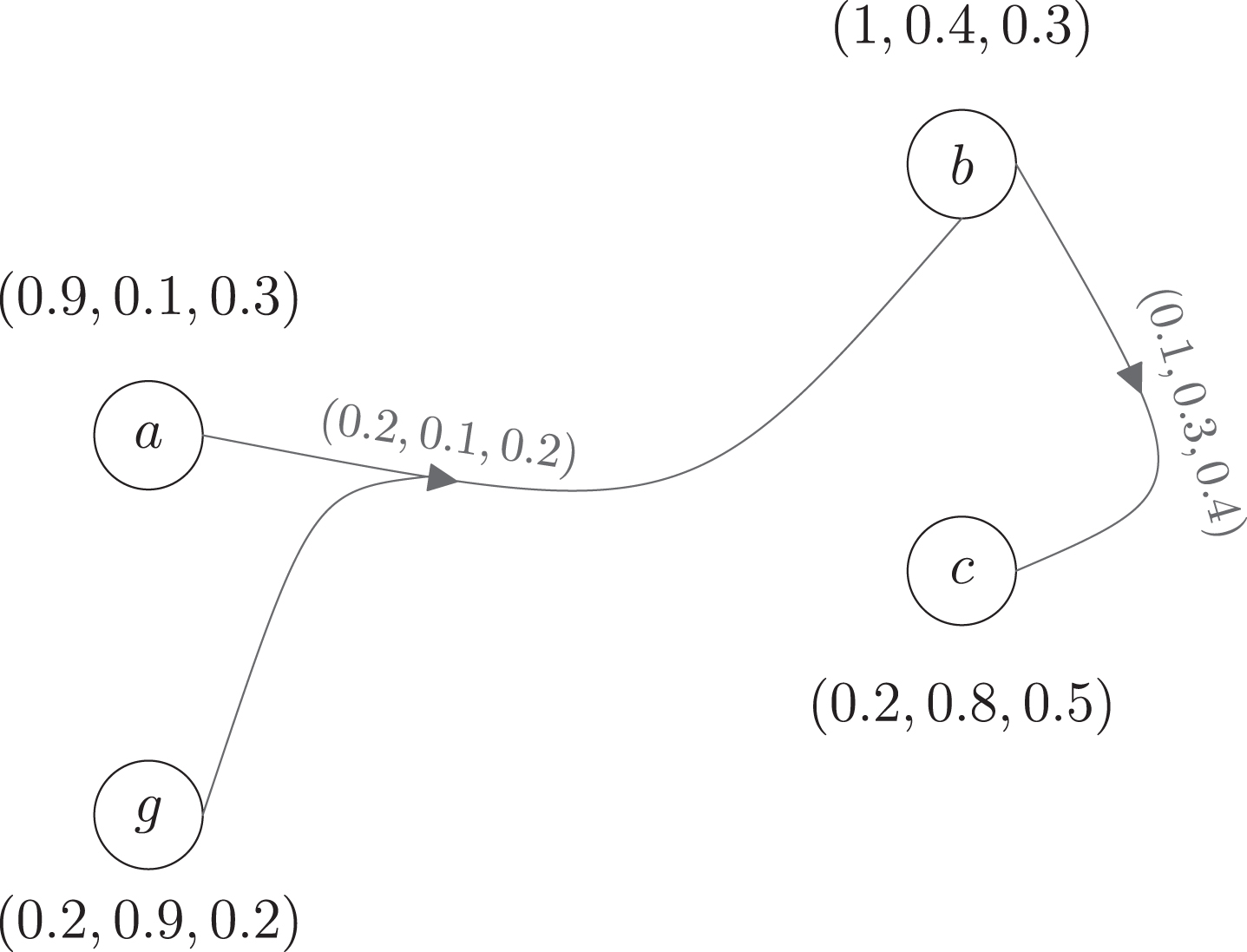
Example 4.4. Consider the SVN–DG, G = (V, A) in Figure 9, where V = {a, b, c} and
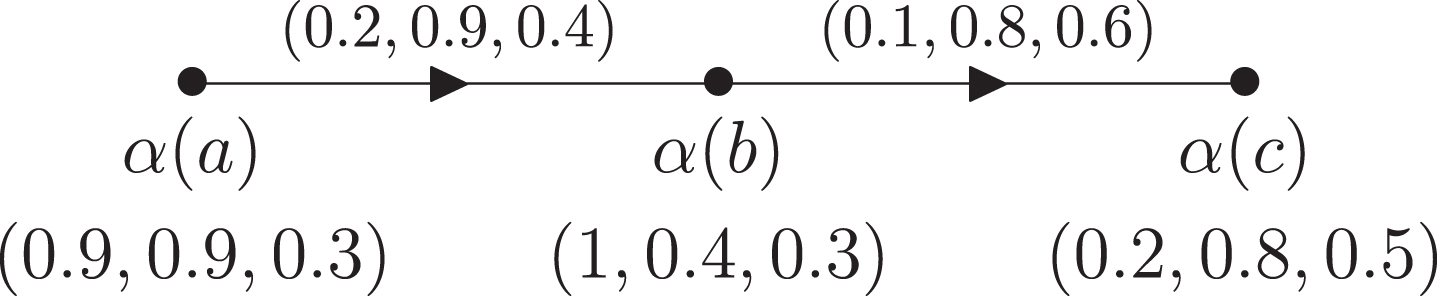
Clearly is a nontrivial SVN–DHG, where G = {a, b, c, g}, G1 = {{(a, 0.9, 0.1, 0.3) , (g, 0.2, 0.9, 0.2)} , {(b, 1, 0.4, 0.3)}} , G2 = {{(b, 1, 0.4, 0.3)} , {(c, 0.2, 0.8, 0.5)}} , and F1 (T (G1) , H (G1) = (0.2, 0.1, 0.2) , F2 (T (G2) , H (G2) = (0.1, 0.3, 0.4)) .Computations show that α (a) = {a, g} , α (b) = {b} andα (c) = {c} . By Theorem 4, it is easy to see that digraph is obtained in Figure 11. Clearly . Since |G| ≠ |V|, we have digraph G = (V, A) is an α-derivable SVN–DG and it is not an α-self derivable SVN–DG.
SVN–DG G
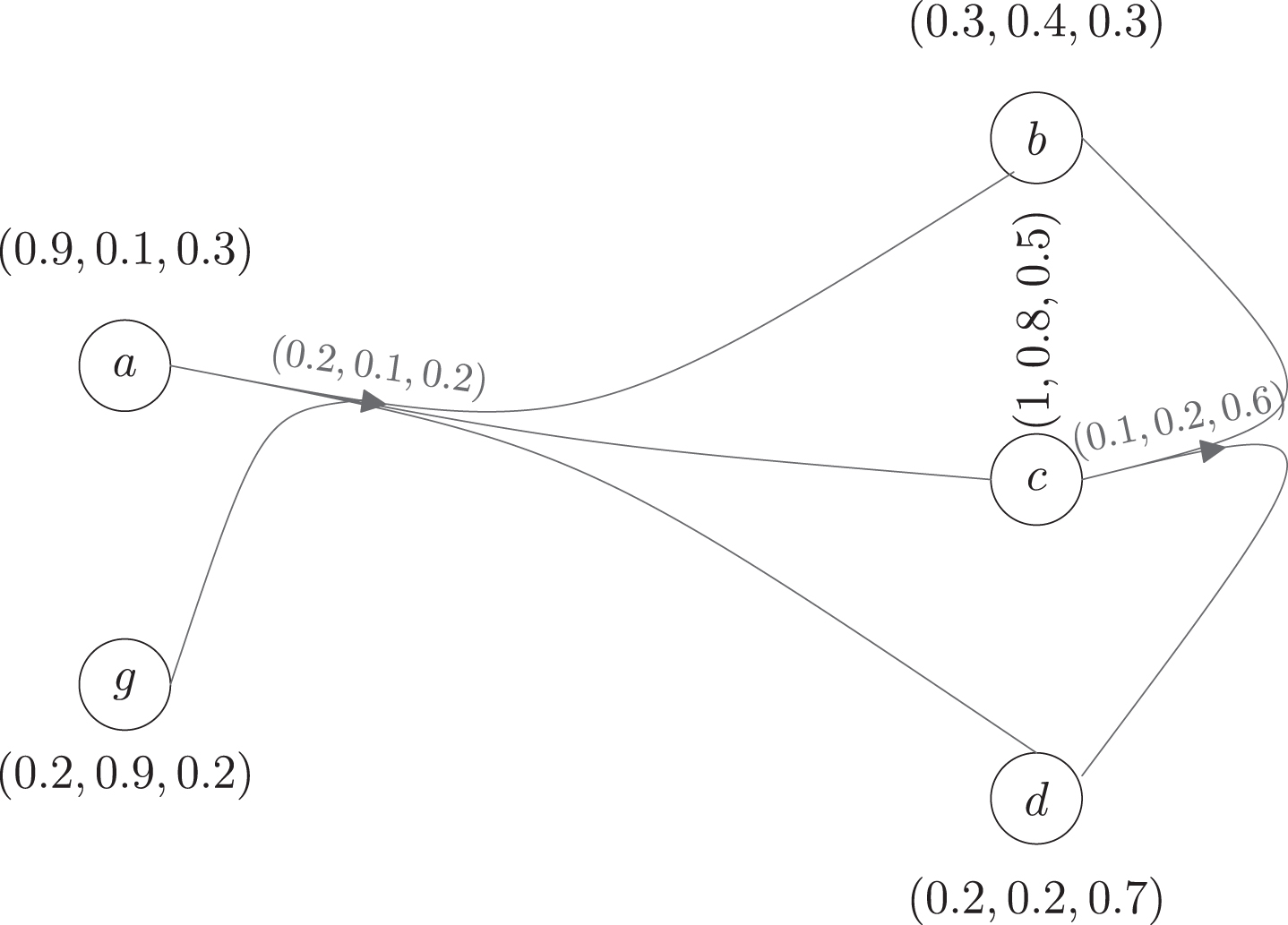
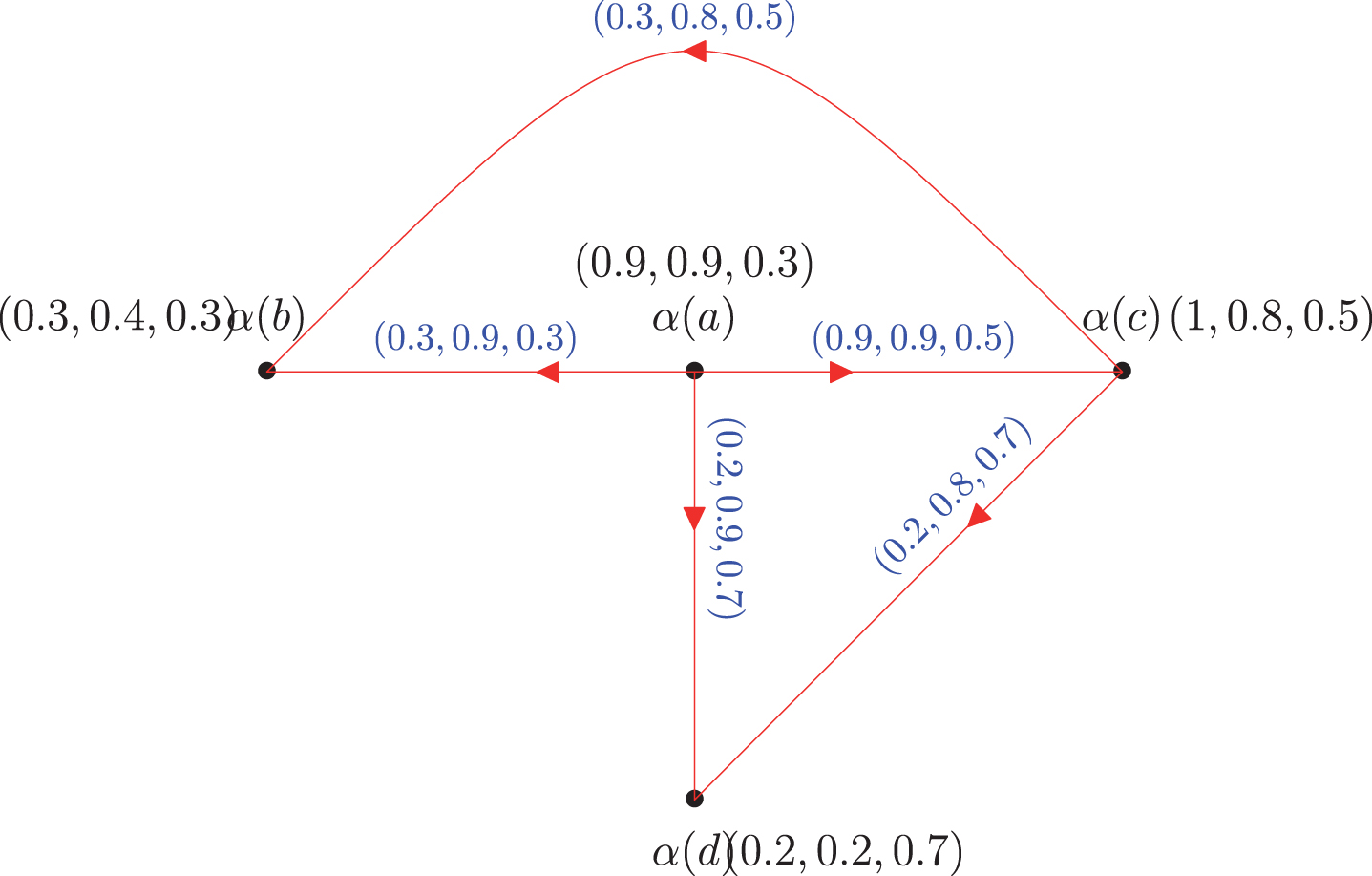
Example 4.5. Consider the SVN–DG, G = (V, A) in Figure 12, where V = {a, b, c, d} and A = {((a, b) , (0.2, 0.9, 0.4) , ((a, c) , (0.8, 1, 0.6) , ((a, d) , (0.1, 0.9, 0.8) , ((c, d) , (0.2, 0.8, 0.7) , ((c, b) , (0.3, 0.8, 0.5))} . Now we construct an SVN–DHG in Figure 13. Clearly is a nontrivial SVN–DHG, where G = {a, b, c, d, g}, G1 = {{(a, 0.9, 0.1, 0.3) , (g, 0.2, 0.9, 0.2)} , {(c, 1, 0.8, 0.5) , (b, 0.3, 0.4, 0.3) , (d, 0.2, 0.2, 0.7)}} , G2 = {{(c, 1, 0.8, 0.5)} , {(b, 0.3, 0.4, 0.3) , (d, 0.2, 0.2, 0.7)}} , and F1 (T (G1) , H (G1) = (0.2, 0.1, 0.2) , F2 (T (G2) , H (G2) = (0.1, 0.2, 0.6)) . Computations show that α (a) = {a, g} , α (b) = {b} , α (c) = {c} and α (d) = {d}. By Theorem 4.1, it is easy to see that digraph is obtained in Figure 14.
SVN–DG G
SVN–DHG
SVN–DG,
Clearly . Since |G| = |V|, we have digraph G = (V, A) is an α-self derivable SVN–DG.
Let V = {a1, a2, …, an}. Then we denote the directed path graph in Figure 15 by DPn.
Path graph DPn.
Theorem 4.6.IfDPn = (V, E) is an SVN–DG, then for all 1 ≤ i ≤ n - 1, αV (ai) ≥ αV (ai+1) or βV (ai) ≥ βV (ai+1);
Proof. Since A = {(ai, ai+1) | 1 ≤ i ≤ n - 1}, we get that
Thus for all 1 ≤ i ≤ n - 1, αV (ai) ≥ αV (ai+1) or βV (ai) ≥ βV (ai+1). □
Theorem 4.7.Let. Then
SVN–DG, DPn is an α-derivable SVN–DG.
SVN–DG, DP2 is not an α-self derivable SVN–DG.
Proof. (i) Let DPn = (V, A) be a path SVN–DG, where V = {(aj, αV (aj)), βV (aj)), . Then for any a, b ∉ V consider G1 = ({(a1, αV (a1)), βV (a1)), γV (a1)), (a, t1, t2, t3)}, {(a2, αV (a2)), βV (a2)), γV (a2)}), where 0 < t1 ≤ αV (a1)), 0 < t2 ≤ βV (a1)) and 0 < t3 ≤ γV (a1)). Also for any 2 ≤ i ≤ n - 2, Gi = ({(ai, αV (ai)), βV (ai)), γV (ai))} and Gn-1 = ({(an-1, αV (an-1)), βV (an-1)), γV (an-1), {(an, αV (an)), βV (an)), γV (an)), (b, s1, s2, s3)}), where 0 < s1 ≤ αV (an)), 0 < s2 ≤ βV (an)) and 0 < s3 ≤ γV (an)). It can see that α (a1) = α (a) = {a1, a}, α (an) = α (b) = {an, b} and for any 2 ≤ i ≤ n - 1, α (ai) = {ai}. If G = V ∪ {(a, t1, t2, t3), (b, s1, s2, s3)}, then = (G = , {Fi (T (Gi), is a nontrivial SVN–DHG, where for any 1 ≤ i ≤ n - 1 we have Fi (T (Gi), = ( di ⋀aαx, bαy (αα(Gi) (a) ∧ αα(Gi) (b)), di ⋁aαx, bαy (βα(Gi) (a) ∨ βα(Gi) (b)), di ⋁aαx, bαy (γα(Gi) (a) ∨ γα(Gi) (b))) . Since for any 1 ≤ i ≤ n which is an odd, we have α (ai) ∩ T (Gi) ≠ ∅ and for any 1 ≤ i ≤n which is an even, we have α (ai) ∩ H (Gi) ≠ ∅, we get that α (ai) * α (ai+1) = (α (ai), α (ai+1)) = eii+1, where for all 1 ≤ i ≤ n, α (ai) = (α (ai), αV (ai)), βV (ai)), γV (ai))) and for all 1 ≤ i ≤ n - 1, ei = Fi (T (Gi), . Hence we obtain an SVN–DG in Figure 16. Clearly and so for any n ≥ 2, DPn is an α-derivable SVN–DG.
SVN–DG .
(ii) Let DP2 be an α-self derivable SVN–DG. Then there exists an associated SVN–DHG, with SVN–DG, DP2 such that and |G|=2. Suppose that G = {x, y}, since is a nontrivial SVN–DHG, must be 2 ≤ m. But |G|=2 implies that m = 1 which is a contradiction. □
Corollary 4.8.Let. Then DPn is an α-derivable SVN–DG but is not an α-self derivable SVN–DG.
We introduce SVN–DG G′ in Figure 17. From now on, we apply the SVN–DG, G′ in Figure 17, in the following Theorem.
SVN–DG G′
Theorem 4.9.LetG′ = ({a, b} , A′) be an SVN–DG. Then the following properties hold.
;
G′ is not an α-derivable SVN–DG.
Proof. (i) Since G′ = ({a, b} , A′) is an SVN–DG and e1, e2 ∈ A′, we get that αV (a) + βV (a) ≥ βV (b) + αV (b) and αV (a) + βV (a) ≤ αV (b) + βV (b). It follows that .
(ii) Let G′ = ({a, b} , A′) be an α-derivable SVN–DG. Then there exist a nontrivial SVN–DHG, and 1 ≤ k, l ≤ n such that , where G = {x1, x2, …, xn}. Since |V|=2, we get m = 2. In addition, implies that there exists 1 ≤ j ≤ n such that α (xk)∩ T (Gj) ≠ ∅ and α (xl)∩ H (Gj) ≠ ∅ or α (xk)∩ H (Gj) ≠ ∅ and α (xl)∩ T (Gj) ≠ ∅. It follows that H (G1)∩ T (G2) ≠ ∅ and H (G2)∩ T (G1) ≠ ∅ and so which is a contradiction. □
Corollary 4.10.LetG = (V, A) be an SVN–DG. If G is homeomorphic to SVN–DG, G′, then G is not an α-derivable SVN–DG.
Let , V = {v1, v2, v3, . . . , vn} and E = {e1, e2, e3, . . . , en-1}, where ei = v1vi+1, for every 1 ≤ i ≤ n - 1, and DSn = (V, E) be a star directed graph as Figure 18.
Star digraph DSn
Theorem 4.11.IfDSn = (V, E) is an SVN–DG, then for all 2 ≤ i ≤ n, αV (v1) ≥ αV (vi) or βV (v1) ≥ βV (vi).
Proof. Since A = {(v1, vi) | 1 ≤ i ≤ n}, for all 1 ≤ i ≤ n, we have . It follows that for all 2 ≤ i ≤ n, αV (v1) ≥ αV (vi) or βV (v1) ≥ βV (vi). □
Theorem 4.12.Let. Then
SVN–DG, DSn is an α-derivable SVN–DG.
SVN–DG, DS2 is not an α-self derivable SVN–DG.
For all n ≥ 3, SVN–DG, DSn is an α-self derivable SVN–DG.
Proof. (i, ii) The proof is similar to Theorem 4 and Corollary 4.
(iii) Let DSn = (V, A) be a path SVN–DG, where . For simplifying we denote (vj, αV (vj)) , βV (vj) , γV (vj)) by vj and consider
and for all 3 ≤ i ≤ n - 3, Gi = ({v1} , {vi+3} . One can see that for any 1 ≤ i ≤ n, α (ai) = {ai} and is a nontrivial SVN–DHG, where for any 1 ≤ i ≤ n - 3, we have di ⋁ aαx, bαy (γα(Gi) (a) ∨ γα(Gi) (b))) . In a similar way of Theorem 4.7, and so for any n ≥ 3, DSn is an α-self derivable SVN–DG. □
Corollary 4.13.Let. Then DSn is an α-derivable SVN–DG and for 3 ≤ n, it is an α-self derivable SVN–DG.
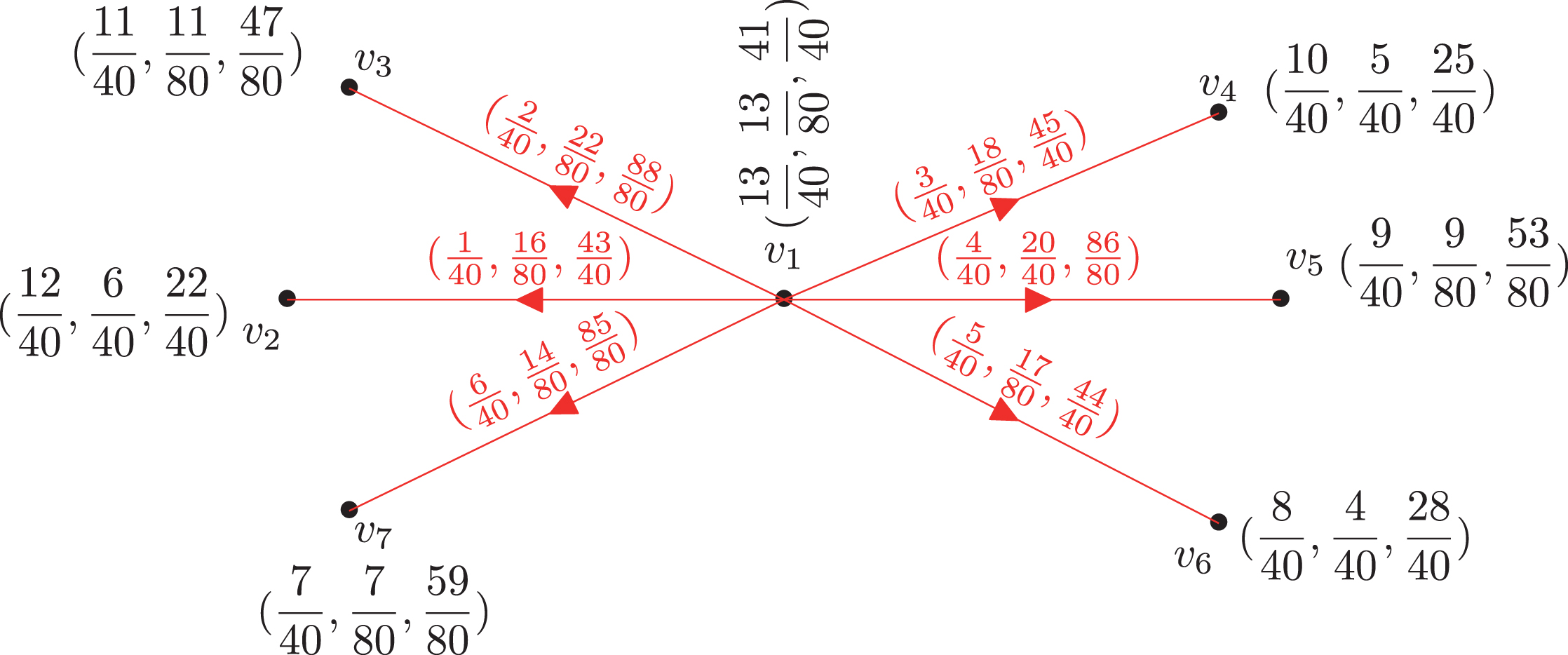
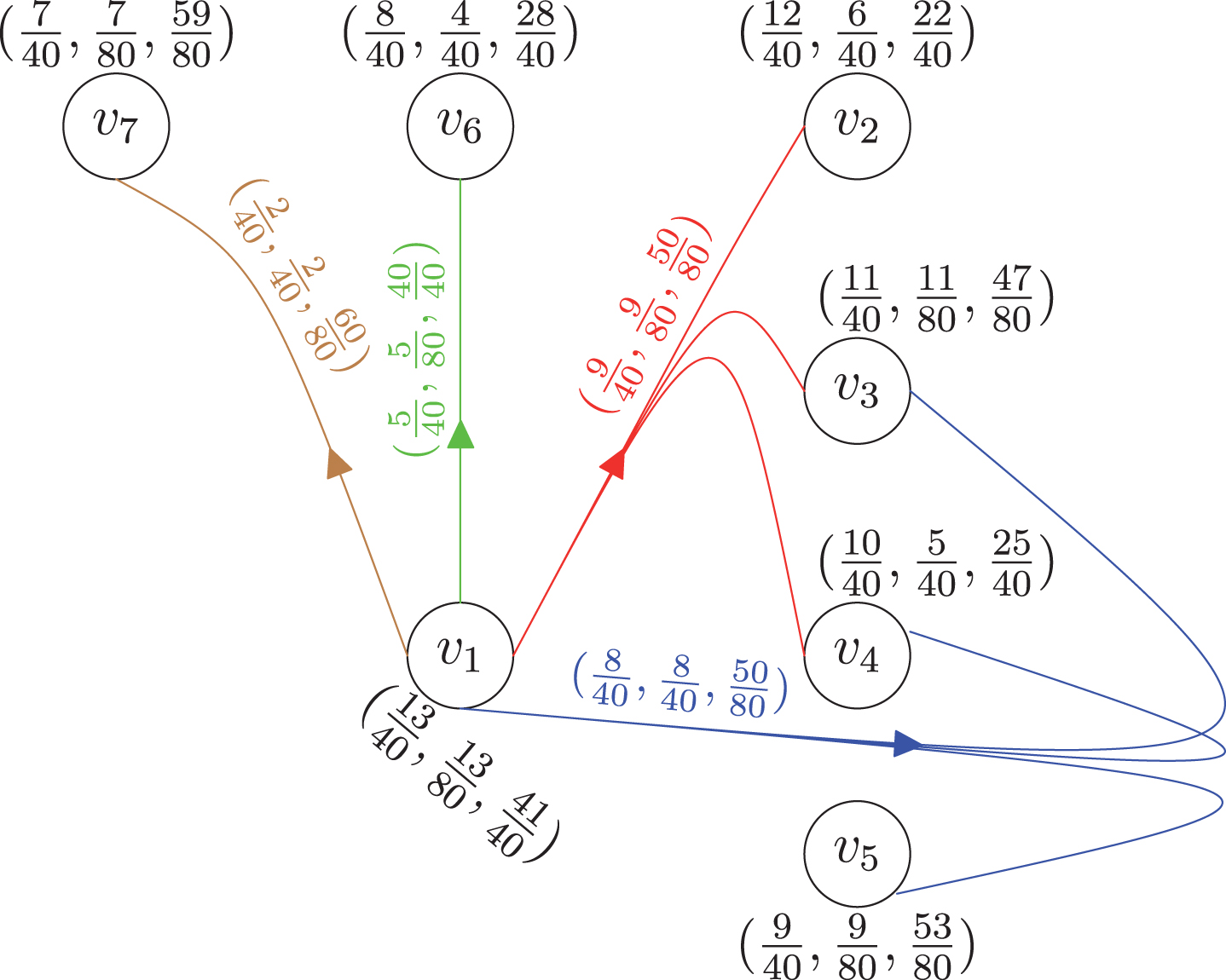
Example 4.14. Consider the SVN–DG, DS7 in Figure 19. Now, construct the SVN–DHG, in Figure 20. Clearly , G3 = and G4 = Obviously, for all 1 ≤ i ≤ 6, we have α (vi) = {vi} and so.
SVN–DG, DS7
SVN–DHG
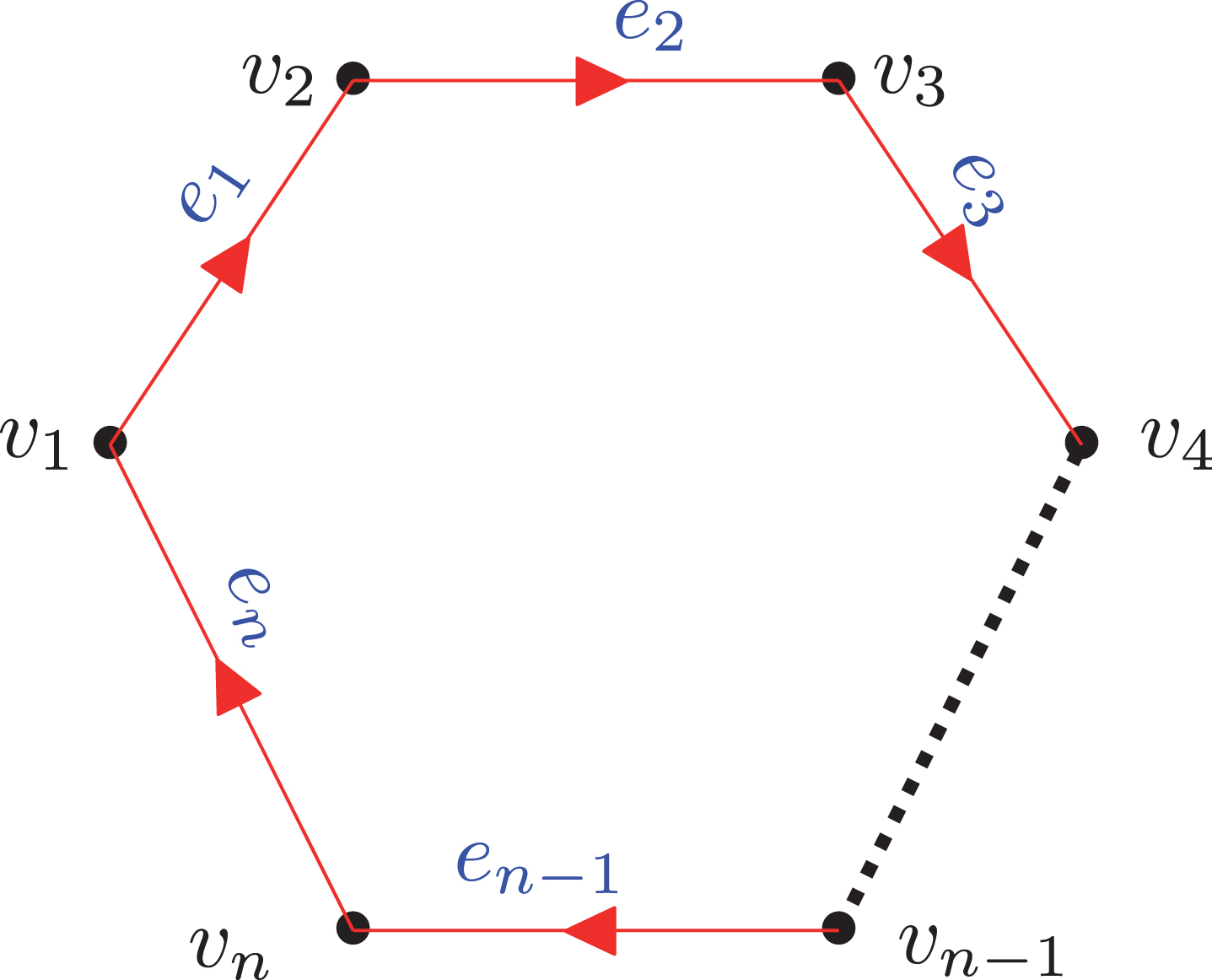
Let and V = {v1, v2, …, vn}. Then we denote the directed cyclic graph in Figure 21.
Cycle digraph
Theorem 4.15.If is an SVN–DG, then for all v, v′ ∈ V.
Proof. Since DSn = (V, E) is an SVN–DG, for every 1 ≤ i ≤ n, we get that αV (vi) + βV (vi) ≥ αV (vi+1) + βV (vi+1). Consider en = (vn, v1), so αV (vn) + βV (vn) ≥ αV (v1) + βV (v1) ≥ αV (v2) + βV (v2) ≥ αV (v3) + βV (v3) ≥ αV (v4) + βV (v4) ≥ … ≥ αV (vn-1) + βV (vn-1) ≥ αV (vn) + βV (vn) ≥ αV (v1) + βV (v1) . Hence for all v, v′ ∈ V we get that . □
Theorem 4.16.Let. Then
SVN–DG, is not an α-derivable SVN–DG.
SVN–DG, is not an α-derivable SVN–DG.
SVN–DG, is not an α-self derivable SVN–DG.
SVN–DG, is an α-semiself derivable SVN–DG.
Proof. (i) Consider the SVN–DG, in Figure 22. If is an α-derivable SVN–DG, then we can consider the smallest associated SVN-DHG , where there exists 1 ≤ t ≤ n, in such a way that 2 ∈ {|T (Gt) |, |H (Gt) |} and for any 1 ≤ i ≠ t ≤ n, |T (Ei) | = |H (Ei) |=1. Since for any 1 ≤ i ≤ n, ud (vi) = id (vi) =1(output degree and input degree of vi), for all 1 ≤ i ≠ j ≤ n we get that {vi, vj} ⊈ T (Ei) , {vi, vj} ⊈ H (Ei) , {vi, vj} ⊈ T (Ej) and {vi, vj} ⊈ H (Ej). Hence there exists x′ ∉ H such that x′ ∈ T (Et) ∪ H (Et) and so m = n = 3. In addition, for some 1 ≤ k ≤ n, vt ∈ (T (Et) ∪ H (Et)) ∩ (T (Ek) ∪ H (Ek)) implies that α (vt) ≠ α (x′) and for 1 ≤ i ≤ n, α (vi) = {vi}. It follows that and so , which is a contradiction.
Cycle digraph
(ii) Since every SVN–DG, is homeomorphic to SVN–DG, , by item (i) we get that for every SVN–DG, is not an α-derivable SVN–DG.
(iii) Since SVN–DG, is not an α-derivable SVN–DG, we get that it is not an α-self derivable SVN–DG.
(iv) Let be a cyclic SVN–DG, where . For simplifying we denote (aj, αV (aj)) , βV (aj) , γV (aj)) by aj and consider G1 = ({a1a2} , {a3}), for any 2 ≤ i ≤ n - 2, Gi = ({ai} , {ai+1}) , Gn-1 = ({an} , {a1}) and Gn = ({a1} , {a2}) . It can see that for any 1 ≤ i ≤ n, α (ai) = {ai} and by Theorem 4, for all v, v′ ∈ V. Also, is a nontrivial SVN–DHG, where for any 1 ≤ i ≤ n - 1 we have In a similar way to Theorem 4, one can see that is isomorphic to a subgraph of and . □
Let and V = {v1, v2, …, vn}. Then we denote the directed complete graph by DKn .
Corollary 4.17.Let. Then
for all v, v′ ∈ V, we have ;
SVN–DG, DKn is not both an α-derivable SVN–and α-self derivable SVN–DG.
SVN–DG, DKn is an α-semiself derivable SVN–DG.
Applications of α-driveable SVN–DG
In this subsection, we describe some applications of the concept of α-derivable single–valued neutrosophic digraphs and single–valued neutrosophic dihypergraphs.
Graphs and hypergraphs can be used to describe the network systems. The network systems, including social networks, world wide web, neural networks are investigated by means of simple graphs and digraphs. The graphs take the nodes as a set of objects or people and the edges define the relations between them. In many cases, it is not possible to give full description of real world systems using the simple graphs or digraphs. For example, if a collaboration network is represented through a simple graph. We only know that whether the two researchers are working together or not. We can not know if three or more researchers, which are connected in the network, are coauthors of the same article or not. Further, in various situations, the given data contains the information of existence, indeterminacy and non-existence. We represented these systems by SVN–DG(SVN–DHG) that consist of sets of nodes representing the objects or group under investigation, joined together in pairs by links if the corresponding nodes or sets are related by some kind of relationship. Consequently, we will formally apply the SVN–DHG concept as a generalization for representing weighted networks and will call them weighted hypernetworks. A cluster in WNS consists of three main different elements: sensor nodes (SNs), base station (BS), and cluster–heads (CH). The SNs are the set of sensors present in the network, arranged to sense the environment and collect the data. The main task of an SN in a sensor field is to detect events, perform quick local data processing, and then transmit the data. The BS is the data processing point for the data received from the sensor nodes, and where the data are accessed by the end-user. It is generally considered fixed and at a far distance from the sensor nodes.The CH acts as a gateway between the SNs and the BS. The function of the cluster–head is to perform common functions for all the nodes in the cluster, like aggregating the data before sending it to the BS. In some way, the CH is the sink for the cluster nodes, and the BS is the sink for the cluster–heads. This structure formed between the sensor nodes, the sink, and the base station can be replicated as many times as it is needed, creating the different layers of the hierarchical WSN. The SNs and the communication links between them can be represented by an undirected graph G = (V, E), where each vertex v ∈ V (the set of vertices in the graph) represents a sensor node with a unique ID. An edge (u, v) ∈ E (the set of edges in the graph) represents a communication link if the corresponding nodes u and v are within the transmission range of each other. We apply the concept of SVN–DG for clustering WSNs via the notation of positive relation and obtain directed clustering graphs.
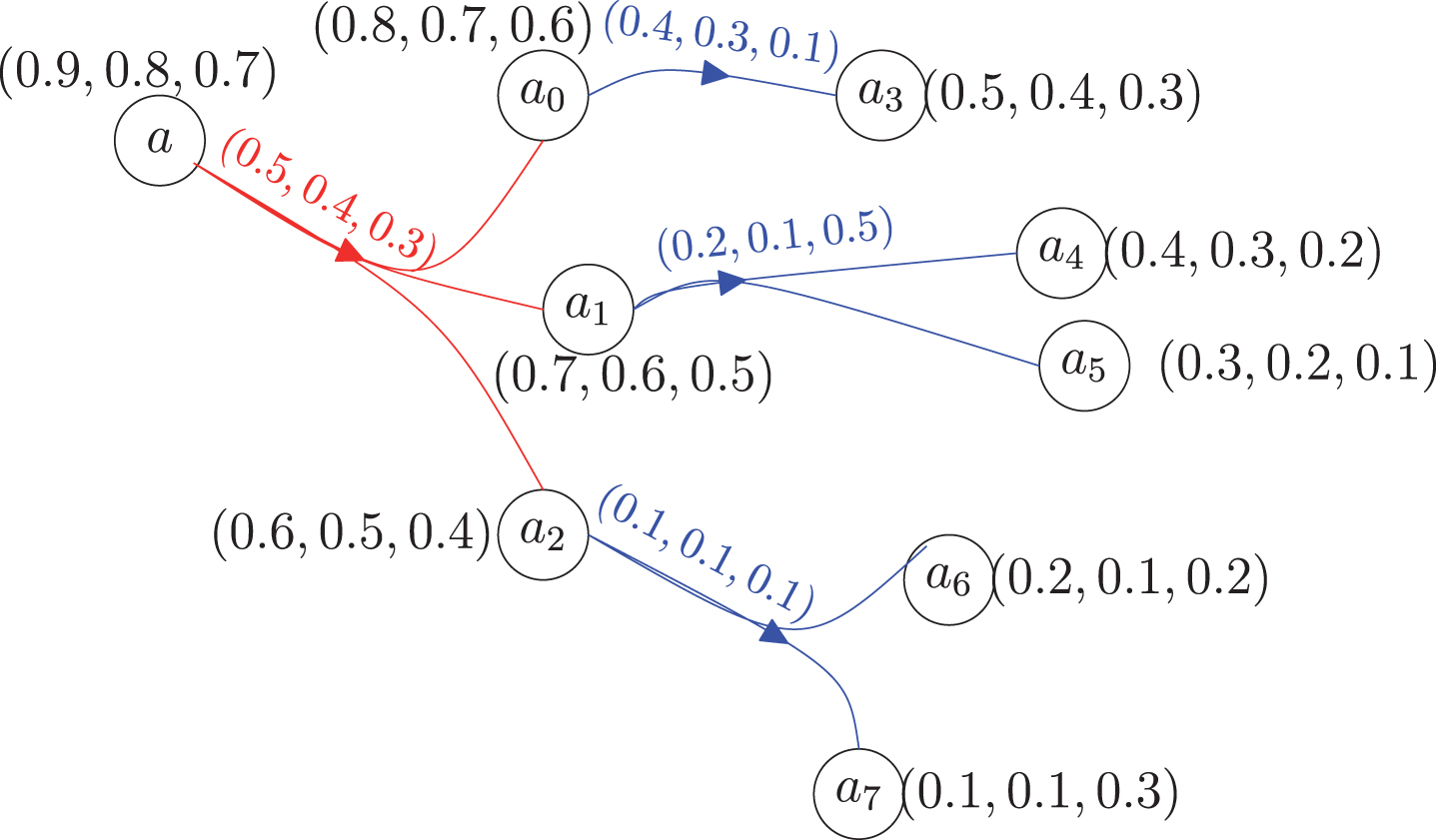
Example 4.18. (Lifetime in wireless sensor network) The proposed protocol weight-based clustering routing (WCR) is a clustering-based, energy-efficient protocol for wireless sensor networks. The objective of the protocol is to reduce the energy dissipation of nodes for routing data to the base station and prolong the network lifetime. In WCR, a cluster–head selection algorithm is designed for periodically selecting cluster–heads based on the node position information and residual energy of node. This cluster–head selection scheme is a central controlled algorithm performed by the base station which is assumed to have no energy constraint. Distributed weight-based energy-efficient hierarchical clustering (DWEHC) as an algorithm, aims at high energy efficiency by generating balanced cluster sizes and optimizing the intra cluster topology. DWEHC algorithm has been shown to generate more well-balanced clusters as well as to achieve significantly lower energy consumption in intra cluster and intra cluster communication. Let H = {a, a0, a1, a2, a3, a4, a5, a6, a7, a8, a9} be a set of nodes in a wireless sensor networks as a hyper network. Figure 23, shows a multi-level cluster generated by DWEHC, where a is the cluster–head, first level children are a0, a1, a2, second level children are a3, a4, a5, a6 and a7. Let the degree of contribution in the energy-efficient protocol relationships of a is 90/100, degree of indeterminacy of energy-efficient protocol is 80/100 and degree of false–energy-efficient protocol is 70/100, i.e. the truth–energy-efficient protocol, indeterminacy–energy-efficient protocol and falsity–energy-efficient protocol values of the vertex of wireless sensor network is (0.9, 0.8, 0.7).
DWEHC multi-hop intracluster topology
Since α (a) = {a} , α (a0) = {a0} , α (a1) = {a1} , α (a2) = {a2} , α (a3) = {a3} , α (a4) = {a4, a5} and α (a7) = {a6, a7} , we get the α-derivable digraph in Figure 24.
Digraph
The directed graph model of SVN–DG associated to a lifetime in wireless sensor network or DWEHC multi-hop intracluster topology is explained in Algorithm 3 in Table 3 and in Figure 24.
Algorithm 3
1. Consider the wireless sensor network and design a SVN–DHG model .
3. By Algorithm 2 in Table 2, construct the SVN–DG .
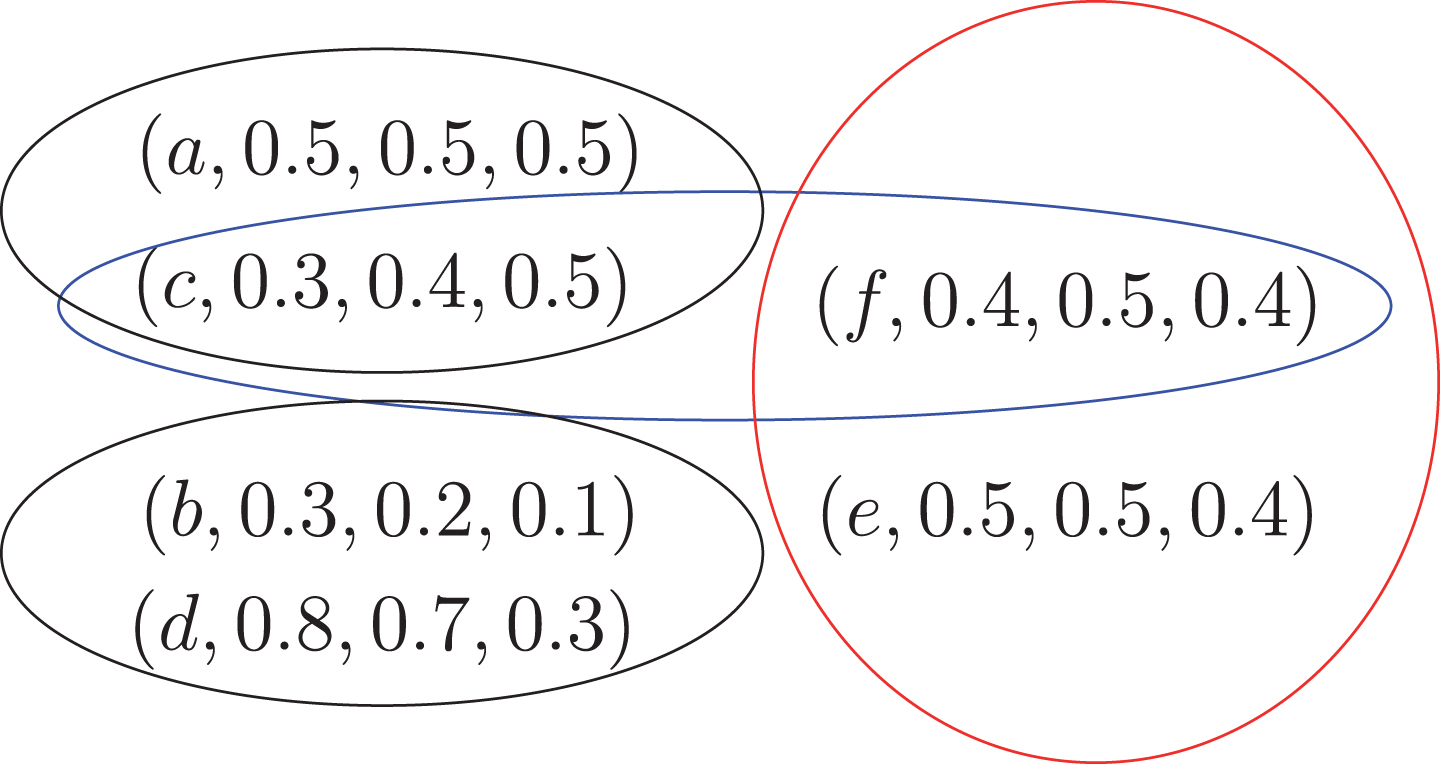
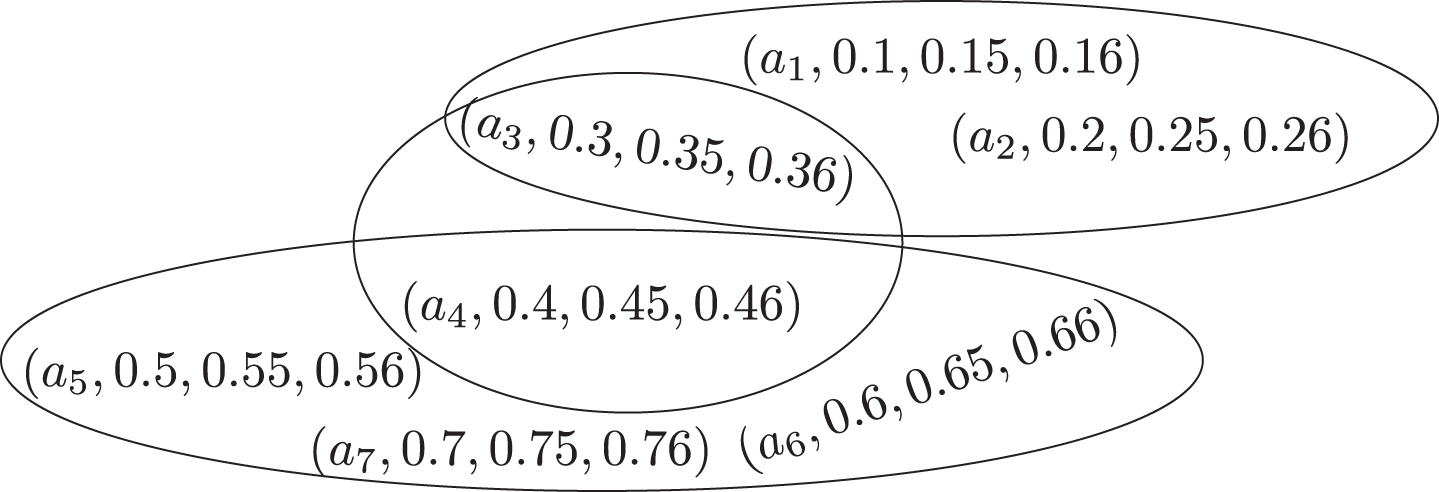
Example 4.19. (Social networking) In social networks nodes represent people or groups of people, normally called actors, that are connected by pairs according to some pattern of contact or interactions between them. Such patterns can be of friendship, collaboration, business relationships, etc. There are some cases in which hypergraph representations of the social network are indispensable. Let X = {a1, a2, a3, a4, a5, a6, a7} be a society and a1, a2, a3, a4, a5, a6, a7 be names of its people. These people create some groups as E1 = {a1, a2, a3} , E2 = {a4, a3} and E3 = {a4, a5, a6, a7}. Let the degree of contribution in the business relationships of a1 is 10/100, degree of indeterminacy of contribution is 15/100 and degree of false–contribution is 16/100, i.e. the truth–membership, indeterminacy–membership and falsity–membership values of the vertex human is (0.1, 0.15, 0.16). The likeness, indeterminacy and dislikeness of contribution in the business relationships this society is shown in the Figure 25.
Social network
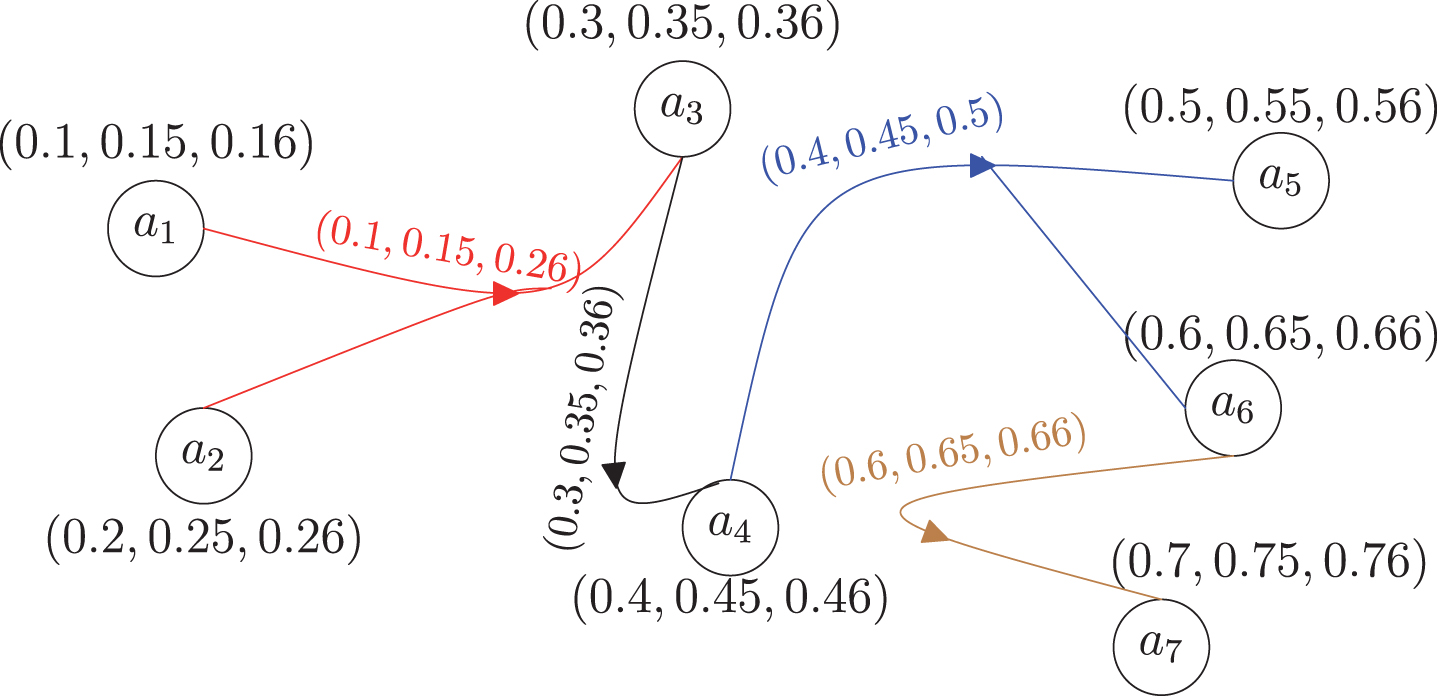
By Theorem 3, the SVN–DHG is obtained in Figure 26.
SVN–DHG
By Theorem 4, and some computations, we obtain the SVN–DG, in Figure 27.
SVN–DG
The mathematical model of SVN–DG associated to a social network is explained in Algorithm 4 in Table 4 and in Figure 27.
Algorithm 4
1. Consider the social network and design a SVN–HG model .
2. By Algorithm 1 in Table 1, construct the SVN–DHG .
3. By Algorithm 2 in Table 2, construct the SVN–DG .
Conclusion
The current paper considered the concepts of single–valued neutrosophic hypergraphs(SVN-HG), single–valued neutrosophic directed hypergraphs(SVN-DHG) and constructed the single–valued neutrosophic directed hypergraphs from single-valued neutrosophic hypergraphs. Moreover
It is introduced the notation of derived SVN–DHG and is shown that every SVN-DHG is a derivable-SVN-DHG.
We defined a concept of weak single valued neutrosophic digraph(WSVN-DG) and proved that any finite set can be a WSVN-DG.
We defined an equivalence relation (titled α) on single–valued neutrosophic directed hypergraphs and investigated the relation between of SVN–DHG and SVN-DG via α.
It is corresponded the single–valued neutrosophic directed (hyper)graphs with wireless sensor (hyper)networks such that the set of vertices (V) represent the sensors and the set of links (E) represents the connections between vertices.
Using the relation α, the sensor clusters of wireless sensor (hyper)networks are considered as a class of wireless sensor (hyper)networks under relation α.
This study introduced the concept of α-(self-semi)derivable directed graph and investigated some conditions such that a single–valued neutrosophic directed graph is an α-(self-semi)derivable directed graph.
Some algorithms are presented in such a way that analyze the application of single–valued neutrosophic directed (hyper)graph in (hyper)networks.
We hope that these results are helpful for further studies in single–valued neutrosophic directed (graphs)hypergraphs theory. In our future studies, we hope to obtain more results in coding theory and single–valued neutrosophic directed (hyper)graphs and their applications in (hyper)networks.
Footnotes
Acknowledgments
The authors would like to express their gratitude to anonymous referees for their comments and suggestions which improved the paper.
References
1.
AkramM., ShahzadiS. and Borumand SaeidA., Neutrosophic hypergraphs, TWMS J App Eng Math8(1) (2018), 122–135.
2.
AkramM. and LuqmanA., Certain concepts of bipolar fuzzy directed hypergraphs, Mathematics5(1) (2017).
3.
AkramM. and LuqmanA., Certain network models using single-valued neutrosophic directed hypergraphs, Journal of Intelligent and Fuzzy Systems33(1) (2017), 575–588.
4.
AkramM. and LuqmanA., Directed hypergraphs under mpolar fuzzy environment, Journal of Intelligent and Fuzzy Systems34(6) (2018), 4127–4137.
5.
AkramaM., SarwaraM. and BorzooeiR.A., A novel decision-making approach based on hypergraphs in intuitionistic fuzzy environment, Journal of Intelligent & Fuzzy Systems35(2) (2018), 1905–1922.
6.
AkramM. and DudekW.A., Intuitionistic fuzzy hypergraphs with applications, Information Sciences218 (2013), 182–193.
7.
AkramM. and SarwarM., Novel applications of m-polar fuzzy hypergraphs, Journal of Intelligent and Fuzzy Systems32(3) (2016), 2747–2762.
8.
AkramM., ShahzadiS. and Borumand SaeidA., single– valued neutrosophic hypergraph, TWMS J App Eng Math8(1) (2018), 122–135.
9.
BergeC., Graphs and Hypergraphs, North Holland, 1979.
10.
DevadossA.V., RajkumarA. and PraveenaN.J.P., A study on miracles through holy bible using neutrosophic cognitive maps (NCMS), International Journal of Computer Applications69(3) (2013).
11.
GalloG., LongoG. and PallottinoS., Directed hypergraphs and applications, Discrete Appl. Math42 (1993), 177–201.
12.
HamidiM. and Borumand SaeidA., Creating and computing graphs from hypergraphs, Kragujevac Journal of Mathematics43(1) (2019), 139–164.
13.
HamidiM. and Borumand saeidA., On derivable trees, Transactions on Combinatorics (2019) (accepted).
14.
HamidiM. and Borumand SaeidA., Accessible single-valued neutrosophic graphs, J Appl Math Comput57 (2018), 121–146.
15.
HamidiM. and Borumand SaeidA., Achievable single-valued neutrosophic graphs in wireless sensor networks, New Mathematics and Natural Computation14(2) (2018), 157–185.
16.
MajumdarP. and SamantaS.K., On similarity and entropy of neutrosophic sets, Journal of Intelligent & Fuzzy Systems26(3) (2014), 1245–1252.
17.
RashmanlouH., SahooS., BorzooeiR.A., PalM. and LakdashtiA., Computation of shortest path in a vague network by euclidean distance, Journal of Mult-Valued Logic and Soft Computing30 (2017), 115–123.
18.
SahooS. and PalM., Certain types of edge irregular intuitionistic fuzzy graphs, Journal of Intelligent and Fuzzy Systems34(1) (2018), 295–305.
19.
SahooS. and PalM., Different types of products on intuitionistic fuzzy graphs, Pacific Science Review A: Natural Science and Engineering17(3) (2015), 87–96.
20.
SahooS. and PalM., Intuitionistic fuzzy competition graph, Journal of Applied Mathematics and Computing52 (2015), 37–57.
21.
SahooS. and PalM., Intuitionistic fuzzy tolerance graph with application, Journal of Applied Mathematics and Computing55 (2016), 495–511.
22.
SahooS. and PalM., Modular and homomorphic product of intuitionistic fuzzy graphs and their degree, International Journal of Computing Science and Mathematics8(5) (2017), 395–404.
23.
SahooS. and PalM., Product of intuitionistic fuzzy graphs and degree, Journal of Intelligent and Fuzzy Systems32(1) (2016), 1059–1067.
24.
SahooS., PalM., RashmanlouH. and BorzooeiR.A., Covering and paired domination in intuitionistic fuzzy graphs, Journal of Intelligent and Fuzzy Systems33(6) (2017), 4007–4015.
25.
SahooS., GhoraiG. and PalM., Embedding and genus of intuitionistic fuzzy graphs on spheres, Journal of Mult.-Valued Logic and Soft Computing31 (2018), 139–154.
26.
SmarandacheF., Neutrosophy neutrosophic probability, Set and Logic, Amer Res Press, Rehoboth, USA, 1998.
27.
SmarandacheF., A unifying field in logics, Neutrosophy: Neutrosophic probability, set and logic, American Research Press, Rehoboth, 1999.
28.
SmarandacheF., Refined literal indeterminacy and the multiplication law of sub-indeterminacies, Neutrosophic Sets and Systems9 (2015), 58.
29.
SmarandacheF., Symbolic Neutrosophic Theory, Europanova asbl, Brussels, p. 195.
30.
Vasantha KandasamyW.B. and IlanthenralK., Florentin Smarandache Neutrosophic Graphs, A New Dimension to Graph Theory, Kindle Edition, 2015.
31.
WangH., SmarandacheF., ZhangY. and SunderramanR., Single valued neutrosophic sets, Multisspace and Multistructure4 (2010), 410–413.
32.
WangH., SmarandacheF., ZhangY.Q. and SunderramanR., Single-valued neutrosophic sets, Multisspace and Multistruct4 (2010), 410–413.
33.
ZadehL.A., Fuzzy sets, Information and Control8(3) (1965), 338–353.